NAST-626: Nanoelectronics and bioelectronics
By:
Sudama Chaurasiya
M. Tech IInd Sem. (NAST)
Submitted to:
Dr. A. K. Viswanath
“Center for Nanoscience and Technology”
PONDICHERRY UNIVERSITY
BIOSENSORS
CONTENTS
• What is biosensors
• History of biosensors
• Elements of biosensors
• Basic characteristics of biosensors
• Biosensing techniques in biosensor
• Types of biosensors
• DNA based biosensors and their types
• Biosensors on the nanoscale
• Applications of biosensors
• References
WHAT IS A BIOSENSOR?
“A self-contained integrated device which is capable of
providing specific quantitative or semi-quantitative analytical
information using a biological recognition element which is in
direct spatial contact with a transducer element.” (IUPAC)
OR
“Biosensors are analytical tools for the analysis of bio-
material samples to gain an understanding of their bio-
composition, structure and function by converting a
biological response into a measurable response”.
FATHER OF BIOSENSORS
The first and the most widespreadly used commercial biosensor: the blood
glucose biosensor – developed by Leland C. Clark in 1962
Professor Leland C Clark (1918–2005)
HISTORY OF BIOSENSORS
1916: First report on immobilization of proteins : adsorption of
invertase on activated charcoal
1922: First glass pH electrode
1956: Clark published his definitive paper on the oxygen
electrode.
1962: First description of a biosensor: an
amperometric enzyme electrodre for glucose
(Clark)
1969: Guilbault and Montalvo – First potentiometric biosensor
urease immobilized on an ammonia electrode to detect urea
1970: Bergveld – ion selective Field Effect Transistor (ISFET)
1975: Lubbers and Opitz described a fibre-optic sensor with
immobilised indicator to measure carbon dioxide or oxygen.
1975: First commercial biosensor ( Yellow springs
Instruments glucose biosensor)
1975: First microbe based biosensor, First immunosensor
1976: First bedside artificial pancreas (Miles)
1980: First fibre optic pH sensor for in vivo blood
gases(Peterson)
1982: First fibre optic-based biosensor for glucose
1983: First surface plasmon resonance (SPR)
immunosensor
1984: First mediated amperometric biosensor:ferrocene
used with glucose oxidase for glucose detection.
1987: Blood-glucose biosensor launched by MediSense
ExacTech.
HISTORY OF BIOSENSORS
1990: SPR based biosensor by Pharmacia BIACore
1992: Hand held blood biosensor by i-STAT
1996: Launching of Glucocard
1998: Blood glucose biosensor launch by LifeScan FastTake
1998: Roche Diagnostics by Merger of Roche and Boehringer
mannheim
CURRENT: Quantom dots, nanoparicles, nanowire,
nanotube, etc
HISTORY OF BIOSENSORS
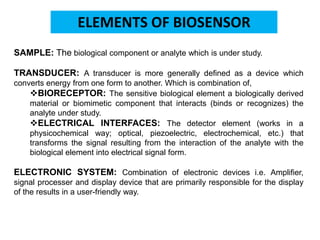
ELEMENTS OF BIOSENSOR
SAMPLE: The biological component or analyte which is under study.
TRANSDUCER: A transducer is more generally defined as a device which
converts energy from one form to another. Which is combination of,
BIORECEPTOR: The sensitive biological element a biologically derived
material or biomimetic component that interacts (binds or recognizes) the
analyte under study.
ELECTRICAL INTERFACES: The detector element (works in a
physicochemical way; optical, piezoelectric, electrochemical, etc.) that
transforms the signal resulting from the interaction of the analyte with the
biological element into electrical signal form.
ELECTRONIC SYSTEM: Combination of electronic devices i.e. Amplifier,
signal processer and display device that are primarily responsible for the display
of the results in a user-friendly way.
ELEMENTS OF BIOSENSOR
1. LINEARITY: Linearity of the sensor should be high for the detection
of high substrate concentration.
2. SENSITIVITY: Value of the electrode response per substrate
concentration.
3. SELECTIVITY: Chemicals Interference must be minimized for
obtaining the correct result.
4. RESPONSE TIME: Time necessary for having 95% of the response.
BASIC CHARACTERISTICS OF A BIOSENSOR
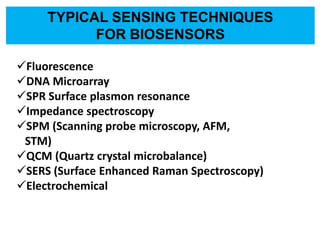
Fluorescence
DNA Microarray
SPR Surface plasmon resonance
Impedance spectroscopy
SPM (Scanning probe microscopy, AFM,
STM)
QCM (Quartz crystal microbalance)
SERS (Surface Enhanced Raman Spectroscopy)
Electrochemical
TYPICAL SENSING TECHNIQUES
FOR BIOSENSORS
TYPES OF BIOSENSORS
1. Calorimetric Biosensor
2. Piezo-electric Biosensor
3. Electrochemical Biosensor
4. Potentiometric Biosensor
5. Optical Biosensor
CALORIMETRIC BIOSENSORS
If the enzyme catalyzed reaction is exothermic, two
thermistors may be used to measure the difference in
resistance between reactant and product and, hence,
the analyte concentration.
PIEZO-ELECTRIC BIOSENSORS
Piezo-electric devices use gold to detect the specific
angle at which electron waves are emitted when the
substance is exposed to laser light or crystals, such as
quartz, which vibrate under the influence of an electric
field.
The change in frequency is proportional to the mass of
absorbed material.
ELECTROCHEMICAL BIOSENSORS
 For applied current: Movement of e- in
redox reactions detected when a potential is
applied between two electrodes.
POTENTIOMETRIC BIOSENSOR
For voltage: Change in distribution of
charge is detected using ion-selective
electrodes, such as pH-meters.
OPTICAL BIOSENSORS
Colorimetric for color
Measure change in light adsorption
Photometric for light intensity
Photon output for a luminescent or
fluorescent process can be detected with
photomultiplier tubes or photodiode
systems.
DNA BASED BISENSOR
 Motivated by the application to clinical diagnosis and genome mutation detection
 PRINCIPLE OF DNA BIOSENSORS
NUCLEIC ACID HYBRIDIZATION
• Reannealing between the ssDNAs from different sources
Perfect match
• stable dsDNA, strong
hybridization
One or more base mismatches
• weak hybridization
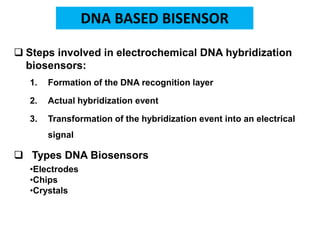
 Steps involved in electrochemical DNA hybridization
biosensors:
1. Formation of the DNA recognition layer
2. Actual hybridization event
3. Transformation of the hybridization event into an electrical
signal
 Types DNA Biosensors
•Electrodes
•Chips
•Crystals
DNA BASED BISENSOR
Steps involved in electrochemical DNA
hybridization biosensors:
TYPES DNA BIOSENSORS
BIOSENSORS ON THE NANOSCALE
 Molecular sheaths around the nanotube are developed that
respond to a particular chemical and modulate the
nanotube's optical properties.
 A layer of olfactory proteins on a nanoelectrode react with
low-concentration odorants (SPOT-NOSED Project).
Doctors can use to diagnose diseases at earlier stages.
 Nanosphere lithography (NSL) derived triangular Ag
nanoparticles are used to detect streptavidin down to
one picomolar concentrations.
 Anti-body based piezoelectric nanobiosensor to be used for
anthrax, HIV, hepatitis detection.
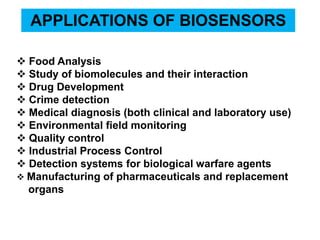
APPLICATIONS OF BIOSENSORS
 Food Analysis
 Study of biomolecules and their interaction
 Drug Development
 Crime detection
 Medical diagnosis (both clinical and laboratory use)
 Environmental field monitoring
 Quality control
 Industrial Process Control
 Detection systems for biological warfare agents
 Manufacturing of pharmaceuticals and replacement
organs
APPLICATIONS OF BIOSENSORS
REFERENCES
1. “Whole cell- and protein-based biosensors for the detection of bioavailable heavy metals
in environmental samples” by Philippe Corbisiera, Daniel van der Leliea, at al. ELSEVISER
Analytica Chimica Acta 387 (1999) 235-244.
2. “DNA BASED BIOSENSORS” By Zhai Iuni-Iui, Cui hong and Yang Yuifu, ELSEVISER
Biotechnology Advances, Vol. 15. No. 1. pp. 43-58.1997.
3. “BIOSENSORS” by Frieder Schelfer and Florian Schubert Akademie der Wissenscha fien,
Zentralinstitut fur Molekularbiologie, Robert-Riissle-Strasse lO,0-1115 Berlin-Buck
Germany ELSEVIER Amsterdam - London - New York -Tokyo 1992
Biosensor

Biosensor

  • 1.
    NAST-626: Nanoelectronics andbioelectronics By: Sudama Chaurasiya M. Tech IInd Sem. (NAST) Submitted to: Dr. A. K. Viswanath “Center for Nanoscience and Technology” PONDICHERRY UNIVERSITY BIOSENSORS
  • 2.
    CONTENTS • What isbiosensors • History of biosensors • Elements of biosensors • Basic characteristics of biosensors • Biosensing techniques in biosensor • Types of biosensors • DNA based biosensors and their types • Biosensors on the nanoscale • Applications of biosensors • References
  • 3.
    WHAT IS ABIOSENSOR? “A self-contained integrated device which is capable of providing specific quantitative or semi-quantitative analytical information using a biological recognition element which is in direct spatial contact with a transducer element.” (IUPAC) OR “Biosensors are analytical tools for the analysis of bio- material samples to gain an understanding of their bio- composition, structure and function by converting a biological response into a measurable response”.
  • 4.
    FATHER OF BIOSENSORS Thefirst and the most widespreadly used commercial biosensor: the blood glucose biosensor – developed by Leland C. Clark in 1962 Professor Leland C Clark (1918–2005)
  • 5.
    HISTORY OF BIOSENSORS 1916:First report on immobilization of proteins : adsorption of invertase on activated charcoal 1922: First glass pH electrode 1956: Clark published his definitive paper on the oxygen electrode. 1962: First description of a biosensor: an amperometric enzyme electrodre for glucose (Clark) 1969: Guilbault and Montalvo – First potentiometric biosensor urease immobilized on an ammonia electrode to detect urea 1970: Bergveld – ion selective Field Effect Transistor (ISFET) 1975: Lubbers and Opitz described a fibre-optic sensor with immobilised indicator to measure carbon dioxide or oxygen.
  • 6.
    1975: First commercialbiosensor ( Yellow springs Instruments glucose biosensor) 1975: First microbe based biosensor, First immunosensor 1976: First bedside artificial pancreas (Miles) 1980: First fibre optic pH sensor for in vivo blood gases(Peterson) 1982: First fibre optic-based biosensor for glucose 1983: First surface plasmon resonance (SPR) immunosensor 1984: First mediated amperometric biosensor:ferrocene used with glucose oxidase for glucose detection. 1987: Blood-glucose biosensor launched by MediSense ExacTech. HISTORY OF BIOSENSORS
  • 7.
    1990: SPR basedbiosensor by Pharmacia BIACore 1992: Hand held blood biosensor by i-STAT 1996: Launching of Glucocard 1998: Blood glucose biosensor launch by LifeScan FastTake 1998: Roche Diagnostics by Merger of Roche and Boehringer mannheim CURRENT: Quantom dots, nanoparicles, nanowire, nanotube, etc HISTORY OF BIOSENSORS
  • 8.
  • 9.
    SAMPLE: The biologicalcomponent or analyte which is under study. TRANSDUCER: A transducer is more generally defined as a device which converts energy from one form to another. Which is combination of, BIORECEPTOR: The sensitive biological element a biologically derived material or biomimetic component that interacts (binds or recognizes) the analyte under study. ELECTRICAL INTERFACES: The detector element (works in a physicochemical way; optical, piezoelectric, electrochemical, etc.) that transforms the signal resulting from the interaction of the analyte with the biological element into electrical signal form. ELECTRONIC SYSTEM: Combination of electronic devices i.e. Amplifier, signal processer and display device that are primarily responsible for the display of the results in a user-friendly way. ELEMENTS OF BIOSENSOR
  • 10.
    1. LINEARITY: Linearityof the sensor should be high for the detection of high substrate concentration. 2. SENSITIVITY: Value of the electrode response per substrate concentration. 3. SELECTIVITY: Chemicals Interference must be minimized for obtaining the correct result. 4. RESPONSE TIME: Time necessary for having 95% of the response. BASIC CHARACTERISTICS OF A BIOSENSOR
  • 11.
    Fluorescence DNA Microarray SPR Surfaceplasmon resonance Impedance spectroscopy SPM (Scanning probe microscopy, AFM, STM) QCM (Quartz crystal microbalance) SERS (Surface Enhanced Raman Spectroscopy) Electrochemical TYPICAL SENSING TECHNIQUES FOR BIOSENSORS
  • 12.
    TYPES OF BIOSENSORS 1.Calorimetric Biosensor 2. Piezo-electric Biosensor 3. Electrochemical Biosensor 4. Potentiometric Biosensor 5. Optical Biosensor
  • 13.
    CALORIMETRIC BIOSENSORS If theenzyme catalyzed reaction is exothermic, two thermistors may be used to measure the difference in resistance between reactant and product and, hence, the analyte concentration. PIEZO-ELECTRIC BIOSENSORS Piezo-electric devices use gold to detect the specific angle at which electron waves are emitted when the substance is exposed to laser light or crystals, such as quartz, which vibrate under the influence of an electric field. The change in frequency is proportional to the mass of absorbed material.
  • 14.
    ELECTROCHEMICAL BIOSENSORS  Forapplied current: Movement of e- in redox reactions detected when a potential is applied between two electrodes. POTENTIOMETRIC BIOSENSOR For voltage: Change in distribution of charge is detected using ion-selective electrodes, such as pH-meters.
  • 15.
    OPTICAL BIOSENSORS Colorimetric forcolor Measure change in light adsorption Photometric for light intensity Photon output for a luminescent or fluorescent process can be detected with photomultiplier tubes or photodiode systems.
  • 16.
    DNA BASED BISENSOR Motivated by the application to clinical diagnosis and genome mutation detection  PRINCIPLE OF DNA BIOSENSORS NUCLEIC ACID HYBRIDIZATION • Reannealing between the ssDNAs from different sources Perfect match • stable dsDNA, strong hybridization One or more base mismatches • weak hybridization
  • 17.
     Steps involvedin electrochemical DNA hybridization biosensors: 1. Formation of the DNA recognition layer 2. Actual hybridization event 3. Transformation of the hybridization event into an electrical signal  Types DNA Biosensors •Electrodes •Chips •Crystals DNA BASED BISENSOR
  • 18.
    Steps involved inelectrochemical DNA hybridization biosensors:
  • 19.
  • 20.
    BIOSENSORS ON THENANOSCALE  Molecular sheaths around the nanotube are developed that respond to a particular chemical and modulate the nanotube's optical properties.  A layer of olfactory proteins on a nanoelectrode react with low-concentration odorants (SPOT-NOSED Project). Doctors can use to diagnose diseases at earlier stages.  Nanosphere lithography (NSL) derived triangular Ag nanoparticles are used to detect streptavidin down to one picomolar concentrations.  Anti-body based piezoelectric nanobiosensor to be used for anthrax, HIV, hepatitis detection.
  • 21.
    APPLICATIONS OF BIOSENSORS Food Analysis  Study of biomolecules and their interaction  Drug Development  Crime detection  Medical diagnosis (both clinical and laboratory use)  Environmental field monitoring  Quality control  Industrial Process Control  Detection systems for biological warfare agents  Manufacturing of pharmaceuticals and replacement organs
  • 22.
  • 23.
    REFERENCES 1. “Whole cell-and protein-based biosensors for the detection of bioavailable heavy metals in environmental samples” by Philippe Corbisiera, Daniel van der Leliea, at al. ELSEVISER Analytica Chimica Acta 387 (1999) 235-244. 2. “DNA BASED BIOSENSORS” By Zhai Iuni-Iui, Cui hong and Yang Yuifu, ELSEVISER Biotechnology Advances, Vol. 15. No. 1. pp. 43-58.1997. 3. “BIOSENSORS” by Frieder Schelfer and Florian Schubert Akademie der Wissenscha fien, Zentralinstitut fur Molekularbiologie, Robert-Riissle-Strasse lO,0-1115 Berlin-Buck Germany ELSEVIER Amsterdam - London - New York -Tokyo 1992