NANOBIOSENSORS 
biosensors on the nano-scale size
BIOSENSORS 
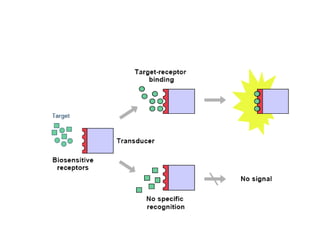
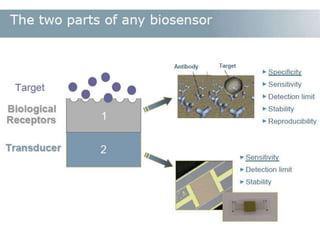
• A device incorporating a biological sensing 
element either intimately connected to or 
integrated within a transducer. 
• Recognition based on affinity between 
complementary structures like: 
enzyme-substrate, antibody-antigen , receptor-hormone 
complex. 
• Selectivity and specificity depend on 
biological recognition systems connected to 
a suitable transducer.
Biosensor Development 
• 1916 First report on the immobilization of proteins: adsorption of 
invertase on activated charcoal. 
• 1956 Invention of the first oxygen electrode [Leland Clark] 
• 1962 First description of a biosensor: an amperometric enzyme electrode 
for glucose. [Leland Clark, New York Academy of Sciences Symposium] 
• 1969 First potentiometric biosensor: urease immobilized on an ammonia 
electrode to detect urea. [Guilbault and Montalvo] 
• 1970 Invention of the Ion-Selective Field-Effect Transistor (ISFET). 
• 1972/5 First commercial biosensor: Yellow Springs Instruments glucose 
biosensor. 
• 1976 First bedside artificial pancreas [Clemens et al.] 
• 1980 First fiber optic pH sensor for in vivo blood gases. 
• 1982 First fiber optic-based biosensor for glucose 
• 1983 First surface plasmon resonance (SPR) immunosensor. 
• 1987 Launch of the blood glucose biosensor[ MediSense]
Theory
8 
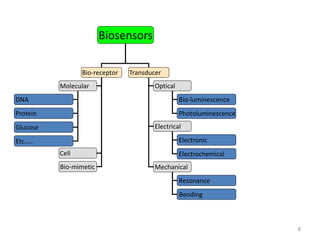
Biosensors 
Bio-receptor Transducer 
Molecular 
DNA 
Protein 
Glucose 
Etc….. Electronic 
Cell 
Bio-mimetic 
Optical 
Bio-luminescence 
Photoluminescence 
Electrical 
Electrochemical 
Mechanical 
Resonance 
Bending
9 
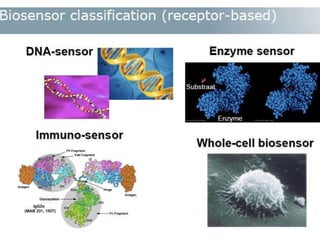
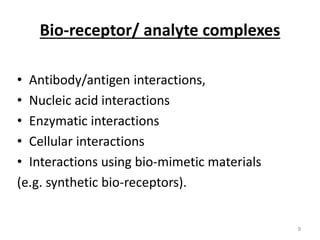
Bio-receptor/ analyte complexes 
• Antibody/antigen interactions, 
• Nucleic acid interactions 
• Enzymatic interactions 
• Cellular interactions 
• Interactions using bio-mimetic materials 
(e.g. synthetic bio-receptors).
10 
Signal transduction methods 
1. Optical measurements - luminescence, 
absorption, surface plasmon resonance 
2. Electrochemical - potentiometric, 
amperometric, etc. 
3. Electrical – transistors, nano-wires, conductive 
gels etc. 
4. Mass-sensitive measurements- surface 
acoustic wave, microcantilever, microbalance, 
etc.).
11 
Electrical sensing 
Nano-bio interfacing  how to translate the 
biological information onto electrical signal ? 
• Electrochemical 
– Redox reactions 
• Electrical 
– FET 
(Nano wires; Conducting Electro-active Polymers)
12 
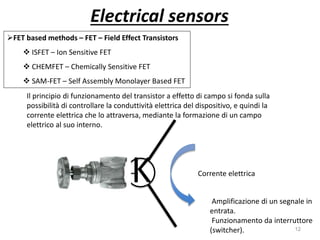
Electrical sensors 
FET based methods – FET – Field Effect Transistors 
 ISFET – Ion Sensitive FET 
 CHEMFET – Chemically Sensitive FET 
 SAM-FET – Self Assembly Monolayer Based FET 
Il principio di funzionamento del transistor a effetto di campo si fonda sulla 
possibilità di controllare la conduttività elettrica del dispositivo, e quindi la 
corrente elettrica che lo attraversa, mediante la formazione di un campo 
elettrico al suo interno. 
K Corrente elettrica 
Amplificazione di un segnale in 
entrata. 
Funzionamento da interruttore 
(switcher).
13 
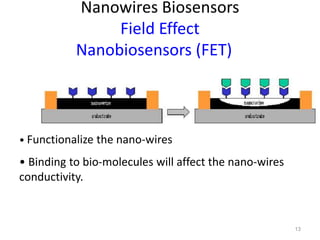
Nanowires Biosensors 
Field Effect 
Nanobiosensors (FET) 
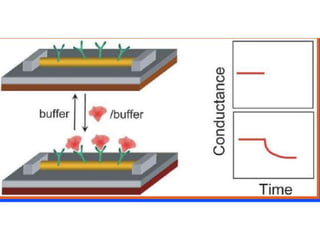
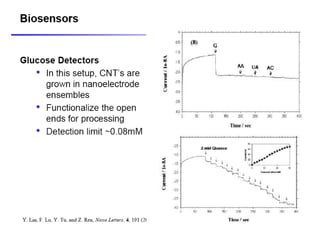
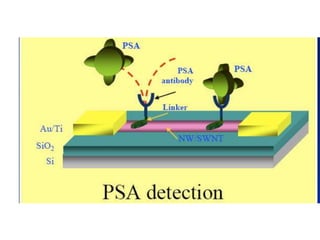
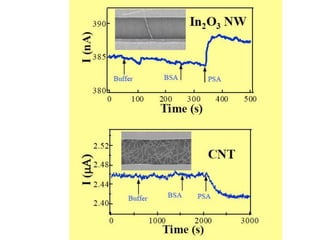
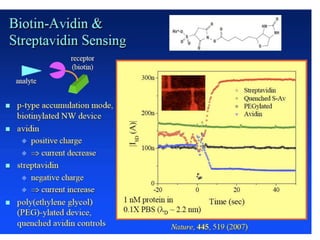
• Functionalize the nano-wires 
• Binding to bio-molecules will affect the nano-wires 
conductivity.
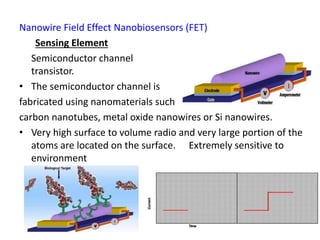
Nanowire Field Effect Nanobiosensors (FET) 
Sensing Element 
Semiconductor channel (nanowire) of the 
transistor. 
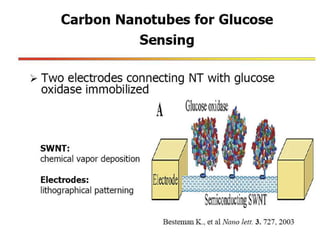
• The semiconductor channel is 
fabricated using nanomaterials such 
carbon nanotubes, metal oxide nanowires or Si nanowires. 
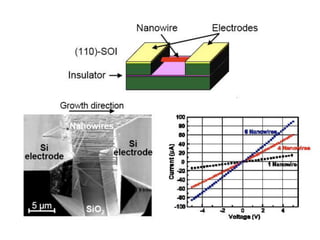
• Very high surface to volume radio and very large portion of the 
atoms are located on the surface. Extremely sensitive to 
environment
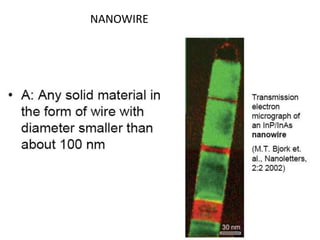
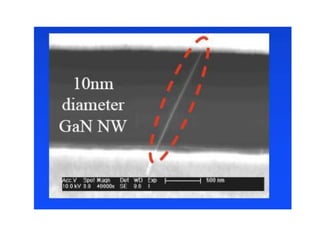
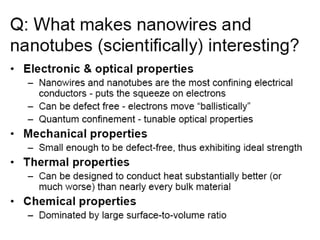
NANOWIRE
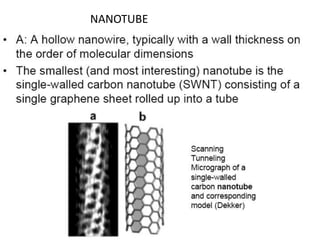
NANOTUBE
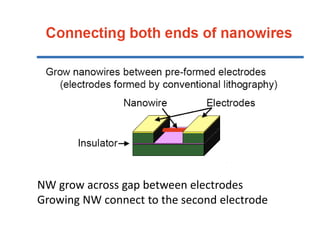
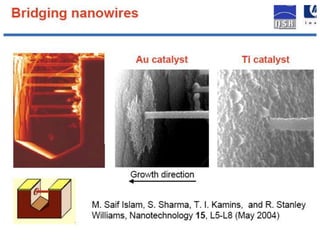
NW grow across gap between electrodes 
Growing NW connect to the second electrode
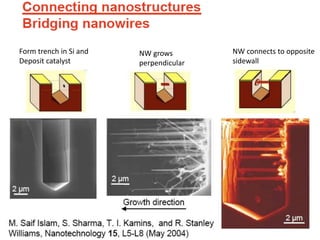
Form trench in Si and 
Deposit catalyst 
NW grows 
perpendicular 
NW connects to opposite 
sidewall
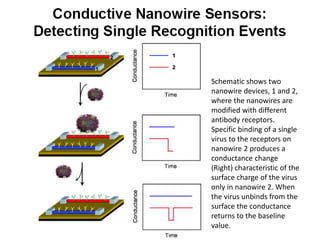
Schematic shows two 
nanowire devices, 1 and 2, 
where the nanowires are 
modified with different 
antibody receptors. 
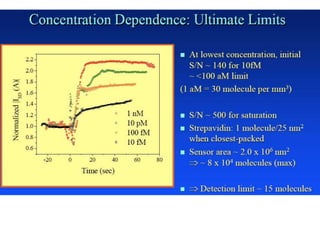
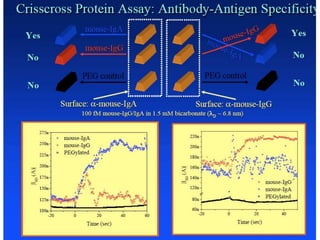
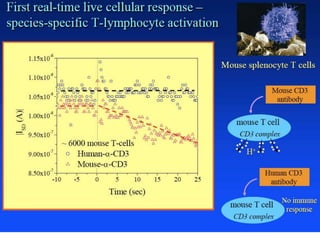
Specific binding of a single 
virus to the receptors on 
nanowire 2 produces a 
conductance change 
(Right) characteristic of the 
surface charge of the virus 
only in nanowire 2. When 
the virus unbinds from the 
surface the conductance 
returns to the baseline 
value.
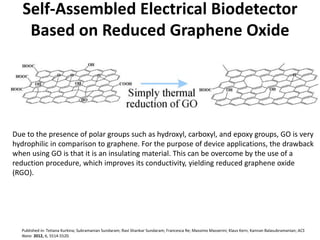
Self-Assembled Electrical Biodetector 
Based on Reduced Graphene Oxide 
Due to the presence of polar groups such as hydroxyl, carboxyl, and epoxy groups, GO is very 
hydrophilic in comparison to graphene. For the purpose of device applications, the drawback 
when using GO is that it is an insulating material. This can be overcome by the use of a 
reduction procedure, which improves its conductivity, yielding reduced graphene oxide 
(RGO). 
Published in: Tetiana Kurkina; Subramanian Sundaram; Ravi Shankar Sundaram; Francesca Re; Massimo Masserini; Klaus Kern; Kannan Balasubramanian; ACS 
Nano 2012, 6, 5514-5520.
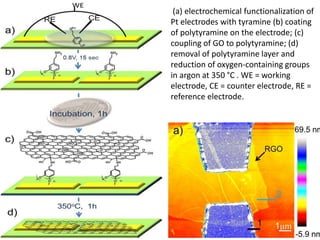
(a) electrochemical functionalization of 
Pt electrodes with tyramine (b) coating 
of polytyramine on the electrode; (c) 
coupling of GO to polytyramine; (d) 
removal of polytyramine layer and 
reduction of oxygen-containing groups 
in argon at 350 °C . WE = working 
electrode, CE = counter electrode, RE = 
reference electrode.
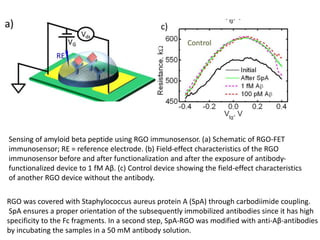
Sensing of amyloid beta peptide using RGO immunosensor. (a) Schematic of RGO-FET 
immunosensor; RE = reference electrode. (b) Field-effect characteristics of the RGO 
immunosensor before and after functionalization and after the exposure of antibody-functionalized 
device to 1 fM Aβ. (c) Control device showing the field-effect characteristics 
of another RGO device without the antibody. 
RGO was covered with Staphylococcus aureus protein A (SpA) through carbodiimide coupling. 
SpA ensures a proper orientation of the subsequently immobilized antibodies since it has high 
specificity to the Fc fragments. In a second step, SpA-RGO was modified with anti-Aβ-antibodies 
by incubating the samples in a 50 mM antibody solution.
36 
optical methods 
• Surface Plasmon Resonance (SPR)
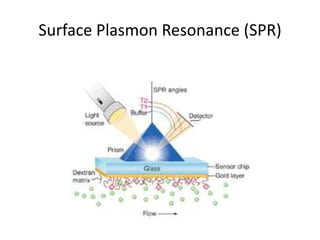
Surface Plasmon Resonance (SPR)
38 
Mechanical sensing 
Cantilever-based sensing
40 
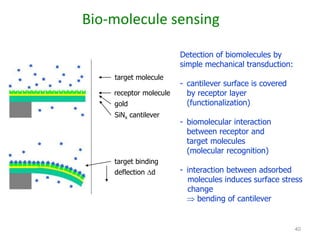
Bio-molecule sensing 
Detection of biomolecules by 
simple mechanical transduction: 
- cantilever surface is covered 
by receptor layer 
(functionalization) 
- biomolecular interaction 
between receptor and 
target molecules 
(molecular recognition) 
- interaction between adsorbed 
molecules induces surface stress 
change 
 bending of cantilever 
target molecule 
receptor molecule 
gold 
SiNx cantilever 
target binding 
deflection d
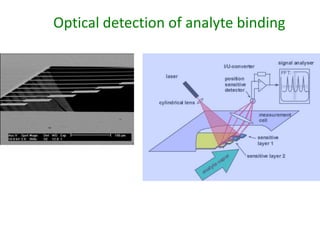
Optical detection of analyte binding
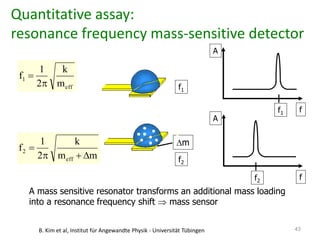
Quantitative assay: 
resonance frequency mass-sensitive detector 
f 
43 
A 
A 
f 
k 
eff 
1 
1 2 
m 
f 
 
 
k 
2    
m m 
1 
2 
f 
eff 
 
f1 
m 
f2 
f1 
f2 
A mass sensitive resonator transforms an additional mass loading 
into a resonance frequency shift  mass sensor 
B. Kim et al, Institut für Angewandte Physik - Universität Tübingen
44 
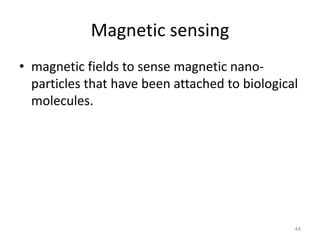
Magnetic sensing 
• magnetic fields to sense magnetic nano-particles 
that have been attached to biological 
molecules.
Magnetic nano - 
particle 
Analyte 
45 
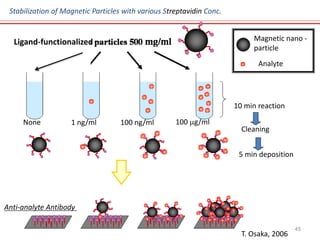
Stabilization of Magnetic Particles with various Streptavidin Conc. 
10 min reaction 
None 1 ng/ml 100 ng/ml 100 mg/ml 
Anti-analyte Antibody 
Cleaning 
5 min deposition 
T. Osaka, 2006 
Ligand-functionalized
Activated pixel 
46 
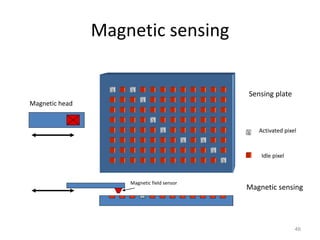
Magnetic sensing 
Magnetic head 
Magnetic field sensor 
Sensing plate 
Idle pixel 
Magnetic sensing
47 
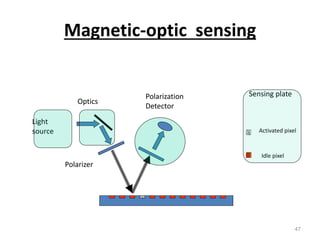
Magnetic-optic sensing 
Sensing plate 
Activated pixel 
Idle pixel 
Light 
source 
Polarizer 
Polarization 
Detector 
Optics
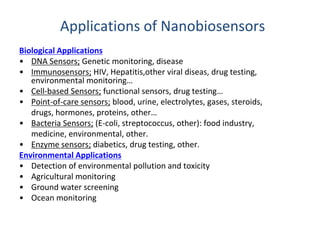
Applications of Nanobiosensors 
Biological Applications 
• DNA Sensors; Genetic monitoring, disease 
• Immunosensors; HIV, Hepatitis,other viral diseas, drug testing, 
environmental monitoring… 
• Cell-based Sensors; functional sensors, drug testing… 
• Point-of-care sensors; blood, urine, electrolytes, gases, steroids, 
drugs, hormones, proteins, other… 
• Bacteria Sensors; (E-coli, streptococcus, other): food industry, 
medicine, environmental, other. 
• Enzyme sensors; diabetics, drug testing, other. 
Environmental Applications 
• Detection of environmental pollution and toxicity 
• Agricultural monitoring 
• Ground water screening 
• Ocean monitoring

Nanobiosensors

  • 1.
    NANOBIOSENSORS biosensors onthe nano-scale size
  • 2.
    BIOSENSORS • Adevice incorporating a biological sensing element either intimately connected to or integrated within a transducer. • Recognition based on affinity between complementary structures like: enzyme-substrate, antibody-antigen , receptor-hormone complex. • Selectivity and specificity depend on biological recognition systems connected to a suitable transducer.
  • 6.
    Biosensor Development •1916 First report on the immobilization of proteins: adsorption of invertase on activated charcoal. • 1956 Invention of the first oxygen electrode [Leland Clark] • 1962 First description of a biosensor: an amperometric enzyme electrode for glucose. [Leland Clark, New York Academy of Sciences Symposium] • 1969 First potentiometric biosensor: urease immobilized on an ammonia electrode to detect urea. [Guilbault and Montalvo] • 1970 Invention of the Ion-Selective Field-Effect Transistor (ISFET). • 1972/5 First commercial biosensor: Yellow Springs Instruments glucose biosensor. • 1976 First bedside artificial pancreas [Clemens et al.] • 1980 First fiber optic pH sensor for in vivo blood gases. • 1982 First fiber optic-based biosensor for glucose • 1983 First surface plasmon resonance (SPR) immunosensor. • 1987 Launch of the blood glucose biosensor[ MediSense]
  • 7.
  • 8.
    8 Biosensors Bio-receptorTransducer Molecular DNA Protein Glucose Etc….. Electronic Cell Bio-mimetic Optical Bio-luminescence Photoluminescence Electrical Electrochemical Mechanical Resonance Bending
  • 9.
    9 Bio-receptor/ analytecomplexes • Antibody/antigen interactions, • Nucleic acid interactions • Enzymatic interactions • Cellular interactions • Interactions using bio-mimetic materials (e.g. synthetic bio-receptors).
  • 10.
    10 Signal transductionmethods 1. Optical measurements - luminescence, absorption, surface plasmon resonance 2. Electrochemical - potentiometric, amperometric, etc. 3. Electrical – transistors, nano-wires, conductive gels etc. 4. Mass-sensitive measurements- surface acoustic wave, microcantilever, microbalance, etc.).
  • 11.
    11 Electrical sensing Nano-bio interfacing  how to translate the biological information onto electrical signal ? • Electrochemical – Redox reactions • Electrical – FET (Nano wires; Conducting Electro-active Polymers)
  • 12.
    12 Electrical sensors FET based methods – FET – Field Effect Transistors  ISFET – Ion Sensitive FET  CHEMFET – Chemically Sensitive FET  SAM-FET – Self Assembly Monolayer Based FET Il principio di funzionamento del transistor a effetto di campo si fonda sulla possibilità di controllare la conduttività elettrica del dispositivo, e quindi la corrente elettrica che lo attraversa, mediante la formazione di un campo elettrico al suo interno. K Corrente elettrica Amplificazione di un segnale in entrata. Funzionamento da interruttore (switcher).
  • 13.
    13 Nanowires Biosensors Field Effect Nanobiosensors (FET) • Functionalize the nano-wires • Binding to bio-molecules will affect the nano-wires conductivity.
  • 14.
    Nanowire Field EffectNanobiosensors (FET) Sensing Element Semiconductor channel (nanowire) of the transistor. • The semiconductor channel is fabricated using nanomaterials such carbon nanotubes, metal oxide nanowires or Si nanowires. • Very high surface to volume radio and very large portion of the atoms are located on the surface. Extremely sensitive to environment
  • 15.
  • 17.
  • 20.
    NW grow acrossgap between electrodes Growing NW connect to the second electrode
  • 21.
    Form trench inSi and Deposit catalyst NW grows perpendicular NW connects to opposite sidewall
  • 24.
    Schematic shows two nanowire devices, 1 and 2, where the nanowires are modified with different antibody receptors. Specific binding of a single virus to the receptors on nanowire 2 produces a conductance change (Right) characteristic of the surface charge of the virus only in nanowire 2. When the virus unbinds from the surface the conductance returns to the baseline value.
  • 33.
    Self-Assembled Electrical Biodetector Based on Reduced Graphene Oxide Due to the presence of polar groups such as hydroxyl, carboxyl, and epoxy groups, GO is very hydrophilic in comparison to graphene. For the purpose of device applications, the drawback when using GO is that it is an insulating material. This can be overcome by the use of a reduction procedure, which improves its conductivity, yielding reduced graphene oxide (RGO). Published in: Tetiana Kurkina; Subramanian Sundaram; Ravi Shankar Sundaram; Francesca Re; Massimo Masserini; Klaus Kern; Kannan Balasubramanian; ACS Nano 2012, 6, 5514-5520.
  • 34.
    (a) electrochemical functionalizationof Pt electrodes with tyramine (b) coating of polytyramine on the electrode; (c) coupling of GO to polytyramine; (d) removal of polytyramine layer and reduction of oxygen-containing groups in argon at 350 °C . WE = working electrode, CE = counter electrode, RE = reference electrode.
  • 35.
    Sensing of amyloidbeta peptide using RGO immunosensor. (a) Schematic of RGO-FET immunosensor; RE = reference electrode. (b) Field-effect characteristics of the RGO immunosensor before and after functionalization and after the exposure of antibody-functionalized device to 1 fM Aβ. (c) Control device showing the field-effect characteristics of another RGO device without the antibody. RGO was covered with Staphylococcus aureus protein A (SpA) through carbodiimide coupling. SpA ensures a proper orientation of the subsequently immobilized antibodies since it has high specificity to the Fc fragments. In a second step, SpA-RGO was modified with anti-Aβ-antibodies by incubating the samples in a 50 mM antibody solution.
  • 36.
    36 optical methods • Surface Plasmon Resonance (SPR)
  • 37.
  • 38.
    38 Mechanical sensing Cantilever-based sensing
  • 40.
    40 Bio-molecule sensing Detection of biomolecules by simple mechanical transduction: - cantilever surface is covered by receptor layer (functionalization) - biomolecular interaction between receptor and target molecules (molecular recognition) - interaction between adsorbed molecules induces surface stress change  bending of cantilever target molecule receptor molecule gold SiNx cantilever target binding deflection d
  • 42.
    Optical detection ofanalyte binding
  • 43.
    Quantitative assay: resonancefrequency mass-sensitive detector f 43 A A f k eff 1 1 2 m f   k 2    m m 1 2 f eff  f1 m f2 f1 f2 A mass sensitive resonator transforms an additional mass loading into a resonance frequency shift  mass sensor B. Kim et al, Institut für Angewandte Physik - Universität Tübingen
  • 44.
    44 Magnetic sensing • magnetic fields to sense magnetic nano-particles that have been attached to biological molecules.
  • 45.
    Magnetic nano - particle Analyte 45 Stabilization of Magnetic Particles with various Streptavidin Conc. 10 min reaction None 1 ng/ml 100 ng/ml 100 mg/ml Anti-analyte Antibody Cleaning 5 min deposition T. Osaka, 2006 Ligand-functionalized
  • 46.
    Activated pixel 46 Magnetic sensing Magnetic head Magnetic field sensor Sensing plate Idle pixel Magnetic sensing
  • 47.
    47 Magnetic-optic sensing Sensing plate Activated pixel Idle pixel Light source Polarizer Polarization Detector Optics
  • 48.
    Applications of Nanobiosensors Biological Applications • DNA Sensors; Genetic monitoring, disease • Immunosensors; HIV, Hepatitis,other viral diseas, drug testing, environmental monitoring… • Cell-based Sensors; functional sensors, drug testing… • Point-of-care sensors; blood, urine, electrolytes, gases, steroids, drugs, hormones, proteins, other… • Bacteria Sensors; (E-coli, streptococcus, other): food industry, medicine, environmental, other. • Enzyme sensors; diabetics, drug testing, other. Environmental Applications • Detection of environmental pollution and toxicity • Agricultural monitoring • Ground water screening • Ocean monitoring