NANOSENSORS
PRESENTED BY:- SAKSHI DAVE
PRK18BT3010
WHAT ARE SENSORS??
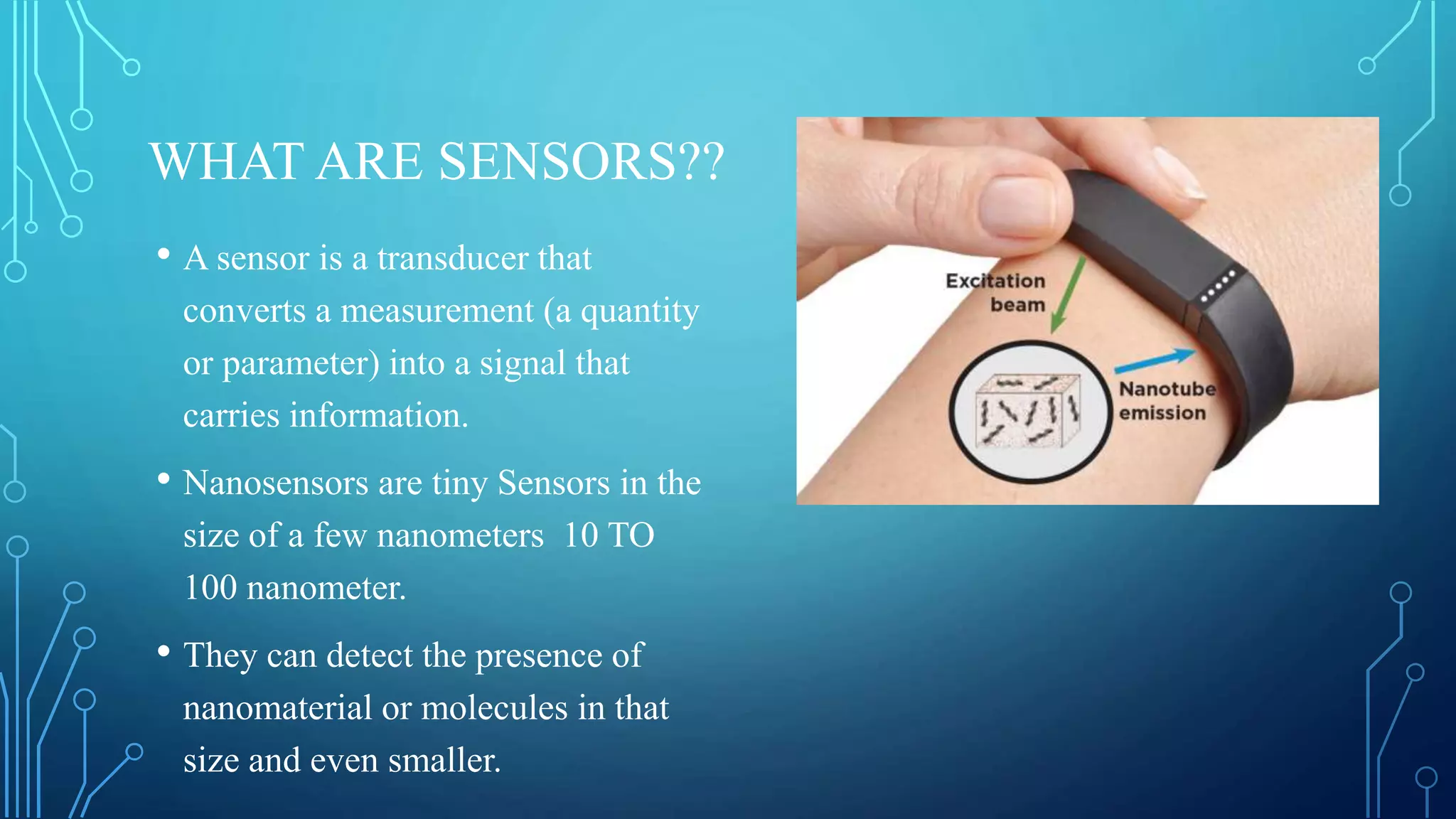
• A sensor is a transducer that
converts a measurement (a quantity
or parameter) into a signal that
carries information.
• Nanosensors are tiny Sensors in the
size of a few nanometers 10 TO
100 nanometer.
• They can detect the presence of
nanomaterial or molecules in that
size and even smaller.
HISTORY OF NANOSENSORS
• In 1990 Dr. Wolter founded his own company called NANOPROBE. After further path breaking
developments NANOPROBE became the first company worldwide to satisfy the emerging need for high
quality AFM sensors.
• 1995 "Dr.-Rudolf-Eberle Award", innovation award of the German State of Baden-Wurttemberg (one of
the high-tech centres in Germany) for exemplary achievements
• 1995 Innovation prize awarded by the Germany Industry
• 1999 "Georg Waeber innovation prize" awarded by the society for the promotion of microelectronics
• October 2002 NANOSENSORS integrated into the Swiss-based NanoWorld AG.
• 2003 NANOSENSORS™ introduces the AdvancedTEC™, a revolutionary new AFM probe type that
allows precise positioning
• 2007 NANOSENSORS™ launches new Silicon MFM Probe Serie
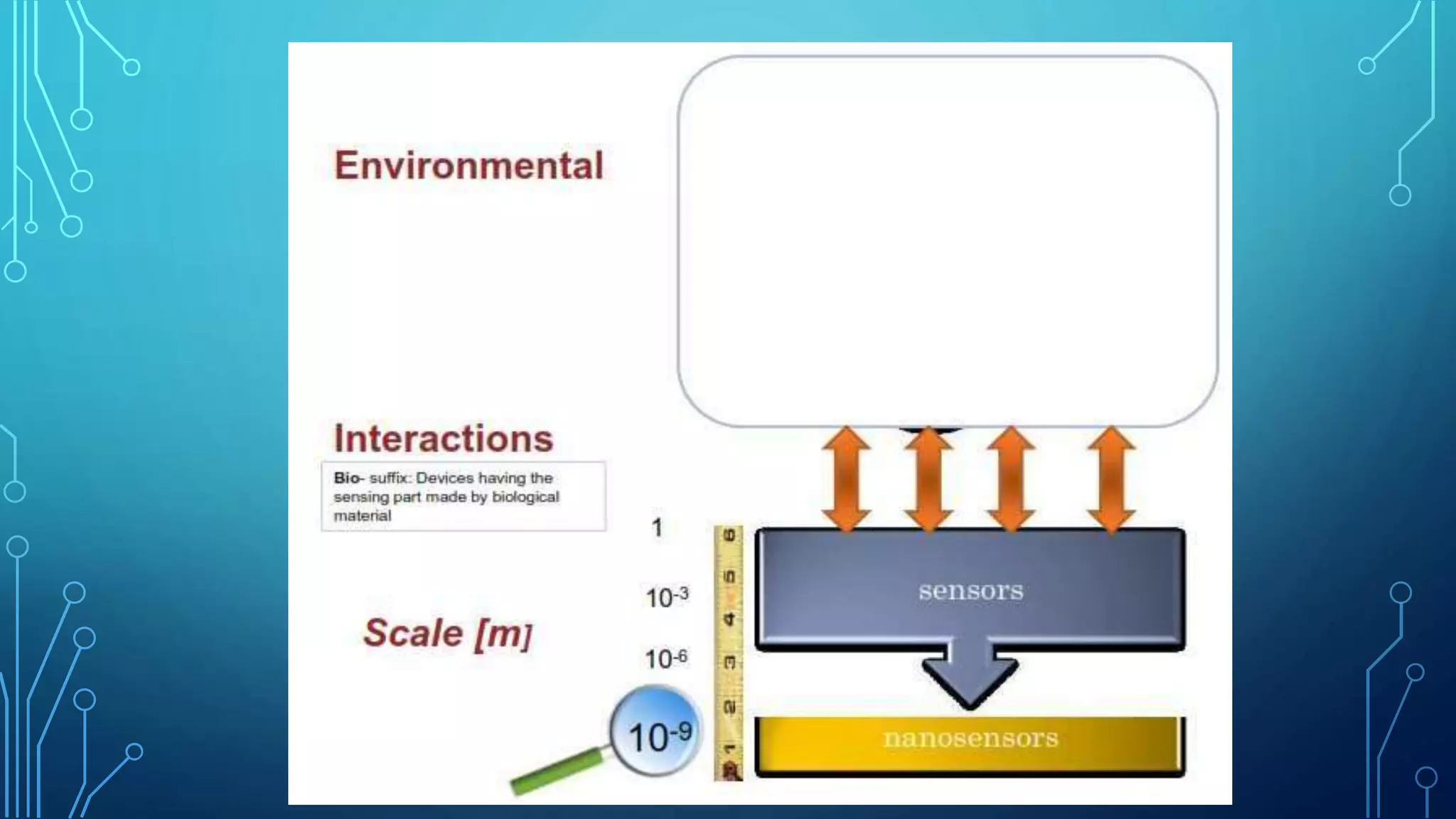
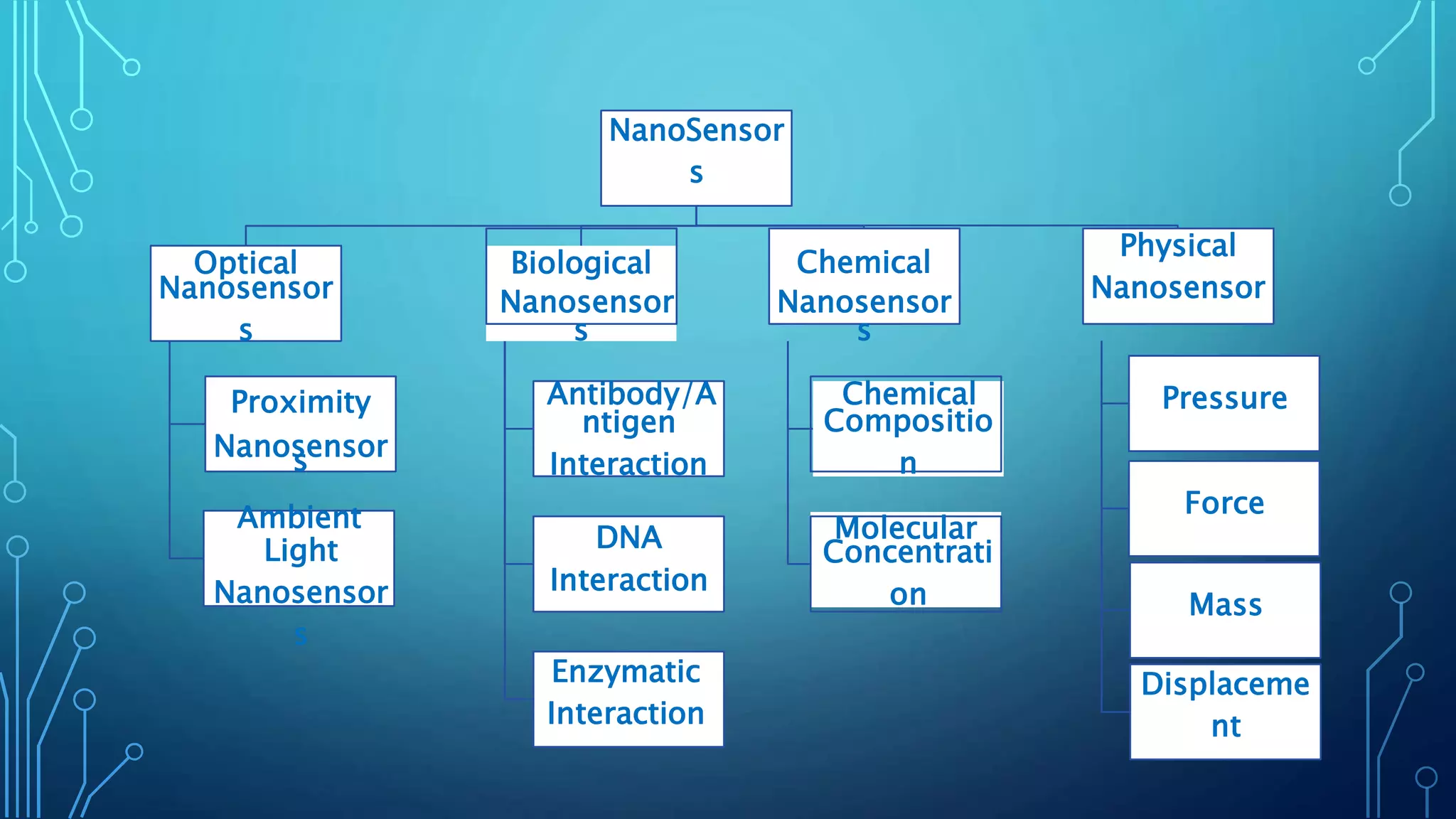
NanoSensor
s
Optical
Nanosensor
s
Light
Nanosensor
s
Proximity
Nanosensor
Ambient
s
Biological
Nanosensor
s
Antibody/A
ntigen
Interaction
DNA
Interaction
Enzymatic
Interaction
Chemical
Nanosensor
s
Chemical
Compositio
n
Molecular
Concentrati
on
Physical
Nanosensor
Pressure
Force
Mass
Displaceme
nt
BIONANOSENSORS
WORKING OF BIOSENSOR
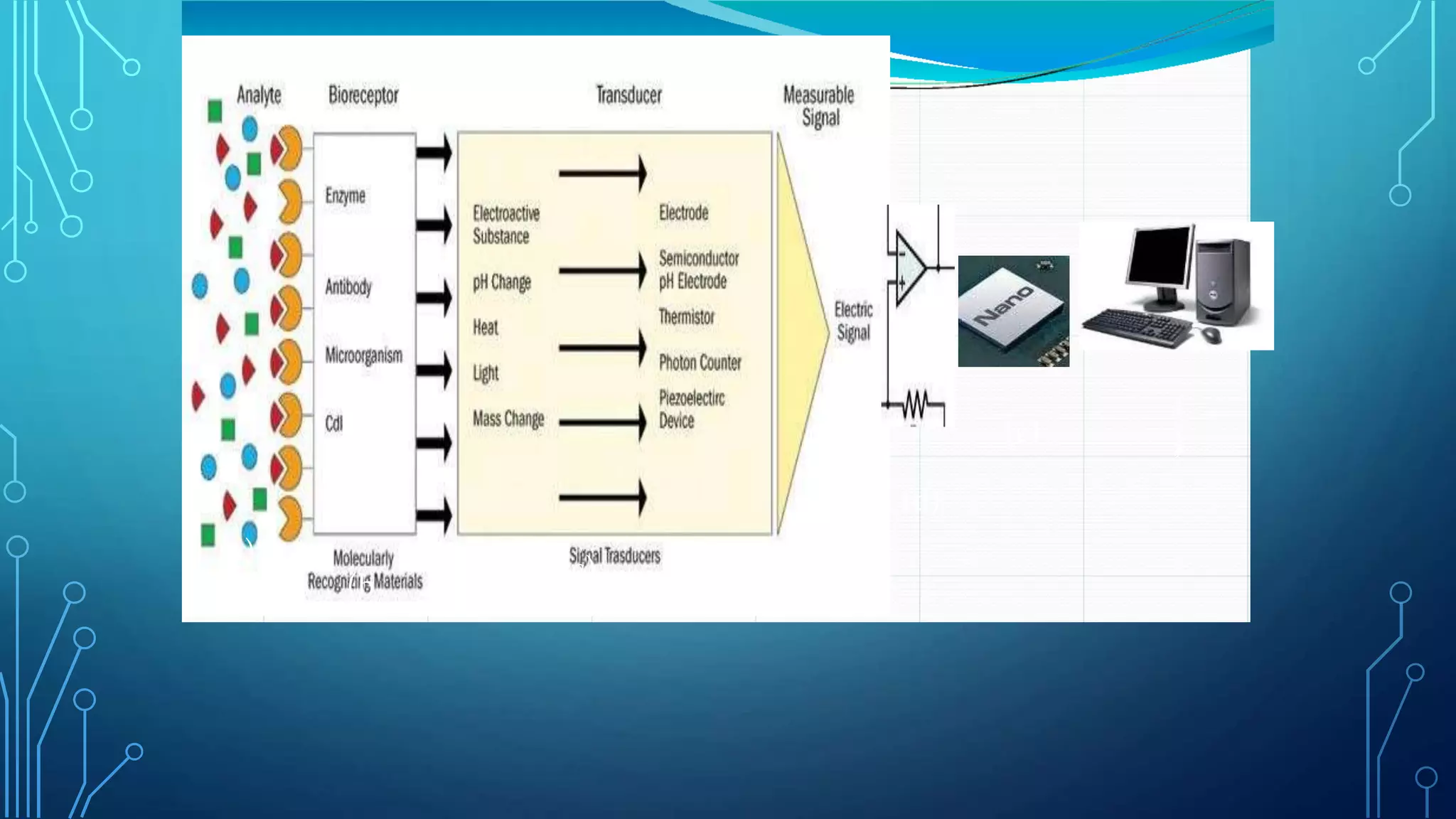
• A biosensor is a measurement system for the detection of an analyte that
combines a biological component with a physicochemical detector and a
nanobiosensor is a biosensor that measures the signal on the nanoscale size.
• The interaction of the analyte with the bioreceptor is designed to produce an
effect measured by the transducer, which converts the information into a
measurable effect, such as an electrical / electronic signal.
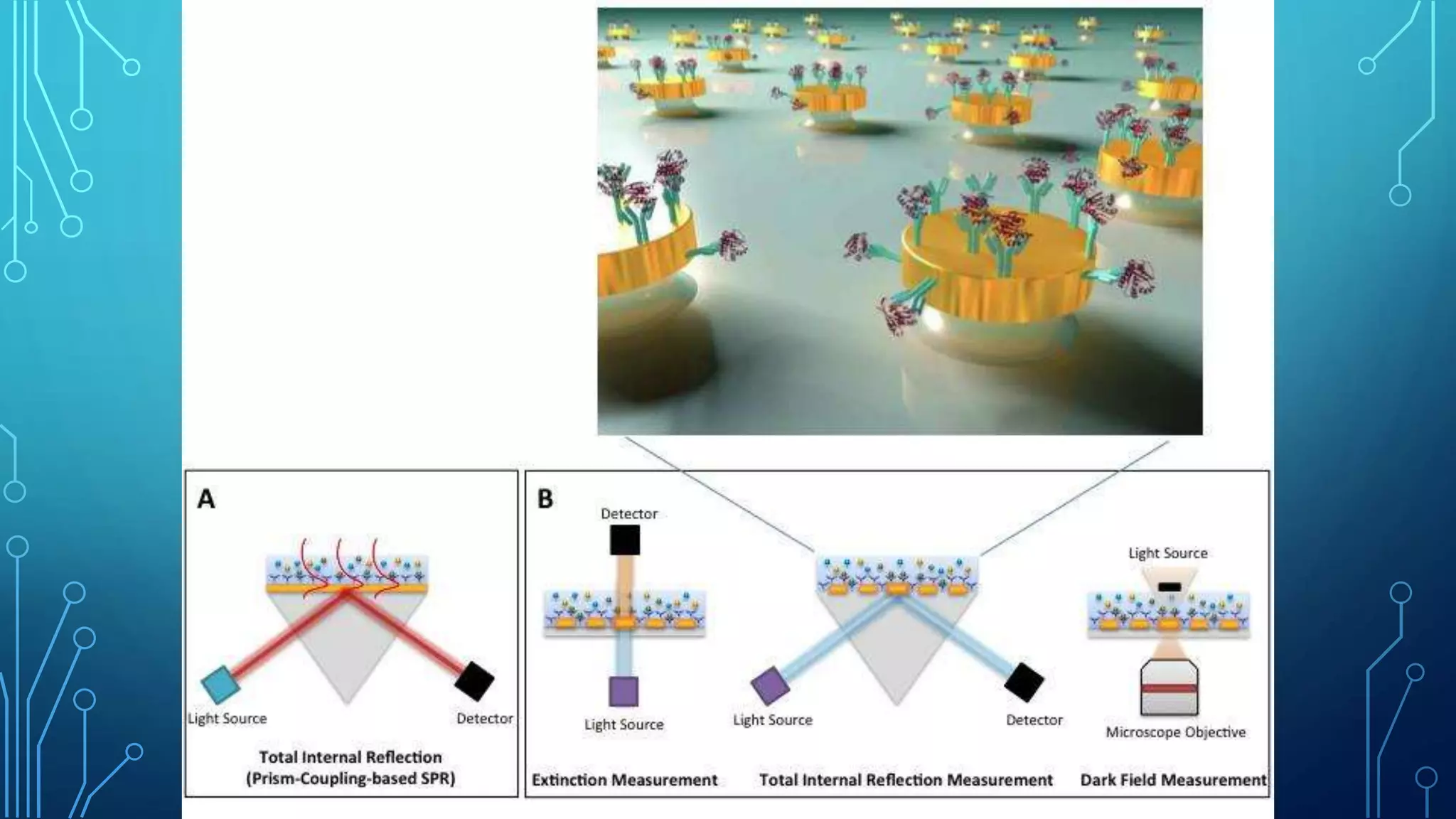
(a)
(b
(c)
(d)
(e)
(
f)
APPLICATIONS OF NANOBIOSENSORS
• Medicinal uses of nanosensors mainly revolve around the potential of nanosensors
to accurately identify particular cells or places in the body in need. By measuring
changes in volume, concentration, displacement, velocity, gravitational, electrical
and magnetic forces, pressure or temperature of cells in a body, nanosensors may be
able to distinguish between and recognize certain cells, most notably those of
cancer, at the molecular level in order to deliver medicine or monitor development
to specific places in the body. In addition, they may be able to detect macroscopic
variations from outside the body and communicate these changes to other
nanoproducts working within the body.
APPLICATIONS OF NANOSENSORS
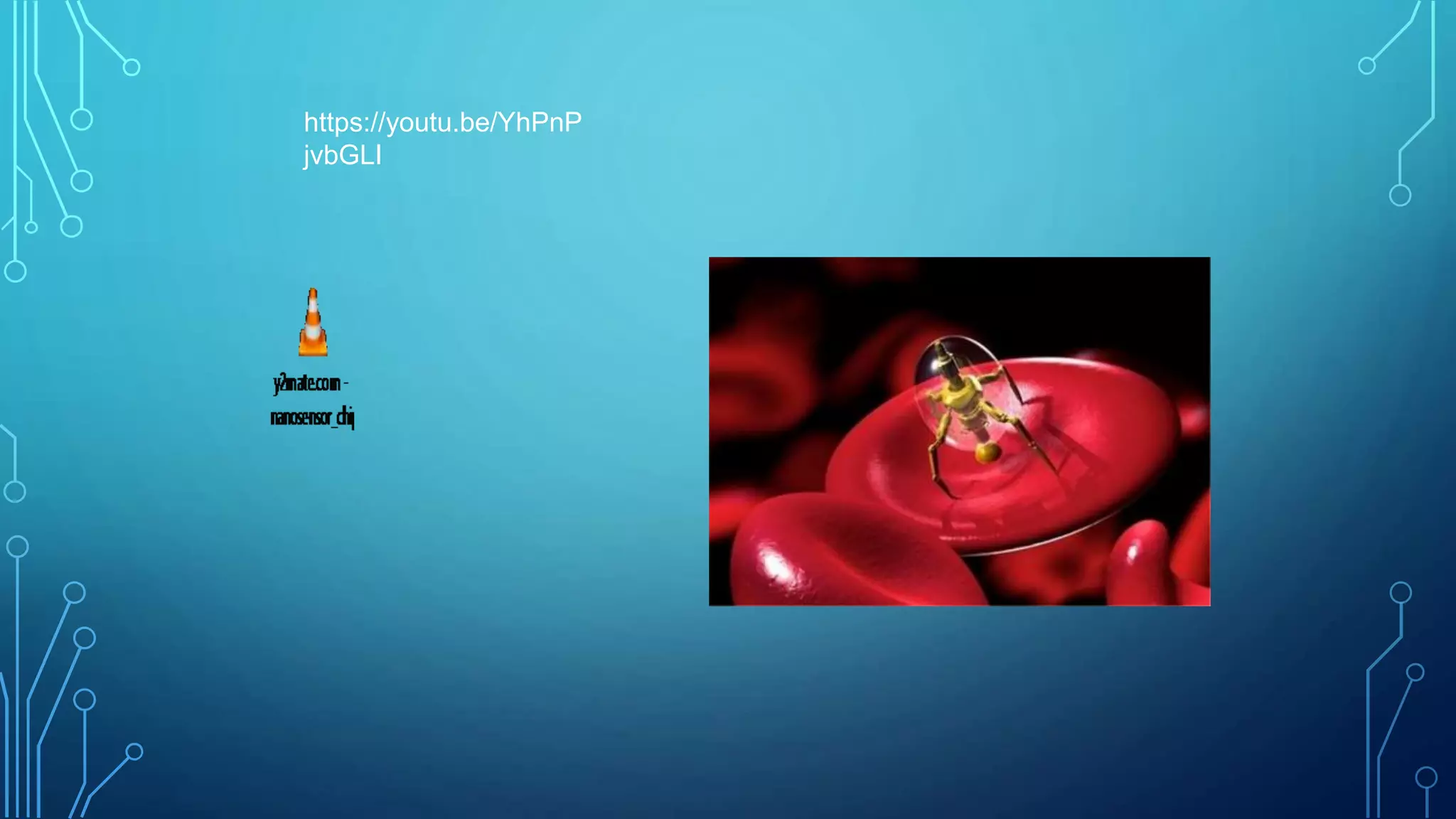
https://youtu.be/YhPnP
jvbGLI
APPLICATIONS
• To detect various chemicals in gases for pollution monitoring
• For medical diagnostic purposes either as bloodborne sensors or in lab-on-a-
chip type devices
• To monitor physical parameters such as temperature, displacement and flow
• To monitor plant signaling and metabolism to understand plant biology
• To study neurotransmitters in brain for understanding neurophysiology.
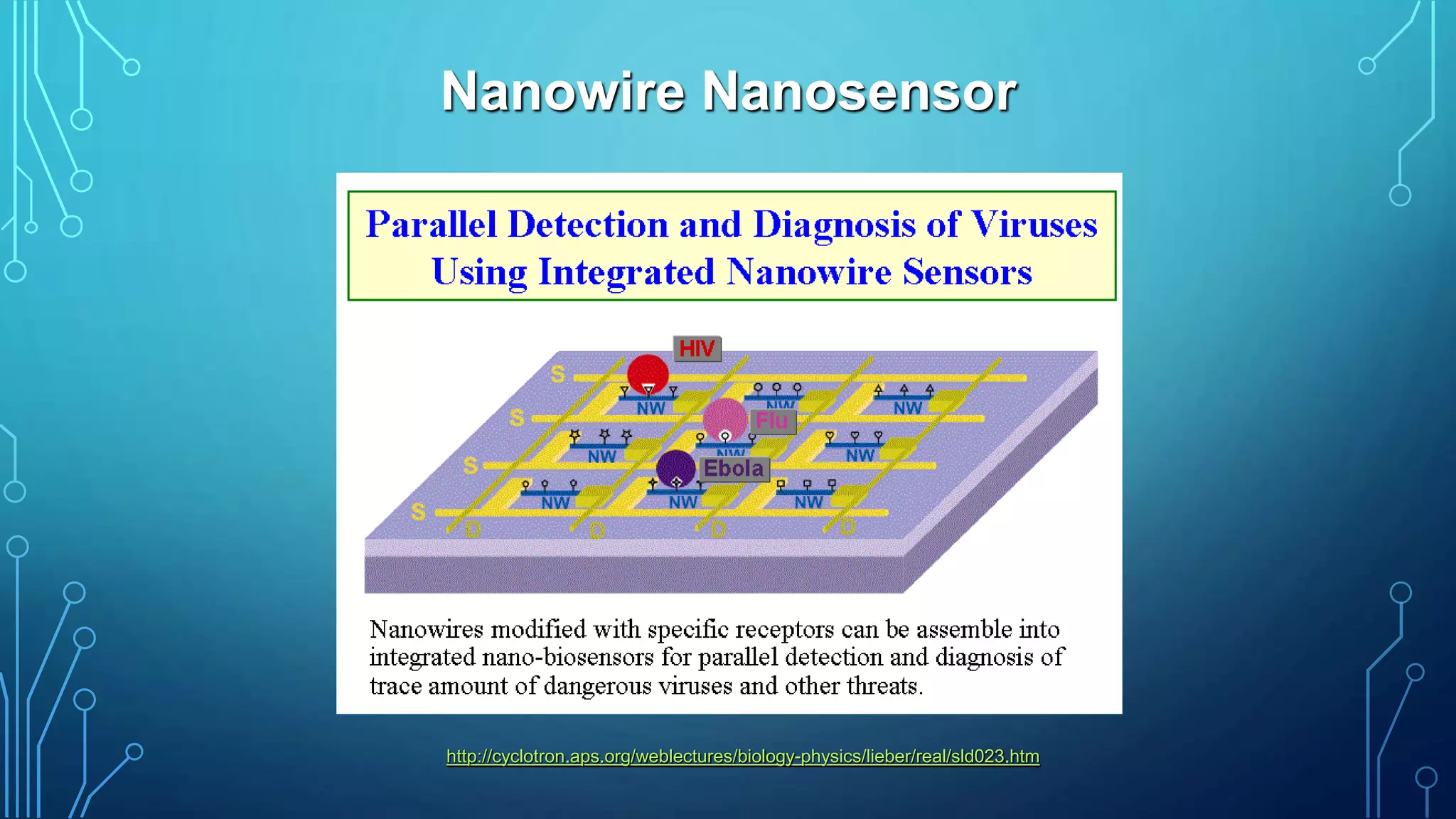
Nanowire Nanosensor
http://cyclotron.aps.org/weblectures/biology-physics/lieber/real/sld023.htm
15
Future Nanosensors
http://cyclotron.aps.org/weblectures/biology-physics/lieber/real/sld025.htm
16
Applications of Nanosensors
Porous silicon gas sensor.
Novel Gas Sensors Based on Porous Silicon Offer Potential for Low-
Voltage, Low-Cost Sensor Arrays Integrated with Electronics
Developed by researchers at the Georgia Institute of Technology
17
Conclusions
Existing nanosensors have realistic applications
Current envisioned nanosensors are still based on macrosensing
techniques that are enhanced or miniaturized
Enabling nanotechnology and future nanosensors will be possible
with the development of nanoelectronics, and integratable
nanodevices
Nanosensors will ultimately have an enormous impact on our
ability to enhance energy conversion, control pollution, produce
food, and improve human health and longevity.
• Consumers increasingly need to know what ingredients or components are in the product and how
the product should be stored, used, and discarded after use. Smart tags and stickers, for example,
will be able to communicate directly with the customer via thin film devices that provide visual
information. Many companies have deployed IP solutions on the market.
• RipeSense is the first intelligent sensor label that changes color to indicate the ripeness of the fruit.
It works through the reaction of the aromas released by the fruit as it ripens; initially it is red and
then graduates to orange and finally yellow, depending on the selection of the desired level of
maturity when it comes to eating the fruit.
Read the sensor
Nanosensors to detect humidity or temperature changes due to moisture ; sensor
for detecting Escherichia coli in a food sample; biosensor for instantly
detecting Salmonella in foods. The IP incorporating nanosen- sors will have
great benefits for the food industry. These NM in the form of tiny chips
invisible to the human eye are embedded in food or in containers, for use as
electronic bar code, which allows for the monitoring of food in all its phases
(production, processing, distribution, and consump- tion).
Table 1 e Current status of nanotechnology-enabled food products.
Sector Application Nanomaterials Manufacturer Current status Note Reference
Food processing Color additives TiO2 Exempt from <1% by weight of the food [41]
certification
Synthetic iron oxide Exempt from <0.25% (for dogs and cats) and 0.1 [41,42]
certification (for human) % by weight of the
finished food
Additive or polymer ZnO Authorized by EC 10/ Authorization based on [43]
production aid Iron oxide 2011 conventional particle size
Aluminium oxide
Silicon dioxide
Cobalt oxide
Manganese oxide (E530)
Titanium nitride No migration reported. Only to be
used in PET bottles up to 20 mg/kg
Carbon black Authorized by EC 10/ <2.5% w/w in the polymer
2011; no longer
authorized by the
U.S. FDA as additives
Preservatives Silver-silica Nanox Intelligent FCS Inventorya
FCN No. 1235. <4 ppm by weight of [44]
Materials silver as an antimicrobial agent
blended into polymers
Flavor carrier Silicon dioxide (E551d
) Authorized by EC <10,000 mg/kg, excluding foods for [45]
1334/2008 infants and young children
Marking fruit and Silicon dioxide (E551) Exempt from <2% of the ink solids [41]
vegetables certification
Anticaking agents Silicon dioxide (E551) REGb
<2% by weight of the food [46]
Nutritional dietary Copper oxide Approved for animal feed [47]
supplement Iron oxide
ZnO GRASc
Food contact packaging Pesticides detection Zinc Oxide QDs R&D [33]
Pathogens detection Magnetic nanosensors R&D [34,35]
Plasmonic nanosensors [36]
Fluorescent nanosensors [37]
Toxins detection Fluorescent nanosensors R&D [38]
Plasmonic nanosensors [39]
Phosphorescent QDs [40]
Edible film/coating Chitosan/Nano-Silica Coating Tested on Longan fruit [48]
Poly-ε-caprolactone Tested on fresh-cut “Red Delicious” [49]
apples
Nanoemulsion/Quinoa Protein/ Tested on fresh strawberries [32]
Chitosan
Bio-nano-hybrid pectins and LDH- Tested on fresh apricots [30]
salicylate
Nanoemulsion with lemongrass R&D Tested on fresh-cut Fuji apples [31]
essential oil
• References:-
1. Guillermo Fuertes et. al; Intellligent Packaging System: Sensors and
Nanosensors To Monitor Food Quality And Safety; Hindawi Publishing
Corporation; Journal Of Sensors; Volume 2016
2. Xiaojia He et al; The Current Application Of Nanotechnology In Food And
Agriculture; Sciencedirect; Journal Of Food And Drug Analysis; 3rd December
2018
url:- https://youtu.be/YhPnPjvbGLI
Naosensors ppt

Naosensors ppt

  • 1.
  • 2.
    WHAT ARE SENSORS?? •A sensor is a transducer that converts a measurement (a quantity or parameter) into a signal that carries information. • Nanosensors are tiny Sensors in the size of a few nanometers 10 TO 100 nanometer. • They can detect the presence of nanomaterial or molecules in that size and even smaller.
  • 3.
    HISTORY OF NANOSENSORS •In 1990 Dr. Wolter founded his own company called NANOPROBE. After further path breaking developments NANOPROBE became the first company worldwide to satisfy the emerging need for high quality AFM sensors. • 1995 "Dr.-Rudolf-Eberle Award", innovation award of the German State of Baden-Wurttemberg (one of the high-tech centres in Germany) for exemplary achievements • 1995 Innovation prize awarded by the Germany Industry • 1999 "Georg Waeber innovation prize" awarded by the society for the promotion of microelectronics • October 2002 NANOSENSORS integrated into the Swiss-based NanoWorld AG. • 2003 NANOSENSORS™ introduces the AdvancedTEC™, a revolutionary new AFM probe type that allows precise positioning • 2007 NANOSENSORS™ launches new Silicon MFM Probe Serie
  • 5.
  • 6.
  • 7.
    WORKING OF BIOSENSOR •A biosensor is a measurement system for the detection of an analyte that combines a biological component with a physicochemical detector and a nanobiosensor is a biosensor that measures the signal on the nanoscale size. • The interaction of the analyte with the bioreceptor is designed to produce an effect measured by the transducer, which converts the information into a measurable effect, such as an electrical / electronic signal.
  • 8.
  • 9.
    APPLICATIONS OF NANOBIOSENSORS •Medicinal uses of nanosensors mainly revolve around the potential of nanosensors to accurately identify particular cells or places in the body in need. By measuring changes in volume, concentration, displacement, velocity, gravitational, electrical and magnetic forces, pressure or temperature of cells in a body, nanosensors may be able to distinguish between and recognize certain cells, most notably those of cancer, at the molecular level in order to deliver medicine or monitor development to specific places in the body. In addition, they may be able to detect macroscopic variations from outside the body and communicate these changes to other nanoproducts working within the body.
  • 11.
  • 12.
  • 13.
    APPLICATIONS • To detectvarious chemicals in gases for pollution monitoring • For medical diagnostic purposes either as bloodborne sensors or in lab-on-a- chip type devices • To monitor physical parameters such as temperature, displacement and flow • To monitor plant signaling and metabolism to understand plant biology • To study neurotransmitters in brain for understanding neurophysiology.
  • 14.
  • 15.
  • 16.
    16 Applications of Nanosensors Poroussilicon gas sensor. Novel Gas Sensors Based on Porous Silicon Offer Potential for Low- Voltage, Low-Cost Sensor Arrays Integrated with Electronics Developed by researchers at the Georgia Institute of Technology
  • 17.
    17 Conclusions Existing nanosensors haverealistic applications Current envisioned nanosensors are still based on macrosensing techniques that are enhanced or miniaturized Enabling nanotechnology and future nanosensors will be possible with the development of nanoelectronics, and integratable nanodevices Nanosensors will ultimately have an enormous impact on our ability to enhance energy conversion, control pollution, produce food, and improve human health and longevity.
  • 19.
    • Consumers increasinglyneed to know what ingredients or components are in the product and how the product should be stored, used, and discarded after use. Smart tags and stickers, for example, will be able to communicate directly with the customer via thin film devices that provide visual information. Many companies have deployed IP solutions on the market. • RipeSense is the first intelligent sensor label that changes color to indicate the ripeness of the fruit. It works through the reaction of the aromas released by the fruit as it ripens; initially it is red and then graduates to orange and finally yellow, depending on the selection of the desired level of maturity when it comes to eating the fruit. Read the sensor
  • 20.
    Nanosensors to detecthumidity or temperature changes due to moisture ; sensor for detecting Escherichia coli in a food sample; biosensor for instantly detecting Salmonella in foods. The IP incorporating nanosen- sors will have great benefits for the food industry. These NM in the form of tiny chips invisible to the human eye are embedded in food or in containers, for use as electronic bar code, which allows for the monitoring of food in all its phases (production, processing, distribution, and consump- tion).
  • 22.
    Table 1 eCurrent status of nanotechnology-enabled food products. Sector Application Nanomaterials Manufacturer Current status Note Reference Food processing Color additives TiO2 Exempt from <1% by weight of the food [41] certification Synthetic iron oxide Exempt from <0.25% (for dogs and cats) and 0.1 [41,42] certification (for human) % by weight of the finished food Additive or polymer ZnO Authorized by EC 10/ Authorization based on [43] production aid Iron oxide 2011 conventional particle size Aluminium oxide Silicon dioxide Cobalt oxide Manganese oxide (E530) Titanium nitride No migration reported. Only to be used in PET bottles up to 20 mg/kg Carbon black Authorized by EC 10/ <2.5% w/w in the polymer 2011; no longer authorized by the U.S. FDA as additives Preservatives Silver-silica Nanox Intelligent FCS Inventorya FCN No. 1235. <4 ppm by weight of [44] Materials silver as an antimicrobial agent blended into polymers Flavor carrier Silicon dioxide (E551d ) Authorized by EC <10,000 mg/kg, excluding foods for [45] 1334/2008 infants and young children Marking fruit and Silicon dioxide (E551) Exempt from <2% of the ink solids [41] vegetables certification Anticaking agents Silicon dioxide (E551) REGb <2% by weight of the food [46] Nutritional dietary Copper oxide Approved for animal feed [47] supplement Iron oxide ZnO GRASc Food contact packaging Pesticides detection Zinc Oxide QDs R&D [33] Pathogens detection Magnetic nanosensors R&D [34,35] Plasmonic nanosensors [36] Fluorescent nanosensors [37] Toxins detection Fluorescent nanosensors R&D [38] Plasmonic nanosensors [39] Phosphorescent QDs [40] Edible film/coating Chitosan/Nano-Silica Coating Tested on Longan fruit [48] Poly-ε-caprolactone Tested on fresh-cut “Red Delicious” [49] apples Nanoemulsion/Quinoa Protein/ Tested on fresh strawberries [32] Chitosan Bio-nano-hybrid pectins and LDH- Tested on fresh apricots [30] salicylate Nanoemulsion with lemongrass R&D Tested on fresh-cut Fuji apples [31] essential oil
  • 23.
    • References:- 1. GuillermoFuertes et. al; Intellligent Packaging System: Sensors and Nanosensors To Monitor Food Quality And Safety; Hindawi Publishing Corporation; Journal Of Sensors; Volume 2016 2. Xiaojia He et al; The Current Application Of Nanotechnology In Food And Agriculture; Sciencedirect; Journal Of Food And Drug Analysis; 3rd December 2018 url:- https://youtu.be/YhPnPjvbGLI