INTRODUCTION
• Our word choice, syntax, and pronunciation reveal us to be members of a
particular speech community, a group of people who share social conventions about
language use. (p.485)

• Some features are noticeable (salient) and are recognized within the community
as having a particular social meaning. Other features are sociolinguistic indicators
that can be associated with certain social characteristics. Different speech
communities may reflect subsets of the same language called dialects (p.486).
LANGUAGE VARIATION & SOCIAL DISTINCTIONS
• Social distinctions will often show up in linguistic distinctions.
When we look at the connections between these distinctions we are
looking at the variation theory, or variationist sociolinguistics.

• We come across variables which are sounds that can be
produced in more than one way. For example, the „th‟ sound in
„brother‟ can be pronounced „brudder‟, „bruvver‟ or „bro‟er‟
(p.487). Social factors will affect these variations, such as the
speaker‟s age, sex or degree of education (p.489).
PLACE
The oldest branch of sociolinguistics is dialectology, the study of regional differences in
language. This type of study looks at the settlement patterns of settlers years ago. This
can help explain the regional differences in language in North America. For example,
people from East Anglia settled in the New England area. People who settled along the
coast came from the south of England. These people brought speech patterns of their
home areas with them (p.490).

Lexical items show differences by region as well. Soda is called „tonic‟ in eastern New
England, „pop‟ in the Northwest and „soda pop‟ in parts of the southern Midland. (p.492).
We‟ll notice regional differences in phonology too, especially in the pronunciations of
vowels. The vowels <e> and <a> following an [r] can be pronounced differently making
words like „merry‟, „Mary‟ and „marry‟ all sound the same.

Differences in morphology and syntax can arise in different regions as well. For example,
„you‟ is often pronounced „y‟all‟ in the South.
TIME
Apparent-time hypothesis looks at the differences that occur in a language over
time. Looking at the differences between old and young speakers is a good example
of this. For example, older speakers have less phoneme merger, while younger
speakers almost always merge the two sounds (p.495).
ISOLATION
Speech communities can be isolated by physical isolation (isolated from everybody),
linguistic isolation (isolated from speakers of the same language) or social isolation
(isolated by conventions or attitudes).
    Physical isolation
A local dialect stays intact when the members of a speech community are isolated
physically. This is rare nowadays because of modern transportation and communication
(p.497).
    Linguistic isolation
Language varieties cut off from their sources, have kept some older features and
developed some of their own innovations (p.499).
    Social Isolation
This is when a smaller speech community is in some way restricted in social interaction
with a larger speech community that shares the same language. A good example of this is
African American Isolation (p.499).
CONTACT


Contact with speakers of other languages or
other varieties is called language contact. New
experiences can occur when speakers of
different languages meet and move towards
bilingualism (p.500).
CONTACT
   CODE SWITCHING & BORROWING

Code switching is when people use two or more languages to communicate.
  Speakers who code switch are often fluent in both of their languages;
  monolinguals think it happens because the speaker is not competent in one of his
  or her languages (p.501)

Borrowing occurs when a single language is dominant but single words from a
  second language will be inserted. If the borrowed word is used enough, it will
  eventually be corrected by the users and used correctly in the dominant language
  (p.501).
CONTACT

   CONTACT LANGUAGES: MIXED LANGUAGES, LINGUA
   FRANCAS, PIDGINS AND CREOLES

Mixed languages occur when there is heavy code-switching occurring in a
language. This is rare and many linguists argue it does not exist. Lingua
francas occur when people from two different languages, who
communicate often, choose a language to consistently use to communicate.
This is an attempt to level the playing field for both groups. A pidgin is an
undeveloped language with few grammatical rules and limited complexity.
It is often used as a lingua franca and does not have native speakers. When
a pidgin‟s lexical items and grammatical rules increase, it can transform
into a creole.
DISTINCTIONS WITHIN A COMMUNITY
Language varieties can often tell us about distinctions (class, ethnicity, gender,
situation specific factors) within regional communities.
DISTINCTIONS WITHIN A COMMUNITY
CLASS

 Studies have shown a close relationship between class and careful
 speech patterns. Higher class speakers usually use more prestige
 variants (p.507). Members of a second-highest class may
 experience linguistic insecurity through hypercorrection of their
 speech. They pay close attention to their speech trying to strive
 for social heights/acceptance.
DISTINCTIONS WITHIN A COMMUNITY
ETHNICITY

 African American English is an ethnic variety gaining attention
 from linguists. It has its own phonological features such as
 consonant cluster reduction and the way final consonants are
 voiced. Some of its features are shared with other dialects of
 English, such as the use of the verb be (p. 508).
DISTINCTIONS WITHIN A COMMUNITY
GENDER

 Differences in language use can also depend on one‟s gender role. For example,
 when the language in a community is stable, women will often use the more
 standard form of the language whereas men will use nonstandard forms more
 often. These differences may be attributed to linguistic insecurity or gender
 expectations (p. 512).
DISTINCTIONS WITHIN A COMMUNITY
SITUATION SPECIFIC FACTORS

  This will happen when the members of a community come together to
 develop shared language practices. An example of this is when speakers
 will exaggerate distinctive features of their local dialect to reinforce their
 local identity (p.514).
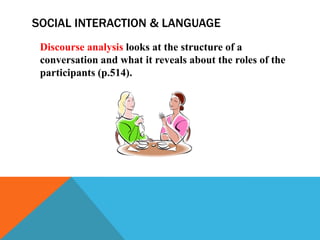
SOCIAL INTERACTION & LANGUAGE
 Discourse analysis looks at the structure of a
 conversation and what it reveals about the roles of the
 participants (p.514).
SOCIAL INTERACTION & LANGUAGE
  Ethnography of Communication:

 This pulls apart speech events into their component parts. In a speech situation,
 cultures have developed conventions governing interactions. It can look at the
 sequencing of a conversation, jargon and openings & closings of conversations (p.
 516).

  Solidarity and Power:

 Speakers express closeness or shared status through solidarity. They may also
 maintain differences and identify social standings of participants through the
 power relationship. Solidarity and power relationships often show themselves
 through address terms (i.e. “Do the participants use reciprocal name calling such
 as friends who call themselves by their first name, or does one participant call the
 other „sir‟?”).
HOW SOCIETIES DEAL WITH LANGUAGE
•      Societies can approach language as a social object. For example, one
    variety of English may be considered the standard over another. Some
    societies even have academies established to maintain the purity of a
    language. The belief in the correctness of a language variety can have
    social impacts regarding education or employment opportunities (p.
    519).

•       Some governments may declare an official language. The official
    language will often benefit the political and economic power of the ethnic
    group that speaks that language. This may occur by majority groups
    perceiving itself as having increased power over a minority group , such
    as groups attempting to make English the official language in the United
    States.

Language in Social Contexts

  • 2.
    INTRODUCTION • Our wordchoice, syntax, and pronunciation reveal us to be members of a particular speech community, a group of people who share social conventions about language use. (p.485) • Some features are noticeable (salient) and are recognized within the community as having a particular social meaning. Other features are sociolinguistic indicators that can be associated with certain social characteristics. Different speech communities may reflect subsets of the same language called dialects (p.486).
  • 3.
    LANGUAGE VARIATION &SOCIAL DISTINCTIONS • Social distinctions will often show up in linguistic distinctions. When we look at the connections between these distinctions we are looking at the variation theory, or variationist sociolinguistics. • We come across variables which are sounds that can be produced in more than one way. For example, the „th‟ sound in „brother‟ can be pronounced „brudder‟, „bruvver‟ or „bro‟er‟ (p.487). Social factors will affect these variations, such as the speaker‟s age, sex or degree of education (p.489).
  • 4.
    PLACE The oldest branchof sociolinguistics is dialectology, the study of regional differences in language. This type of study looks at the settlement patterns of settlers years ago. This can help explain the regional differences in language in North America. For example, people from East Anglia settled in the New England area. People who settled along the coast came from the south of England. These people brought speech patterns of their home areas with them (p.490). Lexical items show differences by region as well. Soda is called „tonic‟ in eastern New England, „pop‟ in the Northwest and „soda pop‟ in parts of the southern Midland. (p.492). We‟ll notice regional differences in phonology too, especially in the pronunciations of vowels. The vowels <e> and <a> following an [r] can be pronounced differently making words like „merry‟, „Mary‟ and „marry‟ all sound the same. Differences in morphology and syntax can arise in different regions as well. For example, „you‟ is often pronounced „y‟all‟ in the South.
  • 5.
    TIME Apparent-time hypothesis looksat the differences that occur in a language over time. Looking at the differences between old and young speakers is a good example of this. For example, older speakers have less phoneme merger, while younger speakers almost always merge the two sounds (p.495).
  • 6.
    ISOLATION Speech communities canbe isolated by physical isolation (isolated from everybody), linguistic isolation (isolated from speakers of the same language) or social isolation (isolated by conventions or attitudes). Physical isolation A local dialect stays intact when the members of a speech community are isolated physically. This is rare nowadays because of modern transportation and communication (p.497). Linguistic isolation Language varieties cut off from their sources, have kept some older features and developed some of their own innovations (p.499). Social Isolation This is when a smaller speech community is in some way restricted in social interaction with a larger speech community that shares the same language. A good example of this is African American Isolation (p.499).
  • 7.
    CONTACT Contact with speakersof other languages or other varieties is called language contact. New experiences can occur when speakers of different languages meet and move towards bilingualism (p.500).
  • 8.
    CONTACT CODE SWITCHING & BORROWING Code switching is when people use two or more languages to communicate. Speakers who code switch are often fluent in both of their languages; monolinguals think it happens because the speaker is not competent in one of his or her languages (p.501) Borrowing occurs when a single language is dominant but single words from a second language will be inserted. If the borrowed word is used enough, it will eventually be corrected by the users and used correctly in the dominant language (p.501).
  • 9.
    CONTACT CONTACT LANGUAGES: MIXED LANGUAGES, LINGUA FRANCAS, PIDGINS AND CREOLES Mixed languages occur when there is heavy code-switching occurring in a language. This is rare and many linguists argue it does not exist. Lingua francas occur when people from two different languages, who communicate often, choose a language to consistently use to communicate. This is an attempt to level the playing field for both groups. A pidgin is an undeveloped language with few grammatical rules and limited complexity. It is often used as a lingua franca and does not have native speakers. When a pidgin‟s lexical items and grammatical rules increase, it can transform into a creole.
  • 10.
    DISTINCTIONS WITHIN ACOMMUNITY Language varieties can often tell us about distinctions (class, ethnicity, gender, situation specific factors) within regional communities.
  • 11.
    DISTINCTIONS WITHIN ACOMMUNITY CLASS Studies have shown a close relationship between class and careful speech patterns. Higher class speakers usually use more prestige variants (p.507). Members of a second-highest class may experience linguistic insecurity through hypercorrection of their speech. They pay close attention to their speech trying to strive for social heights/acceptance.
  • 12.
    DISTINCTIONS WITHIN ACOMMUNITY ETHNICITY African American English is an ethnic variety gaining attention from linguists. It has its own phonological features such as consonant cluster reduction and the way final consonants are voiced. Some of its features are shared with other dialects of English, such as the use of the verb be (p. 508).
  • 13.
    DISTINCTIONS WITHIN ACOMMUNITY GENDER Differences in language use can also depend on one‟s gender role. For example, when the language in a community is stable, women will often use the more standard form of the language whereas men will use nonstandard forms more often. These differences may be attributed to linguistic insecurity or gender expectations (p. 512).
  • 14.
    DISTINCTIONS WITHIN ACOMMUNITY SITUATION SPECIFIC FACTORS This will happen when the members of a community come together to develop shared language practices. An example of this is when speakers will exaggerate distinctive features of their local dialect to reinforce their local identity (p.514).
  • 15.
    SOCIAL INTERACTION &LANGUAGE Discourse analysis looks at the structure of a conversation and what it reveals about the roles of the participants (p.514).
  • 16.
    SOCIAL INTERACTION &LANGUAGE Ethnography of Communication: This pulls apart speech events into their component parts. In a speech situation, cultures have developed conventions governing interactions. It can look at the sequencing of a conversation, jargon and openings & closings of conversations (p. 516). Solidarity and Power: Speakers express closeness or shared status through solidarity. They may also maintain differences and identify social standings of participants through the power relationship. Solidarity and power relationships often show themselves through address terms (i.e. “Do the participants use reciprocal name calling such as friends who call themselves by their first name, or does one participant call the other „sir‟?”).
  • 17.
    HOW SOCIETIES DEALWITH LANGUAGE • Societies can approach language as a social object. For example, one variety of English may be considered the standard over another. Some societies even have academies established to maintain the purity of a language. The belief in the correctness of a language variety can have social impacts regarding education or employment opportunities (p. 519). • Some governments may declare an official language. The official language will often benefit the political and economic power of the ethnic group that speaks that language. This may occur by majority groups perceiving itself as having increased power over a minority group , such as groups attempting to make English the official language in the United States.