PAPER 
SOCIOLINGUISTIC 
“Speech Function” 
Written by: 
Niken Nabella (11321158/6E) 
Siti Purwaningsih (11321159/6E) 
Ryani Ningsih (11321160/6E) 
Kristina Saras (11321161/6E) 
DEPARTEMENT OF ENGLISH TEACHING 
FACULTY OF LETTERS AND ARTS EDUCATION 
IKIP PGRI MADIUN 
2014
PREFACE 
Praise to Allah SWT who has given taufik, guidance, and inayah so that we can still 
move as usual as well as the authors, so we can complete this paper entitled "speech 
function". This paper discusses about the function and the purpose of speech. 
This paper is organized so that readers can add insight or expand existing knowledge 
about young learner teacher that we present in this paper with an arrangement of a concise, 
easy to read and easy to understand. 
The writers also wish to express many thanks to his teammates and lecture who have 
guided the authors in order to make authors of scientific papers in accordance with the 
provisions in force so that it becomes a good and right paper. 
Hopefully, this paper can be useful for readers and expanding horizons about the 
ii 
young learner teacher. 
And also the author apologizes for any shortcomings here and there of the paper's 
authors do. Please critiques and suggestions. Thank you 
Madiun, 18th Juni 2014 
writer
DISCUSSION 
SPEECH FUNCTION 
Language serves a range of functions. It is usually adjusted the speech to suit the 
social context of speech. The language we talk to a child may be different from the 
language we talk to our customer or colleague though the purpose is the same. The 
different purposes of talk can also affect the form of language and the variety of ways. 
Why do we say the same thing in different ways? The answers to the question basically 
imply the speech functions. 
2 
The Function of Speech 
Dialog 1 : 
Boss : Good morning, Sue. Lovely day. 
Secretary : Yes, it is beautiful. Makes you wonder what we are doing here, doesn’t 
it? 
Boss : Mm, that’s right. Look I wonder if you could possibly sort this lot out by 
ten. I need them for a meeting. 
Secretary : Yes, sure. No problem. 
Boss : Thanks. That’s great. 
This dialogue is typical of many everyday interactions in that it serves both an 
affective (or social), and referential (or informative) function. The initial greetings and 
comments on the weather serve a social function; they establish contact between the two 
participants. The exchange then moves on to become more information-oriented or 
referential in function. 
There are a number of ways of categorising the functions of speech. The following 
list has proved a useful one in sociolinguistic research. 
1. Expressive utterances 
Expressive utterances express the speakers’ feelings. This function serves the 
declaration of a speaker’s ambiance. It used to express personal feelings, thoughts, 
ideas and opinions, with different choice words, intonation, etc. These expressions are 
submissive to social factors and to the nature of the expression as negative or positive. 
In Indonesian communication, expression is used to keep up social relationship. When 
someone is meeting a friend or someone he/she is familiar with, he/she will greet 
him/her to make sure “here, I am your friend or your neighbor”.
The following are the form of utterances that serve expressive function: 
– I’m happy today. (positive expression) 
– I am afraid. (negative expression) 
– I'm very gloomy tonight. (negative expression) 
– I'm feeling very good today. (positive expression) 
– I’m feeling great today. (positive expression) 
3 
2. Directive Utterances 
Directive utterances attempt to get someone to do something. In Indonesian 
communication, directive function can be articulated by imperative sentences, 
interrogative sentences as well as declarative sentences. Orders and commands are 
normally expressed in imperative form. 
Directives are concerned with getting people to do things which express 
directive force vary in strength. We came to sit down, for instance, by suggesting or 
inviting or ordering or commanding them to sit down. Orders and speech act which are 
generally expressed in imperative to get people to do something tend to use 
interrogatives are following examples illustrate. 
Sit down IMPERRATIVE 
You sit down You IMPERRATIVE 
Could you sit down? INTERROGATIVE with modal verb 
Sit down, will you? INTERROGATIVE with tag 
Won’t you sit down? INTERROGATIVE with negative modal 
I want you to sit down DECLARATIVE 
I’d like you to sit down DECLARATIVE 
You’d be more comfortable sitting down DECLARATIVE 
It’d be better you to sit down DECLARATIVE 
The list could go on and on. There are many way in directive. And although we 
can say that in general declaratives are more polite than imperatives, a good 
intonation, tone of voice and context. A gentle sit down more polite than a thundered I 
want you all sitting down now (a) in example 1 will be considered normal, while (b) as 
sarcastic. 
Example 1: 
a. Box of matches 
b. Could you possibly give me a box of matches 
How do people decide which form to use in a particular of the social factors 
have been suggested between participants, their relatives status, and the form (the
social dimensions which were discussed. People who are close friends or intimates use 
instance. 
The utterances in example 2 were all produced were (almost!) all said without 
4 
rancour, and caused no offence. 
Example 2: 
(a) Roll over. 
(b) Shut up you fool. 
(c) Set the table, Robbie. 
(d) Wash your hands for tea children. 
(e) Turn that blessed radio down. 
Where status differences are clearly marked and accepted, superiors tends to use 
imperative to subordinates. Teachers often use imperatives to pupils, for instance. 
Example 3: 
(a) Open your book at page 32 
(b) Shut the door 
(c) Stop talking please 
Teacher can use very direct expression of their mea high status relative to their 
pupils. On the other hands, options in a role relationship such as teacher-pupil are so 
can also use minimal explicit forms and be confident they will be interpreted 
accurately as directive. 
Example 4: 
(a) Blackboard! (‘Clean the blackboard’) 
(b) Bus people! (‘ those who get the school bus should now leave’) 
(c) I hear talking (‘stop talking’) 
So clear-cut are the rules for classroom behaviour that it has been suggested that 
pupils operate with a very general rule of the form ‘Scan every utterance of the teacher 
for directive intent’. In the other words pupils consider everything the teacher says as a 
possible directive. New entrant Jason in example 5, however, has obviously not 
learned this rule yet, so his teacher’s attempts to gently direct him to the appropriate 
behaviour are initially far too indirect. 
Example 5: 
Teacher : Jason, why have you got your raincoat it’s raining 
Jason : (smile) 
Teacher : it’s not raining inside 
Jason : (no response)
Teacher : what are you going to do about it? 
Jason : (no response) 
Teacher : go and hang it up 
Formality and status may be very relevant in choosing an appropriate directive 
form. At a graduation ceremony the University Chancellor gave the Vice-Chancellor 
the directive in example 6. 
Example 6: 
I now call on the Vice-Chancellor to read the citation for distinguished guest. 
The required action (‘read the citation’) is embedded as a subordinate clause in 
the second part of the declarative sentence, and this is a common grammatical means 
of expressing directives less directly and more politely. A study which looked at the 
directives used between medical professionals in a meeting also demonstrated the 
importance of relative status in determining the form of directive in a formal setting. 
Imperative were over whelming used by superiors to those of subordinate status. The 
only imperative used ‘upwards’ were greeted with laughter, and regards as humorous 
because they so clearly flouted this sociolinguistic rule. The general rule was that 
directives upwards were couched as indirect forms, such as modal interrogative as in 
example 7(a). Others took the form of hints as illustrated by the exchange in example 
7(b). 
Example 7: 
Medical professional of leave status to person of higher status 
(a) Could you ring his another and find out ? 
(b) A. We’ve get a referral from Dr. T. He’s your neighbour Jody. 
5 
B. Ok I’ll take him. 
The relevance of status in a less formal context was nicely demonstrated in a 
study of children’s directive in New Zealand child-care centre. Relative status in the 
centre was determined by age and size. The oldest, biggest and strongest child used by 
far the most imperatives, while attempts by the other children to get him to cooperate 
involved less direct forms such I think I need that note and could I borrow that? 
Another factor which is relevant to the form of a directive is the routineness or 
reasonableness of the task. A boss might produce utterance (a) in example 8 to his 
mechanic when giving her routine task. If, however, he is expecting her to do
something-out of the ordinary or especially difficult, he is far more likely to use a less 
direct form such as (b) or even a hint such as (c). 
Example 8: 
(a) Get those brake pads in by 5 o’clock Sue. That car’s needed first thing in 
6 
the morning. 
(b) Could you stay a bit later tonight, do you think, and finish this job? 
(c) That job’s taking longer than we predicted. I don’t know what we’ll do if it 
isn’t ready for tomorrow. 
In general, imperative are used between people who know each other well to 
subordinates. Interrogative and declarative, including hints, used between those are less 
familiar with each other, or where there are some reason to feel the task being 
requested is not routine. But there are many qualifications to those generalizations. 
Hints may be used for humorous effect between people who are close friends, as 
example 9 illustrates. 
Example 9: 
(a) To someone blocking the light out. 
You make a better door than a window. 
(b) Mother to teenage son. 
I’m not sure that a couple of smelly socks in the middle of the floor can be 
beaten as a centre piece for our dinner party. What do you think, Tim? 
It has also been noted that girls and women tend to favour more polite and less 
direct form of directives than males - at least in the contexts investigated. Those are 
example of children’s utterances to each other in a play centre. 
Example 10: 
(a) Tom : Give me that. I need it now. 
(b) Seymour : Get off that car. 
(c) Grant : Get out of my house. 
(d) Maria : You finished with that rolling pin now? 
(e) Lisa : My turn now eh? 
(f) Meg : it’s time for tea so you’ll have to go home. 
The form used by the girl are already less direct another those used by the boys. 
In a study of doctors’ directives patients, male doctors typically used imperative (e.g. 
eat more fruit), while female doctors used less direct forms (e.g. maybe you could try 
fresh fruits for dessert). There are many other influences on the form of directives: the 
addressee’s gender is significant, for instance. Women not only use less direct form of 
directive, they also receive less direct forms. Relative power orstatus, and social
distance clearly influence the form of directives, as some of the examples above have 
demonstrated. There is not space to illustrate all the possible contextual influences, but 
you might find it interesting to investigate some of them for yourself in your own 
community. 
Not all communities follow the patterns I have described. In a study of a 
community of lower-class male migrant agricultural workers on the eastern seaboard 
of the United States, for instance, it was found that almost all the directives took the 
form of imperatives regardless of differences in social status, social distance, the 
presence of outsiders and the setting or location. 
Example 11: 
a. Stay away from them social workers 
b. Well if you don’t want to work, get out of the field 
c. Grab that there hand truck 
d. Now get to it 
e. Overseer assigns the farm worker the wrong to hoe 
Farm worker: go to hell. Two times you have told me what to do each time 
it’s been wrong. I’m staying in this row. You put somebody else there. 
The researchers in this study considered that the insecure and unpleasant work 
conditions of the participants accounted for the antagonism evident in many of their 
social interactions. Relations between the workers and their bosses were characterised 
by mistrust and tension on both sides. Their language reflected these social relationships 
in the great majority of directives, whether from bosses to worker or vice versa, took the 
form of unmodified imperatives. 
Clearly getting what you want from someone else requires knowledge of the 
rules for expressing yourself appropriately in the relevant socio-cultural context. A 
successful outcome can reflect a real sociolinguistic accomplishment. And even at the 
age of 3 some children have worked out that a threat can sometimes be more effective 
than any directive. The following example illustrates the sociolinguistic skills of both 
parties to this exchange. 
Example 12: 
Mischa : Can I borrow your biscuit? 
Jake : No, it’s my lunch 
Mischa : I won’t be your friend if you won’t let me 
Jake : OK 
(Jake gives her the biscuit but looks miserable.) 
7
Mischa : Here, it’s OK you have it 
Jake : No. You won’t be my friend 
(Mischa starting eating.) 
Jake : My turn 
(Mischa gives it back and they then finish the biscuit taking.) 
8 
3. Referential Utterances 
Referential utterances provide information. Politeness in these utterances can be 
seen from the substance of cooperative principles – quality, quantity, relation and 
manner. The value of politeness, in the same way, a great deal depends on intonation, 
tone of voice and context too. The following utterances are instances for the referential 
function: 
– The second presenter will be Mrs. Hanna. 
– Make up speaking class will be held on Monday at 1 pm. 
– The capital city of Indonesia is Jakarta. 
– We will leave for Jakarta tomorrow at 9 a.m. 
– Our baby always wakes up at 3 a.m. 
4. Metalinguistic utterances 
Metalinguistic utterances comment on language itself. Holmes (1992: 286) gives 
the example of this function is like ‘Hegemony’ is not a common word. While Cripper 
and Widdowson in Allen and Corder (ed.) (1975: 1997) explain that the utterances of 
this kind focus on the code or the language. The principle purpose of metalinguistic is 
to make sure that the addressee understands the meaning of the code which the 
addresser is using. In Indonesian communication, we often find metalinguistic 
function of speech in scientific discussion. The following utterances are instances for 
the referential function: 
– ‘Nat’ has to be added by affixes. 
– Poetic art is the art of writing a literary work. 
– Stylistics is science about language style in a literary work. 
5. Poetic utterances 
Poetic utterances focus on aesthetic features of language. This speech function is 
rarely used in daily conversation. In special occasion, like in the ceremony of
engagement in North Sumatra community, anyway, poetic function is commonly used. 
RRI Tanjung Pinang broadcasts a special program named Serumpun Melayu that is 
this program dealing with the reproduction of Pantun Melayu on air (Srinthli, 2005). 
The following is the utterances of the broadcaster, Wan Abidah: 
9 
Palm tree is struck by lightning 
It falls over kedondong tree 
Don’t think of losing or winning 
The important thing is the performance 
Poetic utterances may be found in daily conversation, but it seldom happens in 
Javanese community. When it happens, the purpose is to raise a humorous effect 
between people who are close friends. 
Skinny cat takes a bath on a board 
Nameboard made of jati tree 
Skinny body is not because of lack of food 
But thinking of the sweet heart 
6. Phatic utterances 
Phatic utterances express solidarity and empathy with other. This speech 
function always exists in all community, but the form is different. In other words, this 
expression is culturally linked. 
(I). Where are you going? (Mau kemana?) 
(II). Please come in. (Mari singgah dulu.) 
Utterance (I) is Indonesian distinctive expression that often make western people 
offended. For English community “Where are you going?” is such a sensitive 
greeting. This is too private question that someone who is greeted that way will be 
feeling spied and unsecured. That is why the possible answer to this question may be 
“It is none of your business”. On the other hand, in Indonesian daily social interaction, 
“where are you going” is a part of communicative strategy for breaking the ice. This 
expression is commonly used to start a conversation or to show one’s care of others. 
This greeting may become a ‘lip-service’ that is to show “I am your friend and I care 
of you”. This is apparently a form of phatic expression in Indonesian vernacular.
We often hear (II) “Please, come in or mari singgah dulu” in Indonesian daily 
communication and it serves a social function too. The offering is usually done by a 
speaker to someone he/she is familiar with – someone to his/her neighbors. Sometimes 
someone offers his friend or his neighbor to drop in his/her house. He offers 
something, but he actually does not mean so. He just wants to demonstrate utterly that 
“you are my friend”. 
10 
(III). Let’s have a meal. (Mari makan.) 
It happens very often in a canteen when a person is about to eat his/her meal and 
his/her friend comes then he/she will say (III) “Let’s have a meal or mari makan”. 
The statement of offering food is sometimes merely a lip-service. The speaker does 
not intend to share his food with the addressee. What he has in mind is that “well you 
are my friend”‘. Cook (1989) calls this “the phatic function of the language”. As this 
expression is only a lip service, so the addressee usually applies the same strategy, 
namely flouting co-operative principle, by uttering “Terimakasih, saya baru saja 
makan”. Meanwhile, accepting the offer sometimes can cause embracement because 
the food may not be enough for two persons. Conversely, when two persons are very 
close friends, the acceptance of the proposal is reasonable. 
Though I have provided a very brief indication of what the function labels mean, 
and an example of each in the form of a single utterance, it is important to remember that 
any utterance may in fact express more than one function, and any function may be 
expressed by a stretch of discourse which doesn’t exactly with an utterance. 
The first three functions are recognized by many linguists, though the precise labels 
they are given may differ. They seem to be very fundamental functions of language, 
perhaps because they derive from the basic components of any interaction- the speaker 
(expressive), the addressee (directive) and the message (referential). The phatic function is, 
however, equally important from a sociolinguistic perspective. Phatic communication 
conveys an affective or social message rather than a referential one. One of the insights 
provided by sociolinguists has been precisely that language is not simply used to convey 
referential information, but also expresses information about social relationships. 
The list of functions provided above is not definitive or all-encompassing other 
speech function categories have been identified often arising from the particular interests 
of a researcher or the focus of a particular study.
Other researchers have added categories to deal with promises and threats 
(commissives), and with marriage vows, bets, and declarations of war (performatives or 
declarations). Each category has its distinctive characteristic. The precise linguistic form 
used is crucial to bets. Similarly the precise words uttered at particular points are crucial in 
a wedding ceremony. So it is possible to add a variety of further categories which may 
prove useful and illuminating for particular analyses. 
11
CONCLUSION 
Language serves a range of functions. It is usually adjusted the speech to suit the 
social context of speech. There are a number of ways of categorizing the functions of 
speech: 
 Expressive utterances express the speaker’s feelings, e.g. I’m feeling great today. 
 Directive utterances used to get someone to do something, e.g. clear the table. 
 Referential utterances provide information, e.g. At the third stroke it will be three 
12 
o’clock precisely. 
 Metalinguistic utterances comment on language itself, e.g. ‘hegemony’ is not a 
common word. 
 Poetic utterances focus on aesthetic features of language, e.g. a poem, an ear-catching 
motto, a rhyme, peter piper picked a peek of pickled peppers. 
 Phatic utterances express solidarity and empathy with others, e.g. Hi, how are you, 
lovely day isn’t it? 
Any utterances may in fact express more than one function, and any function may be 
expressed by a stretch of discourse which doesn’t exactly coincide with an utterance. They 
seem to be very fundamental functions of language, perhaps because they derive from the 
basic components of any interaction- the speaker (expressive), the addressee (directive) 
and the message (referential).
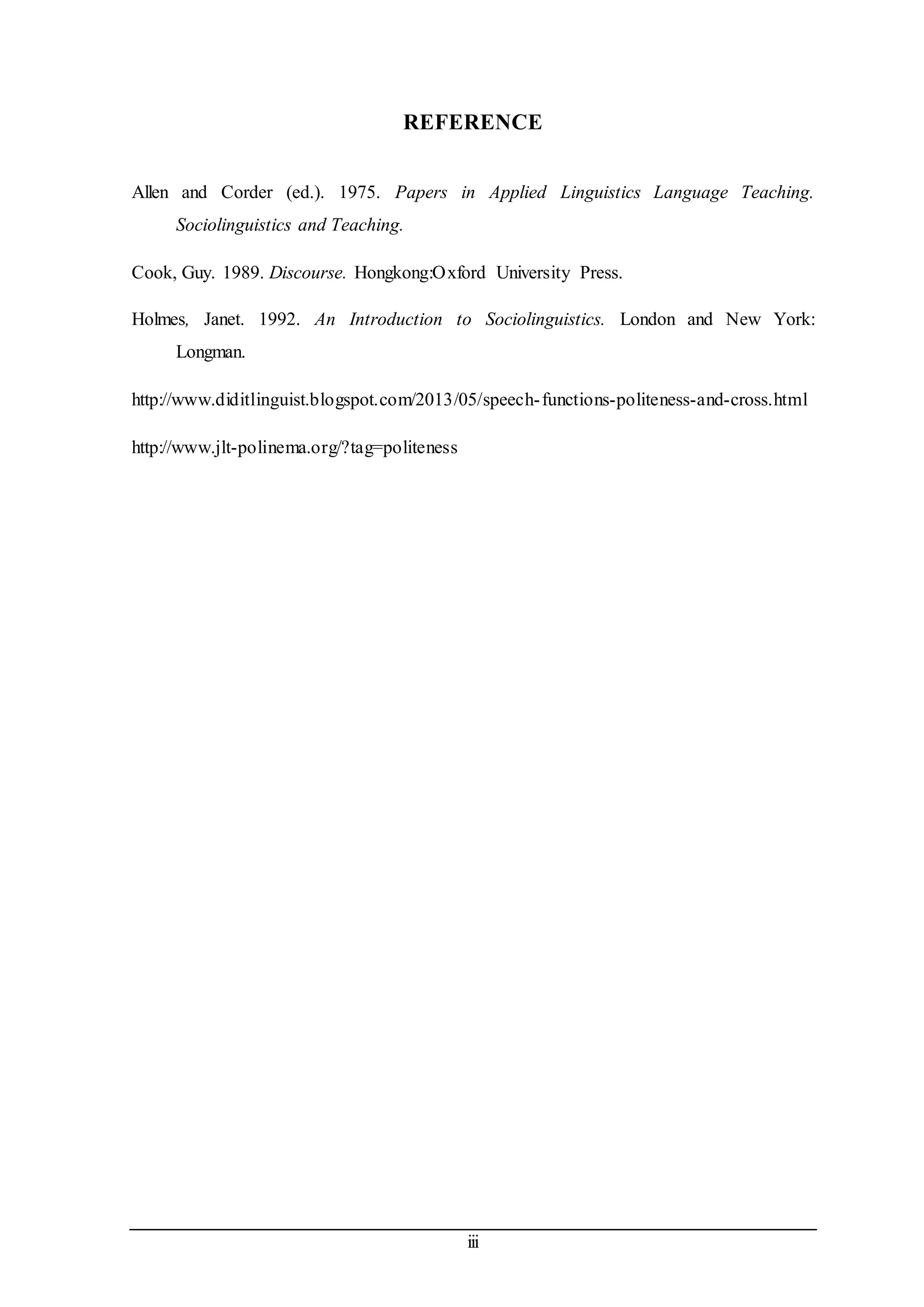
REFERENCE 
Allen and Corder (ed.). 1975. Papers in Applied Linguistics Language Teaching. 
iii 
Sociolinguistics and Teaching. 
Cook, Guy. 1989. Discourse. Hongkong:Oxford University Press. 
Holmes, Janet. 1992. An Introduction to Sociolinguistics. London and New York: 
Longman. 
http://www.diditlinguist.blogspot.com/2013/05/speech- functions-politeness-and-cross.html 
http://www.jlt-polinema.org/?tag=politeness

Makalah sociolinguistic speech function

  • 1.
    PAPER SOCIOLINGUISTIC “SpeechFunction” Written by: Niken Nabella (11321158/6E) Siti Purwaningsih (11321159/6E) Ryani Ningsih (11321160/6E) Kristina Saras (11321161/6E) DEPARTEMENT OF ENGLISH TEACHING FACULTY OF LETTERS AND ARTS EDUCATION IKIP PGRI MADIUN 2014
  • 2.
    PREFACE Praise toAllah SWT who has given taufik, guidance, and inayah so that we can still move as usual as well as the authors, so we can complete this paper entitled "speech function". This paper discusses about the function and the purpose of speech. This paper is organized so that readers can add insight or expand existing knowledge about young learner teacher that we present in this paper with an arrangement of a concise, easy to read and easy to understand. The writers also wish to express many thanks to his teammates and lecture who have guided the authors in order to make authors of scientific papers in accordance with the provisions in force so that it becomes a good and right paper. Hopefully, this paper can be useful for readers and expanding horizons about the ii young learner teacher. And also the author apologizes for any shortcomings here and there of the paper's authors do. Please critiques and suggestions. Thank you Madiun, 18th Juni 2014 writer
  • 3.
    DISCUSSION SPEECH FUNCTION Language serves a range of functions. It is usually adjusted the speech to suit the social context of speech. The language we talk to a child may be different from the language we talk to our customer or colleague though the purpose is the same. The different purposes of talk can also affect the form of language and the variety of ways. Why do we say the same thing in different ways? The answers to the question basically imply the speech functions. 2 The Function of Speech Dialog 1 : Boss : Good morning, Sue. Lovely day. Secretary : Yes, it is beautiful. Makes you wonder what we are doing here, doesn’t it? Boss : Mm, that’s right. Look I wonder if you could possibly sort this lot out by ten. I need them for a meeting. Secretary : Yes, sure. No problem. Boss : Thanks. That’s great. This dialogue is typical of many everyday interactions in that it serves both an affective (or social), and referential (or informative) function. The initial greetings and comments on the weather serve a social function; they establish contact between the two participants. The exchange then moves on to become more information-oriented or referential in function. There are a number of ways of categorising the functions of speech. The following list has proved a useful one in sociolinguistic research. 1. Expressive utterances Expressive utterances express the speakers’ feelings. This function serves the declaration of a speaker’s ambiance. It used to express personal feelings, thoughts, ideas and opinions, with different choice words, intonation, etc. These expressions are submissive to social factors and to the nature of the expression as negative or positive. In Indonesian communication, expression is used to keep up social relationship. When someone is meeting a friend or someone he/she is familiar with, he/she will greet him/her to make sure “here, I am your friend or your neighbor”.
  • 4.
    The following arethe form of utterances that serve expressive function: – I’m happy today. (positive expression) – I am afraid. (negative expression) – I'm very gloomy tonight. (negative expression) – I'm feeling very good today. (positive expression) – I’m feeling great today. (positive expression) 3 2. Directive Utterances Directive utterances attempt to get someone to do something. In Indonesian communication, directive function can be articulated by imperative sentences, interrogative sentences as well as declarative sentences. Orders and commands are normally expressed in imperative form. Directives are concerned with getting people to do things which express directive force vary in strength. We came to sit down, for instance, by suggesting or inviting or ordering or commanding them to sit down. Orders and speech act which are generally expressed in imperative to get people to do something tend to use interrogatives are following examples illustrate. Sit down IMPERRATIVE You sit down You IMPERRATIVE Could you sit down? INTERROGATIVE with modal verb Sit down, will you? INTERROGATIVE with tag Won’t you sit down? INTERROGATIVE with negative modal I want you to sit down DECLARATIVE I’d like you to sit down DECLARATIVE You’d be more comfortable sitting down DECLARATIVE It’d be better you to sit down DECLARATIVE The list could go on and on. There are many way in directive. And although we can say that in general declaratives are more polite than imperatives, a good intonation, tone of voice and context. A gentle sit down more polite than a thundered I want you all sitting down now (a) in example 1 will be considered normal, while (b) as sarcastic. Example 1: a. Box of matches b. Could you possibly give me a box of matches How do people decide which form to use in a particular of the social factors have been suggested between participants, their relatives status, and the form (the
  • 5.
    social dimensions whichwere discussed. People who are close friends or intimates use instance. The utterances in example 2 were all produced were (almost!) all said without 4 rancour, and caused no offence. Example 2: (a) Roll over. (b) Shut up you fool. (c) Set the table, Robbie. (d) Wash your hands for tea children. (e) Turn that blessed radio down. Where status differences are clearly marked and accepted, superiors tends to use imperative to subordinates. Teachers often use imperatives to pupils, for instance. Example 3: (a) Open your book at page 32 (b) Shut the door (c) Stop talking please Teacher can use very direct expression of their mea high status relative to their pupils. On the other hands, options in a role relationship such as teacher-pupil are so can also use minimal explicit forms and be confident they will be interpreted accurately as directive. Example 4: (a) Blackboard! (‘Clean the blackboard’) (b) Bus people! (‘ those who get the school bus should now leave’) (c) I hear talking (‘stop talking’) So clear-cut are the rules for classroom behaviour that it has been suggested that pupils operate with a very general rule of the form ‘Scan every utterance of the teacher for directive intent’. In the other words pupils consider everything the teacher says as a possible directive. New entrant Jason in example 5, however, has obviously not learned this rule yet, so his teacher’s attempts to gently direct him to the appropriate behaviour are initially far too indirect. Example 5: Teacher : Jason, why have you got your raincoat it’s raining Jason : (smile) Teacher : it’s not raining inside Jason : (no response)
  • 6.
    Teacher : whatare you going to do about it? Jason : (no response) Teacher : go and hang it up Formality and status may be very relevant in choosing an appropriate directive form. At a graduation ceremony the University Chancellor gave the Vice-Chancellor the directive in example 6. Example 6: I now call on the Vice-Chancellor to read the citation for distinguished guest. The required action (‘read the citation’) is embedded as a subordinate clause in the second part of the declarative sentence, and this is a common grammatical means of expressing directives less directly and more politely. A study which looked at the directives used between medical professionals in a meeting also demonstrated the importance of relative status in determining the form of directive in a formal setting. Imperative were over whelming used by superiors to those of subordinate status. The only imperative used ‘upwards’ were greeted with laughter, and regards as humorous because they so clearly flouted this sociolinguistic rule. The general rule was that directives upwards were couched as indirect forms, such as modal interrogative as in example 7(a). Others took the form of hints as illustrated by the exchange in example 7(b). Example 7: Medical professional of leave status to person of higher status (a) Could you ring his another and find out ? (b) A. We’ve get a referral from Dr. T. He’s your neighbour Jody. 5 B. Ok I’ll take him. The relevance of status in a less formal context was nicely demonstrated in a study of children’s directive in New Zealand child-care centre. Relative status in the centre was determined by age and size. The oldest, biggest and strongest child used by far the most imperatives, while attempts by the other children to get him to cooperate involved less direct forms such I think I need that note and could I borrow that? Another factor which is relevant to the form of a directive is the routineness or reasonableness of the task. A boss might produce utterance (a) in example 8 to his mechanic when giving her routine task. If, however, he is expecting her to do
  • 7.
    something-out of theordinary or especially difficult, he is far more likely to use a less direct form such as (b) or even a hint such as (c). Example 8: (a) Get those brake pads in by 5 o’clock Sue. That car’s needed first thing in 6 the morning. (b) Could you stay a bit later tonight, do you think, and finish this job? (c) That job’s taking longer than we predicted. I don’t know what we’ll do if it isn’t ready for tomorrow. In general, imperative are used between people who know each other well to subordinates. Interrogative and declarative, including hints, used between those are less familiar with each other, or where there are some reason to feel the task being requested is not routine. But there are many qualifications to those generalizations. Hints may be used for humorous effect between people who are close friends, as example 9 illustrates. Example 9: (a) To someone blocking the light out. You make a better door than a window. (b) Mother to teenage son. I’m not sure that a couple of smelly socks in the middle of the floor can be beaten as a centre piece for our dinner party. What do you think, Tim? It has also been noted that girls and women tend to favour more polite and less direct form of directives than males - at least in the contexts investigated. Those are example of children’s utterances to each other in a play centre. Example 10: (a) Tom : Give me that. I need it now. (b) Seymour : Get off that car. (c) Grant : Get out of my house. (d) Maria : You finished with that rolling pin now? (e) Lisa : My turn now eh? (f) Meg : it’s time for tea so you’ll have to go home. The form used by the girl are already less direct another those used by the boys. In a study of doctors’ directives patients, male doctors typically used imperative (e.g. eat more fruit), while female doctors used less direct forms (e.g. maybe you could try fresh fruits for dessert). There are many other influences on the form of directives: the addressee’s gender is significant, for instance. Women not only use less direct form of directive, they also receive less direct forms. Relative power orstatus, and social
  • 8.
    distance clearly influencethe form of directives, as some of the examples above have demonstrated. There is not space to illustrate all the possible contextual influences, but you might find it interesting to investigate some of them for yourself in your own community. Not all communities follow the patterns I have described. In a study of a community of lower-class male migrant agricultural workers on the eastern seaboard of the United States, for instance, it was found that almost all the directives took the form of imperatives regardless of differences in social status, social distance, the presence of outsiders and the setting or location. Example 11: a. Stay away from them social workers b. Well if you don’t want to work, get out of the field c. Grab that there hand truck d. Now get to it e. Overseer assigns the farm worker the wrong to hoe Farm worker: go to hell. Two times you have told me what to do each time it’s been wrong. I’m staying in this row. You put somebody else there. The researchers in this study considered that the insecure and unpleasant work conditions of the participants accounted for the antagonism evident in many of their social interactions. Relations between the workers and their bosses were characterised by mistrust and tension on both sides. Their language reflected these social relationships in the great majority of directives, whether from bosses to worker or vice versa, took the form of unmodified imperatives. Clearly getting what you want from someone else requires knowledge of the rules for expressing yourself appropriately in the relevant socio-cultural context. A successful outcome can reflect a real sociolinguistic accomplishment. And even at the age of 3 some children have worked out that a threat can sometimes be more effective than any directive. The following example illustrates the sociolinguistic skills of both parties to this exchange. Example 12: Mischa : Can I borrow your biscuit? Jake : No, it’s my lunch Mischa : I won’t be your friend if you won’t let me Jake : OK (Jake gives her the biscuit but looks miserable.) 7
  • 9.
    Mischa : Here,it’s OK you have it Jake : No. You won’t be my friend (Mischa starting eating.) Jake : My turn (Mischa gives it back and they then finish the biscuit taking.) 8 3. Referential Utterances Referential utterances provide information. Politeness in these utterances can be seen from the substance of cooperative principles – quality, quantity, relation and manner. The value of politeness, in the same way, a great deal depends on intonation, tone of voice and context too. The following utterances are instances for the referential function: – The second presenter will be Mrs. Hanna. – Make up speaking class will be held on Monday at 1 pm. – The capital city of Indonesia is Jakarta. – We will leave for Jakarta tomorrow at 9 a.m. – Our baby always wakes up at 3 a.m. 4. Metalinguistic utterances Metalinguistic utterances comment on language itself. Holmes (1992: 286) gives the example of this function is like ‘Hegemony’ is not a common word. While Cripper and Widdowson in Allen and Corder (ed.) (1975: 1997) explain that the utterances of this kind focus on the code or the language. The principle purpose of metalinguistic is to make sure that the addressee understands the meaning of the code which the addresser is using. In Indonesian communication, we often find metalinguistic function of speech in scientific discussion. The following utterances are instances for the referential function: – ‘Nat’ has to be added by affixes. – Poetic art is the art of writing a literary work. – Stylistics is science about language style in a literary work. 5. Poetic utterances Poetic utterances focus on aesthetic features of language. This speech function is rarely used in daily conversation. In special occasion, like in the ceremony of
  • 10.
    engagement in NorthSumatra community, anyway, poetic function is commonly used. RRI Tanjung Pinang broadcasts a special program named Serumpun Melayu that is this program dealing with the reproduction of Pantun Melayu on air (Srinthli, 2005). The following is the utterances of the broadcaster, Wan Abidah: 9 Palm tree is struck by lightning It falls over kedondong tree Don’t think of losing or winning The important thing is the performance Poetic utterances may be found in daily conversation, but it seldom happens in Javanese community. When it happens, the purpose is to raise a humorous effect between people who are close friends. Skinny cat takes a bath on a board Nameboard made of jati tree Skinny body is not because of lack of food But thinking of the sweet heart 6. Phatic utterances Phatic utterances express solidarity and empathy with other. This speech function always exists in all community, but the form is different. In other words, this expression is culturally linked. (I). Where are you going? (Mau kemana?) (II). Please come in. (Mari singgah dulu.) Utterance (I) is Indonesian distinctive expression that often make western people offended. For English community “Where are you going?” is such a sensitive greeting. This is too private question that someone who is greeted that way will be feeling spied and unsecured. That is why the possible answer to this question may be “It is none of your business”. On the other hand, in Indonesian daily social interaction, “where are you going” is a part of communicative strategy for breaking the ice. This expression is commonly used to start a conversation or to show one’s care of others. This greeting may become a ‘lip-service’ that is to show “I am your friend and I care of you”. This is apparently a form of phatic expression in Indonesian vernacular.
  • 11.
    We often hear(II) “Please, come in or mari singgah dulu” in Indonesian daily communication and it serves a social function too. The offering is usually done by a speaker to someone he/she is familiar with – someone to his/her neighbors. Sometimes someone offers his friend or his neighbor to drop in his/her house. He offers something, but he actually does not mean so. He just wants to demonstrate utterly that “you are my friend”. 10 (III). Let’s have a meal. (Mari makan.) It happens very often in a canteen when a person is about to eat his/her meal and his/her friend comes then he/she will say (III) “Let’s have a meal or mari makan”. The statement of offering food is sometimes merely a lip-service. The speaker does not intend to share his food with the addressee. What he has in mind is that “well you are my friend”‘. Cook (1989) calls this “the phatic function of the language”. As this expression is only a lip service, so the addressee usually applies the same strategy, namely flouting co-operative principle, by uttering “Terimakasih, saya baru saja makan”. Meanwhile, accepting the offer sometimes can cause embracement because the food may not be enough for two persons. Conversely, when two persons are very close friends, the acceptance of the proposal is reasonable. Though I have provided a very brief indication of what the function labels mean, and an example of each in the form of a single utterance, it is important to remember that any utterance may in fact express more than one function, and any function may be expressed by a stretch of discourse which doesn’t exactly with an utterance. The first three functions are recognized by many linguists, though the precise labels they are given may differ. They seem to be very fundamental functions of language, perhaps because they derive from the basic components of any interaction- the speaker (expressive), the addressee (directive) and the message (referential). The phatic function is, however, equally important from a sociolinguistic perspective. Phatic communication conveys an affective or social message rather than a referential one. One of the insights provided by sociolinguists has been precisely that language is not simply used to convey referential information, but also expresses information about social relationships. The list of functions provided above is not definitive or all-encompassing other speech function categories have been identified often arising from the particular interests of a researcher or the focus of a particular study.
  • 12.
    Other researchers haveadded categories to deal with promises and threats (commissives), and with marriage vows, bets, and declarations of war (performatives or declarations). Each category has its distinctive characteristic. The precise linguistic form used is crucial to bets. Similarly the precise words uttered at particular points are crucial in a wedding ceremony. So it is possible to add a variety of further categories which may prove useful and illuminating for particular analyses. 11
  • 13.
    CONCLUSION Language servesa range of functions. It is usually adjusted the speech to suit the social context of speech. There are a number of ways of categorizing the functions of speech:  Expressive utterances express the speaker’s feelings, e.g. I’m feeling great today.  Directive utterances used to get someone to do something, e.g. clear the table.  Referential utterances provide information, e.g. At the third stroke it will be three 12 o’clock precisely.  Metalinguistic utterances comment on language itself, e.g. ‘hegemony’ is not a common word.  Poetic utterances focus on aesthetic features of language, e.g. a poem, an ear-catching motto, a rhyme, peter piper picked a peek of pickled peppers.  Phatic utterances express solidarity and empathy with others, e.g. Hi, how are you, lovely day isn’t it? Any utterances may in fact express more than one function, and any function may be expressed by a stretch of discourse which doesn’t exactly coincide with an utterance. They seem to be very fundamental functions of language, perhaps because they derive from the basic components of any interaction- the speaker (expressive), the addressee (directive) and the message (referential).
  • 14.
    REFERENCE Allen andCorder (ed.). 1975. Papers in Applied Linguistics Language Teaching. iii Sociolinguistics and Teaching. Cook, Guy. 1989. Discourse. Hongkong:Oxford University Press. Holmes, Janet. 1992. An Introduction to Sociolinguistics. London and New York: Longman. http://www.diditlinguist.blogspot.com/2013/05/speech- functions-politeness-and-cross.html http://www.jlt-polinema.org/?tag=politeness