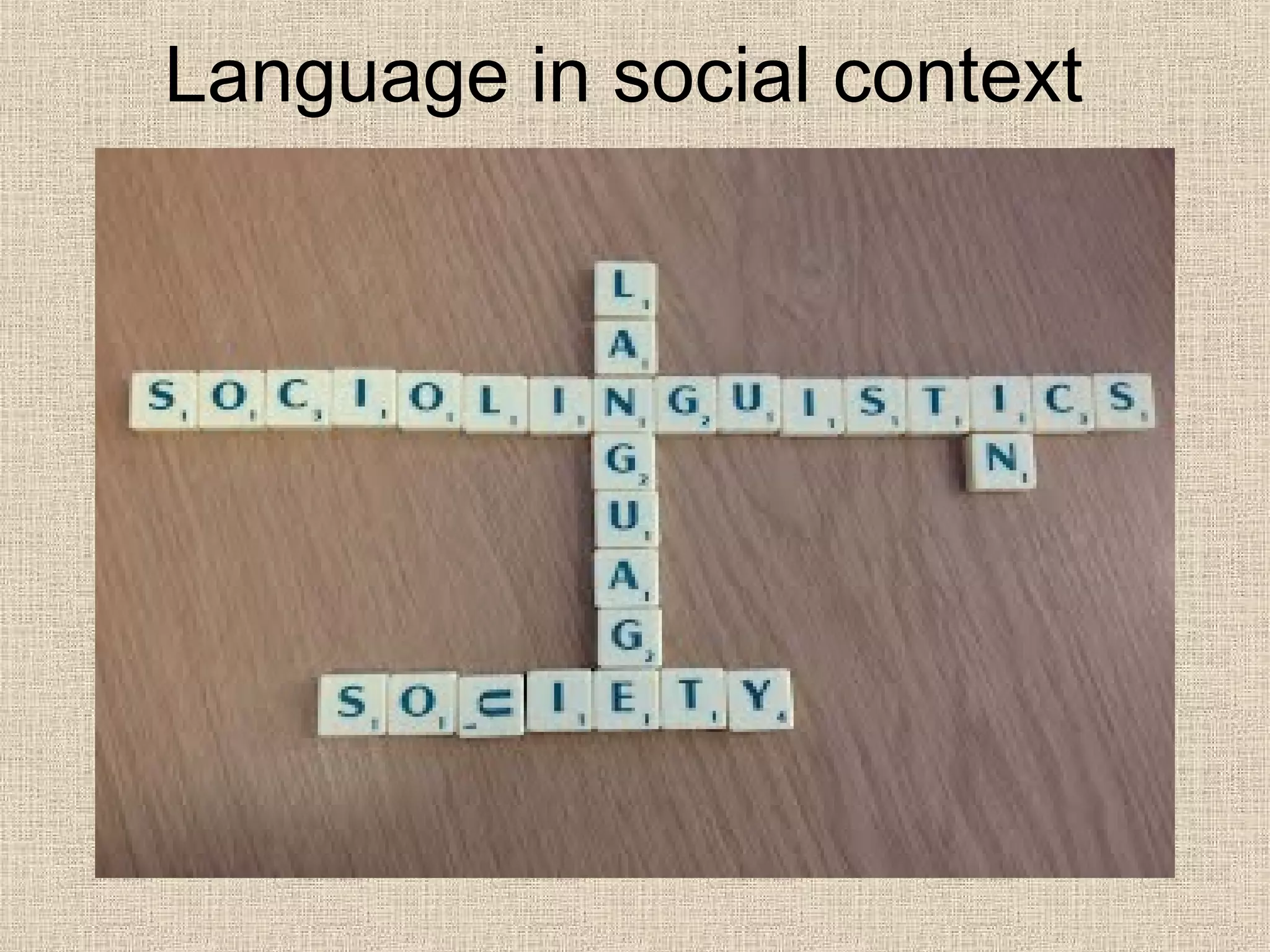
Language in social context
Speech Community 
• Members share a particular language 
(or a variety of language) for the 
appropriate use of their language in 
social context and that these 
speakers be distinguished from other 
comparable groups by similar 
sociolinguistic criteria. (Katamba and 
Southerland n.d.)
Speech Community 
• Shared language use (Lyons 1970) 
• Frequency of interaction by a group of people 
(Bloomfield 1933; Hockett 1958; Gumperz 
1962) 
• Shared rules of speaking and interpretations of 
speech performance (Hymes 1972) 
• Shared attitudes and values regarding 
language forms and language use (Labov 
1972)
Speech Variety 
-label given to that language (or form of 
language) used by any group of speakers. 
Four types of Speech varieties: 
Standard language 
Social Dialect / Sociolect 
Regional Varieties 
Registers
STANDARD LANGUAGE 
• variety that is selected and promoted by 
either authorities or other social institutions, 
such as schools or media. Standard varieties 
are more prestigious than other. 
• Employed by the government and media, 
used and taught in education institutions
SOCIAL DIALECT / SOCIOLECT 
• dialect has to do with separation brought 
about by different social conditions. 
• the way we speak that is individual to a social 
group. It may have features that cross the 
linguistic methods e.g. lexical choice, 
grammar, phonology (pronunciation). Most 
people use several different sociolects e.g. 
occupational groups, friendship groups, family 
groups, cultural groups etc.
REGIONAL VARIETY 
• speech characteristic of a region 
• a variety of a language spoken in a 
particular area of a country. 
• is the distinct form of a language 
spoken in a certain geographical 
area.
REGISTER 
• a variety of language defined 
according to its use in a social 
situation. 
• functional speech variety 
• associated with specific contexts or 
situations and with specific functions 
of language (Zwicky, A 1982)
TYPES 
• Formal 
–One way communications with no 
interruption 
–Used in impersonal , formal settings 
–Follows a complete format (i.e. 
compete sentences, more complex 
syntax & specific word usages) 
–Often used to show respect
• Casual 
–Informal language, ellipsis and 
slangs are common 
–no background information 
–“group” language 
–Interruptions are common
• Technical 
–Specialized variety of language 
used in specialized situations 
–“jargons” 
–E.g. airline pilots use to 
communicate with air traffic 
controllers 
• Simplified 
–Motherese 
–Baby talk
Social Differentiation of Language 
-refers to correlation between variation in language uses 
and a speaker’s membership in various social group. 
Social Stratification 
Correlation of differences in how people speak with 
their membership in various social groups 
Social Correlate: 
SOCIO-ECONOMIC STATUS (SES) 
Vertical Variation 
SES is equated with the level of language use.
Studying Social Variation 
Social Network Analysis 
– Provides a methodology for studying the 
interaction between patterns of maintenance 
and patterns of change. 
– Basic Assumption : to understand how 
language changes are adopted by 
communities, we must also take account of 
patterns of resistance to change.
Social network 
• sample 
C:UserssweetDocumentsSOCIAL NETWORK SAMPLE

Language in social context revised 2012

  • 1.
  • 2.
    Speech Community •Members share a particular language (or a variety of language) for the appropriate use of their language in social context and that these speakers be distinguished from other comparable groups by similar sociolinguistic criteria. (Katamba and Southerland n.d.)
  • 3.
    Speech Community •Shared language use (Lyons 1970) • Frequency of interaction by a group of people (Bloomfield 1933; Hockett 1958; Gumperz 1962) • Shared rules of speaking and interpretations of speech performance (Hymes 1972) • Shared attitudes and values regarding language forms and language use (Labov 1972)
  • 4.
    Speech Variety -labelgiven to that language (or form of language) used by any group of speakers. Four types of Speech varieties: Standard language Social Dialect / Sociolect Regional Varieties Registers
  • 5.
    STANDARD LANGUAGE •variety that is selected and promoted by either authorities or other social institutions, such as schools or media. Standard varieties are more prestigious than other. • Employed by the government and media, used and taught in education institutions
  • 6.
    SOCIAL DIALECT /SOCIOLECT • dialect has to do with separation brought about by different social conditions. • the way we speak that is individual to a social group. It may have features that cross the linguistic methods e.g. lexical choice, grammar, phonology (pronunciation). Most people use several different sociolects e.g. occupational groups, friendship groups, family groups, cultural groups etc.
  • 7.
    REGIONAL VARIETY •speech characteristic of a region • a variety of a language spoken in a particular area of a country. • is the distinct form of a language spoken in a certain geographical area.
  • 8.
    REGISTER • avariety of language defined according to its use in a social situation. • functional speech variety • associated with specific contexts or situations and with specific functions of language (Zwicky, A 1982)
  • 9.
    TYPES • Formal –One way communications with no interruption –Used in impersonal , formal settings –Follows a complete format (i.e. compete sentences, more complex syntax & specific word usages) –Often used to show respect
  • 10.
    • Casual –Informallanguage, ellipsis and slangs are common –no background information –“group” language –Interruptions are common
  • 11.
    • Technical –Specializedvariety of language used in specialized situations –“jargons” –E.g. airline pilots use to communicate with air traffic controllers • Simplified –Motherese –Baby talk
  • 12.
    Social Differentiation ofLanguage -refers to correlation between variation in language uses and a speaker’s membership in various social group. Social Stratification Correlation of differences in how people speak with their membership in various social groups Social Correlate: SOCIO-ECONOMIC STATUS (SES) Vertical Variation SES is equated with the level of language use.
  • 13.
    Studying Social Variation Social Network Analysis – Provides a methodology for studying the interaction between patterns of maintenance and patterns of change. – Basic Assumption : to understand how language changes are adopted by communities, we must also take account of patterns of resistance to change.
  • 14.
    Social network •sample C:UserssweetDocumentsSOCIAL NETWORK SAMPLE