Case Studies of major linguists
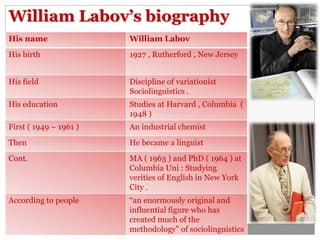
William Labov’s biography 
His name William Labov 
His birth 1927 , Rutherford , New Jersey 
Discipline of variationist 
Sociolinguistics . 
His field 
Studies at Harvard , Columbia ( 
1948 ) 
His education 
First ( 1949 – 1961 ) An industrial chemist 
Then He became a linguist 
MA ( 1963 ) and PhD ( 1964 ) at 
Columbia Uni : Studying 
verities of English in New York 
City . 
Cont. 
“an enormously original and 
influential figure who has 
created much of the 
methodology" of sociolinguistics 
According to people
Cont. 
 He became a professor later in ( 1971 ) at University 
of Pennsylvania . 
 Then he became a director of the university's 
Linguistics Laboratory (1977).
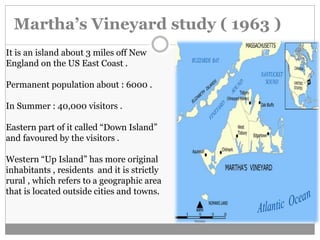
Martha’s Vineyard study ( 1963 ) 
It is an island about 3 miles off New 
England on the US East Coast . 
Permanent population about : 6000 . 
In Summer : 40,000 visitors . 
Eastern part of it called “Down Island” 
and favoured by the visitors . 
Western “Up Island” has more original 
inhabitants , residents and it is strictly 
rural , which refers to a geographic area 
that is located outside cities and towns.
Martha’s Vineyard demographics 
 The permanent population consists of Yankees 
( descendants of early settlers ) . 
 Portuguese ( recent immigrants ) and native 
Americans , especially around Chilmark , because of 
the fish industry : 2.5% of population that still 
involved in fishing . 
 Other islanders considered as independent , skillful , 
physically strong .
Labov’s study 
 He focused on pronunciation of /au/ : out , house , how 
and /ai/ : while , pie , tie . 
 He noticed that locals had a tendency to pronounce these 
diphthongs with a more central start point 
( əi , əa ) . 
 He collected date by interviewing 69 informants , talking 
randomly by using words with these vowels . 
 He got some recordings of school pupils reading text. 
 He brought data from 30’s of Linguistic Atlas of New 
England . 
He said about the “Degree of centralization” that is fairly 
subjective .
Initial results : 
 The usage of the centralized vowel against various 
factors : 
 Age. 
 Population group. 
 Occupation. 
 Location .
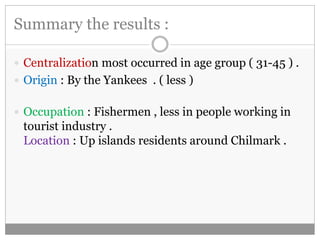
Summary the results : 
 Centralization most occurred in age group ( 31-45 ) . 
 Origin : By the Yankees . ( less ) 
 Occupation : Fishermen , less in people working in 
tourist industry . 
Location : Up islands residents around Chilmark .
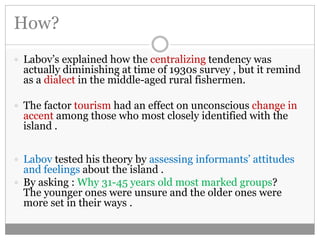
How? 
 Labov’s explained how the centralizing tendency was 
actually diminishing at time of 1930s survey , but it remind 
as a dialect in the middle-aged rural fishermen. 
 The factor tourism had an effect on unconscious change in 
accent among those who most closely identified with the 
island . 
 Labov tested his theory by assessing informants’ attitudes 
and feelings about the island . 
 By asking : Why 31-45 years old most marked groups? 
The younger ones were unsure and the older ones were 
more set in their ways .
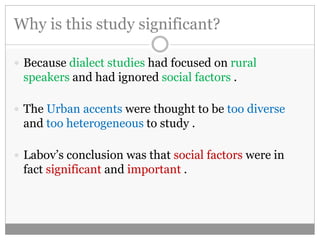
Why is this study significant? 
 Because dialect studies had focused on rural 
speakers and had ignored social factors . 
 The Urban accents were thought to be too diverse 
and too heterogeneous to study . 
 Labov’s conclusion was that social factors were in 
fact significant and important .
Social Stratification of (r) in 
New York City
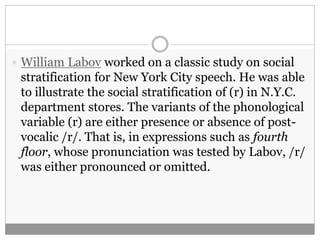
 William Labov worked on a classic study on social 
stratification for New York City speech. He was able 
to illustrate the social stratification of (r) in N.Y.C. 
department stores. The variants of the phonological 
variable (r) are either presence or absence of post-vocalic 
/r/. That is, in expressions such as fourth 
floor, whose pronunciation was tested by Labov, /r/ 
was either pronounced or omitted.
 . Historically, New York City speech had been 
known as r-less, i.e. it featured a non-rhotic accent. 
However, the general attitude towards this accent 
feature was rather negative and the pronunciation 
of /r/ seems to have been reintroduced to New 
York City speech. Labov found that in New York 
City the pronunciation of /r/ occurred and its 
frequency of use depended on the speakers’ 
membership to particular socioeconomic status 
groups, i.e. social classes
Three Large 
Department Stores 
 Differential ranking 
 Location 
 Advertising 
 Price of goods and emphasis on price 
 Physical plant 
 Saks Fifth Avenue (Highest) 
 Macy’s (Middle) 
 S. Klein (Lowest)
Gathering Data Through Observation 
 Tape recorded interviews 
 Speech is formal 
 Alternatives 
 Natural social context 
 No explicit observation
Overall Stratification of (r) 
 Three Categories 
 All (r-1) 
 Some (r-1) 
 No (r-1) 
 Results 
 62% Saks 
 51% Macy’s 
 20% Kleins 
•Emphatic Results 
•(r-1) is most appropriate for emphatic speech 
•Linguistic security
Result 
 The results illustrated that (r) in New York City was 
stratified by class. The pronunciation of /r/ 
depended on the social-class of the employees: 
 Those with higher socioeconomic status pronounced 
/r/ more frequently than those with lower 
socioeconomic status.
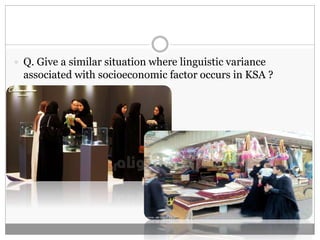
 Q. Give a similar situation where linguistic variance 
associated with socioeconomic factor occurs in KSA ?
Peter Trudgill 
Trudgill Biography: 
 Born in 7 November 1943. 
 He is a sociolinguist, academic and author. 
 He was born in Norwich, England, where he 
attended the City of Norwich School from 
1955. 
 Trudgill studied modern languages at King’s 
Colllege, Cambridge and obtained a PhD 
from the University of Edinburgh . 
 He become a professor of sociolinguistics at 
the University of Essex and retires in 2005. 
 Norwich speech was studied by Peter 
Trudgill in the 1970s to find out how and why 
people's ways of speaking varied.
Trudgill studies 
 One of the variables Trudgill studied was the final consonant in words 
like walking, running. 
 For Example: In standard British English, the sound spelled-ng is a 
velar nasal. 
 In Norwich,however, the pronunciation waikin', talkin' is frequently 
heard. 
 Trudgill notes that this feature is not unique to Norwich: 
 "nearly everywhere in the Eng- speaking world we find this alternation 
between higher-class ̸formal ng and lower class ̸informal n. it goes back 
to fact that in Old English (and later) there where two forms, a gerund 
ending in – ing ( walking is good for you) and a present participle ending 
in – end (he was walking). The –end form was the ancestor of –n' and – 
ing (obviously) of –ing. 
 The two merged – though the storing out of the two forms in terms of 
prestige and "correctness" is something which occurred in the last 300 
years. The famous "hunrin' shootin' of upper class Edwardians shows 
just how recent this storing out has been.
Trudgill’s study discovered the following 
In all social classes, the more careful the speech, the more 
likely people were say walking rather than walkin'. 
The proportion of walkin' type forms was higher in lower 
social classes. 
The nonstandard –in' forms occurred much more often in 
men's speech than in women's, and this was true for all 
social classes. 
When women were questioned about what they thought 
they were saying, they tended to say they used the standard 
–ing forms more often than they really did. 
When men were questioned about what they thought they 
were saying, they tended to say they used the nonstandard 
–in' forms more often than they really did.
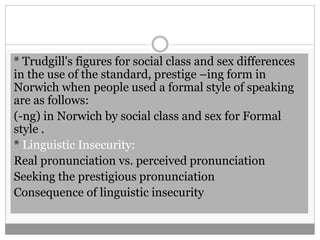
* Trudgill's figures for social class and sex differences 
in the use of the standard, prestige –ing form in 
Norwich when people used a formal style of speaking 
are as follows: 
(-ng) in Norwich by social class and sex for Formal 
style . 
* Linguistic Insecurity: 
Real pronunciation vs. perceived pronunciation 
Seeking the prestigious pronunciation 
Consequence of linguistic insecurity
More studied: 
Prestigious pronunciations: 
Tune, student, music 
These words have variants in Norwich: ̸ ju: ̸ et ̸ u: ̸ 
̸ tju:n̸ (considered more prestigious) 
̸ tu:n̸ (considered less prestigious)
Two steps in this study: 
 Trudgill interpretation (1) 
Women: 
are more preoccupied with the desire to adopt what is promoted as a more socially 
acceptable behavior, in this case, language. 
" women are more likely to have social class aspirations than men" 
Men: 
Do not tend to desire to adopt what is promoted as a more socially acceptable 
behavior, in this case, language. 
 Trudgill interpretation (2): 
Linguistic security vs. insecurity. 
The anxiety experienced by speakers and writers who believe that their use of 
language does not conform to the principles and practices of (e.g. Standard 
English).
Case studies william labov & trudgill

Case studies william labov & trudgill

  • 1.
    Case Studies ofmajor linguists
  • 2.
    William Labov’s biography His name William Labov His birth 1927 , Rutherford , New Jersey Discipline of variationist Sociolinguistics . His field Studies at Harvard , Columbia ( 1948 ) His education First ( 1949 – 1961 ) An industrial chemist Then He became a linguist MA ( 1963 ) and PhD ( 1964 ) at Columbia Uni : Studying verities of English in New York City . Cont. “an enormously original and influential figure who has created much of the methodology" of sociolinguistics According to people
  • 3.
    Cont.  Hebecame a professor later in ( 1971 ) at University of Pennsylvania .  Then he became a director of the university's Linguistics Laboratory (1977).
  • 4.
    Martha’s Vineyard study( 1963 ) It is an island about 3 miles off New England on the US East Coast . Permanent population about : 6000 . In Summer : 40,000 visitors . Eastern part of it called “Down Island” and favoured by the visitors . Western “Up Island” has more original inhabitants , residents and it is strictly rural , which refers to a geographic area that is located outside cities and towns.
  • 5.
    Martha’s Vineyard demographics  The permanent population consists of Yankees ( descendants of early settlers ) .  Portuguese ( recent immigrants ) and native Americans , especially around Chilmark , because of the fish industry : 2.5% of population that still involved in fishing .  Other islanders considered as independent , skillful , physically strong .
  • 6.
    Labov’s study He focused on pronunciation of /au/ : out , house , how and /ai/ : while , pie , tie .  He noticed that locals had a tendency to pronounce these diphthongs with a more central start point ( əi , əa ) .  He collected date by interviewing 69 informants , talking randomly by using words with these vowels .  He got some recordings of school pupils reading text.  He brought data from 30’s of Linguistic Atlas of New England . He said about the “Degree of centralization” that is fairly subjective .
  • 7.
    Initial results :  The usage of the centralized vowel against various factors :  Age.  Population group.  Occupation.  Location .
  • 8.
    Summary the results:  Centralization most occurred in age group ( 31-45 ) .  Origin : By the Yankees . ( less )  Occupation : Fishermen , less in people working in tourist industry . Location : Up islands residents around Chilmark .
  • 9.
    How?  Labov’sexplained how the centralizing tendency was actually diminishing at time of 1930s survey , but it remind as a dialect in the middle-aged rural fishermen.  The factor tourism had an effect on unconscious change in accent among those who most closely identified with the island .  Labov tested his theory by assessing informants’ attitudes and feelings about the island .  By asking : Why 31-45 years old most marked groups? The younger ones were unsure and the older ones were more set in their ways .
  • 10.
    Why is thisstudy significant?  Because dialect studies had focused on rural speakers and had ignored social factors .  The Urban accents were thought to be too diverse and too heterogeneous to study .  Labov’s conclusion was that social factors were in fact significant and important .
  • 11.
    Social Stratification of(r) in New York City
  • 12.
     William Labovworked on a classic study on social stratification for New York City speech. He was able to illustrate the social stratification of (r) in N.Y.C. department stores. The variants of the phonological variable (r) are either presence or absence of post-vocalic /r/. That is, in expressions such as fourth floor, whose pronunciation was tested by Labov, /r/ was either pronounced or omitted.
  • 13.
     . Historically,New York City speech had been known as r-less, i.e. it featured a non-rhotic accent. However, the general attitude towards this accent feature was rather negative and the pronunciation of /r/ seems to have been reintroduced to New York City speech. Labov found that in New York City the pronunciation of /r/ occurred and its frequency of use depended on the speakers’ membership to particular socioeconomic status groups, i.e. social classes
  • 14.
    Three Large DepartmentStores  Differential ranking  Location  Advertising  Price of goods and emphasis on price  Physical plant  Saks Fifth Avenue (Highest)  Macy’s (Middle)  S. Klein (Lowest)
  • 15.
    Gathering Data ThroughObservation  Tape recorded interviews  Speech is formal  Alternatives  Natural social context  No explicit observation
  • 16.
    Overall Stratification of(r)  Three Categories  All (r-1)  Some (r-1)  No (r-1)  Results  62% Saks  51% Macy’s  20% Kleins •Emphatic Results •(r-1) is most appropriate for emphatic speech •Linguistic security
  • 18.
    Result  Theresults illustrated that (r) in New York City was stratified by class. The pronunciation of /r/ depended on the social-class of the employees:  Those with higher socioeconomic status pronounced /r/ more frequently than those with lower socioeconomic status.
  • 20.
     Q. Givea similar situation where linguistic variance associated with socioeconomic factor occurs in KSA ?
  • 21.
    Peter Trudgill TrudgillBiography:  Born in 7 November 1943.  He is a sociolinguist, academic and author.  He was born in Norwich, England, where he attended the City of Norwich School from 1955.  Trudgill studied modern languages at King’s Colllege, Cambridge and obtained a PhD from the University of Edinburgh .  He become a professor of sociolinguistics at the University of Essex and retires in 2005.  Norwich speech was studied by Peter Trudgill in the 1970s to find out how and why people's ways of speaking varied.
  • 22.
    Trudgill studies One of the variables Trudgill studied was the final consonant in words like walking, running.  For Example: In standard British English, the sound spelled-ng is a velar nasal.  In Norwich,however, the pronunciation waikin', talkin' is frequently heard.  Trudgill notes that this feature is not unique to Norwich:  "nearly everywhere in the Eng- speaking world we find this alternation between higher-class ̸formal ng and lower class ̸informal n. it goes back to fact that in Old English (and later) there where two forms, a gerund ending in – ing ( walking is good for you) and a present participle ending in – end (he was walking). The –end form was the ancestor of –n' and – ing (obviously) of –ing.  The two merged – though the storing out of the two forms in terms of prestige and "correctness" is something which occurred in the last 300 years. The famous "hunrin' shootin' of upper class Edwardians shows just how recent this storing out has been.
  • 23.
    Trudgill’s study discoveredthe following In all social classes, the more careful the speech, the more likely people were say walking rather than walkin'. The proportion of walkin' type forms was higher in lower social classes. The nonstandard –in' forms occurred much more often in men's speech than in women's, and this was true for all social classes. When women were questioned about what they thought they were saying, they tended to say they used the standard –ing forms more often than they really did. When men were questioned about what they thought they were saying, they tended to say they used the nonstandard –in' forms more often than they really did.
  • 24.
    * Trudgill's figuresfor social class and sex differences in the use of the standard, prestige –ing form in Norwich when people used a formal style of speaking are as follows: (-ng) in Norwich by social class and sex for Formal style . * Linguistic Insecurity: Real pronunciation vs. perceived pronunciation Seeking the prestigious pronunciation Consequence of linguistic insecurity
  • 25.
    More studied: Prestigiouspronunciations: Tune, student, music These words have variants in Norwich: ̸ ju: ̸ et ̸ u: ̸ ̸ tju:n̸ (considered more prestigious) ̸ tu:n̸ (considered less prestigious)
  • 26.
    Two steps inthis study:  Trudgill interpretation (1) Women: are more preoccupied with the desire to adopt what is promoted as a more socially acceptable behavior, in this case, language. " women are more likely to have social class aspirations than men" Men: Do not tend to desire to adopt what is promoted as a more socially acceptable behavior, in this case, language.  Trudgill interpretation (2): Linguistic security vs. insecurity. The anxiety experienced by speakers and writers who believe that their use of language does not conform to the principles and practices of (e.g. Standard English).