Language and
Gender By: MuhammadAhmad
Contents to be discussed:
• How to define a language?
• Gender and Its types
• GenderWords
• Gendered structured
• Gendered Speech
• Gender Interaction
• Topics of Discussion
• Gender traits
Cont…..
• How women speak?
• Men’s use of language
• Language discrimination
• References
How to define a Language?
According to Nordquist (2013), Language is a human system of
communication uses arbitrary signals, such as voice sounds, gestures, or
written symbols”.
Language is “a set (finite or infinite) of sentences, each finite in length
and constructed out of a finite set of elements” (Chomsky, 1957).
According to my point of view, language in sociolinguistics is a way of
communication that could be in the form of verbal, non-verbal or written
for better conveying of messages.
What is a Gender?
Biological or natural gender is the distinction in sex between the male
and female of each species (Yule,1996).
Grammatical gender is the distinction between masculine and feminine
such as in Spanish as `el sol` and `la luna` (Yule,1996).
On the contrary, social gender is the distinction between man and
woman in terms of social roles (Yule,1996).
Gender Words:
According toYule (1996), the word milk is translated in Sidamo language spoken in
Ethiopia, ado by man but gurda by woman.
Secondly, the word “I” is translated as ‘boku’ by men and ‘atashi’ by women in the
Japanese language (Yule,1996).
The words such as heroine and actress are the derivation of the man`s
terminologies hero and actor (Yule,1996).
Additionally, the word ‘his’ is used a general reference while speaking. For
instances, each student is required to buy his own dictionary.
Gendered Structured:
Women use higher prestige variable such as talking or I saw it, whereas men
are more likely to use lower prestige variables ,e.g. talkin’ or I seen it.
Men use 32% double negative, e.g. I don’t want none (Yule,1996).
Women are more careful, sensitive and aware of social status.
Men are more likely to be tough, strong and independent while speaking.
Gendered Speech:
Men have low pitch (effect of vibration in a vocal folds) than women.
Women use hedges more frequently, e.g. sort of , kind of etc.
Women use more tag questions such as It’s a kind of cold in here, isn’t it?
Men use the strong or assertive language, e.g. it’s too damn cold in here! or
gimme that photo.
Gender Interaction:
Women’s speech allow others to speak in a shared activity whereas men are likely
to interrupt women with 96% (Yule,1996).
Women use the back-channels ( yeah, really, hmm, oh ) in cross-gender
interaction.
Men are more likely not to pay attention to the speakers by avoiding such back-
channels (Yule,1996).
Female give priority to solidarity, building and maintaining social bonds to keep
communities together (Hudson, 1996).
Topics of Discussions:
Men are more likely to discuss about office works, politics, sports and games, e.g.
Khan’s policy, Cricket,T.V talk shows, cars, etc.
Women are more concerned about family matters, e.g. children’s education,
cuisine recipes, fashion shows, shopping, gossip etc.
Men prefer one-to-many pattern,i.e. one speaker with many listeners
(Hudson,1996).
Women tend to break large conversation into many smaller groups (Hudson,1996).
Specific traits to differ Men from Women:
MasculineTraits
Rational
Dominant
Aggressive
Handsome
Problem Solving
Mathematical
FeminineTraits
Imaginative
Supportive
Polite
Pretty
Artistic
Emotional
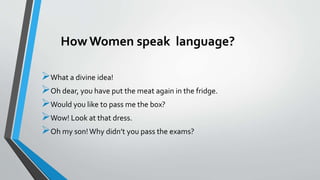
How Women speak language?
What a divine idea!
Oh dear, you have put the meat again in the fridge.
Would you like to pass me the box?
Wow! Look at that dress.
Oh my son!Why didn’t you pass the exams?
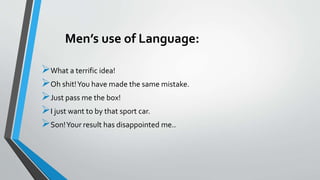
Men’s use of Language:
What a terrific idea!
Oh shit!You have made the same mistake.
Just pass me the box!
I just want to by that sport car.
Son!Your result has disappointed me..
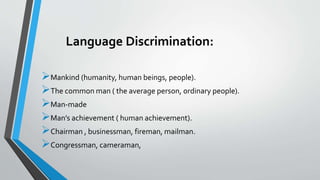
Language Discrimination:
Mankind (humanity, human beings, people).
The common man ( the average person, ordinary people).
Man-made
Man’s achievement ( human achievement).
Chairman , businessman, fireman, mailman.
Congressman, cameraman,
References:
• Hudson, R. A. (1996). Language and Gender . In R. A. Hudson,
Sociolinguistics (pp. 140-143). Cambridge: Cambridge University Press.
• Yule, G. (1996). Language and Gender. In G.Yule,The Study of Language
(2nd ed., pp. 278-280). Cambridge: Cambridge University Press.
• Trudgill, P. (1974). Language and Gender. In P.Trudgill, Sociolinguistics- An
introduction (pp. 84-90). NewYork: Penguin Books.
Cont…
• http://www.linguisticsplanet.com/chomsky-definition-of-language-and-
grammar/#:~:text=Language%20as%20conceived%20of%20by,(Chomsky
%201957%3A13).&text=Hence%2C%20once%20a%20particular%20string,c
an%20be%20classified%20as%20ungrammatical.
Language and Gender by Muhammad Ahmad

Language and Gender by Muhammad Ahmad

  • 1.
  • 2.
    Contents to bediscussed: • How to define a language? • Gender and Its types • GenderWords • Gendered structured • Gendered Speech • Gender Interaction • Topics of Discussion • Gender traits
  • 3.
    Cont….. • How womenspeak? • Men’s use of language • Language discrimination • References
  • 4.
    How to definea Language? According to Nordquist (2013), Language is a human system of communication uses arbitrary signals, such as voice sounds, gestures, or written symbols”. Language is “a set (finite or infinite) of sentences, each finite in length and constructed out of a finite set of elements” (Chomsky, 1957). According to my point of view, language in sociolinguistics is a way of communication that could be in the form of verbal, non-verbal or written for better conveying of messages.
  • 5.
    What is aGender? Biological or natural gender is the distinction in sex between the male and female of each species (Yule,1996). Grammatical gender is the distinction between masculine and feminine such as in Spanish as `el sol` and `la luna` (Yule,1996). On the contrary, social gender is the distinction between man and woman in terms of social roles (Yule,1996).
  • 6.
    Gender Words: According toYule(1996), the word milk is translated in Sidamo language spoken in Ethiopia, ado by man but gurda by woman. Secondly, the word “I” is translated as ‘boku’ by men and ‘atashi’ by women in the Japanese language (Yule,1996). The words such as heroine and actress are the derivation of the man`s terminologies hero and actor (Yule,1996). Additionally, the word ‘his’ is used a general reference while speaking. For instances, each student is required to buy his own dictionary.
  • 7.
    Gendered Structured: Women usehigher prestige variable such as talking or I saw it, whereas men are more likely to use lower prestige variables ,e.g. talkin’ or I seen it. Men use 32% double negative, e.g. I don’t want none (Yule,1996). Women are more careful, sensitive and aware of social status. Men are more likely to be tough, strong and independent while speaking.
  • 8.
    Gendered Speech: Men havelow pitch (effect of vibration in a vocal folds) than women. Women use hedges more frequently, e.g. sort of , kind of etc. Women use more tag questions such as It’s a kind of cold in here, isn’t it? Men use the strong or assertive language, e.g. it’s too damn cold in here! or gimme that photo.
  • 9.
    Gender Interaction: Women’s speechallow others to speak in a shared activity whereas men are likely to interrupt women with 96% (Yule,1996). Women use the back-channels ( yeah, really, hmm, oh ) in cross-gender interaction. Men are more likely not to pay attention to the speakers by avoiding such back- channels (Yule,1996). Female give priority to solidarity, building and maintaining social bonds to keep communities together (Hudson, 1996).
  • 10.
    Topics of Discussions: Menare more likely to discuss about office works, politics, sports and games, e.g. Khan’s policy, Cricket,T.V talk shows, cars, etc. Women are more concerned about family matters, e.g. children’s education, cuisine recipes, fashion shows, shopping, gossip etc. Men prefer one-to-many pattern,i.e. one speaker with many listeners (Hudson,1996). Women tend to break large conversation into many smaller groups (Hudson,1996).
  • 11.
    Specific traits todiffer Men from Women: MasculineTraits Rational Dominant Aggressive Handsome Problem Solving Mathematical FeminineTraits Imaginative Supportive Polite Pretty Artistic Emotional
  • 12.
    How Women speaklanguage? What a divine idea! Oh dear, you have put the meat again in the fridge. Would you like to pass me the box? Wow! Look at that dress. Oh my son!Why didn’t you pass the exams?
  • 13.
    Men’s use ofLanguage: What a terrific idea! Oh shit!You have made the same mistake. Just pass me the box! I just want to by that sport car. Son!Your result has disappointed me..
  • 14.
    Language Discrimination: Mankind (humanity,human beings, people). The common man ( the average person, ordinary people). Man-made Man’s achievement ( human achievement). Chairman , businessman, fireman, mailman. Congressman, cameraman,
  • 15.
    References: • Hudson, R.A. (1996). Language and Gender . In R. A. Hudson, Sociolinguistics (pp. 140-143). Cambridge: Cambridge University Press. • Yule, G. (1996). Language and Gender. In G.Yule,The Study of Language (2nd ed., pp. 278-280). Cambridge: Cambridge University Press. • Trudgill, P. (1974). Language and Gender. In P.Trudgill, Sociolinguistics- An introduction (pp. 84-90). NewYork: Penguin Books.
  • 16.