
SANITARY WASTE DISPOSAL
Dr. Dalia El-Shafei
Assistant professor, Community Medicine Department, Zagazig University
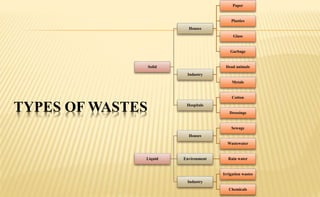
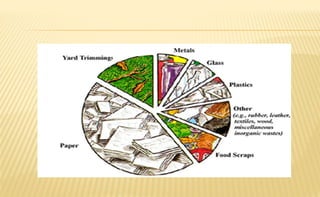
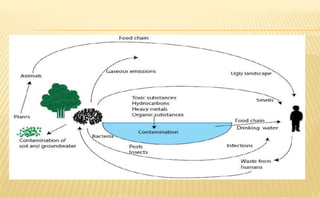
TYPES OF WASTES
Solid
Houses
Paper
Plastics
Glass
Garbage
Industry
Dead animals
Metals
Hospitals
Cotton
Dressings
Liquid
Houses
Sewage
Wastewater
Environment Rain water
Industry
Irrigation wastes
Chemicals
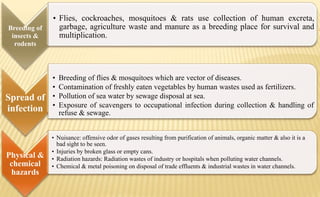
Breeding of
insects &
rodents
• Flies, cockroaches, mosquitoes & rats use collection of human excreta,
garbage, agriculture waste and manure as a breeding place for survival and
multiplication.
Spread of
infection
• Breeding of flies & mosquitoes which are vector of diseases.
• Contamination of freshly eaten vegetables by human wastes used as fertilizers.
• Pollution of sea water by sewage disposal at sea.
• Exposure of scavengers to occupational infection during collection & handling of
refuse & sewage.
Physical &
chemical
hazards
• Nuisance: offensive odor of gases resulting from purification of animals, organic matter & also it is a
bad sight to be seen.
• Injuries by broken glass or empty cans.
• Radiation hazards: Radiation wastes of industry or hospitals when polluting water channels.
• Chemical & metal poisoning on disposal of trade effluents & industrial wastes in water channels.
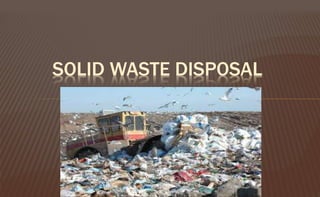
SOLID WASTE DISPOSAL
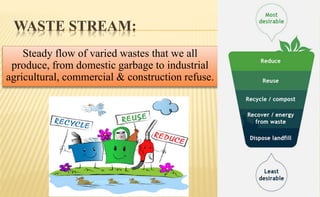
WASTE STREAM:
Steady flow of varied wastes that we all
produce, from domestic garbage to industrial
agricultural, commercial & construction refuse.
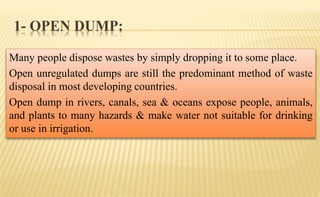
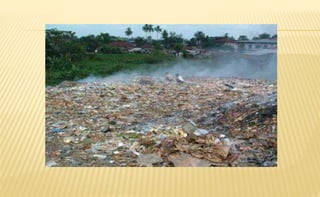
1- OPEN DUMP:
Many people dispose wastes by simply dropping it to some place.
Open unregulated dumps are still the predominant method of waste
disposal in most developing countries.
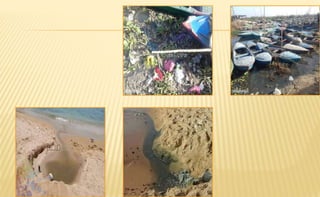
Open dump in rivers, canals, sea & oceans expose people, animals,
and plants to many hazards & make water not suitable for drinking
or use in irrigation.
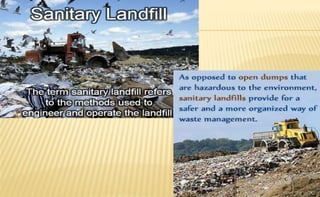
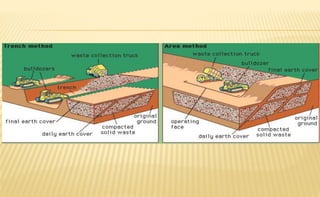
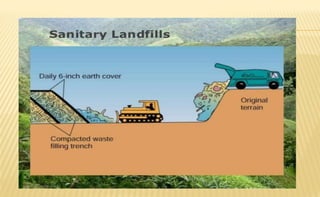
2- LANDFILLS “CONTROLLED DUMPING”
• Solid waste disposal is regulated & controlled.
• To ↓ smells & to discourage insect & rodent breading landfill operators are
required to compress the refuse & cover it every day with a layer of earth.
• Control pollution, but dirt fill takes nearly 20% of the space.
• Oils, chemical compounds and toxic metals seep to the underground
surrounding areas.
• Landfills are chosen to be high away from rivers & other water sources.
• It was inexpensive but with the ↑ in the cost of lands, construction and
maintenance it became costly.
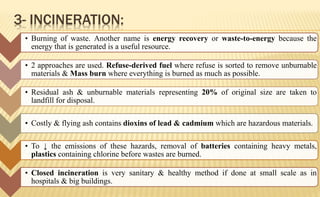
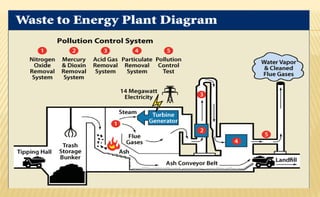
3- INCINERATION:
• Burning of waste. Another name is energy recovery or waste-to-energy because the
energy that is generated is a useful resource.
• 2 approaches are used. Refuse-derived fuel where refuse is sorted to remove unburnable
materials & Mass burn where everything is burned as much as possible.
• Residual ash & unburnable materials representing 20% of original size are taken to
landfill for disposal.
• Costly & flying ash contains dioxins of lead & cadmium which are hazardous materials.
• To ↓ the emissions of these hazards, removal of batteries containing heavy metals,
plastics containing chlorine before wastes are burned.
• Closed incineration is very sanitary & healthy method if done at small scale as in
hospitals & big buildings.
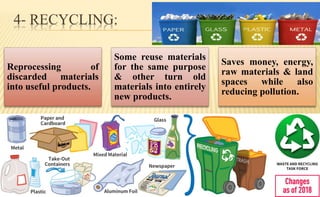
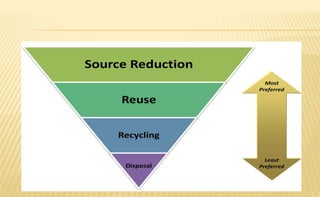
4- RECYCLING:
Reprocessing of
discarded materials
into useful products.
Some reuse materials
for the same purpose
& other turn old
materials into entirely
new products.
Saves money, energy,
raw materials & land
spaces while also
reducing pollution.
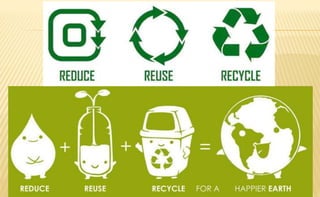
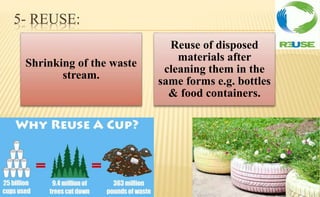
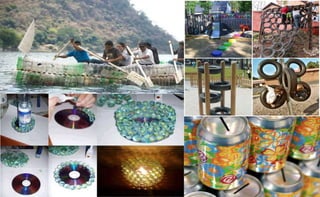
5- REUSE:
Shrinking of the waste
stream.
Reuse of disposed
materials after
cleaning them in the
same forms e.g. bottles
& food containers.
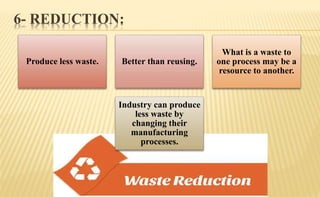
6- REDUCTION:
Produce less waste. Better than reusing.
What is a waste to
one process may be a
resource to another.
Industry can produce
less waste by
changing their
manufacturing
processes.
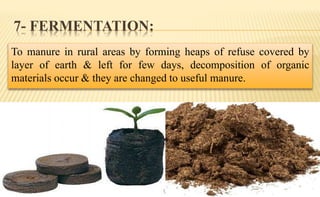
7- FERMENTATION:
To manure in rural areas by forming heaps of refuse covered by
layer of earth & left for few days, decomposition of organic
materials occur & they are changed to useful manure.
LIQUID WASTE DISPOSAL
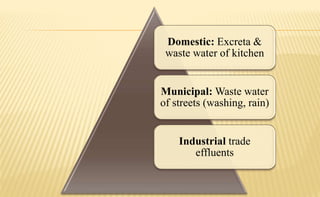
Domestic: Excreta &
waste water of kitchen
Municipal: Waste water
of streets (washing, rain)
Industrial trade
effluents
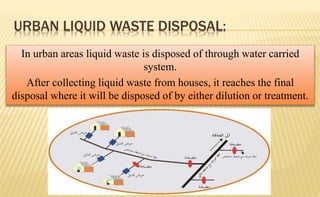
URBAN LIQUID WASTE DISPOSAL:
In urban areas liquid waste is disposed of through water carried
system.
After collecting liquid waste from houses, it reaches the final
disposal where it will be disposed of by either dilution or treatment.
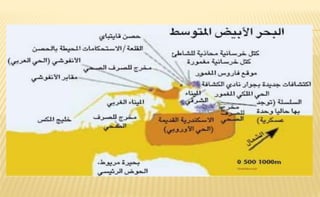
1- LIQUID WASTE DISPOSAL BY DILUTION:
Crude sewage & waste water may be taken as such, or partially
treated & disposes in coastal countries, or rarely in rivers & streams.
Potential risk to health due to the possibility of back flow to shore,
causing its pollution and causing hazards to swimmers & fishing.
Wind may carry smell back to city.
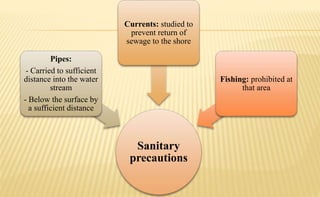
Sanitary
precautions
Pipes:
- Carried to sufficient
distance into the water
stream
- Below the surface by
a sufficient distance
Currents: studied to
prevent return of
sewage to the shore
Fishing: prohibited at
that area
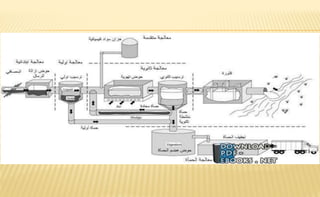
2- LIQUID WASTE DISPOSAL BY TREATMENT:
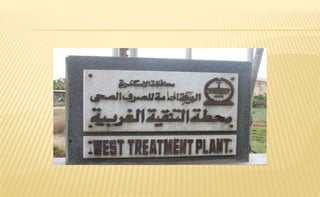
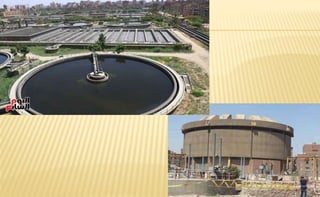
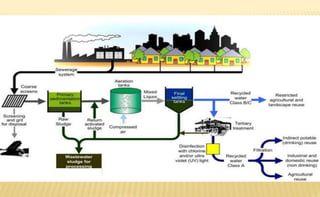
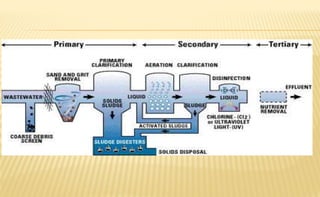
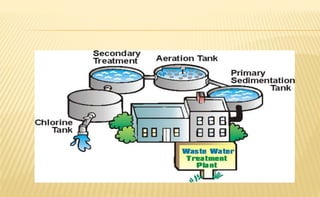
It is the method used in most cities of Egypt.
Separation of suspended matter (sludge) from liquid part (effluent)
& destruction of all micro-organisms in order to end with a safe
material that can be used for economic values.
Sludge as fertilizers
Effluent for irrigation of farm.
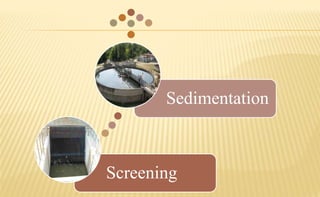
Screening
Sedimentation
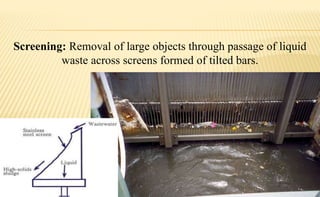
Screening: Removal of large objects through passage of liquid
waste across screens formed of tilted bars.
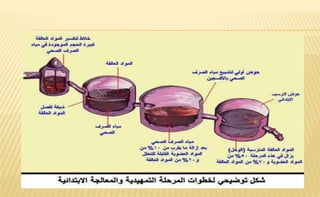
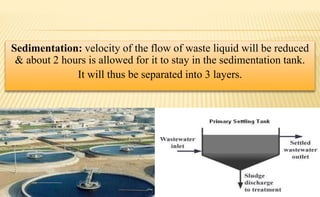
Sedimentation: velocity of the flow of waste liquid will be reduced
& about 2 hours is allowed for it to stay in the sedimentation tank.
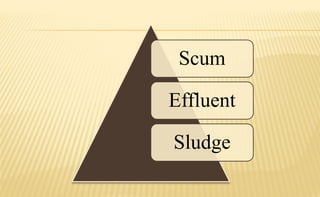
It will thus be separated into 3 layers.
Scum
Effluent
Sludge
A- SLUDGE:
- About 60% of suspended solid will be settled down & form the sludge.
- The removed sludge can be disposed by:
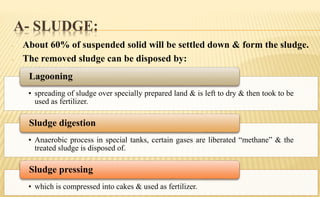
• spreading of sludge over specially prepared land & is left to dry & then took to be
used as fertilizer.
Lagooning
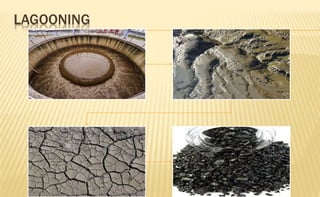
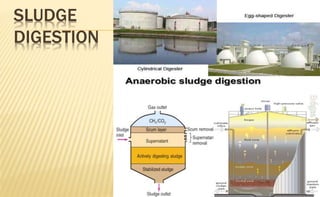
• Anaerobic process in special tanks, certain gases are liberated “methane” & the
treated sludge is disposed of.
Sludge digestion
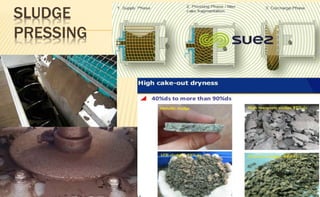
• which is compressed into cakes & used as fertilizer.
Sludge pressing
LAGOONING
SLUDGE
DIGESTION
SLUDGE
PRESSING
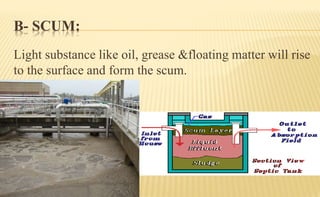
B- SCUM:
Light substance like oil, grease &floating matter will rise
to the surface and form the scum.
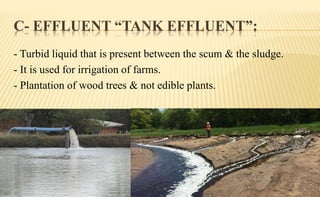
C- EFFLUENT “TANK EFFLUENT”:
- Turbid liquid that is present between the scum & the sludge.
- It is used for irrigation of farms.
- Plantation of wood trees & not edible plants.
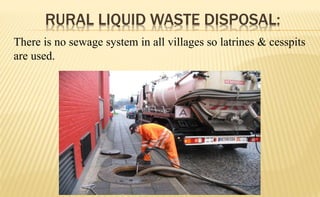
RURAL LIQUID WASTE DISPOSAL:
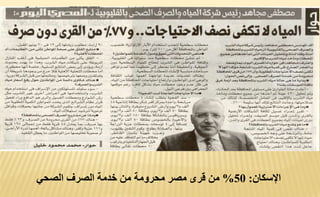
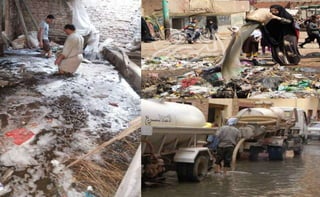
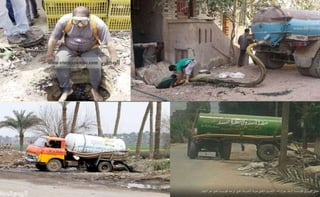
There is no sewage system in all villages so latrines & cesspits
are used.
LATRINE
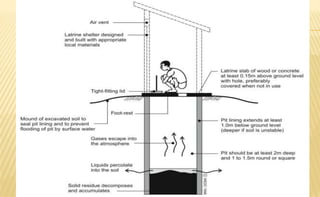
• A pit in the ground (better made impermeable to avoid pollution of shallow
underground water) and is covered by a slab to receive and collect human
excreta.
• Contents are emptied periodically & taken to a suitable place for sanitary
disposal.
• Latrines must be present inside houses to ensure:
• no handling of fresh stool, no contamination of surface soil, no unpleasant
smell, simple, not expensive & acceptable from the community.
CESSPITS
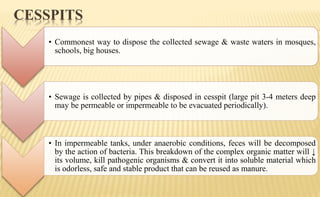
• Commonest way to dispose the collected sewage & waste waters in mosques,
schools, big houses.
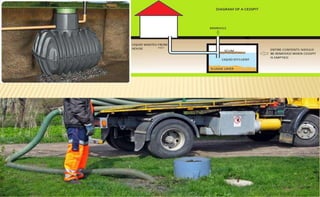
• Sewage is collected by pipes & disposed in cesspit (large pit 3-4 meters deep
may be permeable or impermeable to be evacuated periodically).
• In impermeable tanks, under anaerobic conditions, feces will be decomposed
by the action of bacteria. This breakdown of the complex organic matter will ↓
its volume, kill pathogenic organisms & convert it into soluble material which
is odorless, safe and stable product that can be reused as manure.
‫اإلسكان‬:50%‫الصحي‬ ‫الصرف‬ ‫خدمة‬ ‫من‬ ‫محرومة‬ ‫مصر‬ ‫قرى‬ ‫من‬
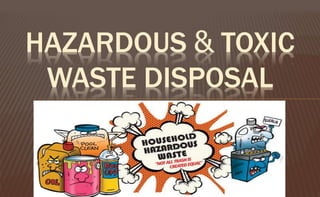
HAZARDOUS & TOXIC
WASTE DISPOSAL
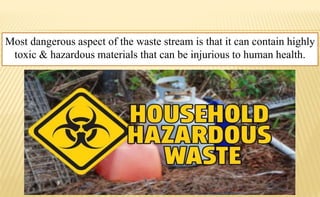
Most dangerous aspect of the waste stream is that it can contain highly
toxic & hazardous materials that can be injurious to human health.
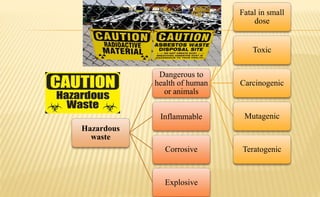
Hazardous
waste
Dangerous to
health of human
or animals
Fatal in small
dose
Toxic
Carcinogenic
Mutagenic
Teratogenic
Inflammable
Corrosive
Explosive
CONTROLLING & MANAGING HAZARDOUS WASTE:
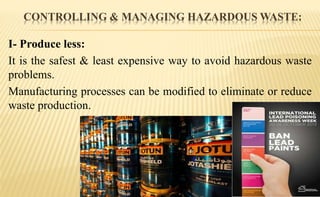
I- Produce less:
It is the safest & least expensive way to avoid hazardous waste
problems.
Manufacturing processes can be modified to eliminate or reduce
waste production.
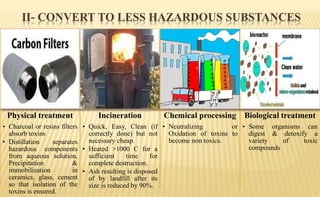
II- CONVERT TO LESS HAZARDOUS SUBSTANCES
Physical treatment
• Charcoal or resins filters
absorb toxins
• Distillation separates
hazardous components
from aqueous solution,
Precipitation &
immobilization in
ceramics, glass, cement
so that isolation of the
toxins is ensured.
Incineration
• Quick, Easy, Clean (if
correctly done) but not
necessary cheap.
• Heated >1000 C for a
sufficient time for
complete destruction.
• Ash resulting is disposed
of by landfill after its
size is reduced by 90%.
Chemical processing
• Neutralizing or
Oxidation of toxins to
become non toxics.
Biological treatment
• Some organisms can
digest & detoxify a
variety of toxic
compounds
III- PERMANENT STORAGE
Retrievable storage
• In a secure place
• Periodically inspected for possible leakage.
• Expensive & need continuous guarding
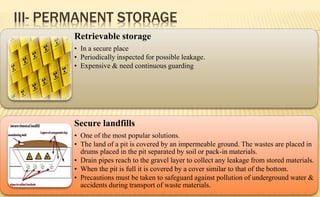
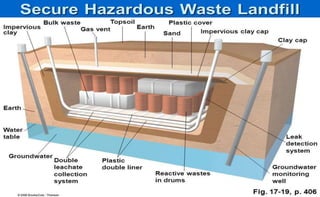
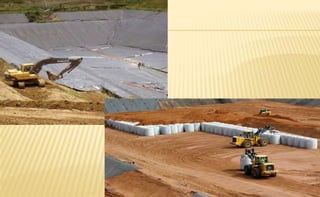
Secure landfills
• One of the most popular solutions.
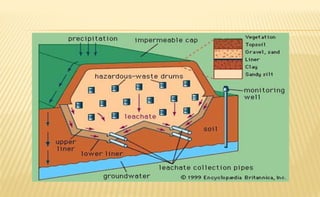
• The land of a pit is covered by an impermeable ground. The wastes are placed in
drums placed in the pit separated by soil or pack-in materials.
• Drain pipes reach to the gravel layer to collect any leakage from stored materials.
• When the pit is full it is covered by a cover similar to that of the bottom.
• Precautions must be taken to safeguard against pollution of underground water &
accidents during transport of waste materials.
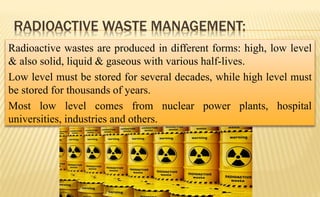
RADIOACTIVE WASTE MANAGEMENT:
Radioactive wastes are produced in different forms: high, low level
& also solid, liquid & gaseous with various half-lives.
Low level must be stored for several decades, while high level must
be stored for thousands of years.
Most low level comes from nuclear power plants, hospital
universities, industries and others.
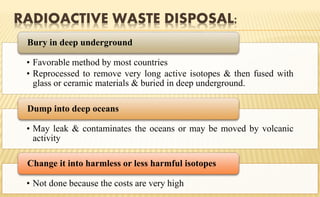
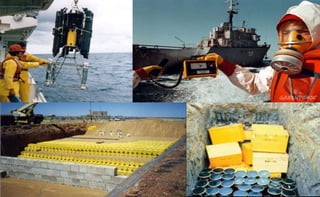
RADIOACTIVE WASTE DISPOSAL:
• Favorable method by most countries
• Reprocessed to remove very long active isotopes & then fused with
glass or ceramic materials & buried in deep underground.
Bury in deep underground
• May leak & contaminates the oceans or may be moved by volcanic
activity
Dump into deep oceans
• Not done because the costs are very high
Change it into harmless or less harmful isotopes
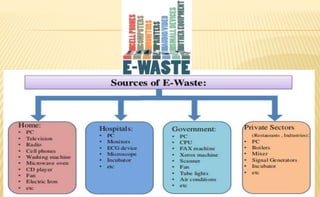
ELECTRONIC WASTE MANAGEMENT:
• Electronic waste or "e-waste" is a term used to describe old,
end-of-life electronic appliances & devices.
• Examples of "e-waste" include: computers; fax machines and
copiers; televisions ….etc.
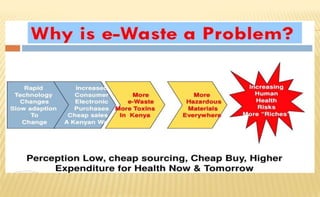
• Electronic waste often has hazardous or toxic components that can impact the
environment once the materials end up in a landfill or if they are improperly
managed and disposed “Arsenic, Beryllium, Cadmium, Chlorofluorocarbon
(CFC), Chromium, Lead, Mercury”.
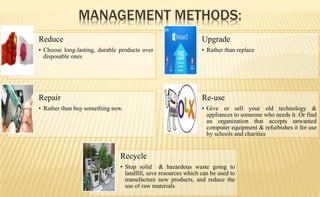
Reduce
• Choose long-lasting, durable products over
disposable ones
Upgrade
• Rather than replace
Repair
• Rather than buy something new.
Re-use
• Give or sell your old technology &
appliances to someone who needs it. Or find
an organization that accepts unwanted
computer equipment & refurbishes it for use
by schools and charities
Recycle
• Stop solid & hazardous waste going to
landfill, save resources which can be used to
manufacture new products, and reduce the
use of raw materials
MANAGEMENT METHODS:
INSECT & RODENT CONTROL
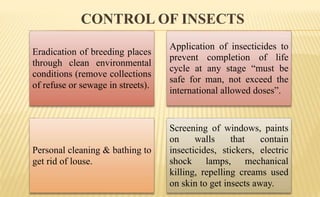
CONTROL OF INSECTS
Eradication of breeding places
through clean environmental
conditions (remove collections
of refuse or sewage in streets).
Application of insecticides to
prevent completion of life
cycle at any stage “must be
safe for man, not exceed the
international allowed doses”.
Personal cleaning & bathing to
get rid of louse.
Screening of windows, paints
on walls that contain
insecticides, stickers, electric
shock lamps, mechanical
killing, repelling creams used
on skin to get insects away.
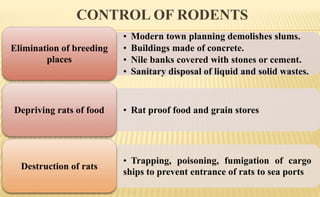
CONTROL OF RODENTS
• Modern town planning demolishes slums.
• Buildings made of concrete.
• Nile banks covered with stones or cement.
• Sanitary disposal of liquid and solid wastes.
Elimination of breeding
places
• Rat proof food and grain storesDepriving rats of food
• Trapping, poisoning, fumigation of cargo
ships to prevent entrance of rats to sea ports
Destruction of rats
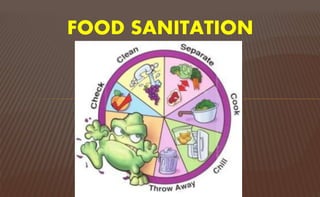
FOOD SANITATION
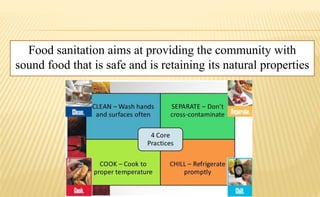
Food sanitation aims at providing the community with
sound food that is safe and is retaining its natural properties
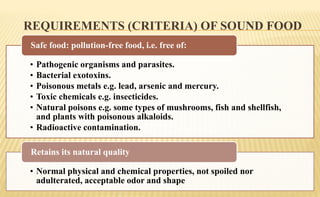
REQUIREMENTS (CRITERIA) OF SOUND FOOD
• Pathogenic organisms and parasites.
• Bacterial exotoxins.
• Poisonous metals e.g. lead, arsenic and mercury.
• Toxic chemicals e.g. insecticides.
• Natural poisons e.g. some types of mushrooms, fish and shellfish,
and plants with poisonous alkaloids.
• Radioactive contamination.
Safe food: pollution-free food, i.e. free of:
• Normal physical and chemical properties, not spoiled nor
adulterated, acceptable odor and shape
Retains its natural quality
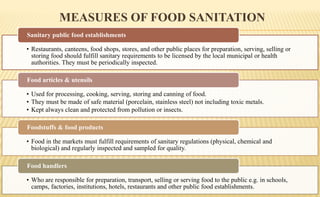
MEASURES OF FOOD SANITATION
• Restaurants, canteens, food shops, stores, and other public places for preparation, serving, selling or
storing food should fulfill sanitary requirements to be licensed by the local municipal or health
authorities. They must be periodically inspected.
Sanitary public food establishments
• Used for processing, cooking, serving, storing and canning of food.
• They must be made of safe material (porcelain, stainless steel) not including toxic metals.
• Kept always clean and protected from pollution or insects.
Food articles & utensils
• Food in the markets must fulfill requirements of sanitary regulations (physical, chemical and
biological) and regularly inspected and sampled for quality.
Foodstuffs & food products
• Who are responsible for preparation, transport, selling or serving food to the public e.g. in schools,
camps, factories, institutions, hotels, restaurants and other public food establishments.
Food handlers
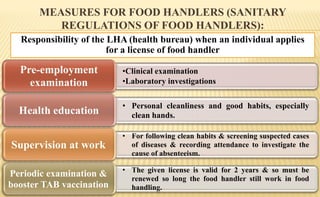
MEASURES FOR FOOD HANDLERS (SANITARY
REGULATIONS OF FOOD HANDLERS):
Responsibility of the LHA (health bureau) when an individual applies
for a license of food handler
•Clinical examination
•Laboratory investigations
Pre-employment
examination
• Personal cleanliness and good habits, especially
clean hands.Health education
• For following clean habits & screening suspected cases
of diseases & recording attendance to investigate the
cause of absenteeism.
Supervision at work
• The given license is valid for 2 years & so must be
renewed so long the food handler still work in food
handling.
Periodic examination &
booster TAB vaccination
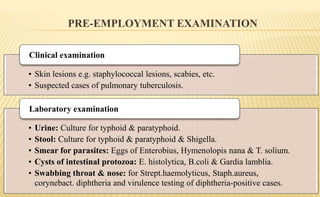
PRE-EMPLOYMENT EXAMINATION
• Skin lesions e.g. staphylococcal lesions, scabies, etc.
• Suspected cases of pulmonary tuberculosis.
Clinical examination
• Urine: Culture for typhoid & paratyphoid.
• Stool: Culture for typhoid & paratyphoid & Shigella.
• Smear for parasites: Eggs of Enterobius, Hymenolopis nana & T. solium.
• Cysts of intestinal protozoa: E. histolytica, B.coli & Gardia lamblia.
• Swabbing throat & nose: for Strept.haemolyticus, Staph.aureus,
corynebact. diphtheria and virulence testing of diphtheria-positive cases.
Laboratory examination
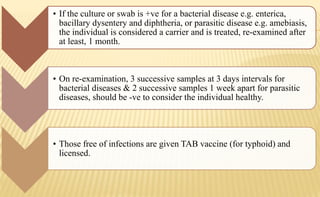
• If the culture or swab is +ve for a bacterial disease e.g. enterica,
bacillary dysentery and diphtheria, or parasitic disease e.g. amebiasis,
the individual is considered a carrier and is treated, re-examined after
at least, 1 month.
• On re-examination, 3 successive samples at 3 days intervals for
bacterial diseases & 2 successive samples 1 week apart for parasitic
diseases, should be -ve to consider the individual healthy.
• Those free of infections are given TAB vaccine (for typhoid) and
licensed.
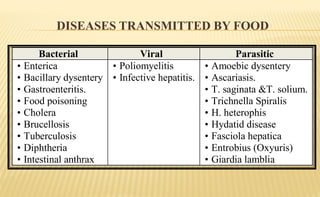
DISEASES TRANSMITTED BY FOOD
Bacterial Viral Parasitic
• Enterica
• Bacillary dysentery
• Gastroenteritis.
• Food poisoning
• Cholera
• Brucellosis
• Tuberculosis
• Diphtheria
• Intestinal anthrax
• Poliomyelitis
• Infective hepatitis.
• Amoebic dysentery
• Ascariasis.
• T. saginata &T. solium.
• Trichnella Spiralis
• H. heterophis
• Hydatid disease
• Fasciola hepatica
• Entrobius (Oxyuris)
• Giardia lamblia
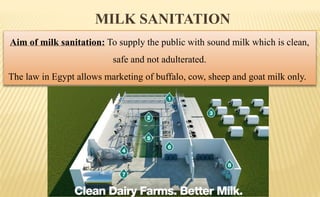
MILK SANITATION
Aim of milk sanitation: To supply the public with sound milk which is clean,
safe and not adulterated.
The law in Egypt allows marketing of buffalo, cow, sheep and goat milk only.
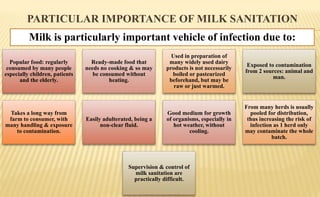
PARTICULAR IMPORTANCE OF MILK SANITATION
Milk is particularly important vehicle of infection due to:
Popular food: regularly
consumed by many people
especially children, patients
and the elderly.
Ready-made food that
needs no cooking & so may
be consumed without
heating.
Used in preparation of
many widely used dairy
products is not necessarily
boiled or pasteurized
beforehand, but may be
raw or just warmed.
Exposed to contamination
from 2 sources: animal and
man.
Takes a long way from
farm to consumer, with
many handling & exposure
to contamination.
Easily adulterated, being a
non-clear fluid.
Good medium for growth
of organisms, especially in
hot weather, without
cooling.
From many herds is usually
pooled for distribution,
thus increasing the risk of
infection as 1 herd only
may contaminate the whole
batch.
Supervision & control of
milk sanitation are
practically difficult.
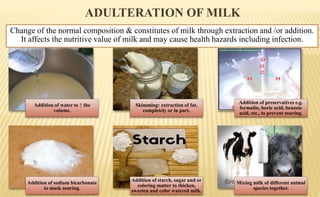
ADULTERATION OF MILK
Change of the normal composition & constitutes of milk through extraction and /or addition.
It affects the nutritive value of milk and may cause health hazards including infection.
Addition of water to ↑ the
volume.
Skimming: extraction of fat,
completely or in part.
Addition of preservatives e.g.
formalin, boric acid, benzoic
acid, etc., to prevent souring.
Addition of sodium bicarbonate
to mask souring.
Addition of starch, sugar and or
coloring matter to thicken,
sweeten and color watered milk.
Mixing milk of different animal
species together.
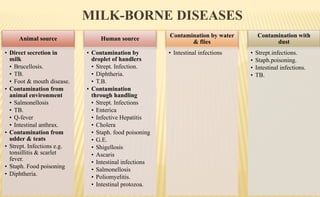
MILK-BORNE DISEASES
Animal source
• Direct secretion in
milk
• Brucellosis.
• TB.
• Foot & mouth disease.
• Contamination from
animal environment
• Salmonellosis
• TB.
• Q-fever
• Intestinal anthrax.
• Contamination from
udder & teats
• Strept. Infections e.g.
tonsillitis & scarlet
fever.
• Staph. Food poisoning
• Diphtheria.
Human source
• Contamination by
droplet of handlers
• Strept. Infection.
• Diphtheria.
• T.B.
• Contamination
through handling
• Strept. Infections
• Enterica
• Infective Hepatitis
• Cholera
• Staph. food poisoning
• G.E.
• Shigellosis
• Ascaris
• Intestinal infections
• Salmonellosis
• Poliomyelitis.
• Intestinal protozoa.
Contamination by water
& flies
• Intestinal infections
Contamination with
dust
• Strept.infections.
• Staph.poisoning.
• Intestinal infections.
• TB.
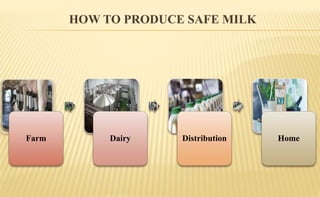
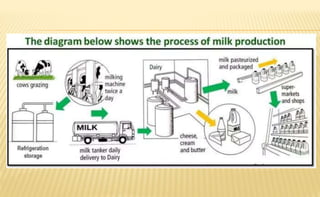
HOW TO PRODUCE SAFE MILK
Farm Dairy Distribution Home
• Healthy animals, adequately fed, no overwork in the farm.
• Of special herds (for milking) to produce large amounts of milk.
• Veterinary care: immunization, early spotting and management of disease.
• Animal shed must fulfill sanitary requirements: Good ventilation, safe water supply, sanitary disposal of wastes.
• No milking of diseased animals.
• Milking: Better by mechanical means & personnel must be licensed as food handlers. Clean hands, cloths, and
habits. Utensils must be properly cleansed & disinfected. Milking room must be clean, with safe water supply.
After milking: Keeping milk in a clean room in clean firmly covered cans to be transported to the dairy in cooled
cars.
Farm
• Sanitary clean place and licensed.
• Personnel licensed as food handlers
• Clarification of milk to remove foreign matters then pasteurized.
• Mechanical filling in sterile sealed bottles or sacs.
Dairy
• By sanitary retail shops where milk must be kept refrigerated.
Distribution of milk
• Pasteurized milk: must be kept cool, in refrigerator, until consumed.
• Raw milk: should be boiled and then cooled and protected in a clean place if not consumed shortly thereafter.
Home
Pasteurization of milk
• Heating milk for a certain temperature
and time, then rapid cooling
• Advantages:
• Enough to destroy all pathogens.
• Not change taste & nutritive value of
milk.
• Methods:
• The high temp. (Short time method):
used for large-scale pasteurization.
Milk is heated to 75°C for 15-20
seconds, then rapidly cooled to 4°C
& kept at this temp. until consumed.
• Holding method: milk is heated to a
temp. of 62°C for 30 minutes, then
cooled rapidly to below 10°C & kept
so till consumed.
Boiling of milk
• Heating milk to boiling point
• Destroys all pathogens & saprophytes.
• Simple domestic method.
• Disadvantages:
• Affects nutritive value & taste
• Precipitates some proteins, calcium
and phosphorus.
• Forms big, less digestible fat
globules.
• Destroys vit. C & most of vit. B1.
• May cause caramelization (burnt
lactose) & change of taste.
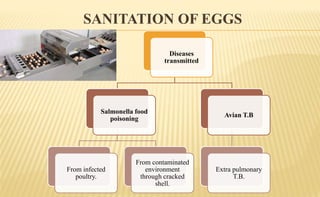
SANITATION OF EGGS
Diseases
transmitted
Salmonella food
poisoning
From infected
poultry.
From contaminated
environment
through cracked
shell.
Avian T.B
Extra pulmonary
T.B.
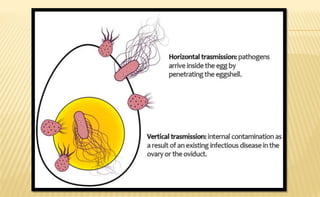
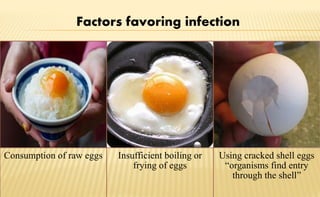
Consumption of raw eggs Insufficient boiling or
frying of eggs
Using cracked shell eggs
“organisms find entry
through the shell”
Factors favoring infection
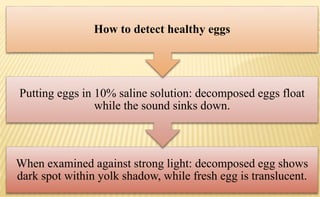
When examined against strong light: decomposed egg shows
dark spot within yolk shadow, while fresh egg is translucent.
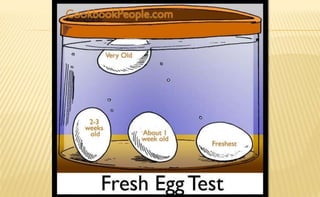
Putting eggs in 10% saline solution: decomposed eggs float
while the sound sinks down.
How to detect healthy eggs
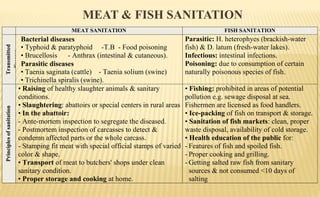
MEAT & FISH SANITATION
MEAT SANITATION FISH SANITATION
Transmitted
diseases
Bacterial diseases
• Typhoid & paratyphoid -T.B - Food poisoning
• Brucellosis - Anthrax (intestinal & cutaneous).
Parasitic diseases
• Taenia saginata (cattle) - Taenia solium (swine)
• Trichinella spiralis (swine).
Parasitic: H. heterophyes (brackish-water
fish) & D. latum (fresh-water lakes).
Infectious: intestinal infections.
Poisoning: due to consumption of certain
naturally poisonous species of fish.
Principlesofsanitation
• Raising of healthy slaughter animals & sanitary
conditions.
• Slaughtering: abattoirs or special centers in rural areas
• In the abattoir:
- Ante-mortem inspection to segregate the diseased.
- Postmortem inspection of carcasses to detect &
condemn affected parts or the whole carcass.
- Stamping fit meat with special official stamps of varied
color & shape.
• Transport of meat to butchers' shops under clean
sanitary condition.
• Proper storage and cooking at home.
• Fishing: prohibited in areas of potential
pollution e.g. sewage disposal at sea.
Fishermen are licensed as food handlers.
• Ice-packing of fish on transport & storage.
• Sanitation of fish markets: clean, proper
waste disposal, availability of cold storage.
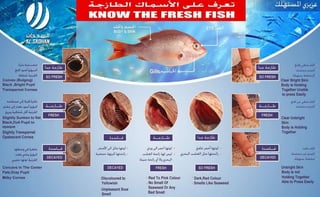
• Health education of the public for:
- Features of fish and spoiled fish.
- Proper cooking and grilling.
- Getting salted raw fish from sanitary
sources & not consumed <10 days of
salting
Waste management
Waste management

Waste management

  • 1.
    SANITARY WASTE DISPOSAL Dr.Dalia El-Shafei Assistant professor, Community Medicine Department, Zagazig University
  • 2.
    TYPES OF WASTES Solid Houses Paper Plastics Glass Garbage Industry Deadanimals Metals Hospitals Cotton Dressings Liquid Houses Sewage Wastewater Environment Rain water Industry Irrigation wastes Chemicals
  • 3.
    Breeding of insects & rodents •Flies, cockroaches, mosquitoes & rats use collection of human excreta, garbage, agriculture waste and manure as a breeding place for survival and multiplication. Spread of infection • Breeding of flies & mosquitoes which are vector of diseases. • Contamination of freshly eaten vegetables by human wastes used as fertilizers. • Pollution of sea water by sewage disposal at sea. • Exposure of scavengers to occupational infection during collection & handling of refuse & sewage. Physical & chemical hazards • Nuisance: offensive odor of gases resulting from purification of animals, organic matter & also it is a bad sight to be seen. • Injuries by broken glass or empty cans. • Radiation hazards: Radiation wastes of industry or hospitals when polluting water channels. • Chemical & metal poisoning on disposal of trade effluents & industrial wastes in water channels.
  • 5.
  • 7.
    WASTE STREAM: Steady flowof varied wastes that we all produce, from domestic garbage to industrial agricultural, commercial & construction refuse.
  • 8.
    1- OPEN DUMP: Manypeople dispose wastes by simply dropping it to some place. Open unregulated dumps are still the predominant method of waste disposal in most developing countries. Open dump in rivers, canals, sea & oceans expose people, animals, and plants to many hazards & make water not suitable for drinking or use in irrigation.
  • 12.
    2- LANDFILLS “CONTROLLEDDUMPING” • Solid waste disposal is regulated & controlled. • To ↓ smells & to discourage insect & rodent breading landfill operators are required to compress the refuse & cover it every day with a layer of earth. • Control pollution, but dirt fill takes nearly 20% of the space. • Oils, chemical compounds and toxic metals seep to the underground surrounding areas. • Landfills are chosen to be high away from rivers & other water sources. • It was inexpensive but with the ↑ in the cost of lands, construction and maintenance it became costly.
  • 15.
    3- INCINERATION: • Burningof waste. Another name is energy recovery or waste-to-energy because the energy that is generated is a useful resource. • 2 approaches are used. Refuse-derived fuel where refuse is sorted to remove unburnable materials & Mass burn where everything is burned as much as possible. • Residual ash & unburnable materials representing 20% of original size are taken to landfill for disposal. • Costly & flying ash contains dioxins of lead & cadmium which are hazardous materials. • To ↓ the emissions of these hazards, removal of batteries containing heavy metals, plastics containing chlorine before wastes are burned. • Closed incineration is very sanitary & healthy method if done at small scale as in hospitals & big buildings.
  • 19.
    4- RECYCLING: Reprocessing of discardedmaterials into useful products. Some reuse materials for the same purpose & other turn old materials into entirely new products. Saves money, energy, raw materials & land spaces while also reducing pollution.
  • 22.
    5- REUSE: Shrinking ofthe waste stream. Reuse of disposed materials after cleaning them in the same forms e.g. bottles & food containers.
  • 24.
    6- REDUCTION: Produce lesswaste. Better than reusing. What is a waste to one process may be a resource to another. Industry can produce less waste by changing their manufacturing processes.
  • 26.
    7- FERMENTATION: To manurein rural areas by forming heaps of refuse covered by layer of earth & left for few days, decomposition of organic materials occur & they are changed to useful manure.
  • 27.
  • 28.
    Domestic: Excreta & wastewater of kitchen Municipal: Waste water of streets (washing, rain) Industrial trade effluents
  • 29.
    URBAN LIQUID WASTEDISPOSAL: In urban areas liquid waste is disposed of through water carried system. After collecting liquid waste from houses, it reaches the final disposal where it will be disposed of by either dilution or treatment.
  • 30.
    1- LIQUID WASTEDISPOSAL BY DILUTION: Crude sewage & waste water may be taken as such, or partially treated & disposes in coastal countries, or rarely in rivers & streams. Potential risk to health due to the possibility of back flow to shore, causing its pollution and causing hazards to swimmers & fishing. Wind may carry smell back to city.
  • 31.
    Sanitary precautions Pipes: - Carried tosufficient distance into the water stream - Below the surface by a sufficient distance Currents: studied to prevent return of sewage to the shore Fishing: prohibited at that area
  • 34.
    2- LIQUID WASTEDISPOSAL BY TREATMENT: It is the method used in most cities of Egypt. Separation of suspended matter (sludge) from liquid part (effluent) & destruction of all micro-organisms in order to end with a safe material that can be used for economic values. Sludge as fertilizers Effluent for irrigation of farm.
  • 41.
  • 42.
    Screening: Removal oflarge objects through passage of liquid waste across screens formed of tilted bars.
  • 43.
    Sedimentation: velocity ofthe flow of waste liquid will be reduced & about 2 hours is allowed for it to stay in the sedimentation tank. It will thus be separated into 3 layers.
  • 44.
  • 45.
    A- SLUDGE: - About60% of suspended solid will be settled down & form the sludge. - The removed sludge can be disposed by: • spreading of sludge over specially prepared land & is left to dry & then took to be used as fertilizer. Lagooning • Anaerobic process in special tanks, certain gases are liberated “methane” & the treated sludge is disposed of. Sludge digestion • which is compressed into cakes & used as fertilizer. Sludge pressing
  • 46.
  • 47.
  • 48.
  • 49.
    B- SCUM: Light substancelike oil, grease &floating matter will rise to the surface and form the scum.
  • 50.
    C- EFFLUENT “TANKEFFLUENT”: - Turbid liquid that is present between the scum & the sludge. - It is used for irrigation of farms. - Plantation of wood trees & not edible plants.
  • 52.
    RURAL LIQUID WASTEDISPOSAL: There is no sewage system in all villages so latrines & cesspits are used.
  • 53.
    LATRINE • A pitin the ground (better made impermeable to avoid pollution of shallow underground water) and is covered by a slab to receive and collect human excreta. • Contents are emptied periodically & taken to a suitable place for sanitary disposal. • Latrines must be present inside houses to ensure: • no handling of fresh stool, no contamination of surface soil, no unpleasant smell, simple, not expensive & acceptable from the community.
  • 55.
    CESSPITS • Commonest wayto dispose the collected sewage & waste waters in mosques, schools, big houses. • Sewage is collected by pipes & disposed in cesspit (large pit 3-4 meters deep may be permeable or impermeable to be evacuated periodically). • In impermeable tanks, under anaerobic conditions, feces will be decomposed by the action of bacteria. This breakdown of the complex organic matter will ↓ its volume, kill pathogenic organisms & convert it into soluble material which is odorless, safe and stable product that can be reused as manure.
  • 57.
    ‫اإلسكان‬:50%‫الصحي‬ ‫الصرف‬ ‫خدمة‬‫من‬ ‫محرومة‬ ‫مصر‬ ‫قرى‬ ‫من‬
  • 60.
  • 61.
    Most dangerous aspectof the waste stream is that it can contain highly toxic & hazardous materials that can be injurious to human health.
  • 62.
    Hazardous waste Dangerous to health ofhuman or animals Fatal in small dose Toxic Carcinogenic Mutagenic Teratogenic Inflammable Corrosive Explosive
  • 63.
    CONTROLLING & MANAGINGHAZARDOUS WASTE: I- Produce less: It is the safest & least expensive way to avoid hazardous waste problems. Manufacturing processes can be modified to eliminate or reduce waste production.
  • 64.
    II- CONVERT TOLESS HAZARDOUS SUBSTANCES Physical treatment • Charcoal or resins filters absorb toxins • Distillation separates hazardous components from aqueous solution, Precipitation & immobilization in ceramics, glass, cement so that isolation of the toxins is ensured. Incineration • Quick, Easy, Clean (if correctly done) but not necessary cheap. • Heated >1000 C for a sufficient time for complete destruction. • Ash resulting is disposed of by landfill after its size is reduced by 90%. Chemical processing • Neutralizing or Oxidation of toxins to become non toxics. Biological treatment • Some organisms can digest & detoxify a variety of toxic compounds
  • 65.
    III- PERMANENT STORAGE Retrievablestorage • In a secure place • Periodically inspected for possible leakage. • Expensive & need continuous guarding Secure landfills • One of the most popular solutions. • The land of a pit is covered by an impermeable ground. The wastes are placed in drums placed in the pit separated by soil or pack-in materials. • Drain pipes reach to the gravel layer to collect any leakage from stored materials. • When the pit is full it is covered by a cover similar to that of the bottom. • Precautions must be taken to safeguard against pollution of underground water & accidents during transport of waste materials.
  • 69.
    RADIOACTIVE WASTE MANAGEMENT: Radioactivewastes are produced in different forms: high, low level & also solid, liquid & gaseous with various half-lives. Low level must be stored for several decades, while high level must be stored for thousands of years. Most low level comes from nuclear power plants, hospital universities, industries and others.
  • 70.
    RADIOACTIVE WASTE DISPOSAL: •Favorable method by most countries • Reprocessed to remove very long active isotopes & then fused with glass or ceramic materials & buried in deep underground. Bury in deep underground • May leak & contaminates the oceans or may be moved by volcanic activity Dump into deep oceans • Not done because the costs are very high Change it into harmless or less harmful isotopes
  • 72.
    ELECTRONIC WASTE MANAGEMENT: •Electronic waste or "e-waste" is a term used to describe old, end-of-life electronic appliances & devices. • Examples of "e-waste" include: computers; fax machines and copiers; televisions ….etc. • Electronic waste often has hazardous or toxic components that can impact the environment once the materials end up in a landfill or if they are improperly managed and disposed “Arsenic, Beryllium, Cadmium, Chlorofluorocarbon (CFC), Chromium, Lead, Mercury”.
  • 75.
    Reduce • Choose long-lasting,durable products over disposable ones Upgrade • Rather than replace Repair • Rather than buy something new. Re-use • Give or sell your old technology & appliances to someone who needs it. Or find an organization that accepts unwanted computer equipment & refurbishes it for use by schools and charities Recycle • Stop solid & hazardous waste going to landfill, save resources which can be used to manufacture new products, and reduce the use of raw materials MANAGEMENT METHODS:
  • 76.
  • 77.
    CONTROL OF INSECTS Eradicationof breeding places through clean environmental conditions (remove collections of refuse or sewage in streets). Application of insecticides to prevent completion of life cycle at any stage “must be safe for man, not exceed the international allowed doses”. Personal cleaning & bathing to get rid of louse. Screening of windows, paints on walls that contain insecticides, stickers, electric shock lamps, mechanical killing, repelling creams used on skin to get insects away.
  • 78.
    CONTROL OF RODENTS •Modern town planning demolishes slums. • Buildings made of concrete. • Nile banks covered with stones or cement. • Sanitary disposal of liquid and solid wastes. Elimination of breeding places • Rat proof food and grain storesDepriving rats of food • Trapping, poisoning, fumigation of cargo ships to prevent entrance of rats to sea ports Destruction of rats
  • 79.
  • 80.
    Food sanitation aimsat providing the community with sound food that is safe and is retaining its natural properties
  • 81.
    REQUIREMENTS (CRITERIA) OFSOUND FOOD • Pathogenic organisms and parasites. • Bacterial exotoxins. • Poisonous metals e.g. lead, arsenic and mercury. • Toxic chemicals e.g. insecticides. • Natural poisons e.g. some types of mushrooms, fish and shellfish, and plants with poisonous alkaloids. • Radioactive contamination. Safe food: pollution-free food, i.e. free of: • Normal physical and chemical properties, not spoiled nor adulterated, acceptable odor and shape Retains its natural quality
  • 82.
    MEASURES OF FOODSANITATION • Restaurants, canteens, food shops, stores, and other public places for preparation, serving, selling or storing food should fulfill sanitary requirements to be licensed by the local municipal or health authorities. They must be periodically inspected. Sanitary public food establishments • Used for processing, cooking, serving, storing and canning of food. • They must be made of safe material (porcelain, stainless steel) not including toxic metals. • Kept always clean and protected from pollution or insects. Food articles & utensils • Food in the markets must fulfill requirements of sanitary regulations (physical, chemical and biological) and regularly inspected and sampled for quality. Foodstuffs & food products • Who are responsible for preparation, transport, selling or serving food to the public e.g. in schools, camps, factories, institutions, hotels, restaurants and other public food establishments. Food handlers
  • 83.
    MEASURES FOR FOODHANDLERS (SANITARY REGULATIONS OF FOOD HANDLERS): Responsibility of the LHA (health bureau) when an individual applies for a license of food handler •Clinical examination •Laboratory investigations Pre-employment examination • Personal cleanliness and good habits, especially clean hands.Health education • For following clean habits & screening suspected cases of diseases & recording attendance to investigate the cause of absenteeism. Supervision at work • The given license is valid for 2 years & so must be renewed so long the food handler still work in food handling. Periodic examination & booster TAB vaccination
  • 84.
    PRE-EMPLOYMENT EXAMINATION • Skinlesions e.g. staphylococcal lesions, scabies, etc. • Suspected cases of pulmonary tuberculosis. Clinical examination • Urine: Culture for typhoid & paratyphoid. • Stool: Culture for typhoid & paratyphoid & Shigella. • Smear for parasites: Eggs of Enterobius, Hymenolopis nana & T. solium. • Cysts of intestinal protozoa: E. histolytica, B.coli & Gardia lamblia. • Swabbing throat & nose: for Strept.haemolyticus, Staph.aureus, corynebact. diphtheria and virulence testing of diphtheria-positive cases. Laboratory examination
  • 85.
    • If theculture or swab is +ve for a bacterial disease e.g. enterica, bacillary dysentery and diphtheria, or parasitic disease e.g. amebiasis, the individual is considered a carrier and is treated, re-examined after at least, 1 month. • On re-examination, 3 successive samples at 3 days intervals for bacterial diseases & 2 successive samples 1 week apart for parasitic diseases, should be -ve to consider the individual healthy. • Those free of infections are given TAB vaccine (for typhoid) and licensed.
  • 86.
    DISEASES TRANSMITTED BYFOOD Bacterial Viral Parasitic • Enterica • Bacillary dysentery • Gastroenteritis. • Food poisoning • Cholera • Brucellosis • Tuberculosis • Diphtheria • Intestinal anthrax • Poliomyelitis • Infective hepatitis. • Amoebic dysentery • Ascariasis. • T. saginata &T. solium. • Trichnella Spiralis • H. heterophis • Hydatid disease • Fasciola hepatica • Entrobius (Oxyuris) • Giardia lamblia
  • 87.
    MILK SANITATION Aim ofmilk sanitation: To supply the public with sound milk which is clean, safe and not adulterated. The law in Egypt allows marketing of buffalo, cow, sheep and goat milk only.
  • 88.
    PARTICULAR IMPORTANCE OFMILK SANITATION Milk is particularly important vehicle of infection due to: Popular food: regularly consumed by many people especially children, patients and the elderly. Ready-made food that needs no cooking & so may be consumed without heating. Used in preparation of many widely used dairy products is not necessarily boiled or pasteurized beforehand, but may be raw or just warmed. Exposed to contamination from 2 sources: animal and man. Takes a long way from farm to consumer, with many handling & exposure to contamination. Easily adulterated, being a non-clear fluid. Good medium for growth of organisms, especially in hot weather, without cooling. From many herds is usually pooled for distribution, thus increasing the risk of infection as 1 herd only may contaminate the whole batch. Supervision & control of milk sanitation are practically difficult.
  • 89.
    ADULTERATION OF MILK Changeof the normal composition & constitutes of milk through extraction and /or addition. It affects the nutritive value of milk and may cause health hazards including infection. Addition of water to ↑ the volume. Skimming: extraction of fat, completely or in part. Addition of preservatives e.g. formalin, boric acid, benzoic acid, etc., to prevent souring. Addition of sodium bicarbonate to mask souring. Addition of starch, sugar and or coloring matter to thicken, sweeten and color watered milk. Mixing milk of different animal species together.
  • 90.
    MILK-BORNE DISEASES Animal source •Direct secretion in milk • Brucellosis. • TB. • Foot & mouth disease. • Contamination from animal environment • Salmonellosis • TB. • Q-fever • Intestinal anthrax. • Contamination from udder & teats • Strept. Infections e.g. tonsillitis & scarlet fever. • Staph. Food poisoning • Diphtheria. Human source • Contamination by droplet of handlers • Strept. Infection. • Diphtheria. • T.B. • Contamination through handling • Strept. Infections • Enterica • Infective Hepatitis • Cholera • Staph. food poisoning • G.E. • Shigellosis • Ascaris • Intestinal infections • Salmonellosis • Poliomyelitis. • Intestinal protozoa. Contamination by water & flies • Intestinal infections Contamination with dust • Strept.infections. • Staph.poisoning. • Intestinal infections. • TB.
  • 91.
    HOW TO PRODUCESAFE MILK Farm Dairy Distribution Home
  • 93.
    • Healthy animals,adequately fed, no overwork in the farm. • Of special herds (for milking) to produce large amounts of milk. • Veterinary care: immunization, early spotting and management of disease. • Animal shed must fulfill sanitary requirements: Good ventilation, safe water supply, sanitary disposal of wastes. • No milking of diseased animals. • Milking: Better by mechanical means & personnel must be licensed as food handlers. Clean hands, cloths, and habits. Utensils must be properly cleansed & disinfected. Milking room must be clean, with safe water supply. After milking: Keeping milk in a clean room in clean firmly covered cans to be transported to the dairy in cooled cars. Farm • Sanitary clean place and licensed. • Personnel licensed as food handlers • Clarification of milk to remove foreign matters then pasteurized. • Mechanical filling in sterile sealed bottles or sacs. Dairy • By sanitary retail shops where milk must be kept refrigerated. Distribution of milk • Pasteurized milk: must be kept cool, in refrigerator, until consumed. • Raw milk: should be boiled and then cooled and protected in a clean place if not consumed shortly thereafter. Home
  • 94.
    Pasteurization of milk •Heating milk for a certain temperature and time, then rapid cooling • Advantages: • Enough to destroy all pathogens. • Not change taste & nutritive value of milk. • Methods: • The high temp. (Short time method): used for large-scale pasteurization. Milk is heated to 75°C for 15-20 seconds, then rapidly cooled to 4°C & kept at this temp. until consumed. • Holding method: milk is heated to a temp. of 62°C for 30 minutes, then cooled rapidly to below 10°C & kept so till consumed. Boiling of milk • Heating milk to boiling point • Destroys all pathogens & saprophytes. • Simple domestic method. • Disadvantages: • Affects nutritive value & taste • Precipitates some proteins, calcium and phosphorus. • Forms big, less digestible fat globules. • Destroys vit. C & most of vit. B1. • May cause caramelization (burnt lactose) & change of taste.
  • 95.
    SANITATION OF EGGS Diseases transmitted Salmonellafood poisoning From infected poultry. From contaminated environment through cracked shell. Avian T.B Extra pulmonary T.B.
  • 97.
    Consumption of raweggs Insufficient boiling or frying of eggs Using cracked shell eggs “organisms find entry through the shell” Factors favoring infection
  • 98.
    When examined againststrong light: decomposed egg shows dark spot within yolk shadow, while fresh egg is translucent. Putting eggs in 10% saline solution: decomposed eggs float while the sound sinks down. How to detect healthy eggs
  • 100.
    MEAT & FISHSANITATION MEAT SANITATION FISH SANITATION Transmitted diseases Bacterial diseases • Typhoid & paratyphoid -T.B - Food poisoning • Brucellosis - Anthrax (intestinal & cutaneous). Parasitic diseases • Taenia saginata (cattle) - Taenia solium (swine) • Trichinella spiralis (swine). Parasitic: H. heterophyes (brackish-water fish) & D. latum (fresh-water lakes). Infectious: intestinal infections. Poisoning: due to consumption of certain naturally poisonous species of fish. Principlesofsanitation • Raising of healthy slaughter animals & sanitary conditions. • Slaughtering: abattoirs or special centers in rural areas • In the abattoir: - Ante-mortem inspection to segregate the diseased. - Postmortem inspection of carcasses to detect & condemn affected parts or the whole carcass. - Stamping fit meat with special official stamps of varied color & shape. • Transport of meat to butchers' shops under clean sanitary condition. • Proper storage and cooking at home. • Fishing: prohibited in areas of potential pollution e.g. sewage disposal at sea. Fishermen are licensed as food handlers. • Ice-packing of fish on transport & storage. • Sanitation of fish markets: clean, proper waste disposal, availability of cold storage. • Health education of the public for: - Features of fish and spoiled fish. - Proper cooking and grilling. - Getting salted raw fish from sanitary sources & not consumed <10 days of salting