COMMUNICATION	
FOR
HEALTH	EDUCATION	
.
Dr Lipilekha Patnaik
Professor, Community Medicine
Institute of Medical Sciences & SUM Hospital
Siksha ‘O’ Anusandhan deemed to be University,
COMMUNICATION
Communication is the two way process of
sharing or exchanging the ideas, feelings and
information.
The essential parts of communication system are
the communicator or sender, the communicate
or receiver, the message or content, the channel
and feed back.
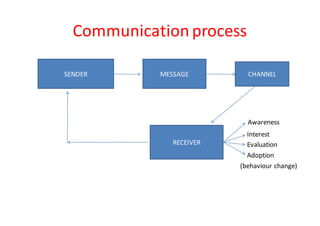
Communication	process
Awareness
Interest
Evaluation
Adoption	
(behaviour	change)					
SENDER MESSAGE CHANNEL
RECEIVER
1. Sender / Communicator
The sender is the originator of the message.
2. Receiver :
All communications must have an audience-which may
be controlled and uncontrolled. The more the control
or homogenous the audience the greater are the chances
of effective communication.
3. Message :
A message must be
• In lines with objectives
• Interesting , meaningful, based on felt needs, clear and
understandable, specific & accurate
• Timely and adequate, culturally and socially appropriate
4) Channels of Communication :
It is the media between the sender and receiver
consisting of 3 medias :
• Interpersonal communication
• Mass media
• Traditional/Folk media
5) Feed Back :
It is the reaction of the audience to the
message. Feed back thus provides an
opportunity to the sender to modify his
message.
Types of Communication
1) One way communication (Didactic method) : Lecture
2) Two way communication (Socratic method):
Both the audience and communicator can take part. The
audience may raise questions, add their ideas ,opinions
to the subject.
3) Verbal Communication :
The traditional method of communication by word of
the mouth. May be loaded with hidden meanings. It is
persuasive.
4) Nonverbal Communication :
Bodily movements, postures, gestures, facial
expressions.
5) Formal and Informal Communication :
Formal (follows lines of authority)
Informal i.e. gossip circle
6) Visual Communication :
charts, graphs, poster, tables, maps, etc.
7) Telecommunication and Internet : Process of
communicating over distance using
electromagnetic instruments.
Radio, TV and Internet etc. are the mass
communication media, while telephone, telegraph
are the point-to-point telecommunication system.
BARRIERS	OF	COMMUNICATION	:
Health education may often fail due to
communication barrier between education and
community. These may be :
• Physiological : Hearing and expression difficulty
• Psychological : Emotional disturbances, neurosis,
level of intelligence, language & comprehension
difficulty.
• Environmental : Noise, congestion and
invisibility
• Cultural : Illiteracy, level of knowledge and
understanding, custom, beliefs, religion, attitudes,
economic & social class diff. etc.
HEALTH COMMUNICATION :
Health is the concern of everyone for every one.
Health communication has to cater the following
needs :
oInformation
oEducation
oMotivation
oPersuasion
oCounselling
oRaising morals
oHealth development
oOrganization
1) Information :
Information should be easily accessible to the
people. Correct information is a basic part of
health education.
2) Education :
Health education can bring about changes in
the life styles and risk factors of the disease.
3) Motivation :
One of the goal of health communication is to
motivate the people. Motivation includes the
stages of interest, evaluation and decision
making
4) Persuasion :
It is a conscious attempt by one individual to
change/influence the general beliefs,
understanding, values and behaviour of another
individual/group of individuals in some desired
way.
5) Counselling :
ØCounselling is the process that can help people
understand better and deal with their problems
and communicate better with those with whom
therefore emotionally involved.
ØCounselling develops positive attitudes, it is an
integral part of all health care programmes.
6) Raising Morale :
Morale is the capacity of a group of people to pull
together persistently or consistently.
7) Health Development :
Communication can play a powerful role in health
development by helping to diffuse knowledge in respect
of goals of development and preparing the people for
the roles expected of them.
8) Health Organization :
Communication is the life and blood of an organization.
Vertical or horizontal.
Health education is still art rather than a science. Each
community and country should develop techniques that
meet its own needs.

Health communication

  • 1.
    COMMUNICATION FOR HEALTH EDUCATION . Dr Lipilekha Patnaik Professor,Community Medicine Institute of Medical Sciences & SUM Hospital Siksha ‘O’ Anusandhan deemed to be University,
  • 2.
    COMMUNICATION Communication is thetwo way process of sharing or exchanging the ideas, feelings and information. The essential parts of communication system are the communicator or sender, the communicate or receiver, the message or content, the channel and feed back.
  • 3.
  • 4.
    1. Sender /Communicator The sender is the originator of the message. 2. Receiver : All communications must have an audience-which may be controlled and uncontrolled. The more the control or homogenous the audience the greater are the chances of effective communication. 3. Message : A message must be • In lines with objectives • Interesting , meaningful, based on felt needs, clear and understandable, specific & accurate • Timely and adequate, culturally and socially appropriate
  • 5.
    4) Channels ofCommunication : It is the media between the sender and receiver consisting of 3 medias : • Interpersonal communication • Mass media • Traditional/Folk media 5) Feed Back : It is the reaction of the audience to the message. Feed back thus provides an opportunity to the sender to modify his message.
  • 6.
    Types of Communication 1)One way communication (Didactic method) : Lecture 2) Two way communication (Socratic method): Both the audience and communicator can take part. The audience may raise questions, add their ideas ,opinions to the subject. 3) Verbal Communication : The traditional method of communication by word of the mouth. May be loaded with hidden meanings. It is persuasive. 4) Nonverbal Communication : Bodily movements, postures, gestures, facial expressions.
  • 7.
    5) Formal andInformal Communication : Formal (follows lines of authority) Informal i.e. gossip circle 6) Visual Communication : charts, graphs, poster, tables, maps, etc. 7) Telecommunication and Internet : Process of communicating over distance using electromagnetic instruments. Radio, TV and Internet etc. are the mass communication media, while telephone, telegraph are the point-to-point telecommunication system.
  • 8.
    BARRIERS OF COMMUNICATION : Health education mayoften fail due to communication barrier between education and community. These may be : • Physiological : Hearing and expression difficulty • Psychological : Emotional disturbances, neurosis, level of intelligence, language & comprehension difficulty. • Environmental : Noise, congestion and invisibility • Cultural : Illiteracy, level of knowledge and understanding, custom, beliefs, religion, attitudes, economic & social class diff. etc.
  • 9.
    HEALTH COMMUNICATION : Healthis the concern of everyone for every one. Health communication has to cater the following needs : oInformation oEducation oMotivation oPersuasion oCounselling oRaising morals oHealth development oOrganization
  • 10.
    1) Information : Informationshould be easily accessible to the people. Correct information is a basic part of health education. 2) Education : Health education can bring about changes in the life styles and risk factors of the disease. 3) Motivation : One of the goal of health communication is to motivate the people. Motivation includes the stages of interest, evaluation and decision making
  • 11.
    4) Persuasion : Itis a conscious attempt by one individual to change/influence the general beliefs, understanding, values and behaviour of another individual/group of individuals in some desired way. 5) Counselling : ØCounselling is the process that can help people understand better and deal with their problems and communicate better with those with whom therefore emotionally involved. ØCounselling develops positive attitudes, it is an integral part of all health care programmes.
  • 12.
    6) Raising Morale: Morale is the capacity of a group of people to pull together persistently or consistently. 7) Health Development : Communication can play a powerful role in health development by helping to diffuse knowledge in respect of goals of development and preparing the people for the roles expected of them. 8) Health Organization : Communication is the life and blood of an organization. Vertical or horizontal. Health education is still art rather than a science. Each community and country should develop techniques that meet its own needs.