KiranRadhakrishnanRoll No. 8ISEM – X
Introduction“any chronic ailment that occurs as a result of work or occupational activity”
An important aspect of OS&H
It is called when it is more prevalent in a given body of workers
Should be distinguishable from injuries due to workplace hazardsOccur in varying time frames – from instantaneous development of symptoms to gradual development
instantaneous reactions - exposure to chemicals such as chlorine or ammonia gas
a delay of some six to twelve hours with fumes of aerosolized zinc
a delay of weeks to months with lead poisoning
a delay of decades with occupational carcinogens
even the finding of congenital malformations in children whose parents may have been exposed to hazardous materials
So, deaths from such diseases - difficult to enumerateSome Numbers...WHO - 100 million occupational injuries  0.1 million deaths in the world
India  17 million occupational non-fatal injuries (17% of the world) & 45,000 fatal injuries (45% of the total deaths due to occupational injuries in world) annually
11 million cases of occupational diseases in the world  1.9 million cases (17%) contributed by India
Of 0.7 million deaths in the world, 0.12 (17%) from India
Adverse occupational factors have been estimated to cost2-14% of the gross national products for various countriesClassificationI. Diseases due to physical agents:Heat: Heat hyperpyrexia, heat exhaustionCold: Trench foot, frost biteLight: Occupational cataract, miner’s nystagmusPressure: Caisson disease, air embolism, blast (explosion)Noise: Occupational deafnessRadiation: Cancer, leukaemia, aplastic anaemia, pancytopeniaII. Diseases due to chemical agents:Gases: Gas poisoningPneumoconiosisMetals and their compounds: Chemicals & Solvents
III. Diseases due to biological agents:Leptospirosis, anthrax, actinomycosis, tetanusIV. Occupational cancer:Cancer of skin, lungs, bladderV. Occupational dermatosis:Dermatitis, eczemaVI. Diseases of psychological origin:Industrial neurosis, hypertension, peptic ulcer, etc.
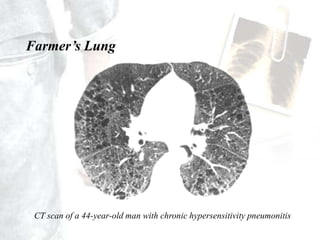
Agricultural Worker’s DiseasesFarmer’s Lunga hypersensitivity pneumonitis induced by inhalation of biological dusts
could progress into a potentially dangerous chronic condition.

Occupational Diseases

  • 1.
  • 2.
    Introduction“any chronic ailmentthat occurs as a result of work or occupational activity”
  • 3.
  • 4.
    It is calledwhen it is more prevalent in a given body of workers
  • 5.
    Should be distinguishablefrom injuries due to workplace hazardsOccur in varying time frames – from instantaneous development of symptoms to gradual development
  • 6.
    instantaneous reactions -exposure to chemicals such as chlorine or ammonia gas
  • 7.
    a delay ofsome six to twelve hours with fumes of aerosolized zinc
  • 8.
    a delay ofweeks to months with lead poisoning
  • 9.
    a delay ofdecades with occupational carcinogens
  • 10.
    even the findingof congenital malformations in children whose parents may have been exposed to hazardous materials
  • 11.
    So, deaths fromsuch diseases - difficult to enumerateSome Numbers...WHO - 100 million occupational injuries  0.1 million deaths in the world
  • 12.
    India  17million occupational non-fatal injuries (17% of the world) & 45,000 fatal injuries (45% of the total deaths due to occupational injuries in world) annually
  • 13.
    11 million casesof occupational diseases in the world  1.9 million cases (17%) contributed by India
  • 14.
    Of 0.7 milliondeaths in the world, 0.12 (17%) from India
  • 15.
    Adverse occupational factorshave been estimated to cost2-14% of the gross national products for various countriesClassificationI. Diseases due to physical agents:Heat: Heat hyperpyrexia, heat exhaustionCold: Trench foot, frost biteLight: Occupational cataract, miner’s nystagmusPressure: Caisson disease, air embolism, blast (explosion)Noise: Occupational deafnessRadiation: Cancer, leukaemia, aplastic anaemia, pancytopeniaII. Diseases due to chemical agents:Gases: Gas poisoningPneumoconiosisMetals and their compounds: Chemicals & Solvents
  • 16.
    III. Diseases due tobiological agents:Leptospirosis, anthrax, actinomycosis, tetanusIV. Occupational cancer:Cancer of skin, lungs, bladderV. Occupational dermatosis:Dermatitis, eczemaVI. Diseases of psychological origin:Industrial neurosis, hypertension, peptic ulcer, etc.
  • 17.
    Agricultural Worker’s DiseasesFarmer’sLunga hypersensitivity pneumonitis induced by inhalation of biological dusts
  • 18.
    could progress intoa potentially dangerous chronic condition.
  • 19.
    Fluid, protein andcells accumulate in the alveolar wall, slows blood-gas interchange and compromises the function of the lung.Silo filler's disease (SFD)pulmonary exposure to oxides of nitrogen – could manifest into pulmonary oedema
  • 20.
    Farmer’s LungCT scanof a 44-year-old man with chronic hypersensitivity pneumonitis
  • 21.
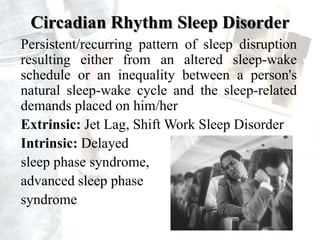
    Circadian Rhythm SleepDisorderPersistent/recurring pattern of sleep disruption resulting either from an altered sleep-wake schedule or an inequality between a person's natural sleep-wake cycle and the sleep-related demands placed on him/herExtrinsic: Jet Lag, Shift Work Sleep DisorderIntrinsic: Delayed sleep phase syndrome, advanced sleep phase syndrome
  • 22.
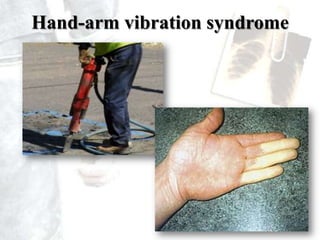
    Hand-arm vibration syndromeRepeatedand frequent use of hand-held vibrating tools/vibrating machinery (power drills, chainsaws, pneumatic drills)
  • 23.
    Probably due toslight but repeated injury to the small nerves and blood vessels in the fingers
  • 24.
    Raynaud's phenomenon (“whitefinger”) nerve symptoms, aches and painsHand-arm vibration syndrome
  • 25.
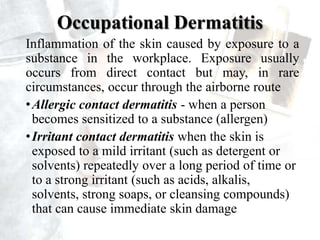
    Occupational DermatitisInflammation ofthe skin caused by exposure to a substance in the workplace. Exposure usually occurs from direct contact but may, in rare circumstances, occur through the airborne routeAllergic contact dermatitis- when a person becomes sensitized to a substance (allergen)
  • 26.
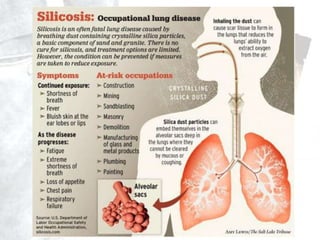
    Irritant contact dermatitiswhen the skin is exposed to a mild irritant (such as detergent or solvents) repeatedly over a long period of time or to a strong irritant (such as acids, alkalis, solvents, strong soaps, or cleansing compounds) that can cause immediate skin damagePneumoconiosischronic lung disease caused due to the inhalation of various forms of dust particles, particularly in industrial workplaces, for an extended period of time
  • 27.
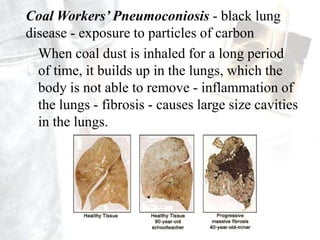
    Shortness of breath,wheezing and chronic coughing are some of the symptomsCoal Workers’ Pneumoconiosis - black lung disease - exposure to particles of carbon When coal dust is inhaled for a long period of time, it builds up in the lungs, which the body is not able to remove - inflammation of the lungs - fibrosis - causes large size cavities in the lungs.
  • 29.
    Asbestosis - inhalationof fibrous minerals of asbestos
  • 30.
    Bauxite fibrosis -exposure to bauxite fumes which contain aluminium and silica particles.
  • 31.
    Berylliosis - exposure toberyllium and its compounds
  • 32.
    Siderosis, by depositionof iron in the tissue
  • 33.
    Byssinosis “brown lungdisease”, caused by exposure to cotton dust in inadequately ventilated working environments
  • 34.
    Silicosiderosis, by mixeddust containing silica and ironPrevention MethodsMedical Methods such as periodic examinations, preplacement examinations, working environment supervision and health education.Notification, maintenance and analysis of records, and counselling are also steps towards prevention.
  • 35.
    Engineering Measures suchas proper design of plant, ventilation, dust isolation through enclosure and isolation, and protective devices.
  • 36.
    Legislative protection likethe Factories Act of 1948 and the Employees State Insurance Act of 1948. 
  • 37.
    Sources“Occupational Diseases” Encyclopedia ofPublic Health. Ed. Lester Breslow. Gale Cengage, 2002. eNotes.com. 2006. 9 Dec, 2010 
  • 38.
  • 39.
    U.S. National Libraryof Medicine website - http://www.nlm.nih.gov/
  • 40.