ACCIDENTS
    AND
  INJURIES
Dr. Muhammedirfan H. Momin
Assistant Professor
Community Medicine Department
Government Medical College, Surat.
ge
               rria
          M   a

      i
    d .
  a …
 h e
S k
 k ar
DEFINITIONS
• ACCIDENT
• Unexpected, unplanned occurrence of an event
  which may involve injury.
• In 1956 WHO advisory group defined accidents as
   – Unpremeditated event resulting in recognizable
     damage.
• Occurrence in a sequence of events which usually
  produce unintended injury, death or property
  damage.
DEFINITIONS
 INJURY

A bodily lesion due to acute exposure to energy
 beyond the physiological tolerance.
• Accidents are the part of prize we are
  paying for technological advances.

• Like other diseases accidents are also
  having –
      • Natural history of disease and
      • Agent, Host and Environmental factors
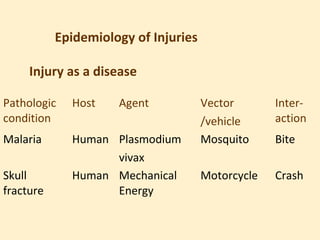
Epidemiology of Injuries

     Injury as a disease

Pathologic   Host    Agent            Vector       Inter-
condition                             /vehicle     action
Malaria      Human Plasmodium         Mosquito     Bite
                   vivax
Skull        Human Mechanical         Motorcycle   Crash
fracture           Energy
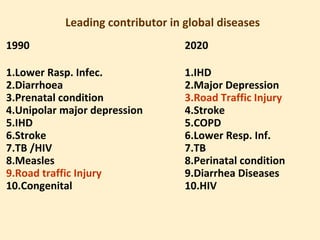
Leading contributor in global diseases
1990                              2020

1.Lower Rasp. Infec.              1.IHD
2.Diarrhoea                       2.Major Depression
3.Prenatal condition              3.Road Traffic Injury
4.Unipolar major depression       4.Stroke
5.IHD                             5.COPD
6.Stroke                          6.Lower Resp. Inf.
7.TB /HIV                         7.TB
8.Measles                         8.Perinatal condition
9.Road traffic Injury             9.Diarrhea Diseases
10.Congenital                     10.HIV
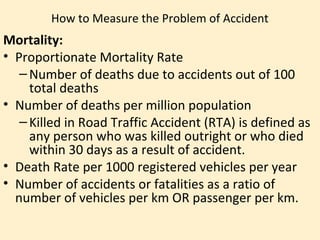
How to Measure the Problem of Accident
Mortality:
• Proportionate Mortality Rate
   – Number of deaths due to accidents out of 100
     total deaths
• Number of deaths per million population
   – Killed in Road Traffic Accident (RTA) is defined as
     any person who was killed outright or who died
     within 30 days as a result of accident.
• Death Rate per 1000 registered vehicles per year
• Number of accidents or fatalities as a ratio of
  number of vehicles per km OR passenger per km.
• Morbidity:
  – Measured in terms of
     • Slight injury and
     • Serious injury
• Disability:
  – Disability is one of the important outcome
    of accidents
     • Temporary or Permanent disability
     • Partial or Total disability
Problem statement
World:
• Accidents are endemic all over the world
• Accidents are major cause of deaths in the
  age-group of 10-24 yrs
In developed countries -
• 57% of male death and
• 43% of female death in 10-24 yrs are due to
  accidents.
• RTA and drowning are the main causes of
  death in that age-group.
In SEAR:
• Out of total 5.1 million accident deaths in the world 1/4th in
   SEAR.
• So thousands of children saved from Nutritional and
   infectious disease are killed by accidents.
India:
• Increasing trends in India due to
    – Mechanization in agriculture and industries
    – Increase in vehicular traffic
• Plus factors like
    – Overcrowding
    – Lack of awareness and
    – Poor implementation of safety precautions
Types of accidents
• Road Traffic Accidents (RTA)
• Domestic accidents
  – Drowning
  – Burns
  – Falls
• Industrial Accidents
• Railway accidents
• Violence
Causes of accidents
• Accidents are complex phenomena with
  multiple causation
• Etiological factors are classified to
  – Human
  – Environmental
  – Psychosocial factors
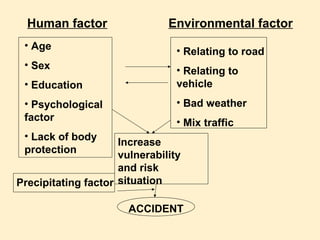
Human factor                 Environmental factor
 • Age
                                 • Relating to road
 • Sex
                                 • Relating to
 • Education                     vehicle
 • Psychological                 • Bad weather
 factor                          • Mix traffic
 • Lack of body
                     Increase
 protection
                     vulnerability
                     and risk
Precipitating factor situation

                       ACCIDENT
Human factor
• Age:15-44 yrs(50% mortality)
• Sex: More in males
• Education: Low educational status
• Medical condition
      • Sudden illness
      • Heart attack
      • Impaired vision
• Fatigue
• Lack of protection
   – Helmet
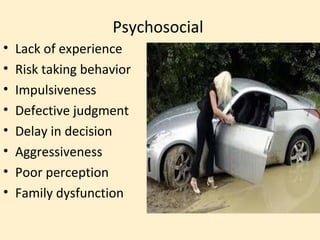
Psychosocial
•   Lack of experience
•   Risk taking behavior
•   Impulsiveness
•   Defective judgment
•   Delay in decision
•   Aggressiveness
•   Poor perception
•   Family dysfunction
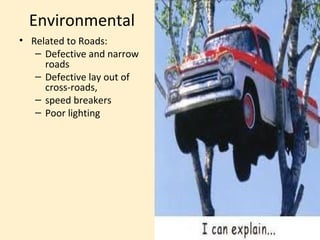
Environmental
• Related to Roads:
   – Defective and narrow
     roads
   – Defective lay out of
     cross-roads,
   – speed breakers
   – Poor lighting
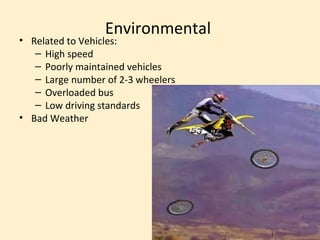
Environmental
• Related to Vehicles:
   – High speed
   – Poorly maintained vehicles
   – Large number of 2-3 wheelers
   – Overloaded bus
   – Low driving standards
• Bad Weather
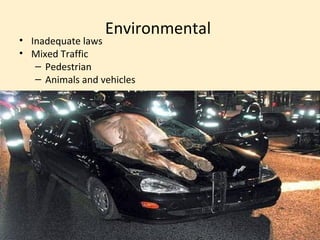
Environmental
• Inadequate laws
• Mixed Traffic
   – Pedestrian
   – Animals and vehicles
Precipitating factors
• Increased emotional tension
• Use of Alcohol during driving
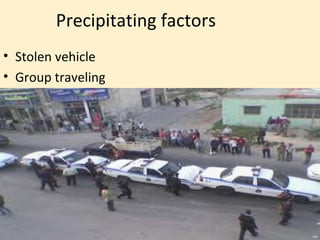
Precipitating factors
• Stolen vehicle
• Group traveling
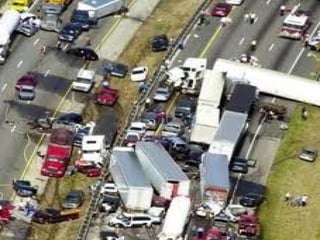
Road Traffic Accident


• “Road Safety is No Accident” – was the slogan given
  by WHO for World Health Day – 2004.

• 85% of all road accident deaths occur in developing
  countries and nearly half in the Asia-Pacific region.

• India has one of the largest highway and road
  networks second only to road network of U.S.
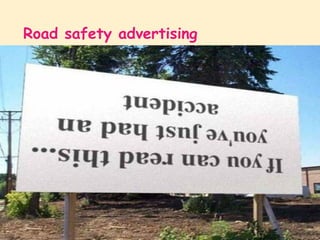
Road safety advertising
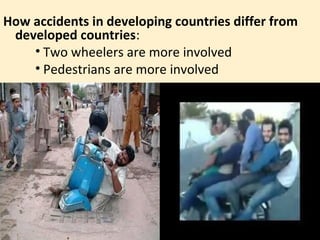
How accidents in developing countries differ from
 developed countries:
    • Two wheelers are more involved
    • Pedestrians are more involved
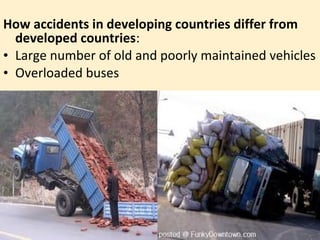
How accidents in developing countries differ from
  developed countries:
• Large number of old and poorly maintained vehicles
• Overloaded buses
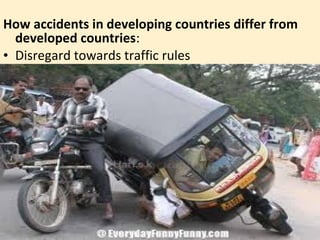
How accidents in developing countries differ from
  developed countries:
• Disregard towards traffic rules
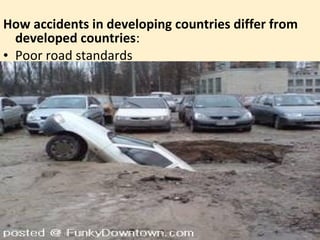
How accidents in developing countries differ from
  developed countries:
• Poor road standards
How accidents in developing countries differ from
  developed countries:
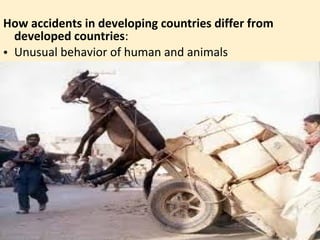
• Unusual behavior of human and animals
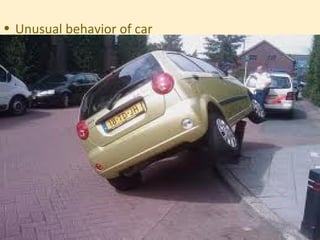
• Unusual behavior of car
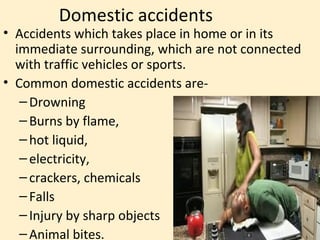
Domestic accidents
• Accidents which takes place in home or in its
  immediate surrounding, which are not connected
  with traffic vehicles or sports.
• Common domestic accidents are-
   – Drowning
   – Burns by flame,
   – hot liquid,
   – electricity,
   – crackers, chemicals
   – Falls
   – Injury by sharp objects
   – Animal bites.
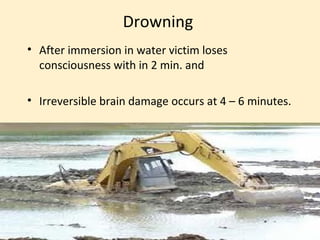
Drowning
• After immersion in water victim loses
  consciousness with in 2 min. and

• Irreversible brain damage occurs at 4 – 6 minutes.
Prevention and control of drowning

Availability of life jackets and flotation devices
around pools & boats

Supervision of children by adults

Fencing of lakes and ponds

Creation of safety standards for public and
private swimming pools

Ensuring availability of weather reports to fishermen and
 to those working on rivers and seas
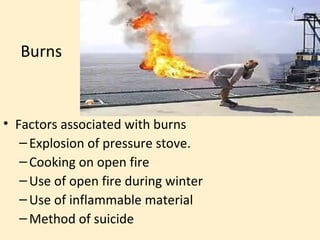
Burns


• Factors associated with burns
   – Explosion of pressure stove.
   – Cooking on open fire
   – Use of open fire during winter
   – Use of inflammable material
   – Method of suicide
Prevention and control of burns
 Stable stoves/lamps
 Replacement of pressure stoves with wick
 and gas stoves
 Installation of fire and smoke alarm
 Promotion of cold water for first aid and
 burns
Poisoning
• Most common agents are –
  – Kerosene
  – Pesticides
  – Household chemicals
  – Drugs

• Kerosene poisoning common among children.
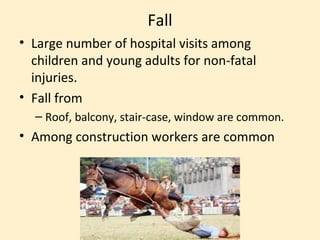
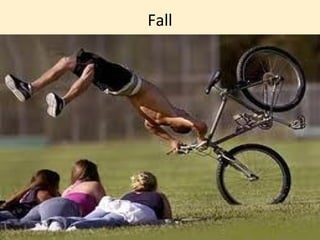
Fall
• Large number of hospital visits among
  children and young adults for non-fatal
  injuries.
• Fall from
  – Roof, balcony, stair-case, window are common.
• Among construction workers are common
Fall
• Prevention and control of falls

• 1.Safer playground (Use of mud & sand
  surfaces instead of paved ones)
• 2.Safer furniture & house designs
• 3.Use of grills on windows
• 4.Safer design of stairs, balconies and
  rooftops with railings and bars
• 5.Safer working techniques for construction
  workers
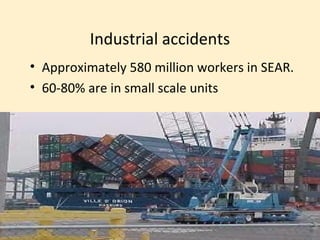
Industrial accidents
• Approximately 580 million workers in SEAR.
• 60-80% are in small scale units
 Prevention and control of industrial
  accidents

 Ensuring the cost effective protection
 measures
 Enforcing safety regulations and standards
 Creating awareness among workers
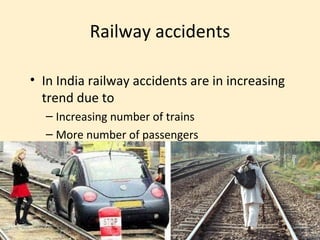
Railway accidents

• In India railway accidents are in increasing
  trend due to
  – Increasing number of trains
  – More number of passengers
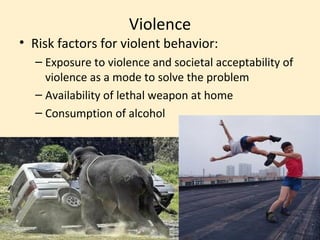
Violence
• Risk factors for violent behavior:
  – Exposure to violence and societal acceptability of
    violence as a mode to solve the problem
  – Availability of lethal weapon at home
  – Consumption of alcohol
• Suicide are increasing in SEAR region
  – 36/1,00,000 in India
  – 22/1,00,000 in Thailand
  – 11/1,00,000 in Bangladesh
  – 8/1,00,000 in Srilanka
• Common methods of suicide:
  – Hanging
  – Drowning
• 70% of cases of suicide in 15-35 yrs age
• M:F ratio is 1:13 to 1:3
Prevention of Accidents
• Multi-sectorial approach approach for
  prevention.
Data collection:
• Reporting system for accidents
• Special surveys for accidents
  – Risk factors
  – Circumstances
  – Chain of event
• No effective system of prevention without
  data collection.
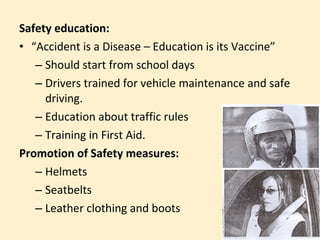
Safety education:
• “Accident is a Disease – Education is its Vaccine”
   – Should start from school days
   – Drivers trained for vehicle maintenance and safe
     driving.
   – Education about traffic rules
   – Training in First Aid.
Promotion of Safety measures:
   – Helmets
   – Seatbelts
   – Leather clothing and boots
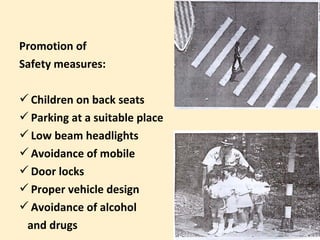
Promotion of
Safety measures:

 Children on back seats
 Parking at a suitable place
 Low beam headlights
 Avoidance of mobile
 Door locks
 Proper vehicle design
 Avoidance of alcohol
 and drugs
Alcohol and other Drugs:
• Alcohol - 30-50 % of RTA
• Alcohol and drugs like
• Barbiturates,
• Amphetamine must be avoided
Primary care
• Planning, Organization and Management of Trauma
  treatment and Emergency care
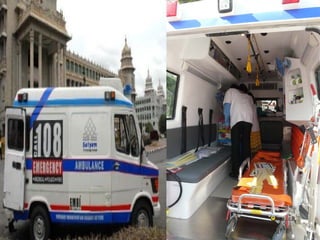
• Emergency care should begin at the site, continue
  during the transport and conclude in the hospital.
• Trauma care hospitals in all major cities
Elimination of Causative Factors:
   – Improper roads
   – Speed limits
   – Marking danger points
   – Fire guards
   – Use of safety equipments
   – Safe storage of drugs, poison and weapon.
Enforcement of Law
o Medical fitness of driver
o Alcohol conc. In blood (80 mg/100 ml limit in India)
o Driving test
o Seat belt wearing
o Speed limit
Enforcement of Law

o Helmets
o Vehicle inspection
o Periodic examination of drivers


Rehabilitation
   – Medical
   – Social
   – Occupational
Accident Research
THANK YOU

Wish you a safe journey of Life….

Accidents and injuries

  • 1.
    ACCIDENTS AND INJURIES Dr. Muhammedirfan H. Momin Assistant Professor Community Medicine Department Government Medical College, Surat.
  • 2.
    ge rria M a i d . a … h e S k k ar
  • 3.
    DEFINITIONS • ACCIDENT • Unexpected,unplanned occurrence of an event which may involve injury. • In 1956 WHO advisory group defined accidents as – Unpremeditated event resulting in recognizable damage. • Occurrence in a sequence of events which usually produce unintended injury, death or property damage.
  • 5.
    DEFINITIONS INJURY A bodilylesion due to acute exposure to energy beyond the physiological tolerance.
  • 7.
    • Accidents arethe part of prize we are paying for technological advances. • Like other diseases accidents are also having – • Natural history of disease and • Agent, Host and Environmental factors
  • 8.
    Epidemiology of Injuries Injury as a disease Pathologic Host Agent Vector Inter- condition /vehicle action Malaria Human Plasmodium Mosquito Bite vivax Skull Human Mechanical Motorcycle Crash fracture Energy
  • 9.
    Leading contributor inglobal diseases 1990 2020 1.Lower Rasp. Infec. 1.IHD 2.Diarrhoea 2.Major Depression 3.Prenatal condition 3.Road Traffic Injury 4.Unipolar major depression 4.Stroke 5.IHD 5.COPD 6.Stroke 6.Lower Resp. Inf. 7.TB /HIV 7.TB 8.Measles 8.Perinatal condition 9.Road traffic Injury 9.Diarrhea Diseases 10.Congenital 10.HIV
  • 10.
    How to Measurethe Problem of Accident Mortality: • Proportionate Mortality Rate – Number of deaths due to accidents out of 100 total deaths • Number of deaths per million population – Killed in Road Traffic Accident (RTA) is defined as any person who was killed outright or who died within 30 days as a result of accident. • Death Rate per 1000 registered vehicles per year • Number of accidents or fatalities as a ratio of number of vehicles per km OR passenger per km.
  • 12.
    • Morbidity: – Measured in terms of • Slight injury and • Serious injury • Disability: – Disability is one of the important outcome of accidents • Temporary or Permanent disability • Partial or Total disability
  • 13.
    Problem statement World: • Accidentsare endemic all over the world • Accidents are major cause of deaths in the age-group of 10-24 yrs In developed countries - • 57% of male death and • 43% of female death in 10-24 yrs are due to accidents. • RTA and drowning are the main causes of death in that age-group.
  • 14.
    In SEAR: • Outof total 5.1 million accident deaths in the world 1/4th in SEAR. • So thousands of children saved from Nutritional and infectious disease are killed by accidents. India: • Increasing trends in India due to – Mechanization in agriculture and industries – Increase in vehicular traffic • Plus factors like – Overcrowding – Lack of awareness and – Poor implementation of safety precautions
  • 15.
    Types of accidents •Road Traffic Accidents (RTA) • Domestic accidents – Drowning – Burns – Falls • Industrial Accidents • Railway accidents • Violence
  • 16.
    Causes of accidents •Accidents are complex phenomena with multiple causation • Etiological factors are classified to – Human – Environmental – Psychosocial factors
  • 17.
    Human factor Environmental factor • Age • Relating to road • Sex • Relating to • Education vehicle • Psychological • Bad weather factor • Mix traffic • Lack of body Increase protection vulnerability and risk Precipitating factor situation ACCIDENT
  • 18.
    Human factor • Age:15-44yrs(50% mortality) • Sex: More in males • Education: Low educational status • Medical condition • Sudden illness • Heart attack • Impaired vision • Fatigue • Lack of protection – Helmet
  • 19.
    Psychosocial • Lack of experience • Risk taking behavior • Impulsiveness • Defective judgment • Delay in decision • Aggressiveness • Poor perception • Family dysfunction
  • 20.
    Environmental • Related toRoads: – Defective and narrow roads – Defective lay out of cross-roads, – speed breakers – Poor lighting
  • 21.
    Environmental • Related toVehicles: – High speed – Poorly maintained vehicles – Large number of 2-3 wheelers – Overloaded bus – Low driving standards • Bad Weather
  • 22.
    Environmental • Inadequate laws •Mixed Traffic – Pedestrian – Animals and vehicles
  • 23.
    Precipitating factors • Increasedemotional tension • Use of Alcohol during driving
  • 24.
    Precipitating factors • Stolenvehicle • Group traveling
  • 25.
    Road Traffic Accident •“Road Safety is No Accident” – was the slogan given by WHO for World Health Day – 2004. • 85% of all road accident deaths occur in developing countries and nearly half in the Asia-Pacific region. • India has one of the largest highway and road networks second only to road network of U.S.
  • 26.
  • 27.
    How accidents indeveloping countries differ from developed countries: • Two wheelers are more involved • Pedestrians are more involved
  • 28.
    How accidents indeveloping countries differ from developed countries: • Large number of old and poorly maintained vehicles • Overloaded buses
  • 29.
    How accidents indeveloping countries differ from developed countries: • Disregard towards traffic rules
  • 30.
    How accidents indeveloping countries differ from developed countries: • Poor road standards
  • 31.
    How accidents indeveloping countries differ from developed countries: • Unusual behavior of human and animals
  • 32.
  • 34.
    Domestic accidents • Accidentswhich takes place in home or in its immediate surrounding, which are not connected with traffic vehicles or sports. • Common domestic accidents are- – Drowning – Burns by flame, – hot liquid, – electricity, – crackers, chemicals – Falls – Injury by sharp objects – Animal bites.
  • 35.
    Drowning • After immersionin water victim loses consciousness with in 2 min. and • Irreversible brain damage occurs at 4 – 6 minutes.
  • 37.
    Prevention and controlof drowning Availability of life jackets and flotation devices around pools & boats Supervision of children by adults Fencing of lakes and ponds Creation of safety standards for public and private swimming pools Ensuring availability of weather reports to fishermen and to those working on rivers and seas
  • 38.
    Burns • Factors associatedwith burns – Explosion of pressure stove. – Cooking on open fire – Use of open fire during winter – Use of inflammable material – Method of suicide
  • 39.
    Prevention and controlof burns  Stable stoves/lamps  Replacement of pressure stoves with wick and gas stoves  Installation of fire and smoke alarm  Promotion of cold water for first aid and burns
  • 40.
    Poisoning • Most commonagents are – – Kerosene – Pesticides – Household chemicals – Drugs • Kerosene poisoning common among children.
  • 41.
    Fall • Large numberof hospital visits among children and young adults for non-fatal injuries. • Fall from – Roof, balcony, stair-case, window are common. • Among construction workers are common
  • 42.
  • 43.
    • Prevention andcontrol of falls • 1.Safer playground (Use of mud & sand surfaces instead of paved ones) • 2.Safer furniture & house designs • 3.Use of grills on windows • 4.Safer design of stairs, balconies and rooftops with railings and bars • 5.Safer working techniques for construction workers
  • 44.
    Industrial accidents • Approximately580 million workers in SEAR. • 60-80% are in small scale units
  • 45.
     Prevention andcontrol of industrial accidents  Ensuring the cost effective protection measures  Enforcing safety regulations and standards  Creating awareness among workers
  • 46.
    Railway accidents • InIndia railway accidents are in increasing trend due to – Increasing number of trains – More number of passengers
  • 48.
    Violence • Risk factorsfor violent behavior: – Exposure to violence and societal acceptability of violence as a mode to solve the problem – Availability of lethal weapon at home – Consumption of alcohol
  • 49.
    • Suicide areincreasing in SEAR region – 36/1,00,000 in India – 22/1,00,000 in Thailand – 11/1,00,000 in Bangladesh – 8/1,00,000 in Srilanka • Common methods of suicide: – Hanging – Drowning • 70% of cases of suicide in 15-35 yrs age • M:F ratio is 1:13 to 1:3
  • 50.
    Prevention of Accidents •Multi-sectorial approach approach for prevention. Data collection: • Reporting system for accidents • Special surveys for accidents – Risk factors – Circumstances – Chain of event • No effective system of prevention without data collection.
  • 53.
    Safety education: • “Accidentis a Disease – Education is its Vaccine” – Should start from school days – Drivers trained for vehicle maintenance and safe driving. – Education about traffic rules – Training in First Aid. Promotion of Safety measures: – Helmets – Seatbelts – Leather clothing and boots
  • 54.
    Promotion of Safety measures: Children on back seats  Parking at a suitable place  Low beam headlights  Avoidance of mobile  Door locks  Proper vehicle design  Avoidance of alcohol and drugs
  • 55.
    Alcohol and otherDrugs: • Alcohol - 30-50 % of RTA • Alcohol and drugs like • Barbiturates, • Amphetamine must be avoided Primary care • Planning, Organization and Management of Trauma treatment and Emergency care • Emergency care should begin at the site, continue during the transport and conclude in the hospital. • Trauma care hospitals in all major cities
  • 58.
    Elimination of CausativeFactors: – Improper roads – Speed limits – Marking danger points – Fire guards – Use of safety equipments – Safe storage of drugs, poison and weapon. Enforcement of Law o Medical fitness of driver o Alcohol conc. In blood (80 mg/100 ml limit in India) o Driving test o Seat belt wearing o Speed limit
  • 60.
    Enforcement of Law oHelmets o Vehicle inspection o Periodic examination of drivers Rehabilitation – Medical – Social – Occupational Accident Research
  • 61.
    THANK YOU Wish youa safe journey of Life….