April 28, 2018
Dr.Praveen Nagula, MD,DM
CARE Hospitals, Banjara Hills,
Hyderabad
A single risk factor…is not sufficiently sensitive to identify
all individuals at high risk of coronary artery disease.
- Assmann & Schulte,1990
Epidemiology of CAD
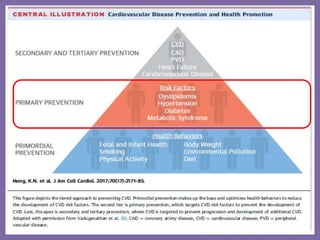
What is meant by primary prevention ?
• Primary prevention is action taken prior to the onset of
disease, which removes the possibility that a disease will
ever occur.
• Prepathogenesis phase of disease.
• Prevent adverse events such as MI, Stroke .
• Ability to tailor therapy to higher risk individuals before the
development of clinical significant atherosclerotic disease.
• Screening and health examination techniques.
Epping-Jordan JE, Galea G, Tukuitonga C, Beaglehole R. Preventing chronic
diseases: taking stepwise action. Lancet. Nov 5 2005;366(9497):1667-1671.
RISK FACTORS FOR HEART DISEASE
Non Modifiable Risk
factors
Modifiable Risk factors Novel Factors
AGE SMOKING C REACTIVE PROTEIN
GENDER HYPERLIPIDEMIA FIBRINOGEN
ETHNICITY HYPERTENSION CORONARY ARTERY
CALCIFICATION
FAMILY HISTORY DIABETES HOMOCYSTEINE
PREVIOUS
CARDIOVASCULAR
EVENT
OBESITY LIPOPROTEIN A
PHYSICAL INACTIVITY SMALL DENSE LDL
RENAL DISEASE
APOB / APOA1 RATIO
HIV
Priamary prevention costs
RISK FACTOR MODIFICATION
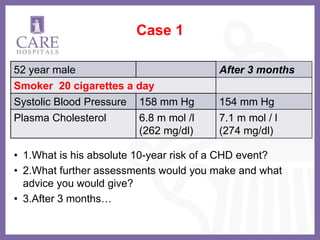
Case 1
• 1.What is his absolute 10-year risk of a CHD event?
• 2.What further assessments would you make and what
advice you would give?
• 3.After 3 months…
52 year male
Smoker 20 cigarettes a day
Systolic Blood Pressure 158 mm Hg
Plasma Cholesterol 6.8 m mol /l
(262 mg/dl)
After 3 months
154 mm Hg
7.1 m mol / l
(274 mg/dl)
• 1. Minimum estimate of the 10 year risk is 20-40%.
• 2. Assess BMI, Alcohol intake, family history, history of
diabetes mellitus, diastolic blood pressure, physical activity.
– Advise the patient – to stop smoking, to change diet to reduce fat
intake and increase intake of fruit and vegetables to achieve ideal
body weight
– To achieve recommended levels of physical activity.
• 3. Minimum estimate of the 10 year risk is 10-20%
representing a reduction by half in risk. BMI within 10% of
ideal limits. DBP – 86 mmHg
• Further investigation of cholesterol elevation is
required.
Smoking
• 60 substances of 4000 chemicals, are known or suspected
carcinogens – IARC 1986 ( class A carcinogen).
• Nicotine – diffuses into blood stream very quickly.
• 1mg of nicotine in one cigarette.
• Level of CO in a smoker’s body depends upon number of
cigarettes smoked and how they are smoked.
• Formaldehyde, ammonia, benzene, tar.
IARC – International Agency for Research on Cancer ,WHO
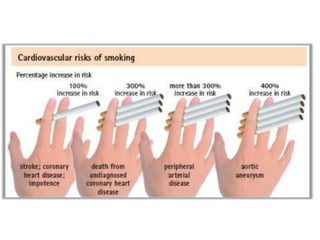
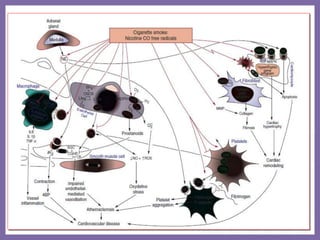
Smoking and CHD
• Nicotine and CO are the main culprits.
• It promotes the development of lesions, thus creating sites
susceptible to blockage, and promotes the occurrence of
triggering events that lead to blockage.
• Nicotine stimulation of adrenergic drive – increases BP
and myocardial oxygen demand.
• Passive smoking decreases the ability of the heart to
receive and process oxygen.
• Decreases the ability of the blood to deliver oxygen.
• Independent and synergistic
E cigarettes
• Evidence remains controversial regarding its beneficial
role in quitting smoking.
Why do smokers continue to smoke ?
• Drug dependence – addictive nature of nicotine
• Enjoyment – enjoy the taste and ritual handling of the
cigarette
• Relaxation – means of relieving stress ,calm the nerves
• Concentration –as an aid to concentrate
• Health beliefs
• Weight control – delays the stomach emptying, speeds up
the colon.
• Mood control
• Fear of failure
How do smokers stop smoking ?
• Cycle of change model
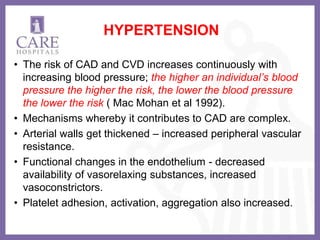
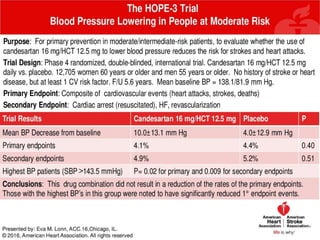
HYPERTENSION
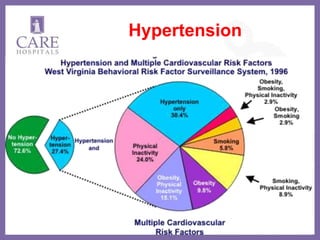
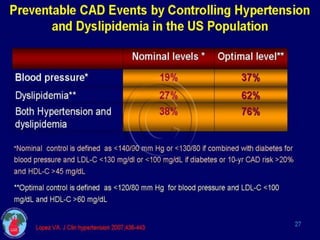
• The risk of CAD and CVD increases continuously with
increasing blood pressure; the higher an individual’s blood
pressure the higher the risk, the lower the blood pressure
the lower the risk ( Mac Mohan et al 1992).
• Mechanisms whereby it contributes to CAD are complex.
• Arterial walls get thickened – increased peripheral vascular
resistance.
• Functional changes in the endothelium - decreased
availability of vasorelaxing substances, increased
vasoconstrictors.
• Platelet adhesion, activation, aggregation also increased.
Hypertension
Long Term Health Benefit of Reduced Salt Intake in Teenagers
by the Time they are 50 Years of Age
Percent reduction Absolute number
7 to 12% in coronary artery disease 120,000 to 210,000
8 to 14% reduction in heart attacks 36,000 to 64,000
5 to 8% reduction in stroke 16,000 to 28,000
5 to 9% reduction in death from any
cause
69,000 to 120,000
Less salt in teenagers’ diet may improve heart health in adulthood.American
Heart Association Meeting Report – Abstract 18899/P2039 Co-authors are:
Pamela Coxson, Ph.D.; Tekeshe Mekonnen, M.S.; David Guzman, M.S.; and
Lee Goldman, M.D., M.P.H. abstract
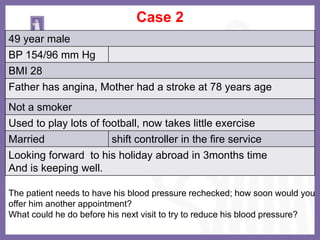
Case 2
49 year male
BP 154/96 mm Hg
BMI 28
Father has angina, Mother had a stroke at 78 years age
Not a smoker
Used to play lots of football, now takes little exercise
Married shift controller in the fire service
Looking forward to his holiday abroad in 3months time
And is keeping well.
The patient needs to have his blood pressure rechecked; how soon would you
offer him another appointment?
What could he do before his next visit to try to reduce his blood pressure?
• 1.Blood pressure to be checked again 4 weeks apart.
apart
• 2.Diet and exercise patterns.
• 3.Reduce his calorie intake, take foods high in fibre, and
vitamin C.
• 4.Amount of salt he consumes per day.
• 5. Amount of alcohol and coffee he takes.
Diabetes mellitus
• Cardiovascular disease equivalent
• Strong CV risk factor in women – diminish the relative
protection against atherosclerotic disease that the female
hormones confer.
• Two to four fold increase in risk of CAD compared to
general population
• Elevated plasma insulin levels is the main culprit in the
pathogenesis contribution to CHD.
– Hypertriglyceridemia, Increased LDL
– Proliferation of smooth muscles
– Increased growth factors
– Increased transport of cholesterol to smooth muscle cells
Obesity
Obstructive Sleep Apnea
Psychological Stress
INTERVENTIONS
ABCDE approach
• A – Assessment of Risk
• B – Blood Pressure
• C - Cholesterol
Cigarette smoking cessation
• D – Diet and weight management
Diabetes prevention and Treatment
• E - Exercise
ACE inhibitor/ARBs
• Advantages beyond blood pressure reduction.
• Regresses left ventricular mass in patients with Left
ventricular hypertrophy.
• Anti atherogenic effects
• Beneficial influence on Insulin resistance
Beta-blockers
• Based on the available evidence, there seems to be little or
no difference between commonly used blood pressure
lowering medications with regards cardiovascular risk
reduction.
• Beta-blockers (atenolol) and alpha-blockers are the only
drug-classes that were not significantly superior to any
other drugs, for any outcome, and may thus not be prime
candidates for first-line antihypertensive treatment.
Case 3
42 year Male
Brother (39) dies of an acute MI
Father died of an MI (50), Mother (68), well and asymptomatic
Brother (40), having angina. His two sons are healthy
Non smoker
Plays Golf every Sunday
BP – 135/90 mm Hg BMI 26
Total cholesterol 8.6 mmol/l TG 2.1 mmol /l HDL 0.95 mmol/L
Glucose 5.0 mmol/L
Does his history suggest any possible specific diagnosis?
How should the man be managed?
What advice would you offer him regarding his family?
• High risk patient.
• Type IIa hyperlipoproteinemia
• Familial hypercholesterolemia
• Lifestyle advice
• Lipid lowering therapy – Statin
• Sons should be screened, as they have a 50% chance of
inheriting his faulty LDL receptor gene.
• ECG, CXR, exercise test to be done.
STATINS AND PRIMARY
PREVENTION
• The available research supports the benefit of statins for
primary prevention of cardiovascular disease in selected
asymptomatic patients.
• Not the only way to reduce cardiovascular risk.
• Statins are not a substitute for smoking cessation, treating
hypertension, maintaining a healthy weight, eating a
healthy diet, and exercising regularly.
Diet
• Include protein at each meal and snack – protein is most
satiating, helps avoid excess eating.
• Vegetable and marine sources of protein to be encouraged.
(2 fish meals,2 vegetable protein meals weekly).
• Increase fiber intake – earlier satiety, decreases the
metabolizable energy content of the diet especially fat.
• Front load calories – calorically heavier meals at the
beginning of the day – reduces the feeling of fatigue.
• Divide calories into six meals rather than three meals.
Healthy Diet Characteristics
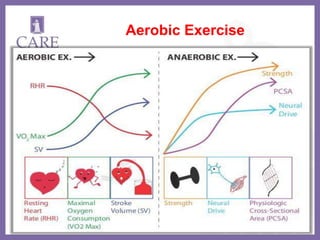
Aerobic Exercise
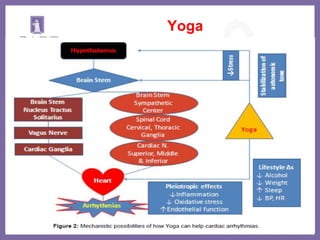
Yoga
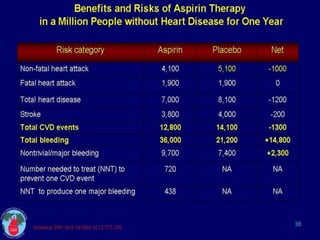
Aspirin
• To be used for secondary prevention.
• To be avoided in primary prevention in those without
comorbidities - increased bleeding risk, no evidence of CVD
risk reduction.
In patients with DM the advice is conflicting:
• ESC guidelines - bleeding risk exceeds the benefits of
aspiring therapy,
• ACCP- with DM and 10-year CVD event risk of 10%.
Which of the following is not a primary prevention ?
• A. Aerobic Exercise and an healthy diet
• B. 45 years male, post MI using beta blockers, ACEI
• C. HbA1C < 6.0% on metformin
• D. LDL <100mg/dl on statins
• B
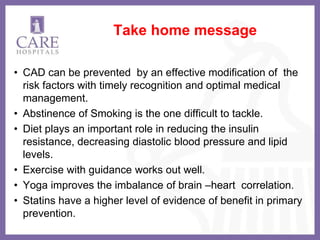
Take home message
• CAD can be prevented by an effective modification of the
risk factors with timely recognition and optimal medical
management.
• Abstinence of Smoking is the one difficult to tackle.
• Diet plays an important role in reducing the insulin
resistance, decreasing diastolic blood pressure and lipid
levels.
• Exercise with guidance works out well.
• Yoga improves the imbalance of brain –heart correlation.
• Statins have a higher level of evidence of benefit in primary
prevention.
CAD -RISK FACTOR MODIFICATION AND PRIMARY PREVENTION

CAD -RISK FACTOR MODIFICATION AND PRIMARY PREVENTION

  • 1.
    April 28, 2018 Dr.PraveenNagula, MD,DM CARE Hospitals, Banjara Hills, Hyderabad
  • 2.
    A single riskfactor…is not sufficiently sensitive to identify all individuals at high risk of coronary artery disease. - Assmann & Schulte,1990
  • 4.
  • 6.
    What is meantby primary prevention ? • Primary prevention is action taken prior to the onset of disease, which removes the possibility that a disease will ever occur. • Prepathogenesis phase of disease. • Prevent adverse events such as MI, Stroke . • Ability to tailor therapy to higher risk individuals before the development of clinical significant atherosclerotic disease. • Screening and health examination techniques. Epping-Jordan JE, Galea G, Tukuitonga C, Beaglehole R. Preventing chronic diseases: taking stepwise action. Lancet. Nov 5 2005;366(9497):1667-1671.
  • 8.
    RISK FACTORS FORHEART DISEASE Non Modifiable Risk factors Modifiable Risk factors Novel Factors AGE SMOKING C REACTIVE PROTEIN GENDER HYPERLIPIDEMIA FIBRINOGEN ETHNICITY HYPERTENSION CORONARY ARTERY CALCIFICATION FAMILY HISTORY DIABETES HOMOCYSTEINE PREVIOUS CARDIOVASCULAR EVENT OBESITY LIPOPROTEIN A PHYSICAL INACTIVITY SMALL DENSE LDL RENAL DISEASE APOB / APOA1 RATIO HIV
  • 9.
  • 11.
  • 12.
    Case 1 • 1.Whatis his absolute 10-year risk of a CHD event? • 2.What further assessments would you make and what advice you would give? • 3.After 3 months… 52 year male Smoker 20 cigarettes a day Systolic Blood Pressure 158 mm Hg Plasma Cholesterol 6.8 m mol /l (262 mg/dl) After 3 months 154 mm Hg 7.1 m mol / l (274 mg/dl)
  • 13.
    • 1. Minimumestimate of the 10 year risk is 20-40%. • 2. Assess BMI, Alcohol intake, family history, history of diabetes mellitus, diastolic blood pressure, physical activity. – Advise the patient – to stop smoking, to change diet to reduce fat intake and increase intake of fruit and vegetables to achieve ideal body weight – To achieve recommended levels of physical activity. • 3. Minimum estimate of the 10 year risk is 10-20% representing a reduction by half in risk. BMI within 10% of ideal limits. DBP – 86 mmHg • Further investigation of cholesterol elevation is required.
  • 14.
    Smoking • 60 substancesof 4000 chemicals, are known or suspected carcinogens – IARC 1986 ( class A carcinogen). • Nicotine – diffuses into blood stream very quickly. • 1mg of nicotine in one cigarette. • Level of CO in a smoker’s body depends upon number of cigarettes smoked and how they are smoked. • Formaldehyde, ammonia, benzene, tar. IARC – International Agency for Research on Cancer ,WHO
  • 16.
    Smoking and CHD •Nicotine and CO are the main culprits. • It promotes the development of lesions, thus creating sites susceptible to blockage, and promotes the occurrence of triggering events that lead to blockage. • Nicotine stimulation of adrenergic drive – increases BP and myocardial oxygen demand. • Passive smoking decreases the ability of the heart to receive and process oxygen. • Decreases the ability of the blood to deliver oxygen. • Independent and synergistic
  • 19.
    E cigarettes • Evidenceremains controversial regarding its beneficial role in quitting smoking.
  • 20.
    Why do smokerscontinue to smoke ? • Drug dependence – addictive nature of nicotine • Enjoyment – enjoy the taste and ritual handling of the cigarette • Relaxation – means of relieving stress ,calm the nerves • Concentration –as an aid to concentrate • Health beliefs • Weight control – delays the stomach emptying, speeds up the colon. • Mood control • Fear of failure
  • 21.
    How do smokersstop smoking ? • Cycle of change model
  • 22.
    HYPERTENSION • The riskof CAD and CVD increases continuously with increasing blood pressure; the higher an individual’s blood pressure the higher the risk, the lower the blood pressure the lower the risk ( Mac Mohan et al 1992). • Mechanisms whereby it contributes to CAD are complex. • Arterial walls get thickened – increased peripheral vascular resistance. • Functional changes in the endothelium - decreased availability of vasorelaxing substances, increased vasoconstrictors. • Platelet adhesion, activation, aggregation also increased.
  • 24.
  • 25.
    Long Term HealthBenefit of Reduced Salt Intake in Teenagers by the Time they are 50 Years of Age Percent reduction Absolute number 7 to 12% in coronary artery disease 120,000 to 210,000 8 to 14% reduction in heart attacks 36,000 to 64,000 5 to 8% reduction in stroke 16,000 to 28,000 5 to 9% reduction in death from any cause 69,000 to 120,000 Less salt in teenagers’ diet may improve heart health in adulthood.American Heart Association Meeting Report – Abstract 18899/P2039 Co-authors are: Pamela Coxson, Ph.D.; Tekeshe Mekonnen, M.S.; David Guzman, M.S.; and Lee Goldman, M.D., M.P.H. abstract
  • 28.
    Case 2 49 yearmale BP 154/96 mm Hg BMI 28 Father has angina, Mother had a stroke at 78 years age Not a smoker Used to play lots of football, now takes little exercise Married shift controller in the fire service Looking forward to his holiday abroad in 3months time And is keeping well. The patient needs to have his blood pressure rechecked; how soon would you offer him another appointment? What could he do before his next visit to try to reduce his blood pressure?
  • 29.
    • 1.Blood pressureto be checked again 4 weeks apart. apart • 2.Diet and exercise patterns. • 3.Reduce his calorie intake, take foods high in fibre, and vitamin C. • 4.Amount of salt he consumes per day. • 5. Amount of alcohol and coffee he takes.
  • 30.
    Diabetes mellitus • Cardiovasculardisease equivalent • Strong CV risk factor in women – diminish the relative protection against atherosclerotic disease that the female hormones confer. • Two to four fold increase in risk of CAD compared to general population • Elevated plasma insulin levels is the main culprit in the pathogenesis contribution to CHD. – Hypertriglyceridemia, Increased LDL – Proliferation of smooth muscles – Increased growth factors – Increased transport of cholesterol to smooth muscle cells
  • 32.
  • 34.
  • 35.
  • 36.
  • 37.
    ABCDE approach • A– Assessment of Risk • B – Blood Pressure • C - Cholesterol Cigarette smoking cessation • D – Diet and weight management Diabetes prevention and Treatment • E - Exercise
  • 38.
    ACE inhibitor/ARBs • Advantagesbeyond blood pressure reduction. • Regresses left ventricular mass in patients with Left ventricular hypertrophy. • Anti atherogenic effects • Beneficial influence on Insulin resistance
  • 40.
    Beta-blockers • Based onthe available evidence, there seems to be little or no difference between commonly used blood pressure lowering medications with regards cardiovascular risk reduction. • Beta-blockers (atenolol) and alpha-blockers are the only drug-classes that were not significantly superior to any other drugs, for any outcome, and may thus not be prime candidates for first-line antihypertensive treatment.
  • 41.
    Case 3 42 yearMale Brother (39) dies of an acute MI Father died of an MI (50), Mother (68), well and asymptomatic Brother (40), having angina. His two sons are healthy Non smoker Plays Golf every Sunday BP – 135/90 mm Hg BMI 26 Total cholesterol 8.6 mmol/l TG 2.1 mmol /l HDL 0.95 mmol/L Glucose 5.0 mmol/L Does his history suggest any possible specific diagnosis? How should the man be managed? What advice would you offer him regarding his family?
  • 42.
    • High riskpatient. • Type IIa hyperlipoproteinemia • Familial hypercholesterolemia • Lifestyle advice • Lipid lowering therapy – Statin • Sons should be screened, as they have a 50% chance of inheriting his faulty LDL receptor gene. • ECG, CXR, exercise test to be done.
  • 43.
    STATINS AND PRIMARY PREVENTION •The available research supports the benefit of statins for primary prevention of cardiovascular disease in selected asymptomatic patients. • Not the only way to reduce cardiovascular risk. • Statins are not a substitute for smoking cessation, treating hypertension, maintaining a healthy weight, eating a healthy diet, and exercising regularly.
  • 47.
    Diet • Include proteinat each meal and snack – protein is most satiating, helps avoid excess eating. • Vegetable and marine sources of protein to be encouraged. (2 fish meals,2 vegetable protein meals weekly). • Increase fiber intake – earlier satiety, decreases the metabolizable energy content of the diet especially fat. • Front load calories – calorically heavier meals at the beginning of the day – reduces the feeling of fatigue. • Divide calories into six meals rather than three meals.
  • 48.
  • 49.
  • 51.
  • 52.
    Aspirin • To beused for secondary prevention. • To be avoided in primary prevention in those without comorbidities - increased bleeding risk, no evidence of CVD risk reduction. In patients with DM the advice is conflicting: • ESC guidelines - bleeding risk exceeds the benefits of aspiring therapy, • ACCP- with DM and 10-year CVD event risk of 10%.
  • 54.
    Which of thefollowing is not a primary prevention ? • A. Aerobic Exercise and an healthy diet • B. 45 years male, post MI using beta blockers, ACEI • C. HbA1C < 6.0% on metformin • D. LDL <100mg/dl on statins • B
  • 55.
    Take home message •CAD can be prevented by an effective modification of the risk factors with timely recognition and optimal medical management. • Abstinence of Smoking is the one difficult to tackle. • Diet plays an important role in reducing the insulin resistance, decreasing diastolic blood pressure and lipid levels. • Exercise with guidance works out well. • Yoga improves the imbalance of brain –heart correlation. • Statins have a higher level of evidence of benefit in primary prevention.