Social Learning Theory
“
“One difficulty with many learning theories is their
One difficulty with many learning theories is their
almost exclusive emphasis on the processes of
acquisition of behavior and performance, and their
almost total neglect of the content of personality”
~Julian Rotter, 1972
Radical Behaviorism
Radical Behaviorism
Pros and Cons
Pros and Cons
• Pros: “Scientific”
Pros: “Scientific”
– Deals with observable, measurable
Deals with observable, measurable
phenomena
phenomena
– Rigorous methodology
Rigorous methodology
• Con: Ignores the things that make
Con: Ignores the things that make
humans “human”
humans “human”
– Cognitions
Cognitions
– Emotions
Emotions
– “
“Free Will”
Free Will”
Therefore….
Therefore….
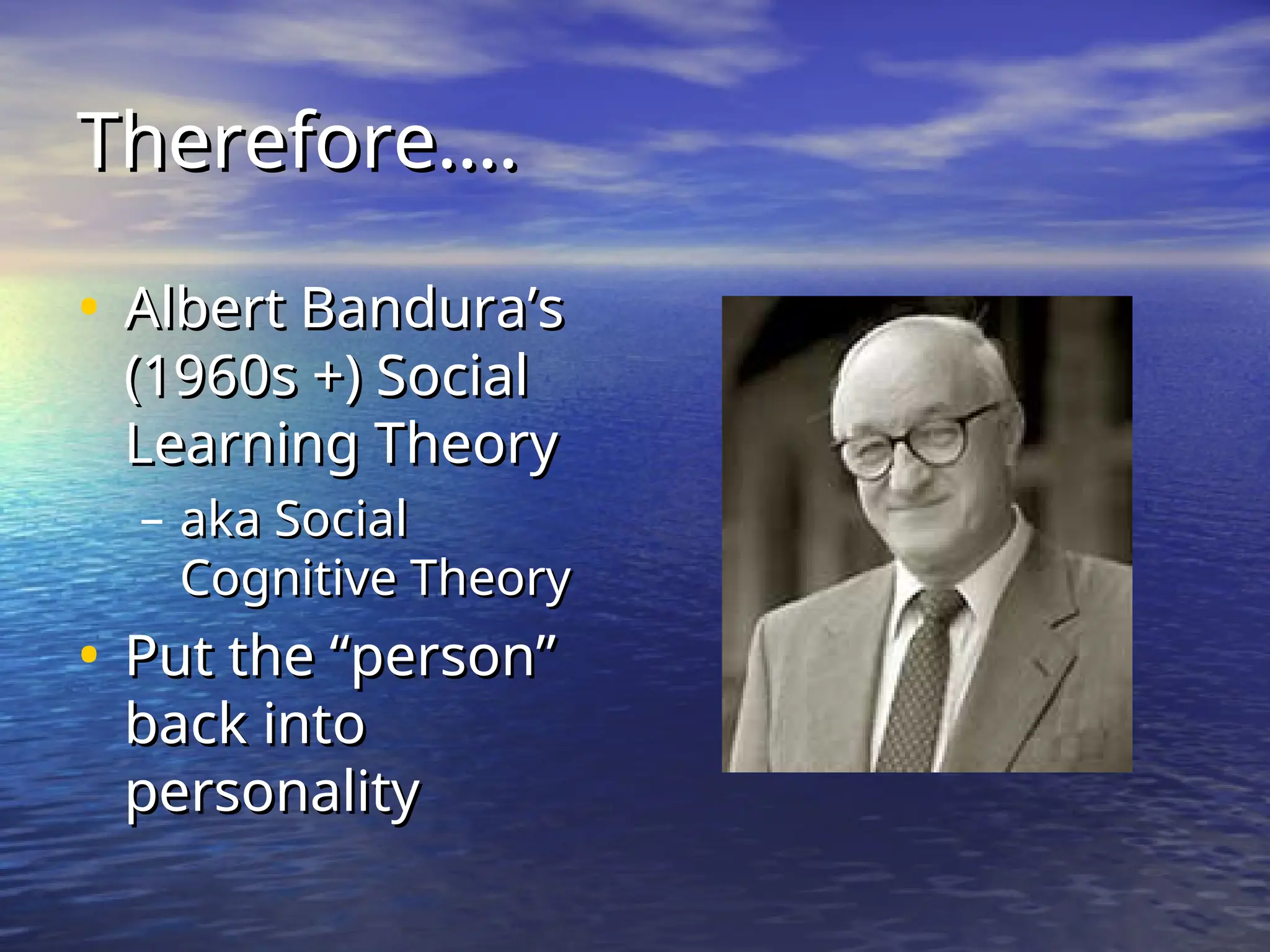
• Albert Bandura’s
Albert Bandura’s
(1960s +) Social
(1960s +) Social
Learning Theory
Learning Theory
– aka Social
aka Social
Cognitive Theory
Cognitive Theory
• Put the “person”
Put the “person”
back into
back into
personality
personality
Theoretical Foundations of
Social Learning Theory
• Psychodynamic explanations of behavior are
Psychodynamic explanations of behavior are
flawed
flawed
– They are based on
They are based on inferred
inferred drives/needs/etc.,
drives/needs/etc.,
which cannot be tested
– They ignore
They ignore conscious
conscious cognitions
cognitions
– They ignore situational influences
They ignore situational influences
• Radical behaviorism is flawed
Radical behaviorism is flawed
– It ignores cognition and emotion (Rotter’s
It ignores cognition and emotion (Rotter’s
“content of personality”)
• e.g., Assumes that
e.g., Assumes that actual reinforcement
actual reinforcement is necessary for
is necessary for
learning to occur
learning to occur
• e.g., Rejects free will
e.g., Rejects free will
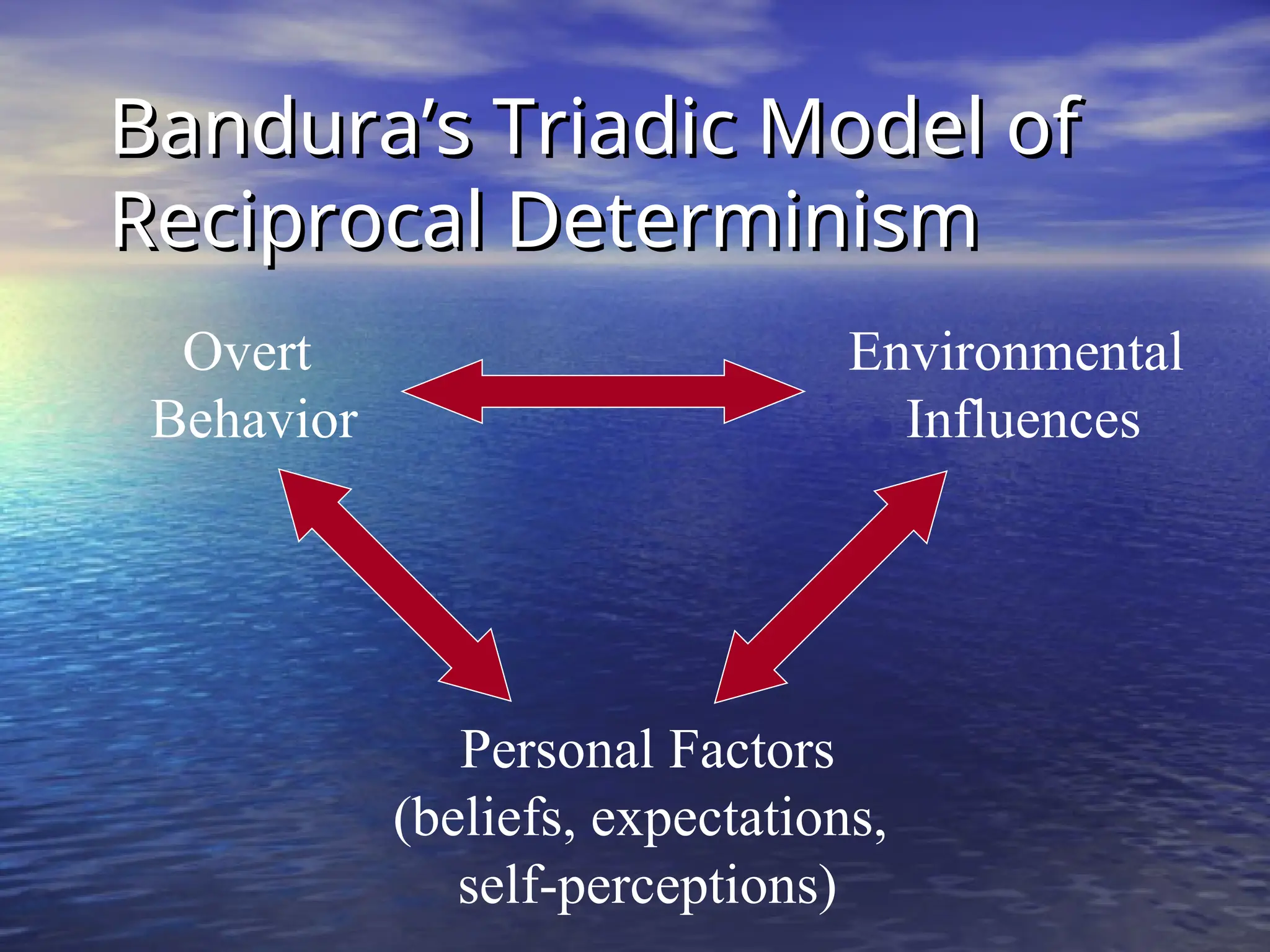
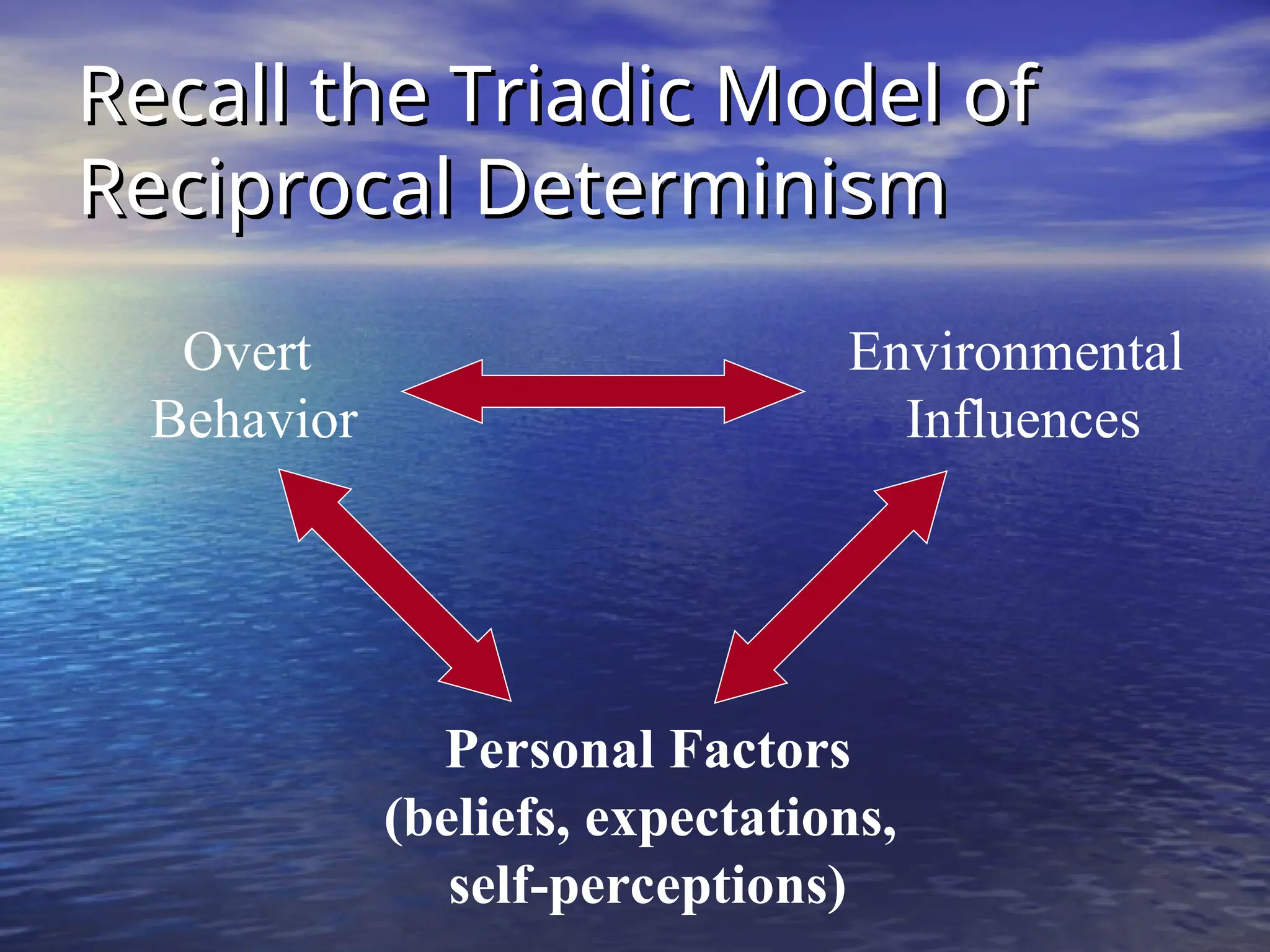
Bandura’s Triadic Model of
Reciprocal Determinism
Environmental
Influences
Personal Factors
(beliefs, expectations,
self-perceptions)
Overt
Behavior
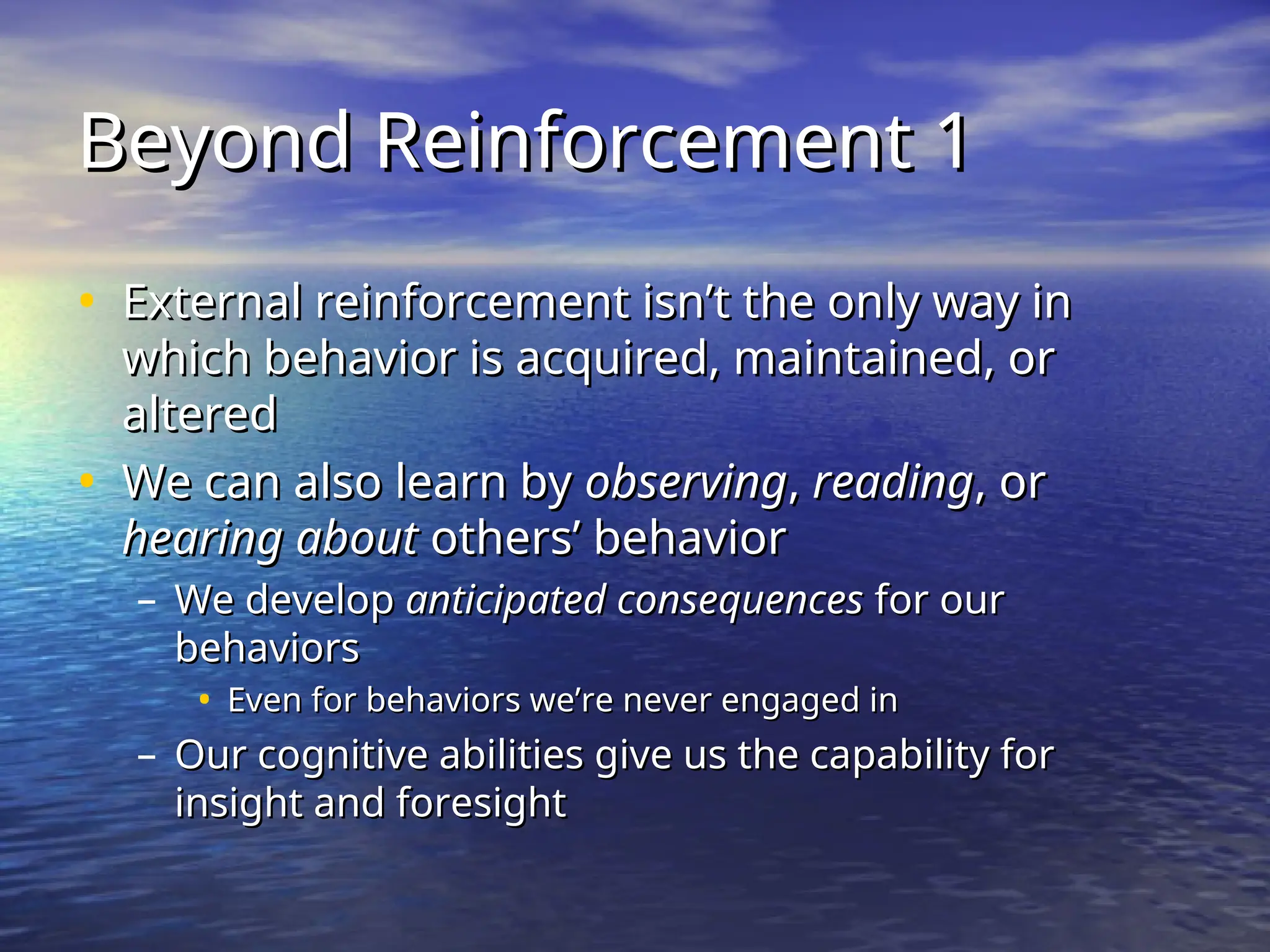
Beyond Reinforcement 1
• External reinforcement isn’t the only way in
External reinforcement isn’t the only way in
which behavior is acquired, maintained, or
altered
altered
• We can also learn by
We can also learn by observing
observing,
, reading
reading, or
, or
hearing about
hearing about others’ behavior
others’ behavior
– We develop
We develop anticipated consequences
anticipated consequences for our
for our
behaviors
behaviors
• Even for behaviors we’re never engaged in
Even for behaviors we’re never engaged in
– Our cognitive abilities give us the capability for
Our cognitive abilities give us the capability for
insight and foresight
Beyond Reinforcement 2
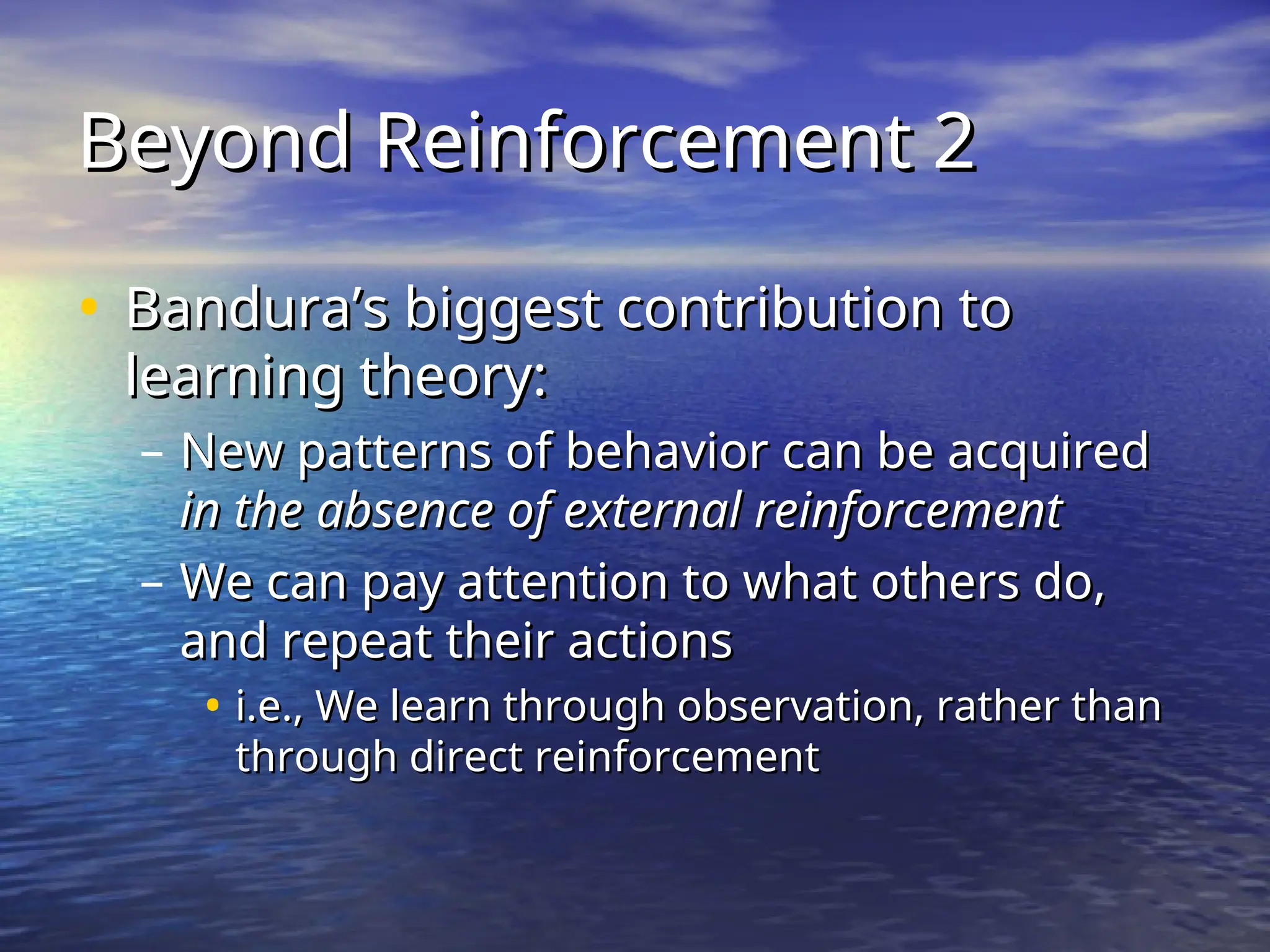
• Bandura’s biggest contribution to
Bandura’s biggest contribution to
learning theory:
learning theory:
– New patterns of behavior can be acquired
New patterns of behavior can be acquired
in the
in the absence of external reinforcement
absence of external reinforcement
– We can pay attention to what others do,
We can pay attention to what others do,
and repeat their actions
• i.e., We learn through observation, rather than
i.e., We learn through observation, rather than
through direct reinforcement
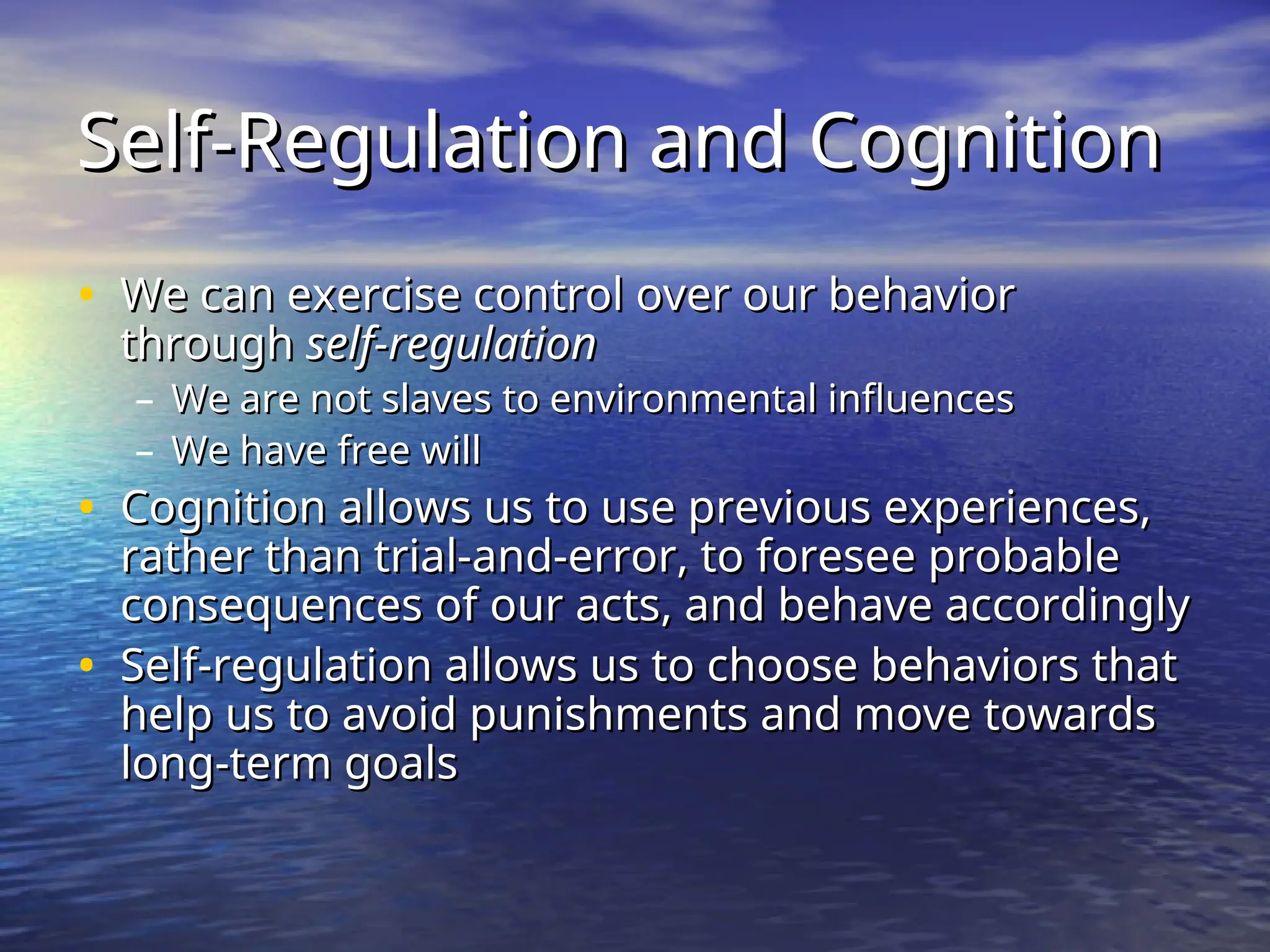
Self-Regulation and Cognition
• We can exercise control over our behavior
We can exercise control over our behavior
through
through self-regulation
self-regulation
– We are not slaves to environmental influences
We are not slaves to environmental influences
– We have free will
We have free will
• Cognition allows us to use previous experiences,
Cognition allows us to use previous experiences,
rather than trial-and-error, to foresee probable
consequences of our acts, and behave accordingly
• Self-regulation allows us to choose behaviors that
Self-regulation allows us to choose behaviors that
help us to avoid punishments and move towards
long-term goals
long-term goals
Bandura et al., 1963
Subjects
Subjects
• 48 boys and 48 girls
48 boys and 48 girls
attending Stanford U
Nursery School
Nursery School
• Mean age 4.3 years
Mean age 4.3 years
• Ss are matched across
Ss are matched across
experimental groups
experimental groups
for degree of
for degree of
aggressive behavior
aggressive behavior
shown in nursery
shown in nursery
school interaction
school interaction
Exposure to an
Exposure to an
aggressive model
aggressive model
(4 conditions)
(4 conditions)
1.
1. Observe an adult model
Observe an adult model
behave aggressive
behave aggressive
2.
2. Observe same adult
Observe same adult
model and same
model and same
behaviors, but on film
3.
3. Observe same behaviors
Observe same behaviors
performed by a cartoon
character
character
4.
4. Control group (no
Control group (no
observations)
observations)
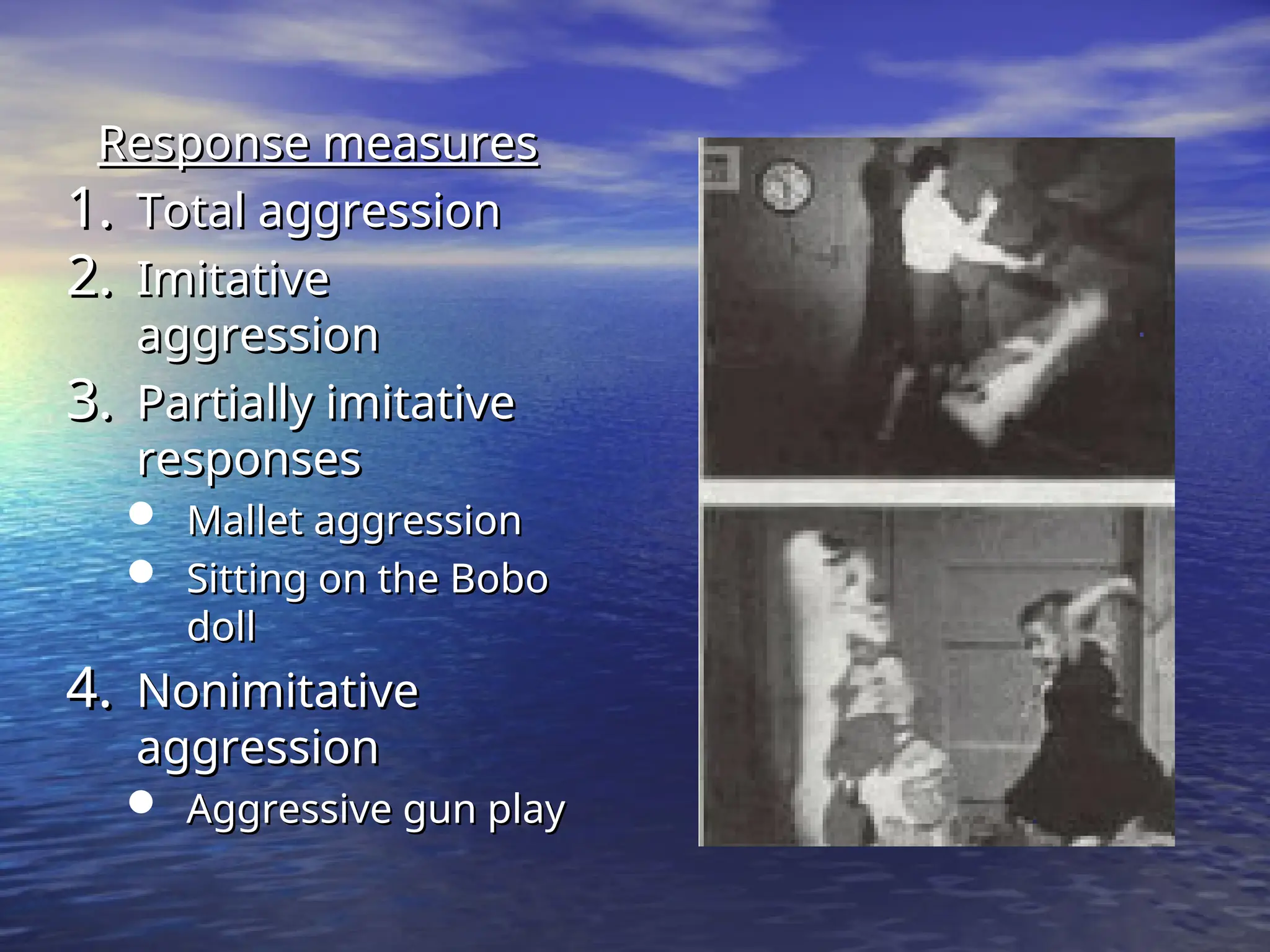
Response measures
Response measures
1.
1. Total aggression
Total aggression
2.
2. Imitative
Imitative
aggression
aggression
3.
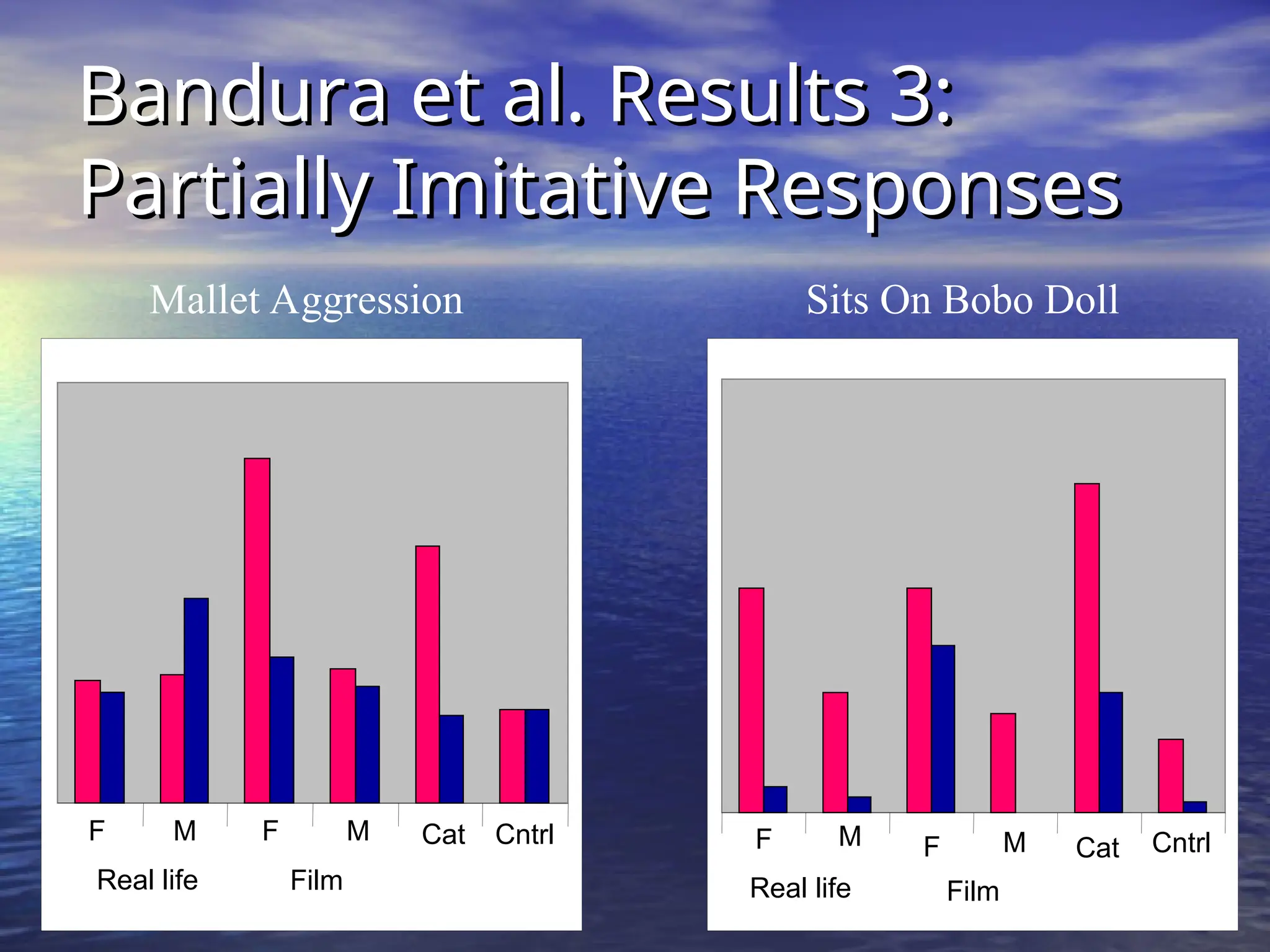
3. Partially imitative
Partially imitative
responses
responses
 Mallet aggression
Mallet aggression
 Sitting on the Bobo
Sitting on the Bobo
doll
doll
4.
4. Nonimitative
Nonimitative
aggression
aggression
 Aggressive gun play
Aggressive gun play
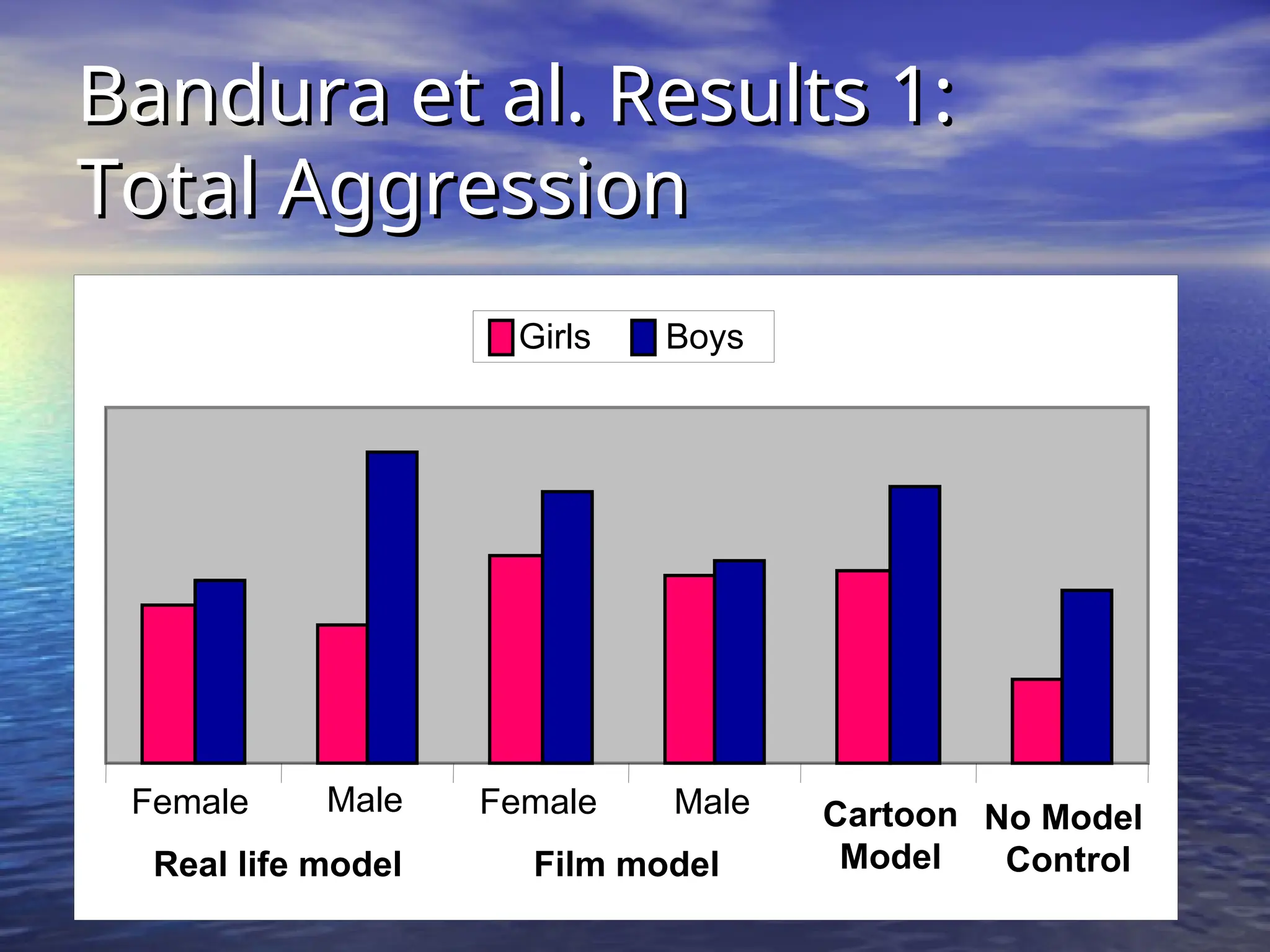
Bandura et al. Results 1:
Total Aggression
Total Aggression
Female Male Female Male
Real life model Film model
Cartoon
Model
No Model
Control
Girls Boys
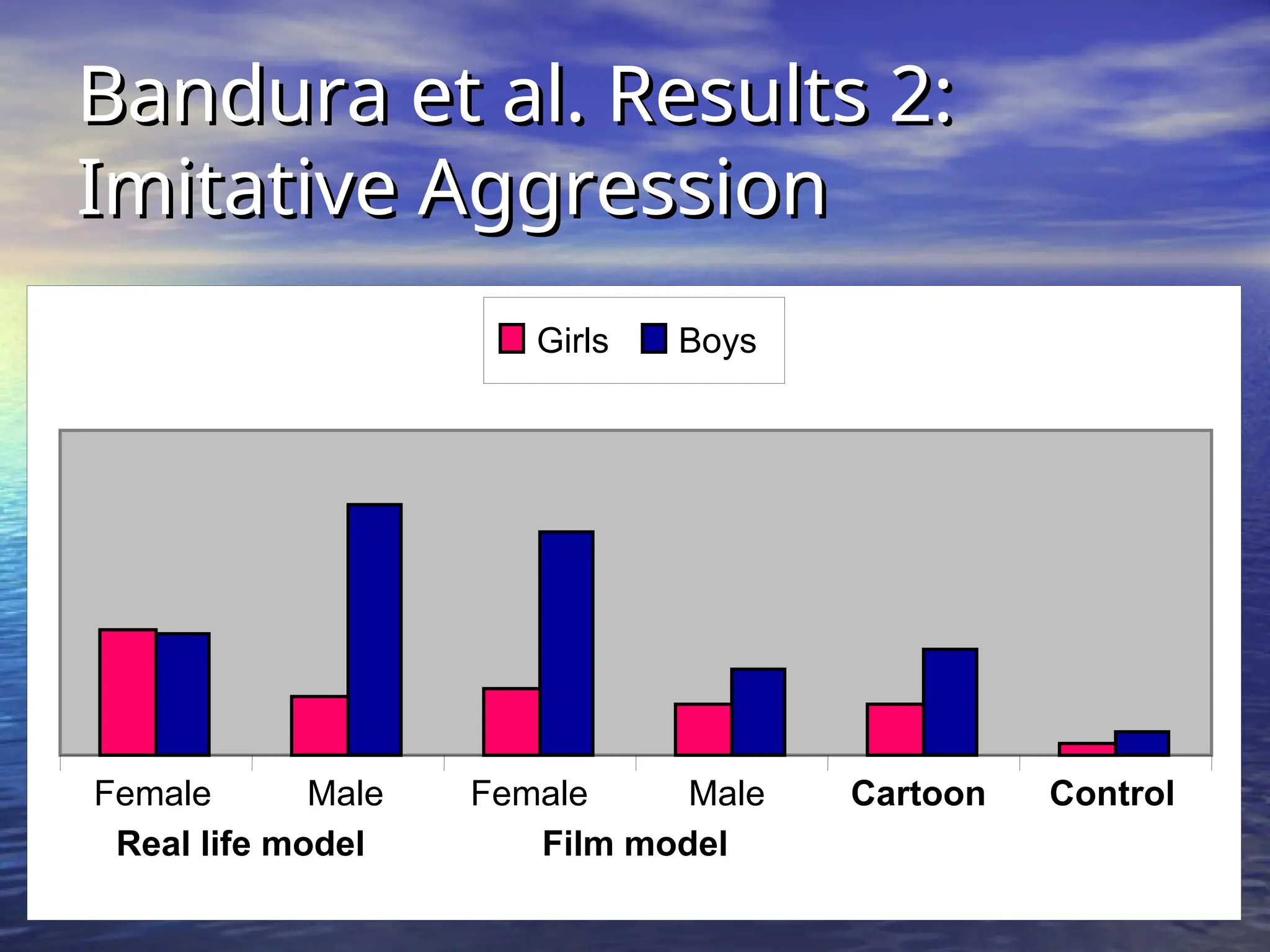
Bandura et al. Results 2:
Imitative Aggression
Female Male Female Male
Real life model Film model
Cartoon Control
Girls Boys
Bandura et al. Results 3:
Partially Imitative Responses
F M F M
Real life Film
Cat Cntrl
Mallet Aggression
F M F M
Real life Film
Cat Cntrl
Sits On Bobo Doll
0
20
40
60
80
100
120
140
Girls
Boys
Girls
Boys
Girls
Boys
Girls
Boys
Total
Aggression
Imitative
Aggression
Mallet
Aggression
Sit on
Bobo Doll
Real life mode –
Female
Real life model –
Male
Film model –
Female
Film model –
Male
Cartoon
Control
Implications:
Implications:
Eron & Heusmann, 1985
0
10
20
30
40
50
DV: Seriousness of Criminal Act by Age 30
Low Low
Med Med
High High
Frequency of TV Viewing at Age 8
Females Males
Modeling
Modeling
• We learn much of what we do through
We learn much of what we do through
observing and speaking with others
(“models”), rather than through
personal experience
personal experience
• We form a cognitive image of how to
We form a cognitive image of how to
perform certain behaviors through
modeling, and use this image as a
guide for later behaviors
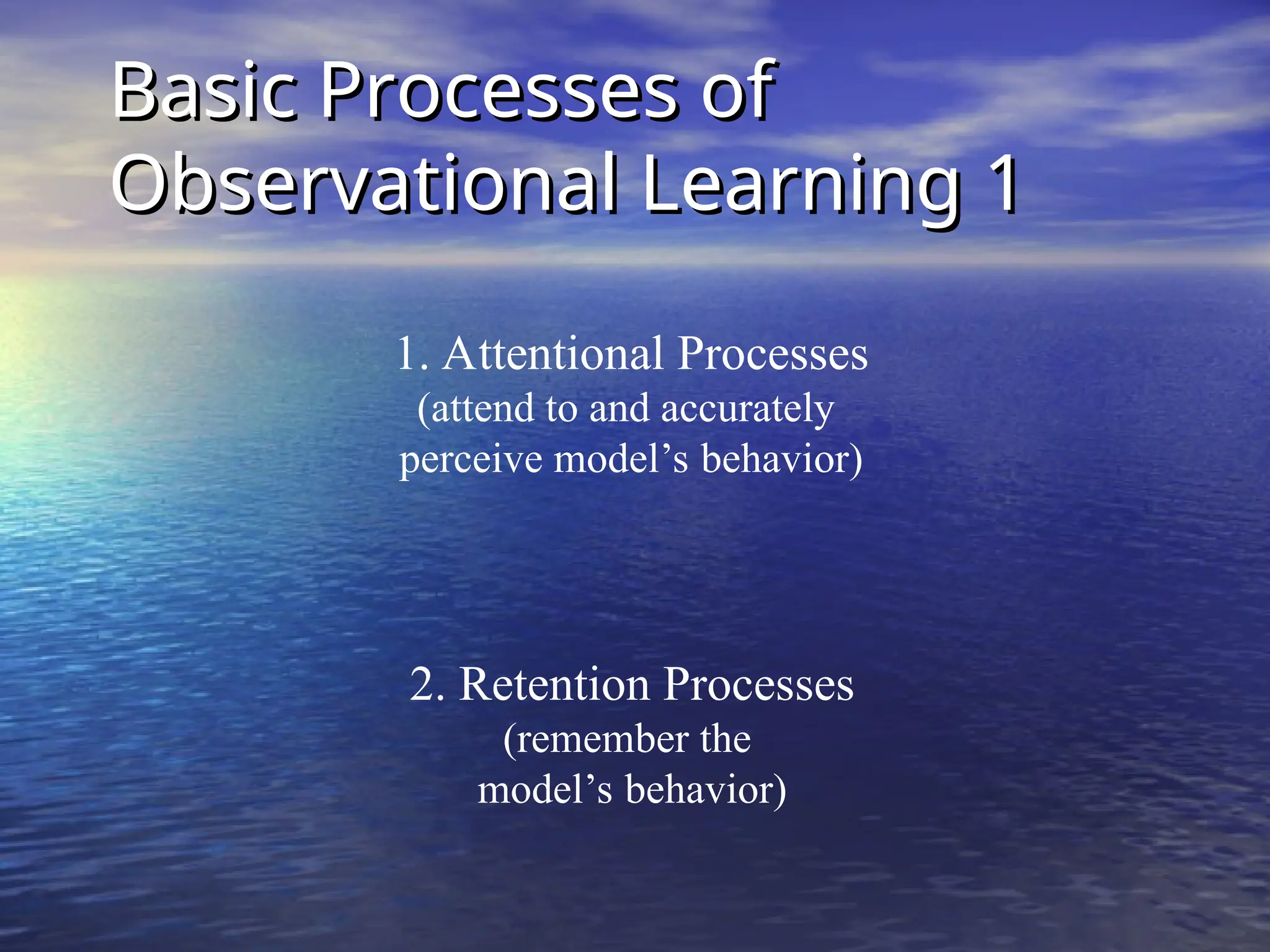
Basic Processes of
Basic Processes of
Observational Learning 1
1. Attentional Processes
(attend to and accurately
perceive model’s behavior)
2. Retention Processes
(remember the
model’s behavior)
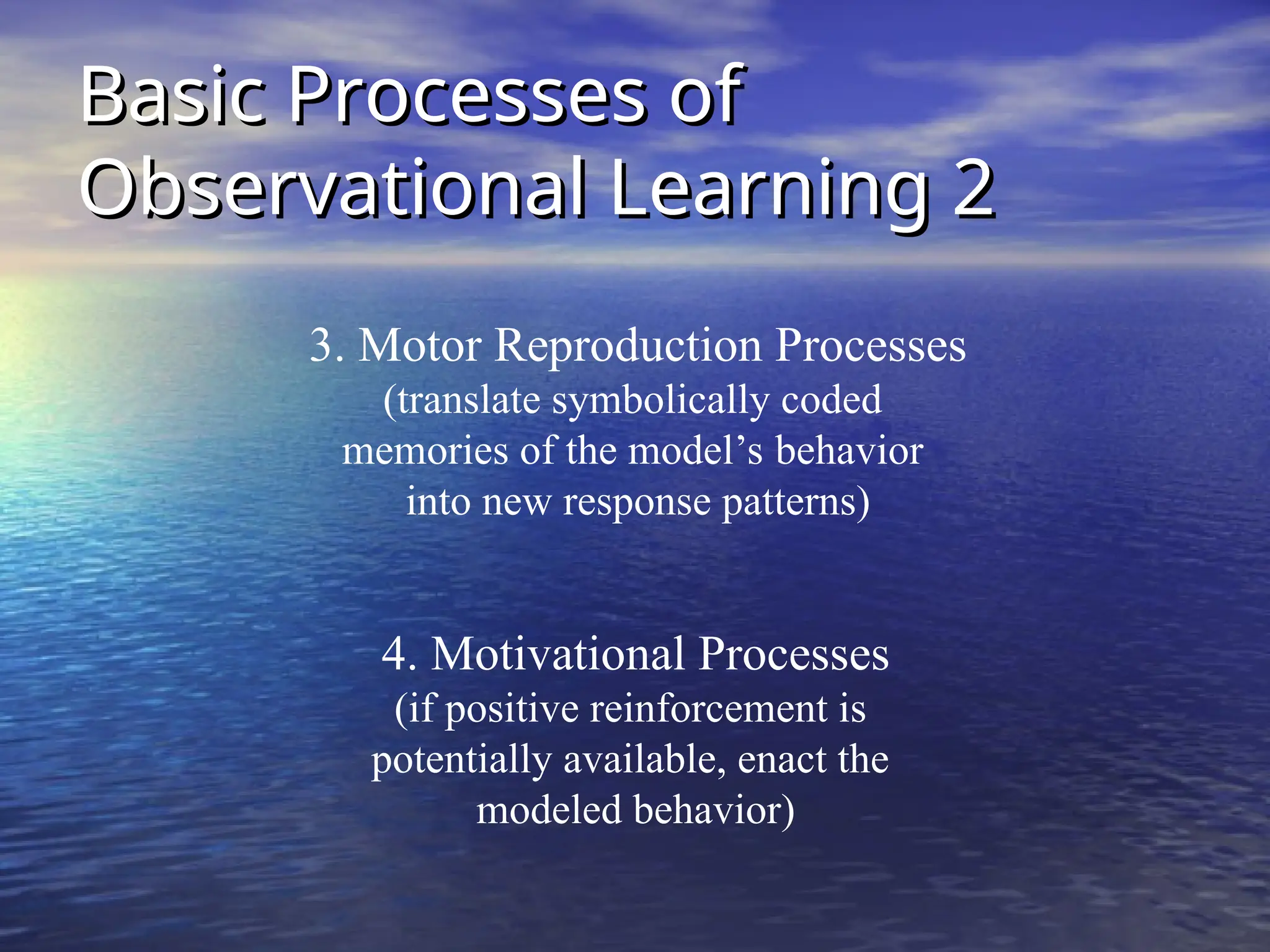
Basic Processes of
Basic Processes of
Observational Learning 2
3. Motor Reproduction Processes
(translate symbolically coded
memories of the model’s behavior
into new response patterns)
4. Motivational Processes
(if positive reinforcement is
potentially available, enact the
modeled behavior)
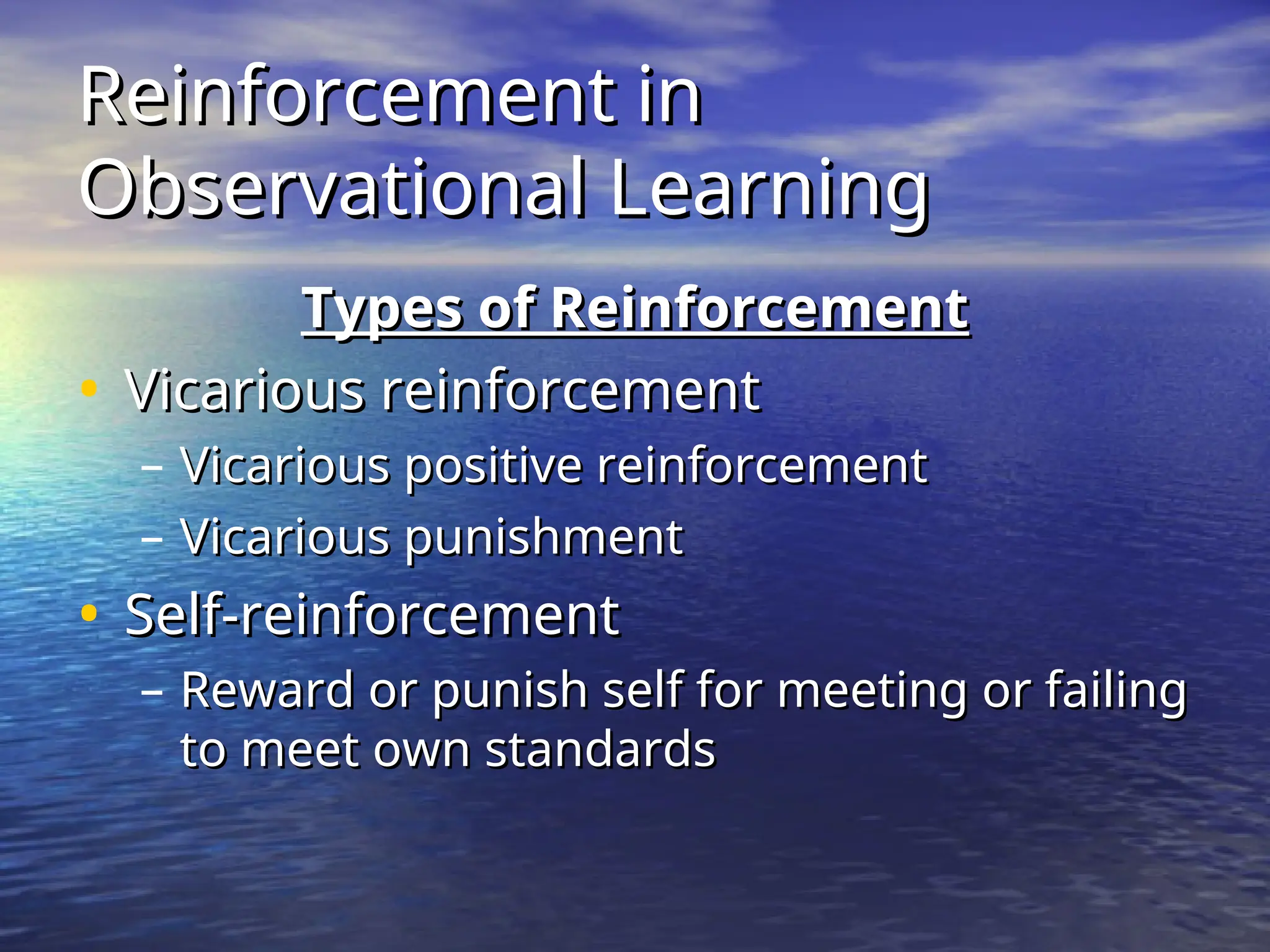
Reinforcement in
Reinforcement in
Observational Learning
Types of Reinforcement
• Vicarious reinforcement
Vicarious reinforcement
– Vicarious positive reinforcement
Vicarious positive reinforcement
– Vicarious punishment
Vicarious punishment
• Self-reinforcement
Self-reinforcement
– Reward or punish self for meeting or failing
Reward or punish self for meeting or failing
to meet own standards
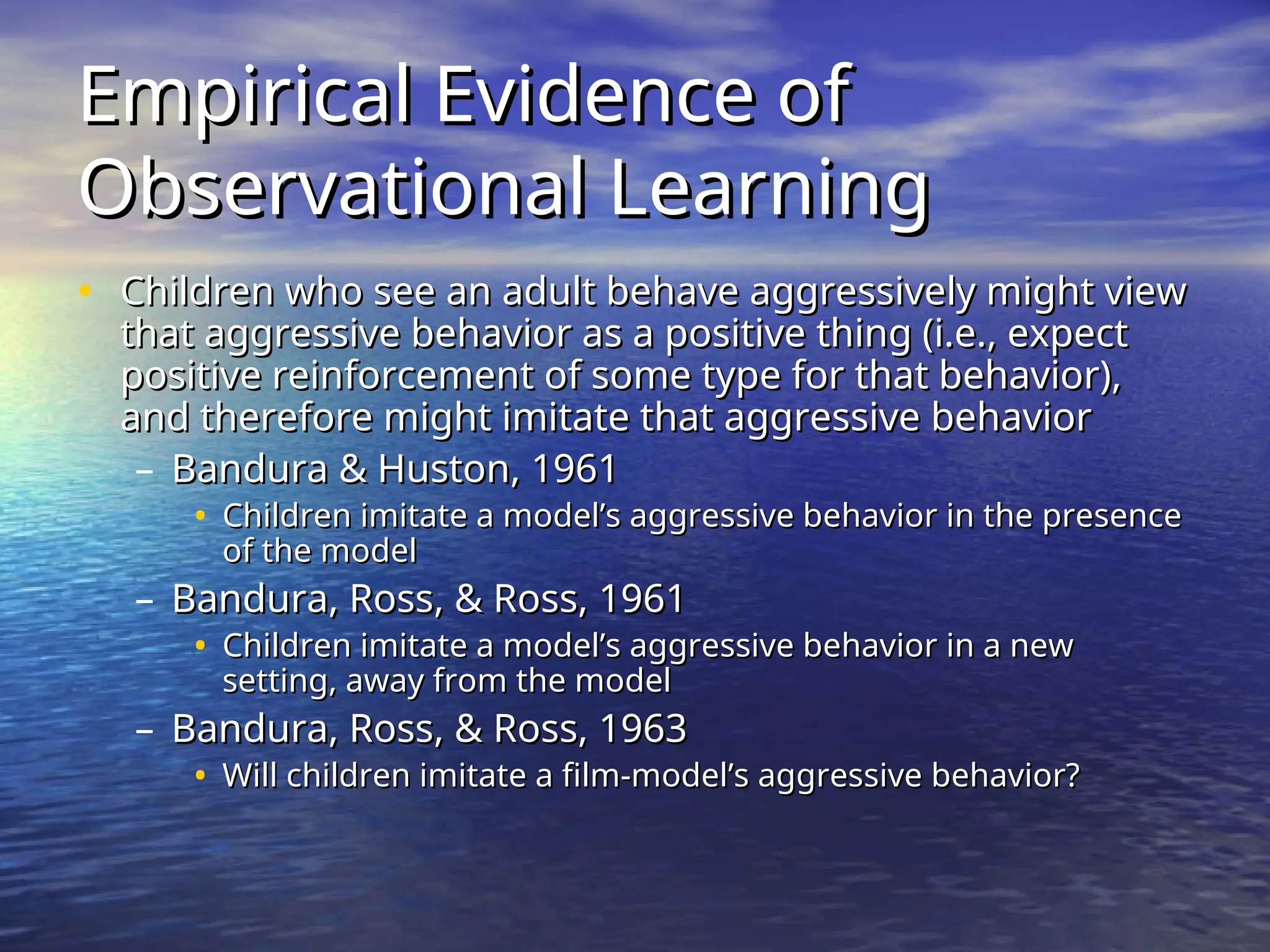
Empirical Evidence of
Observational Learning
• Children who see an adult behave aggressively might view
Children who see an adult behave aggressively might view
that aggressive behavior as a positive thing (i.e., expect
positive reinforcement of some type for that behavior),
and therefore might imitate that aggressive behavior
– Bandura & Huston, 1961
Bandura & Huston, 1961
• Children imitate a model’s aggressive behavior in the presence
Children imitate a model’s aggressive behavior in the presence
of the model
of the model
– Bandura, Ross, & Ross, 1961
Bandura, Ross, & Ross, 1961
• Children imitate a model’s aggressive behavior in a new
Children imitate a model’s aggressive behavior in a new
setting, away from the model
– Bandura, Ross, & Ross, 1963
Bandura, Ross, & Ross, 1963
• Will children imitate a film-model’s aggressive behavior?
Will children imitate a film-model’s aggressive behavior?
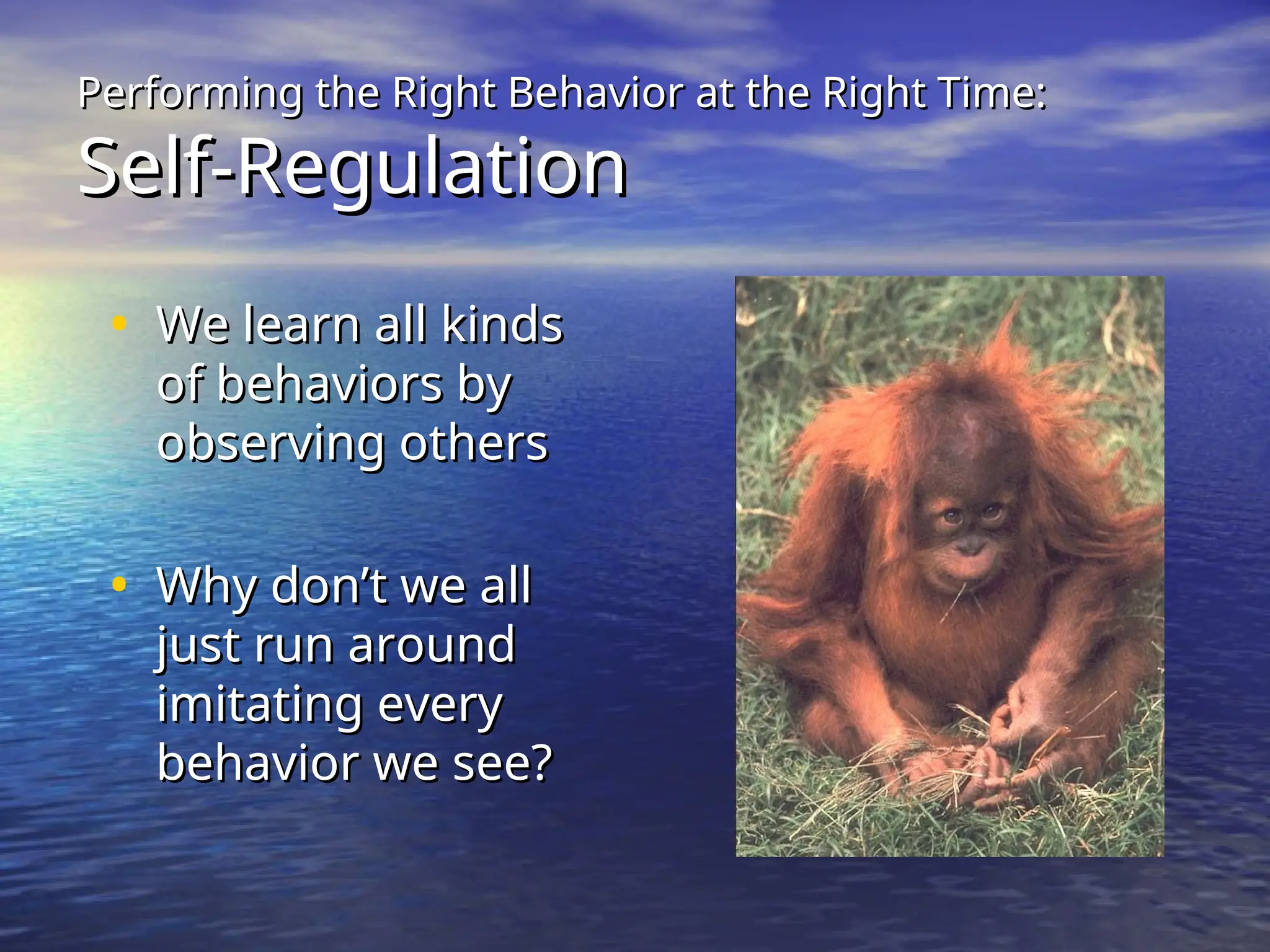
Performing the Right Behavior at the Right Time:
Self-Regulation
Self-Regulation
• We learn all kinds
We learn all kinds
of behaviors by
of behaviors by
observing others
observing others
• Why don’t we all
Why don’t we all
just run around
just run around
imitating every
imitating every
behavior we see?
behavior we see?
Recall the Triadic Model of
Reciprocal Determinism
Environmental
Influences
Personal Factors
(beliefs, expectations,
self-perceptions)
Overt
Behavior
Self-Regulation
Self-Regulation
• An important “personal
An important “personal
factor” is the ability to
self-regulate
self-regulate
• Some people are pretty
Some people are pretty
good at this, some
good at this, some
people aren’t so good
• Self-regulation is
Self-regulation is
probably
probably domain-
domain-
specific
specific (recall the
(recall the
“environmental
“environmental
influences” component
of the triad model)
of the triad model)
– Can regulate some
Can regulate some
things, but not others
Delay of Gratification
• Children who are
Children who are
able to delay
able to delay
gratification at age 5
are less likely to
are less likely to
become alcoholics
become alcoholics
or drug addicts later
in life
in life
– Specific to appetitive
Specific to appetitive
rewards
rewards
Summary
Summary
• We acquire, maintain, and modify behaviors
We acquire, maintain, and modify behaviors
that we see others perform
• We decide which behaviors to keep, and
We decide which behaviors to keep, and
when to use them, by using:
– symbolic thought (“what are my long term
symbolic thought (“what are my long term
goals?”)
goals?”)
– emotion (“damn that Bobo doll!!!”)
emotion (“damn that Bobo doll!!!”)
– self-regulation (“I really want to stab my prof, but
self-regulation (“I really want to stab my prof, but
I need an A, so…”)
I need an A, so…”)
• Bandura and other Social Learning Theorists
Bandura and other Social Learning Theorists
put the “person” back into personality by
stressing the interplay of personal factors,
environmental factors, and behavior

Social Learning Theory-Albert Bandura.ppt

  • 1.
    Social Learning Theory SocialLearning Theory “ “One difficulty with many learning theories is their One difficulty with many learning theories is their almost exclusive emphasis on the processes of almost exclusive emphasis on the processes of acquisition of behavior and performance, and their acquisition of behavior and performance, and their almost total neglect of the content of personality” almost total neglect of the content of personality” ~Julian Rotter, 1972 ~Julian Rotter, 1972
  • 2.
    Radical Behaviorism Radical Behaviorism Prosand Cons Pros and Cons • Pros: “Scientific” Pros: “Scientific” – Deals with observable, measurable Deals with observable, measurable phenomena phenomena – Rigorous methodology Rigorous methodology • Con: Ignores the things that make Con: Ignores the things that make humans “human” humans “human” – Cognitions Cognitions – Emotions Emotions – “ “Free Will” Free Will”
  • 3.
    Therefore…. Therefore…. • Albert Bandura’s AlbertBandura’s (1960s +) Social (1960s +) Social Learning Theory Learning Theory – aka Social aka Social Cognitive Theory Cognitive Theory • Put the “person” Put the “person” back into back into personality personality
  • 4.
    Theoretical Foundations of TheoreticalFoundations of Social Learning Theory Social Learning Theory • Psychodynamic explanations of behavior are Psychodynamic explanations of behavior are flawed flawed – They are based on They are based on inferred inferred drives/needs/etc., drives/needs/etc., which cannot be tested which cannot be tested – They ignore They ignore conscious conscious cognitions cognitions – They ignore situational influences They ignore situational influences • Radical behaviorism is flawed Radical behaviorism is flawed – It ignores cognition and emotion (Rotter’s It ignores cognition and emotion (Rotter’s “content of personality”) “content of personality”) • e.g., Assumes that e.g., Assumes that actual reinforcement actual reinforcement is necessary for is necessary for learning to occur learning to occur • e.g., Rejects free will e.g., Rejects free will
  • 5.
    Bandura’s Triadic Modelof Bandura’s Triadic Model of Reciprocal Determinism Reciprocal Determinism Environmental Influences Personal Factors (beliefs, expectations, self-perceptions) Overt Behavior
  • 6.
    Beyond Reinforcement 1 BeyondReinforcement 1 • External reinforcement isn’t the only way in External reinforcement isn’t the only way in which behavior is acquired, maintained, or which behavior is acquired, maintained, or altered altered • We can also learn by We can also learn by observing observing, , reading reading, or , or hearing about hearing about others’ behavior others’ behavior – We develop We develop anticipated consequences anticipated consequences for our for our behaviors behaviors • Even for behaviors we’re never engaged in Even for behaviors we’re never engaged in – Our cognitive abilities give us the capability for Our cognitive abilities give us the capability for insight and foresight insight and foresight
  • 7.
    Beyond Reinforcement 2 BeyondReinforcement 2 • Bandura’s biggest contribution to Bandura’s biggest contribution to learning theory: learning theory: – New patterns of behavior can be acquired New patterns of behavior can be acquired in the in the absence of external reinforcement absence of external reinforcement – We can pay attention to what others do, We can pay attention to what others do, and repeat their actions and repeat their actions • i.e., We learn through observation, rather than i.e., We learn through observation, rather than through direct reinforcement through direct reinforcement
  • 8.
    Self-Regulation and Cognition Self-Regulationand Cognition • We can exercise control over our behavior We can exercise control over our behavior through through self-regulation self-regulation – We are not slaves to environmental influences We are not slaves to environmental influences – We have free will We have free will • Cognition allows us to use previous experiences, Cognition allows us to use previous experiences, rather than trial-and-error, to foresee probable rather than trial-and-error, to foresee probable consequences of our acts, and behave accordingly consequences of our acts, and behave accordingly • Self-regulation allows us to choose behaviors that Self-regulation allows us to choose behaviors that help us to avoid punishments and move towards help us to avoid punishments and move towards long-term goals long-term goals
  • 9.
    Bandura et al.,1963 Bandura et al., 1963 Subjects Subjects • 48 boys and 48 girls 48 boys and 48 girls attending Stanford U attending Stanford U Nursery School Nursery School • Mean age 4.3 years Mean age 4.3 years • Ss are matched across Ss are matched across experimental groups experimental groups for degree of for degree of aggressive behavior aggressive behavior shown in nursery shown in nursery school interaction school interaction Exposure to an Exposure to an aggressive model aggressive model (4 conditions) (4 conditions) 1. 1. Observe an adult model Observe an adult model behave aggressive behave aggressive 2. 2. Observe same adult Observe same adult model and same model and same behaviors, but on film behaviors, but on film 3. 3. Observe same behaviors Observe same behaviors performed by a cartoon performed by a cartoon character character 4. 4. Control group (no Control group (no observations) observations)
  • 10.
    Response measures Response measures 1. 1.Total aggression Total aggression 2. 2. Imitative Imitative aggression aggression 3. 3. Partially imitative Partially imitative responses responses  Mallet aggression Mallet aggression  Sitting on the Bobo Sitting on the Bobo doll doll 4. 4. Nonimitative Nonimitative aggression aggression  Aggressive gun play Aggressive gun play
  • 11.
    Bandura et al.Results 1: Bandura et al. Results 1: Total Aggression Total Aggression Female Male Female Male Real life model Film model Cartoon Model No Model Control Girls Boys
  • 12.
    Bandura et al.Results 2: Bandura et al. Results 2: Imitative Aggression Imitative Aggression Female Male Female Male Real life model Film model Cartoon Control Girls Boys
  • 13.
    Bandura et al.Results 3: Bandura et al. Results 3: Partially Imitative Responses Partially Imitative Responses F M F M Real life Film Cat Cntrl Mallet Aggression F M F M Real life Film Cat Cntrl Sits On Bobo Doll
  • 14.
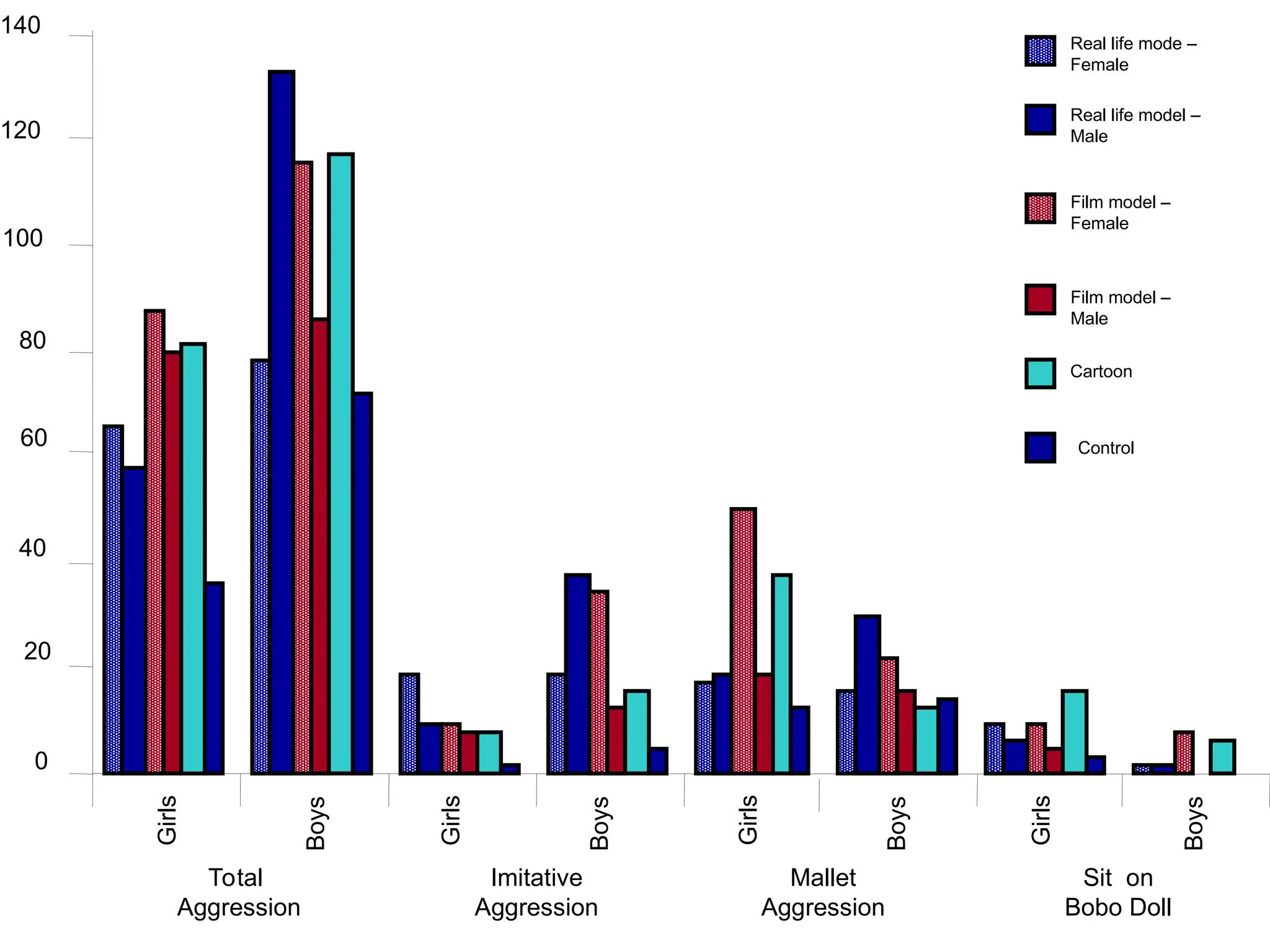
    0 20 40 60 80 100 120 140 Girls Boys Girls Boys Girls Boys Girls Boys Total Aggression Imitative Aggression Mallet Aggression Sit on Bobo Doll Reallife mode – Female Real life model – Male Film model – Female Film model – Male Cartoon Control
  • 15.
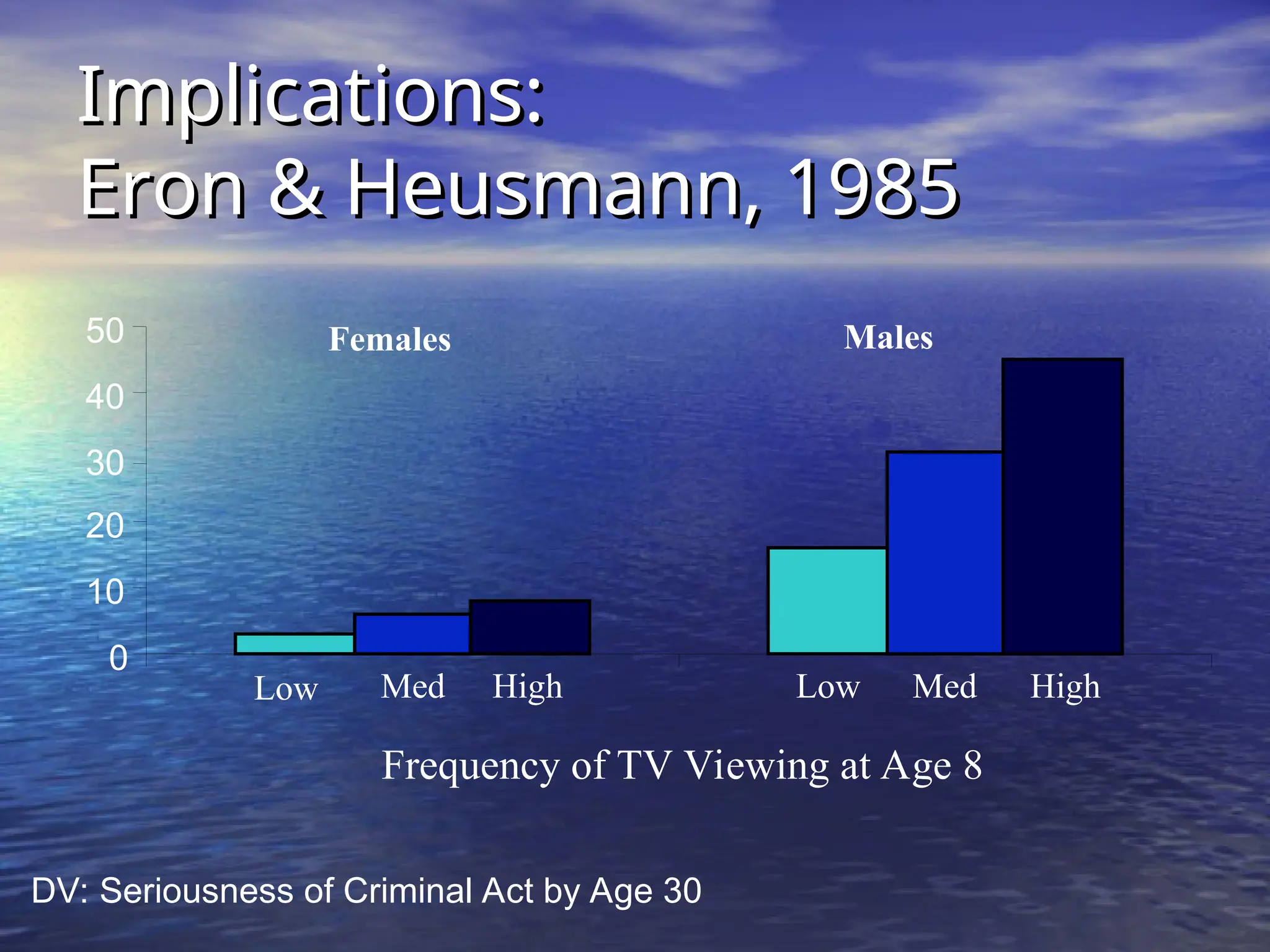
    Implications: Implications: Eron & Heusmann,1985 Eron & Heusmann, 1985 0 10 20 30 40 50 DV: Seriousness of Criminal Act by Age 30 Low Low Med Med High High Frequency of TV Viewing at Age 8 Females Males
  • 16.
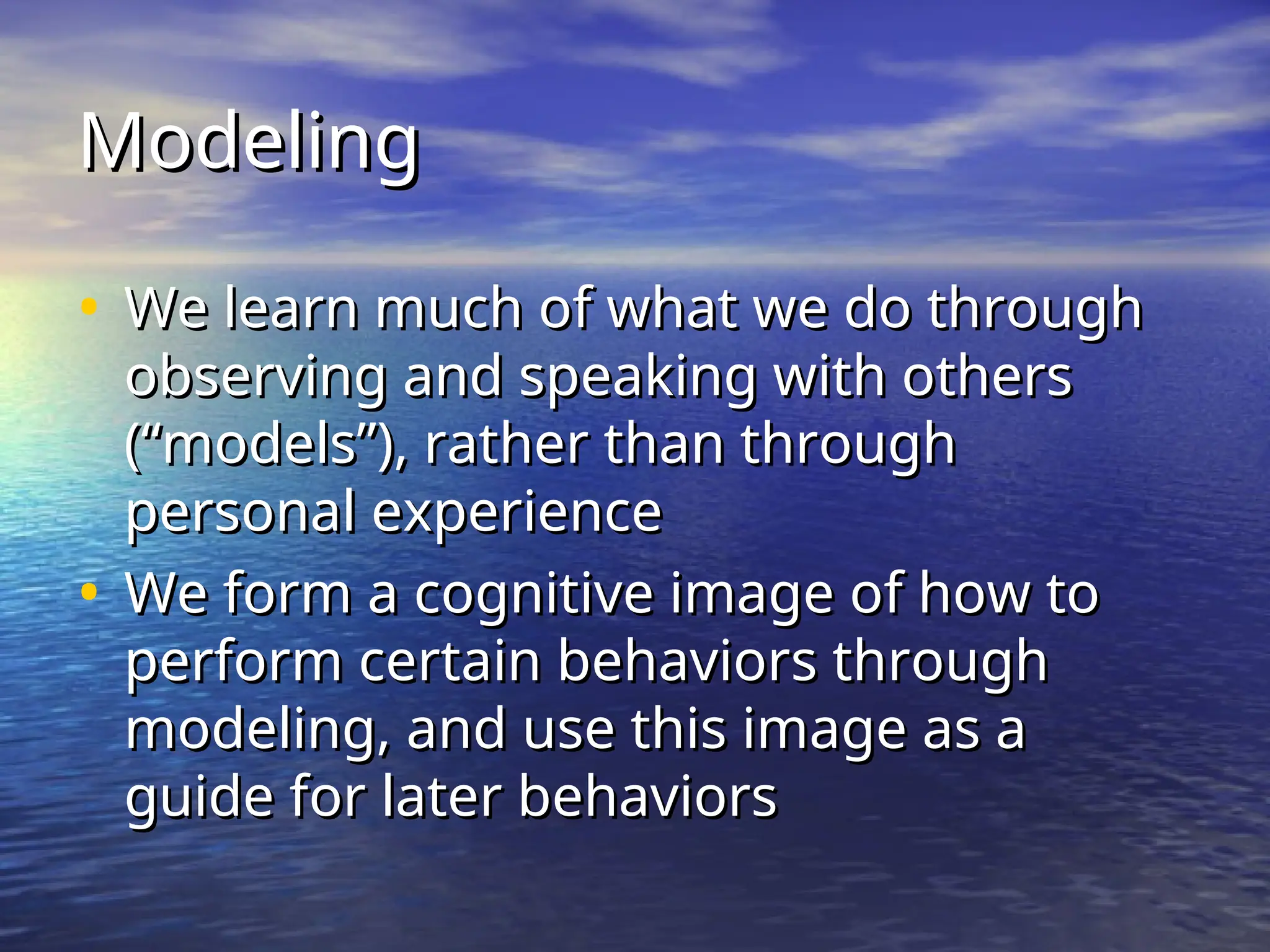
    Modeling Modeling • We learnmuch of what we do through We learn much of what we do through observing and speaking with others observing and speaking with others (“models”), rather than through (“models”), rather than through personal experience personal experience • We form a cognitive image of how to We form a cognitive image of how to perform certain behaviors through perform certain behaviors through modeling, and use this image as a modeling, and use this image as a guide for later behaviors guide for later behaviors
  • 17.
    Basic Processes of BasicProcesses of Observational Learning 1 Observational Learning 1 1. Attentional Processes (attend to and accurately perceive model’s behavior) 2. Retention Processes (remember the model’s behavior)
  • 18.
    Basic Processes of BasicProcesses of Observational Learning 2 Observational Learning 2 3. Motor Reproduction Processes (translate symbolically coded memories of the model’s behavior into new response patterns) 4. Motivational Processes (if positive reinforcement is potentially available, enact the modeled behavior)
  • 19.
    Reinforcement in Reinforcement in ObservationalLearning Observational Learning Types of Reinforcement Types of Reinforcement • Vicarious reinforcement Vicarious reinforcement – Vicarious positive reinforcement Vicarious positive reinforcement – Vicarious punishment Vicarious punishment • Self-reinforcement Self-reinforcement – Reward or punish self for meeting or failing Reward or punish self for meeting or failing to meet own standards to meet own standards
  • 20.
    Empirical Evidence of EmpiricalEvidence of Observational Learning Observational Learning • Children who see an adult behave aggressively might view Children who see an adult behave aggressively might view that aggressive behavior as a positive thing (i.e., expect that aggressive behavior as a positive thing (i.e., expect positive reinforcement of some type for that behavior), positive reinforcement of some type for that behavior), and therefore might imitate that aggressive behavior and therefore might imitate that aggressive behavior – Bandura & Huston, 1961 Bandura & Huston, 1961 • Children imitate a model’s aggressive behavior in the presence Children imitate a model’s aggressive behavior in the presence of the model of the model – Bandura, Ross, & Ross, 1961 Bandura, Ross, & Ross, 1961 • Children imitate a model’s aggressive behavior in a new Children imitate a model’s aggressive behavior in a new setting, away from the model setting, away from the model – Bandura, Ross, & Ross, 1963 Bandura, Ross, & Ross, 1963 • Will children imitate a film-model’s aggressive behavior? Will children imitate a film-model’s aggressive behavior?
  • 21.
    Performing the RightBehavior at the Right Time: Performing the Right Behavior at the Right Time: Self-Regulation Self-Regulation • We learn all kinds We learn all kinds of behaviors by of behaviors by observing others observing others • Why don’t we all Why don’t we all just run around just run around imitating every imitating every behavior we see? behavior we see?
  • 22.
    Recall the TriadicModel of Recall the Triadic Model of Reciprocal Determinism Reciprocal Determinism Environmental Influences Personal Factors (beliefs, expectations, self-perceptions) Overt Behavior
  • 23.
    Self-Regulation Self-Regulation • An important“personal An important “personal factor” is the ability to factor” is the ability to self-regulate self-regulate • Some people are pretty Some people are pretty good at this, some good at this, some people aren’t so good people aren’t so good • Self-regulation is Self-regulation is probably probably domain- domain- specific specific (recall the (recall the “environmental “environmental influences” component influences” component of the triad model) of the triad model) – Can regulate some Can regulate some things, but not others things, but not others
  • 24.
    Delay of Gratification Delayof Gratification • Children who are Children who are able to delay able to delay gratification at age 5 gratification at age 5 are less likely to are less likely to become alcoholics become alcoholics or drug addicts later or drug addicts later in life in life – Specific to appetitive Specific to appetitive rewards rewards
  • 25.
    Summary Summary • We acquire,maintain, and modify behaviors We acquire, maintain, and modify behaviors that we see others perform that we see others perform • We decide which behaviors to keep, and We decide which behaviors to keep, and when to use them, by using: when to use them, by using: – symbolic thought (“what are my long term symbolic thought (“what are my long term goals?”) goals?”) – emotion (“damn that Bobo doll!!!”) emotion (“damn that Bobo doll!!!”) – self-regulation (“I really want to stab my prof, but self-regulation (“I really want to stab my prof, but I need an A, so…”) I need an A, so…”) • Bandura and other Social Learning Theorists Bandura and other Social Learning Theorists put the “person” back into personality by put the “person” back into personality by stressing the interplay of personal factors, stressing the interplay of personal factors, environmental factors, and behavior environmental factors, and behavior