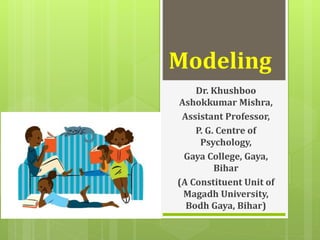
Modeling
Dr. Khushboo
Ashokkumar Mishra,
Assistant Professor,
P. G. Centre of
Psychology,
Gaya College, Gaya,
Bihar
(A Constituent Unit of
Magadh University,
Bodh Gaya, Bihar)
Introduction
 Based on Observational Learning which was
propounded by Albert Bandura
 Modeling is relatively simple and is designed to
assist clients in learning new behaviour patterns
or in changing/modifying the undesired behaviour
patterns
 Modeling is a psychotherapy technique utilized to
produce changes in a client’s behavioural repertoire
by providing a demonstration of the desired
behaviour patterns and then affording
opportunities for imitation
Processes of Observational Learning
 First, Attentional Processes are important in that they
affect how much of an impact the modeled event will have
on the observer.
 Second, Retention Processes are involved, including
factors as symbolic coding of the modeled behaviour.
 Third, Motor Production Processes are important
influences in observational learning. Physical capabilities
of the observer/learner is important in this context
 Finally, Motivational Processes such as external
reinforcement, reward and punishment, and self-reward or
-punishment all are relevant to determining whether
observing a model will produce imitation.
Presentation of the modeled
behaviour
Traditional form involves a live (in vivo) model
demonstrating the desired responses.
Second is symbolic modeling which can be
achieved via the use of several different
modeling formats like video, films, slides and
so on.
Finally Covert modeling involves carrying out
the intervention via imagery.
Imitation involves simply repeating or
matching the demonstrated behaviour or
response.
Vicarious learning involves a change in
the likelihood of the targeted response
being imitated as a function of observing
the model being rewarded or punished for
engaging in the targeted behaviour.
Forms of Modeling
Effects of Modeling
Observing a model can result in the acquisition
of previously unlearned behaviours
It can result in a strengthening or weakening
of inhibitory responses, referred to as
inhibitory or disinhibitory effects
Modeling may evoke previously learned
behaviour patterns, referred to as the response
facilitation effect
Factors which influence the
effectiveness of modeling
 First, it must result in successful consequences for the model.
 Second, model must be similar to the observer.
 Third, the complexity of the behaviour modeled should be
appropriate.
 Fourth, the observer has to attend to the model to have an effect.
 Fifth, the modeled behaviour must occur within the proper
context.
 Sixth, the modeled behaviour should be repeated as frequently as
necessary.
 Finally, the observer should be given opportunities to imitate the
modeled behaviour, with corrective and positive feedback provided.
Thank You

Modeling (Psychotherapy)

  • 1.
    Modeling Dr. Khushboo Ashokkumar Mishra, AssistantProfessor, P. G. Centre of Psychology, Gaya College, Gaya, Bihar (A Constituent Unit of Magadh University, Bodh Gaya, Bihar)
  • 2.
    Introduction  Based onObservational Learning which was propounded by Albert Bandura  Modeling is relatively simple and is designed to assist clients in learning new behaviour patterns or in changing/modifying the undesired behaviour patterns  Modeling is a psychotherapy technique utilized to produce changes in a client’s behavioural repertoire by providing a demonstration of the desired behaviour patterns and then affording opportunities for imitation
  • 3.
    Processes of ObservationalLearning  First, Attentional Processes are important in that they affect how much of an impact the modeled event will have on the observer.  Second, Retention Processes are involved, including factors as symbolic coding of the modeled behaviour.  Third, Motor Production Processes are important influences in observational learning. Physical capabilities of the observer/learner is important in this context  Finally, Motivational Processes such as external reinforcement, reward and punishment, and self-reward or -punishment all are relevant to determining whether observing a model will produce imitation.
  • 4.
    Presentation of themodeled behaviour Traditional form involves a live (in vivo) model demonstrating the desired responses. Second is symbolic modeling which can be achieved via the use of several different modeling formats like video, films, slides and so on. Finally Covert modeling involves carrying out the intervention via imagery.
  • 5.
    Imitation involves simplyrepeating or matching the demonstrated behaviour or response. Vicarious learning involves a change in the likelihood of the targeted response being imitated as a function of observing the model being rewarded or punished for engaging in the targeted behaviour. Forms of Modeling
  • 6.
    Effects of Modeling Observinga model can result in the acquisition of previously unlearned behaviours It can result in a strengthening or weakening of inhibitory responses, referred to as inhibitory or disinhibitory effects Modeling may evoke previously learned behaviour patterns, referred to as the response facilitation effect
  • 7.
    Factors which influencethe effectiveness of modeling  First, it must result in successful consequences for the model.  Second, model must be similar to the observer.  Third, the complexity of the behaviour modeled should be appropriate.  Fourth, the observer has to attend to the model to have an effect.  Fifth, the modeled behaviour must occur within the proper context.  Sixth, the modeled behaviour should be repeated as frequently as necessary.  Finally, the observer should be given opportunities to imitate the modeled behaviour, with corrective and positive feedback provided.
  • 8.