Obj. 12 Proving Lines Parallel 
The student is able to (I can): 
• Use angles formed by a transversal to show that lines are 
parallel.
Recall that the converse of a theorem is 
found by exchanging the hypothesis and 
conclusion. 
The converses of the parallel line theorems 
can be used to prove lines parallel 
• Corresponding Angles 
• Alternate Interior Angles 
• Alternate Exterior Angles 
— If angles are congruent, then the lines 
are parallel. 
• Same-Side Interior Angles 
— If angles are supplementary, then the 
lines are parallel.
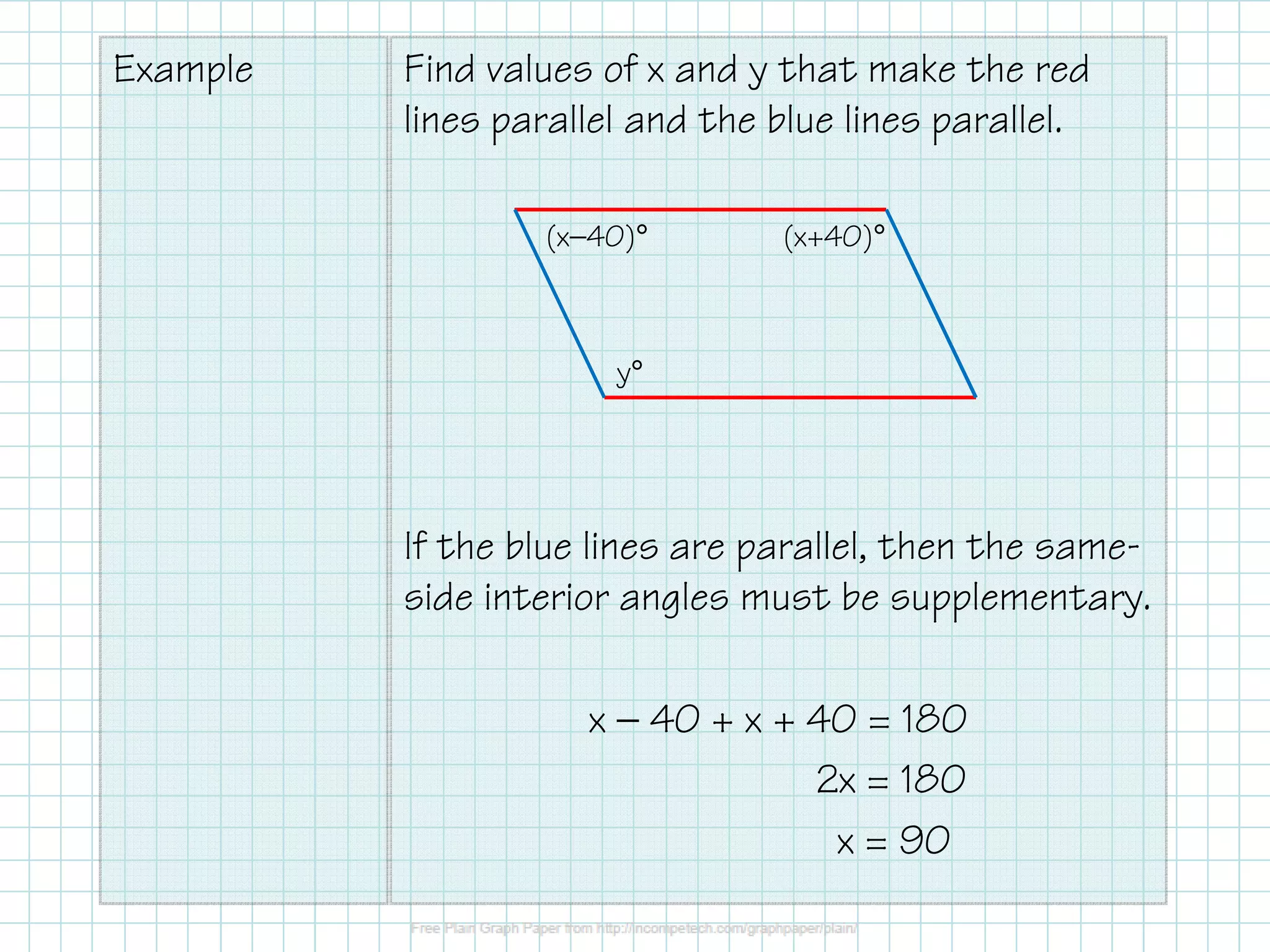
Example Find values of x and y that make the red 
lines parallel and the blue lines parallel. 
(x−40)° (x+40)° 
If the blue lines are parallel, then the same-side 
interior angles must be supplementary. 
x − 40 + x + 40 = 180 
2x = 180 
x = 90 
y°
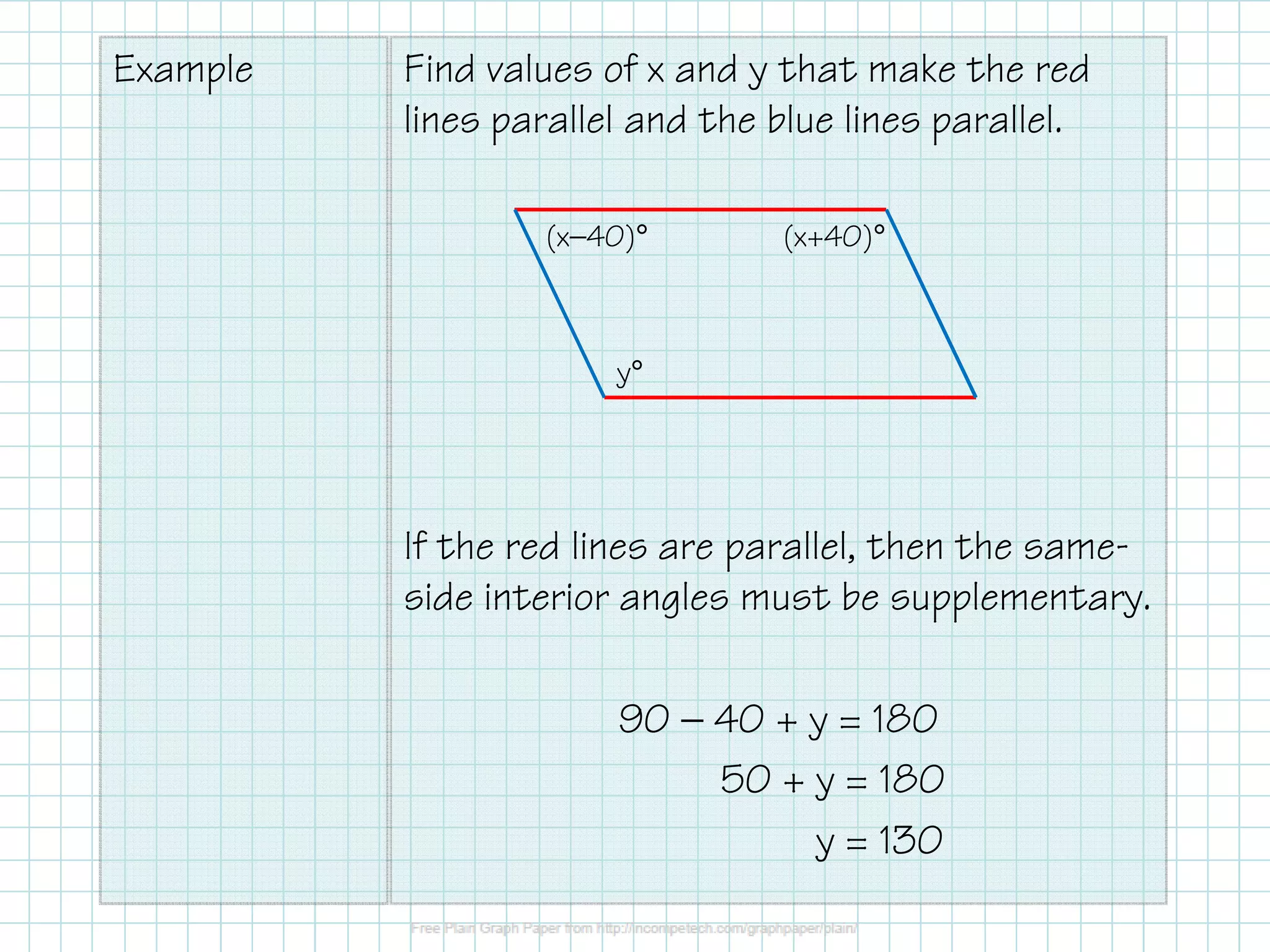
Example Find values of x and y that make the red 
lines parallel and the blue lines parallel. 
(x−40)° (x+40)° 
If the red lines are parallel, then the same-side 
interior angles must be supplementary. 
90 − 40 + y = 180 
50 + y = 180 
y = 130 
y°
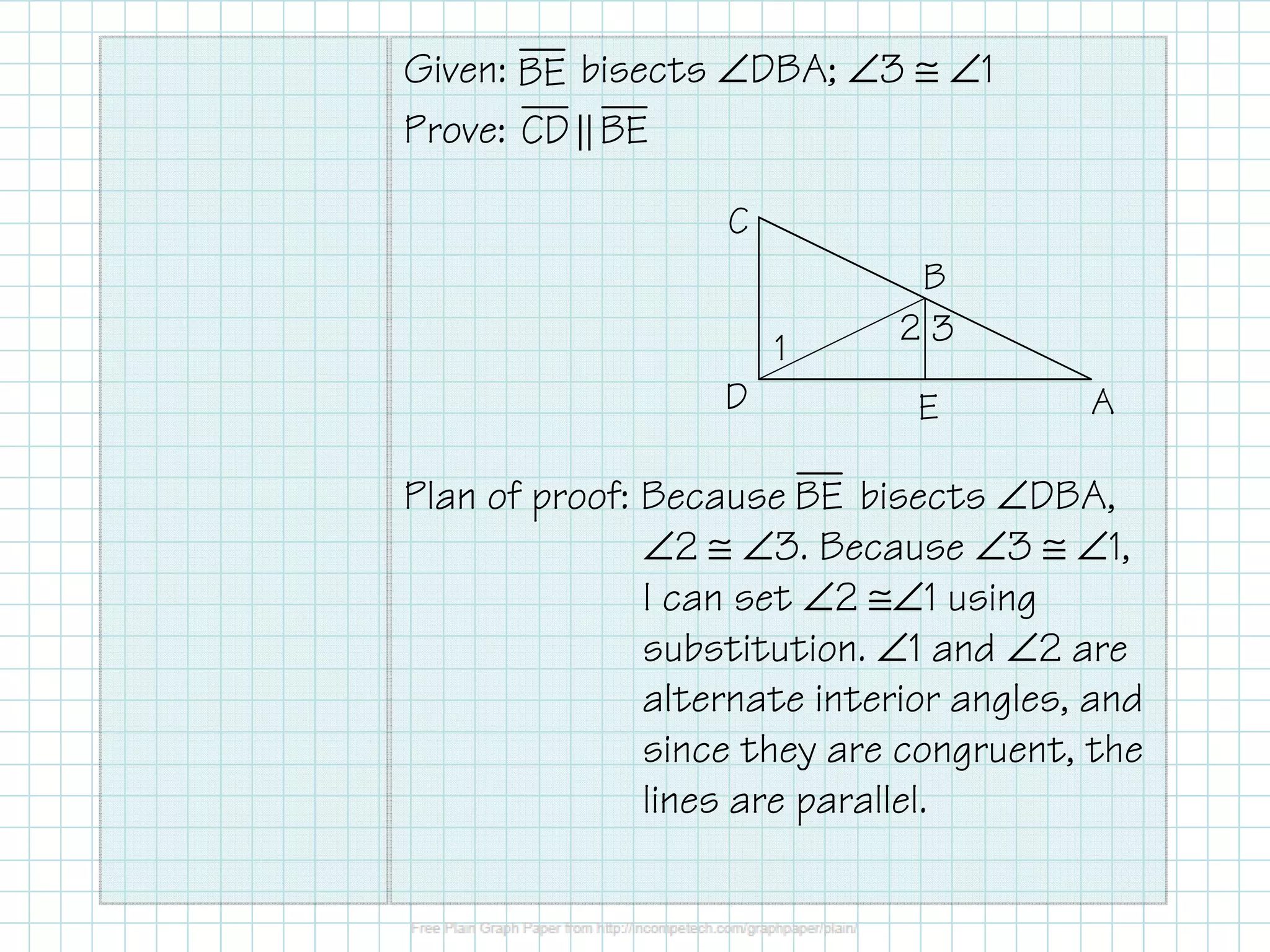
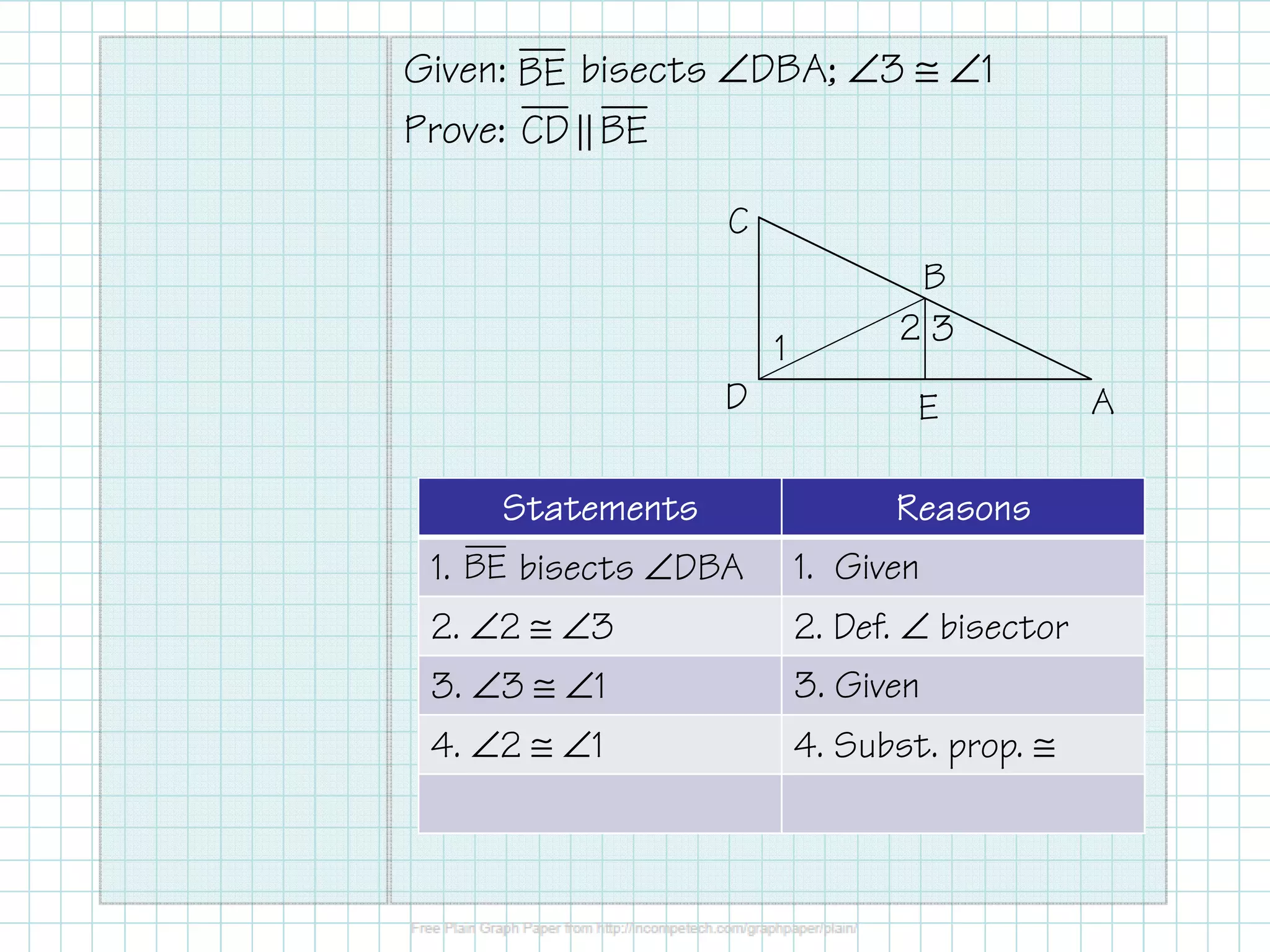
Given: bisects ÐDBA; Ð3 @ Ð1 
Prove: 
BE 
CD BE 
C 
B 
2 3 
1 
D E A 
Plan of proof: Because bisects ÐDBA, 
BE 
Ð2 @ Ð3. Because Ð3 @ Ð1, 
I can set Ð2 @Ð1 using 
substitution. Ð1 and Ð2 are 
alternate interior angles, and 
since they are congruent, the 
lines are parallel.
Given: bisects ÐDBA; Ð3 @ Ð1 
Prove: 
BE 
CD BE 
C 
B 
2 3 
1 
D E A 
SSSSttttaaaatttteeeemmmmeeeennnnttttssss RRRReeeeaaaassssoooonnnnssss 
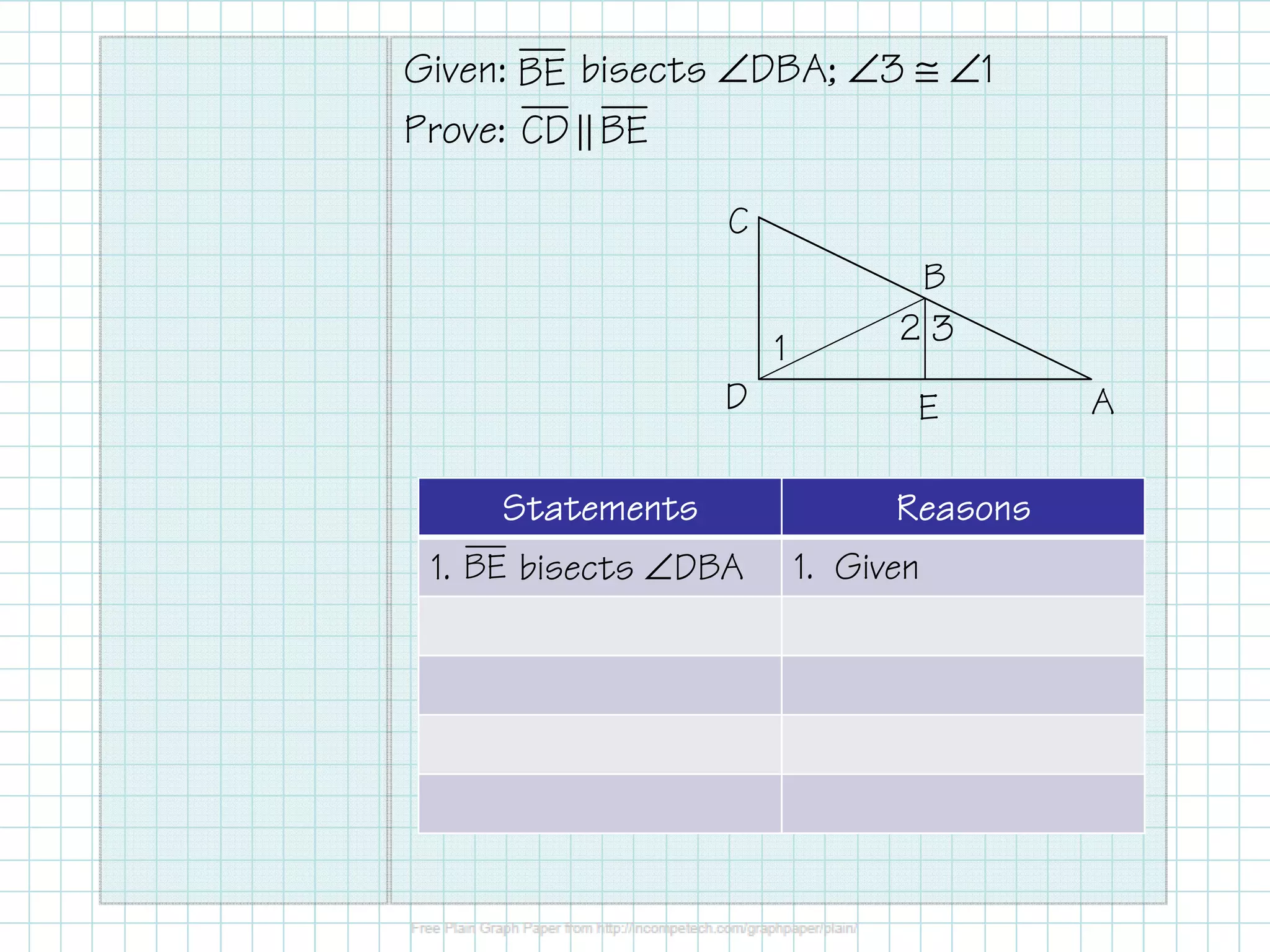
1. B E bisects ÐDBA 1. Given
Given: bisects ÐDBA; Ð3 @ Ð1 
Prove: 
BE 
CD BE 
C 
B 
2 3 
1 
D E A 
SSSSttttaaaatttteeeemmmmeeeennnnttttssss RRRReeeeaaaassssoooonnnnssss 
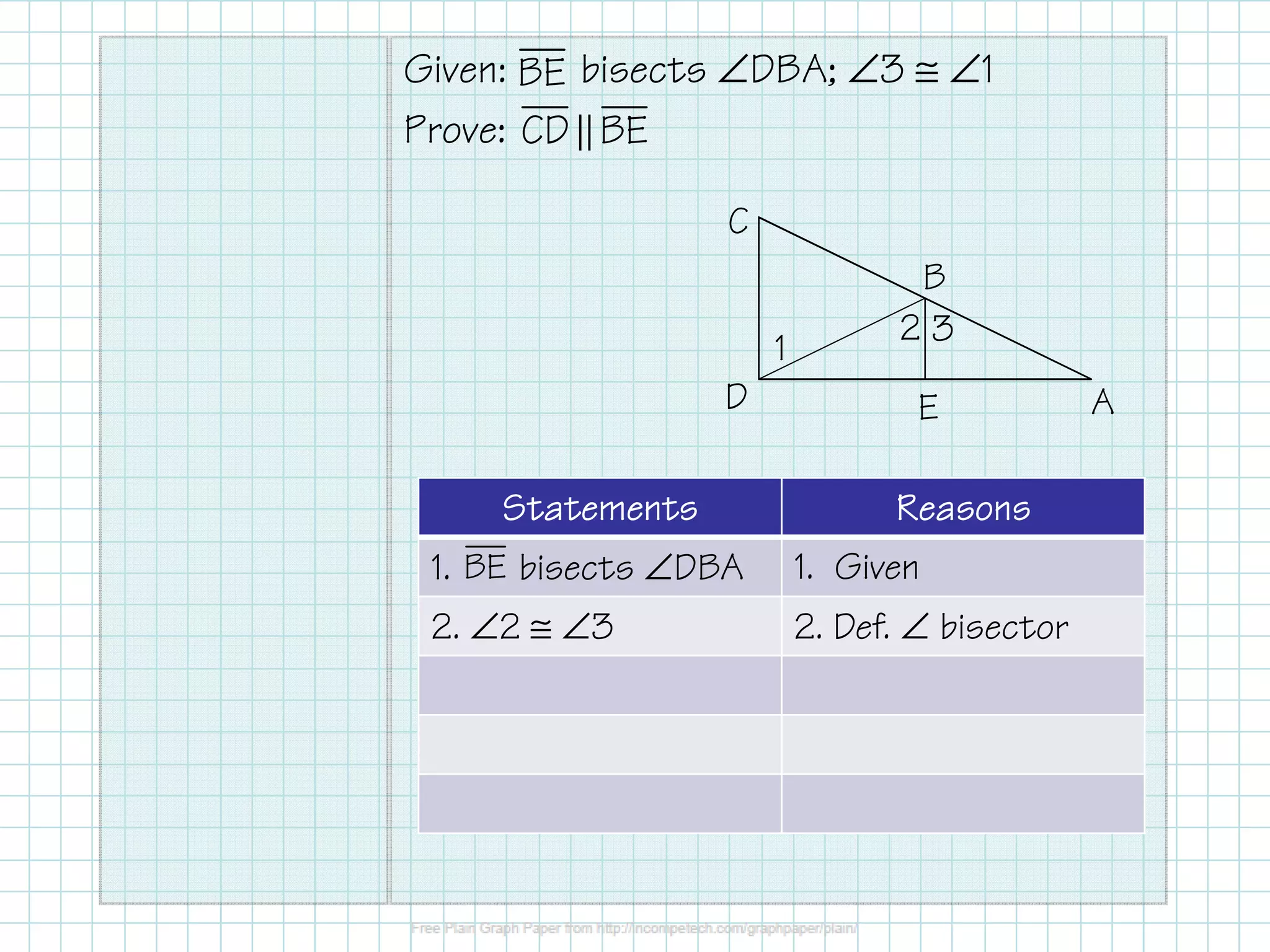
1. BE 
bisects ÐDBA 1. Given 
2. Ð2 @ Ð3 2. Def. Ð bisector
Given: bisects ÐDBA; Ð3 @ Ð1 
Prove: 
BE 
CD BE 
C 
B 
2 3 
1 
D E A 
SSSSttttaaaatttteeeemmmmeeeennnnttttssss RRRReeeeaaaassssoooonnnnssss 
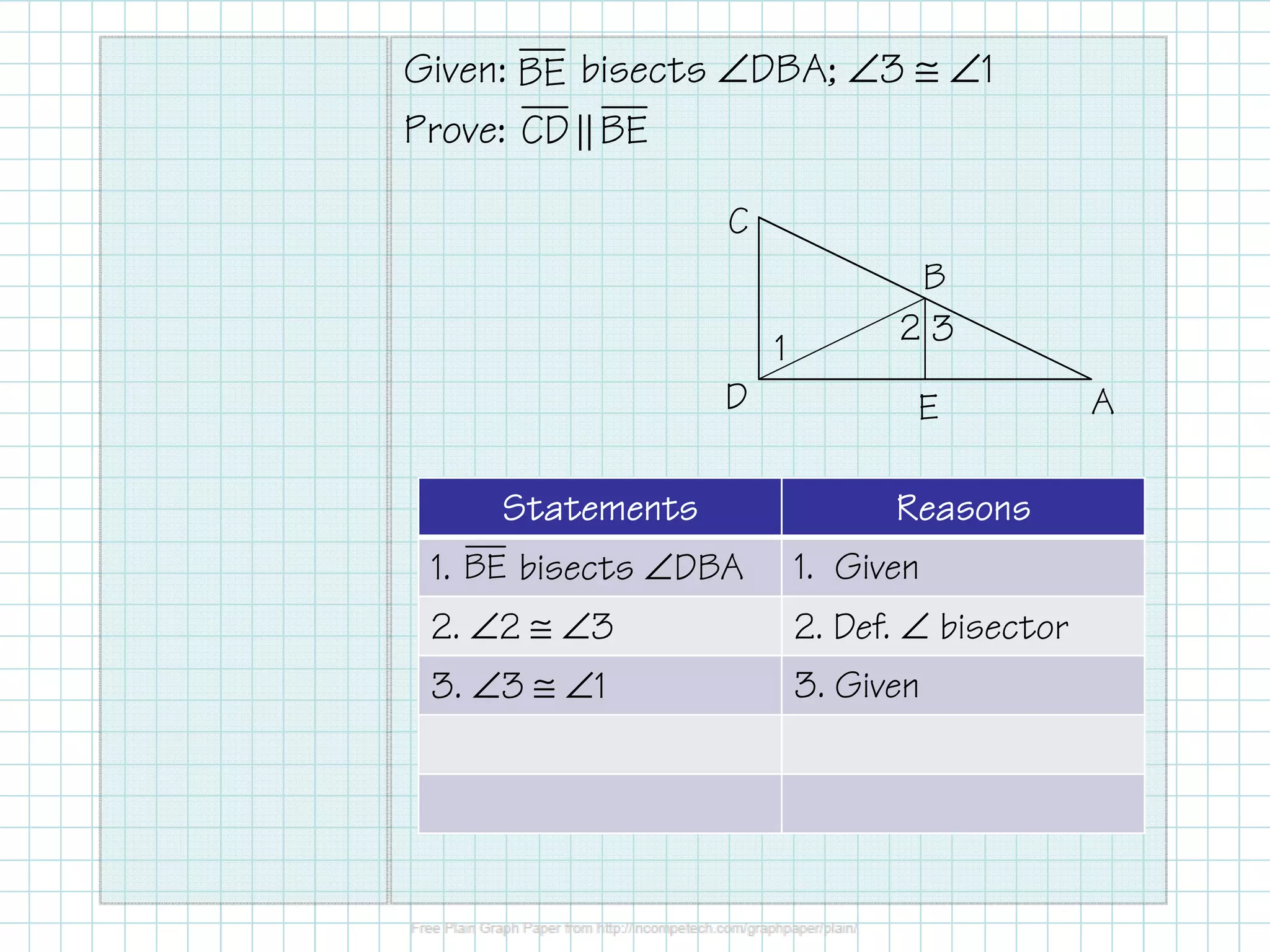
1. BE 
bisects ÐDBA 1. Given 
2. Ð2 @ Ð3 2. Def. Ð bisector 
3. Ð3 @ Ð1 3. Given
Given: bisects ÐDBA; Ð3 @ Ð1 
Prove: 
BE 
CD BE 
C 
B 
2 3 
1 
D E A 
SSSSttttaaaatttteeeemmmmeeeennnnttttssss RRRReeeeaaaassssoooonnnnssss 
1. BE 
bisects ÐDBA 1. Given 
2. Ð2 @ Ð3 2. Def. Ð bisector 
3. Ð3 @ Ð1 3. Given 
4. Ð2 @ Ð1 4. Subst. prop. @
Given: bisects ÐDBA; Ð3 @ Ð1 
Prove: 
BE 
CD BE 
C 
B 
2 3 
1 
D E A 
SSSSttttaaaatttteeeemmmmeeeennnnttttssss RRRReeeeaaaassssoooonnnnssss 
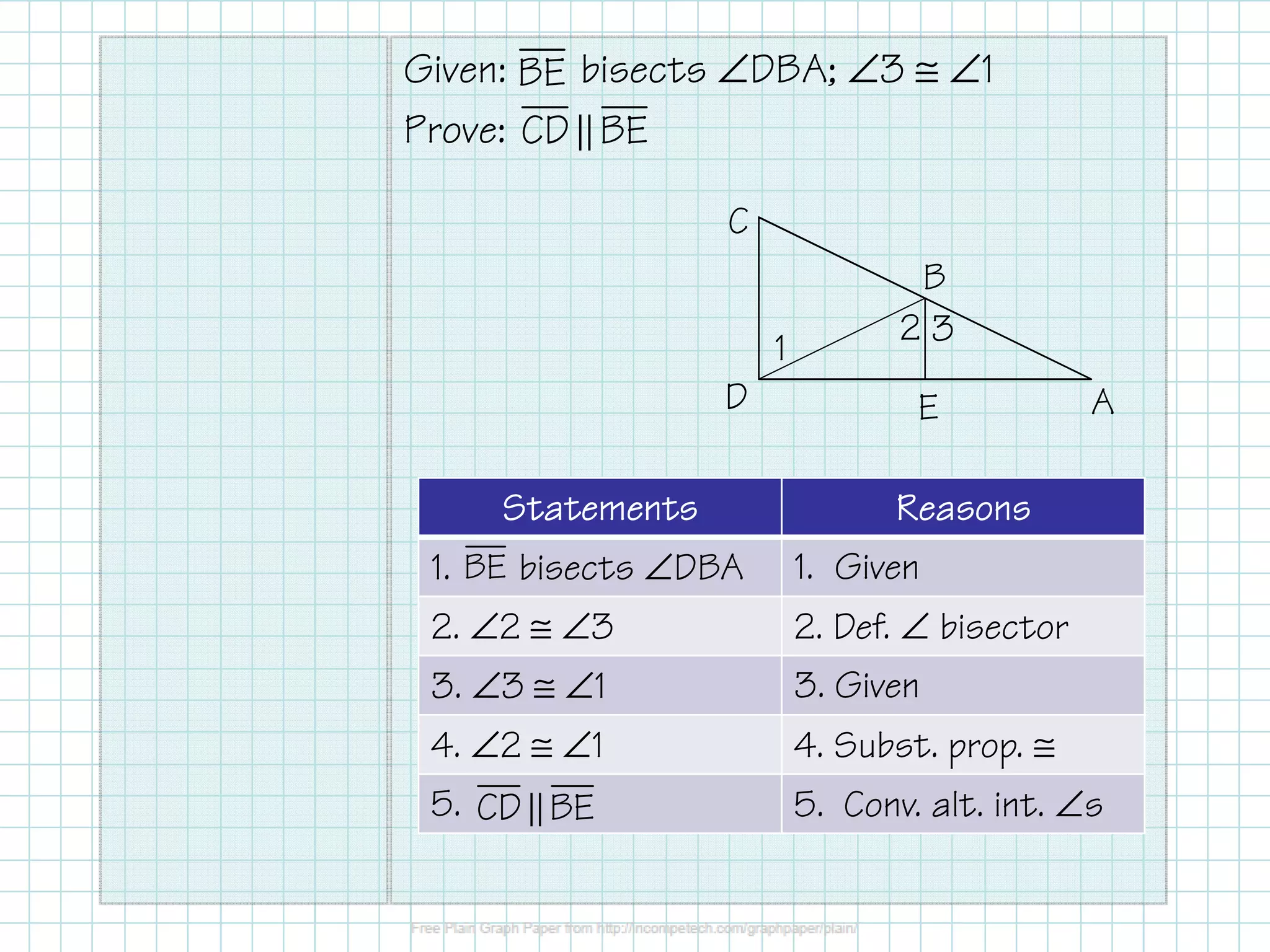
1. BE 
bisects ÐDBA 1. Given 
2. Ð2 @ Ð3 2. Def. Ð bisector 
3. Ð3 @ Ð1 3. Given 
4. Ð2 @ Ð1 4. Subst. prop. @ 
5. 5. Conv. alt. int. Ðs 
CD BE

Obj. 12 Proving Lines Parallel

  • 1.
    Obj. 12 ProvingLines Parallel The student is able to (I can): • Use angles formed by a transversal to show that lines are parallel.
  • 2.
    Recall that theconverse of a theorem is found by exchanging the hypothesis and conclusion. The converses of the parallel line theorems can be used to prove lines parallel • Corresponding Angles • Alternate Interior Angles • Alternate Exterior Angles — If angles are congruent, then the lines are parallel. • Same-Side Interior Angles — If angles are supplementary, then the lines are parallel.
  • 3.
    Example Find valuesof x and y that make the red lines parallel and the blue lines parallel. (x−40)° (x+40)° If the blue lines are parallel, then the same-side interior angles must be supplementary. x − 40 + x + 40 = 180 2x = 180 x = 90 y°
  • 4.
    Example Find valuesof x and y that make the red lines parallel and the blue lines parallel. (x−40)° (x+40)° If the red lines are parallel, then the same-side interior angles must be supplementary. 90 − 40 + y = 180 50 + y = 180 y = 130 y°
  • 5.
    Given: bisects ÐDBA;Ð3 @ Ð1 Prove: BE CD BE C B 2 3 1 D E A Plan of proof: Because bisects ÐDBA, BE Ð2 @ Ð3. Because Ð3 @ Ð1, I can set Ð2 @Ð1 using substitution. Ð1 and Ð2 are alternate interior angles, and since they are congruent, the lines are parallel.
  • 6.
    Given: bisects ÐDBA;Ð3 @ Ð1 Prove: BE CD BE C B 2 3 1 D E A SSSSttttaaaatttteeeemmmmeeeennnnttttssss RRRReeeeaaaassssoooonnnnssss 1. B E bisects ÐDBA 1. Given
  • 7.
    Given: bisects ÐDBA;Ð3 @ Ð1 Prove: BE CD BE C B 2 3 1 D E A SSSSttttaaaatttteeeemmmmeeeennnnttttssss RRRReeeeaaaassssoooonnnnssss 1. BE bisects ÐDBA 1. Given 2. Ð2 @ Ð3 2. Def. Ð bisector
  • 8.
    Given: bisects ÐDBA;Ð3 @ Ð1 Prove: BE CD BE C B 2 3 1 D E A SSSSttttaaaatttteeeemmmmeeeennnnttttssss RRRReeeeaaaassssoooonnnnssss 1. BE bisects ÐDBA 1. Given 2. Ð2 @ Ð3 2. Def. Ð bisector 3. Ð3 @ Ð1 3. Given
  • 9.
    Given: bisects ÐDBA;Ð3 @ Ð1 Prove: BE CD BE C B 2 3 1 D E A SSSSttttaaaatttteeeemmmmeeeennnnttttssss RRRReeeeaaaassssoooonnnnssss 1. BE bisects ÐDBA 1. Given 2. Ð2 @ Ð3 2. Def. Ð bisector 3. Ð3 @ Ð1 3. Given 4. Ð2 @ Ð1 4. Subst. prop. @
  • 10.
    Given: bisects ÐDBA;Ð3 @ Ð1 Prove: BE CD BE C B 2 3 1 D E A SSSSttttaaaatttteeeemmmmeeeennnnttttssss RRRReeeeaaaassssoooonnnnssss 1. BE bisects ÐDBA 1. Given 2. Ð2 @ Ð3 2. Def. Ð bisector 3. Ð3 @ Ð1 3. Given 4. Ð2 @ Ð1 4. Subst. prop. @ 5. 5. Conv. alt. int. Ðs CD BE