Arcs and ChordsArcs and Chords
You will learn to identify and use the relationships among
arcs, chords, and diameters.
Nothing New!
Arcs and ChordsArcs and Chords
BD
S
C
P
A
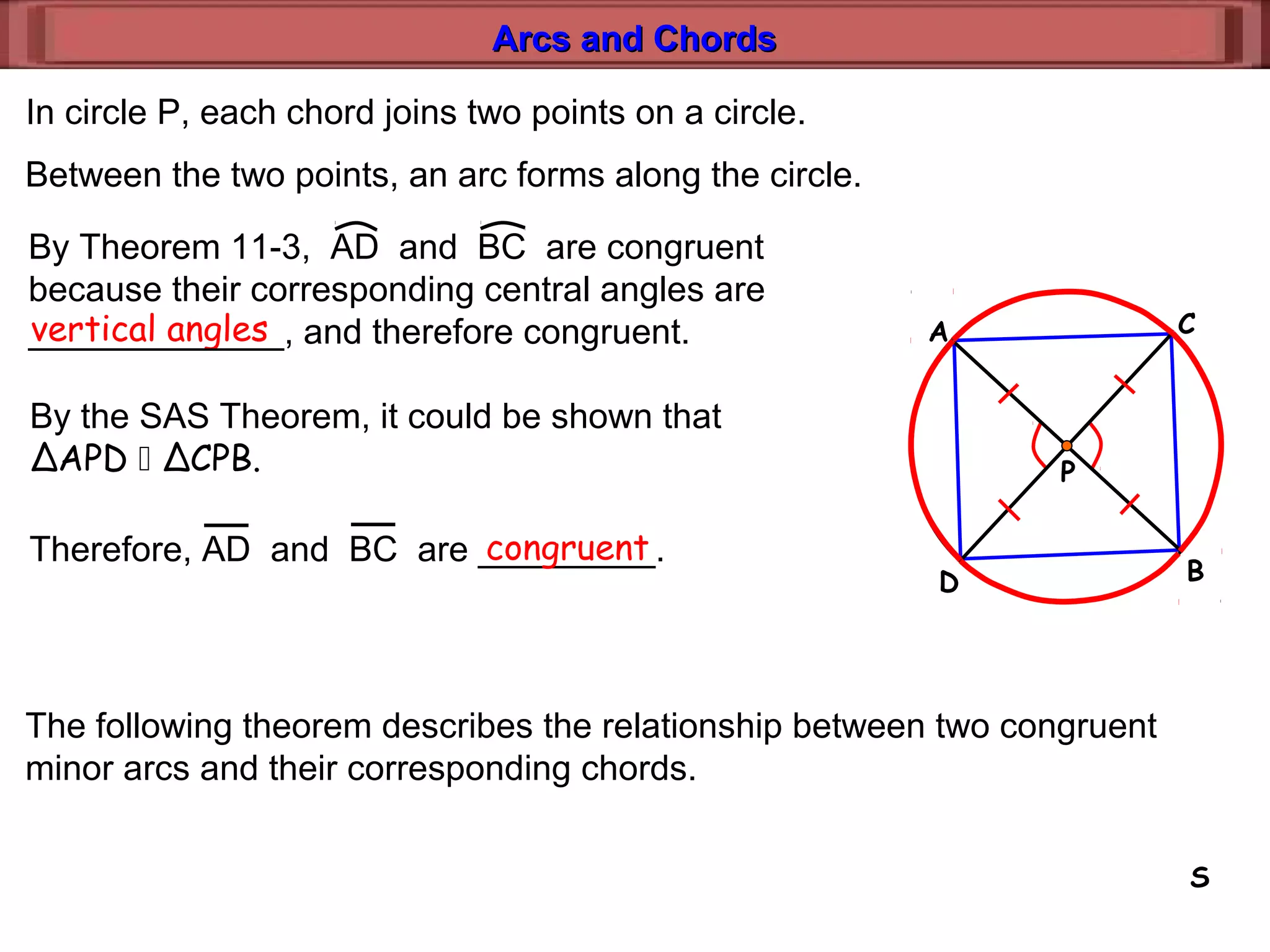
In circle P, each chord joins two points on a circle.
Between the two points, an arc forms along the circle.
vertical angles
By Theorem 11-3, AD and BC are congruent
because their corresponding central angles are
_____________, and therefore congruent.
By the SAS Theorem, it could be shown that
ΔAPD  ΔCPB.
Therefore, AD and BC are _________.congruent
The following theorem describes the relationship between two congruent
minor arcs and their corresponding chords.
Arcs and ChordsArcs and Chords
Theorem
11-4
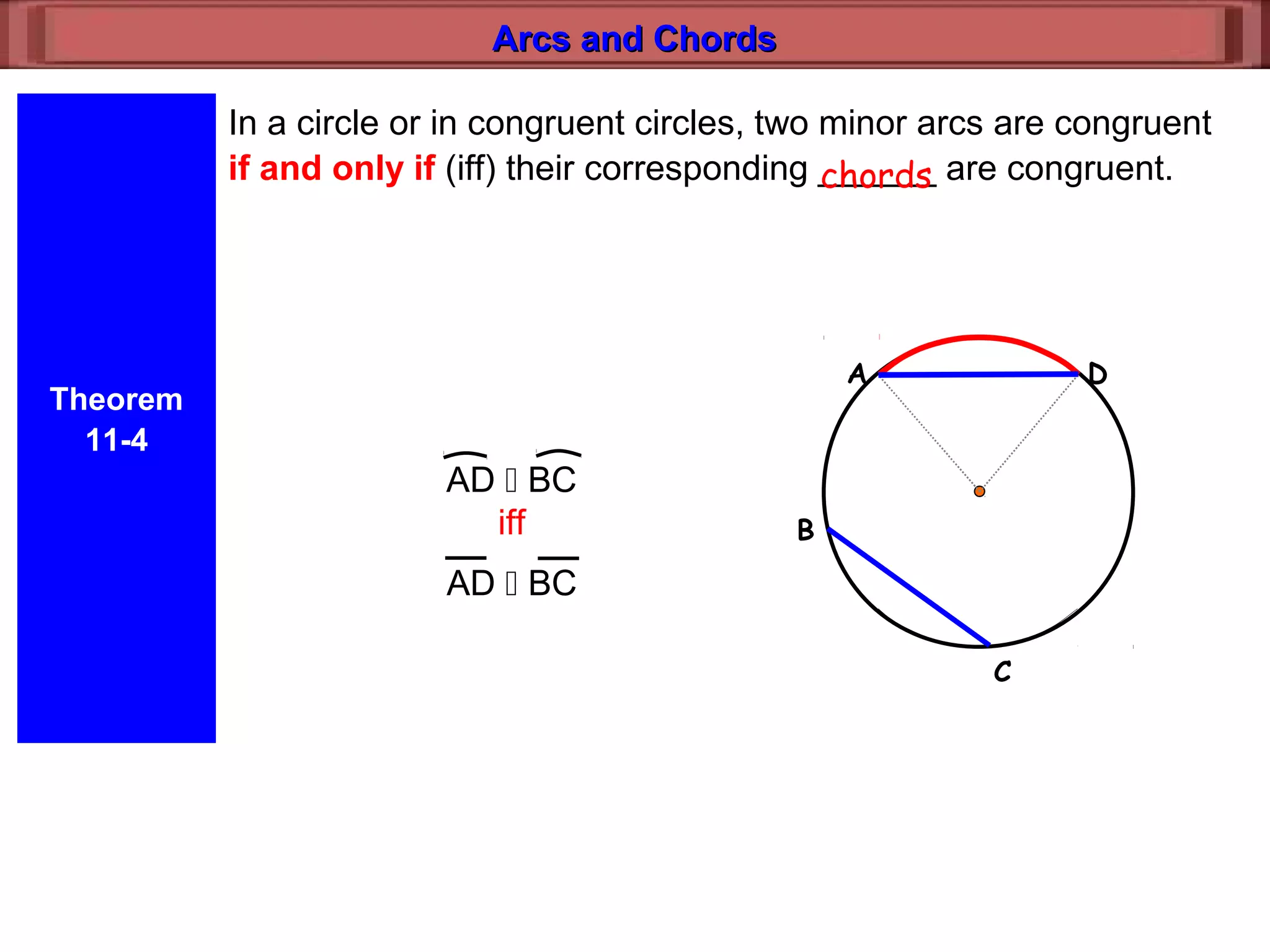
In a circle or in congruent circles, two minor arcs are congruent
if and only if (iff) their corresponding ______ are congruent.
B
D
C
A
chords
AD  BC
iff
AD  BC
Arcs and ChordsArcs and Chords
A
BC
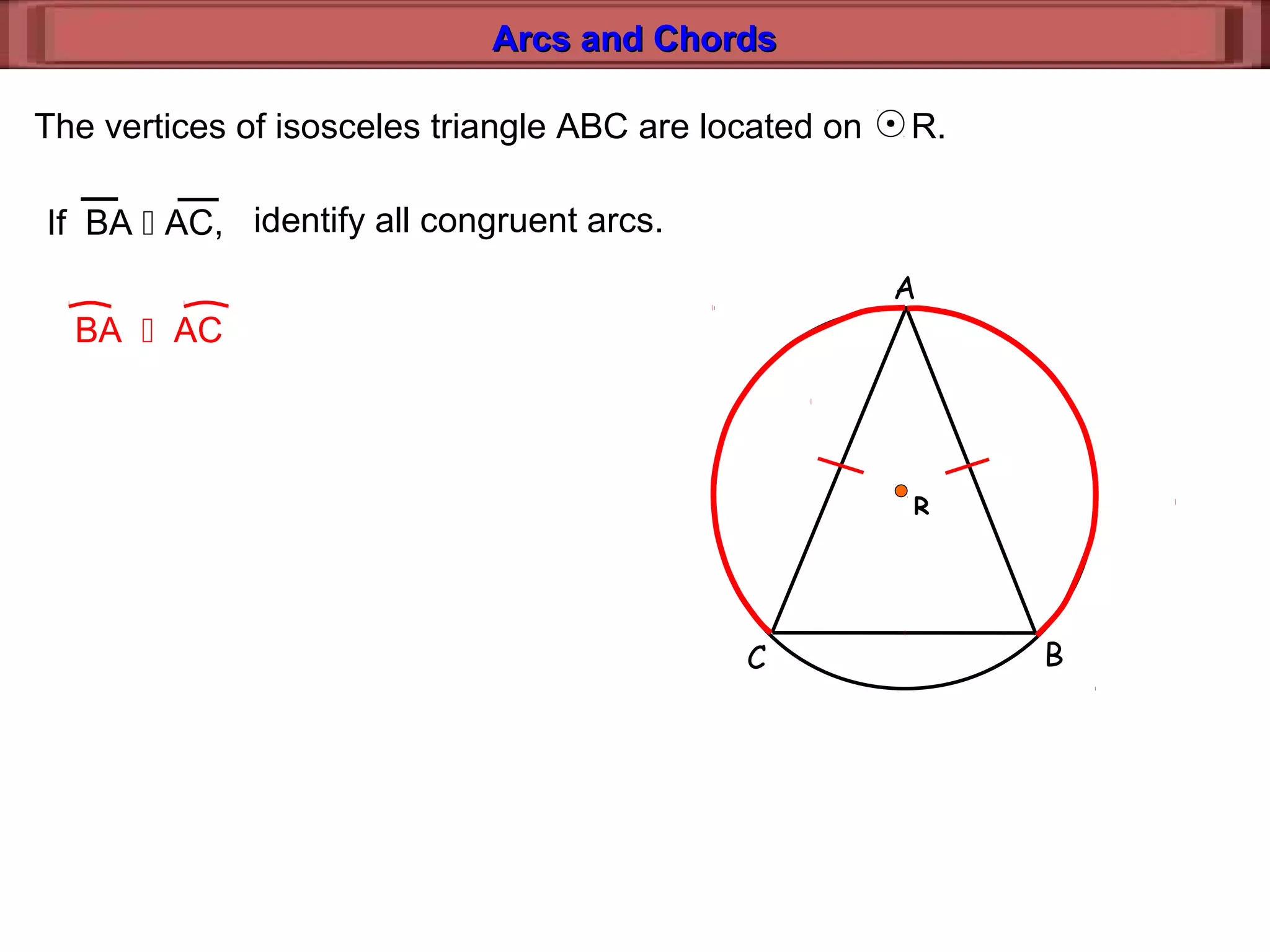
The vertices of isosceles triangle ABC are located on R.
R
If BA  AC, identify all congruent arcs.
BA  AC
Arcs and ChordsArcs and Chords
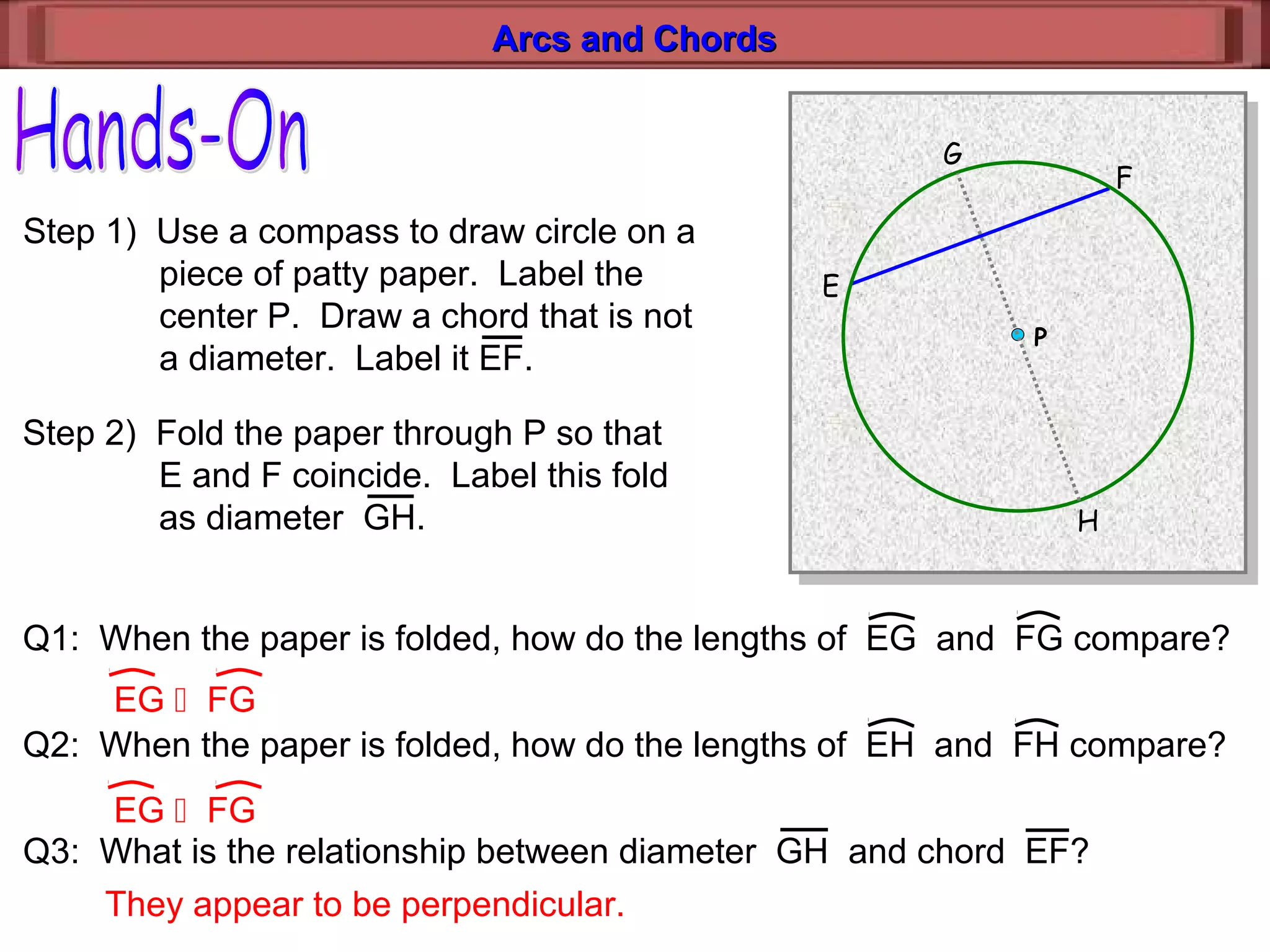
Step 1) Use a compass to draw circle on a
piece of patty paper. Label the
center P. Draw a chord that is not
a diameter. Label it EF.
Step 2) Fold the paper through P so that
E and F coincide. Label this fold
as diameter GH.
E
F
P
G
H
Q1: When the paper is folded, how do the lengths of EG and FG compare?
Q2: When the paper is folded, how do the lengths of EH and FH compare?
Q3: What is the relationship between diameter GH and chord EF?
EG  FG
EG  FG
They appear to be perpendicular.
Arcs and ChordsArcs and Chords
Theorem
11-5
In a circle, a diameter bisects a chord and its arc if and only if
(iff) it is perpendicular to the chord.
P
R
D
C
B
A
AR  BR and AD  BD
iff
CD AB
Like an angle, an arc can be bisected.
Arcs and ChordsArcs and Chords
B
C
A
K
D
7
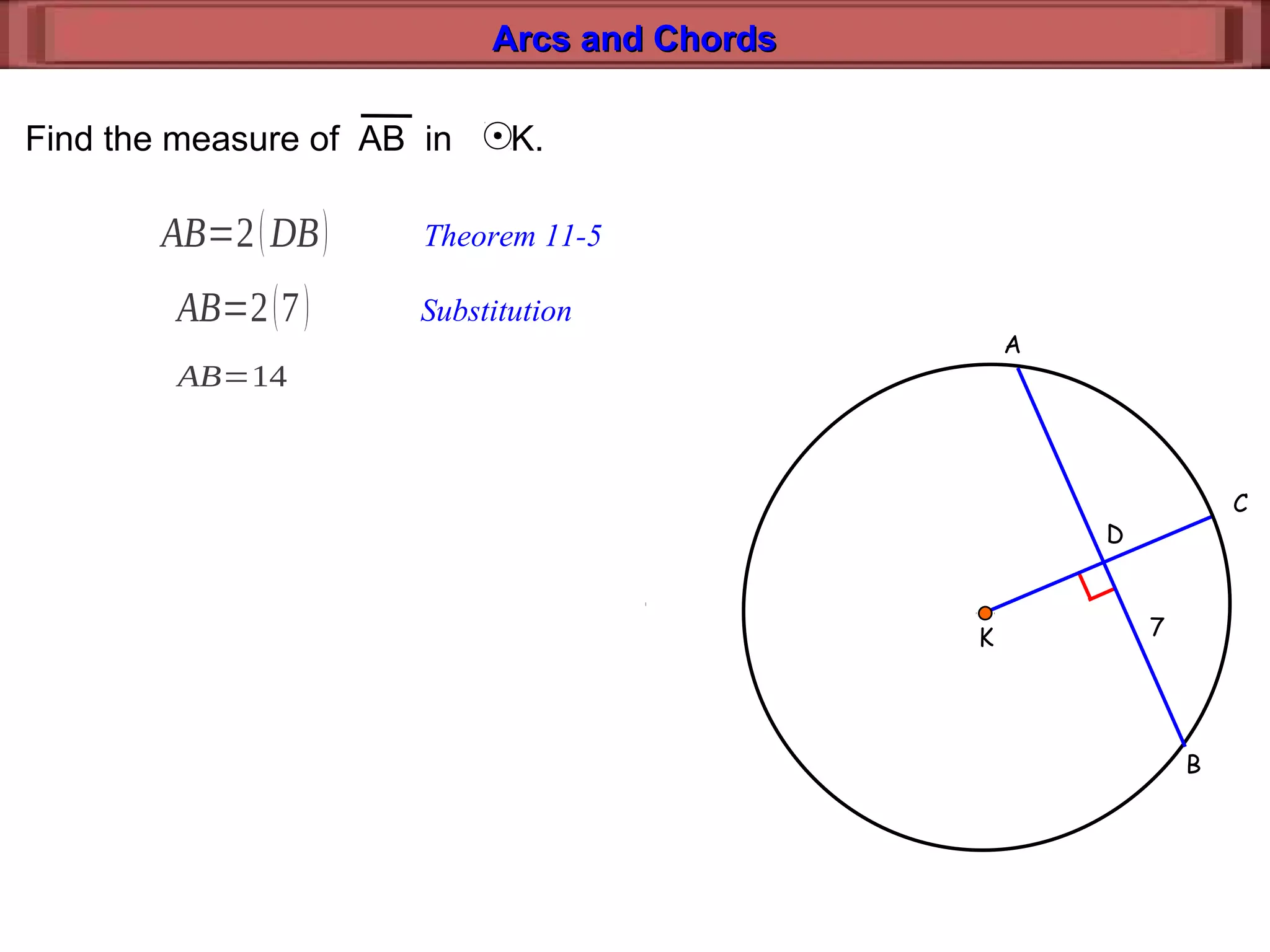
Find the measure of AB in K.
AB=2(DB) Theorem 11-5
AB=2(7)
AB=14
Substitution
Arcs and ChordsArcs and Chords
M
K
L
K
N6
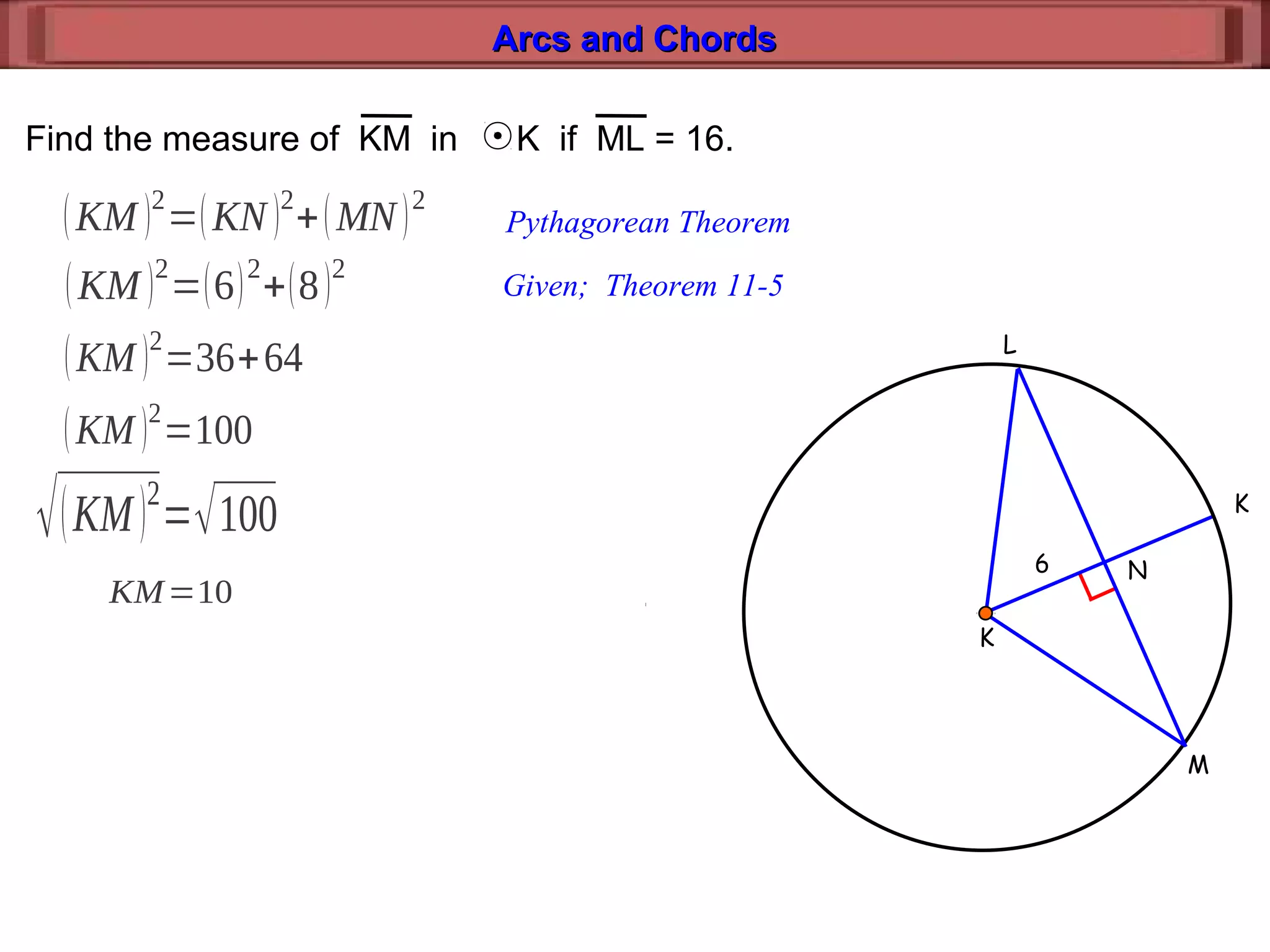
Find the measure of KM in K if ML = 16.
(KM )2
=(KN )2
+(MN)2
Pythagorean Theorem
(KM )2
=(6)2
+(8)2
Given; Theorem 11-5
(KM )2
=36+64
(KM )2
=100
√(KM)2
=√100
KM=10

11 3 arcs and chords lesson

  • 1.
    Arcs and ChordsArcsand Chords You will learn to identify and use the relationships among arcs, chords, and diameters. Nothing New!
  • 2.
    Arcs and ChordsArcsand Chords BD S C P A In circle P, each chord joins two points on a circle. Between the two points, an arc forms along the circle. vertical angles By Theorem 11-3, AD and BC are congruent because their corresponding central angles are _____________, and therefore congruent. By the SAS Theorem, it could be shown that ΔAPD  ΔCPB. Therefore, AD and BC are _________.congruent The following theorem describes the relationship between two congruent minor arcs and their corresponding chords.
  • 3.
    Arcs and ChordsArcsand Chords Theorem 11-4 In a circle or in congruent circles, two minor arcs are congruent if and only if (iff) their corresponding ______ are congruent. B D C A chords AD  BC iff AD  BC
  • 4.
    Arcs and ChordsArcsand Chords A BC The vertices of isosceles triangle ABC are located on R. R If BA  AC, identify all congruent arcs. BA  AC
  • 5.
    Arcs and ChordsArcsand Chords Step 1) Use a compass to draw circle on a piece of patty paper. Label the center P. Draw a chord that is not a diameter. Label it EF. Step 2) Fold the paper through P so that E and F coincide. Label this fold as diameter GH. E F P G H Q1: When the paper is folded, how do the lengths of EG and FG compare? Q2: When the paper is folded, how do the lengths of EH and FH compare? Q3: What is the relationship between diameter GH and chord EF? EG  FG EG  FG They appear to be perpendicular.
  • 6.
    Arcs and ChordsArcsand Chords Theorem 11-5 In a circle, a diameter bisects a chord and its arc if and only if (iff) it is perpendicular to the chord. P R D C B A AR  BR and AD  BD iff CD AB Like an angle, an arc can be bisected.
  • 7.
    Arcs and ChordsArcsand Chords B C A K D 7 Find the measure of AB in K. AB=2(DB) Theorem 11-5 AB=2(7) AB=14 Substitution
  • 8.
    Arcs and ChordsArcsand Chords M K L K N6 Find the measure of KM in K if ML = 16. (KM )2 =(KN )2 +(MN)2 Pythagorean Theorem (KM )2 =(6)2 +(8)2 Given; Theorem 11-5 (KM )2 =36+64 (KM )2 =100 √(KM)2 =√100 KM=10