TheAPMG-InternationalOBASHIandSwirlDevicelogoisatrademarkofTheAPMGroupLimited.
OBASHI®isaRegisteredTradeMarkintheUnitedKingdomandothercountries.
Start and finish Course style
LunchCoffee and breaks
M00 - Course introduction 2/10 2/143
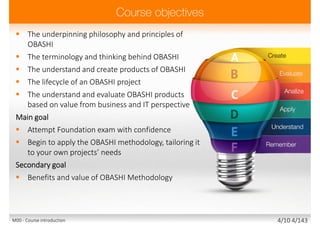
 The underpinning philosophy and principles of
OBASHI
 The terminology and thinking behind OBASHI
 The understand and create products of OBASHI
 The lifecycle of an OBASHI project
 The understand and evaluate OBASHI products
based on value from business and IT perspective
Main goal
 Attempt Foundation exam with confidence
 Begin to apply the OBASHI methodology, tailoring it
to your own projects’ needs
Secondary goal
 Benefits and value of OBASHI Methodology
M00 - Course introduction 3/10 3/143
 Let’s Get to Know Each Other
 Please share with the class:
 Your name and surname
 Your organization
 Your profession
 Title, function, job responsibilities
 Your familiarity with the
project management
 Your experience with
Enterprise Architecture (e.g. TOGAF)
 Your experience with
ITIL/ITSM/ASL/BiSL/Business-IT alignment
 Your personal session expectations
M00 - Course introduction 4/10 4/143
 Foundation Exam
 Paper based and closed book exam
 Only pencil and eraser are allowed
 Simple multiple (ABCD) choice exam
 Only one answer is correct
 50 questions, pass mark is 30 (60%)
 1 hour exam
 No negative points, no “Tricky Questions”
 No pre-requisite for Foundation exam
 Sample, one mock exam is provided to
you
Candidates completing an examination in a language that
is not their mother tongue, will receive additional time
M00 - Course introduction 5/10 5/143
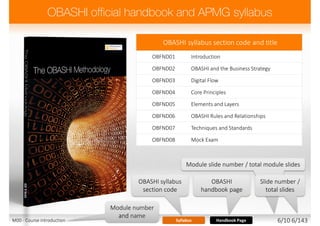
OBASHI syllabus section code and title
OBFND01 Introduction
OBFND02 OBASHI and the Business Strategy
OBFND03 Digital Flow
OBFND04 Core Principles
OBFND05 Elements and Layers
OBFND06 OBASHI Rules and Relationships
OBFND07 Techniques and Standards
OBFND08 Mock Exam
Syllabus
Module slide number / total module slides
Slide number /
total slides
Module number
and name
OBASHI
handbook page
OBASHI syllabus
section code
Handbook PageM00 - Course introduction 6/10 6/143
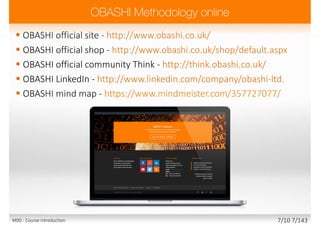
 OBASHI official site - http://www.obashi.co.uk/
 OBASHI official shop - http://www.obashi.co.uk/shop/default.aspx
 OBASHI official community Think - http://think.obashi.co.uk/
 OBASHI LinkedIn - http://www.linkedin.com/company/obashi-ltd.
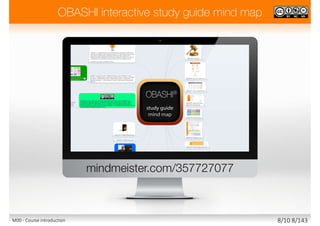
 OBASHI mind map - https://www.mindmeister.com/357727077/
M00 - Course introduction 7/10 7/143
M00 - Course introduction 8/10 8/143
quizlet.com/44010938/
M00 - Course introduction 9/10 9/143
twitter.com/mirodabrowski
linkedin.com/in/miroslawdabrowski
google.com/+miroslawdabrowski
miroslaw_dabrowski
www.miroslawdabrowski.com
Mirosław Dąbrowski
Agile Coach, Trainer, Consultant
(former JEE/PHP developer, UX/UI designer, BA/SA)
Creator Writer / Translator Trainer / Coach
• Creator of 50+ mind maps from PPM and related
topics (2mln views): miroslawdabrowski.com
• Lead author of more than 50+ accredited materials
from PRINCE2, PRINCE2 Agile, MSP, MoP, P3O, ITIL,
M_o_R, MoV, PMP, Scrum, AgilePM, DSDM, CISSP,
CISA, CISM, CRISC, CGEIT, TOGAF, COBIT5 etc.
• Creator of 50+ interactive mind maps from PPM
topics: mindmeister.com/users/channel/2757050
• Product Owner of biggest Polish project
management portal: 4PM: 4pm.pl (15.000+ views
each month)
• Editorial Board Member of Official PMI Poland
Chapter magazine: “Strefa PMI”: strefapmi.pl
• Official PRINCE2 Agile, AgilePM, ASL2, BiSL methods
translator for Polish language
• English speaking, international, independent
trainer and coach from multiple domains.
• Master Lead Trainer
• 11+ years in training and coaching / 15.000+ hours
• 100+ certifications
• 5000+ people trained and coached
• 25+ trainers trained and coached
linkedin.com/in/miroslawdabrowski
Agile Coach / Scrum Master PM / IT architect Notable clients
• 8+ years of experience with Agile projects as a
Scrum Master, Product Owner and Agile Coach
• Coached 25+ teams from Agile and Scrum
• Agile Coach coaching C-level executives
• Scrum Master facilitating multiple teams
experienced with UX/UI + Dev teams
• Experience multiple Agile methods
• Author of AgilePM/DSDM Project Health Check
Questionnaire (PHCQ) audit tool
• Dozens of mobile and ecommerce projects
• IT architect experienced in IT projects with budget
above 10mln PLN and timeline of 3+ years
• Experienced with (“traditional”) projects under high
security, audit and compliance requirements based
on ISO/EIC 27001
• 25+ web portal design and development and
mobile application projects with iterative,
incremental and adaptive approach
ABB, AGH, Aiton Caldwell, Asseco, Capgemini, Deutsche Bank,
Descom, Ericsson, Ericpol, Euler Hermes, General Electric,
Glencore, HP Global Business Center, Ideo, Infovide-Matrix,
Interia, Kemira, Lufthansa Systems, Media-Satrun Group,
Ministry of Defense (Poland), Ministry of Justice (Poland),
Nokia Siemens Networks, Oracle, Orange, Polish Air Force,
Proama, Roche, Sabre Holdings, Samsung Electronics, Sescom,
Scania, Sopra Steria, Sun Microsystems, Tauron Polish Energy,
Tieto, University of Wroclaw, UBS Service Centre, Volvo IT…
miroslawdabrowski.com/about-me/clients-and-references/
Accreditations/certifications (selected): CISA, CISM, CRISC, CASP, Security+, Project+, Network+, Server+, Approved
Trainer: (MoP, MSP, PRINCE2, PRINCE2 Agile, M_o_R, MoV, P3O, ITIL Expert, RESILIA), ASL2, BiSL, Change Management,
Facilitation, Managing Benefits, COBIT5, TOGAF 8/9L2, OBASHI, CAPM, PSM I, SDC, SMC, ESMC, SPOC, AEC, DSDM Atern,
DSDM Agile Professional, DSDM Agile Trainer-Coach, AgilePM, OCUP Advanced, SCWCD, SCBCD, SCDJWS, SCMAD, ZCE 5.0,
ZCE 5.3, MCT, MCP, MCITP, MCSE-S, MCSA-S, MCS, MCSA, ISTQB, IQBBA, REQB, CIW Web Design / Web Development /
Web Security Professional, Playing Lean Facilitator, DISC D3 Consultant, SDI Facilitator, Certified Trainer Apollo 13 ITSM
Simulation …
M00 - Course introduction 10/10 10/143
1. Introduction to OBASHI
2. Elements and layers
3. B&IT diagrams
4. Relationship rules
5. DAV diagrams
6. Physical vs logical modelling
7. Project lifecycle
M01 - Introduction to OBASHI 2/31 12/143
ReproducedunderlicencefromOBASHILtd.
84OBFND01M01 - Introduction to OBASHI 3/31 13/143
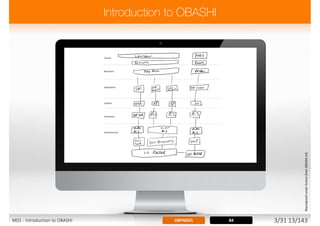
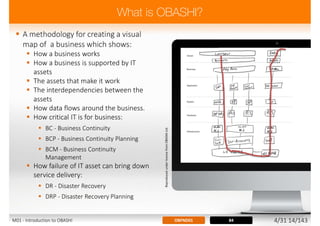
 A methodology for creating a visual
map of a business which shows:
 How a business works
 How a business is supported by IT
assets
 The assets that make it work
 The interdependencies between the
assets
 How data flows around the business.
 How critical IT is for business:
 BC - Business Continuity
 BCP - Business Continuity Planning
 BCM - Business Continuity
Management
 How failure of IT asset can bring down
service delivery:
 DR - Disaster Recovery
 DRP - Disaster Recovery Planning
ReproducedunderlicencefromOBASHILtd.
84OBFND01M01 - Introduction to OBASHI 4/31 14/143
"Far too often, major investments in new information and
communications technology (ICT) fail to deliver on the benefits
promised...
The OBASHI Methodology addresses directly the key issues
behind the underperformance of ICT enabled business change.
I commend it to you..."
"I believe that everyone trained in any best practice should
become trained in OBASHI"
"There is huge potential for an International Standard (ISO)
being created for OBASHI"
Professor Jim Norton, President - British Computer Society
Colin Bentley, Author of PRINCE2
ReproducedunderlicencefromOBASHILtd.
M01 - Introduction to OBASHI 5/31 15/143
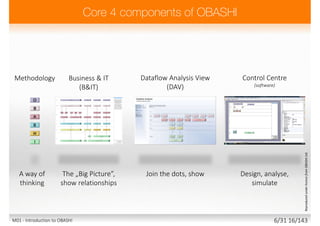
Methodology Business & IT
(B&IT)
Dataflow Analysis View
(DAV)
A way of
thinking
The „Big Picture”,
show relationships
Join the dots, show
Control Centre
(software)
Design, analyse,
simulate
ReproducedunderlicencefromOBASHILtd.
M01 - Introduction to OBASHI 6/31 16/143
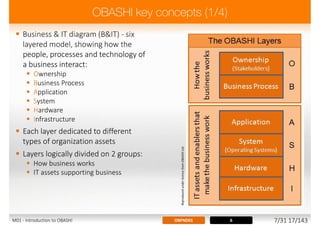
 Business & IT diagram (B&IT) - six
layered model, showing how the
people, processes and technology of
a business interact:
 Ownership
 Business Process
 Application
 System
 Hardware
 Infrastructure
 Each layer dedicated to different
types of organization assets
 Layers logically divided on 2 groups:
 How business works
 IT assets supporting business
6OBFND01
ReproducedunderlicencefromOBASHILtd.
M01 - Introduction to OBASHI 7/31 17/143
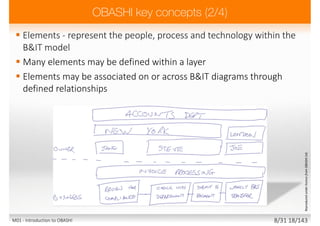
 Elements - represent the people, process and technology within the
B&IT model
 Many elements may be defined within a layer
 Elements may be associated on or across B&IT diagrams through
defined relationships
ReproducedunderlicencefromOBASHILtd.
M01 - Introduction to OBASHI 8/31 18/143
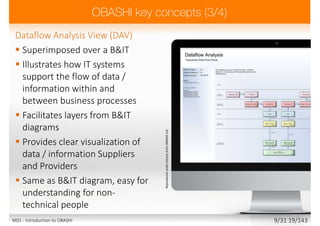
Dataflow Analysis View (DAV)
 Superimposed over a B&IT
 Illustrates how IT systems
support the flow of data /
information within and
between business processes
 Facilitates layers from B&IT
diagrams
 Provides clear visualization of
data / information Suppliers
and Providers
 Same as B&IT diagram, easy for
understanding for non-
technical people
ReproducedunderlicencefromOBASHILtd.
M01 - Introduction to OBASHI 9/31 19/143
ReproducedunderlicencefromOBASHILtd.
M01 - Introduction to OBASHI 10/31 20/143
 OBASHI provides the “big picture” of how the
business works:
 Enables communications with all levels in the
organization
 Puts people, process and technology in a
business context
 Shows how the business normally achieves its
objectives (Business as Usual)
 Provides a platform for analyzing and simulating
strategic development and speculative
opportunities
 Shows hot the business relies on IT assets
 Shows which information is critical for
successful business process execution
 Provides overview look on key risks related to
business risk and IT
“with clarity and vision,
you can develop and improve.”
ReproducedunderlicencefromOBASHILtd.
12OBFND02M01 - Introduction to OBASHI 11/31 21/143
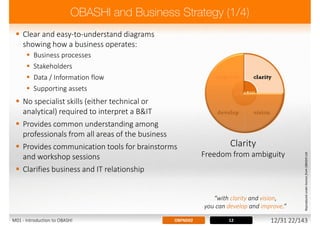
 Clear and easy-to-understand diagrams
showing how a business operates:
 Business processes
 Stakeholders
 Data / Information flow
 Supporting assets
 No specialist skills (either technical or
analytical) required to interpret a B&IT
 Provides common understanding among
professionals from all areas of the business
 Provides communication tools for brainstorms
and workshop sessions
 Clarifies business and IT relationship
Clarity
Freedom from ambiguity
ReproducedunderlicencefromOBASHILtd.
“with clarity and vision,
you can develop and improve.”
12OBFND02M01 - Introduction to OBASHI 12/31 22/143
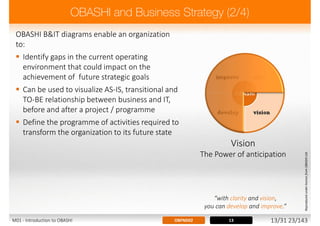
OBASHI B&IT diagrams enable an organization
to:
 Identify gaps in the current operating
environment that could impact on the
achievement of future strategic goals
 Can be used to visualize AS-IS, transitional and
TO-BE relationship between business and IT,
before and after a project / programme
 Define the programme of activities required to
transform the organization to its future state
Vision
The Power of anticipation
“with clarity and vision,
you can develop and improve.”
ReproducedunderlicencefromOBASHILtd.
13OBFND02M01 - Introduction to OBASHI 13/31 23/143
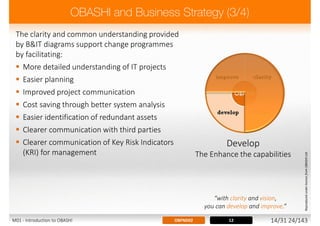
The clarity and common understanding provided
by B&IT diagrams support change programmes
by facilitating:
 More detailed understanding of IT projects
 Easier planning
 Improved project communication
 Cost saving through better system analysis
 Easier identification of redundant assets
 Clearer communication with third parties
 Clearer communication of Key Risk Indicators
(KRI) for management
Develop
The Enhance the capabilities
ReproducedunderlicencefromOBASHILtd.
“with clarity and vision,
you can develop and improve.”
12OBFND02M01 - Introduction to OBASHI 14/31 24/143
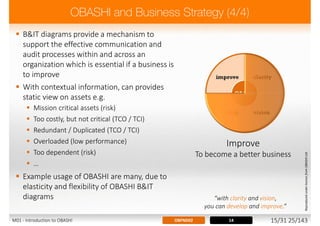
 B&IT diagrams provide a mechanism to
support the effective communication and
audit processes within and across an
organization which is essential if a business is
to improve
 With contextual information, can provides
static view on assets e.g.
 Mission critical assets (risk)
 Too costly, but not critical (TCO / TCI)
 Redundant / Duplicated (TCO / TCI)
 Overloaded (low performance)
 Too dependent (risk)
 …
 Example usage of OBASHI are many, due to
elasticity and flexibility of OBASHI B&IT
diagrams
Improve
To become a better business
ReproducedunderlicencefromOBASHILtd.
“with clarity and vision,
you can develop and improve.”
14OBFND02M01 - Introduction to OBASHI 15/31 25/143
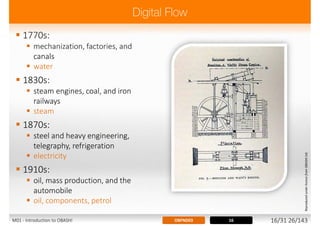
 1770s:
 mechanization, factories, and
canals
 water
 1830s:
 steam engines, coal, and iron
railways
 steam
 1870s:
 steel and heavy engineering,
telegraphy, refrigeration
 electricity
 1910s:
 oil, mass production, and the
automobile
 oil, components, petrol
16OBFND03
ReproducedunderlicencefromOBASHILtd.
M01 - Introduction to OBASHI 16/31 26/143
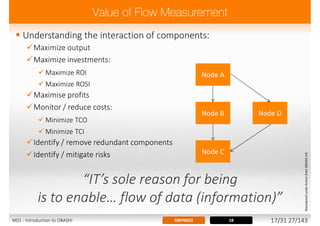
 Understanding the interaction of components:
Maximize output
Maximize investments:
 Maximize ROI
 Maximize ROSI
Maximise profits
Monitor / reduce costs:
 Minimize TCO
 Minimize TCI
Identify / remove redundant components
Identify / mitigate risks
Node A
Node B
Node C
Node D
“IT’s sole reason for being
is to enable… flow of data (information)”
ReproducedunderlicencefromOBASHILtd.
18OBFND03M01 - Introduction to OBASHI 17/31 27/143
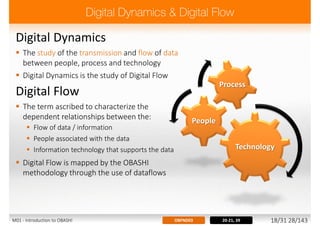
Digital Dynamics
 The study of the transmission and flow of data
between people, process and technology
 Digital Dynamics is the study of Digital Flow
Digital Flow
 The term ascribed to characterize the
dependent relationships between the:
 Flow of data / information
 People associated with the data
 Information technology that supports the data
 Digital Flow is mapped by the OBASHI
methodology through the use of dataflows
Technology
People
Process
20-21, 39OBFND03M01 - Introduction to OBASHI 18/31 28/143
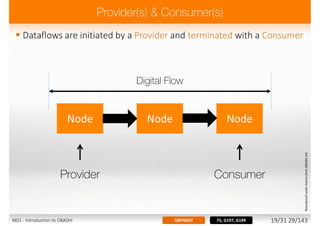
 Dataflows are initiated by a Provider and terminated with a Consumer
Node Node Node
ReproducedunderlicencefromOBASHILtd.
75, G197, G199OBFND07M01 - Introduction to OBASHI 19/31 29/143
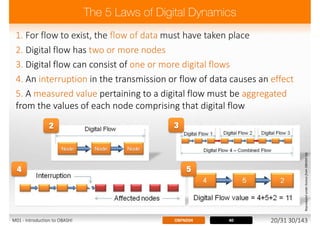
1. For flow to exist, the flow of data must have taken place
2. Digital flow has two or more nodes
3. Digital flow can consist of one or more digital flows
4. An interruption in the transmission or flow of data causes an effect
5. A measured value pertaining to a digital flow must be aggregated
from the values of each node comprising that digital flow
ReproducedunderlicencefromOBASHILtd.
40OBFND04M01 - Introduction to OBASHI 20/31 30/143
M01 - Introduction to OBASHI 21/31 31/143
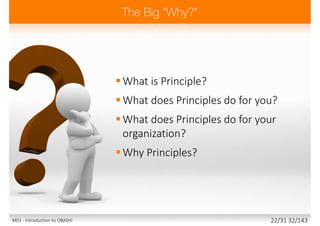
What is Principle?
What does Principles do for you?
What does Principles do for your
organization?
Why Principles?
M01 - Introduction to OBASHI 22/31 32/143
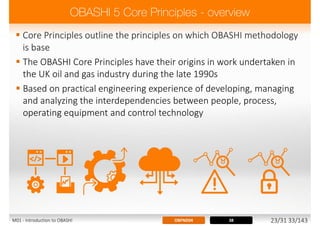
 Core Principles outline the principles on which OBASHI methodology
is base
 The OBASHI Core Principles have their origins in work undertaken in
the UK oil and gas industry during the late 1990s
 Based on practical engineering experience of developing, managing
and analyzing the interdependencies between people, process,
operating equipment and control technology
38OBFND04M01 - Introduction to OBASHI 23/31 33/143
 Principle #1
 The understanding of the flow of data is fundamental to an
organization’s financial well-being:
 How does the infrastructure support the flow of data around an organisation?
 Who uses / depends on that data throughout the execution of a business
process?
 How valuable is the data?
 What would be the total impact if that data flow were interrupted?
38OBFND04M01 - Introduction to OBASHI 24/31 34/143
 Principle #2
 Business resources (including people) and IT assets are either
providers or consumers of data, or are the conduit through which
data flows:
 Data is passed between individuals, departments, processes
 The IT infrastructure enables the flow of data
38OBFND04M01 - Introduction to OBASHI 25/31 35/143
 Principle #3
 Information Technology exists for one reason, namely, to enable the
flow of data between business assets:
 Data in, data out
 Simplify a process
 Streamline a process
 Enable a process to happen
 Not the beginning or end of a process
38OBFND04M01 - Introduction to OBASHI 26/31 36/143
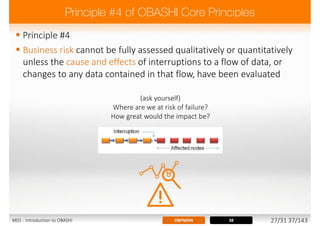
 Principle #4
 Business risk cannot be fully assessed qualitatively or quantitatively
unless the cause and effects of interruptions to a flow of data, or
changes to any data contained in that flow, have been evaluated
(ask yourself)
Where are we at risk of failure?
How great would the impact be?
38OBFND04M01 - Introduction to OBASHI 27/31 37/143
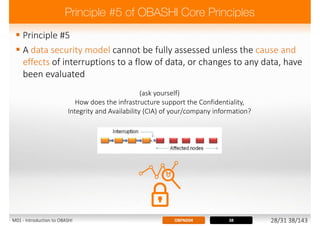
 Principle #5
 A data security model cannot be fully assessed unless the cause and
effects of interruptions to a flow of data, or changes to any data, have
been evaluated
(ask yourself)
How does the infrastructure support the Confidentiality,
Integrity and Availability (CIA) of your/company information?
38OBFND04M01 - Introduction to OBASHI 28/31 38/143
1. An element can represent any business resource or asset, physical or non-
physical
2. An element can only reside in its own OBASHI layer and cannot be resized beyond
the dimensions of that layer
3. An element can be related to any other element
4. Any data type, or classification of data, can be attributed to an element
5. Elements can be related using one or more of the six relationship types
6. The 6 relationship types are Connection, Dependency, Spatial, Set, Layer and
Sequential
7. The relationship types adhere to the OBASHI Relationship rules
8. The OBASHI methodology complies with the Laws of Digital Dynamics
9. Any data type, or classification of data, can be attributed to a Digital Flow of data
ReproducedunderlicencefromOBASHILtd.
39OBFND04M01 - Introduction to OBASHI 29/31 39/143
M01 - Introduction to OBASHI 30/31 40/143
I hope you enjoyed
this presentation. If so,
please like, share and
leave a comment
below.
Endorsements on
LinkedIn are also
highly appreciated! 
(your feedback = more free stuff)

MIROSLAWDABROWSKI.COM/downloads

OBASHI® - Foundation

  • 1.
  • 2.
    Start and finishCourse style LunchCoffee and breaks M00 - Course introduction 2/10 2/143
  • 3.
     The underpinningphilosophy and principles of OBASHI  The terminology and thinking behind OBASHI  The understand and create products of OBASHI  The lifecycle of an OBASHI project  The understand and evaluate OBASHI products based on value from business and IT perspective Main goal  Attempt Foundation exam with confidence  Begin to apply the OBASHI methodology, tailoring it to your own projects’ needs Secondary goal  Benefits and value of OBASHI Methodology M00 - Course introduction 3/10 3/143
  • 4.
     Let’s Getto Know Each Other  Please share with the class:  Your name and surname  Your organization  Your profession  Title, function, job responsibilities  Your familiarity with the project management  Your experience with Enterprise Architecture (e.g. TOGAF)  Your experience with ITIL/ITSM/ASL/BiSL/Business-IT alignment  Your personal session expectations M00 - Course introduction 4/10 4/143
  • 5.
     Foundation Exam Paper based and closed book exam  Only pencil and eraser are allowed  Simple multiple (ABCD) choice exam  Only one answer is correct  50 questions, pass mark is 30 (60%)  1 hour exam  No negative points, no “Tricky Questions”  No pre-requisite for Foundation exam  Sample, one mock exam is provided to you Candidates completing an examination in a language that is not their mother tongue, will receive additional time M00 - Course introduction 5/10 5/143
  • 6.
    OBASHI syllabus sectioncode and title OBFND01 Introduction OBFND02 OBASHI and the Business Strategy OBFND03 Digital Flow OBFND04 Core Principles OBFND05 Elements and Layers OBFND06 OBASHI Rules and Relationships OBFND07 Techniques and Standards OBFND08 Mock Exam Syllabus Module slide number / total module slides Slide number / total slides Module number and name OBASHI handbook page OBASHI syllabus section code Handbook PageM00 - Course introduction 6/10 6/143
  • 7.
     OBASHI officialsite - http://www.obashi.co.uk/  OBASHI official shop - http://www.obashi.co.uk/shop/default.aspx  OBASHI official community Think - http://think.obashi.co.uk/  OBASHI LinkedIn - http://www.linkedin.com/company/obashi-ltd.  OBASHI mind map - https://www.mindmeister.com/357727077/ M00 - Course introduction 7/10 7/143
  • 8.
    M00 - Courseintroduction 8/10 8/143
  • 9.
    quizlet.com/44010938/ M00 - Courseintroduction 9/10 9/143
  • 10.
    twitter.com/mirodabrowski linkedin.com/in/miroslawdabrowski google.com/+miroslawdabrowski miroslaw_dabrowski www.miroslawdabrowski.com Mirosław Dąbrowski Agile Coach,Trainer, Consultant (former JEE/PHP developer, UX/UI designer, BA/SA) Creator Writer / Translator Trainer / Coach • Creator of 50+ mind maps from PPM and related topics (2mln views): miroslawdabrowski.com • Lead author of more than 50+ accredited materials from PRINCE2, PRINCE2 Agile, MSP, MoP, P3O, ITIL, M_o_R, MoV, PMP, Scrum, AgilePM, DSDM, CISSP, CISA, CISM, CRISC, CGEIT, TOGAF, COBIT5 etc. • Creator of 50+ interactive mind maps from PPM topics: mindmeister.com/users/channel/2757050 • Product Owner of biggest Polish project management portal: 4PM: 4pm.pl (15.000+ views each month) • Editorial Board Member of Official PMI Poland Chapter magazine: “Strefa PMI”: strefapmi.pl • Official PRINCE2 Agile, AgilePM, ASL2, BiSL methods translator for Polish language • English speaking, international, independent trainer and coach from multiple domains. • Master Lead Trainer • 11+ years in training and coaching / 15.000+ hours • 100+ certifications • 5000+ people trained and coached • 25+ trainers trained and coached linkedin.com/in/miroslawdabrowski Agile Coach / Scrum Master PM / IT architect Notable clients • 8+ years of experience with Agile projects as a Scrum Master, Product Owner and Agile Coach • Coached 25+ teams from Agile and Scrum • Agile Coach coaching C-level executives • Scrum Master facilitating multiple teams experienced with UX/UI + Dev teams • Experience multiple Agile methods • Author of AgilePM/DSDM Project Health Check Questionnaire (PHCQ) audit tool • Dozens of mobile and ecommerce projects • IT architect experienced in IT projects with budget above 10mln PLN and timeline of 3+ years • Experienced with (“traditional”) projects under high security, audit and compliance requirements based on ISO/EIC 27001 • 25+ web portal design and development and mobile application projects with iterative, incremental and adaptive approach ABB, AGH, Aiton Caldwell, Asseco, Capgemini, Deutsche Bank, Descom, Ericsson, Ericpol, Euler Hermes, General Electric, Glencore, HP Global Business Center, Ideo, Infovide-Matrix, Interia, Kemira, Lufthansa Systems, Media-Satrun Group, Ministry of Defense (Poland), Ministry of Justice (Poland), Nokia Siemens Networks, Oracle, Orange, Polish Air Force, Proama, Roche, Sabre Holdings, Samsung Electronics, Sescom, Scania, Sopra Steria, Sun Microsystems, Tauron Polish Energy, Tieto, University of Wroclaw, UBS Service Centre, Volvo IT… miroslawdabrowski.com/about-me/clients-and-references/ Accreditations/certifications (selected): CISA, CISM, CRISC, CASP, Security+, Project+, Network+, Server+, Approved Trainer: (MoP, MSP, PRINCE2, PRINCE2 Agile, M_o_R, MoV, P3O, ITIL Expert, RESILIA), ASL2, BiSL, Change Management, Facilitation, Managing Benefits, COBIT5, TOGAF 8/9L2, OBASHI, CAPM, PSM I, SDC, SMC, ESMC, SPOC, AEC, DSDM Atern, DSDM Agile Professional, DSDM Agile Trainer-Coach, AgilePM, OCUP Advanced, SCWCD, SCBCD, SCDJWS, SCMAD, ZCE 5.0, ZCE 5.3, MCT, MCP, MCITP, MCSE-S, MCSA-S, MCS, MCSA, ISTQB, IQBBA, REQB, CIW Web Design / Web Development / Web Security Professional, Playing Lean Facilitator, DISC D3 Consultant, SDI Facilitator, Certified Trainer Apollo 13 ITSM Simulation … M00 - Course introduction 10/10 10/143
  • 12.
    1. Introduction toOBASHI 2. Elements and layers 3. B&IT diagrams 4. Relationship rules 5. DAV diagrams 6. Physical vs logical modelling 7. Project lifecycle M01 - Introduction to OBASHI 2/31 12/143
  • 13.
  • 14.
     A methodologyfor creating a visual map of a business which shows:  How a business works  How a business is supported by IT assets  The assets that make it work  The interdependencies between the assets  How data flows around the business.  How critical IT is for business:  BC - Business Continuity  BCP - Business Continuity Planning  BCM - Business Continuity Management  How failure of IT asset can bring down service delivery:  DR - Disaster Recovery  DRP - Disaster Recovery Planning ReproducedunderlicencefromOBASHILtd. 84OBFND01M01 - Introduction to OBASHI 4/31 14/143
  • 15.
    "Far too often,major investments in new information and communications technology (ICT) fail to deliver on the benefits promised... The OBASHI Methodology addresses directly the key issues behind the underperformance of ICT enabled business change. I commend it to you..." "I believe that everyone trained in any best practice should become trained in OBASHI" "There is huge potential for an International Standard (ISO) being created for OBASHI" Professor Jim Norton, President - British Computer Society Colin Bentley, Author of PRINCE2 ReproducedunderlicencefromOBASHILtd. M01 - Introduction to OBASHI 5/31 15/143
  • 16.
    Methodology Business &IT (B&IT) Dataflow Analysis View (DAV) A way of thinking The „Big Picture”, show relationships Join the dots, show Control Centre (software) Design, analyse, simulate ReproducedunderlicencefromOBASHILtd. M01 - Introduction to OBASHI 6/31 16/143
  • 17.
     Business &IT diagram (B&IT) - six layered model, showing how the people, processes and technology of a business interact:  Ownership  Business Process  Application  System  Hardware  Infrastructure  Each layer dedicated to different types of organization assets  Layers logically divided on 2 groups:  How business works  IT assets supporting business 6OBFND01 ReproducedunderlicencefromOBASHILtd. M01 - Introduction to OBASHI 7/31 17/143
  • 18.
     Elements -represent the people, process and technology within the B&IT model  Many elements may be defined within a layer  Elements may be associated on or across B&IT diagrams through defined relationships ReproducedunderlicencefromOBASHILtd. M01 - Introduction to OBASHI 8/31 18/143
  • 19.
    Dataflow Analysis View(DAV)  Superimposed over a B&IT  Illustrates how IT systems support the flow of data / information within and between business processes  Facilitates layers from B&IT diagrams  Provides clear visualization of data / information Suppliers and Providers  Same as B&IT diagram, easy for understanding for non- technical people ReproducedunderlicencefromOBASHILtd. M01 - Introduction to OBASHI 9/31 19/143
  • 20.
  • 21.
     OBASHI providesthe “big picture” of how the business works:  Enables communications with all levels in the organization  Puts people, process and technology in a business context  Shows how the business normally achieves its objectives (Business as Usual)  Provides a platform for analyzing and simulating strategic development and speculative opportunities  Shows hot the business relies on IT assets  Shows which information is critical for successful business process execution  Provides overview look on key risks related to business risk and IT “with clarity and vision, you can develop and improve.” ReproducedunderlicencefromOBASHILtd. 12OBFND02M01 - Introduction to OBASHI 11/31 21/143
  • 22.
     Clear andeasy-to-understand diagrams showing how a business operates:  Business processes  Stakeholders  Data / Information flow  Supporting assets  No specialist skills (either technical or analytical) required to interpret a B&IT  Provides common understanding among professionals from all areas of the business  Provides communication tools for brainstorms and workshop sessions  Clarifies business and IT relationship Clarity Freedom from ambiguity ReproducedunderlicencefromOBASHILtd. “with clarity and vision, you can develop and improve.” 12OBFND02M01 - Introduction to OBASHI 12/31 22/143
  • 23.
    OBASHI B&IT diagramsenable an organization to:  Identify gaps in the current operating environment that could impact on the achievement of future strategic goals  Can be used to visualize AS-IS, transitional and TO-BE relationship between business and IT, before and after a project / programme  Define the programme of activities required to transform the organization to its future state Vision The Power of anticipation “with clarity and vision, you can develop and improve.” ReproducedunderlicencefromOBASHILtd. 13OBFND02M01 - Introduction to OBASHI 13/31 23/143
  • 24.
    The clarity andcommon understanding provided by B&IT diagrams support change programmes by facilitating:  More detailed understanding of IT projects  Easier planning  Improved project communication  Cost saving through better system analysis  Easier identification of redundant assets  Clearer communication with third parties  Clearer communication of Key Risk Indicators (KRI) for management Develop The Enhance the capabilities ReproducedunderlicencefromOBASHILtd. “with clarity and vision, you can develop and improve.” 12OBFND02M01 - Introduction to OBASHI 14/31 24/143
  • 25.
     B&IT diagramsprovide a mechanism to support the effective communication and audit processes within and across an organization which is essential if a business is to improve  With contextual information, can provides static view on assets e.g.  Mission critical assets (risk)  Too costly, but not critical (TCO / TCI)  Redundant / Duplicated (TCO / TCI)  Overloaded (low performance)  Too dependent (risk)  …  Example usage of OBASHI are many, due to elasticity and flexibility of OBASHI B&IT diagrams Improve To become a better business ReproducedunderlicencefromOBASHILtd. “with clarity and vision, you can develop and improve.” 14OBFND02M01 - Introduction to OBASHI 15/31 25/143
  • 26.
     1770s:  mechanization,factories, and canals  water  1830s:  steam engines, coal, and iron railways  steam  1870s:  steel and heavy engineering, telegraphy, refrigeration  electricity  1910s:  oil, mass production, and the automobile  oil, components, petrol 16OBFND03 ReproducedunderlicencefromOBASHILtd. M01 - Introduction to OBASHI 16/31 26/143
  • 27.
     Understanding theinteraction of components: Maximize output Maximize investments:  Maximize ROI  Maximize ROSI Maximise profits Monitor / reduce costs:  Minimize TCO  Minimize TCI Identify / remove redundant components Identify / mitigate risks Node A Node B Node C Node D “IT’s sole reason for being is to enable… flow of data (information)” ReproducedunderlicencefromOBASHILtd. 18OBFND03M01 - Introduction to OBASHI 17/31 27/143
  • 28.
    Digital Dynamics  Thestudy of the transmission and flow of data between people, process and technology  Digital Dynamics is the study of Digital Flow Digital Flow  The term ascribed to characterize the dependent relationships between the:  Flow of data / information  People associated with the data  Information technology that supports the data  Digital Flow is mapped by the OBASHI methodology through the use of dataflows Technology People Process 20-21, 39OBFND03M01 - Introduction to OBASHI 18/31 28/143
  • 29.
     Dataflows areinitiated by a Provider and terminated with a Consumer Node Node Node ReproducedunderlicencefromOBASHILtd. 75, G197, G199OBFND07M01 - Introduction to OBASHI 19/31 29/143
  • 30.
    1. For flowto exist, the flow of data must have taken place 2. Digital flow has two or more nodes 3. Digital flow can consist of one or more digital flows 4. An interruption in the transmission or flow of data causes an effect 5. A measured value pertaining to a digital flow must be aggregated from the values of each node comprising that digital flow ReproducedunderlicencefromOBASHILtd. 40OBFND04M01 - Introduction to OBASHI 20/31 30/143
  • 31.
    M01 - Introductionto OBASHI 21/31 31/143
  • 32.
    What is Principle? Whatdoes Principles do for you? What does Principles do for your organization? Why Principles? M01 - Introduction to OBASHI 22/31 32/143
  • 33.
     Core Principlesoutline the principles on which OBASHI methodology is base  The OBASHI Core Principles have their origins in work undertaken in the UK oil and gas industry during the late 1990s  Based on practical engineering experience of developing, managing and analyzing the interdependencies between people, process, operating equipment and control technology 38OBFND04M01 - Introduction to OBASHI 23/31 33/143
  • 34.
     Principle #1 The understanding of the flow of data is fundamental to an organization’s financial well-being:  How does the infrastructure support the flow of data around an organisation?  Who uses / depends on that data throughout the execution of a business process?  How valuable is the data?  What would be the total impact if that data flow were interrupted? 38OBFND04M01 - Introduction to OBASHI 24/31 34/143
  • 35.
     Principle #2 Business resources (including people) and IT assets are either providers or consumers of data, or are the conduit through which data flows:  Data is passed between individuals, departments, processes  The IT infrastructure enables the flow of data 38OBFND04M01 - Introduction to OBASHI 25/31 35/143
  • 36.
     Principle #3 Information Technology exists for one reason, namely, to enable the flow of data between business assets:  Data in, data out  Simplify a process  Streamline a process  Enable a process to happen  Not the beginning or end of a process 38OBFND04M01 - Introduction to OBASHI 26/31 36/143
  • 37.
     Principle #4 Business risk cannot be fully assessed qualitatively or quantitatively unless the cause and effects of interruptions to a flow of data, or changes to any data contained in that flow, have been evaluated (ask yourself) Where are we at risk of failure? How great would the impact be? 38OBFND04M01 - Introduction to OBASHI 27/31 37/143
  • 38.
     Principle #5 A data security model cannot be fully assessed unless the cause and effects of interruptions to a flow of data, or changes to any data, have been evaluated (ask yourself) How does the infrastructure support the Confidentiality, Integrity and Availability (CIA) of your/company information? 38OBFND04M01 - Introduction to OBASHI 28/31 38/143
  • 39.
    1. An elementcan represent any business resource or asset, physical or non- physical 2. An element can only reside in its own OBASHI layer and cannot be resized beyond the dimensions of that layer 3. An element can be related to any other element 4. Any data type, or classification of data, can be attributed to an element 5. Elements can be related using one or more of the six relationship types 6. The 6 relationship types are Connection, Dependency, Spatial, Set, Layer and Sequential 7. The relationship types adhere to the OBASHI Relationship rules 8. The OBASHI methodology complies with the Laws of Digital Dynamics 9. Any data type, or classification of data, can be attributed to a Digital Flow of data ReproducedunderlicencefromOBASHILtd. 39OBFND04M01 - Introduction to OBASHI 29/31 39/143
  • 40.
    M01 - Introductionto OBASHI 30/31 40/143
  • 41.
    I hope youenjoyed this presentation. If so, please like, share and leave a comment below. Endorsements on LinkedIn are also highly appreciated!  (your feedback = more free stuff)  MIROSLAWDABROWSKI.COM/downloads