SESSION 6
Reading Chapter 13 & 14
Session Outline
 How new systems produce organizational
change.
 The objectives of project management and
why is it so essential
Systems as Planned Organizational
Change
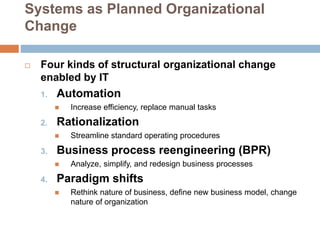
 Four kinds of structural organizational change
enabled by IT
1. Automation
 Increase efficiency, replace manual tasks
2. Rationalization
 Streamline standard operating procedures
3. Business process reengineering (BPR)
 Analyze, simplify, and redesign business processes
4. Paradigm shifts
 Rethink nature of business, define new business model, change
nature of organization
Systems as Planned Organizational
Change
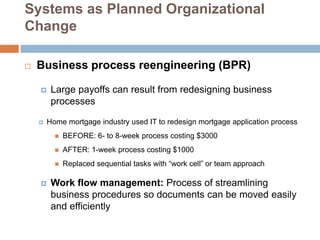
 Business process reengineering (BPR)
 Large payoffs can result from redesigning business
processes
 Home mortgage industry used IT to redesign mortgage application process
 BEFORE: 6- to 8-week process costing $3000
 AFTER: 1-week process costing $1000
 Replaced sequential tasks with “work cell” or team approach
 Work flow management: Process of streamlining
business procedures so documents can be moved easily
and efficiently
Systems as Planned Organizational
Change
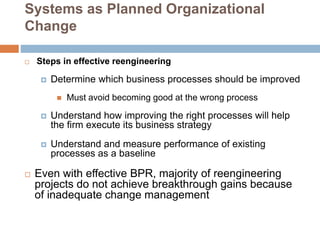
 Steps in effective reengineering
 Determine which business processes should be improved
 Must avoid becoming good at the wrong process
 Understand how improving the right processes will help
the firm execute its business strategy
 Understand and measure performance of existing
processes as a baseline
 Even with effective BPR, majority of reengineering
projects do not achieve breakthrough gains because
of inadequate change management
Systems as Planned Organizational
Change
 Business process management (BPM)
 Helps firms manage incremental process changes
 Uses process-mapping tools to:
 Identify and document existing processes
 Create models of improved processes that can be
translated into software systems
 Measure impact of process changes on key business
performance indicators
Systems as Planned Organizational
Change
 Business process management (cont.)
 Includes:
 Work flow management
 Business process modeling notation
 Quality measurement and management
 Change management
 Tools for standardizing business processes so they can be
continually manipulated
 Process monitoring and analytics
 To verify process performance has improved and measure impact of
process changes on key business performance indicators
Systems as Planned Organizational
Change
 Quality management:
 Fine-tuning business processes to improve quality in
their products, services, and operations
 The earlier in the business cycle a problem is
eliminated, the less it costs the company
 Quality improvements raise level of product and
service quality as well as lower costs
Systems as Planned Organizational
Change
 Total Quality Management (TQM):
 Achievement of quality control is end in itself
 Everyone is expected to contribute to improvement of
quality
 Focuses on continuous improvements rather than dramatic
bursts of change
 Six sigma:
 Specific measure of quality
 3.4 defects per million opportunities
 Uses statistical analysis tools to detect flaws in the
execution of an existing process and make minor
adjustments
Systems as Planned Organizational
Change
 Information systems support quality improvements
by helping firms:
 Simplify products or processes
 Make improvements based on customer
demands
 Reduce cycle time
 Improve quality and precision of design and
production
 Meet benchmarking standards
 Benchmarking: Setting strict standards for products, services, and
other activities, and then measuring performance against those
standards
Managing Projects
• Project management
• Activities include planning work, assessing risk, estimating
resources required, organizing the work, assigning tasks,
controlling project execution, reporting progress, analyzing
results
• Five major variables
• Scope
• Time
• Cost
• Quality
• Risk
Managing Project Risk
• Very high failure rate among enterprise
application and BPR projects (up to 70% for BPR)
• Poor implementation and change management practices
• Employee’s concerns about change
• Resistance by key managers
• Changing job functions, career paths, recruitment practices
• Mergers and acquisitions
• Similarly high failure rate of integration projects
• Merging of systems of two companies requires:
• Considerable organizational change
• Complex systems projects
Managing Project Risk
• Controlling risk factors
• First step in managing project risk involves identifying nature and
level of risk of project
• Each project can then be managed with tools and risk-
management approaches geared to level of risk
• Managing technical complexity
• Internal integration tools
• Project leaders with technical and administrative experience
• Highly experienced team members
• Frequent team meetings
• Securing of technical experience outside firm if necessary
Managing Project Risk
• Formal planning and control tools
• Document and monitor project plans
• Help identify bottlenecks and determine impact of problems on
project completion times
• Chart progress of project against budgets and target dates
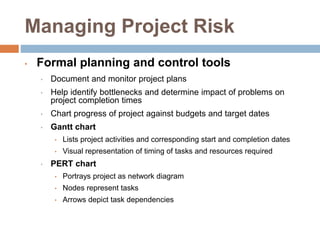
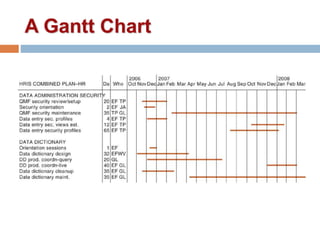
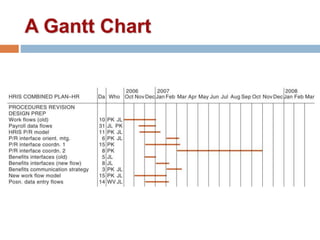
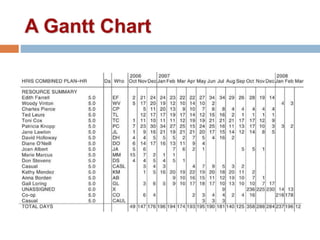
• Gantt chart
• Lists project activities and corresponding start and completion dates
• Visual representation of timing of tasks and resources required
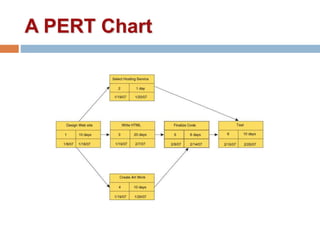
• PERT chart
• Portrays project as network diagram
• Nodes represent tasks
• Arrows depict task dependencies
A Gantt Chart
A Gantt Chart
A Gantt Chart
A PERT Chart
Managing Project Risk
• Increasing user involvement and
overcoming user resistance
• External integration tools consist of ways to link work of
implementation team to users at all organizational levels
• Active involvement of users
• Implementation team’s responsiveness to users
• User resistance to organizational change
• Users may believe change is detrimental to their interests
Managing Project Risk
• Strategies to overcome user resistance
• User participation
• User education and training
• Management edicts and policies
• Incentives for cooperation
• Improvement of end-user interface
• Resolution of organizational problems prior to
introduction of new system
Managing Project Risk
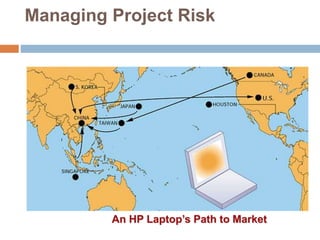
An HP Laptop’s Path to Market
Managing Global Project Risk
• Strategy when building international systems
1. Understand global environment
• Business drivers pushing your industry toward global competition
• Inhibitors creating management challenges
2. Develop corporate strategy for competition
• How firm should respond to global competition
3. Develop organization structure and division of labor
• Where will production, marketing, sales, etc., be located
4. Consider management issues
• Design of business procedures, reengineering, managing change
5. Consider technology platform
Managing Global Project Risk
• Challenges and obstacles to global
business systems
• General cultural challenges
• Cultural particularism
• Regionalism, nationalism, language differences
• Social expectations:
• Brand-name expectations, work hours
• Political laws
• Transborder data flow
• Transborder data and privacy laws, commercial regulations
Managing Global Project Risk
• Challenges and obstacles to global business systems (cont.)
• Specific challenges
• Standards
• Different EDI, e-mail, telecommunication standards
• Reliability
• Phone networks not uniformly reliable
• Speed
• Different data transfer speeds.
• Personnel
• Shortages of skilled consultants
Managing Global Project Risk
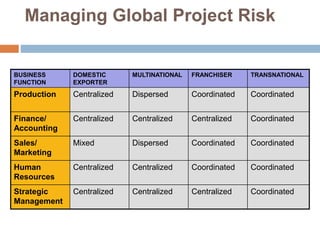
• Global strategies and business organization
• Three main kinds of organizational structure
• Centralized: In the home country
• Decentralized/dispersed: To local foreign units
• Coordinated: All units participate as equals
• Four main global strategies
• Domestic exporter
• Multinational
• Franchisers
• Transnational
Managing Global Project Risk
BUSINESS
FUNCTION
DOMESTIC
EXPORTER
MULTINATIONAL FRANCHISER TRANSNATIONAL
Production Centralized Dispersed Coordinated Coordinated
Finance/
Accounting
Centralized Centralized Centralized Coordinated
Sales/
Marketing
Mixed Dispersed Coordinated Coordinated
Human
Resources
Centralized Centralized Coordinated Coordinated
Strategic
Management
Centralized Centralized Centralized Coordinated
Managing Project Risk
• Project management software
• Can automate many aspects of project management
• Capabilities for
• Defining, ordering, editing tasks
• Assigning resources to tasks
• Tracking progress
• Microsoft Project
• Most widely used project management software
• PERT, Gantt charts
• Critical path analysis
• Product Guide wizards
• Enterprise Project Management Solution version

MIS Session 6

  • 1.
  • 2.
    Session Outline  Hownew systems produce organizational change.  The objectives of project management and why is it so essential
  • 3.
    Systems as PlannedOrganizational Change  Four kinds of structural organizational change enabled by IT 1. Automation  Increase efficiency, replace manual tasks 2. Rationalization  Streamline standard operating procedures 3. Business process reengineering (BPR)  Analyze, simplify, and redesign business processes 4. Paradigm shifts  Rethink nature of business, define new business model, change nature of organization
  • 4.
    Systems as PlannedOrganizational Change  Business process reengineering (BPR)  Large payoffs can result from redesigning business processes  Home mortgage industry used IT to redesign mortgage application process  BEFORE: 6- to 8-week process costing $3000  AFTER: 1-week process costing $1000  Replaced sequential tasks with “work cell” or team approach  Work flow management: Process of streamlining business procedures so documents can be moved easily and efficiently
  • 5.
    Systems as PlannedOrganizational Change  Steps in effective reengineering  Determine which business processes should be improved  Must avoid becoming good at the wrong process  Understand how improving the right processes will help the firm execute its business strategy  Understand and measure performance of existing processes as a baseline  Even with effective BPR, majority of reengineering projects do not achieve breakthrough gains because of inadequate change management
  • 6.
    Systems as PlannedOrganizational Change  Business process management (BPM)  Helps firms manage incremental process changes  Uses process-mapping tools to:  Identify and document existing processes  Create models of improved processes that can be translated into software systems  Measure impact of process changes on key business performance indicators
  • 7.
    Systems as PlannedOrganizational Change  Business process management (cont.)  Includes:  Work flow management  Business process modeling notation  Quality measurement and management  Change management  Tools for standardizing business processes so they can be continually manipulated  Process monitoring and analytics  To verify process performance has improved and measure impact of process changes on key business performance indicators
  • 8.
    Systems as PlannedOrganizational Change  Quality management:  Fine-tuning business processes to improve quality in their products, services, and operations  The earlier in the business cycle a problem is eliminated, the less it costs the company  Quality improvements raise level of product and service quality as well as lower costs
  • 9.
    Systems as PlannedOrganizational Change  Total Quality Management (TQM):  Achievement of quality control is end in itself  Everyone is expected to contribute to improvement of quality  Focuses on continuous improvements rather than dramatic bursts of change  Six sigma:  Specific measure of quality  3.4 defects per million opportunities  Uses statistical analysis tools to detect flaws in the execution of an existing process and make minor adjustments
  • 10.
    Systems as PlannedOrganizational Change  Information systems support quality improvements by helping firms:  Simplify products or processes  Make improvements based on customer demands  Reduce cycle time  Improve quality and precision of design and production  Meet benchmarking standards  Benchmarking: Setting strict standards for products, services, and other activities, and then measuring performance against those standards
  • 11.
    Managing Projects • Projectmanagement • Activities include planning work, assessing risk, estimating resources required, organizing the work, assigning tasks, controlling project execution, reporting progress, analyzing results • Five major variables • Scope • Time • Cost • Quality • Risk
  • 12.
    Managing Project Risk •Very high failure rate among enterprise application and BPR projects (up to 70% for BPR) • Poor implementation and change management practices • Employee’s concerns about change • Resistance by key managers • Changing job functions, career paths, recruitment practices • Mergers and acquisitions • Similarly high failure rate of integration projects • Merging of systems of two companies requires: • Considerable organizational change • Complex systems projects
  • 13.
    Managing Project Risk •Controlling risk factors • First step in managing project risk involves identifying nature and level of risk of project • Each project can then be managed with tools and risk- management approaches geared to level of risk • Managing technical complexity • Internal integration tools • Project leaders with technical and administrative experience • Highly experienced team members • Frequent team meetings • Securing of technical experience outside firm if necessary
  • 14.
    Managing Project Risk •Formal planning and control tools • Document and monitor project plans • Help identify bottlenecks and determine impact of problems on project completion times • Chart progress of project against budgets and target dates • Gantt chart • Lists project activities and corresponding start and completion dates • Visual representation of timing of tasks and resources required • PERT chart • Portrays project as network diagram • Nodes represent tasks • Arrows depict task dependencies
  • 15.
  • 16.
  • 17.
  • 18.
  • 19.
    Managing Project Risk •Increasing user involvement and overcoming user resistance • External integration tools consist of ways to link work of implementation team to users at all organizational levels • Active involvement of users • Implementation team’s responsiveness to users • User resistance to organizational change • Users may believe change is detrimental to their interests
  • 20.
    Managing Project Risk •Strategies to overcome user resistance • User participation • User education and training • Management edicts and policies • Incentives for cooperation • Improvement of end-user interface • Resolution of organizational problems prior to introduction of new system
  • 21.
    Managing Project Risk AnHP Laptop’s Path to Market
  • 22.
    Managing Global ProjectRisk • Strategy when building international systems 1. Understand global environment • Business drivers pushing your industry toward global competition • Inhibitors creating management challenges 2. Develop corporate strategy for competition • How firm should respond to global competition 3. Develop organization structure and division of labor • Where will production, marketing, sales, etc., be located 4. Consider management issues • Design of business procedures, reengineering, managing change 5. Consider technology platform
  • 23.
    Managing Global ProjectRisk • Challenges and obstacles to global business systems • General cultural challenges • Cultural particularism • Regionalism, nationalism, language differences • Social expectations: • Brand-name expectations, work hours • Political laws • Transborder data flow • Transborder data and privacy laws, commercial regulations
  • 24.
    Managing Global ProjectRisk • Challenges and obstacles to global business systems (cont.) • Specific challenges • Standards • Different EDI, e-mail, telecommunication standards • Reliability • Phone networks not uniformly reliable • Speed • Different data transfer speeds. • Personnel • Shortages of skilled consultants
  • 25.
    Managing Global ProjectRisk • Global strategies and business organization • Three main kinds of organizational structure • Centralized: In the home country • Decentralized/dispersed: To local foreign units • Coordinated: All units participate as equals • Four main global strategies • Domestic exporter • Multinational • Franchisers • Transnational
  • 26.
    Managing Global ProjectRisk BUSINESS FUNCTION DOMESTIC EXPORTER MULTINATIONAL FRANCHISER TRANSNATIONAL Production Centralized Dispersed Coordinated Coordinated Finance/ Accounting Centralized Centralized Centralized Coordinated Sales/ Marketing Mixed Dispersed Coordinated Coordinated Human Resources Centralized Centralized Coordinated Coordinated Strategic Management Centralized Centralized Centralized Coordinated
  • 27.
    Managing Project Risk •Project management software • Can automate many aspects of project management • Capabilities for • Defining, ordering, editing tasks • Assigning resources to tasks • Tracking progress • Microsoft Project • Most widely used project management software • PERT, Gantt charts • Critical path analysis • Product Guide wizards • Enterprise Project Management Solution version