TheAPMG-InternationalFacilitationandSwirlDevicelogoisatrademarkofTheAPMGroupLimited.
Start and finish Course style
LunchCoffee and breaks
M00 - Course introduction 2/9 | 2/293
 Good understanding of the Facilitation
 Understanding of role Facilitator
 Knowledge of Facilitation techniques
and tools
Main goal
 Attempt Foundation exam with
confidence
 Begin to apply the facilitated workshops,
tailoring it to your own projects’ needs
Secondary goal
 Benefits and value of facilitation
M00 - Course introduction 3/9 | 3/293
 Please share with the class:
 Your name and surname
 Your organization
 Your profession (title, function,
job responsibilities)
 Your experience with facilitation
 Your experience with facilitated
workshops
 Your personal session
expectations
M00 - Course introduction 4/9 | 4/293
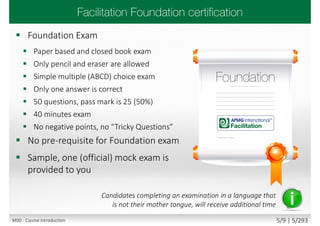
 Foundation Exam
 Paper based and closed book exam
 Only pencil and eraser are allowed
 Simple multiple (ABCD) choice exam
 Only one answer is correct
 50 questions, pass mark is 25 (50%)
 40 minutes exam
 No negative points, no “Tricky Questions”
 No pre-requisite for Foundation exam
 Sample, one (official) mock exam is
provided to you
Candidates completing an examination in a language that
is not their mother tongue, will receive additional time
M00 - Course introduction 5/9 | 5/293
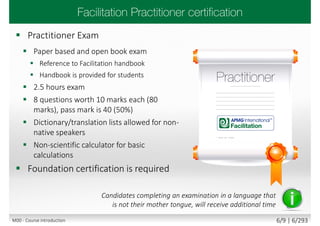
 Practitioner Exam
 Paper based and open book exam
 Reference to Facilitation handbook
 Handbook is provided for students
 2.5 hours exam
 8 questions worth 10 marks each (80
marks), pass mark is 40 (50%)
 Dictionary/translation lists allowed for non-
native speakers
 Non-scientific calculator for basic
calculations
 Foundation certification is required
Candidates completing an examination in a language that
is not their mother tongue, will receive additional time
M00 - Course introduction 6/9 | 6/293
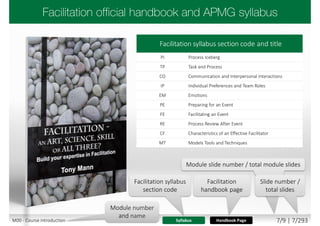
Facilitation syllabus section code and title
PI Process Iceberg
TP Task and Process
CO Communication and Interpersonal Interactions
IP Individual Preferences and Team Roles
EM Emotions
PE Preparing for an Event
FE Facilitating an Event
RE Process Review After Event
CF Characteristics of an Effective Facilitator
MT Models Tools and Techniques
Syllabus Handbook Page
Module slide number / total module slides
Slide number /
total slides
Module number
and name
Facilitation
handbook page
Facilitation syllabus
section code
M00 - Course introduction 7/9 | 7/293
M00 - Course introduction 8/9 | 8/293
twitter.com/mirodabrowski
linkedin.com/in/miroslawdabrowski
google.com/+miroslawdabrowski
miroslaw_dabrowski
www.miroslawdabrowski.com
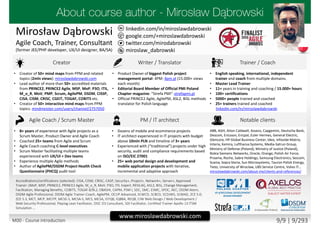
Mirosław Dąbrowski
Agile Coach, Trainer, Consultant
(former JEE/PHP developer, UX/UI designer, BA/SA)
Creator Writer / Translator Trainer / Coach
• Creator of 50+ mind maps from PPM and related
topics (2mln views): miroslawdabrowski.com
• Lead author of more than 50+ accredited materials
from PRINCE2, PRINCE2 Agile, MSP, MoP, P3O, ITIL,
M_o_R, MoV, PMP, Scrum, AgilePM, DSDM, CISSP,
CISA, CISM, CRISC, CGEIT, TOGAF, COBIT5 etc.
• Creator of 50+ interactive mind maps from PPM
topics: mindmeister.com/users/channel/2757050
• Product Owner of biggest Polish project
management portal: 4PM: 4pm.pl (15.000+ views
each month)
• Editorial Board Member of Official PMI Poland
Chapter magazine: “Strefa PMI”: strefapmi.pl
• Official PRINCE2 Agile, AgilePM, ASL2, BiSL methods
translator for Polish language
• English speaking, international, independent
trainer and coach from multiple domains.
• Master Lead Trainer
• 11+ years in training and coaching / 15.000+ hours
• 100+ certifications
• 5000+ people trained and coached
• 25+ trainers trained and coached
linkedin.com/in/miroslawdabrowski
Agile Coach / Scrum Master PM / IT architect Notable clients
• 8+ years of experience with Agile projects as a
Scrum Master, Product Owner and Agile Coach
• Coached 25+ teams from Agile and Scrum
• Agile Coach coaching C-level executives
• Scrum Master facilitating multiple teams
experienced with UX/UI + Dev teams
• Experience multiple Agile methods
• Author of AgilePM/DSDM Project Health Check
Questionnaire (PHCQ) audit tool
• Dozens of mobile and ecommerce projects
• IT architect experienced in IT projects with budget
above 10mln PLN and timeline of 3+ years
• Experienced with (“traditional”) projects under high
security, audit and compliance requirements based
on ISO/EIC 27001
• 25+ web portal design and development and
mobile application projects with iterative,
incremental and adaptive approach
ABB, AGH, Aiton Caldwell, Asseco, Capgemini, Deutsche Bank,
Descom, Ericsson, Ericpol, Euler Hermes, General Electric,
Glencore, HP Global Business Center, Ideo, Infovide-Matrix,
Interia, Kemira, Lufthansa Systems, Media-Satrun Group,
Ministry of Defense (Poland), Ministry of Justice (Poland),
Nokia Siemens Networks, Oracle, Orange, Polish Air Force,
Proama, Roche, Sabre Holdings, Samsung Electronics, Sescom,
Scania, Sopra Steria, Sun Microsystems, Tauron Polish Energy,
Tieto, University of Wroclaw, UBS Service Centre, Volvo IT…
miroslawdabrowski.com/about-me/clients-and-references/
Accreditations/certifications (selected): CISA, CISM, CRISC, CASP, Security+, Project+, Network+, Server+, Approved
Trainer: (MoP, MSP, PRINCE2, PRINCE2 Agile, M_o_R, MoV, P3O, ITIL Expert, RESILIA), ASL2, BiSL, Change Management,
Facilitation, Managing Benefits, COBIT5, TOGAF 8/9L2, OBASHI, CAPM, PSM I, SDC, SMC, ESMC, SPOC, AEC, DSDM Atern,
DSDM Agile Professional, DSDM Agile Trainer-Coach, AgilePM, OCUP Advanced, SCWCD, SCBCD, SCDJWS, SCMAD, ZCE 5.0,
ZCE 5.3, MCT, MCP, MCITP, MCSE-S, MCSA-S, MCS, MCSA, ISTQB, IQBBA, REQB, CIW Web Design / Web Development /
Web Security Professional, Playing Lean Facilitator, DISC D3 Consultant, SDI Facilitator, Certified Trainer Apollo 13 ITSM
Simulation …
M00 - Course introduction 9/9 | 9/293
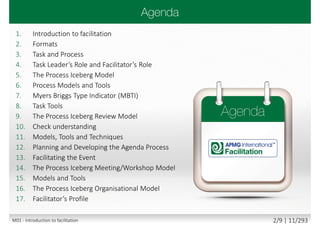
1. Introduction to facilitation
2. Formats
3. Task and Process
4. Task Leader’s Role and Facilitator’s Role
5. The Process Iceberg Model
6. Process Models and Tools
7. Myers Briggs Type Indicator (MBTI)
8. Task Tools
9. The Process Iceberg Review Model
10. Check understanding
11. Models, Tools and Techniques
12. Planning and Developing the Agenda Process
13. Facilitating the Event
14. The Process Iceberg Meeting/Workshop Model
15. Models and Tools
16. The Process Iceberg Organisational Model
17. Facilitator’s Profile
M01 - Introduction to facilitation 2/9 | 11/293
 Group Facilitation
 Facilitation for groups or teams is provided by
internal or external people who are skilled in:
 Presenting content and information,
 Designing and formulating a process that helps a group
achieve its objectives,
 Providing an appropriate structure to a meeting,
training or team building session, or other work event
 Promoting shared responsibility for the outcome of the
meeting
M01 - Introduction to facilitation 3/9 | 12/293
“A person who is acceptable to all group members,
substantively neutral, and has no decision-making
authority who helps a group improve the way it
identifies and solves problems and makes decisions.”
Roger M. Schwarz
“One who contributes structure and process to
interactions so groups are able to function effectively
and make high-quality decisions. A helper and enabler
whose goal is to support others as they achieve
exceptional performance.”
Ingrid Bens
M01 - Introduction to facilitation 4/9 | 13/293
 Facilitation has three basic principles:
 A facilitator is a guide to help people move
through a process together, not the seat of
wisdom and knowledge
 That means a facilitator isn't there to give opinions, but
to draw out opinions and ideas of the group members
 Facilitation focuses on how people participate in
the process of learning or planning, not just
on what gets achieved
 A facilitator is neutral and never takes sides
M01 - Introduction to facilitation 5/9 | 14/293
 A facilitator focuses on process
 Content = What tasks, subjects, problems are
being addressed
 Process = How things are discussed, including:
Methods
 Procedures
 Format
 Tools Style of interaction
 Group norms
 Group dynamics
 Group climate
M01 - Introduction to facilitation 6/9 | 15/293
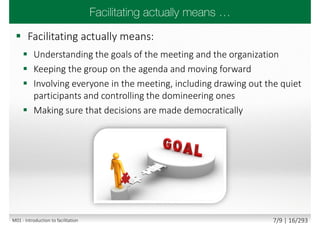
 Facilitating actually means:
 Understanding the goals of the meeting and the organization
 Keeping the group on the agenda and moving forward
 Involving everyone in the meeting, including drawing out the quiet
participants and controlling the domineering ones
 Making sure that decisions are made democratically
M01 - Introduction to facilitation 7/9 | 16/293
M01 - Introduction to facilitation 8/9 | 17/293
I hope you enjoyed
this presentation. If so,
please like, share and
leave a comment
below.
Endorsements on
LinkedIn are also
highly appreciated! 
(your feedback = more free stuff)

MIROSLAWDABROWSKI.COM/downloads

Facilitation Process IceBerg - Foundation

  • 1.
  • 2.
    Start and finishCourse style LunchCoffee and breaks M00 - Course introduction 2/9 | 2/293
  • 3.
     Good understandingof the Facilitation  Understanding of role Facilitator  Knowledge of Facilitation techniques and tools Main goal  Attempt Foundation exam with confidence  Begin to apply the facilitated workshops, tailoring it to your own projects’ needs Secondary goal  Benefits and value of facilitation M00 - Course introduction 3/9 | 3/293
  • 4.
     Please sharewith the class:  Your name and surname  Your organization  Your profession (title, function, job responsibilities)  Your experience with facilitation  Your experience with facilitated workshops  Your personal session expectations M00 - Course introduction 4/9 | 4/293
  • 5.
     Foundation Exam Paper based and closed book exam  Only pencil and eraser are allowed  Simple multiple (ABCD) choice exam  Only one answer is correct  50 questions, pass mark is 25 (50%)  40 minutes exam  No negative points, no “Tricky Questions”  No pre-requisite for Foundation exam  Sample, one (official) mock exam is provided to you Candidates completing an examination in a language that is not their mother tongue, will receive additional time M00 - Course introduction 5/9 | 5/293
  • 6.
     Practitioner Exam Paper based and open book exam  Reference to Facilitation handbook  Handbook is provided for students  2.5 hours exam  8 questions worth 10 marks each (80 marks), pass mark is 40 (50%)  Dictionary/translation lists allowed for non- native speakers  Non-scientific calculator for basic calculations  Foundation certification is required Candidates completing an examination in a language that is not their mother tongue, will receive additional time M00 - Course introduction 6/9 | 6/293
  • 7.
    Facilitation syllabus sectioncode and title PI Process Iceberg TP Task and Process CO Communication and Interpersonal Interactions IP Individual Preferences and Team Roles EM Emotions PE Preparing for an Event FE Facilitating an Event RE Process Review After Event CF Characteristics of an Effective Facilitator MT Models Tools and Techniques Syllabus Handbook Page Module slide number / total module slides Slide number / total slides Module number and name Facilitation handbook page Facilitation syllabus section code M00 - Course introduction 7/9 | 7/293
  • 8.
    M00 - Courseintroduction 8/9 | 8/293
  • 9.
    twitter.com/mirodabrowski linkedin.com/in/miroslawdabrowski google.com/+miroslawdabrowski miroslaw_dabrowski www.miroslawdabrowski.com Mirosław Dąbrowski Agile Coach,Trainer, Consultant (former JEE/PHP developer, UX/UI designer, BA/SA) Creator Writer / Translator Trainer / Coach • Creator of 50+ mind maps from PPM and related topics (2mln views): miroslawdabrowski.com • Lead author of more than 50+ accredited materials from PRINCE2, PRINCE2 Agile, MSP, MoP, P3O, ITIL, M_o_R, MoV, PMP, Scrum, AgilePM, DSDM, CISSP, CISA, CISM, CRISC, CGEIT, TOGAF, COBIT5 etc. • Creator of 50+ interactive mind maps from PPM topics: mindmeister.com/users/channel/2757050 • Product Owner of biggest Polish project management portal: 4PM: 4pm.pl (15.000+ views each month) • Editorial Board Member of Official PMI Poland Chapter magazine: “Strefa PMI”: strefapmi.pl • Official PRINCE2 Agile, AgilePM, ASL2, BiSL methods translator for Polish language • English speaking, international, independent trainer and coach from multiple domains. • Master Lead Trainer • 11+ years in training and coaching / 15.000+ hours • 100+ certifications • 5000+ people trained and coached • 25+ trainers trained and coached linkedin.com/in/miroslawdabrowski Agile Coach / Scrum Master PM / IT architect Notable clients • 8+ years of experience with Agile projects as a Scrum Master, Product Owner and Agile Coach • Coached 25+ teams from Agile and Scrum • Agile Coach coaching C-level executives • Scrum Master facilitating multiple teams experienced with UX/UI + Dev teams • Experience multiple Agile methods • Author of AgilePM/DSDM Project Health Check Questionnaire (PHCQ) audit tool • Dozens of mobile and ecommerce projects • IT architect experienced in IT projects with budget above 10mln PLN and timeline of 3+ years • Experienced with (“traditional”) projects under high security, audit and compliance requirements based on ISO/EIC 27001 • 25+ web portal design and development and mobile application projects with iterative, incremental and adaptive approach ABB, AGH, Aiton Caldwell, Asseco, Capgemini, Deutsche Bank, Descom, Ericsson, Ericpol, Euler Hermes, General Electric, Glencore, HP Global Business Center, Ideo, Infovide-Matrix, Interia, Kemira, Lufthansa Systems, Media-Satrun Group, Ministry of Defense (Poland), Ministry of Justice (Poland), Nokia Siemens Networks, Oracle, Orange, Polish Air Force, Proama, Roche, Sabre Holdings, Samsung Electronics, Sescom, Scania, Sopra Steria, Sun Microsystems, Tauron Polish Energy, Tieto, University of Wroclaw, UBS Service Centre, Volvo IT… miroslawdabrowski.com/about-me/clients-and-references/ Accreditations/certifications (selected): CISA, CISM, CRISC, CASP, Security+, Project+, Network+, Server+, Approved Trainer: (MoP, MSP, PRINCE2, PRINCE2 Agile, M_o_R, MoV, P3O, ITIL Expert, RESILIA), ASL2, BiSL, Change Management, Facilitation, Managing Benefits, COBIT5, TOGAF 8/9L2, OBASHI, CAPM, PSM I, SDC, SMC, ESMC, SPOC, AEC, DSDM Atern, DSDM Agile Professional, DSDM Agile Trainer-Coach, AgilePM, OCUP Advanced, SCWCD, SCBCD, SCDJWS, SCMAD, ZCE 5.0, ZCE 5.3, MCT, MCP, MCITP, MCSE-S, MCSA-S, MCS, MCSA, ISTQB, IQBBA, REQB, CIW Web Design / Web Development / Web Security Professional, Playing Lean Facilitator, DISC D3 Consultant, SDI Facilitator, Certified Trainer Apollo 13 ITSM Simulation … M00 - Course introduction 9/9 | 9/293
  • 11.
    1. Introduction tofacilitation 2. Formats 3. Task and Process 4. Task Leader’s Role and Facilitator’s Role 5. The Process Iceberg Model 6. Process Models and Tools 7. Myers Briggs Type Indicator (MBTI) 8. Task Tools 9. The Process Iceberg Review Model 10. Check understanding 11. Models, Tools and Techniques 12. Planning and Developing the Agenda Process 13. Facilitating the Event 14. The Process Iceberg Meeting/Workshop Model 15. Models and Tools 16. The Process Iceberg Organisational Model 17. Facilitator’s Profile M01 - Introduction to facilitation 2/9 | 11/293
  • 12.
     Group Facilitation Facilitation for groups or teams is provided by internal or external people who are skilled in:  Presenting content and information,  Designing and formulating a process that helps a group achieve its objectives,  Providing an appropriate structure to a meeting, training or team building session, or other work event  Promoting shared responsibility for the outcome of the meeting M01 - Introduction to facilitation 3/9 | 12/293
  • 13.
    “A person whois acceptable to all group members, substantively neutral, and has no decision-making authority who helps a group improve the way it identifies and solves problems and makes decisions.” Roger M. Schwarz “One who contributes structure and process to interactions so groups are able to function effectively and make high-quality decisions. A helper and enabler whose goal is to support others as they achieve exceptional performance.” Ingrid Bens M01 - Introduction to facilitation 4/9 | 13/293
  • 14.
     Facilitation hasthree basic principles:  A facilitator is a guide to help people move through a process together, not the seat of wisdom and knowledge  That means a facilitator isn't there to give opinions, but to draw out opinions and ideas of the group members  Facilitation focuses on how people participate in the process of learning or planning, not just on what gets achieved  A facilitator is neutral and never takes sides M01 - Introduction to facilitation 5/9 | 14/293
  • 15.
     A facilitatorfocuses on process  Content = What tasks, subjects, problems are being addressed  Process = How things are discussed, including: Methods  Procedures  Format  Tools Style of interaction  Group norms  Group dynamics  Group climate M01 - Introduction to facilitation 6/9 | 15/293
  • 16.
     Facilitating actuallymeans:  Understanding the goals of the meeting and the organization  Keeping the group on the agenda and moving forward  Involving everyone in the meeting, including drawing out the quiet participants and controlling the domineering ones  Making sure that decisions are made democratically M01 - Introduction to facilitation 7/9 | 16/293
  • 17.
    M01 - Introductionto facilitation 8/9 | 17/293
  • 18.
    I hope youenjoyed this presentation. If so, please like, share and leave a comment below. Endorsements on LinkedIn are also highly appreciated!  (your feedback = more free stuff)  MIROSLAWDABROWSKI.COM/downloads