Course accredited by APMG International, in alignment with
SDI Service Desk and Support Manager Standards.
Start and finish Course style
LunchCoffee and breaks
2/8 | 2/299M00 - Course introduction
 On completion of this course you will be
able to:
 Develop and deliver service desk and support
strategies to fully underpin the organisation’s
business strategy and objectives
 Demonstrate the key leadership
and management competencies needed
to be a successful service desk and Support
 Develop and deliver service desk and support
technology strategies to underpin strategic
objectives
3/8 | 3/299M00 - Course introduction
 On completion of this course you will be able
to:
 Interface the service desk with other IT
functions, processes and standards to
maximise the efficiency and effectiveness of IT
 Design, contract and deliver service desk
processes and services to deliver exceptional
customer service and support
 Recruit and retain staff and use structured
methods to develop and enhance their skills
 Employ leadership and management skills
to coach, mentor, develop and motivate staff
4/8 | 4/299M00 - Course introduction
 Please share with the class:
 Your name and surname
 Your organization
 Your profession
 Title, function, job responsibilities
 Your experience with service desk
 Your personal session expectations
5/8 | 5/299M00 - Course introduction
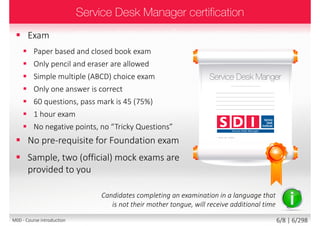
 Exam
 Paper based and closed book exam
 Only pencil and eraser are allowed
 Simple multiple (ABCD) choice exam
 Only one answer is correct
 60 questions, pass mark is 45 (75%)
 1 hour exam
 No negative points, no “Tricky Questions”
 No pre-requisite for Foundation exam
 Sample, two (official) mock exams are
provided to you
Candidates completing an examination in a language that
is not their mother tongue, will receive additional time
6/8 | 6/299M00 - Course introduction
Mission
To enable organisations to enhance the value of business
and IT integration through exceptional IT service and
support by:
Setting global industry standards
Delivering thought-leadership and knowledge
Influencing service improvement for
individuals and organisations
7/8 | 7/299M00 - Course introduction
twitter.com/mirodabrowski
linkedin.com/in/miroslawdabrowski
google.com/+miroslawdabrowski
miroslaw_dabrowski
www.miroslawdabrowski.com
Mirosław Dąbrowski
Agile Coach, Trainer, Consultant
(former JEE/PHP developer, UX/UI designer, BA/SA)
Creator Writer / Translator Trainer / Coach
• Creator of 50+ mind maps from PPM and related
topics (2mln views): miroslawdabrowski.com
• Lead author of more than 50+ accredited materials
from PRINCE2, PRINCE2 Agile, MSP, MoP, P3O, ITIL,
M_o_R, MoV, PMP, Scrum, AgilePM, DSDM, CISSP,
CISA, CISM, CRISC, CGEIT, TOGAF, COBIT5 etc.
• Creator of 50+ interactive mind maps from PPM
topics: mindmeister.com/users/channel/2757050
• Product Owner of biggest Polish project
management portal: 4PM: 4pm.pl (15.000+ views
each month)
• Editorial Board Member of Official PMI Poland
Chapter magazine: “Strefa PMI”: strefapmi.pl
• Official PRINCE2 Agile, AgilePM, ASL2, BiSL methods
translator for Polish language
• English speaking, international, independent
trainer and coach from multiple domains.
• Master Lead Trainer
• 11+ years in training and coaching / 15.000+ hours
• 100+ certifications
• 5000+ people trained and coached
• 25+ trainers trained and coached
linkedin.com/in/miroslawdabrowski
Agile Coach / Scrum Master PM / IT architect Notable clients
• 8+ years of experience with Agile projects as a
Scrum Master, Product Owner and Agile Coach
• Coached 25+ teams from Agile and Scrum
• Agile Coach coaching C-level executives
• Scrum Master facilitating multiple teams
experienced with UX/UI + Dev teams
• Experience multiple Agile methods
• Author of AgilePM/DSDM Project Health Check
Questionnaire (PHCQ) audit tool
• Dozens of mobile and ecommerce projects
• IT architect experienced in IT projects with budget
above 10mln PLN and timeline of 3+ years
• Experienced with (“traditional”) projects under high
security, audit and compliance requirements based
on ISO/EIC 27001
• 25+ web portal design and development and
mobile application projects with iterative,
incremental and adaptive approach
ABB, AGH, Aiton Caldwell, Asseco, Capgemini, Deutsche Bank,
Descom, Ericsson, Ericpol, Euler Hermes, General Electric,
Glencore, HP Global Business Center, Ideo, Infovide-Matrix,
Interia, Kemira, Lufthansa Systems, Media-Satrun Group,
Ministry of Defense (Poland), Ministry of Justice (Poland),
Nokia Siemens Networks, Oracle, Orange, Polish Air Force,
Proama, Roche, Sabre Holdings, Samsung Electronics, Sescom,
Scania, Sopra Steria, Sun Microsystems, Tauron Polish Energy,
Tieto, University of Wroclaw, UBS Service Centre, Volvo IT…
miroslawdabrowski.com/about-me/clients-and-references/
Accreditations/certifications (selected): CISA, CISM, CRISC, CASP, Security+, Project+, Network+, Server+, Approved
Trainer: (MoP, MSP, PRINCE2, PRINCE2 Agile, M_o_R, MoV, P3O, ITIL Expert, RESILIA), ASL2, BiSL, Change Management,
Facilitation, Managing Benefits, COBIT5, TOGAF 8/9L2, OBASHI, CAPM, PSM I, SDC, SMC, ESMC, SPOC, AEC, DSDM Atern,
DSDM Agile Professional, DSDM Agile Trainer-Coach, AgilePM, OCUP Advanced, SCWCD, SCBCD, SCDJWS, SCMAD, ZCE 5.0,
ZCE 5.3, MCT, MCP, MCITP, MCSE-S, MCSA-S, MCS, MCSA, ISTQB, IQBBA, REQB, CIW Web Design / Web Development /
Web Security Professional, Playing Lean Facilitator, DISC D3 Consultant, SDI Facilitator, Certified Trainer Apollo 13 ITSM
Simulation …
8/8 | 8/299M00 - Course introduction
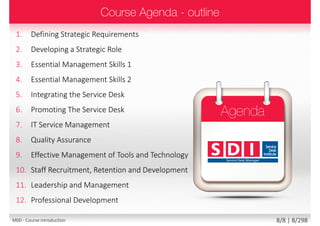
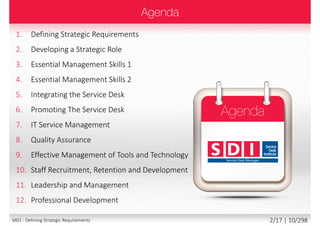
1. Defining Strategic Requirements
2. Developing a Strategic Role
3. Essential Management Skills 1
4. Essential Management Skills 2
5. Integrating the Service Desk
6. Promoting The Service Desk
7. IT Service Management
8. Quality Assurance
9. Effective Management of Tools and Technology
10. Staff Recruitment, Retention and Development
11. Leadership and Management
12. Professional Development
2/18 | 10/299M01 - Defining Strategic Requirements
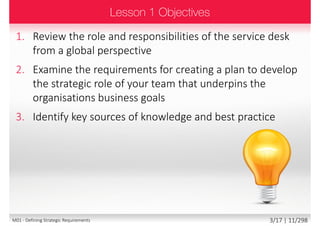
1. Review the role and responsibilities of the service desk
from a global perspective
2. Examine the requirements for creating a plan to develop
the strategic role of your team that underpins the
organisations business goals
3. Identify key sources of knowledge and best practice
3/18 | 11/299M01 - Defining Strategic Requirements
To serve as a single point of contact (SPOC)
4/18 | 12/299M01 - Defining Strategic Requirements
 The service desk is responsible for satisfying the requirements and
needs of its customers, while following the business and operational
guidelines of the organisation.
5/18 | 13/299M01 - Defining Strategic Requirements
 Follow the organisation’s policies, processes and procedures
 Balance support expenses to deliver optimum levels of quality and
cost effectiveness
 Develop and implement service desk goals that align with the
organisation's business objectives
 Demonstrate the value and contribution of the service desk to the
organisation
 Identify and initiate service improvement initiatives
 Manage customer expectations
6/18 | 14/299M01 - Defining Strategic Requirements
 Provide a clear communication channel between customers and the
IT organisation
 Contribute to knowledge creation and maintenance
 Develop and implement effective processes and procedures to ensure
consistent service support
 Be aware of appropriate societal and environmental issues and
responsibilities relating to the service desk
 Adhere to, police and support the organisation's security
policies/requirements
 Manage compliments and complaints relating to IT service issues
 Represent the IT organisation to its customers
7/18 | 15/299M01 - Defining Strategic Requirements
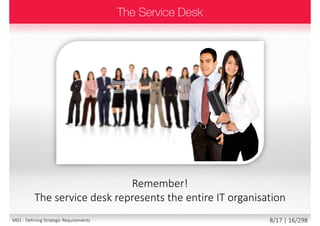
Remember!
The service desk represents the entire IT organisation
8/18 | 16/299M01 - Defining Strategic Requirements
 Leadership
 Commitment to quality
 Policy and strategy
 People management
 Resources
 Processes and documentation
 Staff satisfaction
 Customer satisfaction
 Performance results
 KPIs
 Operational metrics
 Unit costs
 Total costs
 Benchmarking and certification
 Service ethics
 Credibility
9/18 | 17/299M01 - Defining Strategic Requirements
 The purpose of a vision
statement:
 To provide a longer term view of
what the service desk wishes to
become.
 The objectives are to:
 Promote the image of the service
desk
 Engender pride in the team
 Encourage team members to
develop skills to support the vision
10/18 | 18/299M01 - Defining Strategic Requirements
 Purpose
 To define the service desk’s reason
for existing
 What you are doing
 Why you are doing it
 It typically includes
 A statement about what the service
desk is aiming to achieve
 The underpinning objectives
required to achieve the stated
purpose
 Objectives
 Identify the purpose and role of the
service desk
 Align support goals with the
organisation’s goals
 Inspire commitment and buy-in
 The mission statement provides an
instrument for both measuring
progress and moving ahead
11/18 | 19/299M01 - Defining Strategic Requirements
Good practice
Best practice
12/18 | 20/299M01 - Defining Strategic Requirements
 Formal standards
 Formal IT governance and audit
assessment
 Industry good and best practice
 Formal business best practice
quality models
13/18 | 21/299M01 - Defining Strategic Requirements
 Increased consistency and accountability
 Improved governance
 Reduced business risk
 Greater control of IT infrastructure
 Improvements are identified
 Costs maintained and managed
 Increased employee morale and customer satisfaction
 Commitment to quality is demonstrated
 Improved development time
 Achieving certification demonstrates tangible evidence
of following best practice
14/18 | 22/299M01 - Defining Strategic Requirements
 To meet IT governance
 To meet industry-sector
regulatory requirements
 To demonstrate compliance
15/18 | 23/299M01 - Defining Strategic Requirements
 Different time-zones
 Language support
 Cultural differences
 Services alignment
 Local currency
 Public holidays
 The organisation's business
mission
 Legal requirements and local
governance
16/18 | 24/299M01 - Defining Strategic Requirements
17/18 | 25/299M01 - Defining Strategic Requirements
I hope you enjoyed
this presentation. If so,
please like, share and
leave a comment
below.
Endorsements on
LinkedIn are also
highly appreciated! 
(your feedback = more free stuff)

MIROSLAWDABROWSKI.COM/downloads

SDI - Service Desk Manager

  • 1.
    Course accredited byAPMG International, in alignment with SDI Service Desk and Support Manager Standards.
  • 2.
    Start and finishCourse style LunchCoffee and breaks 2/8 | 2/299M00 - Course introduction
  • 3.
     On completionof this course you will be able to:  Develop and deliver service desk and support strategies to fully underpin the organisation’s business strategy and objectives  Demonstrate the key leadership and management competencies needed to be a successful service desk and Support  Develop and deliver service desk and support technology strategies to underpin strategic objectives 3/8 | 3/299M00 - Course introduction
  • 4.
     On completionof this course you will be able to:  Interface the service desk with other IT functions, processes and standards to maximise the efficiency and effectiveness of IT  Design, contract and deliver service desk processes and services to deliver exceptional customer service and support  Recruit and retain staff and use structured methods to develop and enhance their skills  Employ leadership and management skills to coach, mentor, develop and motivate staff 4/8 | 4/299M00 - Course introduction
  • 5.
     Please sharewith the class:  Your name and surname  Your organization  Your profession  Title, function, job responsibilities  Your experience with service desk  Your personal session expectations 5/8 | 5/299M00 - Course introduction
  • 6.
     Exam  Paperbased and closed book exam  Only pencil and eraser are allowed  Simple multiple (ABCD) choice exam  Only one answer is correct  60 questions, pass mark is 45 (75%)  1 hour exam  No negative points, no “Tricky Questions”  No pre-requisite for Foundation exam  Sample, two (official) mock exams are provided to you Candidates completing an examination in a language that is not their mother tongue, will receive additional time 6/8 | 6/299M00 - Course introduction
  • 7.
    Mission To enable organisationsto enhance the value of business and IT integration through exceptional IT service and support by: Setting global industry standards Delivering thought-leadership and knowledge Influencing service improvement for individuals and organisations 7/8 | 7/299M00 - Course introduction
  • 8.
    twitter.com/mirodabrowski linkedin.com/in/miroslawdabrowski google.com/+miroslawdabrowski miroslaw_dabrowski www.miroslawdabrowski.com Mirosław Dąbrowski Agile Coach,Trainer, Consultant (former JEE/PHP developer, UX/UI designer, BA/SA) Creator Writer / Translator Trainer / Coach • Creator of 50+ mind maps from PPM and related topics (2mln views): miroslawdabrowski.com • Lead author of more than 50+ accredited materials from PRINCE2, PRINCE2 Agile, MSP, MoP, P3O, ITIL, M_o_R, MoV, PMP, Scrum, AgilePM, DSDM, CISSP, CISA, CISM, CRISC, CGEIT, TOGAF, COBIT5 etc. • Creator of 50+ interactive mind maps from PPM topics: mindmeister.com/users/channel/2757050 • Product Owner of biggest Polish project management portal: 4PM: 4pm.pl (15.000+ views each month) • Editorial Board Member of Official PMI Poland Chapter magazine: “Strefa PMI”: strefapmi.pl • Official PRINCE2 Agile, AgilePM, ASL2, BiSL methods translator for Polish language • English speaking, international, independent trainer and coach from multiple domains. • Master Lead Trainer • 11+ years in training and coaching / 15.000+ hours • 100+ certifications • 5000+ people trained and coached • 25+ trainers trained and coached linkedin.com/in/miroslawdabrowski Agile Coach / Scrum Master PM / IT architect Notable clients • 8+ years of experience with Agile projects as a Scrum Master, Product Owner and Agile Coach • Coached 25+ teams from Agile and Scrum • Agile Coach coaching C-level executives • Scrum Master facilitating multiple teams experienced with UX/UI + Dev teams • Experience multiple Agile methods • Author of AgilePM/DSDM Project Health Check Questionnaire (PHCQ) audit tool • Dozens of mobile and ecommerce projects • IT architect experienced in IT projects with budget above 10mln PLN and timeline of 3+ years • Experienced with (“traditional”) projects under high security, audit and compliance requirements based on ISO/EIC 27001 • 25+ web portal design and development and mobile application projects with iterative, incremental and adaptive approach ABB, AGH, Aiton Caldwell, Asseco, Capgemini, Deutsche Bank, Descom, Ericsson, Ericpol, Euler Hermes, General Electric, Glencore, HP Global Business Center, Ideo, Infovide-Matrix, Interia, Kemira, Lufthansa Systems, Media-Satrun Group, Ministry of Defense (Poland), Ministry of Justice (Poland), Nokia Siemens Networks, Oracle, Orange, Polish Air Force, Proama, Roche, Sabre Holdings, Samsung Electronics, Sescom, Scania, Sopra Steria, Sun Microsystems, Tauron Polish Energy, Tieto, University of Wroclaw, UBS Service Centre, Volvo IT… miroslawdabrowski.com/about-me/clients-and-references/ Accreditations/certifications (selected): CISA, CISM, CRISC, CASP, Security+, Project+, Network+, Server+, Approved Trainer: (MoP, MSP, PRINCE2, PRINCE2 Agile, M_o_R, MoV, P3O, ITIL Expert, RESILIA), ASL2, BiSL, Change Management, Facilitation, Managing Benefits, COBIT5, TOGAF 8/9L2, OBASHI, CAPM, PSM I, SDC, SMC, ESMC, SPOC, AEC, DSDM Atern, DSDM Agile Professional, DSDM Agile Trainer-Coach, AgilePM, OCUP Advanced, SCWCD, SCBCD, SCDJWS, SCMAD, ZCE 5.0, ZCE 5.3, MCT, MCP, MCITP, MCSE-S, MCSA-S, MCS, MCSA, ISTQB, IQBBA, REQB, CIW Web Design / Web Development / Web Security Professional, Playing Lean Facilitator, DISC D3 Consultant, SDI Facilitator, Certified Trainer Apollo 13 ITSM Simulation … 8/8 | 8/299M00 - Course introduction
  • 10.
    1. Defining StrategicRequirements 2. Developing a Strategic Role 3. Essential Management Skills 1 4. Essential Management Skills 2 5. Integrating the Service Desk 6. Promoting The Service Desk 7. IT Service Management 8. Quality Assurance 9. Effective Management of Tools and Technology 10. Staff Recruitment, Retention and Development 11. Leadership and Management 12. Professional Development 2/18 | 10/299M01 - Defining Strategic Requirements
  • 11.
    1. Review therole and responsibilities of the service desk from a global perspective 2. Examine the requirements for creating a plan to develop the strategic role of your team that underpins the organisations business goals 3. Identify key sources of knowledge and best practice 3/18 | 11/299M01 - Defining Strategic Requirements
  • 12.
    To serve asa single point of contact (SPOC) 4/18 | 12/299M01 - Defining Strategic Requirements
  • 13.
     The servicedesk is responsible for satisfying the requirements and needs of its customers, while following the business and operational guidelines of the organisation. 5/18 | 13/299M01 - Defining Strategic Requirements
  • 14.
     Follow theorganisation’s policies, processes and procedures  Balance support expenses to deliver optimum levels of quality and cost effectiveness  Develop and implement service desk goals that align with the organisation's business objectives  Demonstrate the value and contribution of the service desk to the organisation  Identify and initiate service improvement initiatives  Manage customer expectations 6/18 | 14/299M01 - Defining Strategic Requirements
  • 15.
     Provide aclear communication channel between customers and the IT organisation  Contribute to knowledge creation and maintenance  Develop and implement effective processes and procedures to ensure consistent service support  Be aware of appropriate societal and environmental issues and responsibilities relating to the service desk  Adhere to, police and support the organisation's security policies/requirements  Manage compliments and complaints relating to IT service issues  Represent the IT organisation to its customers 7/18 | 15/299M01 - Defining Strategic Requirements
  • 16.
    Remember! The service deskrepresents the entire IT organisation 8/18 | 16/299M01 - Defining Strategic Requirements
  • 17.
     Leadership  Commitmentto quality  Policy and strategy  People management  Resources  Processes and documentation  Staff satisfaction  Customer satisfaction  Performance results  KPIs  Operational metrics  Unit costs  Total costs  Benchmarking and certification  Service ethics  Credibility 9/18 | 17/299M01 - Defining Strategic Requirements
  • 18.
     The purposeof a vision statement:  To provide a longer term view of what the service desk wishes to become.  The objectives are to:  Promote the image of the service desk  Engender pride in the team  Encourage team members to develop skills to support the vision 10/18 | 18/299M01 - Defining Strategic Requirements
  • 19.
     Purpose  Todefine the service desk’s reason for existing  What you are doing  Why you are doing it  It typically includes  A statement about what the service desk is aiming to achieve  The underpinning objectives required to achieve the stated purpose  Objectives  Identify the purpose and role of the service desk  Align support goals with the organisation’s goals  Inspire commitment and buy-in  The mission statement provides an instrument for both measuring progress and moving ahead 11/18 | 19/299M01 - Defining Strategic Requirements
  • 20.
    Good practice Best practice 12/18| 20/299M01 - Defining Strategic Requirements
  • 21.
     Formal standards Formal IT governance and audit assessment  Industry good and best practice  Formal business best practice quality models 13/18 | 21/299M01 - Defining Strategic Requirements
  • 22.
     Increased consistencyand accountability  Improved governance  Reduced business risk  Greater control of IT infrastructure  Improvements are identified  Costs maintained and managed  Increased employee morale and customer satisfaction  Commitment to quality is demonstrated  Improved development time  Achieving certification demonstrates tangible evidence of following best practice 14/18 | 22/299M01 - Defining Strategic Requirements
  • 23.
     To meetIT governance  To meet industry-sector regulatory requirements  To demonstrate compliance 15/18 | 23/299M01 - Defining Strategic Requirements
  • 24.
     Different time-zones Language support  Cultural differences  Services alignment  Local currency  Public holidays  The organisation's business mission  Legal requirements and local governance 16/18 | 24/299M01 - Defining Strategic Requirements
  • 25.
    17/18 | 25/299M01- Defining Strategic Requirements
  • 26.
    I hope youenjoyed this presentation. If so, please like, share and leave a comment below. Endorsements on LinkedIn are also highly appreciated!  (your feedback = more free stuff)  MIROSLAWDABROWSKI.COM/downloads