TheAPMG-InternationalManagingBenefitsandSwirlDevicelogoisatrademarkofTheAPMGroupLimited.
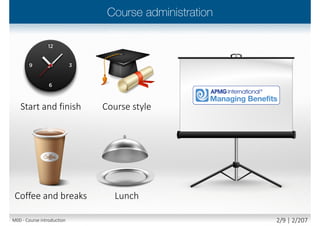
Start and finish Course style
LunchCoffee and breaks
M00 - Course introduction 2/10 | 2/210
 The underpinning philosophy and principles of
Managing Benefits
 The terminology and thinking
behind Managing Benefits
 The Managing Benefits process and techniques
 The Managing Benefits documents, roles and
responsibilities
 The Managing Benefits alignment with
other best practice methodologies and standards
Main goal
 Attempt Foundation exam with confidence
 Begin to apply the best practice, tailoring it to
your own organisational needs
Secondary goal
 Benefits and value of Managing Benefits
M00 - Course introduction 3/10 | 3/210
 Please share with the class:
 Your name and surname
 Your organization
 Your profession
 Ttitle, function, job responsibilities
 Your familiarity with the
portfolio management
 Your experience with PMO/
Support offices/Project Management
 Your personal session expectations
M00 - Course introduction 4/10 | 4/210
 Foundation Exam
 Paper based and closed book exam
 Only pencil and eraser are allowed
 50 questions, pass mark is 25 (50%)
 Simple multiple (ABCD) choice exam
 Only one answer is correct
 40 minutes exam
 No negative points, no “Tricky Questions”
 No pre-requisite for Foundation exam
 Sample, one mock exam is provided
to you.
Candidates completing an examination in a language that
is not their mother tongue, will receive additional time
M00 - Course introduction 5/10 | 5/210
 Practitioner Exam
 Paper based and open book exam
 Reference to Managing Benefits handbook
 Handbook is provided for students
 2.5 hour exam
 8 x 10 mark questions = 80 question
items/lines
 Dictionary/translation lists allowed for non-
native speakers
 Non-scientific calculator for basic
calculations
 Pass mark – 50% / 40 marks
 Foundation certification is required
Candidates completing an examination in a language that
is not their mother tongue, will receive additional time
M00 - Course introduction 6/10 | 6/210
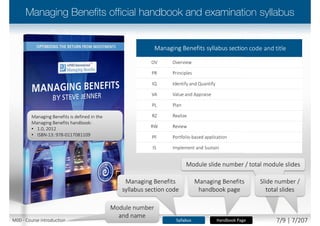
Managing Benefits syllabus section code and title
OV Overview
PR Principles
IQ Identify and Quantify
VA Value and Appraise
PL Plan
RZ Realize
RW Review
PF Portfolio-based application
IS Implement and Sustain
Syllabus Handbook Page
Module slide number / total module slides
Slide number /
total slides
Module number
and name
Managing Benefits
handbook page
Managing Benefits
syllabus section code
M00 - Course introduction 7/10 | 7/210
M00 - Course introduction 8/10 | 8/210
quizlet.com/45248717/
M00 - Course introduction 9/10 | 9/210
twitter.com/mirodabrowski
linkedin.com/in/miroslawdabrowski
google.com/+miroslawdabrowski
miroslaw_dabrowski
www.miroslawdabrowski.com
Mirosław Dąbrowski
Agile Coach, Trainer, Consultant
(former JEE/PHP developer, UX/UI designer, BA/SA)
Creator Writer / Translator Trainer / Coach
• Creator of 50+ mind maps from PPM and related
topics (2mln views): miroslawdabrowski.com
• Lead author of more than 50+ accredited materials
from PRINCE2, PRINCE2 Agile, MSP, MoP, P3O, ITIL,
M_o_R, MoV, PMP, Scrum, AgilePM, DSDM, CISSP,
CISA, CISM, CRISC, CGEIT, TOGAF, COBIT5 etc.
• Creator of 50+ interactive mind maps from PPM
topics: mindmeister.com/users/channel/2757050
• Product Owner of biggest Polish project
management portal: 4PM: 4pm.pl (15.000+ views
each month)
• Editorial Board Member of Official PMI Poland
Chapter magazine: “Strefa PMI”: strefapmi.pl
• Official PRINCE2 Agile, AgilePM, ASL2, BiSL methods
translator for Polish language
• English speaking, international, independent
trainer and coach from multiple domains.
• Master Lead Trainer
• 11+ years in training and coaching / 15.000+ hours
• 100+ certifications
• 5000+ people trained and coached
• 25+ trainers trained and coached
linkedin.com/in/miroslawdabrowski
Agile Coach / Scrum Master PM / IT architect Notable clients
• 8+ years of experience with Agile projects as a
Scrum Master, Product Owner and Agile Coach
• Coached 25+ teams from Agile and Scrum
• Agile Coach coaching C-level executives
• Scrum Master facilitating multiple teams
experienced with UX/UI + Dev teams
• Experience multiple Agile methods
• Author of AgilePM/DSDM Project Health Check
Questionnaire (PHCQ) audit tool
• Dozens of mobile and ecommerce projects
• IT architect experienced in IT projects with budget
above 10mln PLN and timeline of 3+ years
• Experienced with (“traditional”) projects under high
security, audit and compliance requirements based
on ISO/EIC 27001
• 25+ web portal design and development and
mobile application projects with iterative,
incremental and adaptive approach
ABB, AGH, Aiton Caldwell, Asseco, Capgemini, Deutsche Bank,
Descom, Ericsson, Ericpol, Euler Hermes, General Electric,
Glencore, HP Global Business Center, Ideo, Infovide-Matrix,
Interia, Kemira, Lufthansa Systems, Media-Satrun Group,
Ministry of Defense (Poland), Ministry of Justice (Poland),
Nokia Siemens Networks, Oracle, Orange, Polish Air Force,
Proama, Roche, Sabre Holdings, Samsung Electronics, Sescom,
Scania, Sopra Steria, Sun Microsystems, Tauron Polish Energy,
Tieto, University of Wroclaw, UBS Service Centre, Volvo IT…
miroslawdabrowski.com/about-me/clients-and-references/
Accreditations/certifications (selected): CISA, CISM, CRISC, CASP, Security+, Project+, Network+, Server+, Approved
Trainer: (MoP, MSP, PRINCE2, PRINCE2 Agile, M_o_R, MoV, P3O, ITIL Expert, RESILIA), ASL2, BiSL, Change Management,
Facilitation, Managing Benefits, COBIT5, TOGAF 8/9L2, OBASHI, CAPM, PSM I, SDC, SMC, ESMC, SPOC, AEC, DSDM Atern,
DSDM Agile Professional, DSDM Agile Trainer-Coach, AgilePM, OCUP Advanced, SCWCD, SCBCD, SCDJWS, SCMAD, ZCE 5.0,
ZCE 5.3, MCT, MCP, MCITP, MCSE-S, MCSA-S, MCS, MCSA, ISTQB, IQBBA, REQB, CIW Web Design / Web Development /
Web Security Professional, Playing Lean Facilitator, DISC D3 Consultant, SDI Facilitator, Certified Trainer Apollo 13 ITSM
Simulation …
M00 - Course introduction 10/10 | 10/210
1. Overview of Managing Benefits
2. The Benefits Management Model
3. The 7 Benefits Management Principles
4. Identify and Quantify
5. Value and Appraise
6. Plan
7. Realize
8. Review
9. Portfolio-based application
10. Implementation, Sustain, Measure
M01 - Overview of Managing Benefits 2/12 | 12/210
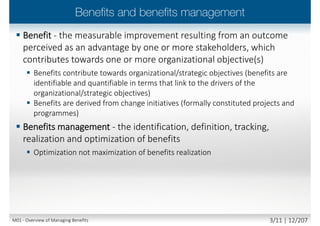
 Benefit - the measurable improvement resulting from an
outcome perceived as an advantage by one or more
stakeholders, which contributes towards one or more
organizational objective(s)
 Benefits contribute towards organizational/strategic objectives
(benefits are identifiable and quantifiable in terms that link to the
drivers of the organizational/strategic objectives)
 Benefits are derived from change initiatives (formally constituted
projects and programmes)
 Benefits management - the identification, definition,
tracking, realization and optimization of benefits
 Optimization not maximization of benefits realization
M01 - Overview of Managing Benefits 3/12 | 13/210
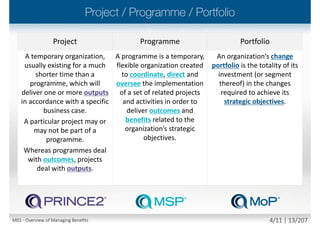
Project Programme Portfolio
A temporary organization,
usually existing for a much
shorter time than a
programme, which will
deliver one or more outputs
in accordance with a specific
business case.
A particular project may or
may not be part of a
programme.
Whereas programmes deal
with outcomes, projects
deal with outputs.
A programme is a temporary,
flexible organization created
to coordinate, direct and
oversee the implementation
of a set of related projects
and activities in order to
deliver outcomes and
benefits related to the
organization’s strategic
objectives.
An organization’s change
portfolio is the totality of its
investment (or segment
thereof) in the changes
required to achieve its
strategic objectives.
M01 - Overview of Managing Benefits 4/12 | 14/210
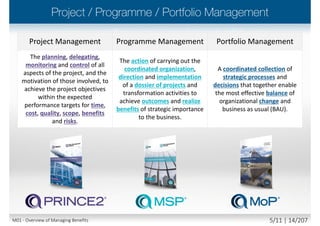
Project Management Programme Management Portfolio Management
The planning, delegating,
monitoring and control of all
aspects of the project, and the
motivation of those involved, to
achieve the project objectives
within the expected
performance targets for time,
cost, quality, scope, benefits
and risks.
The action of carrying out the
coordinated organization,
direction and implementation
of a dossier of projects and
transformation activities to
achieve outcomes and realize
benefits of strategic importance
to the business.
A coordinated collection of
strategic processes and
decisions that together enable
the most effective balance of
organizational change and
business as usual (BAU).
M01 - Overview of Managing Benefits 5/12 | 15/210
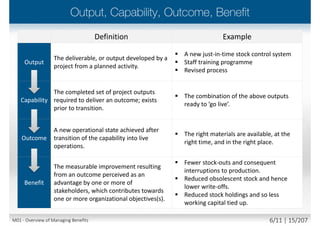
Definition Example
Output
The deliverable, or output developed by a
project from a planned activity.
 A new just-in-time stock control system
 Staff training programme
 Revised process
Capability
The completed set of project outputs
required to deliver an outcome; exists
prior to transition.
 The combination of the above outputs
ready to ’go live’.
Outcome
A new operational state achieved after
transition of the capability into live
operations.
 The right materials are available, at the
right time, and in the right place.
Benefit
The measurable improvement resulting
from an outcome perceived as an
advantage by one or more of
stakeholders, which contributes towards
one or more organizational objectives(s).
 Fewer stock-outs and consequent
interruptions to production.
 Reduced obsolescent stock and hence
lower write-offs.
 Reduced stock holdings and so less
working capital tied up.
M01 - Overview of Managing Benefits 6/12 | 16/210
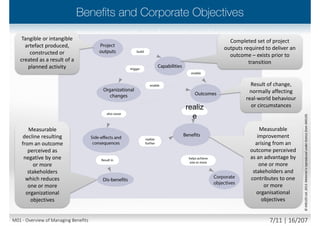
Side-effects and
consequences
Corporate
objectives
realize
further
also cause
Project
outputs
Organizational
changes
Dis-benefits
enable
realize
helps achieve
one or more
Outcomes
Benefits
trigger
Result in
Capabilities
build
enable
Measurable
improvement
arising from an
outcome perceived
as an advantage by
one or more
stakeholders and
contributes to one
or more
organisational
objectives
Measurable
decline resulting
from an outcome
perceived as
negative by one
or more
stakeholders
which reduces
one or more
organizational
objectives
Tangible or intangible
artefact produced,
constructed or
created as a result of a
planned activity
Completed set of project
outputs required to deliver an
outcome – exists prior to
transition
Result of change,
normally affecting
real-world behaviour
or circumstances
©AXELOSLtd.2013.MaterialisreproducedunderlicencefromAXELOS.
M01 - Overview of Managing Benefits 7/12 | 17/210
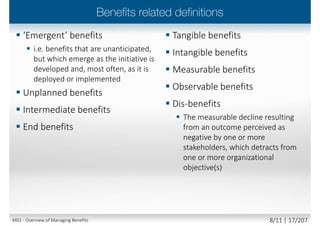
 ‘Emergent’ benefits
 i.e. benefits that are unanticipated,
but which emerge as the initiative is
developed and, most often, as it is
deployed or implemented
 Unplanned benefits
 Intermediate benefits
 End benefits
 Tangible benefits
 Intangible benefits
 Measurable benefits
 Observable benefits
 Dis-benefits
 The measurable decline resulting
from an outcome perceived as
negative by one or more
stakeholders, which detracts from
one or more organizational
objective(s)
M01 - Overview of Managing Benefits 8/12 | 18/210
 Forecast benefits are complete (all sources of potential value are
identified), realizable and represent value for money
 Forecast benefits are realized in practice, including by ensuring the
required enabling, business and behavioural change take place
 Benefits are realized as early as possible and are sustained for as
long as possible
 Emergent or unplanned benefits are captured and leveraged
(and any dis-benefits are minimized)
 We optimize the benefits realized and value for money achieved
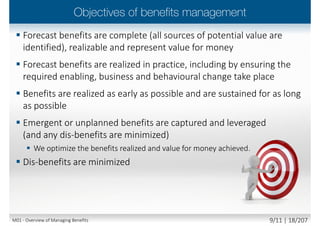
 Dis-benefits are minimized
M01 - Overview of Managing Benefits 9/12 | 19/210
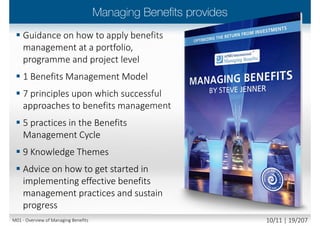
 Guidance on how to apply benefits
management at a portfolio,
programme and project level
 1 Benefits Management Model
 7 principles upon which successful
approaches to benefits management
 5 practices in the Benefits
Management Cycle
 9 Knowledge Themes
 Advice on how to get started in
implementing effective benefits
management practices and sustain
progress
M01 - Overview of Managing Benefits 10/12 | 20/210
M01 - Overview of Managing Benefits 11/12 | 21/210
I hope you enjoyed
this presentation. If so,
please like, share and
leave a comment
below.
Endorsements on
LinkedIn are also
highly appreciated! 
(your feedback = more free stuff)

MIROSLAWDABROWSKI.COM/downloads

Managing Benefits - Foundation

  • 1.
  • 2.
    Start and finishCourse style LunchCoffee and breaks M00 - Course introduction 2/10 | 2/210
  • 3.
     The underpinningphilosophy and principles of Managing Benefits  The terminology and thinking behind Managing Benefits  The Managing Benefits process and techniques  The Managing Benefits documents, roles and responsibilities  The Managing Benefits alignment with other best practice methodologies and standards Main goal  Attempt Foundation exam with confidence  Begin to apply the best practice, tailoring it to your own organisational needs Secondary goal  Benefits and value of Managing Benefits M00 - Course introduction 3/10 | 3/210
  • 4.
     Please sharewith the class:  Your name and surname  Your organization  Your profession  Ttitle, function, job responsibilities  Your familiarity with the portfolio management  Your experience with PMO/ Support offices/Project Management  Your personal session expectations M00 - Course introduction 4/10 | 4/210
  • 5.
     Foundation Exam Paper based and closed book exam  Only pencil and eraser are allowed  50 questions, pass mark is 25 (50%)  Simple multiple (ABCD) choice exam  Only one answer is correct  40 minutes exam  No negative points, no “Tricky Questions”  No pre-requisite for Foundation exam  Sample, one mock exam is provided to you. Candidates completing an examination in a language that is not their mother tongue, will receive additional time M00 - Course introduction 5/10 | 5/210
  • 6.
     Practitioner Exam Paper based and open book exam  Reference to Managing Benefits handbook  Handbook is provided for students  2.5 hour exam  8 x 10 mark questions = 80 question items/lines  Dictionary/translation lists allowed for non- native speakers  Non-scientific calculator for basic calculations  Pass mark – 50% / 40 marks  Foundation certification is required Candidates completing an examination in a language that is not their mother tongue, will receive additional time M00 - Course introduction 6/10 | 6/210
  • 7.
    Managing Benefits syllabussection code and title OV Overview PR Principles IQ Identify and Quantify VA Value and Appraise PL Plan RZ Realize RW Review PF Portfolio-based application IS Implement and Sustain Syllabus Handbook Page Module slide number / total module slides Slide number / total slides Module number and name Managing Benefits handbook page Managing Benefits syllabus section code M00 - Course introduction 7/10 | 7/210
  • 8.
    M00 - Courseintroduction 8/10 | 8/210
  • 9.
    quizlet.com/45248717/ M00 - Courseintroduction 9/10 | 9/210
  • 10.
    twitter.com/mirodabrowski linkedin.com/in/miroslawdabrowski google.com/+miroslawdabrowski miroslaw_dabrowski www.miroslawdabrowski.com Mirosław Dąbrowski Agile Coach,Trainer, Consultant (former JEE/PHP developer, UX/UI designer, BA/SA) Creator Writer / Translator Trainer / Coach • Creator of 50+ mind maps from PPM and related topics (2mln views): miroslawdabrowski.com • Lead author of more than 50+ accredited materials from PRINCE2, PRINCE2 Agile, MSP, MoP, P3O, ITIL, M_o_R, MoV, PMP, Scrum, AgilePM, DSDM, CISSP, CISA, CISM, CRISC, CGEIT, TOGAF, COBIT5 etc. • Creator of 50+ interactive mind maps from PPM topics: mindmeister.com/users/channel/2757050 • Product Owner of biggest Polish project management portal: 4PM: 4pm.pl (15.000+ views each month) • Editorial Board Member of Official PMI Poland Chapter magazine: “Strefa PMI”: strefapmi.pl • Official PRINCE2 Agile, AgilePM, ASL2, BiSL methods translator for Polish language • English speaking, international, independent trainer and coach from multiple domains. • Master Lead Trainer • 11+ years in training and coaching / 15.000+ hours • 100+ certifications • 5000+ people trained and coached • 25+ trainers trained and coached linkedin.com/in/miroslawdabrowski Agile Coach / Scrum Master PM / IT architect Notable clients • 8+ years of experience with Agile projects as a Scrum Master, Product Owner and Agile Coach • Coached 25+ teams from Agile and Scrum • Agile Coach coaching C-level executives • Scrum Master facilitating multiple teams experienced with UX/UI + Dev teams • Experience multiple Agile methods • Author of AgilePM/DSDM Project Health Check Questionnaire (PHCQ) audit tool • Dozens of mobile and ecommerce projects • IT architect experienced in IT projects with budget above 10mln PLN and timeline of 3+ years • Experienced with (“traditional”) projects under high security, audit and compliance requirements based on ISO/EIC 27001 • 25+ web portal design and development and mobile application projects with iterative, incremental and adaptive approach ABB, AGH, Aiton Caldwell, Asseco, Capgemini, Deutsche Bank, Descom, Ericsson, Ericpol, Euler Hermes, General Electric, Glencore, HP Global Business Center, Ideo, Infovide-Matrix, Interia, Kemira, Lufthansa Systems, Media-Satrun Group, Ministry of Defense (Poland), Ministry of Justice (Poland), Nokia Siemens Networks, Oracle, Orange, Polish Air Force, Proama, Roche, Sabre Holdings, Samsung Electronics, Sescom, Scania, Sopra Steria, Sun Microsystems, Tauron Polish Energy, Tieto, University of Wroclaw, UBS Service Centre, Volvo IT… miroslawdabrowski.com/about-me/clients-and-references/ Accreditations/certifications (selected): CISA, CISM, CRISC, CASP, Security+, Project+, Network+, Server+, Approved Trainer: (MoP, MSP, PRINCE2, PRINCE2 Agile, M_o_R, MoV, P3O, ITIL Expert, RESILIA), ASL2, BiSL, Change Management, Facilitation, Managing Benefits, COBIT5, TOGAF 8/9L2, OBASHI, CAPM, PSM I, SDC, SMC, ESMC, SPOC, AEC, DSDM Atern, DSDM Agile Professional, DSDM Agile Trainer-Coach, AgilePM, OCUP Advanced, SCWCD, SCBCD, SCDJWS, SCMAD, ZCE 5.0, ZCE 5.3, MCT, MCP, MCITP, MCSE-S, MCSA-S, MCS, MCSA, ISTQB, IQBBA, REQB, CIW Web Design / Web Development / Web Security Professional, Playing Lean Facilitator, DISC D3 Consultant, SDI Facilitator, Certified Trainer Apollo 13 ITSM Simulation … M00 - Course introduction 10/10 | 10/210
  • 12.
    1. Overview ofManaging Benefits 2. The Benefits Management Model 3. The 7 Benefits Management Principles 4. Identify and Quantify 5. Value and Appraise 6. Plan 7. Realize 8. Review 9. Portfolio-based application 10. Implementation, Sustain, Measure M01 - Overview of Managing Benefits 2/12 | 12/210
  • 13.
     Benefit -the measurable improvement resulting from an outcome perceived as an advantage by one or more stakeholders, which contributes towards one or more organizational objective(s)  Benefits contribute towards organizational/strategic objectives (benefits are identifiable and quantifiable in terms that link to the drivers of the organizational/strategic objectives)  Benefits are derived from change initiatives (formally constituted projects and programmes)  Benefits management - the identification, definition, tracking, realization and optimization of benefits  Optimization not maximization of benefits realization M01 - Overview of Managing Benefits 3/12 | 13/210
  • 14.
    Project Programme Portfolio Atemporary organization, usually existing for a much shorter time than a programme, which will deliver one or more outputs in accordance with a specific business case. A particular project may or may not be part of a programme. Whereas programmes deal with outcomes, projects deal with outputs. A programme is a temporary, flexible organization created to coordinate, direct and oversee the implementation of a set of related projects and activities in order to deliver outcomes and benefits related to the organization’s strategic objectives. An organization’s change portfolio is the totality of its investment (or segment thereof) in the changes required to achieve its strategic objectives. M01 - Overview of Managing Benefits 4/12 | 14/210
  • 15.
    Project Management ProgrammeManagement Portfolio Management The planning, delegating, monitoring and control of all aspects of the project, and the motivation of those involved, to achieve the project objectives within the expected performance targets for time, cost, quality, scope, benefits and risks. The action of carrying out the coordinated organization, direction and implementation of a dossier of projects and transformation activities to achieve outcomes and realize benefits of strategic importance to the business. A coordinated collection of strategic processes and decisions that together enable the most effective balance of organizational change and business as usual (BAU). M01 - Overview of Managing Benefits 5/12 | 15/210
  • 16.
    Definition Example Output The deliverable,or output developed by a project from a planned activity.  A new just-in-time stock control system  Staff training programme  Revised process Capability The completed set of project outputs required to deliver an outcome; exists prior to transition.  The combination of the above outputs ready to ’go live’. Outcome A new operational state achieved after transition of the capability into live operations.  The right materials are available, at the right time, and in the right place. Benefit The measurable improvement resulting from an outcome perceived as an advantage by one or more of stakeholders, which contributes towards one or more organizational objectives(s).  Fewer stock-outs and consequent interruptions to production.  Reduced obsolescent stock and hence lower write-offs.  Reduced stock holdings and so less working capital tied up. M01 - Overview of Managing Benefits 6/12 | 16/210
  • 17.
    Side-effects and consequences Corporate objectives realize further also cause Project outputs Organizational changes Dis-benefits enable realize helpsachieve one or more Outcomes Benefits trigger Result in Capabilities build enable Measurable improvement arising from an outcome perceived as an advantage by one or more stakeholders and contributes to one or more organisational objectives Measurable decline resulting from an outcome perceived as negative by one or more stakeholders which reduces one or more organizational objectives Tangible or intangible artefact produced, constructed or created as a result of a planned activity Completed set of project outputs required to deliver an outcome – exists prior to transition Result of change, normally affecting real-world behaviour or circumstances ©AXELOSLtd.2013.MaterialisreproducedunderlicencefromAXELOS. M01 - Overview of Managing Benefits 7/12 | 17/210
  • 18.
     ‘Emergent’ benefits i.e. benefits that are unanticipated, but which emerge as the initiative is developed and, most often, as it is deployed or implemented  Unplanned benefits  Intermediate benefits  End benefits  Tangible benefits  Intangible benefits  Measurable benefits  Observable benefits  Dis-benefits  The measurable decline resulting from an outcome perceived as negative by one or more stakeholders, which detracts from one or more organizational objective(s) M01 - Overview of Managing Benefits 8/12 | 18/210
  • 19.
     Forecast benefitsare complete (all sources of potential value are identified), realizable and represent value for money  Forecast benefits are realized in practice, including by ensuring the required enabling, business and behavioural change take place  Benefits are realized as early as possible and are sustained for as long as possible  Emergent or unplanned benefits are captured and leveraged (and any dis-benefits are minimized)  We optimize the benefits realized and value for money achieved  Dis-benefits are minimized M01 - Overview of Managing Benefits 9/12 | 19/210
  • 20.
     Guidance onhow to apply benefits management at a portfolio, programme and project level  1 Benefits Management Model  7 principles upon which successful approaches to benefits management  5 practices in the Benefits Management Cycle  9 Knowledge Themes  Advice on how to get started in implementing effective benefits management practices and sustain progress M01 - Overview of Managing Benefits 10/12 | 20/210
  • 21.
    M01 - Overviewof Managing Benefits 11/12 | 21/210
  • 22.
    I hope youenjoyed this presentation. If so, please like, share and leave a comment below. Endorsements on LinkedIn are also highly appreciated!  (your feedback = more free stuff)  MIROSLAWDABROWSKI.COM/downloads