TheAPMG-InternationalOBASHIandSwirlDevicelogoisatrademarkofTheAPMGroupLimited.
OBASHI®isaRegisteredTradeMarkintheUnitedKingdomandothercountries.
Start and finish Course style
LunchCoffee and breaks
M00 - Course introduction 2/7 | 2/185
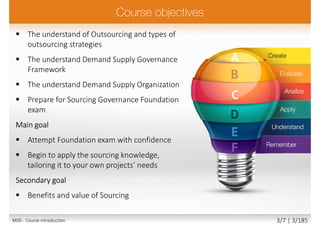
 The understand of Outsourcing and types of
outsourcing strategies
 The understand Demand Supply Governance
Framework
 The understand Demand Supply Organization
 Prepare for Sourcing Governance Foundation
exam
Main goal
 Attempt Foundation exam with confidence
 Begin to apply the sourcing knowledge,
tailoring it to your own projects’ needs
Secondary goal
 Benefits and value of Sourcing
M00 - Course introduction 3/7 | 3/185
 Please share with the class:
 Your name and surname
 Your organization
 Your profession
 Title, function, job responsibilities
 Your familiarity with the project
management
 Your experience with
sourcing/outsourcing
 Your personal session expectations
M00 - Course introduction 4/7 | 4/185
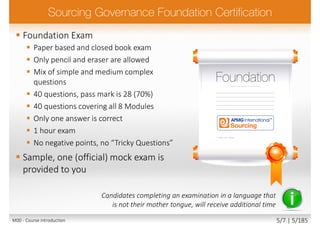
 Foundation Exam
 Paper based and closed book exam
 Only pencil and eraser are allowed
 Mix of simple and medium complex
questions
 40 questions, pass mark is 28 (70%)
 40 questions covering all 8 Modules
 Only one answer is correct
 1 hour exam
 No negative points, no “Tricky Questions”
 Sample, one (official) mock exam is
provided to you
Candidates completing an examination in a language that
is not their mother tongue, will receive additional time
M00 - Course introduction 5/7 | 5/185
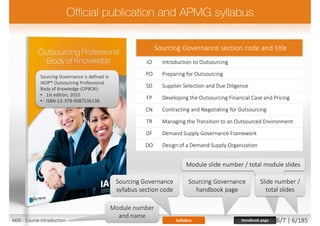
Handbook page
Sourcing Governance section code and title
IO Introduction to Outsourcing
PO Preparing for Outsourcing
SD Supplier Selection and Due Diligence
FP Developing the Outsourcing Financial Case and Pricing
CN Contracting and Negotiating for Outsourcing
TR Managing the Transition to an Outsourced Environment
DF Demand Supply Governance Framework
DO Design of a Demand Supply Organization
Module slide number / total module slides
Slide number /
total slides
Module number
and name
Sourcing Governance
handbook page
Sourcing Governance
syllabus section code
Sourcing Governance is defined in
IAOP® Outsourcing Professional
Body of Knowledge (OPBOK):
• 1st edition, 2010
• ISBN-13: 978-9087536138
SyllabusM00 - Course introduction 6/7 | 6/185
twitter.com/mirodabrowski
linkedin.com/in/miroslawdabrowski
google.com/+miroslawdabrowski
miroslaw_dabrowski
www.miroslawdabrowski.com
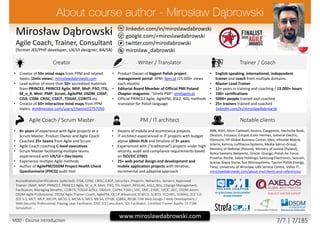
Mirosław Dąbrowski
Agile Coach, Trainer, Consultant
(former JEE/PHP developer, UX/UI designer, BA/SA)
Creator Writer / Translator Trainer / Coach
• Creator of 50+ mind maps from PPM and related
topics (2mln views): miroslawdabrowski.com
• Lead author of more than 50+ accredited materials
from PRINCE2, PRINCE2 Agile, MSP, MoP, P3O, ITIL,
M_o_R, MoV, PMP, Scrum, AgilePM, DSDM, CISSP,
CISA, CISM, CRISC, CGEIT, TOGAF, COBIT5 etc.
• Creator of 50+ interactive mind maps from PPM
topics: mindmeister.com/users/channel/2757050
• Product Owner of biggest Polish project
management portal: 4PM: 4pm.pl (15.000+ views
each month)
• Editorial Board Member of Official PMI Poland
Chapter magazine: “Strefa PMI”: strefapmi.pl
• Official PRINCE2 Agile, AgilePM, ASL2, BiSL methods
translator for Polish language
• English speaking, international, independent
trainer and coach from multiple domains.
• Master Lead Trainer
• 11+ years in training and coaching / 15.000+ hours
• 100+ certifications
• 5000+ people trained and coached
• 25+ trainers trained and coached
linkedin.com/in/miroslawdabrowski
Agile Coach / Scrum Master PM / IT architect Notable clients
• 8+ years of experience with Agile projects as a
Scrum Master, Product Owner and Agile Coach
• Coached 25+ teams from Agile and Scrum
• Agile Coach coaching C-level executives
• Scrum Master facilitating multiple teams
experienced with UX/UI + Dev teams
• Experience multiple Agile methods
• Author of AgilePM/DSDM Project Health Check
Questionnaire (PHCQ) audit tool
• Dozens of mobile and ecommerce projects
• IT architect experienced in IT projects with budget
above 10mln PLN and timeline of 3+ years
• Experienced with (“traditional”) projects under high
security, audit and compliance requirements based
on ISO/EIC 27001
• 25+ web portal design and development and
mobile application projects with iterative,
incremental and adaptive approach
ABB, AGH, Aiton Caldwell, Asseco, Capgemini, Deutsche Bank,
Descom, Ericsson, Ericpol, Euler Hermes, General Electric,
Glencore, HP Global Business Center, Ideo, Infovide-Matrix,
Interia, Kemira, Lufthansa Systems, Media-Satrun Group,
Ministry of Defense (Poland), Ministry of Justice (Poland),
Nokia Siemens Networks, Oracle, Orange, Polish Air Force,
Proama, Roche, Sabre Holdings, Samsung Electronics, Sescom,
Scania, Sopra Steria, Sun Microsystems, Tauron Polish Energy,
Tieto, University of Wroclaw, UBS Service Centre, Volvo IT…
miroslawdabrowski.com/about-me/clients-and-references/
Accreditations/certifications (selected): CISA, CISM, CRISC, CASP, Security+, Project+, Network+, Server+, Approved
Trainer: (MoP, MSP, PRINCE2, PRINCE2 Agile, M_o_R, MoV, P3O, ITIL Expert, RESILIA), ASL2, BiSL, Change Management,
Facilitation, Managing Benefits, COBIT5, TOGAF 8/9L2, OBASHI, CAPM, PSM I, SDC, SMC, ESMC, SPOC, AEC, DSDM Atern,
DSDM Agile Professional, DSDM Agile Trainer-Coach, AgilePM, OCUP Advanced, SCWCD, SCBCD, SCDJWS, SCMAD, ZCE 5.0,
ZCE 5.3, MCT, MCP, MCITP, MCSE-S, MCSA-S, MCS, MCSA, ISTQB, IQBBA, REQB, CIW Web Design / Web Development /
Web Security Professional, Playing Lean Facilitator, DISC D3 Consultant, SDI Facilitator, Certified Trainer Apollo 13 ITSM
Simulation …
M00 - Course introduction 7/7 | 7/185
1. Introduction to Outsourcing
2. Preparing to Outsource
3. Supplier Selection and Due Diligence
4. Developing the Outsourcing
Financial Case and Pricing
5. Contracting and Negotiation
6. Managing the Transition to an
Outsourced Environment
7. Demand Supply Governance
Framework
8. Design of a Demand Supply
Organization
M01 - Introduction to Outsourcing 2/22 | 9/185
M01 - Introduction to Outsourcing 3/22 | 10/185
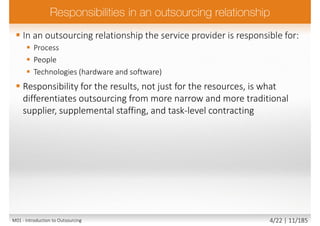
 In an outsourcing relationship the service provider is responsible for:
 Process
 People
 Technologies (hardware and software)
 Responsibility for the results, not just for the resources, is what
differentiates outsourcing from more narrow and more traditional
supplier, supplemental staffing, and task-level contracting
M01 - Introduction to Outsourcing 4/22 | 11/185
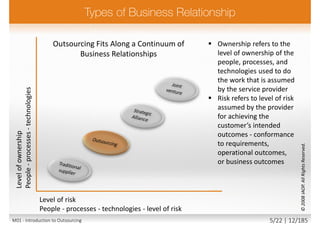
 Ownership refers to the
level of ownership of the
people, processes, and
technologies used to do
the work that is assumed
by the service provider
 Risk refers to level of risk
assumed by the provider
for achieving the
customer’s intended
outcomes - conformance
to requirements,
operational outcomes,
or business outcomes
Levelofownership
People-processes-technologies
Level of risk
People - processes - technologies - level of risk
Outsourcing Fits Along a Continuum of
Business Relationships
©2008IAOP.AllRightsReserved.
M01 - Introduction to Outsourcing 5/22 | 12/185
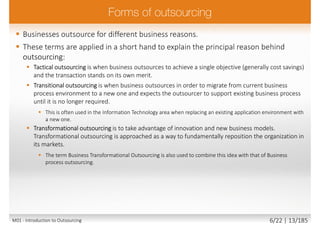
 Businesses outsource for different business reasons.
 These terms are applied in a short hand to explain the principal reason behind
outsourcing:
 Tactical outsourcing is when business outsources to achieve a single objective (generally cost savings)
and the transaction stands on its own merit.
 Transitional outsourcing is when business outsources in order to migrate from current business
process environment to a new one and expects the outsourcer to support existing business process
until it is no longer required.
 This is often used in the Information Technology area when replacing an existing application environment with
a new one.
 Transformational outsourcing is to take advantage of innovation and new business models.
Transformational outsourcing is approached as a way to fundamentally reposition the organization in
its markets.
 The term Business Transformational Outsourcing is also used to combine this idea with that of Business
process outsourcing.
M01 - Introduction to Outsourcing 6/22 | 13/185
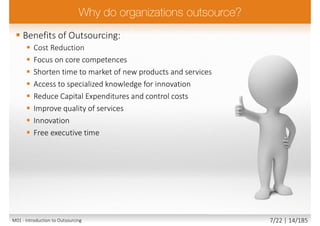
 Benefits of Outsourcing:
 Cost Reduction
 Focus on core competences
 Shorten time to market of new products and services
 Access to specialized knowledge for innovation
 Reduce Capital Expenditures and control costs
 Improve quality of services
 Innovation
 Free executive time
M01 - Introduction to Outsourcing 7/22 | 14/185
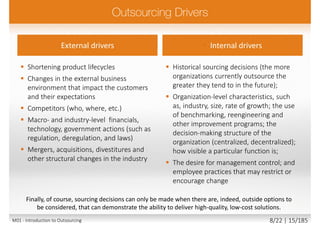
 Shortening product lifecycles
 Changes in the external business
environment that impact the customers
and their expectations
 Competitors (who, where, etc.)
 Macro- and industry-level financials,
technology, government actions (such as
regulation, deregulation, and laws)
 Mergers, acquisitions, divestitures and
other structural changes in the industry
 Historical sourcing decisions (the more
organizations currently outsource the
greater they tend to in the future);
 Organization-level characteristics, such
as, industry, size, rate of growth; the use
of benchmarking, reengineering and
other improvement programs; the
decision-making structure of the
organization (centralized, decentralized);
how visible a particular function is;
 The desire for management control; and
employee practices that may restrict or
encourage change
External drivers • Internal drivers
Finally, of course, sourcing decisions can only be made when there are, indeed, outside options to
be considered, that can demonstrate the ability to deliver high-quality, low-cost solutions.
M01 - Introduction to Outsourcing 8/22 | 15/185
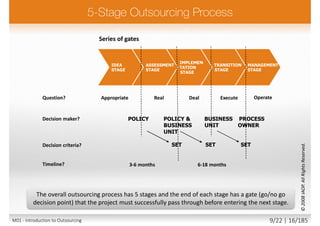
The overall outsourcing process has 5 stages and the end of each stage has a gate (go/no go
decision point) that the project must successfully pass through before entering the next stage.
©2008IAOP.AllRightsReserved.
IDEA
STAGE
ASSESSMENT
STAGE
IMPLEMEN-
TATION
STAGE
TRANSITION
STAGE
MANAGEMENT
STAGE
Series of gates
Question? Appropriate Real Deal Execute
Timeline? 3-6 months 6-18 months
Decision maker? POLICY POLICY & BUSINESS PROCESS
BUSINESS UNIT OWNER
UNIT
Operate
SET SET SETDecision criteria?
M01 - Introduction to Outsourcing 9/22 | 16/185
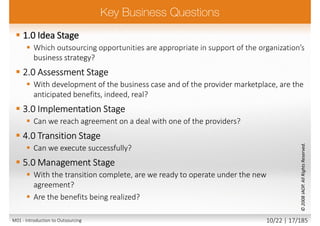
 1.0 Idea Stage
 Which outsourcing opportunities are appropriate in support of the organization’s
business strategy?
 2.0 Assessment Stage
 With development of the business case and of the provider marketplace, are the
anticipated benefits, indeed, real?
 3.0 Implementation Stage
 Can we reach agreement on a deal with one of the providers?
 4.0 Transition Stage
 Can we execute successfully?
 5.0 Management Stage
 With the transition complete, are we ready to operate under the new
agreement?
 Are the benefits being realized?
©2008IAOP.AllRightsReserved.
M01 - Introduction to Outsourcing 10/22 | 17/185
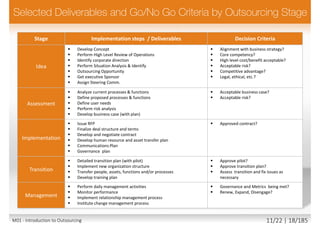
Stage Implementation steps / Deliverables Decision Criteria
Idea
 Develop Concept
 Perform High Level Review of Operations
 Identify corporate direction
 Perform Situation Analysis & Identify
 Outsourcing Opportunity
 Get executive Sponsor
 Assign Steering Comm.
 Alignment with business strategy?
 Core competency?
 High level cost/benefit acceptable?
 Acceptable risk?
 Competitive advantage?
 Legal, ethical, etc.?
Assessment
 Analyze current processes & functions
 Define proposed processes & functions
 Define user needs
 Perform risk analysis
 Develop business case (with plan)
 Acceptable business case?
 Acceptable risk?
Implementation
 Issue RFP
 Finalize deal structure and terms
 Develop and negotiate contract
 Develop human resource and asset transfer plan
 Communications Plan
 Governance plan
 Approved contract?
Transition
 Detailed transition plan (with pilot)
 Implement new organization structure
 Transfer people, assets, functions and/or processes
 Develop training plan
 Approve pilot?
 Approve transition plan?
 Assess transition and fix issues as
necessary
Management
 Perform daily management activities
 Monitor performance
 Implement relationship management process
 Institute change management process
 Governance and Metrics being met?
 Renew, Expand, Disengage?
M01 - Introduction to Outsourcing 11/22 | 18/185
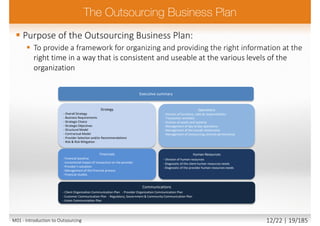
 Purpose of the Outsourcing Business Plan:
 To provide a framework for organizing and providing the right information at the
right time in a way that is consistent and useable at the various levels of the
organization
Executive summary
Strategy
- Overall Strategy
- Business Requirements
- Strategic Choice
- Strategic Objectives
- Structural Model
- Contractual Model
- Provider Selection and/or Recommendations
- Risk & Risk Mitigation
Operations
- Division of functions, roles & responsibilities
- Transaction activities
- Division of assets and systems
- Management of day to day operations
- Management of the overall relationship
- Management of outsourcing contract performance
Human Resources
- Division of human resources
- Diagnostic of the client human resources needs
- Diagnostic of the provider human resources needs
Financials
- Financial baseline
- Incremental impact of transaction on the provider
- Provider’s valuation
- Management of the financial process
- Financial studies
Communications
- Client Organization Communication Plan - Provider Organization Communication Plan
- Customer Communication Plan - Regulatory, Government & Community Communication Plan
- Union Communication Plan
M01 - Introduction to Outsourcing 12/22 | 19/185
Executive summary
Strategy
- Overall Strategy
- Business Requirements
- Strategic Choice
- Strategic Objectives
- Structural Model
- Contractual Model
- Provider Selection and/or Recommendations
- Risk & Risk Mitigation
Operations
- Division of functions, roles & responsibilities
- Transaction activities
- Division of assets and systems
- Management of day to day operations
- Management of the overall relationship
- Management of outsourcing contract performance
Human Resources
- Division of human resources
- Diagnostic of the client human resources needs
- Diagnostic of the provider human resources needs
Financials
- Financial baseline
- Incremental impact of transaction on the provider
- Provider’s valuation
- Management of the financial process
- Financial studies
Communications
- Client Organization Communication Plan - Provider Organization Communication Plan
- Customer Communication Plan - Regulatory, Government & Community Communication Plan
- Union Communication Plan
M01 - Introduction to Outsourcing 13/22 | 20/185
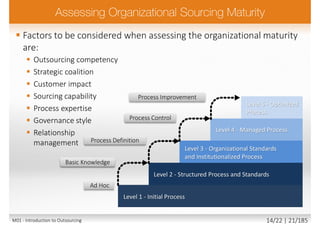
 Factors to be considered when assessing the organizational maturity
are:
 Outsourcing competency
 Strategic coalition
 Customer impact
 Sourcing capability
 Process expertise
 Governance style
 Relationship
management
Level 1 - Initial Process
Level 5 - Optimized
Process
Level 4 - Managed Process
Level 3 - Organizational Standards
and Institutionalized Process
Level 2 - Structured Process and Standards
Ad Hoc
Process Control
Basic Knowledge
Process Improvement
Process Definition
M01 - Introduction to Outsourcing 14/22 | 21/185
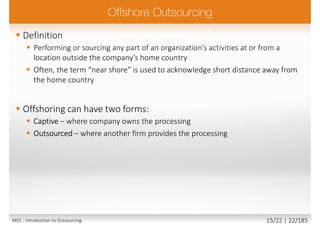
 Definition
 Performing or sourcing any part of an organization’s activities at or from a
location outside the company’s home country
 Often, the term “near shore” is used to acknowledge short distance away from
the home country
 Offshoring can have two forms:
 Captive – where company owns the processing
 Outsourced – where another firm provides the processing
M01 - Introduction to Outsourcing 15/22 | 22/185
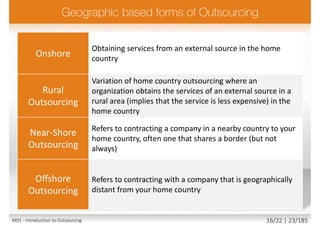
Onshore
Obtaining services from an external source in the home
country
Rural
Outsourcing
Variation of home country outsourcing where an
organization obtains the services of an external source in a
rural area (implies that the service is less expensive) in the
home country
Near-Shore
Outsourcing
Refers to contracting a company in a nearby country to your
home country, often one that shares a border (but not
always)
Offshore
Outsourcing
Refers to contracting with a company that is geographically
distant from your home country
M01 - Introduction to Outsourcing 16/22 | 23/185
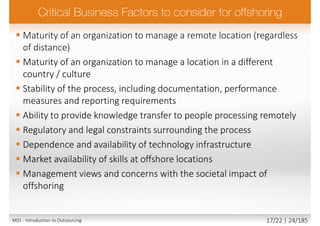
 Maturity of an organization to manage a remote location (regardless
of distance)
 Maturity of an organization to manage a location in a different
country / culture
 Stability of the process, including documentation, performance
measures and reporting requirements
 Ability to provide knowledge transfer to people processing remotely
 Regulatory and legal constraints surrounding the process
 Dependence and availability of technology infrastructure
 Market availability of skills at offshore locations
 Management views and concerns with the societal impact of
offshoring
M01 - Introduction to Outsourcing 17/22 | 24/185
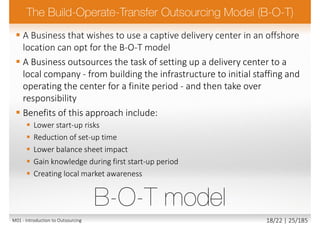
 A Business that wishes to use a captive delivery center in an offshore
location can opt for the B-O-T model
 A Business outsources the task of setting up a delivery center to a
local company - from building the infrastructure to initial staffing and
operating the center for a finite period - and then take over
responsibility
 Benefits of this approach include:
 Lower start-up risks
 Reduction of set-up time
 Lower balance sheet impact
 Gain knowledge during first start-up period
 Creating local market awareness
M01 - Introduction to Outsourcing 18/22 | 25/185
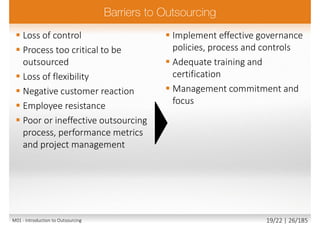
 Loss of control
 Process too critical to be
outsourced
 Loss of flexibility
 Negative customer reaction
 Employee resistance
 Poor or ineffective outsourcing
process, performance metrics
and project management
 Implement effective governance
policies, process and controls
 Adequate training and
certification
 Management commitment and
focus
M01 - Introduction to Outsourcing 19/22 | 26/185
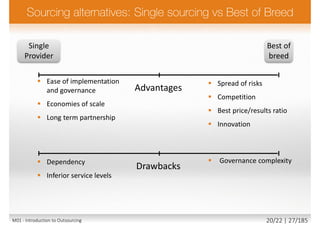
Best of
breed
Single
Provider
 Ease of implementation
and governance
 Economies of scale
 Long term partnership
 Dependency
 Inferior service levels
Advantages
Drawbacks
 Spread of risks
 Competition
 Best price/results ratio
 Innovation
 Governance complexity
M01 - Introduction to Outsourcing 20/22 | 27/185
M01 - Introduction to Outsourcing 21/22 | 28/185
I hope you enjoyed
this presentation. If so,
please like, share and
leave a comment
below.
Endorsements on
LinkedIn are also
highly appreciated! 
(your feedback = more free stuff)

MIROSLAWDABROWSKI.COM/downloads

Sourcing Governance - Foundation

  • 1.
  • 2.
    Start and finishCourse style LunchCoffee and breaks M00 - Course introduction 2/7 | 2/185
  • 3.
     The understandof Outsourcing and types of outsourcing strategies  The understand Demand Supply Governance Framework  The understand Demand Supply Organization  Prepare for Sourcing Governance Foundation exam Main goal  Attempt Foundation exam with confidence  Begin to apply the sourcing knowledge, tailoring it to your own projects’ needs Secondary goal  Benefits and value of Sourcing M00 - Course introduction 3/7 | 3/185
  • 4.
     Please sharewith the class:  Your name and surname  Your organization  Your profession  Title, function, job responsibilities  Your familiarity with the project management  Your experience with sourcing/outsourcing  Your personal session expectations M00 - Course introduction 4/7 | 4/185
  • 5.
     Foundation Exam Paper based and closed book exam  Only pencil and eraser are allowed  Mix of simple and medium complex questions  40 questions, pass mark is 28 (70%)  40 questions covering all 8 Modules  Only one answer is correct  1 hour exam  No negative points, no “Tricky Questions”  Sample, one (official) mock exam is provided to you Candidates completing an examination in a language that is not their mother tongue, will receive additional time M00 - Course introduction 5/7 | 5/185
  • 6.
    Handbook page Sourcing Governancesection code and title IO Introduction to Outsourcing PO Preparing for Outsourcing SD Supplier Selection and Due Diligence FP Developing the Outsourcing Financial Case and Pricing CN Contracting and Negotiating for Outsourcing TR Managing the Transition to an Outsourced Environment DF Demand Supply Governance Framework DO Design of a Demand Supply Organization Module slide number / total module slides Slide number / total slides Module number and name Sourcing Governance handbook page Sourcing Governance syllabus section code Sourcing Governance is defined in IAOP® Outsourcing Professional Body of Knowledge (OPBOK): • 1st edition, 2010 • ISBN-13: 978-9087536138 SyllabusM00 - Course introduction 6/7 | 6/185
  • 7.
    twitter.com/mirodabrowski linkedin.com/in/miroslawdabrowski google.com/+miroslawdabrowski miroslaw_dabrowski www.miroslawdabrowski.com Mirosław Dąbrowski Agile Coach,Trainer, Consultant (former JEE/PHP developer, UX/UI designer, BA/SA) Creator Writer / Translator Trainer / Coach • Creator of 50+ mind maps from PPM and related topics (2mln views): miroslawdabrowski.com • Lead author of more than 50+ accredited materials from PRINCE2, PRINCE2 Agile, MSP, MoP, P3O, ITIL, M_o_R, MoV, PMP, Scrum, AgilePM, DSDM, CISSP, CISA, CISM, CRISC, CGEIT, TOGAF, COBIT5 etc. • Creator of 50+ interactive mind maps from PPM topics: mindmeister.com/users/channel/2757050 • Product Owner of biggest Polish project management portal: 4PM: 4pm.pl (15.000+ views each month) • Editorial Board Member of Official PMI Poland Chapter magazine: “Strefa PMI”: strefapmi.pl • Official PRINCE2 Agile, AgilePM, ASL2, BiSL methods translator for Polish language • English speaking, international, independent trainer and coach from multiple domains. • Master Lead Trainer • 11+ years in training and coaching / 15.000+ hours • 100+ certifications • 5000+ people trained and coached • 25+ trainers trained and coached linkedin.com/in/miroslawdabrowski Agile Coach / Scrum Master PM / IT architect Notable clients • 8+ years of experience with Agile projects as a Scrum Master, Product Owner and Agile Coach • Coached 25+ teams from Agile and Scrum • Agile Coach coaching C-level executives • Scrum Master facilitating multiple teams experienced with UX/UI + Dev teams • Experience multiple Agile methods • Author of AgilePM/DSDM Project Health Check Questionnaire (PHCQ) audit tool • Dozens of mobile and ecommerce projects • IT architect experienced in IT projects with budget above 10mln PLN and timeline of 3+ years • Experienced with (“traditional”) projects under high security, audit and compliance requirements based on ISO/EIC 27001 • 25+ web portal design and development and mobile application projects with iterative, incremental and adaptive approach ABB, AGH, Aiton Caldwell, Asseco, Capgemini, Deutsche Bank, Descom, Ericsson, Ericpol, Euler Hermes, General Electric, Glencore, HP Global Business Center, Ideo, Infovide-Matrix, Interia, Kemira, Lufthansa Systems, Media-Satrun Group, Ministry of Defense (Poland), Ministry of Justice (Poland), Nokia Siemens Networks, Oracle, Orange, Polish Air Force, Proama, Roche, Sabre Holdings, Samsung Electronics, Sescom, Scania, Sopra Steria, Sun Microsystems, Tauron Polish Energy, Tieto, University of Wroclaw, UBS Service Centre, Volvo IT… miroslawdabrowski.com/about-me/clients-and-references/ Accreditations/certifications (selected): CISA, CISM, CRISC, CASP, Security+, Project+, Network+, Server+, Approved Trainer: (MoP, MSP, PRINCE2, PRINCE2 Agile, M_o_R, MoV, P3O, ITIL Expert, RESILIA), ASL2, BiSL, Change Management, Facilitation, Managing Benefits, COBIT5, TOGAF 8/9L2, OBASHI, CAPM, PSM I, SDC, SMC, ESMC, SPOC, AEC, DSDM Atern, DSDM Agile Professional, DSDM Agile Trainer-Coach, AgilePM, OCUP Advanced, SCWCD, SCBCD, SCDJWS, SCMAD, ZCE 5.0, ZCE 5.3, MCT, MCP, MCITP, MCSE-S, MCSA-S, MCS, MCSA, ISTQB, IQBBA, REQB, CIW Web Design / Web Development / Web Security Professional, Playing Lean Facilitator, DISC D3 Consultant, SDI Facilitator, Certified Trainer Apollo 13 ITSM Simulation … M00 - Course introduction 7/7 | 7/185
  • 9.
    1. Introduction toOutsourcing 2. Preparing to Outsource 3. Supplier Selection and Due Diligence 4. Developing the Outsourcing Financial Case and Pricing 5. Contracting and Negotiation 6. Managing the Transition to an Outsourced Environment 7. Demand Supply Governance Framework 8. Design of a Demand Supply Organization M01 - Introduction to Outsourcing 2/22 | 9/185
  • 10.
    M01 - Introductionto Outsourcing 3/22 | 10/185
  • 11.
     In anoutsourcing relationship the service provider is responsible for:  Process  People  Technologies (hardware and software)  Responsibility for the results, not just for the resources, is what differentiates outsourcing from more narrow and more traditional supplier, supplemental staffing, and task-level contracting M01 - Introduction to Outsourcing 4/22 | 11/185
  • 12.
     Ownership refersto the level of ownership of the people, processes, and technologies used to do the work that is assumed by the service provider  Risk refers to level of risk assumed by the provider for achieving the customer’s intended outcomes - conformance to requirements, operational outcomes, or business outcomes Levelofownership People-processes-technologies Level of risk People - processes - technologies - level of risk Outsourcing Fits Along a Continuum of Business Relationships ©2008IAOP.AllRightsReserved. M01 - Introduction to Outsourcing 5/22 | 12/185
  • 13.
     Businesses outsourcefor different business reasons.  These terms are applied in a short hand to explain the principal reason behind outsourcing:  Tactical outsourcing is when business outsources to achieve a single objective (generally cost savings) and the transaction stands on its own merit.  Transitional outsourcing is when business outsources in order to migrate from current business process environment to a new one and expects the outsourcer to support existing business process until it is no longer required.  This is often used in the Information Technology area when replacing an existing application environment with a new one.  Transformational outsourcing is to take advantage of innovation and new business models. Transformational outsourcing is approached as a way to fundamentally reposition the organization in its markets.  The term Business Transformational Outsourcing is also used to combine this idea with that of Business process outsourcing. M01 - Introduction to Outsourcing 6/22 | 13/185
  • 14.
     Benefits ofOutsourcing:  Cost Reduction  Focus on core competences  Shorten time to market of new products and services  Access to specialized knowledge for innovation  Reduce Capital Expenditures and control costs  Improve quality of services  Innovation  Free executive time M01 - Introduction to Outsourcing 7/22 | 14/185
  • 15.
     Shortening productlifecycles  Changes in the external business environment that impact the customers and their expectations  Competitors (who, where, etc.)  Macro- and industry-level financials, technology, government actions (such as regulation, deregulation, and laws)  Mergers, acquisitions, divestitures and other structural changes in the industry  Historical sourcing decisions (the more organizations currently outsource the greater they tend to in the future);  Organization-level characteristics, such as, industry, size, rate of growth; the use of benchmarking, reengineering and other improvement programs; the decision-making structure of the organization (centralized, decentralized); how visible a particular function is;  The desire for management control; and employee practices that may restrict or encourage change External drivers • Internal drivers Finally, of course, sourcing decisions can only be made when there are, indeed, outside options to be considered, that can demonstrate the ability to deliver high-quality, low-cost solutions. M01 - Introduction to Outsourcing 8/22 | 15/185
  • 16.
    The overall outsourcingprocess has 5 stages and the end of each stage has a gate (go/no go decision point) that the project must successfully pass through before entering the next stage. ©2008IAOP.AllRightsReserved. IDEA STAGE ASSESSMENT STAGE IMPLEMEN- TATION STAGE TRANSITION STAGE MANAGEMENT STAGE Series of gates Question? Appropriate Real Deal Execute Timeline? 3-6 months 6-18 months Decision maker? POLICY POLICY & BUSINESS PROCESS BUSINESS UNIT OWNER UNIT Operate SET SET SETDecision criteria? M01 - Introduction to Outsourcing 9/22 | 16/185
  • 17.
     1.0 IdeaStage  Which outsourcing opportunities are appropriate in support of the organization’s business strategy?  2.0 Assessment Stage  With development of the business case and of the provider marketplace, are the anticipated benefits, indeed, real?  3.0 Implementation Stage  Can we reach agreement on a deal with one of the providers?  4.0 Transition Stage  Can we execute successfully?  5.0 Management Stage  With the transition complete, are we ready to operate under the new agreement?  Are the benefits being realized? ©2008IAOP.AllRightsReserved. M01 - Introduction to Outsourcing 10/22 | 17/185
  • 18.
    Stage Implementation steps/ Deliverables Decision Criteria Idea  Develop Concept  Perform High Level Review of Operations  Identify corporate direction  Perform Situation Analysis & Identify  Outsourcing Opportunity  Get executive Sponsor  Assign Steering Comm.  Alignment with business strategy?  Core competency?  High level cost/benefit acceptable?  Acceptable risk?  Competitive advantage?  Legal, ethical, etc.? Assessment  Analyze current processes & functions  Define proposed processes & functions  Define user needs  Perform risk analysis  Develop business case (with plan)  Acceptable business case?  Acceptable risk? Implementation  Issue RFP  Finalize deal structure and terms  Develop and negotiate contract  Develop human resource and asset transfer plan  Communications Plan  Governance plan  Approved contract? Transition  Detailed transition plan (with pilot)  Implement new organization structure  Transfer people, assets, functions and/or processes  Develop training plan  Approve pilot?  Approve transition plan?  Assess transition and fix issues as necessary Management  Perform daily management activities  Monitor performance  Implement relationship management process  Institute change management process  Governance and Metrics being met?  Renew, Expand, Disengage? M01 - Introduction to Outsourcing 11/22 | 18/185
  • 19.
     Purpose ofthe Outsourcing Business Plan:  To provide a framework for organizing and providing the right information at the right time in a way that is consistent and useable at the various levels of the organization Executive summary Strategy - Overall Strategy - Business Requirements - Strategic Choice - Strategic Objectives - Structural Model - Contractual Model - Provider Selection and/or Recommendations - Risk & Risk Mitigation Operations - Division of functions, roles & responsibilities - Transaction activities - Division of assets and systems - Management of day to day operations - Management of the overall relationship - Management of outsourcing contract performance Human Resources - Division of human resources - Diagnostic of the client human resources needs - Diagnostic of the provider human resources needs Financials - Financial baseline - Incremental impact of transaction on the provider - Provider’s valuation - Management of the financial process - Financial studies Communications - Client Organization Communication Plan - Provider Organization Communication Plan - Customer Communication Plan - Regulatory, Government & Community Communication Plan - Union Communication Plan M01 - Introduction to Outsourcing 12/22 | 19/185
  • 20.
    Executive summary Strategy - OverallStrategy - Business Requirements - Strategic Choice - Strategic Objectives - Structural Model - Contractual Model - Provider Selection and/or Recommendations - Risk & Risk Mitigation Operations - Division of functions, roles & responsibilities - Transaction activities - Division of assets and systems - Management of day to day operations - Management of the overall relationship - Management of outsourcing contract performance Human Resources - Division of human resources - Diagnostic of the client human resources needs - Diagnostic of the provider human resources needs Financials - Financial baseline - Incremental impact of transaction on the provider - Provider’s valuation - Management of the financial process - Financial studies Communications - Client Organization Communication Plan - Provider Organization Communication Plan - Customer Communication Plan - Regulatory, Government & Community Communication Plan - Union Communication Plan M01 - Introduction to Outsourcing 13/22 | 20/185
  • 21.
     Factors tobe considered when assessing the organizational maturity are:  Outsourcing competency  Strategic coalition  Customer impact  Sourcing capability  Process expertise  Governance style  Relationship management Level 1 - Initial Process Level 5 - Optimized Process Level 4 - Managed Process Level 3 - Organizational Standards and Institutionalized Process Level 2 - Structured Process and Standards Ad Hoc Process Control Basic Knowledge Process Improvement Process Definition M01 - Introduction to Outsourcing 14/22 | 21/185
  • 22.
     Definition  Performingor sourcing any part of an organization’s activities at or from a location outside the company’s home country  Often, the term “near shore” is used to acknowledge short distance away from the home country  Offshoring can have two forms:  Captive – where company owns the processing  Outsourced – where another firm provides the processing M01 - Introduction to Outsourcing 15/22 | 22/185
  • 23.
    Onshore Obtaining services froman external source in the home country Rural Outsourcing Variation of home country outsourcing where an organization obtains the services of an external source in a rural area (implies that the service is less expensive) in the home country Near-Shore Outsourcing Refers to contracting a company in a nearby country to your home country, often one that shares a border (but not always) Offshore Outsourcing Refers to contracting with a company that is geographically distant from your home country M01 - Introduction to Outsourcing 16/22 | 23/185
  • 24.
     Maturity ofan organization to manage a remote location (regardless of distance)  Maturity of an organization to manage a location in a different country / culture  Stability of the process, including documentation, performance measures and reporting requirements  Ability to provide knowledge transfer to people processing remotely  Regulatory and legal constraints surrounding the process  Dependence and availability of technology infrastructure  Market availability of skills at offshore locations  Management views and concerns with the societal impact of offshoring M01 - Introduction to Outsourcing 17/22 | 24/185
  • 25.
     A Businessthat wishes to use a captive delivery center in an offshore location can opt for the B-O-T model  A Business outsources the task of setting up a delivery center to a local company - from building the infrastructure to initial staffing and operating the center for a finite period - and then take over responsibility  Benefits of this approach include:  Lower start-up risks  Reduction of set-up time  Lower balance sheet impact  Gain knowledge during first start-up period  Creating local market awareness M01 - Introduction to Outsourcing 18/22 | 25/185
  • 26.
     Loss ofcontrol  Process too critical to be outsourced  Loss of flexibility  Negative customer reaction  Employee resistance  Poor or ineffective outsourcing process, performance metrics and project management  Implement effective governance policies, process and controls  Adequate training and certification  Management commitment and focus M01 - Introduction to Outsourcing 19/22 | 26/185
  • 27.
    Best of breed Single Provider  Easeof implementation and governance  Economies of scale  Long term partnership  Dependency  Inferior service levels Advantages Drawbacks  Spread of risks  Competition  Best price/results ratio  Innovation  Governance complexity M01 - Introduction to Outsourcing 20/22 | 27/185
  • 28.
    M01 - Introductionto Outsourcing 21/22 | 28/185
  • 29.
    I hope youenjoyed this presentation. If so, please like, share and leave a comment below. Endorsements on LinkedIn are also highly appreciated!  (your feedback = more free stuff)  MIROSLAWDABROWSKI.COM/downloads