ITIL
V4
Agenda
• ITIL History
• ITIL Transition from V3 to V4
• Key Concept of ITSM
• ITIL Dimensions and Principles
• Service Value System (SVS)
• ITIL Practices
• ITIL Certification Schema
The top benefits of ITIL
• Stronger alignment between IT and the
business
• Improved service delivery and customer
satisfaction
• Reduced costs through improved
utilization of resources
• Greater visibility of IT costs and assets
The top benefits of ITIL
• Better management of business risk
and service disruption or failure
• More stable service environment to
support constant business change
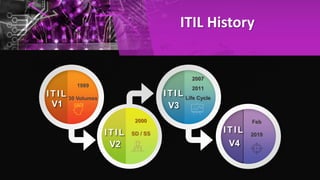
ITIL History
ITIL History
ITIL
V1
ITIL
V3
ITIL
V2
ITIL
V4
1989
30 Volumes
2007
2011
Life Cycle
2000
SD / SS
Feb
2019
ITIL - V1 ITIL soon grew to a 30-volume strong catalogue that
recommended and provided IT best practices that focused
on and catered for client and business needs.
1989 - The beginning
ITIL
V1
1989
30 Volumes
ITIL
V1
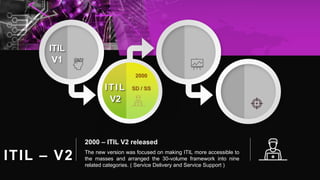
The new version was focused on making ITIL more accessible to
the masses and arranged the 30-volume framework into nine
related categories. ( Service Delivery and Service Support )
2000 – ITIL V2 released
ITIL
V2
2000
SD / SS
ITIL – V2
ITIL v3 condensed 26 processes and functions into just 5
volumes, and, upon launch, acquired the name ITIL Refresh
Project, In 2011, AXELOS released a revision of ITIL that
resolved errors and inconsistencies with V3.
2007 / 2011 Life Cycle
ITIL
V3
2007
2011
Life Cycle
ITIL
V1
ITIL
V2
ITIL – V3
The current version of ITIL launched in 2019. V4 has more
practical guidance on how to use ITIL, particularly in collaborative
environments. This makes it easier for organizations to align ITIL
with DevOps, Agile, and Lean work methods.
2019 - Holistic Towards Service Management
ITIL
V4
Feb
2019
ITIL
V1
ITIL
V2
ITIL
V3
ITIL – V4
ITIL Transition
from V3 to V4
Difference between
ITIL v3 & ITIL4
SLC
Replace
with SVS
ITIL v3
processes
are now
ITIL 4
practices
focus on
the “co-
creation of
value
Nine
principles
are now
seven
4 Ps are
now the 4
dimensions
Key Concept
of ITSM
Key Concept of ITSM
• Services and service management
• Creating value with services
• Service relationships
Services and Service
Management
• Service and Service management
• Utility and Warranty
• Customer, User, Sponsor
Service and Service management
• Service
– Means of enabling value co-creation by facilitating
outcomes customers want to achieve, without the
customer having to manage specific costs and risks.
• Service management
– A set of specialized organizational capabilities for
enabling value for customers in the form of services.
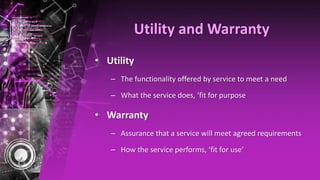
Utility and Warranty
• Utility
– The functionality offered by service to meet a need
– What the service does, ‘fit for purpose
• Warranty
– Assurance that a service will meet agreed requirements
– How the service performs, ‘fit for use’
Utility and Warranty
UTILITY
WARRANTY
T/F
T/F
Fit for
purpose?
Fit for
use?
OR
AND
Available enough?
Capacity enough?
T: True
F:False
AND VALUE
CREATED?
Continuous enough?
Secure enough?
Performance supported?
Constraints removed?
Customer, User, Sponsor
• Customer
– Person who defines the requirements for a service and takes
responsibility for the outcomes of service consumption.
• User
– Person who uses services
• Sponsor
– Person who authorizes budget for service consumption;
also, an person/organization giving financial/other support
for an initiative.
Creating value with services
• Value
• Outcomes and Outputs
• Costs and Risks
• Organization
Value
Service Provider
Role performed by an
organization in a service
relationship to provide
services.
Service Consumer
Role performed by an
organization in a
service relationship to
consume services.
Value
Perceived benefits,
usefulness and
importance of
something.
Outcomes and
Outputs
Output
Tangible or intangible
deliverable of an activity.
Outcome
Result for a stakeholder enabled
by one or more outputs.
Costs and Risks
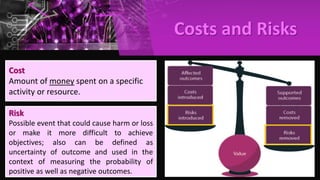
Cost
Amount of money spent on a specific
activity or resource.
Risk
Possible event that could cause harm or loss
or make it more difficult to achieve
objectives; also can be defined as
uncertainty of outcome and used in the
context of measuring the probability of
positive as well as negative outcomes.
Service Relationships
• Service Offering
• Service Relationship Management
• Service Provision
• Service Consumption
Service Offering
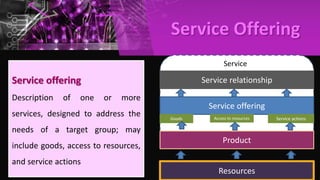
Service offering
Description of one or more
services, designed to address the
needs of a target group; may
include goods, access to resources,
and service actions
Service
Service relationship
Service offering
Goods Access to resources Service actions
Product
Resources
Service
Service Relationship
Management
Service
Service relationship
Service offering
Goods Access to resources Service actions
Product
Resources
Service
Service relationship
Cooperation between a service
provider and consumer, including
service provision, consumption, and
service relationship management.
Service relationship management
Joint activities performed by a service
provider and consumer to ensure
continual value co-creation based on
agreed and available service offerings.
Service Provision
Service
Service relationship
Service offering
Goods Access to resources Service actions
Product
Resources
Service
Service provision
Activities performed by an organization to
provide services, including management
of resources configured to
deliver the service, user access to the
resources, fulfilment of agreed service
actions, management of service
performance and continual improvement;
may include supply of goods.
Service Consumption
Service
Service relationship
Service offering
Goods Access to resources Service actions
Product
Resources
Service
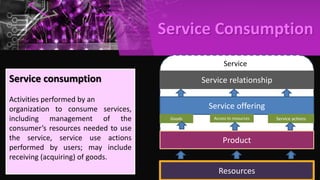
Service consumption
Activities performed by an
organization to consume services,
including management of the
consumer’s resources needed to use
the service, service use actions
performed by users; may include
receiving (acquiring) of goods.
ITIL
Dimensions
and Principles
Dimensions
PESTLE Factors
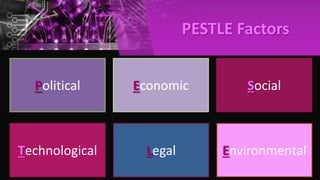
Political Economic Social
Technological Legal Environmental
SVS and SVC
SVS
Services Value system
Model of how all of an
organization’s components
and activities work together to
facilitate value creation.
Guiding principles
Governance
Governance
Monitor
Direct
Evaluate
Governance
Means by which an
organization is directed
and controlled.
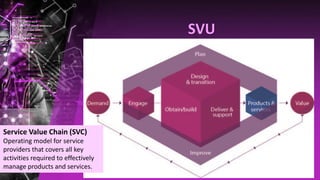
SVU
Service Value Chain (SVC)
Operating model for service
providers that covers all key
activities required to effectively
manage products and services.
Practices
ITIL
Practices
Practices
General
Architecture management
Architect management
Continual improvement
Information security
management
Knowledge management
Measurement and reporting
Organizational change
management
Portfolio management
Project management
Relationship management
Risk management
Service financial management
Strategy management
Supplier management
Workforce and talent
General management practices (14)
Availability management
Business analysis
Capacity and performance
management
Change control
Incident management
IT asset management
Monitoring and event management
Problem management
Release management
Service catalogue management
Service configuration management
Service continuity management
Service design
Service desk
Service level management
Service request management
Service validation and testing
Service management practices (17)
Deployment management
Infrastructure and
platform
management
Software development
and
Management
Technical management
practices (3)
Bolded practices are
practices ITIL 4
includes at the
Foundation level;
highlighted practices
are those roughly
equivalent to ITIL v3
processes or functions.
ITIL V4
Certification
Scheme
ITIL V4
Certification Scheme
ITIL Master
MP Transition ITIL Managing Professional (MP)
ITIL Specialist
Create, Deliver &
Support
ITIL Specialist
Drive
Stakeholder
Value
ITIL Specialist
High Velocity
IT
ITIL Strategist
Direct, Plan &
Improve
ITIL Strategic Leader (SL)
ITIL Strategist
Direct, Plan &
Improve
ITIL Leader Digital
& IT Strategy
ITIL Foundation
5
2 2 2 3 3 4
1

ITIL 4 Verses ITIL v3

  • 1.
  • 2.
    Agenda • ITIL History •ITIL Transition from V3 to V4 • Key Concept of ITSM • ITIL Dimensions and Principles • Service Value System (SVS) • ITIL Practices • ITIL Certification Schema
  • 3.
    The top benefitsof ITIL • Stronger alignment between IT and the business • Improved service delivery and customer satisfaction • Reduced costs through improved utilization of resources • Greater visibility of IT costs and assets
  • 4.
    The top benefitsof ITIL • Better management of business risk and service disruption or failure • More stable service environment to support constant business change
  • 5.
  • 8.
  • 9.
    ITIL - V1ITIL soon grew to a 30-volume strong catalogue that recommended and provided IT best practices that focused on and catered for client and business needs. 1989 - The beginning ITIL V1 1989 30 Volumes
  • 10.
    ITIL V1 The new versionwas focused on making ITIL more accessible to the masses and arranged the 30-volume framework into nine related categories. ( Service Delivery and Service Support ) 2000 – ITIL V2 released ITIL V2 2000 SD / SS ITIL – V2
  • 11.
    ITIL v3 condensed26 processes and functions into just 5 volumes, and, upon launch, acquired the name ITIL Refresh Project, In 2011, AXELOS released a revision of ITIL that resolved errors and inconsistencies with V3. 2007 / 2011 Life Cycle ITIL V3 2007 2011 Life Cycle ITIL V1 ITIL V2 ITIL – V3
  • 12.
    The current versionof ITIL launched in 2019. V4 has more practical guidance on how to use ITIL, particularly in collaborative environments. This makes it easier for organizations to align ITIL with DevOps, Agile, and Lean work methods. 2019 - Holistic Towards Service Management ITIL V4 Feb 2019 ITIL V1 ITIL V2 ITIL V3 ITIL – V4
  • 13.
  • 14.
  • 15.
    SLC Replace with SVS ITIL v3 processes arenow ITIL 4 practices focus on the “co- creation of value Nine principles are now seven 4 Ps are now the 4 dimensions
  • 16.
  • 17.
    Key Concept ofITSM • Services and service management • Creating value with services • Service relationships
  • 18.
    Services and Service Management •Service and Service management • Utility and Warranty • Customer, User, Sponsor
  • 19.
    Service and Servicemanagement • Service – Means of enabling value co-creation by facilitating outcomes customers want to achieve, without the customer having to manage specific costs and risks. • Service management – A set of specialized organizational capabilities for enabling value for customers in the form of services.
  • 20.
    Utility and Warranty •Utility – The functionality offered by service to meet a need – What the service does, ‘fit for purpose • Warranty – Assurance that a service will meet agreed requirements – How the service performs, ‘fit for use’
  • 21.
    Utility and Warranty UTILITY WARRANTY T/F T/F Fitfor purpose? Fit for use? OR AND Available enough? Capacity enough? T: True F:False AND VALUE CREATED? Continuous enough? Secure enough? Performance supported? Constraints removed?
  • 22.
    Customer, User, Sponsor •Customer – Person who defines the requirements for a service and takes responsibility for the outcomes of service consumption. • User – Person who uses services • Sponsor – Person who authorizes budget for service consumption; also, an person/organization giving financial/other support for an initiative.
  • 23.
    Creating value withservices • Value • Outcomes and Outputs • Costs and Risks • Organization
  • 24.
    Value Service Provider Role performedby an organization in a service relationship to provide services. Service Consumer Role performed by an organization in a service relationship to consume services. Value Perceived benefits, usefulness and importance of something.
  • 25.
    Outcomes and Outputs Output Tangible orintangible deliverable of an activity. Outcome Result for a stakeholder enabled by one or more outputs.
  • 26.
    Costs and Risks Cost Amountof money spent on a specific activity or resource. Risk Possible event that could cause harm or loss or make it more difficult to achieve objectives; also can be defined as uncertainty of outcome and used in the context of measuring the probability of positive as well as negative outcomes.
  • 27.
    Service Relationships • ServiceOffering • Service Relationship Management • Service Provision • Service Consumption
  • 28.
    Service Offering Service offering Descriptionof one or more services, designed to address the needs of a target group; may include goods, access to resources, and service actions Service Service relationship Service offering Goods Access to resources Service actions Product Resources Service
  • 29.
    Service Relationship Management Service Service relationship Serviceoffering Goods Access to resources Service actions Product Resources Service Service relationship Cooperation between a service provider and consumer, including service provision, consumption, and service relationship management. Service relationship management Joint activities performed by a service provider and consumer to ensure continual value co-creation based on agreed and available service offerings.
  • 30.
    Service Provision Service Service relationship Serviceoffering Goods Access to resources Service actions Product Resources Service Service provision Activities performed by an organization to provide services, including management of resources configured to deliver the service, user access to the resources, fulfilment of agreed service actions, management of service performance and continual improvement; may include supply of goods.
  • 31.
    Service Consumption Service Service relationship Serviceoffering Goods Access to resources Service actions Product Resources Service Service consumption Activities performed by an organization to consume services, including management of the consumer’s resources needed to use the service, service use actions performed by users; may include receiving (acquiring) of goods.
  • 32.
  • 33.
  • 34.
    PESTLE Factors Political EconomicSocial Technological Legal Environmental
  • 35.
  • 36.
    SVS Services Value system Modelof how all of an organization’s components and activities work together to facilitate value creation.
  • 37.
  • 38.
  • 39.
    SVU Service Value Chain(SVC) Operating model for service providers that covers all key activities required to effectively manage products and services.
  • 40.
  • 41.
  • 42.
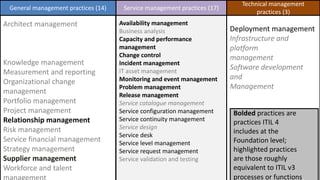
    Practices General Architecture management Architect management Continualimprovement Information security management Knowledge management Measurement and reporting Organizational change management Portfolio management Project management Relationship management Risk management Service financial management Strategy management Supplier management Workforce and talent General management practices (14) Availability management Business analysis Capacity and performance management Change control Incident management IT asset management Monitoring and event management Problem management Release management Service catalogue management Service configuration management Service continuity management Service design Service desk Service level management Service request management Service validation and testing Service management practices (17) Deployment management Infrastructure and platform management Software development and Management Technical management practices (3) Bolded practices are practices ITIL 4 includes at the Foundation level; highlighted practices are those roughly equivalent to ITIL v3 processes or functions.
  • 43.
  • 44.
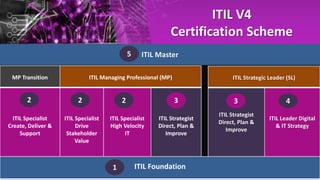
    ITIL V4 Certification Scheme ITILMaster MP Transition ITIL Managing Professional (MP) ITIL Specialist Create, Deliver & Support ITIL Specialist Drive Stakeholder Value ITIL Specialist High Velocity IT ITIL Strategist Direct, Plan & Improve ITIL Strategic Leader (SL) ITIL Strategist Direct, Plan & Improve ITIL Leader Digital & IT Strategy ITIL Foundation 5 2 2 2 3 3 4 1