TheAPMG-InternationalChangeManagementandSwirlDevicelogoisatrademarkofTheAPMGroupLimited.
Start and finish Course style
LunchCoffee and breaks
2/8 2/186M00 - Course introduction
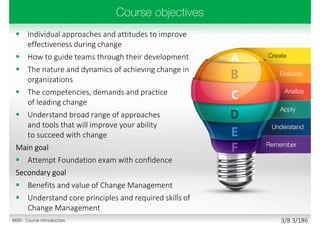
 Individual approaches and attitudes to improve
effectiveness during change
 How to guide teams through their development
 The nature and dynamics of achieving change in
organizations
 The competencies, demands and practice
of leading change
 Understand broad range of approaches
and tools that will improve your ability
to succeed with change
Main goal
 Attempt Foundation exam with confidence
Secondary goal
 Benefits and value of Change Management
 Understand core principles and required skills of
Change Management
3/8 3/186M00 - Course introduction
 Please share with the class:
 Your name and surname
 Your organization
 Your profession
 Title, function, job responsibilities
 Your familiarity with the
project/programme management
 Your familiarity with the change
management
 Your familiarity with soft-skills aspects
 Your personal session expectations
4/8 4/186M00 - Course introduction
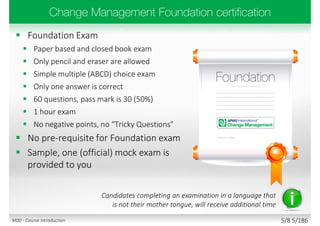
 Foundation Exam
 Paper based and closed book exam
 Only pencil and eraser are allowed
 Simple multiple (ABCD) choice exam
 Only one answer is correct
 60 questions, pass mark is 30 (50%)
 1 hour exam
 No negative points, no “Tricky Questions”
 No pre-requisite for Foundation exam
 Sample, one (official) mock exam is
provided to you
Candidates completing an examination in a language that
is not their mother tongue, will receive additional time
5/8 5/186M00 - Course introduction
 Practitioner Exam
 Paper based and open book exam
 Reference to Making Sense of Change
Management book ONLY allowed
 Book is provided for students during exam
 3 hours exam
 Complex multiple choice - Objective Test
 4 x 20 complex multiple choice questions =
80 question items/lines
 Pass mark – 50% / 40 marks
 Dictionary / translation lists allowed
 Foundation certification is required
Candidates completing an examination in a language that
is not their mother tongue, will receive additional time
6/8 6/186M00 - Course introduction
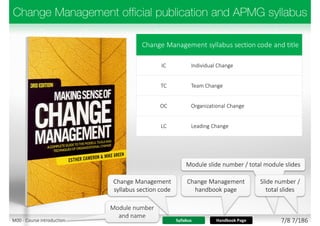
Change Management syllabus section code and title
IC Individual Change
TC Team Change
OC Organizational Change
LC Leading Change
Syllabus Handbook Page
Module slide number / total module slides
Slide number /
total slides
Module number
and name
Change Management
handbook page
Change Management
syllabus section code
7/8 7/186M00 - Course introduction
twitter.com/mirodabrowski
linkedin.com/in/miroslawdabrowski
google.com/+miroslawdabrowski
miroslaw_dabrowski
www.miroslawdabrowski.com
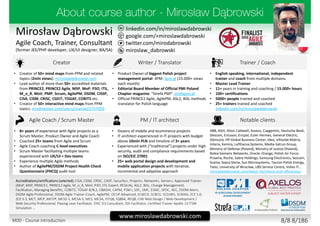
Mirosław Dąbrowski
Agile Coach, Trainer, Consultant
(former JEE/PHP developer, UX/UI designer, BA/SA)
Creator Writer / Translator Trainer / Coach
• Creator of 50+ mind maps from PPM and related
topics (2mln views): miroslawdabrowski.com
• Lead author of more than 50+ accredited materials
from PRINCE2, PRINCE2 Agile, MSP, MoP, P3O, ITIL,
M_o_R, MoV, PMP, Scrum, AgilePM, DSDM, CISSP,
CISA, CISM, CRISC, CGEIT, TOGAF, COBIT5 etc.
• Creator of 50+ interactive mind maps from PPM
topics: mindmeister.com/users/channel/2757050
• Product Owner of biggest Polish project
management portal: 4PM: 4pm.pl (15.000+ views
each month)
• Editorial Board Member of Official PMI Poland
Chapter magazine: “Strefa PMI”: strefapmi.pl
• Official PRINCE2 Agile, AgilePM, ASL2, BiSL methods
translator for Polish language
• English speaking, international, independent
trainer and coach from multiple domains.
• Master Lead Trainer
• 11+ years in training and coaching / 15.000+ hours
• 100+ certifications
• 5000+ people trained and coached
• 25+ trainers trained and coached
linkedin.com/in/miroslawdabrowski
Agile Coach / Scrum Master PM / IT architect Notable clients
• 8+ years of experience with Agile projects as a
Scrum Master, Product Owner and Agile Coach
• Coached 25+ teams from Agile and Scrum
• Agile Coach coaching C-level executives
• Scrum Master facilitating multiple teams
experienced with UX/UI + Dev teams
• Experience multiple Agile methods
• Author of AgilePM/DSDM Project Health Check
Questionnaire (PHCQ) audit tool
• Dozens of mobile and ecommerce projects
• IT architect experienced in IT projects with budget
above 10mln PLN and timeline of 3+ years
• Experienced with (“traditional”) projects under high
security, audit and compliance requirements based
on ISO/EIC 27001
• 25+ web portal design and development and
mobile application projects with iterative,
incremental and adaptive approach
ABB, AGH, Aiton Caldwell, Asseco, Capgemini, Deutsche Bank,
Descom, Ericsson, Ericpol, Euler Hermes, General Electric,
Glencore, HP Global Business Center, Ideo, Infovide-Matrix,
Interia, Kemira, Lufthansa Systems, Media-Satrun Group,
Ministry of Defense (Poland), Ministry of Justice (Poland),
Nokia Siemens Networks, Oracle, Orange, Polish Air Force,
Proama, Roche, Sabre Holdings, Samsung Electronics, Sescom,
Scania, Sopra Steria, Sun Microsystems, Tauron Polish Energy,
Tieto, University of Wroclaw, UBS Service Centre, Volvo IT…
miroslawdabrowski.com/about-me/clients-and-references/
Accreditations/certifications (selected): CISA, CISM, CRISC, CASP, Security+, Project+, Network+, Server+, Approved Trainer:
(MoP, MSP, PRINCE2, PRINCE2 Agile, M_o_R, MoV, P3O, ITIL Expert, RESILIA), ASL2, BiSL, Change Management,
Facilitation, Managing Benefits, COBIT5, TOGAF 8/9L2, OBASHI, CAPM, PSM I, SDC, SMC, ESMC, SPOC, AEC, DSDM Atern,
DSDM Agile Professional, DSDM Agile Trainer-Coach, AgilePM, OCUP Advanced, SCWCD, SCBCD, SCDJWS, SCMAD, ZCE 5.0,
ZCE 5.3, MCT, MCP, MCITP, MCSE-S, MCSA-S, MCS, MCSA, ISTQB, IQBBA, REQB, CIW Web Design / Web Development /
Web Security Professional, Playing Lean Facilitator, DISC D3 Consultant, SDI Facilitator, Certified Trainer Apollo 13 ITSM
Simulation …
8/8 8/186M00 - Course introduction
1. The Organizational Context
2. Individual Change
3. Team Change
4. Organizational Change
5. Leading Change
2/4 10/186M01 - The Organizational Context
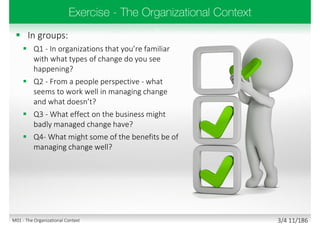
 In groups:
 Q1 - In organizations that you’re familiar
with what types of change do you see
happening?
 Q2 - From a people perspective - what
seems to work well in managing change
and what doesn’t?
 Q3 - What effect on the business might
badly managed change have?
 Q4- What might some of the benefits be of
managing change well?
3/4 11/186M01 - The Organizational Context
4/4 12/186M01 - The Organizational Context
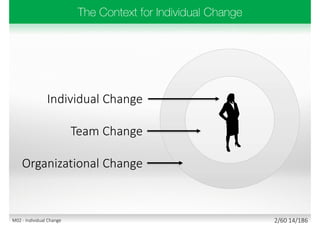
Individual Change
Team Change
Organizational Change
2/60 14/186M02 - Individual Change
3/60 15/186M02 - Individual Change
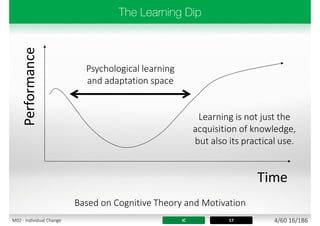
Performance
Time
Based on Cognitive Theory and Motivation
Psychological learning
and adaptation space
Learning is not just the
acquisition of knowledge,
but also its practical use.
IC 17 4/60 16/186M02 - Individual Change
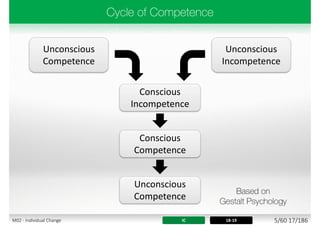
Unconscious
Competence
Unconscious
Incompetence
Conscious
Incompetence
Conscious
Competence
Unconscious
Competence
IC 18-19 5/60 17/186M02 - Individual Change
 Competence:
 Establish ways in which people’s competence can be assessed in
the new and ‘to be improved’ areas
 Design, develop and deliver training and coaching programmes
 Use strategies from the Learning Dip
6/60 18/186M02 - Individual Change
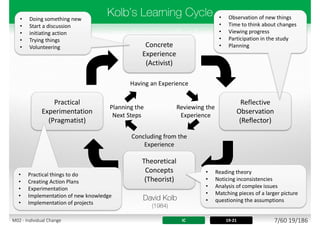
Concrete
Experience
(Activist)
Theoretical
Concepts
(Theorist)
Reflective
Observation
(Reflector)
Practical
Experimentation
(Pragmatist)
Having an Experience
Reviewing the
Experience
Concluding from the
Experience
Planning the
Next Steps
• Doing something new
• Start a discussion
• initiating action
• Trying things
• Volunteering
• Observation of new things
• Time to think about changes
• Viewing progress
• Participation in the study
• Planning
IC 19-21
• Reading theory
• Noticing inconsistencies
• Analysis of complex issues
• Matching pieces of a larger picture
• questioning the assumptions
• Practical things to do
• Creating Action Plans
• Experimentation
• Implementation of new knowledge
• Implementation of projects
7/60 19/186M02 - Individual Change
 Q1. For a typical ‘self-assembly’ task,
what is your Kolb learning
preference? Position yourself in
relation to one or more of the
learning styles
 Q2. Why are you in that position?
What is your strongest preference?
How does this reflect your preferred
approach to learning?
8/60 20/186M02 - Individual Change
9/60 21/186M02 - Individual Change
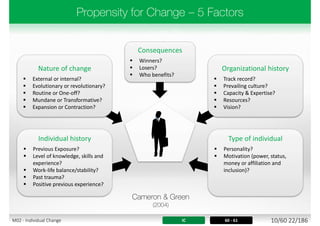
Consequences
 Winners?
 Losers?
 Who benefits?
Organizational history
 Track record?
 Prevailing culture?
 Capacity & Expertise?
 Resources?
 Vision?
Nature of change
 External or internal?
 Evolutionary or revolutionary?
 Routine or One-off?
 Mundane or Transformative?
 Expansion or Contraction?
Type of individual
 Personality?
 Motivation (power, status,
money or affiliation and
inclusion)?
Individual history
 Previous Exposure?
 Level of knowledge, skills and
experience?
 Work-life balance/stability?
 Past trauma?
 Positive previous experience?
IC 60 - 61 10/60 22/186M02 - Individual Change
11/60 23/186M02 - Individual Change
IC 16 12/60 24/186M02 - Individual Change
13/60 25/186M02 - Individual Change
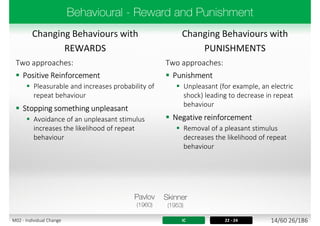
Changing Behaviours with
REWARDS
Changing Behaviours with
PUNISHMENTS
Two approaches:
 Positive Reinforcement
 Pleasurable and increases probability of
repeat behaviour
 Stopping something unpleasant
 Avoidance of an unpleasant stimulus
increases the likelihood of repeat
behaviour
Two approaches:
 Punishment
 Unpleasant (for example, an electric
shock) leading to decrease in repeat
behaviour
 Negative reinforcement
 Removal of a pleasant stimulus
decreases the likelihood of repeat
behaviour
IC 22 - 24 14/60 26/186M02 - Individual Change
 Financial
 e.g. bonus, prize, tangible reward
 Non-financial
 Feedback - e.g. performance, coaching
 Social - e.g. praise, recognition, name and shame
Reinforcement can take both
positive and negative forms
IC 25 - 26 15/60 27/186M02 - Individual Change
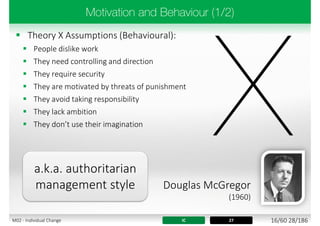
 Theory X Assumptions (Behavioural):
 People dislike work
 They need controlling and direction
 They require security
 They are motivated by threats of punishment
 They avoid taking responsibility
 They lack ambition
 They don’t use their imagination
IC 27
Douglas McGregor
(1960)
a.k.a. authoritarian
management style
16/60 28/186M02 - Individual Change
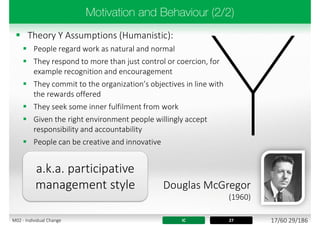
 Theory Y Assumptions (Humanistic):
 People regard work as natural and normal
 They respond to more than just control or coercion, for
example recognition and encouragement
 They commit to the organization’s objectives in line with
the rewards offered
 They seek some inner fulfilment from work
 Given the right environment people willingly accept
responsibility and accountability
 People can be creative and innovative
IC 27
Douglas McGregor
(1960)
a.k.a. participative
management style
17/60 29/186M02 - Individual Change
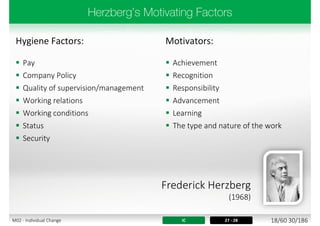
Hygiene Factors: Motivators:
 Pay
 Company Policy
 Quality of supervision/management
 Working relations
 Working conditions
 Status
 Security
 Achievement
 Recognition
 Responsibility
 Advancement
 Learning
 The type and nature of the work
IC 27 - 28
Frederick Herzberg
(1968)
18/60 30/186M02 - Individual Change
19/60 31/186M02 - Individual Change
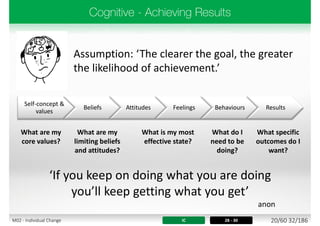
Assumption: ‘The clearer the goal, the greater
the likelihood of achievement.’
Self-concept &
values
Beliefs Attitudes Feelings Behaviours Results
What are my
core values?
What are my
limiting beliefs
and attitudes?
What is my most
effective state?
What do I
need to be
doing?
What specific
outcomes do I
want?
‘If you keep on doing what you are doing
you’ll keep getting what you get’
anon
IC 28 - 30 20/60 32/186M02 - Individual Change
 Positive Listings – ‘I am good at…’
 Affirmations – ‘I am always enthusiastic when…’
 Visualizations – ‘This is the way I want to be…’
 Reframing – ‘I can reduce my negative feelings…’
 Pattern Breaking – ‘That wasn’t me, this is me…’
 Detachment – ‘I can step outside of myself…’
 Anchoring and resource states – ‘I can remember a time
when…’
 s – ‘I can prove this is irrational!’
IC 32 - 35 21/60 33/186M02 - Individual Change
22/60 34/186M02 - Individual Change
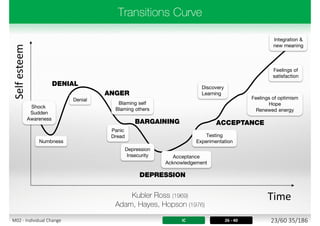
Selfesteem
Time
IC 26 - 40 23/60 35/186M02 - Individual Change
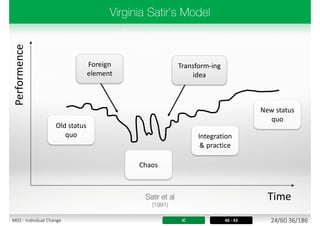
Old status
quo
Chaos
Integration
& practice
New status
quo
Foreign
element
Transform-ing
idea
Performence
Time
IC 40 - 43 24/60 36/186M02 - Individual Change
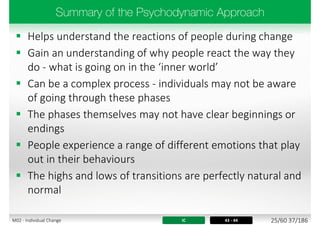
 Helps understand the reactions of people during change
 Gain an understanding of why people react the way they
do - what is going on in the ‘inner world’
 Can be a complex process - individuals may not be aware
of going through these phases
 The phases themselves may not have clear beginnings or
endings
 People experience a range of different emotions that play
out in their behaviours
 The highs and lows of transitions are perfectly natural and
normal
IC 43 - 44 25/60 37/186M02 - Individual Change
26/60 38/186M02 - Individual Change
 Combines insights from other approaches
 Focus on:
 Importance of subjective awareness
 Importance of taking responsibility
 Significance of the person as a whole entity
 Emotional self-awareness
 Ability to engage with others on an emotional level
 Addresses motivation and behaviour
27/60 39/186M02 - Individual Change
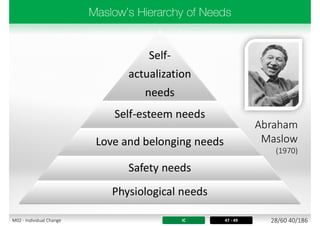
Self-
actualization
needs
Self-esteem needs
Love and belonging needs
Safety needs
Physiological needs
IC 47 - 49
Abraham
Maslow
(1970)
28/60 40/186M02 - Individual Change
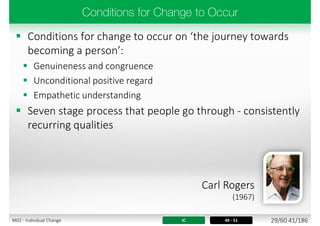
 Conditions for change to occur on ‘the journey towards
becoming a person’:
 Genuineness and congruence
 Unconditional positive regard
 Empathetic understanding
 Seven stage process that people go through - consistently
recurring qualities
IC 49 - 51
Carl Rogers
(1967)
29/60 41/186M02 - Individual Change
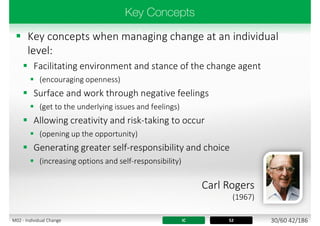
 Key concepts when managing change at an individual
level:
 Facilitating environment and stance of the change agent
 (encouraging openness)
 Surface and work through negative feelings
 (get to the underlying issues and feelings)
 Allowing creativity and risk-taking to occur
 (opening up the opportunity)
 Generating greater self-responsibility and choice
 (increasing options and self-responsibility)
IC 52
Carl Rogers
(1967)
30/60 42/186M02 - Individual Change
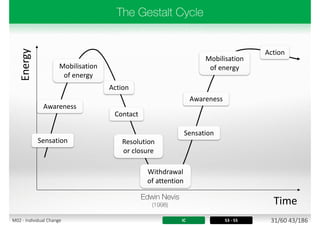
Contact
Awareness
Mobilisation
of energy
Action
Resolution
or closure
Sensation
Awareness
Mobilisation
of energy
Action
Energy
Time
Sensation
Withdrawal
of attention
IC 53 - 55 31/60 43/186M02 - Individual Change
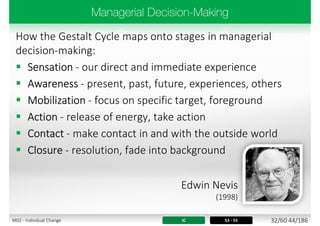
How the Gestalt Cycle maps onto stages in managerial
decision-making:
 Sensation - our direct and immediate experience
 Awareness - present, past, future, experiences, others
 Mobilization - focus on specific target, foreground
 Action - release of energy, take action
 Contact - make contact in and with the outside world
 Closure - resolution, fade into background
IC 53 - 55
Edwin Nevis
(1998)
32/60 44/186M02 - Individual Change
 Q1. What are the advantages and
disadvantages of each of the 4
approaches?
 Q2. How might you use each
approach to enable people to
change?
33/60 45/186M02 - Individual Change
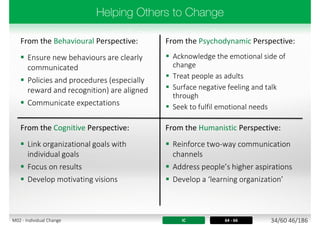
From the Behavioural Perspective: From the Psychodynamic Perspective:
 Acknowledge the emotional side of
change
 Treat people as adults
 Surface negative feeling and talk
through
 Seek to fulfil emotional needs
 Reinforce two-way communication
channels
 Address people’s higher aspirations
 Develop a ‘learning organization’
 Ensure new behaviours are clearly
communicated
 Policies and procedures (especially
reward and recognition) are aligned
 Communicate expectations
 Link organizational goals with
individual goals
 Focus on results
 Develop motivating visions
From the Cognitive Perspective: From the Humanistic Perspective:
IC 64 - 66 34/60 46/186M02 - Individual Change
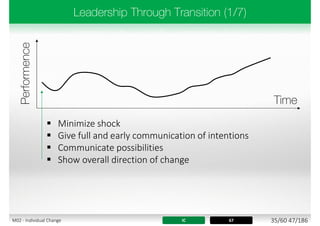
 Minimize shock
 Give full and early communication of intentions
 Communicate possibilities
 Show overall direction of change
IC 67 35/60 47/186M02 - Individual Change
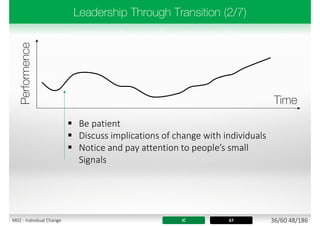
 Be patient
 Discuss implications of change with individuals
 Notice and pay attention to people’s small
Signals
IC 67 36/60 48/186M02 - Individual Change
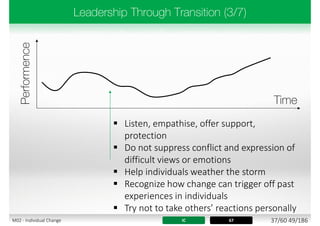
 Listen, empathise, offer support,
protection
 Do not suppress conflict and expression of
difficult views or emotions
 Help individuals weather the storm
 Recognize how change can trigger off past
experiences in individuals
 Try not to take others’ reactions personally
IC 67 37/60 49/186M02 - Individual Change
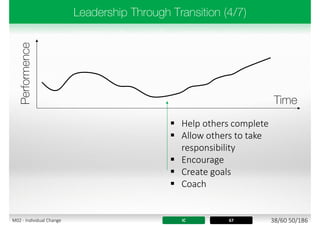
 Help others complete
 Allow others to take
responsibility
 Encourage
 Create goals
 Coach
IC 67 38/60 50/186M02 - Individual Change
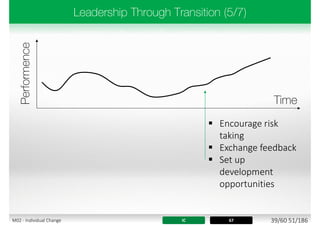
 Encourage risk
taking
 Exchange feedback
 Set up
development
opportunities
IC 67 39/60 51/186M02 - Individual Change
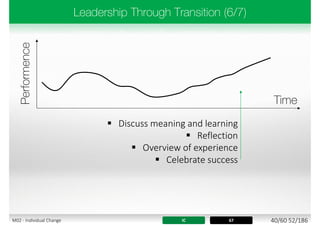
 Discuss meaning and learning
 Reflection
 Overview of experience
 Celebrate success
IC 67 40/60 52/186M02 - Individual Change
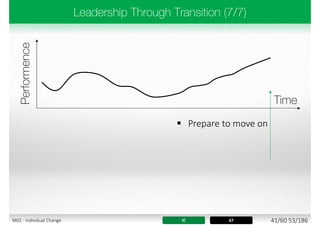
 Prepare to move on
IC 67 41/60 53/186M02 - Individual Change
42/60 54/186M02 - Individual Change
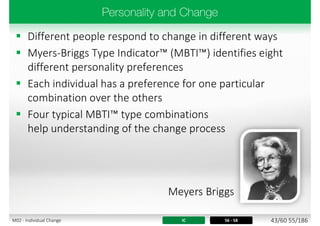
 Different people respond to change in different ways
 Myers-Briggs Type Indicator™ (MBTI™) identifies eight
different personality preferences
 Each individual has a preference for one particular
combination over the others
 Four typical MBTI™ type combinations
help understanding of the change process
IC 56 - 58
Meyers Briggs
43/60 55/186M02 - Individual Change
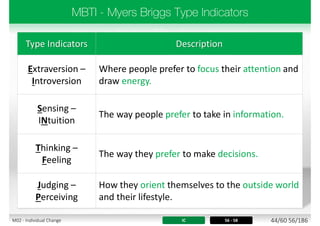
Type Indicators Description
Extraversion –
Introversion
Where people prefer to focus their attention and
draw energy.
Sensing –
INtuition
The way people prefer to take in information.
Thinking –
Feeling
The way they prefer to make decisions.
Judging –
Perceiving
How they orient themselves to the outside world
and their lifestyle.
IC 56 - 58 44/60 56/186M02 - Individual Change
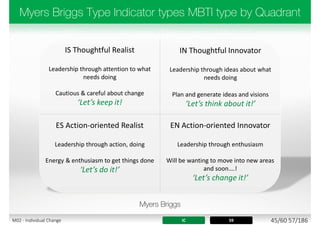
IS Thoughtful Realist
Leadership through attention to what
needs doing
Cautious & careful about change
‘Let’s keep it!
IN Thoughtful Innovator
Leadership through ideas about what
needs doing
Plan and generate ideas and visions
‘Let’s think about it!’
ES Action-oriented Realist
Leadership through action, doing
Energy & enthusiasm to get things done
‘Let’s do it!’
EN Action-oriented Innovator
Leadership through enthusiasm
Will be wanting to move into new areas
and soon….!
‘Let’s change it!’
IC 59 45/60 57/186M02 - Individual Change
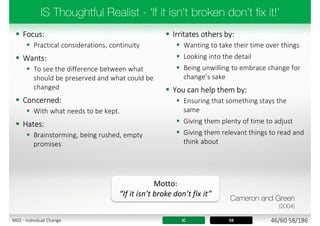
 Focus:
 Practical considerations, continuity
 Wants:
 To see the difference between what
should be preserved and what could be
changed
 Concerned:
 With what needs to be kept.
 Hates:
 Brainstorming, being rushed, empty
promises
 Irritates others by:
 Wanting to take their time over things
 Looking into the detail
 Being unwilling to embrace change for
change’s sake
 You can help them by:
 Ensuring that something stays the
same
 Giving them plenty of time to adjust
 Giving them relevant things to read and
think about
IC 59
Motto:
“If it isn’t broke don’t fix it”
46/60 58/186M02 - Individual Change
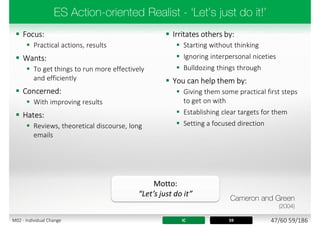
 Focus:
 Practical actions, results
 Wants:
 To get things to run more effectively
and efficiently
 Concerned:
 With improving results
 Hates:
 Reviews, theoretical discourse, long
emails
 Irritates others by:
 Starting without thinking
 Ignoring interpersonal niceties
 Bulldozing things through
 You can help them by:
 Giving them some practical first steps
to get on with
 Establishing clear targets for them
 Setting a focused direction
IC 59
Motto:
“Let’s just do it”
47/60 59/186M02 - Individual Change
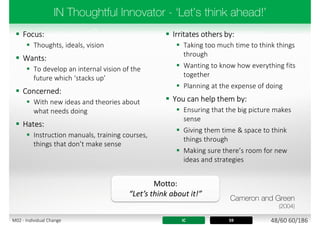
 Focus:
 Thoughts, ideals, vision
 Wants:
 To develop an internal vision of the
future which ‘stacks up’
 Concerned:
 With new ideas and theories about
what needs doing
 Hates:
 Instruction manuals, training courses,
things that don’t make sense
 Irritates others by:
 Taking too much time to think things
through
 Wanting to know how everything fits
together
 Planning at the expense of doing
 You can help them by:
 Ensuring that the big picture makes
sense
 Giving them time & space to think
things through
 Making sure there’s room for new
ideas and strategies
IC 59
Motto:
“Let’s think about it!”
48/60 60/186M02 - Individual Change
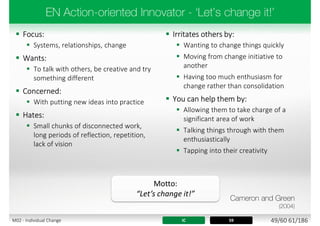
 Focus:
 Systems, relationships, change
 Wants:
 To talk with others, be creative and try
something different
 Concerned:
 With putting new ideas into practice
 Hates:
 Small chunks of disconnected work,
long periods of reflection, repetition,
lack of vision
 Irritates others by:
 Wanting to change things quickly
 Moving from change initiative to
another
 Having too much enthusiasm for
change rather than consolidation
 You can help them by:
 Allowing them to take charge of a
significant area of work
 Talking things through with them
enthusiastically
 Tapping into their creativity
IC 59
Motto:
“Let’s change it!”
49/60 61/186M02 - Individual Change
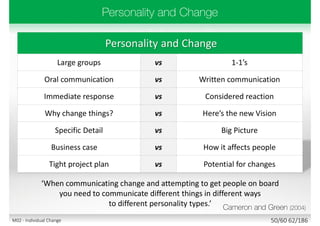
Personality and Change
Large groups vs 1-1’s
Oral communication vs Written communication
Immediate response vs Considered reaction
Why change things? vs Here’s the new Vision
Specific Detail vs Big Picture
Business case vs How it affects people
Tight project plan vs Potential for changes
‘When communicating change and attempting to get people on board
you need to communicate different things in different ways
to different personality types.’
50/60 62/186M02 - Individual Change
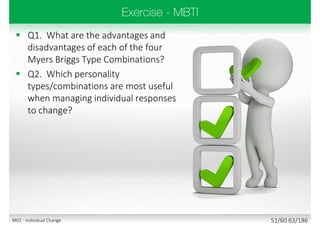
 Q1. What are the advantages and
disadvantages of each of the four
Myers Briggs Type Combinations?
 Q2. Which personality
types/combinations are most useful
when managing individual responses
to change?
51/60 63/186M02 - Individual Change
52/60 64/186M02 - Individual Change
 Q1. Why do people resist change?
 Q2. What does resistance to change
look like?
53/60 65/186M02 - Individual Change
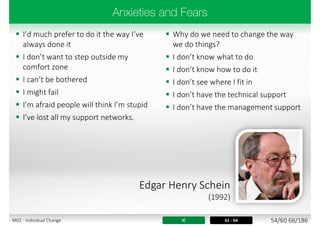
 I’d much prefer to do it the way I’ve
always done it
 I don’t want to step outside my
comfort zone
 I can’t be bothered
 I might fail
 I’m afraid people will think I’m stupid
 I’ve lost all my support networks.
 Why do we need to change the way
we do things?
 I don’t know what to do
 I don’t know how to do it
 I don’t see where I fit in
 I don’t have the technical support
 I don’t have the management support
IC 61 - 64
Edgar Henry Schein
(1992)
54/60 66/186M02 - Individual Change
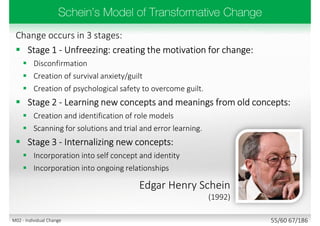
Change occurs in 3 stages:
 Stage 1 - Unfreezing: creating the motivation for change:
 Disconfirmation
 Creation of survival anxiety/guilt
 Creation of psychological safety to overcome guilt.
 Stage 2 - Learning new concepts and meanings from old concepts:
 Creation and identification of role models
 Scanning for solutions and trial and error learning.
 Stage 3 - Internalizing new concepts:
 Incorporation into self concept and identity
 Incorporation into ongoing relationships
Edgar Henry Schein
(1992)
55/60 67/186M02 - Individual Change
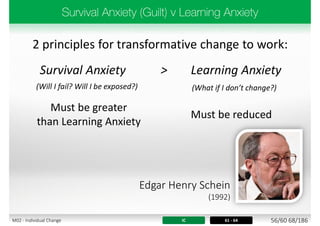
Survival Anxiety > Learning Anxiety
Must be greater
than Learning Anxiety
Must be reduced
2 principles for transformative change to work:
(What if I don’t change?)(Will I fail? Will I be exposed?)
IC 61 - 64
Edgar Henry Schein
(1992)
56/60 68/186M02 - Individual Change
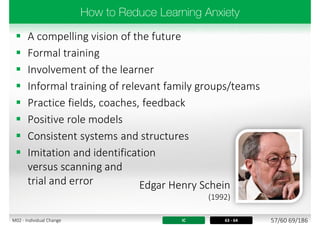
 A compelling vision of the future
 Formal training
 Involvement of the learner
 Informal training of relevant family groups/teams
 Practice fields, coaches, feedback
 Positive role models
 Consistent systems and structures
 Imitation and identification
versus scanning and
trial and error
IC 63 - 64
Edgar Henry Schein
(1992)
57/60 69/186M02 - Individual Change
„When it comes to change…
some people make it happen,
some people let it happen, and
some people wonder what happened.”
anon
58/60 70/186M02 - Individual Change
59/60 71/186M02 - Individual Change
I hope you enjoyed
this presentation. If so,
please like, share and
leave a comment
below.
Endorsements on
LinkedIn are also
highly appreciated! 
(your feedback = more free stuff)

MIROSLAWDABROWSKI.COM/downloads

Change Management - Foundation

  • 1.
  • 2.
    Start and finishCourse style LunchCoffee and breaks 2/8 2/186M00 - Course introduction
  • 3.
     Individual approachesand attitudes to improve effectiveness during change  How to guide teams through their development  The nature and dynamics of achieving change in organizations  The competencies, demands and practice of leading change  Understand broad range of approaches and tools that will improve your ability to succeed with change Main goal  Attempt Foundation exam with confidence Secondary goal  Benefits and value of Change Management  Understand core principles and required skills of Change Management 3/8 3/186M00 - Course introduction
  • 4.
     Please sharewith the class:  Your name and surname  Your organization  Your profession  Title, function, job responsibilities  Your familiarity with the project/programme management  Your familiarity with the change management  Your familiarity with soft-skills aspects  Your personal session expectations 4/8 4/186M00 - Course introduction
  • 5.
     Foundation Exam Paper based and closed book exam  Only pencil and eraser are allowed  Simple multiple (ABCD) choice exam  Only one answer is correct  60 questions, pass mark is 30 (50%)  1 hour exam  No negative points, no “Tricky Questions”  No pre-requisite for Foundation exam  Sample, one (official) mock exam is provided to you Candidates completing an examination in a language that is not their mother tongue, will receive additional time 5/8 5/186M00 - Course introduction
  • 6.
     Practitioner Exam Paper based and open book exam  Reference to Making Sense of Change Management book ONLY allowed  Book is provided for students during exam  3 hours exam  Complex multiple choice - Objective Test  4 x 20 complex multiple choice questions = 80 question items/lines  Pass mark – 50% / 40 marks  Dictionary / translation lists allowed  Foundation certification is required Candidates completing an examination in a language that is not their mother tongue, will receive additional time 6/8 6/186M00 - Course introduction
  • 7.
    Change Management syllabussection code and title IC Individual Change TC Team Change OC Organizational Change LC Leading Change Syllabus Handbook Page Module slide number / total module slides Slide number / total slides Module number and name Change Management handbook page Change Management syllabus section code 7/8 7/186M00 - Course introduction
  • 8.
    twitter.com/mirodabrowski linkedin.com/in/miroslawdabrowski google.com/+miroslawdabrowski miroslaw_dabrowski www.miroslawdabrowski.com Mirosław Dąbrowski Agile Coach,Trainer, Consultant (former JEE/PHP developer, UX/UI designer, BA/SA) Creator Writer / Translator Trainer / Coach • Creator of 50+ mind maps from PPM and related topics (2mln views): miroslawdabrowski.com • Lead author of more than 50+ accredited materials from PRINCE2, PRINCE2 Agile, MSP, MoP, P3O, ITIL, M_o_R, MoV, PMP, Scrum, AgilePM, DSDM, CISSP, CISA, CISM, CRISC, CGEIT, TOGAF, COBIT5 etc. • Creator of 50+ interactive mind maps from PPM topics: mindmeister.com/users/channel/2757050 • Product Owner of biggest Polish project management portal: 4PM: 4pm.pl (15.000+ views each month) • Editorial Board Member of Official PMI Poland Chapter magazine: “Strefa PMI”: strefapmi.pl • Official PRINCE2 Agile, AgilePM, ASL2, BiSL methods translator for Polish language • English speaking, international, independent trainer and coach from multiple domains. • Master Lead Trainer • 11+ years in training and coaching / 15.000+ hours • 100+ certifications • 5000+ people trained and coached • 25+ trainers trained and coached linkedin.com/in/miroslawdabrowski Agile Coach / Scrum Master PM / IT architect Notable clients • 8+ years of experience with Agile projects as a Scrum Master, Product Owner and Agile Coach • Coached 25+ teams from Agile and Scrum • Agile Coach coaching C-level executives • Scrum Master facilitating multiple teams experienced with UX/UI + Dev teams • Experience multiple Agile methods • Author of AgilePM/DSDM Project Health Check Questionnaire (PHCQ) audit tool • Dozens of mobile and ecommerce projects • IT architect experienced in IT projects with budget above 10mln PLN and timeline of 3+ years • Experienced with (“traditional”) projects under high security, audit and compliance requirements based on ISO/EIC 27001 • 25+ web portal design and development and mobile application projects with iterative, incremental and adaptive approach ABB, AGH, Aiton Caldwell, Asseco, Capgemini, Deutsche Bank, Descom, Ericsson, Ericpol, Euler Hermes, General Electric, Glencore, HP Global Business Center, Ideo, Infovide-Matrix, Interia, Kemira, Lufthansa Systems, Media-Satrun Group, Ministry of Defense (Poland), Ministry of Justice (Poland), Nokia Siemens Networks, Oracle, Orange, Polish Air Force, Proama, Roche, Sabre Holdings, Samsung Electronics, Sescom, Scania, Sopra Steria, Sun Microsystems, Tauron Polish Energy, Tieto, University of Wroclaw, UBS Service Centre, Volvo IT… miroslawdabrowski.com/about-me/clients-and-references/ Accreditations/certifications (selected): CISA, CISM, CRISC, CASP, Security+, Project+, Network+, Server+, Approved Trainer: (MoP, MSP, PRINCE2, PRINCE2 Agile, M_o_R, MoV, P3O, ITIL Expert, RESILIA), ASL2, BiSL, Change Management, Facilitation, Managing Benefits, COBIT5, TOGAF 8/9L2, OBASHI, CAPM, PSM I, SDC, SMC, ESMC, SPOC, AEC, DSDM Atern, DSDM Agile Professional, DSDM Agile Trainer-Coach, AgilePM, OCUP Advanced, SCWCD, SCBCD, SCDJWS, SCMAD, ZCE 5.0, ZCE 5.3, MCT, MCP, MCITP, MCSE-S, MCSA-S, MCS, MCSA, ISTQB, IQBBA, REQB, CIW Web Design / Web Development / Web Security Professional, Playing Lean Facilitator, DISC D3 Consultant, SDI Facilitator, Certified Trainer Apollo 13 ITSM Simulation … 8/8 8/186M00 - Course introduction
  • 10.
    1. The OrganizationalContext 2. Individual Change 3. Team Change 4. Organizational Change 5. Leading Change 2/4 10/186M01 - The Organizational Context
  • 11.
     In groups: Q1 - In organizations that you’re familiar with what types of change do you see happening?  Q2 - From a people perspective - what seems to work well in managing change and what doesn’t?  Q3 - What effect on the business might badly managed change have?  Q4- What might some of the benefits be of managing change well? 3/4 11/186M01 - The Organizational Context
  • 12.
    4/4 12/186M01 -The Organizational Context
  • 14.
    Individual Change Team Change OrganizationalChange 2/60 14/186M02 - Individual Change
  • 15.
    3/60 15/186M02 -Individual Change
  • 16.
    Performance Time Based on CognitiveTheory and Motivation Psychological learning and adaptation space Learning is not just the acquisition of knowledge, but also its practical use. IC 17 4/60 16/186M02 - Individual Change
  • 17.
  • 18.
     Competence:  Establishways in which people’s competence can be assessed in the new and ‘to be improved’ areas  Design, develop and deliver training and coaching programmes  Use strategies from the Learning Dip 6/60 18/186M02 - Individual Change
  • 19.
    Concrete Experience (Activist) Theoretical Concepts (Theorist) Reflective Observation (Reflector) Practical Experimentation (Pragmatist) Having an Experience Reviewingthe Experience Concluding from the Experience Planning the Next Steps • Doing something new • Start a discussion • initiating action • Trying things • Volunteering • Observation of new things • Time to think about changes • Viewing progress • Participation in the study • Planning IC 19-21 • Reading theory • Noticing inconsistencies • Analysis of complex issues • Matching pieces of a larger picture • questioning the assumptions • Practical things to do • Creating Action Plans • Experimentation • Implementation of new knowledge • Implementation of projects 7/60 19/186M02 - Individual Change
  • 20.
     Q1. Fora typical ‘self-assembly’ task, what is your Kolb learning preference? Position yourself in relation to one or more of the learning styles  Q2. Why are you in that position? What is your strongest preference? How does this reflect your preferred approach to learning? 8/60 20/186M02 - Individual Change
  • 21.
    9/60 21/186M02 -Individual Change
  • 22.
    Consequences  Winners?  Losers? Who benefits? Organizational history  Track record?  Prevailing culture?  Capacity & Expertise?  Resources?  Vision? Nature of change  External or internal?  Evolutionary or revolutionary?  Routine or One-off?  Mundane or Transformative?  Expansion or Contraction? Type of individual  Personality?  Motivation (power, status, money or affiliation and inclusion)? Individual history  Previous Exposure?  Level of knowledge, skills and experience?  Work-life balance/stability?  Past trauma?  Positive previous experience? IC 60 - 61 10/60 22/186M02 - Individual Change
  • 23.
    11/60 23/186M02 -Individual Change
  • 24.
    IC 16 12/6024/186M02 - Individual Change
  • 25.
    13/60 25/186M02 -Individual Change
  • 26.
    Changing Behaviours with REWARDS ChangingBehaviours with PUNISHMENTS Two approaches:  Positive Reinforcement  Pleasurable and increases probability of repeat behaviour  Stopping something unpleasant  Avoidance of an unpleasant stimulus increases the likelihood of repeat behaviour Two approaches:  Punishment  Unpleasant (for example, an electric shock) leading to decrease in repeat behaviour  Negative reinforcement  Removal of a pleasant stimulus decreases the likelihood of repeat behaviour IC 22 - 24 14/60 26/186M02 - Individual Change
  • 27.
     Financial  e.g.bonus, prize, tangible reward  Non-financial  Feedback - e.g. performance, coaching  Social - e.g. praise, recognition, name and shame Reinforcement can take both positive and negative forms IC 25 - 26 15/60 27/186M02 - Individual Change
  • 28.
     Theory XAssumptions (Behavioural):  People dislike work  They need controlling and direction  They require security  They are motivated by threats of punishment  They avoid taking responsibility  They lack ambition  They don’t use their imagination IC 27 Douglas McGregor (1960) a.k.a. authoritarian management style 16/60 28/186M02 - Individual Change
  • 29.
     Theory YAssumptions (Humanistic):  People regard work as natural and normal  They respond to more than just control or coercion, for example recognition and encouragement  They commit to the organization’s objectives in line with the rewards offered  They seek some inner fulfilment from work  Given the right environment people willingly accept responsibility and accountability  People can be creative and innovative IC 27 Douglas McGregor (1960) a.k.a. participative management style 17/60 29/186M02 - Individual Change
  • 30.
    Hygiene Factors: Motivators: Pay  Company Policy  Quality of supervision/management  Working relations  Working conditions  Status  Security  Achievement  Recognition  Responsibility  Advancement  Learning  The type and nature of the work IC 27 - 28 Frederick Herzberg (1968) 18/60 30/186M02 - Individual Change
  • 31.
    19/60 31/186M02 -Individual Change
  • 32.
    Assumption: ‘The clearerthe goal, the greater the likelihood of achievement.’ Self-concept & values Beliefs Attitudes Feelings Behaviours Results What are my core values? What are my limiting beliefs and attitudes? What is my most effective state? What do I need to be doing? What specific outcomes do I want? ‘If you keep on doing what you are doing you’ll keep getting what you get’ anon IC 28 - 30 20/60 32/186M02 - Individual Change
  • 33.
     Positive Listings– ‘I am good at…’  Affirmations – ‘I am always enthusiastic when…’  Visualizations – ‘This is the way I want to be…’  Reframing – ‘I can reduce my negative feelings…’  Pattern Breaking – ‘That wasn’t me, this is me…’  Detachment – ‘I can step outside of myself…’  Anchoring and resource states – ‘I can remember a time when…’  s – ‘I can prove this is irrational!’ IC 32 - 35 21/60 33/186M02 - Individual Change
  • 34.
    22/60 34/186M02 -Individual Change
  • 35.
    Selfesteem Time IC 26 -40 23/60 35/186M02 - Individual Change
  • 36.
    Old status quo Chaos Integration & practice Newstatus quo Foreign element Transform-ing idea Performence Time IC 40 - 43 24/60 36/186M02 - Individual Change
  • 37.
     Helps understandthe reactions of people during change  Gain an understanding of why people react the way they do - what is going on in the ‘inner world’  Can be a complex process - individuals may not be aware of going through these phases  The phases themselves may not have clear beginnings or endings  People experience a range of different emotions that play out in their behaviours  The highs and lows of transitions are perfectly natural and normal IC 43 - 44 25/60 37/186M02 - Individual Change
  • 38.
    26/60 38/186M02 -Individual Change
  • 39.
     Combines insightsfrom other approaches  Focus on:  Importance of subjective awareness  Importance of taking responsibility  Significance of the person as a whole entity  Emotional self-awareness  Ability to engage with others on an emotional level  Addresses motivation and behaviour 27/60 39/186M02 - Individual Change
  • 40.
    Self- actualization needs Self-esteem needs Love andbelonging needs Safety needs Physiological needs IC 47 - 49 Abraham Maslow (1970) 28/60 40/186M02 - Individual Change
  • 41.
     Conditions forchange to occur on ‘the journey towards becoming a person’:  Genuineness and congruence  Unconditional positive regard  Empathetic understanding  Seven stage process that people go through - consistently recurring qualities IC 49 - 51 Carl Rogers (1967) 29/60 41/186M02 - Individual Change
  • 42.
     Key conceptswhen managing change at an individual level:  Facilitating environment and stance of the change agent  (encouraging openness)  Surface and work through negative feelings  (get to the underlying issues and feelings)  Allowing creativity and risk-taking to occur  (opening up the opportunity)  Generating greater self-responsibility and choice  (increasing options and self-responsibility) IC 52 Carl Rogers (1967) 30/60 42/186M02 - Individual Change
  • 43.
    Contact Awareness Mobilisation of energy Action Resolution or closure Sensation Awareness Mobilisation ofenergy Action Energy Time Sensation Withdrawal of attention IC 53 - 55 31/60 43/186M02 - Individual Change
  • 44.
    How the GestaltCycle maps onto stages in managerial decision-making:  Sensation - our direct and immediate experience  Awareness - present, past, future, experiences, others  Mobilization - focus on specific target, foreground  Action - release of energy, take action  Contact - make contact in and with the outside world  Closure - resolution, fade into background IC 53 - 55 Edwin Nevis (1998) 32/60 44/186M02 - Individual Change
  • 45.
     Q1. Whatare the advantages and disadvantages of each of the 4 approaches?  Q2. How might you use each approach to enable people to change? 33/60 45/186M02 - Individual Change
  • 46.
    From the BehaviouralPerspective: From the Psychodynamic Perspective:  Acknowledge the emotional side of change  Treat people as adults  Surface negative feeling and talk through  Seek to fulfil emotional needs  Reinforce two-way communication channels  Address people’s higher aspirations  Develop a ‘learning organization’  Ensure new behaviours are clearly communicated  Policies and procedures (especially reward and recognition) are aligned  Communicate expectations  Link organizational goals with individual goals  Focus on results  Develop motivating visions From the Cognitive Perspective: From the Humanistic Perspective: IC 64 - 66 34/60 46/186M02 - Individual Change
  • 47.
     Minimize shock Give full and early communication of intentions  Communicate possibilities  Show overall direction of change IC 67 35/60 47/186M02 - Individual Change
  • 48.
     Be patient Discuss implications of change with individuals  Notice and pay attention to people’s small Signals IC 67 36/60 48/186M02 - Individual Change
  • 49.
     Listen, empathise,offer support, protection  Do not suppress conflict and expression of difficult views or emotions  Help individuals weather the storm  Recognize how change can trigger off past experiences in individuals  Try not to take others’ reactions personally IC 67 37/60 49/186M02 - Individual Change
  • 50.
     Help otherscomplete  Allow others to take responsibility  Encourage  Create goals  Coach IC 67 38/60 50/186M02 - Individual Change
  • 51.
     Encourage risk taking Exchange feedback  Set up development opportunities IC 67 39/60 51/186M02 - Individual Change
  • 52.
     Discuss meaningand learning  Reflection  Overview of experience  Celebrate success IC 67 40/60 52/186M02 - Individual Change
  • 53.
     Prepare tomove on IC 67 41/60 53/186M02 - Individual Change
  • 54.
    42/60 54/186M02 -Individual Change
  • 55.
     Different peoplerespond to change in different ways  Myers-Briggs Type Indicator™ (MBTI™) identifies eight different personality preferences  Each individual has a preference for one particular combination over the others  Four typical MBTI™ type combinations help understanding of the change process IC 56 - 58 Meyers Briggs 43/60 55/186M02 - Individual Change
  • 56.
    Type Indicators Description Extraversion– Introversion Where people prefer to focus their attention and draw energy. Sensing – INtuition The way people prefer to take in information. Thinking – Feeling The way they prefer to make decisions. Judging – Perceiving How they orient themselves to the outside world and their lifestyle. IC 56 - 58 44/60 56/186M02 - Individual Change
  • 57.
    IS Thoughtful Realist Leadershipthrough attention to what needs doing Cautious & careful about change ‘Let’s keep it! IN Thoughtful Innovator Leadership through ideas about what needs doing Plan and generate ideas and visions ‘Let’s think about it!’ ES Action-oriented Realist Leadership through action, doing Energy & enthusiasm to get things done ‘Let’s do it!’ EN Action-oriented Innovator Leadership through enthusiasm Will be wanting to move into new areas and soon….! ‘Let’s change it!’ IC 59 45/60 57/186M02 - Individual Change
  • 58.
     Focus:  Practicalconsiderations, continuity  Wants:  To see the difference between what should be preserved and what could be changed  Concerned:  With what needs to be kept.  Hates:  Brainstorming, being rushed, empty promises  Irritates others by:  Wanting to take their time over things  Looking into the detail  Being unwilling to embrace change for change’s sake  You can help them by:  Ensuring that something stays the same  Giving them plenty of time to adjust  Giving them relevant things to read and think about IC 59 Motto: “If it isn’t broke don’t fix it” 46/60 58/186M02 - Individual Change
  • 59.
     Focus:  Practicalactions, results  Wants:  To get things to run more effectively and efficiently  Concerned:  With improving results  Hates:  Reviews, theoretical discourse, long emails  Irritates others by:  Starting without thinking  Ignoring interpersonal niceties  Bulldozing things through  You can help them by:  Giving them some practical first steps to get on with  Establishing clear targets for them  Setting a focused direction IC 59 Motto: “Let’s just do it” 47/60 59/186M02 - Individual Change
  • 60.
     Focus:  Thoughts,ideals, vision  Wants:  To develop an internal vision of the future which ‘stacks up’  Concerned:  With new ideas and theories about what needs doing  Hates:  Instruction manuals, training courses, things that don’t make sense  Irritates others by:  Taking too much time to think things through  Wanting to know how everything fits together  Planning at the expense of doing  You can help them by:  Ensuring that the big picture makes sense  Giving them time & space to think things through  Making sure there’s room for new ideas and strategies IC 59 Motto: “Let’s think about it!” 48/60 60/186M02 - Individual Change
  • 61.
     Focus:  Systems,relationships, change  Wants:  To talk with others, be creative and try something different  Concerned:  With putting new ideas into practice  Hates:  Small chunks of disconnected work, long periods of reflection, repetition, lack of vision  Irritates others by:  Wanting to change things quickly  Moving from change initiative to another  Having too much enthusiasm for change rather than consolidation  You can help them by:  Allowing them to take charge of a significant area of work  Talking things through with them enthusiastically  Tapping into their creativity IC 59 Motto: “Let’s change it!” 49/60 61/186M02 - Individual Change
  • 62.
    Personality and Change Largegroups vs 1-1’s Oral communication vs Written communication Immediate response vs Considered reaction Why change things? vs Here’s the new Vision Specific Detail vs Big Picture Business case vs How it affects people Tight project plan vs Potential for changes ‘When communicating change and attempting to get people on board you need to communicate different things in different ways to different personality types.’ 50/60 62/186M02 - Individual Change
  • 63.
     Q1. Whatare the advantages and disadvantages of each of the four Myers Briggs Type Combinations?  Q2. Which personality types/combinations are most useful when managing individual responses to change? 51/60 63/186M02 - Individual Change
  • 64.
    52/60 64/186M02 -Individual Change
  • 65.
     Q1. Whydo people resist change?  Q2. What does resistance to change look like? 53/60 65/186M02 - Individual Change
  • 66.
     I’d muchprefer to do it the way I’ve always done it  I don’t want to step outside my comfort zone  I can’t be bothered  I might fail  I’m afraid people will think I’m stupid  I’ve lost all my support networks.  Why do we need to change the way we do things?  I don’t know what to do  I don’t know how to do it  I don’t see where I fit in  I don’t have the technical support  I don’t have the management support IC 61 - 64 Edgar Henry Schein (1992) 54/60 66/186M02 - Individual Change
  • 67.
    Change occurs in3 stages:  Stage 1 - Unfreezing: creating the motivation for change:  Disconfirmation  Creation of survival anxiety/guilt  Creation of psychological safety to overcome guilt.  Stage 2 - Learning new concepts and meanings from old concepts:  Creation and identification of role models  Scanning for solutions and trial and error learning.  Stage 3 - Internalizing new concepts:  Incorporation into self concept and identity  Incorporation into ongoing relationships Edgar Henry Schein (1992) 55/60 67/186M02 - Individual Change
  • 68.
    Survival Anxiety >Learning Anxiety Must be greater than Learning Anxiety Must be reduced 2 principles for transformative change to work: (What if I don’t change?)(Will I fail? Will I be exposed?) IC 61 - 64 Edgar Henry Schein (1992) 56/60 68/186M02 - Individual Change
  • 69.
     A compellingvision of the future  Formal training  Involvement of the learner  Informal training of relevant family groups/teams  Practice fields, coaches, feedback  Positive role models  Consistent systems and structures  Imitation and identification versus scanning and trial and error IC 63 - 64 Edgar Henry Schein (1992) 57/60 69/186M02 - Individual Change
  • 70.
    „When it comesto change… some people make it happen, some people let it happen, and some people wonder what happened.” anon 58/60 70/186M02 - Individual Change
  • 71.
    59/60 71/186M02 -Individual Change
  • 72.
    I hope youenjoyed this presentation. If so, please like, share and leave a comment below. Endorsements on LinkedIn are also highly appreciated!  (your feedback = more free stuff)  MIROSLAWDABROWSKI.COM/downloads