Welcome to
Challenges and Oportunities
Organizational Behavior
][
1-2Copyright © 2011 Pearson Education, Inc. publishing as
Prentice Hall
Challenges and
Opportunities for OB
• Responding to Econimic
Pressures
• Responding to Globalization
• Managing Workforce
Diversity
• Improving Quality and
Productivity
• Improving Customer Services
• Improving People Skills
Copyright © 2011 Pearson Education, Inc. publishing as
Prentice Hall
• Stimulating Innovation and
Change
• Coping with “Temporariness”
• Working in Networked
Organizations
• Helping Employees Balance
Work-Life Conflicts
• Creating a Positive Work
Environment
• Improving Ethical Behavior
1-41-4Copyright © 2011 Pearson Education, Inc. publishing as
Prentice Hall
Responding to Economic Pressures
What do you do during difficult economic times?
1-5Copyright © 2011 Pearson Education, Inc. publishing as
Prentice Hall
Managers need to
handle difficult
activities such as firing
employees, motivating
employees to do more
with less and working
through the stress
employees feel when
they are worrying
about their future.
OB focuses on
issues such as
stress, decision
making, and
coping during
difficult times
Effective
management is
critical during
hard economic
times
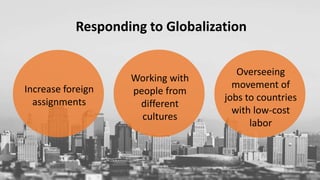
Responding to Globalization
1-6Copyright © 2011 Pearson Education, Inc. publishing as
Prentice Hall
Increase foreign
assignments
Working with
people from
different
cultures
Overseeing
movement of
jobs to countries
with low-cost
labor
1-71-7Copyright © 2011 Pearson Education, Inc. publishing as
Prentice Hall
Managing Workforce Diversity
The people in organizations are becoming more
heterogeneous demographically
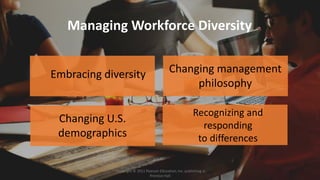
Embracing diversity
Changing U.S.
demographics
Changing management
philosophy
Recognizing and
responding
to differences
Copyright © 2011 Pearson Education, Inc. publishing as
Prentice Hall
Managing Workforce Diversity
1-9Copyright © 2011 Pearson Education, Inc. publishing as
Prentice Hall
Developing an OB Model
A model is an abstraction of reality – a simplified
representation of some real-world phenomenon
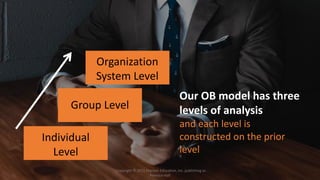
Organization
System Level
Group Level
Individual
Level
Our OB model has three
levels of analysis
and each level is
constructed on the prior
level
Copyright © 2011 Pearson Education, Inc. publishing as
Prentice Hall
1-11
Summary and Managerial
Implications
Copyright © 2011 Pearson Education, Inc. publishing as
Prentice Hall
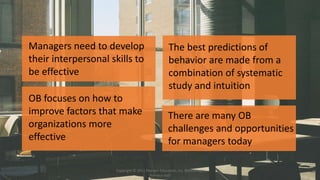
Managers need to develop
their interpersonal skills to
be effective
OB focuses on how to
improve factors that make
organizations more
effective
The best predictions of
behavior are made from a
combination of systematic
study and intuition
There are many OB
challenges and opportunities
for managers today
Copyright © 2011 Pearson Education, Inc. publishing as
Prentice Hall

Ob topic 1 challenges and opportunities

  • 1.
    Welcome to Challenges andOportunities Organizational Behavior ][
  • 2.
    1-2Copyright © 2011Pearson Education, Inc. publishing as Prentice Hall Challenges and Opportunities for OB
  • 3.
    • Responding toEconimic Pressures • Responding to Globalization • Managing Workforce Diversity • Improving Quality and Productivity • Improving Customer Services • Improving People Skills Copyright © 2011 Pearson Education, Inc. publishing as Prentice Hall • Stimulating Innovation and Change • Coping with “Temporariness” • Working in Networked Organizations • Helping Employees Balance Work-Life Conflicts • Creating a Positive Work Environment • Improving Ethical Behavior
  • 4.
    1-41-4Copyright © 2011Pearson Education, Inc. publishing as Prentice Hall Responding to Economic Pressures What do you do during difficult economic times?
  • 5.
    1-5Copyright © 2011Pearson Education, Inc. publishing as Prentice Hall Managers need to handle difficult activities such as firing employees, motivating employees to do more with less and working through the stress employees feel when they are worrying about their future. OB focuses on issues such as stress, decision making, and coping during difficult times Effective management is critical during hard economic times
  • 6.
    Responding to Globalization 1-6Copyright© 2011 Pearson Education, Inc. publishing as Prentice Hall Increase foreign assignments Working with people from different cultures Overseeing movement of jobs to countries with low-cost labor
  • 7.
    1-71-7Copyright © 2011Pearson Education, Inc. publishing as Prentice Hall Managing Workforce Diversity The people in organizations are becoming more heterogeneous demographically
  • 8.
    Embracing diversity Changing U.S. demographics Changingmanagement philosophy Recognizing and responding to differences Copyright © 2011 Pearson Education, Inc. publishing as Prentice Hall Managing Workforce Diversity
  • 9.
    1-9Copyright © 2011Pearson Education, Inc. publishing as Prentice Hall Developing an OB Model A model is an abstraction of reality – a simplified representation of some real-world phenomenon
  • 10.
    Organization System Level Group Level Individual Level OurOB model has three levels of analysis and each level is constructed on the prior level Copyright © 2011 Pearson Education, Inc. publishing as Prentice Hall
  • 11.
    1-11 Summary and Managerial Implications Copyright© 2011 Pearson Education, Inc. publishing as Prentice Hall
  • 12.
    Managers need todevelop their interpersonal skills to be effective OB focuses on how to improve factors that make organizations more effective The best predictions of behavior are made from a combination of systematic study and intuition There are many OB challenges and opportunities for managers today Copyright © 2011 Pearson Education, Inc. publishing as Prentice Hall

Editor's Notes

  • #3 In the workplace today, there are many challenges and opportunities in the area of Organizational Behavior. Understanding OB has never been more important for managers as organizations are changing at a much more rapid pace than historically seen.
  • #5 During economic difficulties, the need for effective managers is heightened. Anyone can manage during good times; it is much tougher to manage through economic struggles. Often when there are economic pressures, managers are forced to make decisions based on resource constraints. These situations may include laying off employees, motivating employees when there are limited resources, and encouraging employees when they are stressed about their futures.
  • #7 Organizations now exist in an environment with no national borders. As a result, the manager’s job has changed. They need to have a broader perspective when making decisions. As foreign assignments increase. you will need to be able to manage a workforce that is different than what you may be used to and may bring different needs, aspirations and attitudes to the workplace. You will also have individuals coming to work in your own country that come from different cultures and you will need to find ways to accommodate their needs and help them assimilate to your workplace culture. You may also need to do the difficult task of moving jobs outside of your country to a country with lower labor costs. This is a difficult process logistically but also emotionally for the workers who will be losing their jobs.
  • #8 As the borders are disappearing, we are seeing more and more heterogeneity in the workplace. Managers today need to embrace diversity and find ways to manage it effectively. The changing demographics have shifted management philosophy in a way that recognizes and utilizes differences to create productivity, profitability, and welcoming cultures.
  • #10 In Organizational Behavior (OB), we utilize the representation of the world as broken down into three levels. The first level of analysis we will look at is the individual level. At this level we look at individual behavior. Next, recognizing that individuals make up groups, we analyze how group behavior occurs. Finally, organizations are made up of groups of individuals so we analyze the organization at a systems level.
  • #12 The OB Model is critical to your understanding of how organizations behave. The remainder of this book we will be utilizing that model to look at behavior on an individual, group, and organizational level.