PERFORMANCE &
POTENTIAL APPRAISAL
“Nurturing
turns potential
into
performance”
What is performance appraisal?
 Employee Assessment – the assessment of an
employee's effectiveness, usually as undertaken at
regular intervals
 Performance appraisal may be defined as a
structured formal interaction between a subordinate
and supervisor in which the work performance of
the subordinate is examined and discussed
 with a view to identifying weaknesses and strengths as
well as opportunities for improvement and skills’
development
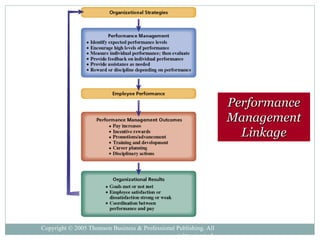
Performance Management
Performance appraisal: the measurement and
assessment of an employee’s job performance
Performance management: the integration of
performance appraisal systems with other HRM
systems for the purpose of aligning the employees’
work behaviors and results with the organization’s
goals
 Example: link an employee’s pay increase to the employee’s job
performance
 To do this, we have to measure the employee’s job performance
 Goal: Improve the organization by improving the employees’
work behaviors and results
4
Copyright © 2005 Thomson Business & Professional Publishing. All
rights reserved.
PerformancePerformance
ManagementManagement
LinkageLinkage
Copyright © 2005 Thomson Business & Professional Publishing. All
Difference Between Performance
Management and Performance Appraisals
Performance
Management
 Processes used to identify,
encourage, measure,
evaluate, improve, and
reward employee
performance.
Performance
Appraisal
 The process of evaluating
how well employees perform
their jobs and then
communicating that
information to the
employees.
Why Have Performance Appraisal ?
 Performance Appraisal offers several
advantages at the level of the:
 Individual
 Recognition of past effort
 Developmental requirements can be uncovered
 Team
 Alignment of effort with objectives
 Motivation of team members
 Organization
 Development of staff
 Achievement of key objectives
 Best and focused utilization of human resources
Objectives
 Compensation decisions
 Promotion decisions
 Training and development programmes
 Feedback to the employee
 Personal growth and development
Performance Management Cycle
Source of figure: Adapted from Fisher, Schoenfeldt, & Shaw (2006), Figure 10.1, p. 421
9
Development Tool
Administrative
Tool
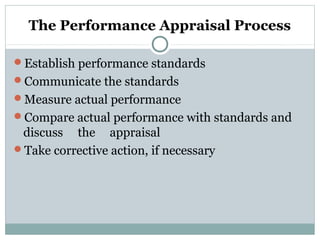
The Performance Appraisal Process
Establish performance standards
Communicate the standards
Measure actual performance
Compare actual performance with standards and
discuss the appraisal
Take corrective action, if necessary
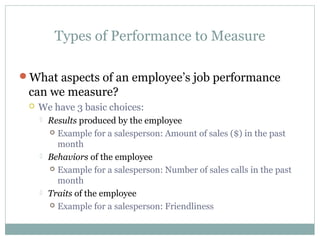
Types of Performance to Measure
What aspects of an employee’s job performance
can we measure?
 We have 3 basic choices:
 Results produced by the employee
 Example for a salesperson: Amount of sales ($) in the past
month
 Behaviors of the employee
 Example for a salesperson: Number of sales calls in the past
month
 Traits of the employee
 Example for a salesperson: Friendliness
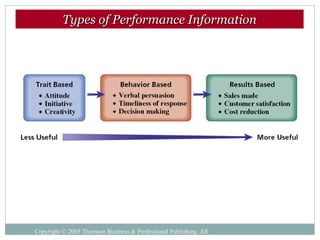
Copyright © 2005 Thomson Business & Professional Publishing. All
Types of Performance InformationTypes of Performance Information
Types of Performance to Measure
Results-based (results-oriented): measure the
results produced by the employee
 Examples for a retail store manager (examples of some
results for which the store manager has responsibility and
so should be held accountable):
 Sales of the store
 Profit per square foot
 Inventory shrinkage
 Customer satisfaction
 Makes sense for most jobs
 Results matter (usually)
Types of Performance to Measure
Results-based (more)
 Challenges:
 Which results are relevant may not be obvious for all jobs
 Some results are not under the employee’s control
 May foster a “results at all costs” mentality
 May interfere with teamwork
 May be difficult to provide effective feedback
Types of Performance to Measure
Behavior-based (behavior-oriented): measure the
employee’s behaviors
 Examples for a retail store manager:
 Good attendance
 Completes management reports correctly & on time
 Monitors customers and employees for theft
 Coaches employees to welcome customers to the store & offer
assistance within 3 minutes, and to thank customers as they
leave
 Conducts regular sessions with employees to develop teamwork
 Makes sense for many jobs
 Use it where how the employee produces results matters
Types of Performance to Measure
Behavior-based (more)
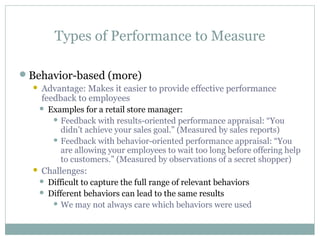
 Advantage: Makes it easier to provide effective performance
feedback to employees
 Examples for a retail store manager:
 Feedback with results-oriented performance appraisal: “You
didn’t achieve your sales goal.” (Measured by sales reports)
 Feedback with behavior-oriented performance appraisal: “You
are allowing your employees to wait too long before offering help
to customers.” (Measured by observations of a secret shopper)
 Challenges:
 Difficult to capture the full range of relevant behaviors
 Different behaviors can lead to the same results
 We may not always care which behaviors were used
Types of Performance to Measure
Trait-based (trait-oriented): measure the employee’s
personal characteristics
 Examples for a retail store manager:
 Ability to make decisions
 Loyalty to the company
 Communication skills
 Level of initiative
 This is usually a bad idea for several reasons:
 Poor reliability & validity of measures of traits
 Weak relationship between traits and job effectiveness
 Measurements of traits are more likely to be subject to biases
(sexism, racism, ageism, etc.)
 Hard to use traits to provide effective feedback
Types of Performance to Measure
So, in most cases, we want to measure the job
performance of an employee in terms of the results
and behaviors of the employee
 Make a list of results & behaviors that are relevant to the job
 Starting point: Use the job description to identify the essential
tasks of the job
 Example task statement on job description for a Retail Store
Manager: “Manage inventory shrinkage.”
 Translate the tasks into results & behaviors
 Example (continued): Measure the amount of inventory
shrinkage in the store (a result)
Characteristics of an Effective
Appraisal System
 Job-related criteria
 Performance expectations
 Standardization
 Trained appraisers
 Continuous open communication
 Performance reviews
360-Degree Feedback
 Performance information is collected from
supervisors, subordinates, peers, and
internal/external customers
 Generally done for development rather than
for pay raises
360-degree Feedback
 Many organizations now use some form of
360-degree feedback program
 Upward and peer feedback can have positive
effects on behavior
 These effects are sustainable over time
 Introducing a 360-degree system into a culture not
prepared for it can have disastrous effects
360-degree Feedback
 Positive features of a 360-degree system:
 Multiple perspectives of a person’s performance
 Raters base evaluations on contact and observation
 Feedback is provided from multiple directions…
above, below, peer
 Anonymous upward feedback, which results in full
participation
 Learning about weaknesses and strengths is
motivational
360-degree Feedback
 Negative features of a 360-degree system:
 Feedback from all sources can be overwhelming
 Rater can hide in a group of raters and provide
harsh evaluations
 Conflicting ratings can be confusing and frustrating
 Providing feedback that is constructive requires a
plan and well-trained raters
Selected Evaluation Techniques
 Ways of evaluating employees can generally
be divided into two categories:
 Methods that evaluate employees individually
 Multiple-person evaluations
 In a multiple-person evaluation, the supervisor
directly and intentionally compares the
performance of one employee to that of others
Individual Evaluation Methods
 Graphic rating scale
 The rater is presented with a set of traits
 The employee is rated on the traits
 Ratings are assigned points, which are then
computed
 Raters are often asked to explain each rating with a
sentence or two
Individual Evaluation Methods
 Forced choice:
 Was developed because graphic rating scales
allowed supervisors to rate everyone high
 The rater must choose from a set of descriptive
statements about employee
 Supervisors check the statements that describe the
employee, or they rank the statements from most to
least descriptive
 Forced choice can be used by superiors, peers,
subordinates, or a combination of these
Individual Evaluation Methods
 Essay Evaluation
 The rater is asked to describe the strong and weak
aspects of the employee’s behavior
 It can be used by superiors, peers, or subordinates
 Essay evaluations are flexible; an evaluator can
specifically address the ratee’s skill in any area
 Comparing essays is difficult
 Skilled writers can paint a better picture
Individual Evaluation Methods
 Critical Incident Technique
 Raters maintain a log of behavioral incidents that
represent effective and ineffective performance for
each employee
 Two factors determine the success of this technique:
 The supervisor must have enough time to observe
subordinates during the evaluation period
 The supervisor must record incidents as they are
seen
 Logs can help avoid common rating errors and
facilitate discussions about performance improvement
Individual Evaluation Methods
 Checklists
 In its simplest form, the checklist is a set of
objectives or descriptive statements
 If the rater believes that the employee possesses a
listed trait, the item is checked
 A rating score equals the number of checks
Individual Evaluation Methods
 A variation is the weighted checklist
 Supervisors and HR specialists prepare a list of
descriptive statements about behavior
 Judges who have observed behavior on the job sort
the statements into piles rated from excellent to
poor
 When there is agreement on an item, it is included
in the weighted checklist
 The employee’s evaluation is the sum of the scores
(weights) on the items checked
Checklists and weighted checklists can be used
by superiors, peers, or subordinates
Individual Evaluation Methods
 Behaviorally Anchored Rating Scales
 Smith and Kendall developed the behaviorally
anchored rating scale (BARS), or the behavioral
expectation scale (BES)
 The BARS approach uses critical incidents to
anchor statements on a scale
 The rater reads the anchors and places an X at some
point on the scale for the ratee
Individual Evaluation Methods
 A BARS usually contains these features:
 Six to 10 performance dimensions identified and
defined by raters and ratees
 The dimensions are anchored with positive and
negative critical incidents
 Each ratee is then rated on the dimensions
 Ratings are fed back using the terms on the form
It takes two to four days to construct a BARS that is
jargon free and closely related to the requirements of the job
 Behaviorally Anchored Rating Scale
Uses specific descriptions of actual behaviors to rate various levels of actual
performance
Copyright © 2005 Thomson Business & Professional Publishing. All
Behaviorally-Anchored Rating ScaleBehaviorally-Anchored Rating Scale
for Customer Service Skillsfor Customer Service Skills
Multiple-Person Evaluation Methods
 Ranking
 A supervisor is asked to rank subordinates in order
on some overall criterion
 It is easier to rank the best and worst employees
than average ones
 Alternative rankings can help with this difficulty
 Pick the top employee first, then the bottom one
 The second best is chosen, then the second worst
 Follow this process until everyone has been ranked
Multiple-Person Evaluation Methods
 Paired Comparison
 The supervisor reviews a series of cards; each
contains two subordinates names
 The higher performer in each pair is chosen
 Final ranking is made by counting how many times
a given employee was chosen as the better
performer
 A major limitation is the number of paired
comparisons that must be made
 With only 10 subordinates, a supervisor would have
45 pairs of names
Paired Comparison Method
Multiple-Person Evaluation Methods
 Forced Distribution
 Employees are rated on a pre-existing distribution
of pre-determined categories
 The predetermined distribution must be followed,
regardless of how well the employees performed
 A supervisor with all exceptional subordinates will
be forced to rate some poorly
 A supervisor with mediocre subordinates must rate
some highly
This technique is similar to grading on a curve
Forced Distribution Method
 At Sun Microsystems managers appraise
employees in groups of about 30.
 There is a top 10%, a middle 70%, and a
bottom 10%.
 The bottom 10% can either take a quick exit
package or embark on a 90-day performance
improvement action plan.
Copyright © 2005 Thomson Business & Professional Publishing. All
Forced Distribution on a Bell-Shaped CurveForced Distribution on a Bell-Shaped Curve
Multiple-Person Evaluation Methods
 An MBO program follows a systematic process:
 Superior/subordinates define tasks and set objectives
 The superior, consulting with subordinates, sets criteria
for assessing objective accomplishment
 Dates to review progress are agreed upon and used
 Superior and subordinates make any required
modifications in the original objectives
 A final evaluation by the superior is made
 The superior meets with the subordinate in a
counseling, encouraging session
 Objectives for the next cycle are set
Performance Evaluation Problems
No technique is perfect;
they all have limitations
Opposition to Evaluation
 Most employees are wary of performance evaluation
 Subjective bias and favoritism are real problems
 Opponents of formal evaluation argue that:
 They focus too much symptoms of poor performance
rather than finding the underlying causes
 Managers and employees dislike the process
 Raters have trouble deciding performance levels
 Employees who are not placed in the top performance
category experience a reverse motivation effect
System Design and Operating Problems
 Performance evaluation systems break down
because they are poorly designed
 If the criteria focus solely on results, or on
personality traits rather than performance, the
evaluation may not be well received
 Some techniques take a long time to carry out or
require extensive written analysis, both of which
managers resist
 Some systems are not fully online
Rater Problems
 Even if a system is well designed, problems can arise if
raters are not cooperative and well trained
 Supervisors may not be comfortable “playing God”
 Inadequate training can lead to:
 Problems with standards of evaluation
 Halo effect
 Leniency or harshness
 Central tendency error
 “Recency of events” error
 Contracts effects
 Personal bias (stereotyping, similar to me)
Standards of Evaluation
 Problems with evaluation standards arise
because of perceptual differences in the
meaning of words
 Good, adequate, satisfactory, and excellent mean
different things to different evaluators
 If only one rater is used, evaluations can be
distorted
 This arises most often in graphic rating scales
 It may also appear with essays, critical incidents,
and checklists
Potential appraisal
The objective of potential appraisal is to identify the
potential of a given employee to occupy higher positions in
the organizational hierarchy and undertake higher
responsibilities. It is required to:
Inform employees about their future prospects
Help the organization chalk out a suitable succession plan
Update training efforts from time to time
Advise employees about what they must do to improve their
career prospects.
Problem
Children
Stars
Planned separation Solid citizens
PERFORMANCE
P
O
T
E
N
T
I
A
L

Hrm performance & potential appraisal

  • 1.
  • 2.
  • 3.
    What is performanceappraisal?  Employee Assessment – the assessment of an employee's effectiveness, usually as undertaken at regular intervals  Performance appraisal may be defined as a structured formal interaction between a subordinate and supervisor in which the work performance of the subordinate is examined and discussed  with a view to identifying weaknesses and strengths as well as opportunities for improvement and skills’ development
  • 4.
    Performance Management Performance appraisal:the measurement and assessment of an employee’s job performance Performance management: the integration of performance appraisal systems with other HRM systems for the purpose of aligning the employees’ work behaviors and results with the organization’s goals  Example: link an employee’s pay increase to the employee’s job performance  To do this, we have to measure the employee’s job performance  Goal: Improve the organization by improving the employees’ work behaviors and results 4
  • 5.
    Copyright © 2005Thomson Business & Professional Publishing. All rights reserved. PerformancePerformance ManagementManagement LinkageLinkage
  • 6.
    Copyright © 2005Thomson Business & Professional Publishing. All Difference Between Performance Management and Performance Appraisals Performance Management  Processes used to identify, encourage, measure, evaluate, improve, and reward employee performance. Performance Appraisal  The process of evaluating how well employees perform their jobs and then communicating that information to the employees.
  • 7.
    Why Have PerformanceAppraisal ?  Performance Appraisal offers several advantages at the level of the:  Individual  Recognition of past effort  Developmental requirements can be uncovered  Team  Alignment of effort with objectives  Motivation of team members  Organization  Development of staff  Achievement of key objectives  Best and focused utilization of human resources
  • 8.
    Objectives  Compensation decisions Promotion decisions  Training and development programmes  Feedback to the employee  Personal growth and development
  • 9.
    Performance Management Cycle Sourceof figure: Adapted from Fisher, Schoenfeldt, & Shaw (2006), Figure 10.1, p. 421 9 Development Tool Administrative Tool
  • 10.
    The Performance AppraisalProcess Establish performance standards Communicate the standards Measure actual performance Compare actual performance with standards and discuss the appraisal Take corrective action, if necessary
  • 11.
    Types of Performanceto Measure What aspects of an employee’s job performance can we measure?  We have 3 basic choices:  Results produced by the employee  Example for a salesperson: Amount of sales ($) in the past month  Behaviors of the employee  Example for a salesperson: Number of sales calls in the past month  Traits of the employee  Example for a salesperson: Friendliness
  • 12.
    Copyright © 2005Thomson Business & Professional Publishing. All Types of Performance InformationTypes of Performance Information
  • 13.
    Types of Performanceto Measure Results-based (results-oriented): measure the results produced by the employee  Examples for a retail store manager (examples of some results for which the store manager has responsibility and so should be held accountable):  Sales of the store  Profit per square foot  Inventory shrinkage  Customer satisfaction  Makes sense for most jobs  Results matter (usually)
  • 14.
    Types of Performanceto Measure Results-based (more)  Challenges:  Which results are relevant may not be obvious for all jobs  Some results are not under the employee’s control  May foster a “results at all costs” mentality  May interfere with teamwork  May be difficult to provide effective feedback
  • 15.
    Types of Performanceto Measure Behavior-based (behavior-oriented): measure the employee’s behaviors  Examples for a retail store manager:  Good attendance  Completes management reports correctly & on time  Monitors customers and employees for theft  Coaches employees to welcome customers to the store & offer assistance within 3 minutes, and to thank customers as they leave  Conducts regular sessions with employees to develop teamwork  Makes sense for many jobs  Use it where how the employee produces results matters
  • 16.
    Types of Performanceto Measure Behavior-based (more)  Advantage: Makes it easier to provide effective performance feedback to employees  Examples for a retail store manager:  Feedback with results-oriented performance appraisal: “You didn’t achieve your sales goal.” (Measured by sales reports)  Feedback with behavior-oriented performance appraisal: “You are allowing your employees to wait too long before offering help to customers.” (Measured by observations of a secret shopper)  Challenges:  Difficult to capture the full range of relevant behaviors  Different behaviors can lead to the same results  We may not always care which behaviors were used
  • 17.
    Types of Performanceto Measure Trait-based (trait-oriented): measure the employee’s personal characteristics  Examples for a retail store manager:  Ability to make decisions  Loyalty to the company  Communication skills  Level of initiative  This is usually a bad idea for several reasons:  Poor reliability & validity of measures of traits  Weak relationship between traits and job effectiveness  Measurements of traits are more likely to be subject to biases (sexism, racism, ageism, etc.)  Hard to use traits to provide effective feedback
  • 18.
    Types of Performanceto Measure So, in most cases, we want to measure the job performance of an employee in terms of the results and behaviors of the employee  Make a list of results & behaviors that are relevant to the job  Starting point: Use the job description to identify the essential tasks of the job  Example task statement on job description for a Retail Store Manager: “Manage inventory shrinkage.”  Translate the tasks into results & behaviors  Example (continued): Measure the amount of inventory shrinkage in the store (a result)
  • 19.
    Characteristics of anEffective Appraisal System  Job-related criteria  Performance expectations  Standardization  Trained appraisers  Continuous open communication  Performance reviews
  • 20.
    360-Degree Feedback  Performanceinformation is collected from supervisors, subordinates, peers, and internal/external customers  Generally done for development rather than for pay raises
  • 21.
    360-degree Feedback  Manyorganizations now use some form of 360-degree feedback program  Upward and peer feedback can have positive effects on behavior  These effects are sustainable over time  Introducing a 360-degree system into a culture not prepared for it can have disastrous effects
  • 22.
    360-degree Feedback  Positivefeatures of a 360-degree system:  Multiple perspectives of a person’s performance  Raters base evaluations on contact and observation  Feedback is provided from multiple directions… above, below, peer  Anonymous upward feedback, which results in full participation  Learning about weaknesses and strengths is motivational
  • 23.
    360-degree Feedback  Negativefeatures of a 360-degree system:  Feedback from all sources can be overwhelming  Rater can hide in a group of raters and provide harsh evaluations  Conflicting ratings can be confusing and frustrating  Providing feedback that is constructive requires a plan and well-trained raters
  • 24.
    Selected Evaluation Techniques Ways of evaluating employees can generally be divided into two categories:  Methods that evaluate employees individually  Multiple-person evaluations  In a multiple-person evaluation, the supervisor directly and intentionally compares the performance of one employee to that of others
  • 25.
    Individual Evaluation Methods Graphic rating scale  The rater is presented with a set of traits  The employee is rated on the traits  Ratings are assigned points, which are then computed  Raters are often asked to explain each rating with a sentence or two
  • 26.
    Individual Evaluation Methods Forced choice:  Was developed because graphic rating scales allowed supervisors to rate everyone high  The rater must choose from a set of descriptive statements about employee  Supervisors check the statements that describe the employee, or they rank the statements from most to least descriptive  Forced choice can be used by superiors, peers, subordinates, or a combination of these
  • 27.
    Individual Evaluation Methods Essay Evaluation  The rater is asked to describe the strong and weak aspects of the employee’s behavior  It can be used by superiors, peers, or subordinates  Essay evaluations are flexible; an evaluator can specifically address the ratee’s skill in any area  Comparing essays is difficult  Skilled writers can paint a better picture
  • 28.
    Individual Evaluation Methods Critical Incident Technique  Raters maintain a log of behavioral incidents that represent effective and ineffective performance for each employee  Two factors determine the success of this technique:  The supervisor must have enough time to observe subordinates during the evaluation period  The supervisor must record incidents as they are seen  Logs can help avoid common rating errors and facilitate discussions about performance improvement
  • 29.
    Individual Evaluation Methods Checklists  In its simplest form, the checklist is a set of objectives or descriptive statements  If the rater believes that the employee possesses a listed trait, the item is checked  A rating score equals the number of checks
  • 30.
    Individual Evaluation Methods A variation is the weighted checklist  Supervisors and HR specialists prepare a list of descriptive statements about behavior  Judges who have observed behavior on the job sort the statements into piles rated from excellent to poor  When there is agreement on an item, it is included in the weighted checklist  The employee’s evaluation is the sum of the scores (weights) on the items checked Checklists and weighted checklists can be used by superiors, peers, or subordinates
  • 31.
    Individual Evaluation Methods Behaviorally Anchored Rating Scales  Smith and Kendall developed the behaviorally anchored rating scale (BARS), or the behavioral expectation scale (BES)  The BARS approach uses critical incidents to anchor statements on a scale  The rater reads the anchors and places an X at some point on the scale for the ratee
  • 32.
    Individual Evaluation Methods A BARS usually contains these features:  Six to 10 performance dimensions identified and defined by raters and ratees  The dimensions are anchored with positive and negative critical incidents  Each ratee is then rated on the dimensions  Ratings are fed back using the terms on the form It takes two to four days to construct a BARS that is jargon free and closely related to the requirements of the job
  • 33.
     Behaviorally AnchoredRating Scale Uses specific descriptions of actual behaviors to rate various levels of actual performance
  • 34.
    Copyright © 2005Thomson Business & Professional Publishing. All Behaviorally-Anchored Rating ScaleBehaviorally-Anchored Rating Scale for Customer Service Skillsfor Customer Service Skills
  • 35.
    Multiple-Person Evaluation Methods Ranking  A supervisor is asked to rank subordinates in order on some overall criterion  It is easier to rank the best and worst employees than average ones  Alternative rankings can help with this difficulty  Pick the top employee first, then the bottom one  The second best is chosen, then the second worst  Follow this process until everyone has been ranked
  • 36.
    Multiple-Person Evaluation Methods Paired Comparison  The supervisor reviews a series of cards; each contains two subordinates names  The higher performer in each pair is chosen  Final ranking is made by counting how many times a given employee was chosen as the better performer  A major limitation is the number of paired comparisons that must be made  With only 10 subordinates, a supervisor would have 45 pairs of names
  • 37.
  • 38.
    Multiple-Person Evaluation Methods Forced Distribution  Employees are rated on a pre-existing distribution of pre-determined categories  The predetermined distribution must be followed, regardless of how well the employees performed  A supervisor with all exceptional subordinates will be forced to rate some poorly  A supervisor with mediocre subordinates must rate some highly This technique is similar to grading on a curve
  • 39.
    Forced Distribution Method At Sun Microsystems managers appraise employees in groups of about 30.  There is a top 10%, a middle 70%, and a bottom 10%.  The bottom 10% can either take a quick exit package or embark on a 90-day performance improvement action plan.
  • 40.
    Copyright © 2005Thomson Business & Professional Publishing. All Forced Distribution on a Bell-Shaped CurveForced Distribution on a Bell-Shaped Curve
  • 41.
    Multiple-Person Evaluation Methods An MBO program follows a systematic process:  Superior/subordinates define tasks and set objectives  The superior, consulting with subordinates, sets criteria for assessing objective accomplishment  Dates to review progress are agreed upon and used  Superior and subordinates make any required modifications in the original objectives  A final evaluation by the superior is made  The superior meets with the subordinate in a counseling, encouraging session  Objectives for the next cycle are set
  • 42.
    Performance Evaluation Problems Notechnique is perfect; they all have limitations
  • 43.
    Opposition to Evaluation Most employees are wary of performance evaluation  Subjective bias and favoritism are real problems  Opponents of formal evaluation argue that:  They focus too much symptoms of poor performance rather than finding the underlying causes  Managers and employees dislike the process  Raters have trouble deciding performance levels  Employees who are not placed in the top performance category experience a reverse motivation effect
  • 44.
    System Design andOperating Problems  Performance evaluation systems break down because they are poorly designed  If the criteria focus solely on results, or on personality traits rather than performance, the evaluation may not be well received  Some techniques take a long time to carry out or require extensive written analysis, both of which managers resist  Some systems are not fully online
  • 45.
    Rater Problems  Evenif a system is well designed, problems can arise if raters are not cooperative and well trained  Supervisors may not be comfortable “playing God”  Inadequate training can lead to:  Problems with standards of evaluation  Halo effect  Leniency or harshness  Central tendency error  “Recency of events” error  Contracts effects  Personal bias (stereotyping, similar to me)
  • 46.
    Standards of Evaluation Problems with evaluation standards arise because of perceptual differences in the meaning of words  Good, adequate, satisfactory, and excellent mean different things to different evaluators  If only one rater is used, evaluations can be distorted  This arises most often in graphic rating scales  It may also appear with essays, critical incidents, and checklists
  • 47.
    Potential appraisal The objectiveof potential appraisal is to identify the potential of a given employee to occupy higher positions in the organizational hierarchy and undertake higher responsibilities. It is required to: Inform employees about their future prospects Help the organization chalk out a suitable succession plan Update training efforts from time to time Advise employees about what they must do to improve their career prospects.
  • 48.
    Problem Children Stars Planned separation Solidcitizens PERFORMANCE P O T E N T I A L