Submitted By-
Manisha Gupta
MBA-4A
02614803912
What is IHRM?
• IHRM can be defined as set of activities aimed
managing organizational human resources at
international level to achieve organizational
objectives and achieve competitive advantage
over competitors at national and international
level.
• IHRM includes typical HRM functions such as
recruitment, selection, training and development,
performance appraisal and dismissal done at
international level and additional activities such
as global skills management, expatriate
management and so on.
OBJECTIVES OF IHRM
• Create a local appeal without compromising
upon the global identity.
• Generating awareness of cross cultural
sensitivities among managers globally and
hiring of staff across geographic boundaries.
• Training upon cultures and sensitivities of the
host country.
NEED FOR IHRM
• Managing expatriates
• Globalization has forced HRM to have
international orientation
• Effectively utilise services of people at both
the corporate office and at the foreign plants
FUNCTIONS OF IHRM
RECRUITMENT
SELECTION
EXPATRIATES
PERFORMANCE APPRAISAL
TRAINING AND DEVELOPMENT
COMPENSATION
WOMEN IN INTERNATIONAL BUSINESS
DUAL CAREER GROUPS
INTERNATIONAL INDUSTRIAL RELATIONS
TRADE UNIOUNS
PARTICIPATIVE MANAGEMENT
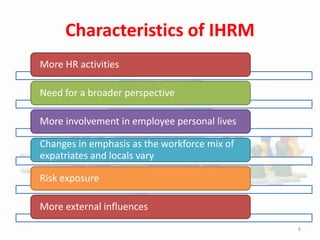
More HR activities
Need for a broader perspective
More involvement in employee personal lives
Changes in emphasis as the workforce mix of
expatriates and locals vary
Risk exposure
More external influences
Characteristics of IHRM
6
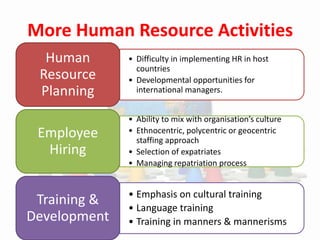
More Human Resource Activities
7
• Difficulty in implementing HR in host
countries
• Developmental opportunities for
international managers.
Human
Resource
Planning
• Ability to mix with organisation’s culture
• Ethnocentric, polycentric or geocentric
staffing approach
• Selection of expatriates
• Managing repatriation process
Employee
Hiring
• Emphasis on cultural training
• Language training
• Training in manners & mannerisms
Training &
Development
8
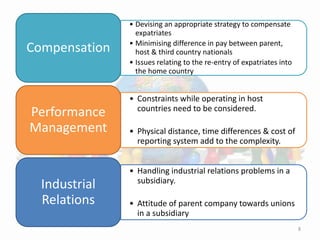
• Devising an appropriate strategy to compensate
expatriates
• Minimising difference in pay between parent,
host & third country nationals
• Issues relating to the re-entry of expatriates into
the home country
Compensation
• Constraints while operating in host
countries need to be considered.
• Physical distance, time differences & cost of
reporting system add to the complexity.
Performance
Management
• Handling industrial relations problems in a
subsidiary.
• Attitude of parent company towards unions
in a subsidiary
Industrial
Relations
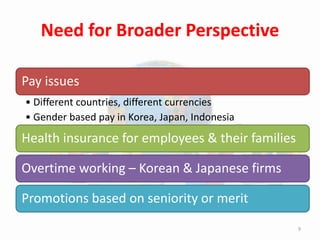
Pay issues
• Different countries, different currencies
• Gender based pay in Korea, Japan, Indonesia
Health insurance for employees & their families
Overtime working – Korean & Japanese firms
Promotions based on seniority or merit
Need for Broader Perspective
9
10
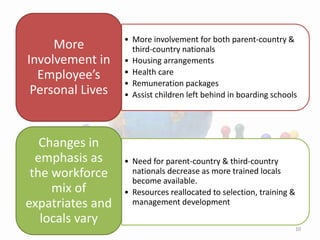
• More involvement for both parent-country &
third-country nationals
• Housing arrangements
• Health care
• Remuneration packages
• Assist children left behind in boarding schools
More
Involvement in
Employee’s
Personal Lives
• Need for parent-country & third-country
nationals decrease as more trained locals
become available.
• Resources reallocated to selection, training &
management development
Changes in
emphasis as
the workforce
mix of
expatriates and
locals vary
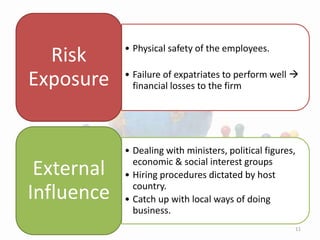
11
• Physical safety of the employees.
• Failure of expatriates to perform well 
financial losses to the firm
Risk
Exposure
• Dealing with ministers, political figures,
economic & social interest groups
• Hiring procedures dictated by host
country.
• Catch up with local ways of doing
business.
External
Influence
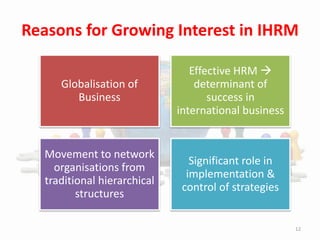
Reasons for Growing Interest in IHRM
12
Globalisation of
Business
Effective HRM 
determinant of
success in
international business
Movement to network
organisations from
traditional hierarchical
structures
Significant role in
implementation &
control of strategies
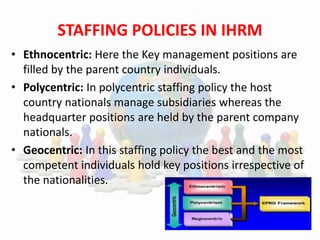
STAFFING POLICIES IN IHRM
• Ethnocentric: Here the Key management positions are
filled by the parent country individuals.
• Polycentric: In polycentric staffing policy the host
country nationals manage subsidiaries whereas the
headquarter positions are held by the parent company
nationals.
• Geocentric: In this staffing policy the best and the most
competent individuals hold key positions irrespective of
the nationalities.
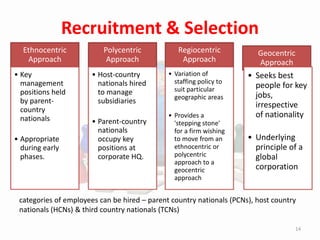
Recruitment & Selection
14
Ethnocentric
Approach
• Key
management
positions held
by parent-
country
nationals
• Appropriate
during early
phases.
Polycentric
Approach
• Host-country
nationals hired
to manage
subsidiaries
• Parent-country
nationals
occupy key
positions at
corporate HQ.
Geocentric
Approach
• Seeks best
people for key
jobs,
irrespective
of nationality
• Underlying
principle of a
global
corporation
Regiocentric
Approach
• Variation of
staffing policy to
suit particular
geographic areas
• Provides a
'stepping stone'
for a firm wishing
to move from an
ethnocentric or
polycentric
approach to a
geocentric
approach
categories of employees can be hired – parent country nationals (PCNs), host country
nationals (HCNs) & third country nationals (TCNs)
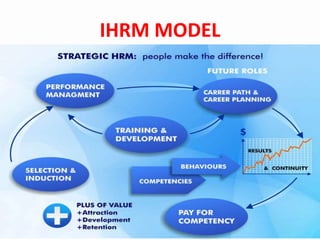
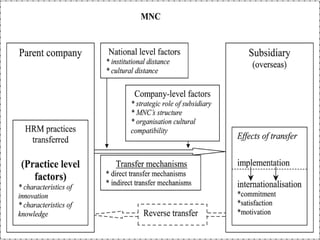
IHRM MODEL
How It Is Different from
Domestic HRM
• Domestic HRM is done at national level and IHRM is done
at international level.
• Domestic HRM is concerned with managing
employees belonging to one nation and IHRM is concerned
with managing employees belonging to many nations
(Home country, host country and third country employees)
• Domestic HRM is concerned with managing limited number
of HRM activities at national level and IHRM has concerned
with managing additional activities such as
expatriate management.
• Domestic HRM is less complicated due to less influence
from the external environment. IHRM is very complicated
as it is affected heavily by external factors such as cultural
distance and institutional factors.
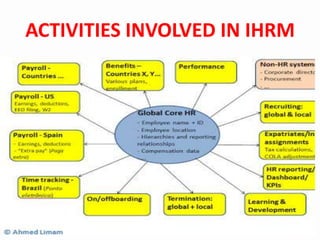
ACTIVITIES INVOLVED IN IHRM
ISSUES IN IHRM
• Managing International Assignments
• Employee and Family Adjustments
• Selecting the right person for foreign
assignments
• Culture and Gauge
• Language and Communication
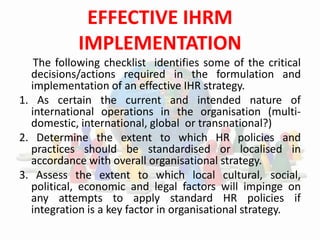
EFFECTIVE IHRM
IMPLEMENTATION
The following checklist identifies some of the critical
decisions/actions required in the formulation and
implementation of an effective IHR strategy.
1. As certain the current and intended nature of
international operations in the organisation (multi-
domestic, international, global or transnational?)
2. Determine the extent to which HR policies and
practices should be standardised or localised in
accordance with overall organisational strategy.
3. Assess the extent to which local cultural, social,
political, economic and legal factors will impinge on
any attempts to apply standard HR policies if
integration is a key factor in organisational strategy.
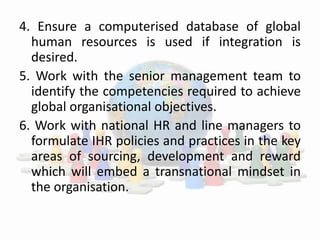
4. Ensure a computerised database of global
human resources is used if integration is
desired.
5. Work with the senior management team to
identify the competencies required to achieve
global organisational objectives.
6. Work with national HR and line managers to
formulate IHR policies and practices in the key
areas of sourcing, development and reward
which will embed a transnational mindset in
the organisation.
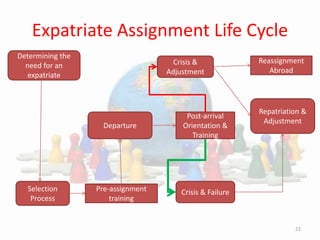
Expatriate Assignment Life Cycle
22
Determining the
need for an
expatriate
Selection
Process
Pre-assignment
training
Departure
Post-arrival
Orientation &
Training
Crisis &
Adjustment
Crisis & Failure
Repatriation &
Adjustment
Reassignment
Abroad
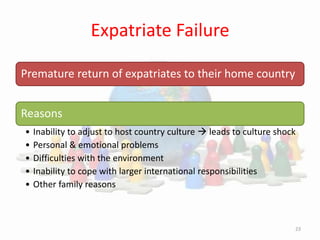
Expatriate Failure
23
Premature return of expatriates to their home country
Reasons
• Inability to adjust to host country culture  leads to culture shock
• Personal & emotional problems
• Difficulties with the environment
• Inability to cope with larger international responsibilities
• Other family reasons
THANK YOU

Ihrm

  • 1.
  • 2.
    What is IHRM? •IHRM can be defined as set of activities aimed managing organizational human resources at international level to achieve organizational objectives and achieve competitive advantage over competitors at national and international level. • IHRM includes typical HRM functions such as recruitment, selection, training and development, performance appraisal and dismissal done at international level and additional activities such as global skills management, expatriate management and so on.
  • 3.
    OBJECTIVES OF IHRM •Create a local appeal without compromising upon the global identity. • Generating awareness of cross cultural sensitivities among managers globally and hiring of staff across geographic boundaries. • Training upon cultures and sensitivities of the host country.
  • 4.
    NEED FOR IHRM •Managing expatriates • Globalization has forced HRM to have international orientation • Effectively utilise services of people at both the corporate office and at the foreign plants
  • 5.
    FUNCTIONS OF IHRM RECRUITMENT SELECTION EXPATRIATES PERFORMANCEAPPRAISAL TRAINING AND DEVELOPMENT COMPENSATION WOMEN IN INTERNATIONAL BUSINESS DUAL CAREER GROUPS INTERNATIONAL INDUSTRIAL RELATIONS TRADE UNIOUNS PARTICIPATIVE MANAGEMENT
  • 6.
    More HR activities Needfor a broader perspective More involvement in employee personal lives Changes in emphasis as the workforce mix of expatriates and locals vary Risk exposure More external influences Characteristics of IHRM 6
  • 7.
    More Human ResourceActivities 7 • Difficulty in implementing HR in host countries • Developmental opportunities for international managers. Human Resource Planning • Ability to mix with organisation’s culture • Ethnocentric, polycentric or geocentric staffing approach • Selection of expatriates • Managing repatriation process Employee Hiring • Emphasis on cultural training • Language training • Training in manners & mannerisms Training & Development
  • 8.
    8 • Devising anappropriate strategy to compensate expatriates • Minimising difference in pay between parent, host & third country nationals • Issues relating to the re-entry of expatriates into the home country Compensation • Constraints while operating in host countries need to be considered. • Physical distance, time differences & cost of reporting system add to the complexity. Performance Management • Handling industrial relations problems in a subsidiary. • Attitude of parent company towards unions in a subsidiary Industrial Relations
  • 9.
    Pay issues • Differentcountries, different currencies • Gender based pay in Korea, Japan, Indonesia Health insurance for employees & their families Overtime working – Korean & Japanese firms Promotions based on seniority or merit Need for Broader Perspective 9
  • 10.
    10 • More involvementfor both parent-country & third-country nationals • Housing arrangements • Health care • Remuneration packages • Assist children left behind in boarding schools More Involvement in Employee’s Personal Lives • Need for parent-country & third-country nationals decrease as more trained locals become available. • Resources reallocated to selection, training & management development Changes in emphasis as the workforce mix of expatriates and locals vary
  • 11.
    11 • Physical safetyof the employees. • Failure of expatriates to perform well  financial losses to the firm Risk Exposure • Dealing with ministers, political figures, economic & social interest groups • Hiring procedures dictated by host country. • Catch up with local ways of doing business. External Influence
  • 12.
    Reasons for GrowingInterest in IHRM 12 Globalisation of Business Effective HRM  determinant of success in international business Movement to network organisations from traditional hierarchical structures Significant role in implementation & control of strategies
  • 13.
    STAFFING POLICIES INIHRM • Ethnocentric: Here the Key management positions are filled by the parent country individuals. • Polycentric: In polycentric staffing policy the host country nationals manage subsidiaries whereas the headquarter positions are held by the parent company nationals. • Geocentric: In this staffing policy the best and the most competent individuals hold key positions irrespective of the nationalities.
  • 14.
    Recruitment & Selection 14 Ethnocentric Approach •Key management positions held by parent- country nationals • Appropriate during early phases. Polycentric Approach • Host-country nationals hired to manage subsidiaries • Parent-country nationals occupy key positions at corporate HQ. Geocentric Approach • Seeks best people for key jobs, irrespective of nationality • Underlying principle of a global corporation Regiocentric Approach • Variation of staffing policy to suit particular geographic areas • Provides a 'stepping stone' for a firm wishing to move from an ethnocentric or polycentric approach to a geocentric approach categories of employees can be hired – parent country nationals (PCNs), host country nationals (HCNs) & third country nationals (TCNs)
  • 15.
  • 16.
    How It IsDifferent from Domestic HRM • Domestic HRM is done at national level and IHRM is done at international level. • Domestic HRM is concerned with managing employees belonging to one nation and IHRM is concerned with managing employees belonging to many nations (Home country, host country and third country employees) • Domestic HRM is concerned with managing limited number of HRM activities at national level and IHRM has concerned with managing additional activities such as expatriate management. • Domestic HRM is less complicated due to less influence from the external environment. IHRM is very complicated as it is affected heavily by external factors such as cultural distance and institutional factors.
  • 17.
  • 18.
    ISSUES IN IHRM •Managing International Assignments • Employee and Family Adjustments • Selecting the right person for foreign assignments • Culture and Gauge • Language and Communication
  • 19.
    EFFECTIVE IHRM IMPLEMENTATION The followingchecklist identifies some of the critical decisions/actions required in the formulation and implementation of an effective IHR strategy. 1. As certain the current and intended nature of international operations in the organisation (multi- domestic, international, global or transnational?) 2. Determine the extent to which HR policies and practices should be standardised or localised in accordance with overall organisational strategy. 3. Assess the extent to which local cultural, social, political, economic and legal factors will impinge on any attempts to apply standard HR policies if integration is a key factor in organisational strategy.
  • 20.
    4. Ensure acomputerised database of global human resources is used if integration is desired. 5. Work with the senior management team to identify the competencies required to achieve global organisational objectives. 6. Work with national HR and line managers to formulate IHR policies and practices in the key areas of sourcing, development and reward which will embed a transnational mindset in the organisation.
  • 22.
    Expatriate Assignment LifeCycle 22 Determining the need for an expatriate Selection Process Pre-assignment training Departure Post-arrival Orientation & Training Crisis & Adjustment Crisis & Failure Repatriation & Adjustment Reassignment Abroad
  • 23.
    Expatriate Failure 23 Premature returnof expatriates to their home country Reasons • Inability to adjust to host country culture  leads to culture shock • Personal & emotional problems • Difficulties with the environment • Inability to cope with larger international responsibilities • Other family reasons
  • 24.