What Is Organizational
Behavior
1–1
Chapter One
1–2
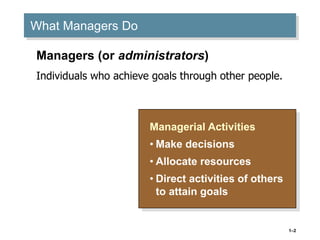
What Managers Do
Managerial Activities
• Make decisions
• Allocate resources
• Direct activities of others
to attain goals
Managers (or administrators)
Individuals who achieve goals through other people.
1–3
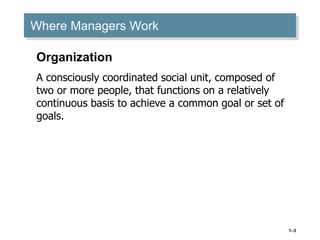
Where Managers Work
Organization
A consciously coordinated social unit, composed of
two or more people, that functions on a relatively
continuous basis to achieve a common goal or set of
goals.
1–4
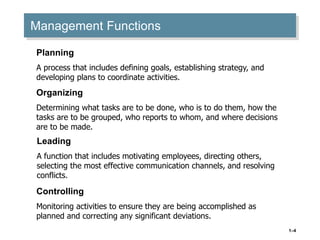
Management Functions
Planning
A process that includes defining goals, establishing strategy, and
developing plans to coordinate activities.
Organizing
Determining what tasks are to be done, who is to do them, how the
tasks are to be grouped, who reports to whom, and where decisions
are to be made.
Leading
A function that includes motivating employees, directing others,
selecting the most effective communication channels, and resolving
conflicts.
Controlling
Monitoring activities to ensure they are being accomplished as
planned and correcting any significant deviations.
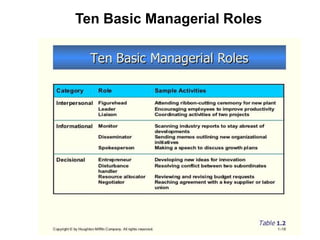
Ten Basic Managerial Roles
1–6
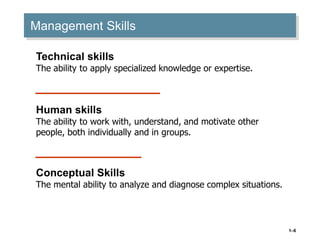
Management Skills
Technical skills
The ability to apply specialized knowledge or expertise.
Human skills
The ability to work with, understand, and motivate other
people, both individually and in groups.
Conceptual Skills
The mental ability to analyze and diagnose complex situations.
1–7
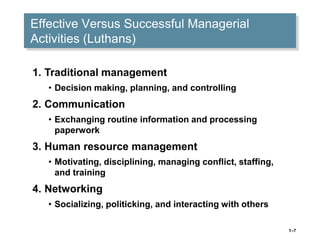
Effective Versus Successful Managerial
Activities (Luthans)
1. Traditional management
• Decision making, planning, and controlling
2. Communication
• Exchanging routine information and processing
paperwork
3. Human resource management
• Motivating, disciplining, managing conflict, staffing,
and training
4. Networking
• Socializing, politicking, and interacting with others
1–8
Enter Organizational Behavior
Organizational behavior (OB)
A field of study that investigates the impact that
individuals, groups, and structure have on behavior
within organizations, for the purpose of applying such
knowledge toward improving an organization’s
effectiveness.
1–9
Contributing Disciplines to the OB Field
Psychology
The science that seeks to measure, explain, and sometimes change
the behavior of humans and other animals.
Sociology
The study of people in relation to their fellow human beings.
Social Psychology
An area within psychology that blends concepts from psychology and
sociology and that focuses on the influence of people on one another.
Anthropology
The study of societies to learn about human beings and their
activities.
Political Science
The study of the behavior of individuals and groups within a
political environment.
1–10
Challenges and Opportunities for OB
 Responding to Economic Pressure
– In good times, OB approaches come with how to
reward, satisfy and retain employees
– In bad times, stress, decision making and adaptation
are to be managed
 Responding to Globalization
– Increased foreign assignments
– Working with people from different cultures
– Overseeing movement of jobs to countries with low-
cost labor
 Managing Workforce Diversity
– Embracing diversity
– Changing demographics
– Recognizing and responding to differences
1–11
Challenges and Opportunities for OB (cont’d)
 Improving Customer Service
– Increased expectation of service quality
– Customer-responsive cultures
 Improving People Skills
– Predicting people skills
– Learning ways to design motivating jobs, techniques
for improving personal skills and to create effective
teams
 Stimulating innovation and change
– Fostering creativity may lead to excellence
– Developing ideas to stimulate innovation
1–12
Challenges and Opportunities for OB (cont’d)
 Coping with temporariness
– Organizations are now fast and flexible
– All skills and knowledge are temporary, hence are
needed to be improved and updated
– Temporary work groups are to be maintained
efficiently
– Through shaped OB, temporariness, flexibility,
spontaneity and unpredictability can be overcome
 Working in a networked organization
– Motivating and collaborating distant employees need
advanced OB techniques
 Helping employees balance work-life conflicts
– Work life is interfering personal life
– Job satisfaction should be provided by OB practices
1–13
Challenges and Opportunities for OB (cont’d)
 Creating a positive work environment
– Fostering positivity helps to create a warm
environment
– Positivity may lead to success
 Improving ethical behavior
– Ethically healthy climate is a must for modern
organization
– OB practices may lead to develop skills to establish
code of conducts
– Protection from unethical practices
A basic OB model
1–14

OB Chapter 1 Robbins

  • 1.
  • 2.
    1–2 What Managers Do ManagerialActivities • Make decisions • Allocate resources • Direct activities of others to attain goals Managers (or administrators) Individuals who achieve goals through other people.
  • 3.
    1–3 Where Managers Work Organization Aconsciously coordinated social unit, composed of two or more people, that functions on a relatively continuous basis to achieve a common goal or set of goals.
  • 4.
    1–4 Management Functions Planning A processthat includes defining goals, establishing strategy, and developing plans to coordinate activities. Organizing Determining what tasks are to be done, who is to do them, how the tasks are to be grouped, who reports to whom, and where decisions are to be made. Leading A function that includes motivating employees, directing others, selecting the most effective communication channels, and resolving conflicts. Controlling Monitoring activities to ensure they are being accomplished as planned and correcting any significant deviations.
  • 5.
  • 6.
    1–6 Management Skills Technical skills Theability to apply specialized knowledge or expertise. Human skills The ability to work with, understand, and motivate other people, both individually and in groups. Conceptual Skills The mental ability to analyze and diagnose complex situations.
  • 7.
    1–7 Effective Versus SuccessfulManagerial Activities (Luthans) 1. Traditional management • Decision making, planning, and controlling 2. Communication • Exchanging routine information and processing paperwork 3. Human resource management • Motivating, disciplining, managing conflict, staffing, and training 4. Networking • Socializing, politicking, and interacting with others
  • 8.
    1–8 Enter Organizational Behavior Organizationalbehavior (OB) A field of study that investigates the impact that individuals, groups, and structure have on behavior within organizations, for the purpose of applying such knowledge toward improving an organization’s effectiveness.
  • 9.
    1–9 Contributing Disciplines tothe OB Field Psychology The science that seeks to measure, explain, and sometimes change the behavior of humans and other animals. Sociology The study of people in relation to their fellow human beings. Social Psychology An area within psychology that blends concepts from psychology and sociology and that focuses on the influence of people on one another. Anthropology The study of societies to learn about human beings and their activities. Political Science The study of the behavior of individuals and groups within a political environment.
  • 10.
    1–10 Challenges and Opportunitiesfor OB  Responding to Economic Pressure – In good times, OB approaches come with how to reward, satisfy and retain employees – In bad times, stress, decision making and adaptation are to be managed  Responding to Globalization – Increased foreign assignments – Working with people from different cultures – Overseeing movement of jobs to countries with low- cost labor  Managing Workforce Diversity – Embracing diversity – Changing demographics – Recognizing and responding to differences
  • 11.
    1–11 Challenges and Opportunitiesfor OB (cont’d)  Improving Customer Service – Increased expectation of service quality – Customer-responsive cultures  Improving People Skills – Predicting people skills – Learning ways to design motivating jobs, techniques for improving personal skills and to create effective teams  Stimulating innovation and change – Fostering creativity may lead to excellence – Developing ideas to stimulate innovation
  • 12.
    1–12 Challenges and Opportunitiesfor OB (cont’d)  Coping with temporariness – Organizations are now fast and flexible – All skills and knowledge are temporary, hence are needed to be improved and updated – Temporary work groups are to be maintained efficiently – Through shaped OB, temporariness, flexibility, spontaneity and unpredictability can be overcome  Working in a networked organization – Motivating and collaborating distant employees need advanced OB techniques  Helping employees balance work-life conflicts – Work life is interfering personal life – Job satisfaction should be provided by OB practices
  • 13.
    1–13 Challenges and Opportunitiesfor OB (cont’d)  Creating a positive work environment – Fostering positivity helps to create a warm environment – Positivity may lead to success  Improving ethical behavior – Ethically healthy climate is a must for modern organization – OB practices may lead to develop skills to establish code of conducts – Protection from unethical practices
  • 14.
    A basic OBmodel 1–14