INTERPERSONAL TRUST
Interpersonal Trust is the perception you have that other person will not do anything that harm your interest What is Interpersonal Trust?
Basic Trust General Trust Situational Trust TYPES OF TRUST
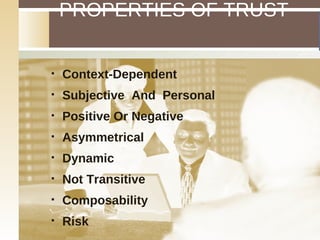
PROPERTIES OF TRUST  Context-Dependent Subjective  And  Personal Positive Or Negative Asymmetrical Dynamic Not Transitive Composability Risk
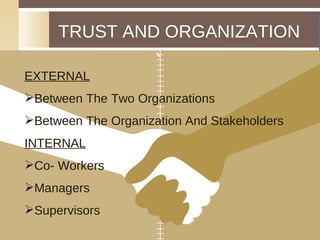
TRUST AND ORGANIZATION EXTERNAL Between The Two Organizations Between The Organization And Stakeholders INTERNAL Co- Workers Managers Supervisors
Being Fooled Frequently Due To Over-trusting Behavior Tendency To Believe Too Readily : Easily Deceived Low Trusters V/S High Trusters: "High Trusters Are Just Plain Dumb And Are More Likely To Be Fooled" – Low Trusters High Trusters Can Understand As Well Or As Poorly As Low Trusters Difference Is : Degree Of Willingness To Believe Stranger In Absence Of Clear Data Gullible Trusts Others Until Has Clear Evidence That  He/She Can't Be Trusted Low Truster Will Not Trust Others Until Has Clear Evidence That He/ She Can Be Trusted.  Note :  Gullible  : Less Likely To Lie Or Cheat Or Steal More Likely To Give Others A Second Chance  More Likely To Respect The Rights Of Others TRUST & GULLIBILITY
Reputation Length Of The Relationship  Size Communication Commitment Opportunistic Behavior Adjusting To The Needs Of The Other  People Threat FACTORS AFFECTING TRUST
Experienced A Great Deal Of Emotional Or Physical Abuse Or Neglect Been Emotionally Hurt In The Past And Are Not Willing To Risk Getting Hurt In The Future. Experienced The Loss Of A Loved One Through Death Experienced A Hostile Or Bitter Divorce, Separation, Or End Of A Relationship Low Self-esteem Experienced A Hostile Or Bitter Divorce, Separation, Or End Of A Relationship Why do People have Trouble Developing Trust in others?
BELIEFS OF PEOPLE WHO HAVE PROBLEMS TRUSTING OTHERS I have been hurt too much in the past, and I refuse to be hurt again now  or in the future People are out to get all they can from me, so I avoid them to survive. As soon as I let my guard down, I will be stepped on again. I get no respect from anyone. All men (or women) are dishonest and are never to be trusted. There is no such thing as a healthy relationship. There is no such thing as a fair employer, generous company, or  supportive workplace
Maintain  one  another’s Self-esteem  Support  and  praise  one  another Keep  sensitive  information  confidential Stand  up  for  one  another Avoid  gossip  or  unfair  criticism  of  others Appreciate one another’s skills and differences. CREATING TRUST
- Sharing Of Information - Reduction In Workload Due To Easier Communication - Increased Referral Of Clients - Improved Client Outcomes Through Better Communication - Reduced Need For Self-protection - Low Turnover And Absenteeism - Delegation Of Authority And Responsibility -Healthy Work Environment BENEFITS
Organizational Behavior- Mcgraw Hill, India.1995 Robbins,Stephen, Organisation Behavior R.K. Sharma; Organisation Behavior Chaudhari, Sushama: Effective Psychological Contract, The ICFAI University Press Frédérique Six; The trouble with trust Marco Tulilo Zanini, Trust within organization of new economy Excellence Magazine (Sep ’07 & Dec ’07) Brad L. Rawlins; Trust and PR Practice Paul Bernthal; A Survey of Trust in the workplace IILM Reading Material Roderick Moreland Kramer; Trust and Distrust in Organisations : Dillemmas and Approaches www.beyondintractabilty.org
 

trust

  • 1.
  • 2.
    Interpersonal Trust isthe perception you have that other person will not do anything that harm your interest What is Interpersonal Trust?
  • 3.
    Basic Trust GeneralTrust Situational Trust TYPES OF TRUST
  • 4.
    PROPERTIES OF TRUST Context-Dependent Subjective And Personal Positive Or Negative Asymmetrical Dynamic Not Transitive Composability Risk
  • 5.
    TRUST AND ORGANIZATIONEXTERNAL Between The Two Organizations Between The Organization And Stakeholders INTERNAL Co- Workers Managers Supervisors
  • 6.
    Being Fooled FrequentlyDue To Over-trusting Behavior Tendency To Believe Too Readily : Easily Deceived Low Trusters V/S High Trusters: "High Trusters Are Just Plain Dumb And Are More Likely To Be Fooled" – Low Trusters High Trusters Can Understand As Well Or As Poorly As Low Trusters Difference Is : Degree Of Willingness To Believe Stranger In Absence Of Clear Data Gullible Trusts Others Until Has Clear Evidence That He/She Can't Be Trusted Low Truster Will Not Trust Others Until Has Clear Evidence That He/ She Can Be Trusted. Note : Gullible : Less Likely To Lie Or Cheat Or Steal More Likely To Give Others A Second Chance More Likely To Respect The Rights Of Others TRUST & GULLIBILITY
  • 7.
    Reputation Length OfThe Relationship Size Communication Commitment Opportunistic Behavior Adjusting To The Needs Of The Other People Threat FACTORS AFFECTING TRUST
  • 8.
    Experienced A GreatDeal Of Emotional Or Physical Abuse Or Neglect Been Emotionally Hurt In The Past And Are Not Willing To Risk Getting Hurt In The Future. Experienced The Loss Of A Loved One Through Death Experienced A Hostile Or Bitter Divorce, Separation, Or End Of A Relationship Low Self-esteem Experienced A Hostile Or Bitter Divorce, Separation, Or End Of A Relationship Why do People have Trouble Developing Trust in others?
  • 9.
    BELIEFS OF PEOPLEWHO HAVE PROBLEMS TRUSTING OTHERS I have been hurt too much in the past, and I refuse to be hurt again now or in the future People are out to get all they can from me, so I avoid them to survive. As soon as I let my guard down, I will be stepped on again. I get no respect from anyone. All men (or women) are dishonest and are never to be trusted. There is no such thing as a healthy relationship. There is no such thing as a fair employer, generous company, or supportive workplace
  • 10.
    Maintain one another’s Self-esteem Support and praise one another Keep sensitive information confidential Stand up for one another Avoid gossip or unfair criticism of others Appreciate one another’s skills and differences. CREATING TRUST
  • 11.
    - Sharing OfInformation - Reduction In Workload Due To Easier Communication - Increased Referral Of Clients - Improved Client Outcomes Through Better Communication - Reduced Need For Self-protection - Low Turnover And Absenteeism - Delegation Of Authority And Responsibility -Healthy Work Environment BENEFITS
  • 12.
    Organizational Behavior- McgrawHill, India.1995 Robbins,Stephen, Organisation Behavior R.K. Sharma; Organisation Behavior Chaudhari, Sushama: Effective Psychological Contract, The ICFAI University Press Frédérique Six; The trouble with trust Marco Tulilo Zanini, Trust within organization of new economy Excellence Magazine (Sep ’07 & Dec ’07) Brad L. Rawlins; Trust and PR Practice Paul Bernthal; A Survey of Trust in the workplace IILM Reading Material Roderick Moreland Kramer; Trust and Distrust in Organisations : Dillemmas and Approaches www.beyondintractabilty.org
  • 13.