INTERNATIONAL PERFORMANCE
       MANAGEMENT
                  Amaresh C Nayak
International Performance Management

   • Performance appraisal
     – It is the process of assessing an individual's
       performance in a systematic way.
     – The performance being measured against
       various job related factors as well as
       individual traits.
     – In addition one's potential for performance is
       measured.
     – The performance appraisal outcome is linked
       to a number of personnel decisions.

                                         Asst. Prof. Amaresh C Nayak
International Performance Manaement

   • Performance management
     – This stretches beyond appraisal.
     – The emphasis in performance management
       is enhanced employee performance.


                                   Asst. Prof. Amaresh C Nayak
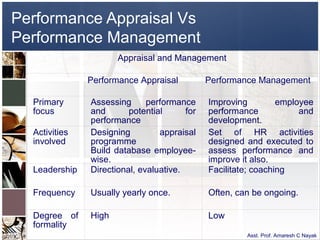
Performance Appraisal Vs
Performance Management
                      Appraisal and Management

               Performance Appraisal          Performance Management

  Primary      Assessing      performance     Improving         employee
  focus        and       potential      for   performance            and
               performance                    development.
  Activities   Designing         appraisal    Set of HR activities
  involved     programme                      designed and executed to
               Build database employee-       assess performance and
               wise.                          improve it also.
  Leadership   Directional, evaluative.       Facilitate; coaching

  Frequency    Usually yearly once.           Often, can be ongoing.

  Degree of    High                           Low
  formality
                                                       Asst. Prof. Amaresh C Nayak
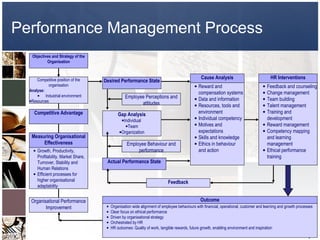
Performance Management Process
   Objectives and Strategy of the
           Organisation


      Competitive position of the                                                               Cause Analysis                            HR Interventions
                                     Desired Performance State
            organisation                                                                    • Reward and                             • Feedback and counseling
  Analyse:
                                                                                              compensation systems                   • Change management
      • Industrial environment                    Employee Perceptions and
  •Resources                                                                                • Data and information                   • Team building
                                                         attitudes                          • Resources, tools and                   • Talent management
    Competitive Advantage                                                                     environment                            • Training and
                                              Gap Analysis
                                                •Individual                                 • Individual competency                    development
                                                  •Team                                     • Motives and                            • Reward management
                                               •Organization                                  expectations                           • Competency mapping
   Measuring Organisational                                                                 • Skills and knowledge                     and learning
        Effectiveness                              Employee Behaviour and                   • Ethics in behaviour                      management
    • Growth, Productivity,                             performance                           and action                             • Ethical performance
      Profitability, Market Share,                                                                                                     training
      Turnover, Stability and         Actual Performance State
      Human Relations
    • Efficient processes for
      higher organisational                                                 Feedback
      adaptability


   Organisational Performance                                                                   Outcome
          Improvement                 •   Organisation wide alignment of employee behaviours with financial, operational, customer and learning and growth processes
                                      •   Clear focus on ethical performance
                                      •   Driven by organisational strategy
                                      •   Orchestrated by HR
                                      •   HR outcomes: Quality of work, tangible rewards, future growth, enabling environment and inspiration
                                                                                                                            Asst. Prof. Amaresh C Nayak
Performance Management for Expats

  • Expatriate performance management
    comprises seven activities -
    – Linkage to organisational strategy
    – Setting individual performance behaviour
    – Identifying variables impacting performance
    – Appraising the performance
    – Providing regular feedback on progress
      towards these goals
    – Providing opportunities for improvement
    – Linking results with rewards

                                     Asst. Prof. Amaresh C Nayak
ORGANISATIONAL STRATEGY AND
PERFORMANCE MANAGEMENT
  • Performance management becomes an
    integral part of corporate strategy
  • It serves many organisational goals
  • Performance management helps
    – Identify employees with high potentials
    – Facilitates reward performance equitably
    – Delieanates an employee's needs for
      development


                                   Asst. Prof. Amaresh C Nayak
ORGANISATIONAL STRATEGY AND
PERFORMANCE MANAGEMENT
  • From     the    strategic    management
    perspective    organisations     can     be
    grouped into any of the four categories:
    – Defenders
    – Prospectors
    – Analyzers
    – Reactors


                                    Asst. Prof. Amaresh C Nayak
ORGANISATIONAL STRATEGY AND
PERFORMANCE MANAGEMENT
  • Defenders (low-cost producer)
    – Have cost control as the primary focus
    – Predictability and a short-term focus are valued
       • Seek to provide goods and services at a low cost
       • Maintain quality
       • Provide customer service
    – HR activities are relevant in this context
       • Development and training
    – Employees are expected to stay with the
      organisation for a long time
    – The PMS in such organisations is based on outcome
      result as well as on behavioural traits.

                                                   Asst. Prof. Amaresh C Nayak
ORGANISATIONAL STRATEGY AND
PERFORMANCE MANAGEMENT
  • Prospector's (innovators)
    – Design and produce new products
    – Redeploys resources from discontinued products to
      the development of new ones
    – Organisational conditions that foster
         • Risk taking, Cooperation, Creativity and A long-term
           perspective
    –   Talented individuals are hired
    –   Training is mainly on-the-job
    –   Employee turnover is high
    –   Performance appraisal is result-based
         • Emphasis on skills identification
         • Acquisition of human resources from external sources
                                                     Asst. Prof. Amaresh C Nayak
ORGANISATIONAL STRATEGY AND
PERFORMANCE MANAGEMENT
  • Analyzer operate in two types of product-
    market domains
       • Stable domain
       • Changing domain
    – These firms are of some hybrid type
    – They are both product innovators and competitors in
      long-run production lines
    – The personnel policies fall between the extremes of
      defenders and prospector's
       • Firms spend heavily on training
       • Talents are also 'bought' to fill higher-level positions
    – PMS focuses on result as well as on behavioural
      traits.
                                                        Asst. Prof. Amaresh C Nayak
ORGANISATIONAL STRATEGY AND
PERFORMANCE MANAGEMENT
  • Reactor's
    – Operates in a highly competitive market
    – Slaves of their environments
    – There are few systematic strategic
      implications
    – PMS focus
      • Result based
      • behavioural trait based


                                  Asst. Prof. Amaresh C Nayak
SETTING INDIVIDUAL PERFORMANCE
GOALS
  • It is critical to closely link unit goals to
    individual/team goals
  • Popularly, goals seek to serve several
    purposes:
    – Guide and direct behaviour in the direction of the
      goal
    – Offer benchmarks for employees to strive towards
      excellence
    – Reflect what the employees and managers consider
      as important
  • While setting the goals the organisations should
    follow the SMART PRINCIPLE
                                           Asst. Prof. Amaresh C Nayak
SETTING INDIVIDUAL PERFORMANCE
GOALS
  • Goals need to be carefully identified, depending
    on the following factors:
    – Resources need to be provided for the individuals,
      teams
       • Finance is fundamental to a lot of initiatives
       • To make decisions at the unit level needs to be clearly
         identified
       • The power of authority and control on local spending would
         need to be ensured for smooth operational decisions.
    – Participation of the individual/teams in goal setting
       • The rationale for such involvement is the employee's
         acceptance and commitment to the established goals
    – There is also the need for prioritizing goals

                                                   Asst. Prof. Amaresh C Nayak
IDENTIFYING VARIABLES AFFECTING
PERFORMANCE
  • Performance of the non-expatriate is generally
    influenced by
    – Job extrinsic factors (e.g. working conditions and
      company policy)
    – Job intrinsic factors (e.g. challenging job, career
      prospects).
  • An expatriate's performance            depends              on
    several other influencing factors
    – The impact of job extrinsic and job intrinsic factors
      on performance cannot be undermined.


                                             Asst. Prof. Amaresh C Nayak
IDENTIFYING VARIABLES AFFECTING
PERFORMANCE
  • The performance of an          expatriate
    depends on several variables
    – Compensation Package
    – Task
    – Headquarters Support
    – Host Environment
    – Cultural Adjustment


                                   Asst. Prof. Amaresh C Nayak
IDENTIFYING VARIABLES AFFECTING
PERFORMANCE
  • Compensation Package
    – Perceived as a balancing factor for the
      'emotional relocation” that the assignment
      demands
    – Pay, according to Herzberg's two-factor
      theory of motivation, is a hygiene factor
    – Pay acts as remover of dissatisfaction as
      well as a booster for enhanced performance
    – Money continues to remain as one of the
      most significant motivators for expats.

                                     Asst. Prof. Amaresh C Nayak
IDENTIFYING VARIABLES AFFECTING
PERFORMANCE
  • Task
    – Nature of the job tends to influence
      performance.
    – A tougher task tends to evoke better
      performance than a job which is relatively
      easy to handle.
    – How work is viewed by the expatriate also
      matters.


                                     Asst. Prof. Amaresh C Nayak
IDENTIFYING VARIABLES AFFECTING
PERFORMANCE
  • Headquarters Support
    – An assignee accepts
       •   Making extra money
       •   Improving his career prospects
       •   Loyalty to the organisation
       •   Commitment to make the Arm successful
  • It is necessary that the home office extends
    support and offers moral courage, particularly in
    times when the expatriate is passing through a
    culture shock.


                                                   Asst. Prof. Amaresh C Nayak
IDENTIFYING VARIABLES AFFECTING
PERFORMANCE
  • Headquarters Support
    – The following are some specific support facilities
      required from the headquarters:
    – Organisational support in managing the practical
      problems
       • Setting up home in a new culture
       • Enabling an expatriate to settle down.
    – The provision of timely psychological counselling for
      expatriates
       • Contributing to their mental health and performance
    – The families of employees should also be assisted

                                                    Asst. Prof. Amaresh C Nayak
IDENTIFYING VARIABLES AFFECTING
PERFORMANCE
  • Host Environment
    – Hostile host country environment, expatriates
      are under constant pressure and often there
      is a threat to their life itself.
    – The form of ownership of the subsidiary is
      important too.


                                       Asst. Prof. Amaresh C Nayak
IDENTIFYING VARIABLES AFFECTING
PERFORMANCE
  • Cultural Adjustment
    – Multicultural adjustability refers to being
      sensitive to the host culture
      •   Multicultural sensitivity
      •   Language ability
      •   Diplomacy
      •   Adaptability
      •   Positive attitude
      •   Emotional stability
      •   Maturity

                                      Asst. Prof. Amaresh C Nayak
APPRAISING THE PERFORMANCE

  • The international HR manager should
    decide on three key areas
    – specifying performance criteria
    – identifying the appraisers
    – deciding on the frequency of appraisal.


                                       Asst. Prof. Amaresh C Nayak
APPRAISING THE PERFORMANCE

  • Performance Criteria
    – The criteria for assessing performance should be
      clear, relevant, practical and reliable if assessments
      were to be meaningful
  • Trait Based
    – Traits are abstract properties of individuals
       •   openness to other cultures
       •   ability to live in other cultures
       •   loyalty to the company
       •   articulation and level of initiative
    – Focus here is on what a person is and not on what
      he or she does.

                                                  Asst. Prof. Amaresh C Nayak
APPRAISING THE PERFORMANCE

  • Behaviour Based
    – Focus on what the person actually does
      • Accomplish the job is very important
      • emphasize how a job is done.
  • Result Based
    – How much profit the assignee brought into
      the organisation during the assignment
    – Adherence lo target dates for commissioning
      plants/offices
    – Establishing strategic alliances

                                               Asst. Prof. Amaresh C Nayak
APPRAISING THE PERFORMANCE

  • Others
    – A new approach “the balanced score card”
       • Propounded by Kaplan and Norton
    – the financial perspective
       • organization’s   short-term    and     long-term           financial
         performance
    – the internal business perspective
       • focus on production and operating statistics
       • order fulfillment or cost per order
    – the innovation and learning perspective
       • human resource—its potential to learn and grow
    – the customer perspective.
       • Customer’s view, customer retention and satisfaction

                                                        Asst. Prof. Amaresh C Nayak
APPRAISING THE PERFORMANCE

  • Who are the Appraisers?
    – Appraisers are immediate managers/leaders at the
      host and parent locations, team members and
      clients
    – Self-appraisal is a common practice
  • In most MNC's, appraisal systems have a
    combination of these appraisers
  • Some common practices adopted by the
    industry are:
    – Matrix reporting
    – Use of multiple appraisers (360-degree appraisal)
    – The appraisal/review cycle
                                            Asst. Prof. Amaresh C Nayak
APPRAISING THE PERFORMANCE

  • Frequency of Assessment
    – The general trend is to evaluate
      • once in three months
      • six months
      • once in a year
  • Survey conducted in 1997 by Arthur
    Anderson
    – 70 percent of the organisations conduct
      performance appraisals once in a year

                                         Asst. Prof. Amaresh C Nayak
PERFORMANCE MANAGEMENT

  • PROVIDING FEEDBACK
    – Feedback controls the work behaviour of employees
      by directing actions
  • OPPORTUNITIES FOR IMPROVEMENT
    – Feedback has a developmental aspect as it
      highlights the need for training and development.
    – Opportunities to expatriates to improve, socialize
      and adjust to local environment ably.
  • LINKING REWARDS AND RESULTS
    – establishing linkages between performance and
      compensation


                                           Asst. Prof. Amaresh C Nayak
ISSUES IN MANAGING
PERFORMANCE IN GLOBAL CONTEXT
  • Cultural consequences           on     performance
    management
    – rewarding performance
    – managing under performers
    – managing virtual teams
  • Assessing subsidiary performance is also a
    critical dimension
  • There are three ways in which cultural
    differences impact performance management:
    – Goal commitment and participation in organisations
    – Feedback performance relationship
    – Feedback seeking behaviour
                                            Asst. Prof. Amaresh C Nayak
ASSESSING SUBSIDIARY
PERFORMANCE
  • Difficulties in Assessment
    – Balancing HQ and Host Unit Performance
    – Attention to External Forces
    – Vagaries of the International Environment
    – Significance of Time and Distance


                                       Asst. Prof. Amaresh C Nayak
THANK YOU


            Asst. Prof. Amaresh C Nayak

Ihrm performance management

  • 1.
    INTERNATIONAL PERFORMANCE MANAGEMENT Amaresh C Nayak
  • 2.
    International Performance Management • Performance appraisal – It is the process of assessing an individual's performance in a systematic way. – The performance being measured against various job related factors as well as individual traits. – In addition one's potential for performance is measured. – The performance appraisal outcome is linked to a number of personnel decisions. Asst. Prof. Amaresh C Nayak
  • 3.
    International Performance Manaement • Performance management – This stretches beyond appraisal. – The emphasis in performance management is enhanced employee performance. Asst. Prof. Amaresh C Nayak
  • 4.
    Performance Appraisal Vs PerformanceManagement Appraisal and Management Performance Appraisal Performance Management Primary Assessing performance Improving employee focus and potential for performance and performance development. Activities Designing appraisal Set of HR activities involved programme designed and executed to Build database employee- assess performance and wise. improve it also. Leadership Directional, evaluative. Facilitate; coaching Frequency Usually yearly once. Often, can be ongoing. Degree of High Low formality Asst. Prof. Amaresh C Nayak
  • 5.
    Performance Management Process Objectives and Strategy of the Organisation Competitive position of the Cause Analysis HR Interventions Desired Performance State organisation • Reward and • Feedback and counseling Analyse: compensation systems • Change management • Industrial environment Employee Perceptions and •Resources • Data and information • Team building attitudes • Resources, tools and • Talent management Competitive Advantage environment • Training and Gap Analysis •Individual • Individual competency development •Team • Motives and • Reward management •Organization expectations • Competency mapping Measuring Organisational • Skills and knowledge and learning Effectiveness Employee Behaviour and • Ethics in behaviour management • Growth, Productivity, performance and action • Ethical performance Profitability, Market Share, training Turnover, Stability and Actual Performance State Human Relations • Efficient processes for higher organisational Feedback adaptability Organisational Performance Outcome Improvement • Organisation wide alignment of employee behaviours with financial, operational, customer and learning and growth processes • Clear focus on ethical performance • Driven by organisational strategy • Orchestrated by HR • HR outcomes: Quality of work, tangible rewards, future growth, enabling environment and inspiration Asst. Prof. Amaresh C Nayak
  • 6.
    Performance Management forExpats • Expatriate performance management comprises seven activities - – Linkage to organisational strategy – Setting individual performance behaviour – Identifying variables impacting performance – Appraising the performance – Providing regular feedback on progress towards these goals – Providing opportunities for improvement – Linking results with rewards Asst. Prof. Amaresh C Nayak
  • 7.
    ORGANISATIONAL STRATEGY AND PERFORMANCEMANAGEMENT • Performance management becomes an integral part of corporate strategy • It serves many organisational goals • Performance management helps – Identify employees with high potentials – Facilitates reward performance equitably – Delieanates an employee's needs for development Asst. Prof. Amaresh C Nayak
  • 8.
    ORGANISATIONAL STRATEGY AND PERFORMANCEMANAGEMENT • From the strategic management perspective organisations can be grouped into any of the four categories: – Defenders – Prospectors – Analyzers – Reactors Asst. Prof. Amaresh C Nayak
  • 9.
    ORGANISATIONAL STRATEGY AND PERFORMANCEMANAGEMENT • Defenders (low-cost producer) – Have cost control as the primary focus – Predictability and a short-term focus are valued • Seek to provide goods and services at a low cost • Maintain quality • Provide customer service – HR activities are relevant in this context • Development and training – Employees are expected to stay with the organisation for a long time – The PMS in such organisations is based on outcome result as well as on behavioural traits. Asst. Prof. Amaresh C Nayak
  • 10.
    ORGANISATIONAL STRATEGY AND PERFORMANCEMANAGEMENT • Prospector's (innovators) – Design and produce new products – Redeploys resources from discontinued products to the development of new ones – Organisational conditions that foster • Risk taking, Cooperation, Creativity and A long-term perspective – Talented individuals are hired – Training is mainly on-the-job – Employee turnover is high – Performance appraisal is result-based • Emphasis on skills identification • Acquisition of human resources from external sources Asst. Prof. Amaresh C Nayak
  • 11.
    ORGANISATIONAL STRATEGY AND PERFORMANCEMANAGEMENT • Analyzer operate in two types of product- market domains • Stable domain • Changing domain – These firms are of some hybrid type – They are both product innovators and competitors in long-run production lines – The personnel policies fall between the extremes of defenders and prospector's • Firms spend heavily on training • Talents are also 'bought' to fill higher-level positions – PMS focuses on result as well as on behavioural traits. Asst. Prof. Amaresh C Nayak
  • 12.
    ORGANISATIONAL STRATEGY AND PERFORMANCEMANAGEMENT • Reactor's – Operates in a highly competitive market – Slaves of their environments – There are few systematic strategic implications – PMS focus • Result based • behavioural trait based Asst. Prof. Amaresh C Nayak
  • 13.
    SETTING INDIVIDUAL PERFORMANCE GOALS • It is critical to closely link unit goals to individual/team goals • Popularly, goals seek to serve several purposes: – Guide and direct behaviour in the direction of the goal – Offer benchmarks for employees to strive towards excellence – Reflect what the employees and managers consider as important • While setting the goals the organisations should follow the SMART PRINCIPLE Asst. Prof. Amaresh C Nayak
  • 14.
    SETTING INDIVIDUAL PERFORMANCE GOALS • Goals need to be carefully identified, depending on the following factors: – Resources need to be provided for the individuals, teams • Finance is fundamental to a lot of initiatives • To make decisions at the unit level needs to be clearly identified • The power of authority and control on local spending would need to be ensured for smooth operational decisions. – Participation of the individual/teams in goal setting • The rationale for such involvement is the employee's acceptance and commitment to the established goals – There is also the need for prioritizing goals Asst. Prof. Amaresh C Nayak
  • 15.
    IDENTIFYING VARIABLES AFFECTING PERFORMANCE • Performance of the non-expatriate is generally influenced by – Job extrinsic factors (e.g. working conditions and company policy) – Job intrinsic factors (e.g. challenging job, career prospects). • An expatriate's performance depends on several other influencing factors – The impact of job extrinsic and job intrinsic factors on performance cannot be undermined. Asst. Prof. Amaresh C Nayak
  • 16.
    IDENTIFYING VARIABLES AFFECTING PERFORMANCE • The performance of an expatriate depends on several variables – Compensation Package – Task – Headquarters Support – Host Environment – Cultural Adjustment Asst. Prof. Amaresh C Nayak
  • 17.
    IDENTIFYING VARIABLES AFFECTING PERFORMANCE • Compensation Package – Perceived as a balancing factor for the 'emotional relocation” that the assignment demands – Pay, according to Herzberg's two-factor theory of motivation, is a hygiene factor – Pay acts as remover of dissatisfaction as well as a booster for enhanced performance – Money continues to remain as one of the most significant motivators for expats. Asst. Prof. Amaresh C Nayak
  • 18.
    IDENTIFYING VARIABLES AFFECTING PERFORMANCE • Task – Nature of the job tends to influence performance. – A tougher task tends to evoke better performance than a job which is relatively easy to handle. – How work is viewed by the expatriate also matters. Asst. Prof. Amaresh C Nayak
  • 19.
    IDENTIFYING VARIABLES AFFECTING PERFORMANCE • Headquarters Support – An assignee accepts • Making extra money • Improving his career prospects • Loyalty to the organisation • Commitment to make the Arm successful • It is necessary that the home office extends support and offers moral courage, particularly in times when the expatriate is passing through a culture shock. Asst. Prof. Amaresh C Nayak
  • 20.
    IDENTIFYING VARIABLES AFFECTING PERFORMANCE • Headquarters Support – The following are some specific support facilities required from the headquarters: – Organisational support in managing the practical problems • Setting up home in a new culture • Enabling an expatriate to settle down. – The provision of timely psychological counselling for expatriates • Contributing to their mental health and performance – The families of employees should also be assisted Asst. Prof. Amaresh C Nayak
  • 21.
    IDENTIFYING VARIABLES AFFECTING PERFORMANCE • Host Environment – Hostile host country environment, expatriates are under constant pressure and often there is a threat to their life itself. – The form of ownership of the subsidiary is important too. Asst. Prof. Amaresh C Nayak
  • 22.
    IDENTIFYING VARIABLES AFFECTING PERFORMANCE • Cultural Adjustment – Multicultural adjustability refers to being sensitive to the host culture • Multicultural sensitivity • Language ability • Diplomacy • Adaptability • Positive attitude • Emotional stability • Maturity Asst. Prof. Amaresh C Nayak
  • 23.
    APPRAISING THE PERFORMANCE • The international HR manager should decide on three key areas – specifying performance criteria – identifying the appraisers – deciding on the frequency of appraisal. Asst. Prof. Amaresh C Nayak
  • 24.
    APPRAISING THE PERFORMANCE • Performance Criteria – The criteria for assessing performance should be clear, relevant, practical and reliable if assessments were to be meaningful • Trait Based – Traits are abstract properties of individuals • openness to other cultures • ability to live in other cultures • loyalty to the company • articulation and level of initiative – Focus here is on what a person is and not on what he or she does. Asst. Prof. Amaresh C Nayak
  • 25.
    APPRAISING THE PERFORMANCE • Behaviour Based – Focus on what the person actually does • Accomplish the job is very important • emphasize how a job is done. • Result Based – How much profit the assignee brought into the organisation during the assignment – Adherence lo target dates for commissioning plants/offices – Establishing strategic alliances Asst. Prof. Amaresh C Nayak
  • 26.
    APPRAISING THE PERFORMANCE • Others – A new approach “the balanced score card” • Propounded by Kaplan and Norton – the financial perspective • organization’s short-term and long-term financial performance – the internal business perspective • focus on production and operating statistics • order fulfillment or cost per order – the innovation and learning perspective • human resource—its potential to learn and grow – the customer perspective. • Customer’s view, customer retention and satisfaction Asst. Prof. Amaresh C Nayak
  • 27.
    APPRAISING THE PERFORMANCE • Who are the Appraisers? – Appraisers are immediate managers/leaders at the host and parent locations, team members and clients – Self-appraisal is a common practice • In most MNC's, appraisal systems have a combination of these appraisers • Some common practices adopted by the industry are: – Matrix reporting – Use of multiple appraisers (360-degree appraisal) – The appraisal/review cycle Asst. Prof. Amaresh C Nayak
  • 28.
    APPRAISING THE PERFORMANCE • Frequency of Assessment – The general trend is to evaluate • once in three months • six months • once in a year • Survey conducted in 1997 by Arthur Anderson – 70 percent of the organisations conduct performance appraisals once in a year Asst. Prof. Amaresh C Nayak
  • 29.
    PERFORMANCE MANAGEMENT • PROVIDING FEEDBACK – Feedback controls the work behaviour of employees by directing actions • OPPORTUNITIES FOR IMPROVEMENT – Feedback has a developmental aspect as it highlights the need for training and development. – Opportunities to expatriates to improve, socialize and adjust to local environment ably. • LINKING REWARDS AND RESULTS – establishing linkages between performance and compensation Asst. Prof. Amaresh C Nayak
  • 30.
    ISSUES IN MANAGING PERFORMANCEIN GLOBAL CONTEXT • Cultural consequences on performance management – rewarding performance – managing under performers – managing virtual teams • Assessing subsidiary performance is also a critical dimension • There are three ways in which cultural differences impact performance management: – Goal commitment and participation in organisations – Feedback performance relationship – Feedback seeking behaviour Asst. Prof. Amaresh C Nayak
  • 31.
    ASSESSING SUBSIDIARY PERFORMANCE • Difficulties in Assessment – Balancing HQ and Host Unit Performance – Attention to External Forces – Vagaries of the International Environment – Significance of Time and Distance Asst. Prof. Amaresh C Nayak
  • 32.
    THANK YOU Asst. Prof. Amaresh C Nayak