Financial Management
TOPIC
Jl IKPN Bintaro No 1, Pesanggrahan,
Tanah Kusir, Jakarta, Special Capital
Region of Jakarta 12330, Indonesia
FORECASTING
i
. . . . . . . . . . . . . . . . . . . . . . . . . . . . . . . . . . . . . . . . . . . . . . . . . . . . . . . . . . . . . . . . . . . . . . . . . . .
Forecasting
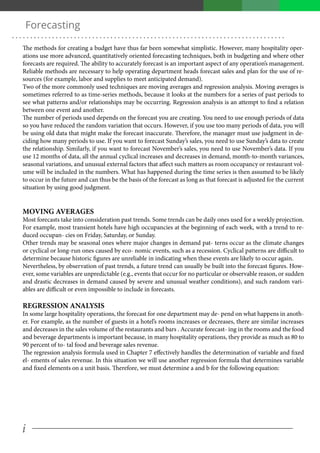
The methods for creating a budget have thus far been somewhat simplistic. However, many hospitality oper-
ations use more advanced, quantitatively oriented forecasting techniques, both in budgeting and where other
forecasts are required. The ability to accurately forecast is an important aspect of any operation’s management.
Reliable methods are necessary to help operating department heads forecast sales and plan for the use of re-
sources (for example, labor and supplies to meet anticipated demand).
Two of the more commonly used techniques are moving averages and regression analysis. Moving averages is
sometimes referred to as time-series methods, because it looks at the numbers for a series of past periods to
see what patterns and/or relationships may be occurring. Regression analysis is an attempt to find a relation
between one event and another.
The number of periods used depends on the forecast you are creating. You need to use enough periods of data
so you have reduced the random variation that occurs. However, if you use too many periods of data, you will
be using old data that might make the forecast inaccurate. Therefore, the manager must use judgment in de-
ciding how many periods to use. If you want to forecast Sunday’s sales, you need to use Sunday’s data to create
the relationship. Similarly, if you want to forecast November’s sales, you need to use November’s data. If you
use 12 months of data, all the annual cyclical increases and decreases in demand, month-to-month variances,
seasonal variations, and unusual external factors that affect such matters as room occupancy or restaurant vol-
ume will be included in the numbers. What has happened during the time series is then assumed to be likely
to occur in the future and can thus be the basis of the forecast as long as that forecast is adjusted for the current
situation by using good judgment.
MOVING AVERAGES
Most forecasts take into consideration past trends. Some trends can be daily ones used for a weekly projection.
For example, most transient hotels have high occupancies at the beginning of each week, with a trend to re-
duced occupan- cies on Friday, Saturday, or Sunday.
Other trends may be seasonal ones where major changes in demand pat- terns occur as the climate changes
or cyclical or long-run ones caused by eco- nomic events, such as a recession. Cyclical patterns are difficult to
determine because historic figures are unreliable in indicating when these events are likely to occur again.
Nevertheless, by observation of past trends, a future trend can usually be built into the forecast figures. How-
ever, some variables are unpredictable (e.g., events that occur for no particular or observable reason, or sudden
and drastic decreases in demand caused by severe and unusual weather conditions), and such random vari-
ables are difficult or even impossible to include in forecasts.
REGRESSION ANALYSIS
In some large hospitality operations, the forecast for one department may de- pend on what happens in anoth-
er. For example, as the number of guests in a hotel’s rooms increases or decreases, there are similar increases
and decreases in the sales volume of the restaurants and bars . Accurate forecast- ing in the rooms and the food
and beverage departments is important because, in many hospitality operations, they provide as much as 80 to
90 percent of to- tal food and beverage sales revenue.
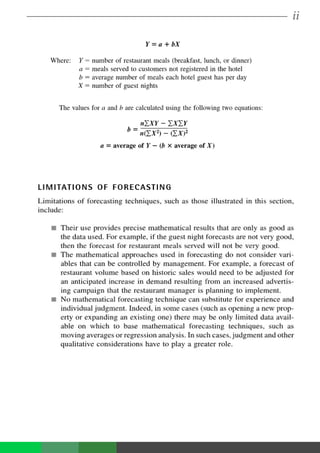
The regression analysis formula used in Chapter 7 effectively handles the determination of variable and fixed
el- ements of sales revenue. In this situation we will use another regression formula that determines variable
and fixed elements on a unit basis. Therefore, we must determine a and b for the following equation:
ii
i
CHOOSING A FORECASTING METHOD
Studies show that the lowest forecasting errors result from the use of trend pro- jections, moving averages, and
regression analysis rather than judgmental meth- ods. What is important is not the actual forecasting method
used, but how effective the forecasts are and their practical value in the operation.
In a small hospitality operation that can adapt quickly to changing circum- stances, most forecasting will be
done using simple methods, such as adjusting the sales for the coming month by a certain percentage increase
or decrease over last year’s or last month’s, or by using the fairly simple moving average method. Larger enter-
prises will probably use more complex methods, such as regression analysis.
Even though the regression analysis method requires more work, it does not require tedious manual calcula-
tions because most calculators are programmed to perform the arithmetic once each series of X and Y variables
have been en- tered. Spreadsheets can be used for budgeting, forecasting, and variance analy- sis. Once sales
forecasts have been completed, they can be used to help determine the quantities of items such as food and
beverages to be purchased and when they should be purchased.
ii

Forecasting

  • 1.
    Financial Management TOPIC Jl IKPNBintaro No 1, Pesanggrahan, Tanah Kusir, Jakarta, Special Capital Region of Jakarta 12330, Indonesia FORECASTING
  • 2.
    i . . .. . . . . . . . . . . . . . . . . . . . . . . . . . . . . . . . . . . . . . . . . . . . . . . . . . . . . . . . . . . . . . . . . . . . . . . . Forecasting The methods for creating a budget have thus far been somewhat simplistic. However, many hospitality oper- ations use more advanced, quantitatively oriented forecasting techniques, both in budgeting and where other forecasts are required. The ability to accurately forecast is an important aspect of any operation’s management. Reliable methods are necessary to help operating department heads forecast sales and plan for the use of re- sources (for example, labor and supplies to meet anticipated demand). Two of the more commonly used techniques are moving averages and regression analysis. Moving averages is sometimes referred to as time-series methods, because it looks at the numbers for a series of past periods to see what patterns and/or relationships may be occurring. Regression analysis is an attempt to find a relation between one event and another. The number of periods used depends on the forecast you are creating. You need to use enough periods of data so you have reduced the random variation that occurs. However, if you use too many periods of data, you will be using old data that might make the forecast inaccurate. Therefore, the manager must use judgment in de- ciding how many periods to use. If you want to forecast Sunday’s sales, you need to use Sunday’s data to create the relationship. Similarly, if you want to forecast November’s sales, you need to use November’s data. If you use 12 months of data, all the annual cyclical increases and decreases in demand, month-to-month variances, seasonal variations, and unusual external factors that affect such matters as room occupancy or restaurant vol- ume will be included in the numbers. What has happened during the time series is then assumed to be likely to occur in the future and can thus be the basis of the forecast as long as that forecast is adjusted for the current situation by using good judgment. MOVING AVERAGES Most forecasts take into consideration past trends. Some trends can be daily ones used for a weekly projection. For example, most transient hotels have high occupancies at the beginning of each week, with a trend to re- duced occupan- cies on Friday, Saturday, or Sunday. Other trends may be seasonal ones where major changes in demand pat- terns occur as the climate changes or cyclical or long-run ones caused by eco- nomic events, such as a recession. Cyclical patterns are difficult to determine because historic figures are unreliable in indicating when these events are likely to occur again. Nevertheless, by observation of past trends, a future trend can usually be built into the forecast figures. How- ever, some variables are unpredictable (e.g., events that occur for no particular or observable reason, or sudden and drastic decreases in demand caused by severe and unusual weather conditions), and such random vari- ables are difficult or even impossible to include in forecasts. REGRESSION ANALYSIS In some large hospitality operations, the forecast for one department may de- pend on what happens in anoth- er. For example, as the number of guests in a hotel’s rooms increases or decreases, there are similar increases and decreases in the sales volume of the restaurants and bars . Accurate forecast- ing in the rooms and the food and beverage departments is important because, in many hospitality operations, they provide as much as 80 to 90 percent of to- tal food and beverage sales revenue. The regression analysis formula used in Chapter 7 effectively handles the determination of variable and fixed el- ements of sales revenue. In this situation we will use another regression formula that determines variable and fixed elements on a unit basis. Therefore, we must determine a and b for the following equation:
  • 3.
  • 4.
    i CHOOSING A FORECASTINGMETHOD Studies show that the lowest forecasting errors result from the use of trend pro- jections, moving averages, and regression analysis rather than judgmental meth- ods. What is important is not the actual forecasting method used, but how effective the forecasts are and their practical value in the operation. In a small hospitality operation that can adapt quickly to changing circum- stances, most forecasting will be done using simple methods, such as adjusting the sales for the coming month by a certain percentage increase or decrease over last year’s or last month’s, or by using the fairly simple moving average method. Larger enter- prises will probably use more complex methods, such as regression analysis. Even though the regression analysis method requires more work, it does not require tedious manual calcula- tions because most calculators are programmed to perform the arithmetic once each series of X and Y variables have been en- tered. Spreadsheets can be used for budgeting, forecasting, and variance analy- sis. Once sales forecasts have been completed, they can be used to help determine the quantities of items such as food and beverages to be purchased and when they should be purchased.
  • 5.