INDIVIDUAL BEHAVIOUR MODULE 7 12/25/11 SANDHYA ANIL
INTRODUCTION An organization is basically the association of human beings and a major problem of today’s organization is how to get maximum possible efforts and contributions of the human beings determining these efforts and contributions, those responsible for managing the organization must understand the way human beings behave. It is to be noted that the world of human work consists of individual performing jobs in some setting, usually in some organization.  12/25/11 SANDHYA ANIL
CONT….. The fact that there are tremendous differences among individuals and among jobs is the basis of the frequently expressed notion of “matching” people and jobs and of the expression “round pegs in square holes” when the “match” is not a good one. Mismatches can occur in any setting.  12/25/11 SANDHYA ANIL
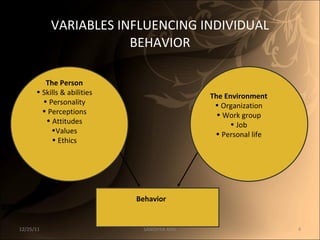
VARIABLES INFLUENCING INDIVIDUAL BEHAVIOR 12/25/11 SANDHYA ANIL The Environment Organization Work group Job Personal life The Person Skills & abilities Personality Perceptions Attitudes Values Ethics Behavior
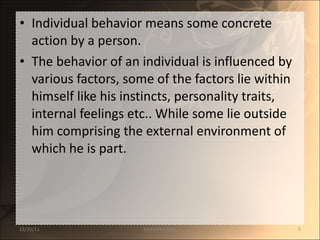
Individual behavior means some concrete  action by a person.  The behavior of an individual is influenced by various factors, some of the factors lie within himself like his instincts, personality traits, internal feelings etc.. While some lie outside him comprising the external environment of which he is part. 12/25/11 SANDHYA ANIL
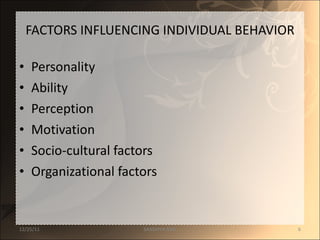
FACTORS INFLUENCING INDIVIDUAL BEHAVIOR Personality Ability Perception Motivation Socio-cultural factors Organizational factors 12/25/11 SANDHYA ANIL
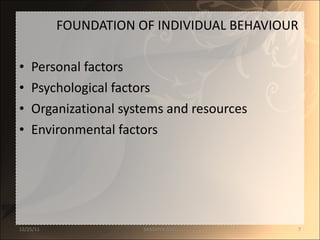
FOUNDATION OF INDIVIDUAL BEHAVIOUR Personal factors Psychological factors Organizational systems and resources Environmental factors 12/25/11 SANDHYA ANIL
Personal Factors Age Education Abilities creativity 12/25/11 SANDHYA ANIL
Psychological Factors Personality Perception Attitude Values learning 12/25/11 SANDHYA ANIL
Organizational systems and resources Physical facilities Organization structure and design Leadership Reward system work 12/25/11 SANDHYA ANIL
Environmental Factors Economic political Social norms and cultural values 12/25/11 SANDHYA ANIL
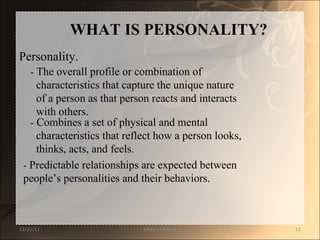
WHAT IS PERSONALITY?  Personality.  -  The overall profile or combination of  characteristics that capture the unique nature  of a person as that person reacts and interacts  with others.  -  Combines a set of physical and mental  characteristics that reflect how a person looks,  thinks, acts, and feels.  -  Predictable relationships are expected between  people ’s personalities and their behaviors.  12/25/11 SANDHYA ANIL
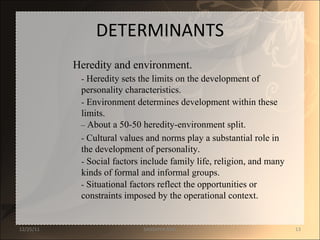
DETERMINANTS Heredity and environment.  -  Heredity sets the limits on the development of  personality characteristics.  -  Environment determines development within these  limits.  –   About a 50-50 heredity-environment split.  -  Cultural values and norms play a substantial role in  the development of personality.  -  Social factors include family life, religion, and many  kinds of formal and informal groups.  -  Situational factors reflect the opportunities or  constraints imposed by the operational context.  12/25/11 SANDHYA ANIL
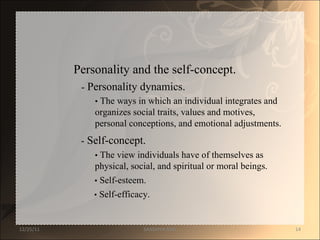
Personality and the self-concept.  -  Personality dynamics.  •   The ways in which an individual integrates and  organizes social traits, values and motives,  personal conceptions, and emotional adjustments.  -  Self-concept.  •   The view individuals have of themselves as  physical, social, and spiritual or moral beings.  •   Self-esteem.  •   Self-efficacy.  12/25/11 SANDHYA ANIL
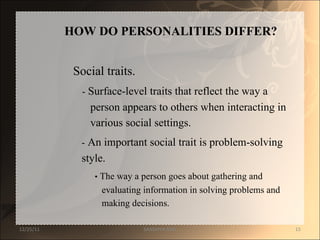
HOW DO PERSONALITIES DIFFER?  Social traits.  -  Surface-level traits that reflect the way a  person appears to others when interacting in  various social settings.  -  An important social trait is problem-solving  style.  •   The way a person goes about gathering and  evaluating information in solving problems and  making decisions.  12/25/11 SANDHYA ANIL
Information gathering in problem solving.  -  Getting and organizing data for use.  -  Sensation-type individuals prefer routine and  order and emphasize well-defined details in  gathering information.  -  Intuitive-type individuals like new problems  and dislike routine.  12/25/11 SANDHYA ANIL
Information evaluation in problem solving.  -  Making judgments about how to deal with  information once it has been collected.  –   Feeling-type individuals are oriented toward  conformity and try to accommodate  themselves to other people.  -  Thinking-type individuals use reason and  intellect to deal with problems and downplay  emotions.  12/25/11 SANDHYA ANIL
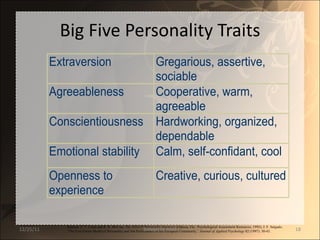
Big Five Personality Traits Sources: P. T. Costa and R. R. McCrae,  The NEO-PI Personality Inventory  (Odessa, Fla.: Psychological Assessment Resources, 1992); J. F. Salgado, “The Five Factor Model of Personality and Job Performance in the European Community,”  Journal of Applied Psychology  82 (1997): 30-43. 12/25/11 SANDHYA ANIL
Types of Personality Personality type theory aims to classify people into distinct CATEGORIES. i.e. this type or that.  Personality types are synonymous with "personality styles". Types refers to categories that are distinct and discontinuous. e.g. you are one or the other.  This is important to understand, because it helps to distinguish a personality type approach from a personality trait approach, which takes a continuous approach . Type A personality Type B personality 12/25/11 SANDHYA ANIL
Meyer Friedman, an American cardiologist, noticed in the 1940's that the chairs in his waiting room got worn out from the edges.  They hypothesized that his patients were driven, impatient people, who sat on the edge of their seats when waiting.  They labelled these people "Type A" personalities.  Type A personalities are work-aholics, always busy, driven, somewhat impatient, and so on.  Type B personalities, on the other hand are laid back and easy going.  "Type A personality" has found its way into general parlance. 12/25/11 SANDHYA ANIL
THE PERFECTIONIST One: Rational, conscientious, and responsible, Type Ones organize their energy around doing what is right and good. Self-controlled and sometimes resentful, they can be critical of self and others. They are also idealistic, purposeful, and tend to adhere to ethics, standards, and principles. 12/25/11 SANDHYA ANIL
THE HELPER Two: Caring, empathic, and generous, Type Twos organize their attention around being loving and giving. Thoughtful and attentive, they can also become demanding and overly-intrusive if they feel their kindness isn't appreciated. They may neglect their own needs to serve others. Good-natured and friendly, they are also competent and reliable. 12/25/11 SANDHYA ANIL
THE ACHIEVER Three: Efficient, effective high-achievers, Threes believe they must be successful to be loved. Industrious, practical, and goal-oriented, they can also be impatient and insensitive to others, when they can tune-out their feelings to accomplish tasks. They are at their best when they learn to balance work with relaxation and achieving with feeling. 12/25/11 SANDHYA ANIL
CREATIVE ARTIST Four: Expressive, empathetic, and moody, Fours base their identity on their feelings. They tend to cultivate only certain feelings, while rejecting others. They may focus on what's distant and special and have an aversion to the ordinary. Artistic, authentic, and sensitive, they are able to process painful experiences more easily than other types. 12/25/11 SANDHYA ANIL
THE OBSERVER Five: Intense, cerebral, and isolated, Fives place their attention on thinking, learning, and observing. They identify with having ideas and expressing unusual and insightful concepts. Doubting their competency leads Fives to become withholding, detached, and overly private. At their best, they are analytical, original thinkers who explore unknown territory. 12/25/11 SANDHYA ANIL
THE LOYAL SPECIFIC Six: Engaging, responsible, and committed, Sixes can also be fearful/anxious or rebellious/confrontational. They have an ambivalent relationship to authority, wanting an outside authority to ensure their safety, while doubting the authority figure can deliver. On the high side, Sixes are intuitive and loyal. They make excellent troubleshooters who can see through false pretenses. 12/25/11 SANDHYA ANIL
THE OPTIMIST Seven: Energetic, positive, and future-oriented, Sevens seek fun, new experiences. They avoid anxiety and pain by staying busy, planning, and through achievements. Spontaneous and adventurous, Sevens can become distracted and scattered, trying to do too many things at once. On the high side, they are often multi-talented, accomplished, and bring levity and "joie de vivre" to those around them. 12/25/11 SANDHYA ANIL
THE BOSS Eight: Powerful, decisive, and action-oriented, Eights focus on being strong and tough to earn respect and survive in a hostile world. When threatened, they can become aggressive, quick to anger, and extremely confrontational. Decisive and confident, they make excellent leaders, protecting the weak and fighting injustice. 12/25/11 SANDHYA ANIL
THE MEDIATOR Nine: Agreeable, gentle, and easygoing, Nines focus their attention on blending in with others and going with the flow. Since they are conflict-averse, it can be challenging for Nines to be direct, state what they want, and take action. Their ability to see both sides makes Nines excellent mediators. They are also loyal friends and steadfast partners. 12/25/11 SANDHYA ANIL
CONCEPTS TO SKILLS The self-concept is the accumulation of knowledge about the self, such as beliefs regarding personality traits, physical characteristics, abilities, values, goals, and roles. Beginning in infancy, children acquire and organize information about themselves as a way to enable them to understand the relation between the self and their social world. This developmental process is a direct consequence of children's emerging cognitive skills and their social relationships with both family and peers. During early childhood, children's self-concepts are less differentiated and are centered on concrete characteristics, such as physical attributes, possessions, and skills.  12/25/11 SANDHYA ANIL
Cont….. During middle childhood, the self-concept becomes more integrated and differentiated as the child engages in social comparison and more clearly perceives the self as consisting of internal, psychological characteristics. Throughout later childhood and adolescence, the self-concept becomes more abstract, complex, and hierarchically organized into cognitive mental representations or self-schemas, which direct the processing of self-relevant information. 12/25/11 SANDHYA ANIL
Four Theories of Personality 1. Trait 2. Psychoanalytic 3. Humanistic 4. Socio-Cognitive 12/25/11 SANDHYA ANIL
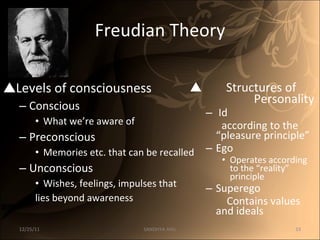
Freudian Theory Structures of  Personality Id according to the “pleasure principle” Ego Operates according to the “reality” principle Superego Contains values and ideals Levels of consciousness Conscious What we’re aware of Preconscious Memories etc. that can be recalled Unconscious Wishes, feelings, impulses that  lies beyond awareness 12/25/11 SANDHYA ANIL
Freudian Theory Anxiety occurs when: Impulses from the id threaten to get out of control The ego perceives danger from the environment The ego deals with the problem through: coping strategies defense mechanisms 12/25/11 SANDHYA ANIL
Myers-Briggs Personality Type Indicator – MBTI Swiss psychiatrist Carl Jung developed a theory early in the 20 th  century to describe basic individual preferences and explain similarities and differences between people Main postulate of the theory is that people have inborn behavioral tendencies and preferences Your natural response in daily situations Used when we are generally not stressed and feel competent, and energetic Could be defined as those behaviors you often don’t notice 12/25/11 SANDHYA ANIL
Four MBTI   Dichotomies 12/25/11 SANDHYA ANIL Extr a version – Introversion E - I Dichotomy Where do you prefer to focus your attention – and get your energy? Sensing – Intuition  S - N Dichotomy How do you prefer to take in information? Thinking – Feeling  T - F Dichotomy How do you make decisions? Judging – Perceiving J - P Dichotomy How do you deal with the outer world?
Humanistic Theory Humanistic personality  theories reject psychoanalytic notions Humanistic theories view each person as basically good and that people are striving for self-fulfillment Humanistic theory argues that people carry a perception of themselves and of the world The goal for a humanist is to develop/promote a positive self-concept 12/25/11 SANDHYA ANIL
Humanistic Perspectives Carl Rogers We have needs for: Self-consistency (absence of conflict between self-perceptions Congruence (consistency between self-perceptions and experience) Inconsistency evokes anxiety and threat People with low self-esteem generally have poor  congruence  between their self-concepts and life experiences. 12/25/11 SANDHYA ANIL
Social/Cognitive Perspective Proposed that each person has a unique personality because of our personal histories and interpretations shape our personalities Albert Bandura’s social-cognitive approach focuses on  self-efficacy   and   reciprocal determinism. Julian Rotter’s  locus of control theory  emphasizes a person’s internal or external focus as a major determinant of personality. 12/25/11 SANDHYA ANIL
Locus of Control (Rotter) Internal locus of control Life outcomes are under personal control Positively correlated with self-esteem Internals use more problem-focused coping External locus of control Luck, chance, and powerful others control behavior 12/25/11 SANDHYA ANIL
How is Personality Measured? Projective Test -   elicits an individual’s response to abstract stimuli Behavioral Measures  -  personality assessments that involve observing an individual’s behavior in a controlled situation Self-Report Questionnaire -   assessment involving an individual’s responses to questions Myers-Briggs Type Indicator (MBTI) -   instrument measuring Jung’s theory of individual differences.  12/25/11 SANDHYA ANIL
Cont…. Interview method Case history method Observation method 12/25/11 SANDHYA ANIL
-  The way individuals tend to think about their  social and physical settings as well as their  major beliefs and personal orientation.  •   Locus of control.  •   Authoritarianism/dogmatism.  •   Machiavellianism.  •   Self-monitoring.  Personality Attributes Influencing OB 12/25/11 SANDHYA ANIL
Locus of control.  -  The extent to which a person feels able to  control his/her own life.  -  Externals.  •   More extraverted in their interpersonal  relationships and more oriented toward the world  around them.  -  Internals.  •   More introverted and more oriented towards their  own feelings and ideas.  12/25/11 SANDHYA ANIL
Authoritarianism/dogmatism.  -  Authoritarianism.  •   Tendency  to adhere rigidly to conventional values  and to obey recognized authority.  -  Dogmatism.  •   Tendency to view the world as a threatening place.  12/25/11 SANDHYA ANIL
People with a high-Machiavellian personality:  -  Approach situations logically and  thoughtfully.  -  Are capable of lying to achieve personal goals.  – Are rarely swayed by loyalty, friendships, past  promises, or others’ opinions.  -  Are skilled at influencing others.  -  Try to exploit loosely structured situations.  -  Perform in a perfunctory or detached manner  in highly structured situations.  12/25/11 SANDHYA ANIL
People with a low-Machiavellian personality:  -  Accept direction imposed by others in loosely  structured situations.  –   Work hard to do well in highly structured  situations.  -  Are strongly guided by ethical considerations.  -  Are unlikely to lie or cheat.  12/25/11 SANDHYA ANIL
Self-monitoring.  -  A person ’s ability to adjust his/her behavior to  external situational factors.  –   High self-monitors.  •   Sensitive to external cues.  •   Behave differently in different situations.  -  Low self-monitors.  •   Not sensitive to external cues.  •   Not able to disguise their behaviors.  12/25/11 SANDHYA ANIL
PERCEPTION People often see the same phenomenon differently both with the organizational context and outside the organization. For example, in relation to a strike, a manager may perceive the immediate cause of the strike as trivial, while the workers may see it as very serious. Similarly, when there is any accident in the factory, the supervisor treat it as the carelessness of workers while the workers may treat it has high handedness of the management and lack of adequate provisions of security measures.  Thus, the situations remaining the same, causes have been assigned differently by different group of persons. In order to understand the significance of this phenomenon, one has to understand perception and its different aspects . 12/25/11 SANDHYA ANIL
Cont….. The behaviour of people is according to their perception. Perception is the cognitive process. Cognition is basically a bit of information, and cognitive process involved in ways in which people process that information. Like central processing units (CPU) of a computer, human beings also or information processors with on basic difference. While as the computers process a piece of information in the identical manner with identical output, human beings may differ because of their difference and uniqueness. 12/25/11 SANDHYA ANIL
DEFINITION Stephen P. Robins has defined perception as “Perception may be defined as a process by which individuals organize and interpret their sensory impressions in order to give meaning to their environment.” 12/25/11 SANDHYA ANIL
DEFINITION B. Von Haller Gilmer defined,  “ Perception is the process of becoming aware of situations, of adding meaningful associations to sensations”. 12/25/11 SANDHYA ANIL
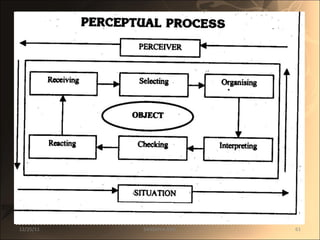
DEFINITION Udai Pareek defined,  “ Perception can be defined as the process of receiving, Selecting organizing, interpreting, checking and reactive to sensory stimuli or data”. 12/25/11 SANDHYA ANIL
Perception is an intellectual process, through which person selects the data from environment, organizes it and obtains meaning from it. The physical of obtaining data from environment, known as sensation. Perception is the basic cognitive or psychological process. The manner in which a person perceives the environment  affects his behavior. Thus, people’s actions, emotions, thoughts or feelings are triggered by the perception. 12/25/11 SANDHYA ANIL
Perception, being an intellectual and psychological process, becomes a subjective process and different people may perceive the same environmental event differently  based on what particular aspects of the situation they choose to absorb, how they organize this information, and the manner in which they interpret it to obtain their grasp of the situation. Thus, the subjectively perceived “really” in any given setting may be different for different people. 12/25/11 SANDHYA ANIL
Why is perception important in the study of O.B? Because people’s behavior is based on their perception of what reality is, not reality itself. The world as it is perceived is the world i.e., behaviorally important.  12/25/11 SANDHYA ANIL
Perception and Sensation :   There has been a great deal of misunderstanding about the relationship between sensation and perception. The physical senses vision, hearing, touch, smell and taste are different from the perception.  The sensation essentially deals with very elementary behavior that is largely determined by physiological  functioning. Perception on the other hand, is much more complex and broader than sensation.  It is virtually a cognitive, psychological process of sensing, filtering and modifying the raw data. As sensation plays an important role of people in their private lives, perception plays a crucial part in organizational life. 12/25/11 SANDHYA ANIL
When you change  the way you look at things, the things you look at change. 12/25/11 SANDHYA ANIL
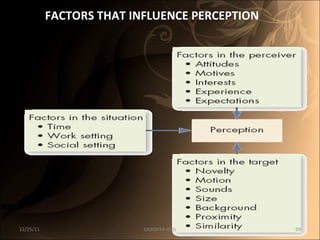
FACTORS THAT INFLUENCE PERCEPTION 12/25/11 SANDHYA ANIL
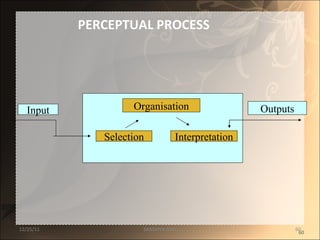
Organisation Selection Interpretation Input Input Outputs PERCEPTUAL PROCESS   12/25/11 SANDHYA ANIL
12/25/11 SANDHYA ANIL
Perception is essentially a psychological process. It is the chief mechanism by which people come to know about their surrounding environment. Perception is the process whereby people select, organize and interpret sensory stimulations into meaningful information about their work environment.  There can be known behavior without perception and perception lies at the base of every individual behavior. The best supervisor is one who can accurately and precisely estimate employee’s perceptions and made his moves. 12/25/11 SANDHYA ANIL
Perception is a process that operates constantly between reality and us.  There are three well-noted mechanisms of perception – section takes account of only those stimuli that are relevant and appropriate for only those stimuli that are relevant and appropriate for an individual.  Perceptual organization is concerned with harnessing the perceived inputs and converting them into a meaningful shape or form.  The final mechanism – perceptual interpretation, deals with inference from observed meaning from the perceived events or objects. From it emanates the resultant behavior of individual. 12/25/11 SANDHYA ANIL
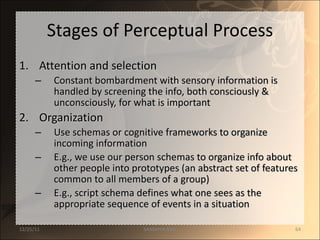
Stages of Perceptual Process Attention and selection Constant bombardment with sensory information is handled by screening the info, both consciously & unconsciously, for what is important Organization  Use schemas or cognitive frameworks to organize incoming information E.g., we use our person schemas to organize info about other people into prototypes (an abstract set of features common to all members of a group) E.g., script schema defines what one sees as the appropriate sequence of events in a situation 12/25/11 SANDHYA ANIL
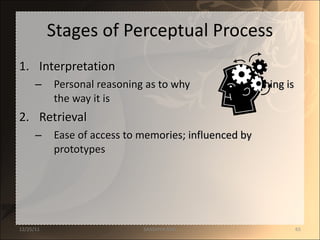
Stages of Perceptual Process Interpretation  Personal reasoning as to why  something is the way it is Retrieval Ease of access to memories; influenced by prototypes 12/25/11 SANDHYA ANIL
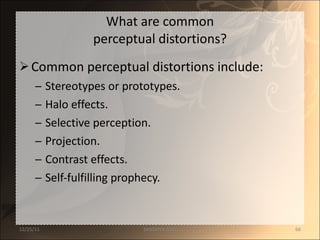
What are common perceptual distortions? Common perceptual distortions include: Stereotypes or prototypes. Halo effects. Selective perception. Projection. Contrast effects. Self-fulfilling prophecy. 12/25/11 SANDHYA ANIL
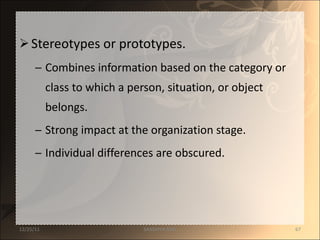
Stereotypes or prototypes. Combines information based on the category or class to which a person, situation, or object belongs. Strong impact at the organization stage. Individual differences are obscured. 12/25/11 SANDHYA ANIL
Halo effects. Occur when one attribute of a person or situation is used to develop an overall impression of the individual or situation. Likely to occur in the organization stage. Individual differences are obscured. Important in the performance appraisal process. 12/25/11 SANDHYA ANIL
Selective perception. The tendency to single out those aspects of a situation, person, or object that are consistent with one’s needs, values, or attitudes. Strongest impact is at the attention stage. Perception checking with other persons can help counter the adverse impact of selective perception. 12/25/11 SANDHYA ANIL
Projection. The assignment of one’s personal attributes to other individuals. Especially likely to occur in interpretation stage. Projection can be controlled through a high degree of self-awareness and empathy. 12/25/11 SANDHYA ANIL
Contrast effects. Occur when an individual is compared to other people on the same characteristics on which the others rank higher or lower. 12/25/11 SANDHYA ANIL
Self-fulfilling prophecy. The tendency to create or find in another situation or individual that which one expected to find. Also called the “Pygmalion effect.” Can have either positive or negative outcomes. Managers should adopt positive and optimistic approaches to people at work. 12/25/11 SANDHYA ANIL
Impression management. A person’s systematic attempt to behave in ways that create and maintain desired impressions in others’ eyes. Successful managers: Use impression management to enhance their own images. Are sensitive to other people’s use of impression management. 12/25/11 SANDHYA ANIL
How can the perceptual process be managed? Distortion management. Managers should: Balance automatic and controlled information processing at the attention and selection stage. Broaden their schemas at the organizing stage. Be attuned to attributions at the interpretation stage. 12/25/11 SANDHYA ANIL
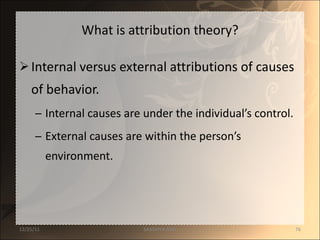
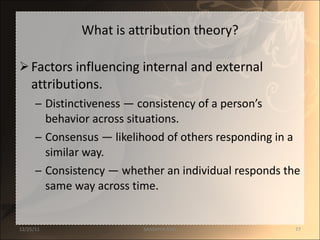
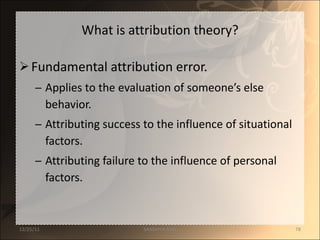
What is attribution theory? Attribution theory aids in perceptual interpretation by focusing on how people attempt to: Understand the causes of a certain event. Assess responsibility for the outcomes of the event. Evaluate the personal qualities of the people involved in the event. 12/25/11 SANDHYA ANIL
What is attribution theory? Internal versus external attributions of causes of behavior. Internal causes are under the individual’s control. External causes are within the person’s environment. 12/25/11 SANDHYA ANIL
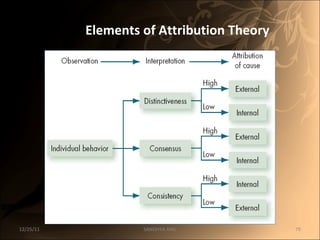
What is attribution theory? Factors influencing internal and external attributions. Distinctiveness  — c onsistency of a person’s behavior across situations. Consensus  — l ikelihood of others responding in a similar way. Consistency  — w hether an individual responds the same way across time. 12/25/11 SANDHYA ANIL
What is attribution theory? Fundamental attribution error. Applies to the evaluation of someone’s else behavior. Attributing success to the influence of situational factors. Attributing failure to the influence of personal factors. 12/25/11 SANDHYA ANIL
Elements of Attribution Theory 12/25/11 SANDHYA ANIL
What is attribution theory? Self-serving bias. Applies to the evaluation of our own behavior. Attributing success to the influence of personal factors. Attributing failure to the influence of situational factors. 12/25/11 SANDHYA ANIL
What is attribution theory? Attributions across cultures. The fundamental attribution error and self-serving bias operate differently in different cultures. 12/25/11 SANDHYA ANIL
EMOTIONS Emotions can influence organizational behavior in a number of ways, Some of the ways are direct, such as the triggering of behavior by emotions, whereas other ways are indirect, such as emotions influencing behavior through mediating mechanisms like motivation or cognition. 12/25/11 SANDHYA ANIL
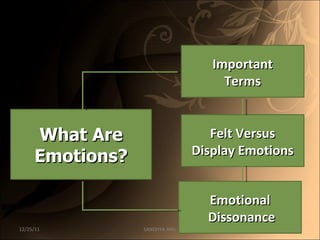
Felt Versus Display Emotions What Are Emotions? Emotional Dissonance Important Terms 12/25/11 SANDHYA ANIL
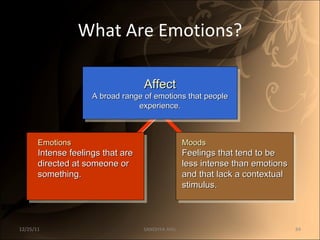
What Are Emotions? Moods Feelings that tend to be less intense than emotions and that lack a contextual stimulus. Emotions Intense feelings that are directed at someone or something. Affect A broad range of emotions that people experience. 12/25/11 SANDHYA ANIL
Until recently, the topic of emotions had been all but ignored in management scholarship. There are two possible explanations. First, the myth of rationality held that well-run organizations operated without frustration, anger, love, hate, joy, grief, and similar feelings. Since such emotions were the antithesis of rationality, even though researchers and managers tried to create organizations that were emotion-free. Second, when emotions were considered, the strong negative emotions (like anger) took center stage because they interfered with the productivity of employees. So emotions were rarely viewed as being constructive or motivational. But no study of behavior could be comprehensive without studying the role of emotions in the workplace.  12/25/11 SANDHYA ANIL
Before going further, we need to clarify three closely-related terms.  Affect  is a generic term that covers a broad range of human feelings. It is an umbrella concept that encompasses both emotions and moods.  Emotions  are intense feelings which are directed at someone or something.  Moods  are feelings that tend to be less intense than emotions and lack a contextual stimulus.  12/25/11 SANDHYA ANIL
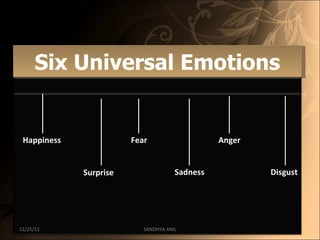
Six Universal Emotions Happiness Surprise Fear Sadness Anger Disgust 12/25/11 SANDHYA ANIL
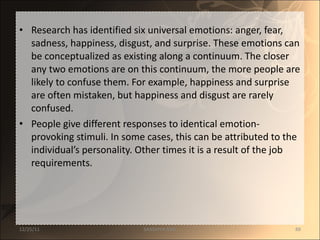
Research has identified six universal emotions: anger, fear, sadness, happiness, disgust, and surprise. These emotions can be conceptualized as existing along a continuum. The closer any two emotions are on this continuum, the more people are likely to confuse them. For example, happiness and surprise are often mistaken, but happiness and disgust are rarely confused.  People give different responses to identical emotion-provoking stimuli. In some cases, this can be attributed to the individual’s personality. Other times it is a result of the job requirements.  12/25/11 SANDHYA ANIL
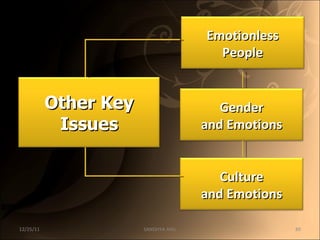
12/25/11 SANDHYA ANIL Emotionless People Other Key Issues Gender and Emotions Culture and Emotions
Some people find it hard to express their emotions and to understand the emotions of others. Psychologists call this condition  alexithymia  (Greek for lack of emotion). Does their inability to express emotions or read others mean that they will be poor workers? Not necessarily. While they are ill-suited for sales or managerial positions, they may be excellent computer programmers. 12/25/11 SANDHYA ANIL
It is widely assumed that women are more “in touch” with their feelings than men. Is this assumption true? Evidence confirms that women and men differ in their emotional abilities. Women show greater emotional expression than men; they experience emotions more intensely and display them more frequently; they are more comfortable expressing their emotions; and they are better at reading nonverbal cues. Three possible explanations for these differences have been offered:  (1) men and women are socialized differently;  (2) women have more innate ability to read others and express their emotions; and (3) women have a greater need for social approval and display more positive emotions.  12/25/11 SANDHYA ANIL
What is acceptable in one culture may be unusual or dysfunctional in another culture. And cultures interpret emotions differently. There tends to be high agreement on what emotions mean within cultures but not between them. Studies show that some cultures lack words for such standard emotions as anxiety, depression, or guilt, for instance, do not have a word directly equivalent to sadness.  12/25/11 SANDHYA ANIL
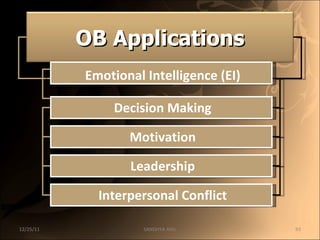
Emotional Intelligence (EI) Decision Making Motivation Leadership Interpersonal Conflict 12/25/11 SANDHYA ANIL OB Applications
EMOTIONAL INTELLIGENCE Emotional intelligence (EI) refers to a assortment of non-cognitive skills, capabilities, and competencies that influence a person’s ability to cope with environmental demands and pressures. It is composed of five dimensions: self-awareness, self-management, self-motivation, empathy, and social skills. Several studies show that EI can play an important role in job performance, especially in jobs that demand a high degree of social interaction. Traditional approaches to decision making in organizations have emphasized rationality and downplayed or ignored the role of emotions. Yet, it is naïve to assume that decisions are not influenced by one’s feelings. Indeed, people use emotions as well as rational and intuitive processes when making decisions. 12/25/11 SANDHYA ANIL
Ability and Selection Emotional Intelligence (EI) Self-awareness Self-management Self-motivation Empathy Social skills Research Findings High EI scores, not high IQ scores, characterize high performers. 12/25/11 SANDHYA ANIL
EMOTIONAL LABOR 12/25/11 SANDHYA ANIL
Every employee expends physical and mental labor on the job. But most jobs require  emotional labor . This is when an employee expresses organizationally desired emotions during interpersonal transactions. Emotional labor creates dilemmas for employees when their job requires that they exhibit emotions which are incongruous with their true feelings.  Felt emotions  are a person’s actual emotions.  Displayed emotions  are considered appropriate in a given job. The key point is that felt and displayed emotions are often quite different. 12/25/11 SANDHYA ANIL
OB Applications of Understanding Emotions Ability and Selection Emotions affect employee effectiveness. Decision Making Emotions are an important part of the decision-making process in organizations. Motivation Emotional commitment to work and high motivation are strongly linked. Leadership Emotions are important to acceptance of messages from organizational leaders. 12/25/11 SANDHYA ANIL
OB Applications of Understanding Emotions Interpersonal Conflict Conflict in the workplace and individual emotions are strongly intertwined. Deviant Workplace Behaviors Negative emotions can lead to employee deviance in the form of actions that violate established norms and threaten the organization and its members. Productivity failures Property theft and destruction Political actions Personal aggression 12/25/11 SANDHYA ANIL
ATTITUDES An  attitude  is a hypothetical construct that represents an individual's degree of like or dislike for an item. Attitudes are generally positive or negative views of a person, place, thing, or event—this is often referred to as the attitude object. People can also be conflicted or ambivalent toward an object, meaning that they simultaneously possess both positive and negative attitudes toward the item in question. 12/25/11 SANDHYA ANIL
Definitions  “ Attitudes are likes and dislikes”  According to Bem “ Attitude is learned predispositions to respond to an object or class of object in a consistently favorable or unfavorable way” According to  Allport  12/25/11 SANDHYA ANIL
SOURCES OF ATTITUDE Attitudes are acquired from parents, teachers and members of the peer group. The genetic make-up of a child initially determines his personality and attitudes.  However, as the child begins his schooling and interacts with people, his attitudes are influenced by the people whom he admires, respects or fears. Individuals are more willing to modify their behavior and shape their attitude to align with the behavior of people whom they look up to.  This is the reason why companies have their products endorsed by popular personalities such as leading cricket players and film stars. Such endorsement helps develop a positive attitude toward their products among the public. 12/25/11 SANDHYA ANIL
CONT….. People are generally not as steadfast about their attitudes as they are about their values.  Thus, the attitudes of people can be easily influenced and altered. Attitudes can be changed by various means: by providing new information, by coercion or threat, by resolving differences, and by involving people (dissatisfied with a situation in the organization) in problem solving. It is only natural for employees to have a hostile attitude toward change in the organization. However, if the management helps employees understand the competitive threat the organization is facing and makes them realize the need for change and organization development, the employees will, most likely, overcome their hostile attitude and agree to bring about change in the organization. 12/25/11 SANDHYA ANIL
CONT…… Attitudes can also be changed by providing the right type of feedback to employees. If a manager always makes only negative remarks in his feedback to employees, the employees may develop a negative attitude towards the job and workplace.  The manager should therefore be trained to give objective feedback (which includes both positive and negative points) in a manner that does not de-motivating employees. This will help change the attitude of employees towards their job and work environment and will go a long way in preventing job dissatisfaction and turnover. 12/25/11 SANDHYA ANIL
Personal experience   People come into contact with objects in their everyday environment. Some are familiar while others are new. We evaluate the new and reevaluate the old and this evaluation process assists in developing attitudes toward objects.  12/25/11 SANDHYA ANIL
CONT….. Needs: Because needs differ and also vary over time, people can develop different attitudes toward the same object at different points in their life.  Selective perception: We have seen that people operate on their personal interpretation of reality.  Personality is another factor influencing how people process their direct experiences with objects. How aggressive passive introverted extroverted and so on that people are will affect the attitudes they form.  12/25/11 SANDHYA ANIL
Group Associations   All people are influenced to one degree or another by other members in the groups to which they belong. Attitudes are one target for this influence. Our attitudes toward products ethics warfare and a multitude of other subjects are influenced strongly by groups that we value and with which we do or wish to associate. Several groups, including family, work, and peer groups, and cultural and sub-cultural groups, are important in affecting a person’s attitude development.  12/25/11 SANDHYA ANIL
Influential Others   A individual’s attitude can be formed and changed through personal contact with influential persons such as respected friends relatives and experts. Opinion leaders are examples of people who are respected by their followers and who may strongly influence the attitudes.  12/25/11 SANDHYA ANIL
TYPES OF ATTITUDE Job satisfaction Job involvement Organizational commitment 12/25/11 SANDHYA ANIL
Job Satisfaction One of the tasks of managers is to provide satisfaction to employees from their respective jobs. The term Job-satisfaction refers to an individual’s general attitude towards his job. A person with high job satisfaction holds positive attitude towards his job, while a person who is dissatisfied with his job holds a negative attitude more often than not they mean job satisfaction. In fact, the two terms are used interchangeably. 12/25/11 SANDHYA ANIL
Job Involvement The term job involvement refers to the degree to which a person identifies psychologically with his job and considers his perceived performance level important to his self worth. A person with a high degree of involvement will identify with his job and will care about the kind of work he does on his job.  12/25/11 SANDHYA ANIL
Organizational Commitment If job involvement refers to one’s identification with particular job, organizational commitments means one’s involvement with his employing organization. Being another name for organizational loyalty, organizational commitment results in a stable work force. As with job involvement, attitude is an important variable in determining organizational commitment.  12/25/11 SANDHYA ANIL
Cognitive dissonance theory One obstacle to the change of attitude is the attitude theory of balance and consistency. That is, human beings  prefer their attitudes bout people, and things to be in line (i.e., balanced, consistent) with their behaviors towards each other objects.  When attitudes or behaviors are not consistence, people usually seek to reduce the inconsistency rewarding internally. Leon Festinger has developed a theory in support of attitude consistency called cognitive dissonance.  Festinger’s theory states that dissonance makes an individual feel uncomfortable. This feeling makes the individual try to reduce dissonance. 12/25/11 SANDHYA ANIL
Cont….. Cognitive dissonance also occurs when a person behaves in fashion that is inconsistent with his or her attitude. For example, a person may realize that smoking and overeating are dangerous, yet continue to do both.  Because the attitude and behaviors are not consistent with each other, the person probably will experience a certain amount of tension and discomfort and may engage in dissonance reduction, seeking ways to reduce the dissonance and tension it causes. The dissonance associated with smoking might be resolved rationalizing.” Just a pack a day will not affect my health”, or “I can quit when I have to do”. With regard to overrating, the person may decide to go on a diet “Next week”.  In general, the person attempts to change the attitude, alter the behavior, or perceptually distort the circumstances to reduce tension and discomfort.  12/25/11 SANDHYA ANIL
Cont…….. In the organizational setting cognitive dissonance occur when an employee desires to leave the present job as there is no use in continuing and working hard. The individual may rationalize his or her stay with such explanations as, “Organisation is not bad, after all”, or “what is the alternative?” The second barrier to change of attitude is prior commitments. This occurs when people feel a commitment to a particular course of action and are unwilling to change. 12/25/11 SANDHYA ANIL
Cont……… The third barrier results from insufficient information. Sometimes people see no reason why they should change their attitudes. The boss may not like a subordinate’s negative attitude, but the latter may be quite pleased with his behaviour. Unless the boss can show the individual why a negative attitude is detrimental to career progress or salary increases of some other personal objective, the subordinates may continue to have negative. 12/25/11 SANDHYA ANIL
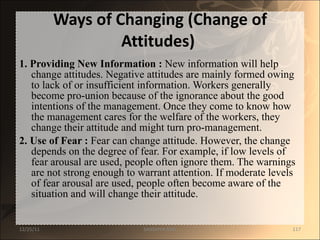
Ways of Changing (Change of Attitudes)   1. Providing New Information :  New information will help change attitudes. Negative attitudes are mainly formed owing to lack of or insufficient information. Workers generally become pro-union because of the ignorance about the good intentions of the management. Once they come to know how the management cares for the welfare of the workers, they change their attitude and might turn pro-management. 2. Use of Fear :  Fear can change attitude. However, the change depends on the degree of fear. For example, if low levels of fear arousal are used, people often ignore them. The warnings are not strong enough to warrant attention. If moderate levels of fear arousal are used, people often become aware of the situation and will change their attitude. 12/25/11 SANDHYA ANIL
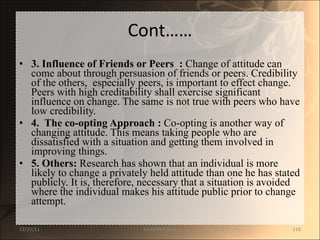
Cont…… 3. Influence of Friends or Peers  :  Change of attitude can come about through persuasion of friends or peers. Credibility of the others,  especially peers, is important to effect change. Peers with high creditability shall exercise significant influence on change. The same is not true with peers who have low credibility. 4.  The co-opting Approach :  Co-opting is another way of changing attitude. This means taking people who are dissatisfied with a situation and getting them involved in improving things. 5. Others:  Research has shown that an individual is more likely to change a privately held attitude than one he has stated publicly. It is, therefore, necessary that a situation is avoided where the individual makes his attitude public prior to change attempt. 12/25/11 SANDHYA ANIL
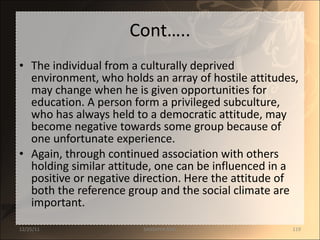
Cont….. The individual from a culturally deprived environment, who holds an array of hostile attitudes, may change when he is given opportunities for education. A person form a privileged subculture, who has always held to a democratic attitude, may become negative towards some group because of one unfortunate experience.  Again, through continued association with others holding similar attitude, one can be influenced in a positive or negative direction. Here the attitude of both the reference group and the social climate are important. 12/25/11 SANDHYA ANIL
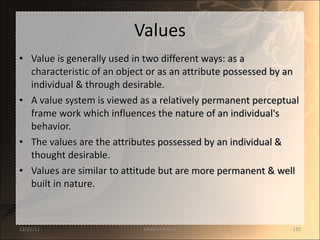
Values Value is generally used in two different ways: as a characteristic of an object or as an attribute possessed by an individual & through desirable. A value system is viewed as a relatively permanent perceptual frame work which influences the nature of an individual's behavior. The values are the attributes possessed by an individual & thought desirable. Values are similar to attitude but are more permanent & well built in nature. 12/25/11 SANDHYA ANIL
A  value system  is a set of consistent values and measures. A  principle value  is a foundation upon which other values and measures of integrity are based. Those values which are not physiologically determined and normally considered objective, such as a desire to avoid physical pain, seek pleasure, etc., are considered subjective, vary across individuals and cultures and are in many ways aligned with belief and belief systems.  12/25/11 SANDHYA ANIL
Values Definition:  “ Values are global beliefs that guide actions & judgments across a variety of situations.” The Characteristics of values are: Values provide standards of competence & morality Values are fewer in number than attitudes Values are relatively permanent & resistance to change Values are most central to the core of the person 12/25/11 SANDHYA ANIL
Values Importance of values: Values lay the foundation for the understanding of attitude and motivation Personal value system influence the perception of individuals Value system influences perception Value system influences decision making & solution to various problems Values influence the attitude & behavior. 12/25/11 SANDHYA ANIL
Values Types of values: An extensive research conducted by the noted psychologist Miltion Rokeach identifies two basic types of values: Terminal values – a terminal value is an ultimate goal in a desired status or outcome. These lead to the ends to be achieved. Eg., comfortable life, wisdom, pleasure, salvation, equality, freedom etc. 12/25/11 SANDHYA ANIL
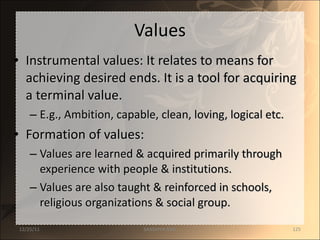
Values Instrumental values: It relates to means for achieving desired ends. It is a tool for acquiring a terminal value. E.g., Ambition, capable, clean, loving, logical etc. Formation of values:  Values are learned & acquired primarily through experience with people & institutions.  Values are also taught & reinforced in schools, religious organizations & social group. 12/25/11 SANDHYA ANIL
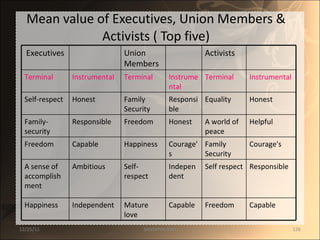
Mean value of Executives, Union Members & Activists ( Top five) 12/25/11 SANDHYA ANIL Executives Union Members Activists Terminal Instrumental Terminal Instrumental Terminal Instrumental Self-respect Honest Family Security Responsible Equality Honest Family-security Responsible Freedom Honest A world of peace Helpful Freedom Capable Happiness Courage's Family Security Courage's A sense of accomplishment Ambitious Self-respect Independent Self respect Responsible Happiness Independent Mature love Capable Freedom Capable
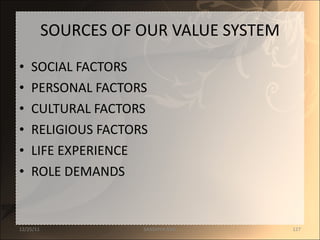
SOURCES OF OUR VALUE SYSTEM SOCIAL FACTORS PERSONAL FACTORS CULTURAL FACTORS RELIGIOUS FACTORS LIFE EXPERIENCE ROLE DEMANDS 12/25/11 SANDHYA ANIL
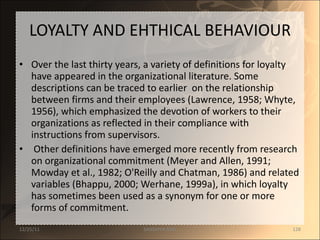
LOYALTY AND EHTHICAL BEHAVIOUR Over the last thirty years, a variety of definitions for loyalty have appeared in the organizational literature. Some descriptions can be traced to earlier  on the relationship between firms and their employees (Lawrence, 1958; Whyte, 1956), which emphasized the devotion of workers to their organizations as reflected in their compliance with instructions from supervisors. Other definitions have emerged more recently from research on organizational commitment (Meyer and Allen, 1991; Mowday et al., 1982; O'Reilly and Chatman, 1986) and related variables (Bhappu, 2000; Werhane, 1999a), in which loyalty has sometimes been used as a synonym for one or more forms of commitment.  12/25/11 SANDHYA ANIL
Cont……. Today, definitions of loyalty range from specific to broad, and capture attitudes and behaviors involving a variety of foci (Butler and Cantrell, 1984; Fletcher, 1993).  As the set of definitions continues to expand, it becomes increasingly difficult to determine exactly what is meant by "loyalty" and how it should be measured. This leads to contradictory findings about the presence or absence of loyalty in organizations and makes it more difficult to identify loyalty's antecedents and outcomes.  12/25/11 SANDHYA ANIL
Cont……. First, the notion that loyal individuals select values highlights the fact that loyalty involves a voluntary decision about what standards to use in evaluating potential courses of action in the workplace. Second, Allport's (1933) suggestion that loyalty involves adherence indicates the importance of on going behavior among loyal individuals.  Finally, his view that loyalty involves adherence to some principle of conduct we consider good emphasizes loyalty's moral nature. Though a variety of definitions for morality exist, they generally refer to behavior that conforms to principles of right conduct (Dunfee, 2001).  By evaluating various principles of conduct and adhering to those viewed as good, the loyal individual engages in moral judgment prior to action.  12/25/11 SANDHYA ANIL
Cont…… The inclusion of "moral principles" in the new definition is based on Oldenquist's (1982) conceptualization of loyalty. It is meant to suggest that a loyal individual decides upon appropriate courses of action by focusing on a community's moral principles.  12/25/11 SANDHYA ANIL
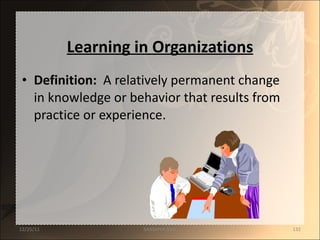
Learning in Organizations Definition:   A relatively permanent change in knowledge or behavior that results from practice or experience. 12/25/11 SANDHYA ANIL
The Learning Organization Organizational learning  is the process through which managers instill in all members of an organization a desire to find new ways to improve organizational effectiveness. Five activities are central to a learning organization: Encouragement of personal mastery or high self-efficacy. Development of complex schemas to understand work activities. Encouragement of learning in groups and teams. Communicating a shared vision for the organization as a whole. Encouraging systematic thinking. 12/25/11 SANDHYA ANIL
Cont….. Knowledge management  is the ability to capitalize on the knowledge possessed by organizational members which is not necessarily written down anywhere or codified in formal documents. 12/25/11 SANDHYA ANIL
THEORIES OF LEARNING The behavioral orientation The cognitive orientation The humanistic orientation The social/situational orientation 12/25/11 SANDHYA ANIL
Few Prominent Theories  Classical conditioning Operant conditioning Cognitive learning Social learning theories 12/25/11 SANDHYA ANIL
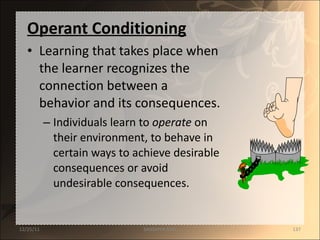
Operant Conditioning Learning that takes place when the learner recognizes the connection between a behavior and its consequences. Individuals learn to  operate  on their environment, to behave in certain ways to achieve desirable consequences or avoid undesirable consequences. 12/25/11 SANDHYA ANIL
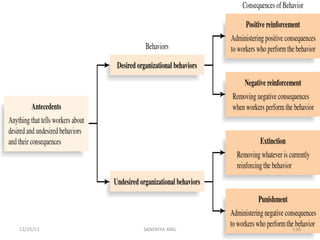
Insert Figure 5.1 here 12/25/11 SANDHYA ANIL
Reinforcement Reinforcement:   Increasing the probability that a desired behavior will occur again in the future by applying consequences that depend on the behavior in question. Positive Reinforcement:   The administration of positive consequences to workers who perform  desired behaviors. Pay, promotions, interesting work, praise, awards Negative Reinforcement:   The removal of  negative consequences when workers perform desired behaviors. Nagging, complaining 12/25/11 SANDHYA ANIL
Reinforcement Schedules Continuous Reinforcement :  Occurs after every occurrence of a behavior. Partial Reinforcement :  Occurs only a portion of the time that behavior occurs. Differences: Continuous reinforcement can result in faster learning of desired behaviors. Behaviors learned using partial reinforcement are likely to last longer. 12/25/11 SANDHYA ANIL
Reinforcement Schedules Fixed-Interval Schedule :  The period of time between the occurrence of each instance of reinforcement is fixed or set. Variable-Interval Schedule :  The amount of time between reinforcements varies around a constant average. Fixed-Ratio Schedule :  A certain number of desired behaviors must occur before reinforcement is provided.  Variable-Ratio Schedule :  The number of desired behaviors that must occur before reinforcement varies around a constant average. 12/25/11 SANDHYA ANIL
Extinction and Punishment Extinction :  Removing a consequence that is currently reinforcing an undesirable behavior in an effort to decrease the probability that the behavior will occur again in the future. Punishment :   Administering negative consequences to workers who perform undesirable behaviors in an effort to decrease the probability that the behavior will occur again in the future. Verbal reprimands, docking pay, loss of privileges 12/25/11 SANDHYA ANIL
Negative Reinforcement vs. Punishment These two concepts are often confused; however, they differ from each other in two important ways. First difference: Punishment  reduces  the probability of an  undesired  behavior. Negative reinforcement  increases  the probability of a  desired  behavior. Second difference: Punishment involves  administering  a  negative   consequence  when an  undesired  behavior occurs. Negative reinforcement entails  removing  a  negative   consequence  when a  desired  behavior occurs. 12/25/11 SANDHYA ANIL
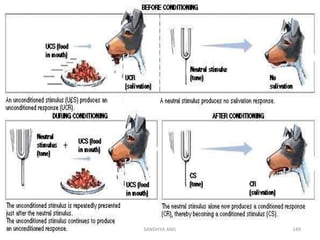
Classical Conditioning Example… Learning that results from pairing two events in the environment. Learn to associate a  neutral event  with another event or stimulus from the environment. 12/25/11 SANDHYA ANIL
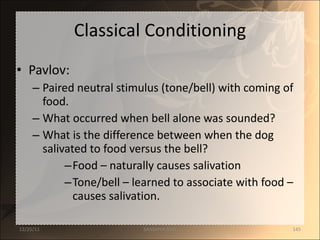
Classical Conditioning Pavlov: Paired neutral stimulus (tone/bell) with coming of food. What occurred when bell alone was sounded? What is the difference between when the dog salivated to food versus the bell? Food – naturally causes salivation Tone/bell – learned to associate with food – causes salivation. 12/25/11 SANDHYA ANIL
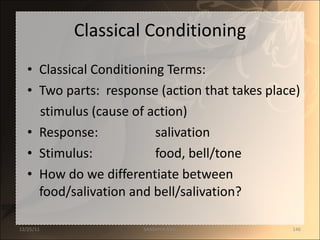
Classical Conditioning Classical Conditioning Terms: Two parts:  response (action that takes place) stimulus (cause of action) Response: salivation Stimulus:  food, bell/tone How do we differentiate between food/salivation and bell/salivation? 12/25/11 SANDHYA ANIL
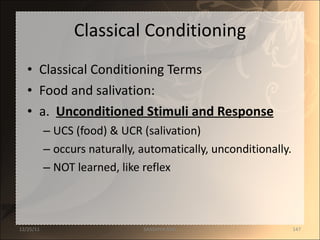
Classical Conditioning Classical Conditioning Terms Food and salivation: a.  Unconditioned Stimuli and Response UCS (food) & UCR (salivation) occurs naturally, automatically, unconditionally.  NOT learned, like reflex 12/25/11 SANDHYA ANIL
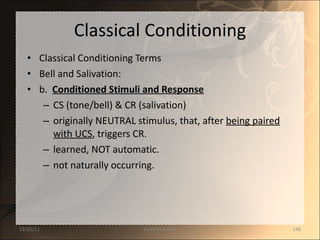
Classical Conditioning Classical Conditioning Terms Bell and Salivation: b.  Conditioned Stimuli and Response CS (tone/bell) & CR (salivation) originally NEUTRAL stimulus, that, after  being paired with UCS , triggers CR. learned, NOT automatic. not naturally occurring. 12/25/11 SANDHYA ANIL
12/25/11 SANDHYA ANIL
Classical Conditioning Conditioning Processes and Principles a.  Acquisition :  initial stage of learning. b.  Extinction : diminishing of a CR. When CS is no longer paired with UCS, eventually, the CS ALONE will not elicit the CR. c.  Spontaneous Recovery : The reappearance, after a rest period, of an extinguished  CR.  (What does this suggest?) 12/25/11 SANDHYA ANIL
Classical Conditioning Example of Little Albert (Watson). d.  Generalization :  when a CS is paired with a UCS, stimuli similar to CS can evoke similar responses (like CR). e.  Discrimination : learned ability to distinguish between two stimuli.  How could an animal be trained to discriminate between stimuli? 12/25/11 SANDHYA ANIL
Classical Conditioning Limits and concerns with original theory. From CC – early psychologists concluded: Any organism can be conditioned to any stimulus. a.  Influence of biological predispositions  (Garcia & Koelling, 1966). Only study observable responses/behavior. No mention of mental processes  (dogs were passive, mechanical, mindless) Behaviorism :  only study observable behavior, no thoughts, cognition, etc. Couldn’t use terms: expectation, prediction 12/25/11 SANDHYA ANIL
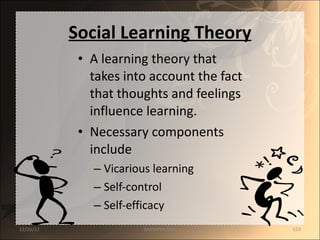
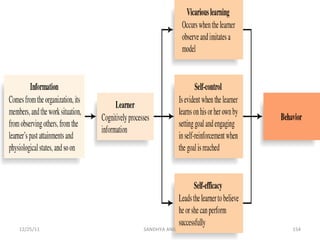
Social Learning Theory A learning theory that takes into account the fact that thoughts and feelings influence learning. Necessary components include Vicarious learning Self-control Self-efficacy 12/25/11 SANDHYA ANIL
Insert Figure 5.3 here 12/25/11 SANDHYA ANIL
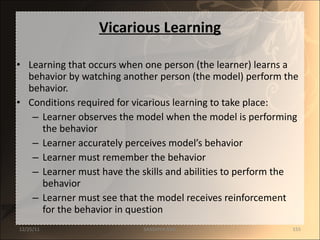
Vicarious Learning Learning that occurs when one person (the learner) learns a behavior by watching another person (the model) perform the behavior. Conditions required for vicarious learning to take place: Learner observes the model when the model is performing the behavior Learner accurately perceives model’s behavior Learner must remember the behavior Learner must have the skills and abilities to perform the behavior Learner must see that the model receives reinforcement for the behavior in question 12/25/11 SANDHYA ANIL
Cont….. Learners can also learn from situations in which models get punished. Role models can be positive or negative. 12/25/11 SANDHYA ANIL
Self-Control Self-discipline that allows a person to learn to perform a behavior even though there is no external pressure to do so. Conditions indicating a person is using self-control: Individual is engaging in a low-probability behavior Self-reinforce are available to the learner The learner sets goals that determine when self-reinforcement takes place The learner administers reinforcers when the goal is achieved 12/25/11 SANDHYA ANIL
Self-Efficacy A person’s belief about his or her ability to perform a particular behavior successfully. Not the same as self-esteem Self-efficacy affects learning in three ways: The activities and goals that individuals choose for themselves The effort that individuals exert The persistence with which a person tries to master new and sometimes difficult tasks 12/25/11 SANDHYA ANIL
Cont…… Four sources of self-efficacy: Past performance Vicarious experience or observation of others Verbal persuasion Individuals’ readings of their internal physiological states 12/25/11 SANDHYA ANIL
Cognitive Theory Jean Piaget Interaction with the environment Development of ‘schemata’ Active nature of learning Discovery learning 12/25/11 SANDHYA ANIL
Cont….. Jean Piaget was a Swiss psychologist who developed an interest in how children think.  He proposed that childrens' thought processes develop from birth through a series of stages.  He stated that children think in a different way to adults.  He felt that the child had to progress through the stages by  interacting with their environment .  He proposed the notion of  schema  - a set of interrelated ideas about a concept. These schemas (or schemata) develop from the basic reflexes that the infant is born with, through the interaction with their environment.  12/25/11 SANDHYA ANIL
Cont…. So a baby is born with a sucking reflex, which is applied to any object that the baby grasps; in doing so the baby notices and absorbs other characteristics of the object Piaget focused on the  active  nature of learning.  The individual is naturally interested in exploring the environment and will learn through  discovery. Piaget never applied his ideas to education, but others have.  Discovery learning focuses on the active nature of the learner, using interaction with the environment.  The teacher must set up an appropriate environment to ensure that learning occurs. 12/25/11 SANDHYA ANIL
Cont…. Discovery learning is one of the most important of the learning approaches because it can be highly motivating and can help children to structure what they are learning.  It is also one of the most difficult to use well and creating situations in which children can make discoveries which are within their capacity is a fascinating professional task. (Dean J.1983) 12/25/11 SANDHYA ANIL
Organizational application Employee discipline Developing training programmes Creating mentoring programmes Self management 12/25/11 SANDHYA ANIL

OB - INDIVIDUAL BEHAVIOUR

  • 1.
    INDIVIDUAL BEHAVIOUR MODULE7 12/25/11 SANDHYA ANIL
  • 2.
    INTRODUCTION An organizationis basically the association of human beings and a major problem of today’s organization is how to get maximum possible efforts and contributions of the human beings determining these efforts and contributions, those responsible for managing the organization must understand the way human beings behave. It is to be noted that the world of human work consists of individual performing jobs in some setting, usually in some organization. 12/25/11 SANDHYA ANIL
  • 3.
    CONT….. The factthat there are tremendous differences among individuals and among jobs is the basis of the frequently expressed notion of “matching” people and jobs and of the expression “round pegs in square holes” when the “match” is not a good one. Mismatches can occur in any setting. 12/25/11 SANDHYA ANIL
  • 4.
    VARIABLES INFLUENCING INDIVIDUALBEHAVIOR 12/25/11 SANDHYA ANIL The Environment Organization Work group Job Personal life The Person Skills & abilities Personality Perceptions Attitudes Values Ethics Behavior
  • 5.
    Individual behavior meanssome concrete action by a person. The behavior of an individual is influenced by various factors, some of the factors lie within himself like his instincts, personality traits, internal feelings etc.. While some lie outside him comprising the external environment of which he is part. 12/25/11 SANDHYA ANIL
  • 6.
    FACTORS INFLUENCING INDIVIDUALBEHAVIOR Personality Ability Perception Motivation Socio-cultural factors Organizational factors 12/25/11 SANDHYA ANIL
  • 7.
    FOUNDATION OF INDIVIDUALBEHAVIOUR Personal factors Psychological factors Organizational systems and resources Environmental factors 12/25/11 SANDHYA ANIL
  • 8.
    Personal Factors AgeEducation Abilities creativity 12/25/11 SANDHYA ANIL
  • 9.
    Psychological Factors PersonalityPerception Attitude Values learning 12/25/11 SANDHYA ANIL
  • 10.
    Organizational systems andresources Physical facilities Organization structure and design Leadership Reward system work 12/25/11 SANDHYA ANIL
  • 11.
    Environmental Factors Economicpolitical Social norms and cultural values 12/25/11 SANDHYA ANIL
  • 12.
    WHAT IS PERSONALITY? Personality. - The overall profile or combination of characteristics that capture the unique nature of a person as that person reacts and interacts with others. - Combines a set of physical and mental characteristics that reflect how a person looks, thinks, acts, and feels. - Predictable relationships are expected between people ’s personalities and their behaviors. 12/25/11 SANDHYA ANIL
  • 13.
    DETERMINANTS Heredity andenvironment. - Heredity sets the limits on the development of personality characteristics. - Environment determines development within these limits. – About a 50-50 heredity-environment split. - Cultural values and norms play a substantial role in the development of personality. - Social factors include family life, religion, and many kinds of formal and informal groups. - Situational factors reflect the opportunities or constraints imposed by the operational context. 12/25/11 SANDHYA ANIL
  • 14.
    Personality and theself-concept. - Personality dynamics. • The ways in which an individual integrates and organizes social traits, values and motives, personal conceptions, and emotional adjustments. - Self-concept. • The view individuals have of themselves as physical, social, and spiritual or moral beings. • Self-esteem. • Self-efficacy. 12/25/11 SANDHYA ANIL
  • 15.
    HOW DO PERSONALITIESDIFFER? Social traits. - Surface-level traits that reflect the way a person appears to others when interacting in various social settings. - An important social trait is problem-solving style. • The way a person goes about gathering and evaluating information in solving problems and making decisions. 12/25/11 SANDHYA ANIL
  • 16.
    Information gathering inproblem solving. - Getting and organizing data for use. - Sensation-type individuals prefer routine and order and emphasize well-defined details in gathering information. - Intuitive-type individuals like new problems and dislike routine. 12/25/11 SANDHYA ANIL
  • 17.
    Information evaluation inproblem solving. - Making judgments about how to deal with information once it has been collected. – Feeling-type individuals are oriented toward conformity and try to accommodate themselves to other people. - Thinking-type individuals use reason and intellect to deal with problems and downplay emotions. 12/25/11 SANDHYA ANIL
  • 18.
    Big Five PersonalityTraits Sources: P. T. Costa and R. R. McCrae, The NEO-PI Personality Inventory (Odessa, Fla.: Psychological Assessment Resources, 1992); J. F. Salgado, “The Five Factor Model of Personality and Job Performance in the European Community,” Journal of Applied Psychology 82 (1997): 30-43. 12/25/11 SANDHYA ANIL
  • 19.
    Types of PersonalityPersonality type theory aims to classify people into distinct CATEGORIES. i.e. this type or that.  Personality types are synonymous with "personality styles". Types refers to categories that are distinct and discontinuous. e.g. you are one or the other.  This is important to understand, because it helps to distinguish a personality type approach from a personality trait approach, which takes a continuous approach . Type A personality Type B personality 12/25/11 SANDHYA ANIL
  • 20.
    Meyer Friedman, anAmerican cardiologist, noticed in the 1940's that the chairs in his waiting room got worn out from the edges.  They hypothesized that his patients were driven, impatient people, who sat on the edge of their seats when waiting.  They labelled these people "Type A" personalities.  Type A personalities are work-aholics, always busy, driven, somewhat impatient, and so on.  Type B personalities, on the other hand are laid back and easy going.  "Type A personality" has found its way into general parlance. 12/25/11 SANDHYA ANIL
  • 21.
    THE PERFECTIONIST One:Rational, conscientious, and responsible, Type Ones organize their energy around doing what is right and good. Self-controlled and sometimes resentful, they can be critical of self and others. They are also idealistic, purposeful, and tend to adhere to ethics, standards, and principles. 12/25/11 SANDHYA ANIL
  • 22.
    THE HELPER Two:Caring, empathic, and generous, Type Twos organize their attention around being loving and giving. Thoughtful and attentive, they can also become demanding and overly-intrusive if they feel their kindness isn't appreciated. They may neglect their own needs to serve others. Good-natured and friendly, they are also competent and reliable. 12/25/11 SANDHYA ANIL
  • 23.
    THE ACHIEVER Three:Efficient, effective high-achievers, Threes believe they must be successful to be loved. Industrious, practical, and goal-oriented, they can also be impatient and insensitive to others, when they can tune-out their feelings to accomplish tasks. They are at their best when they learn to balance work with relaxation and achieving with feeling. 12/25/11 SANDHYA ANIL
  • 24.
    CREATIVE ARTIST Four:Expressive, empathetic, and moody, Fours base their identity on their feelings. They tend to cultivate only certain feelings, while rejecting others. They may focus on what's distant and special and have an aversion to the ordinary. Artistic, authentic, and sensitive, they are able to process painful experiences more easily than other types. 12/25/11 SANDHYA ANIL
  • 25.
    THE OBSERVER Five:Intense, cerebral, and isolated, Fives place their attention on thinking, learning, and observing. They identify with having ideas and expressing unusual and insightful concepts. Doubting their competency leads Fives to become withholding, detached, and overly private. At their best, they are analytical, original thinkers who explore unknown territory. 12/25/11 SANDHYA ANIL
  • 26.
    THE LOYAL SPECIFICSix: Engaging, responsible, and committed, Sixes can also be fearful/anxious or rebellious/confrontational. They have an ambivalent relationship to authority, wanting an outside authority to ensure their safety, while doubting the authority figure can deliver. On the high side, Sixes are intuitive and loyal. They make excellent troubleshooters who can see through false pretenses. 12/25/11 SANDHYA ANIL
  • 27.
    THE OPTIMIST Seven:Energetic, positive, and future-oriented, Sevens seek fun, new experiences. They avoid anxiety and pain by staying busy, planning, and through achievements. Spontaneous and adventurous, Sevens can become distracted and scattered, trying to do too many things at once. On the high side, they are often multi-talented, accomplished, and bring levity and "joie de vivre" to those around them. 12/25/11 SANDHYA ANIL
  • 28.
    THE BOSS Eight:Powerful, decisive, and action-oriented, Eights focus on being strong and tough to earn respect and survive in a hostile world. When threatened, they can become aggressive, quick to anger, and extremely confrontational. Decisive and confident, they make excellent leaders, protecting the weak and fighting injustice. 12/25/11 SANDHYA ANIL
  • 29.
    THE MEDIATOR Nine:Agreeable, gentle, and easygoing, Nines focus their attention on blending in with others and going with the flow. Since they are conflict-averse, it can be challenging for Nines to be direct, state what they want, and take action. Their ability to see both sides makes Nines excellent mediators. They are also loyal friends and steadfast partners. 12/25/11 SANDHYA ANIL
  • 30.
    CONCEPTS TO SKILLSThe self-concept is the accumulation of knowledge about the self, such as beliefs regarding personality traits, physical characteristics, abilities, values, goals, and roles. Beginning in infancy, children acquire and organize information about themselves as a way to enable them to understand the relation between the self and their social world. This developmental process is a direct consequence of children's emerging cognitive skills and their social relationships with both family and peers. During early childhood, children's self-concepts are less differentiated and are centered on concrete characteristics, such as physical attributes, possessions, and skills. 12/25/11 SANDHYA ANIL
  • 31.
    Cont….. During middlechildhood, the self-concept becomes more integrated and differentiated as the child engages in social comparison and more clearly perceives the self as consisting of internal, psychological characteristics. Throughout later childhood and adolescence, the self-concept becomes more abstract, complex, and hierarchically organized into cognitive mental representations or self-schemas, which direct the processing of self-relevant information. 12/25/11 SANDHYA ANIL
  • 32.
    Four Theories ofPersonality 1. Trait 2. Psychoanalytic 3. Humanistic 4. Socio-Cognitive 12/25/11 SANDHYA ANIL
  • 33.
    Freudian Theory Structuresof Personality Id according to the “pleasure principle” Ego Operates according to the “reality” principle Superego Contains values and ideals Levels of consciousness Conscious What we’re aware of Preconscious Memories etc. that can be recalled Unconscious Wishes, feelings, impulses that lies beyond awareness 12/25/11 SANDHYA ANIL
  • 34.
    Freudian Theory Anxietyoccurs when: Impulses from the id threaten to get out of control The ego perceives danger from the environment The ego deals with the problem through: coping strategies defense mechanisms 12/25/11 SANDHYA ANIL
  • 35.
    Myers-Briggs Personality TypeIndicator – MBTI Swiss psychiatrist Carl Jung developed a theory early in the 20 th century to describe basic individual preferences and explain similarities and differences between people Main postulate of the theory is that people have inborn behavioral tendencies and preferences Your natural response in daily situations Used when we are generally not stressed and feel competent, and energetic Could be defined as those behaviors you often don’t notice 12/25/11 SANDHYA ANIL
  • 36.
    Four MBTI  Dichotomies 12/25/11 SANDHYA ANIL Extr a version – Introversion E - I Dichotomy Where do you prefer to focus your attention – and get your energy? Sensing – Intuition S - N Dichotomy How do you prefer to take in information? Thinking – Feeling T - F Dichotomy How do you make decisions? Judging – Perceiving J - P Dichotomy How do you deal with the outer world?
  • 37.
    Humanistic Theory Humanisticpersonality theories reject psychoanalytic notions Humanistic theories view each person as basically good and that people are striving for self-fulfillment Humanistic theory argues that people carry a perception of themselves and of the world The goal for a humanist is to develop/promote a positive self-concept 12/25/11 SANDHYA ANIL
  • 38.
    Humanistic Perspectives CarlRogers We have needs for: Self-consistency (absence of conflict between self-perceptions Congruence (consistency between self-perceptions and experience) Inconsistency evokes anxiety and threat People with low self-esteem generally have poor congruence between their self-concepts and life experiences. 12/25/11 SANDHYA ANIL
  • 39.
    Social/Cognitive Perspective Proposedthat each person has a unique personality because of our personal histories and interpretations shape our personalities Albert Bandura’s social-cognitive approach focuses on self-efficacy and reciprocal determinism. Julian Rotter’s locus of control theory emphasizes a person’s internal or external focus as a major determinant of personality. 12/25/11 SANDHYA ANIL
  • 40.
    Locus of Control(Rotter) Internal locus of control Life outcomes are under personal control Positively correlated with self-esteem Internals use more problem-focused coping External locus of control Luck, chance, and powerful others control behavior 12/25/11 SANDHYA ANIL
  • 41.
    How is PersonalityMeasured? Projective Test - elicits an individual’s response to abstract stimuli Behavioral Measures - personality assessments that involve observing an individual’s behavior in a controlled situation Self-Report Questionnaire - assessment involving an individual’s responses to questions Myers-Briggs Type Indicator (MBTI) - instrument measuring Jung’s theory of individual differences. 12/25/11 SANDHYA ANIL
  • 42.
    Cont…. Interview methodCase history method Observation method 12/25/11 SANDHYA ANIL
  • 43.
    - Theway individuals tend to think about their social and physical settings as well as their major beliefs and personal orientation. • Locus of control. • Authoritarianism/dogmatism. • Machiavellianism. • Self-monitoring. Personality Attributes Influencing OB 12/25/11 SANDHYA ANIL
  • 44.
    Locus of control. - The extent to which a person feels able to control his/her own life. - Externals. • More extraverted in their interpersonal relationships and more oriented toward the world around them. - Internals. • More introverted and more oriented towards their own feelings and ideas. 12/25/11 SANDHYA ANIL
  • 45.
    Authoritarianism/dogmatism. - Authoritarianism. • Tendency to adhere rigidly to conventional values and to obey recognized authority. - Dogmatism. • Tendency to view the world as a threatening place. 12/25/11 SANDHYA ANIL
  • 46.
    People with ahigh-Machiavellian personality: - Approach situations logically and thoughtfully. - Are capable of lying to achieve personal goals. – Are rarely swayed by loyalty, friendships, past promises, or others’ opinions. - Are skilled at influencing others. - Try to exploit loosely structured situations. - Perform in a perfunctory or detached manner in highly structured situations. 12/25/11 SANDHYA ANIL
  • 47.
    People with alow-Machiavellian personality: - Accept direction imposed by others in loosely structured situations. – Work hard to do well in highly structured situations. - Are strongly guided by ethical considerations. - Are unlikely to lie or cheat. 12/25/11 SANDHYA ANIL
  • 48.
    Self-monitoring. - A person ’s ability to adjust his/her behavior to external situational factors. – High self-monitors. • Sensitive to external cues. • Behave differently in different situations. - Low self-monitors. • Not sensitive to external cues. • Not able to disguise their behaviors. 12/25/11 SANDHYA ANIL
  • 49.
    PERCEPTION People oftensee the same phenomenon differently both with the organizational context and outside the organization. For example, in relation to a strike, a manager may perceive the immediate cause of the strike as trivial, while the workers may see it as very serious. Similarly, when there is any accident in the factory, the supervisor treat it as the carelessness of workers while the workers may treat it has high handedness of the management and lack of adequate provisions of security measures. Thus, the situations remaining the same, causes have been assigned differently by different group of persons. In order to understand the significance of this phenomenon, one has to understand perception and its different aspects . 12/25/11 SANDHYA ANIL
  • 50.
    Cont….. The behaviourof people is according to their perception. Perception is the cognitive process. Cognition is basically a bit of information, and cognitive process involved in ways in which people process that information. Like central processing units (CPU) of a computer, human beings also or information processors with on basic difference. While as the computers process a piece of information in the identical manner with identical output, human beings may differ because of their difference and uniqueness. 12/25/11 SANDHYA ANIL
  • 51.
    DEFINITION Stephen P.Robins has defined perception as “Perception may be defined as a process by which individuals organize and interpret their sensory impressions in order to give meaning to their environment.” 12/25/11 SANDHYA ANIL
  • 52.
    DEFINITION B. VonHaller Gilmer defined, “ Perception is the process of becoming aware of situations, of adding meaningful associations to sensations”. 12/25/11 SANDHYA ANIL
  • 53.
    DEFINITION Udai Pareekdefined, “ Perception can be defined as the process of receiving, Selecting organizing, interpreting, checking and reactive to sensory stimuli or data”. 12/25/11 SANDHYA ANIL
  • 54.
    Perception is anintellectual process, through which person selects the data from environment, organizes it and obtains meaning from it. The physical of obtaining data from environment, known as sensation. Perception is the basic cognitive or psychological process. The manner in which a person perceives the environment affects his behavior. Thus, people’s actions, emotions, thoughts or feelings are triggered by the perception. 12/25/11 SANDHYA ANIL
  • 55.
    Perception, being anintellectual and psychological process, becomes a subjective process and different people may perceive the same environmental event differently based on what particular aspects of the situation they choose to absorb, how they organize this information, and the manner in which they interpret it to obtain their grasp of the situation. Thus, the subjectively perceived “really” in any given setting may be different for different people. 12/25/11 SANDHYA ANIL
  • 56.
    Why is perceptionimportant in the study of O.B? Because people’s behavior is based on their perception of what reality is, not reality itself. The world as it is perceived is the world i.e., behaviorally important. 12/25/11 SANDHYA ANIL
  • 57.
    Perception and Sensation: There has been a great deal of misunderstanding about the relationship between sensation and perception. The physical senses vision, hearing, touch, smell and taste are different from the perception. The sensation essentially deals with very elementary behavior that is largely determined by physiological functioning. Perception on the other hand, is much more complex and broader than sensation. It is virtually a cognitive, psychological process of sensing, filtering and modifying the raw data. As sensation plays an important role of people in their private lives, perception plays a crucial part in organizational life. 12/25/11 SANDHYA ANIL
  • 58.
    When you change the way you look at things, the things you look at change. 12/25/11 SANDHYA ANIL
  • 59.
    FACTORS THAT INFLUENCEPERCEPTION 12/25/11 SANDHYA ANIL
  • 60.
    Organisation Selection InterpretationInput Input Outputs PERCEPTUAL PROCESS 12/25/11 SANDHYA ANIL
  • 61.
  • 62.
    Perception is essentiallya psychological process. It is the chief mechanism by which people come to know about their surrounding environment. Perception is the process whereby people select, organize and interpret sensory stimulations into meaningful information about their work environment. There can be known behavior without perception and perception lies at the base of every individual behavior. The best supervisor is one who can accurately and precisely estimate employee’s perceptions and made his moves. 12/25/11 SANDHYA ANIL
  • 63.
    Perception is aprocess that operates constantly between reality and us. There are three well-noted mechanisms of perception – section takes account of only those stimuli that are relevant and appropriate for only those stimuli that are relevant and appropriate for an individual. Perceptual organization is concerned with harnessing the perceived inputs and converting them into a meaningful shape or form. The final mechanism – perceptual interpretation, deals with inference from observed meaning from the perceived events or objects. From it emanates the resultant behavior of individual. 12/25/11 SANDHYA ANIL
  • 64.
    Stages of PerceptualProcess Attention and selection Constant bombardment with sensory information is handled by screening the info, both consciously & unconsciously, for what is important Organization Use schemas or cognitive frameworks to organize incoming information E.g., we use our person schemas to organize info about other people into prototypes (an abstract set of features common to all members of a group) E.g., script schema defines what one sees as the appropriate sequence of events in a situation 12/25/11 SANDHYA ANIL
  • 65.
    Stages of PerceptualProcess Interpretation Personal reasoning as to why something is the way it is Retrieval Ease of access to memories; influenced by prototypes 12/25/11 SANDHYA ANIL
  • 66.
    What are commonperceptual distortions? Common perceptual distortions include: Stereotypes or prototypes. Halo effects. Selective perception. Projection. Contrast effects. Self-fulfilling prophecy. 12/25/11 SANDHYA ANIL
  • 67.
    Stereotypes or prototypes.Combines information based on the category or class to which a person, situation, or object belongs. Strong impact at the organization stage. Individual differences are obscured. 12/25/11 SANDHYA ANIL
  • 68.
    Halo effects. Occurwhen one attribute of a person or situation is used to develop an overall impression of the individual or situation. Likely to occur in the organization stage. Individual differences are obscured. Important in the performance appraisal process. 12/25/11 SANDHYA ANIL
  • 69.
    Selective perception. Thetendency to single out those aspects of a situation, person, or object that are consistent with one’s needs, values, or attitudes. Strongest impact is at the attention stage. Perception checking with other persons can help counter the adverse impact of selective perception. 12/25/11 SANDHYA ANIL
  • 70.
    Projection. The assignmentof one’s personal attributes to other individuals. Especially likely to occur in interpretation stage. Projection can be controlled through a high degree of self-awareness and empathy. 12/25/11 SANDHYA ANIL
  • 71.
    Contrast effects. Occurwhen an individual is compared to other people on the same characteristics on which the others rank higher or lower. 12/25/11 SANDHYA ANIL
  • 72.
    Self-fulfilling prophecy. Thetendency to create or find in another situation or individual that which one expected to find. Also called the “Pygmalion effect.” Can have either positive or negative outcomes. Managers should adopt positive and optimistic approaches to people at work. 12/25/11 SANDHYA ANIL
  • 73.
    Impression management. Aperson’s systematic attempt to behave in ways that create and maintain desired impressions in others’ eyes. Successful managers: Use impression management to enhance their own images. Are sensitive to other people’s use of impression management. 12/25/11 SANDHYA ANIL
  • 74.
    How can theperceptual process be managed? Distortion management. Managers should: Balance automatic and controlled information processing at the attention and selection stage. Broaden their schemas at the organizing stage. Be attuned to attributions at the interpretation stage. 12/25/11 SANDHYA ANIL
  • 75.
    What is attributiontheory? Attribution theory aids in perceptual interpretation by focusing on how people attempt to: Understand the causes of a certain event. Assess responsibility for the outcomes of the event. Evaluate the personal qualities of the people involved in the event. 12/25/11 SANDHYA ANIL
  • 76.
    What is attributiontheory? Internal versus external attributions of causes of behavior. Internal causes are under the individual’s control. External causes are within the person’s environment. 12/25/11 SANDHYA ANIL
  • 77.
    What is attributiontheory? Factors influencing internal and external attributions. Distinctiveness — c onsistency of a person’s behavior across situations. Consensus — l ikelihood of others responding in a similar way. Consistency — w hether an individual responds the same way across time. 12/25/11 SANDHYA ANIL
  • 78.
    What is attributiontheory? Fundamental attribution error. Applies to the evaluation of someone’s else behavior. Attributing success to the influence of situational factors. Attributing failure to the influence of personal factors. 12/25/11 SANDHYA ANIL
  • 79.
    Elements of AttributionTheory 12/25/11 SANDHYA ANIL
  • 80.
    What is attributiontheory? Self-serving bias. Applies to the evaluation of our own behavior. Attributing success to the influence of personal factors. Attributing failure to the influence of situational factors. 12/25/11 SANDHYA ANIL
  • 81.
    What is attributiontheory? Attributions across cultures. The fundamental attribution error and self-serving bias operate differently in different cultures. 12/25/11 SANDHYA ANIL
  • 82.
    EMOTIONS Emotions caninfluence organizational behavior in a number of ways, Some of the ways are direct, such as the triggering of behavior by emotions, whereas other ways are indirect, such as emotions influencing behavior through mediating mechanisms like motivation or cognition. 12/25/11 SANDHYA ANIL
  • 83.
    Felt Versus DisplayEmotions What Are Emotions? Emotional Dissonance Important Terms 12/25/11 SANDHYA ANIL
  • 84.
    What Are Emotions?Moods Feelings that tend to be less intense than emotions and that lack a contextual stimulus. Emotions Intense feelings that are directed at someone or something. Affect A broad range of emotions that people experience. 12/25/11 SANDHYA ANIL
  • 85.
    Until recently, thetopic of emotions had been all but ignored in management scholarship. There are two possible explanations. First, the myth of rationality held that well-run organizations operated without frustration, anger, love, hate, joy, grief, and similar feelings. Since such emotions were the antithesis of rationality, even though researchers and managers tried to create organizations that were emotion-free. Second, when emotions were considered, the strong negative emotions (like anger) took center stage because they interfered with the productivity of employees. So emotions were rarely viewed as being constructive or motivational. But no study of behavior could be comprehensive without studying the role of emotions in the workplace. 12/25/11 SANDHYA ANIL
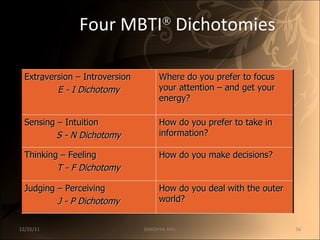
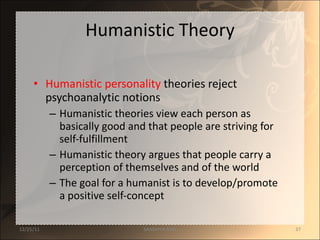
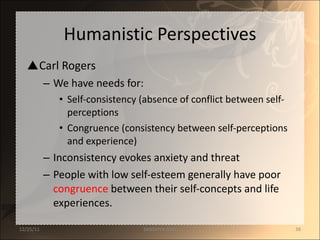
  • 86.
    Before going further,we need to clarify three closely-related terms. Affect is a generic term that covers a broad range of human feelings. It is an umbrella concept that encompasses both emotions and moods. Emotions are intense feelings which are directed at someone or something. Moods are feelings that tend to be less intense than emotions and lack a contextual stimulus. 12/25/11 SANDHYA ANIL
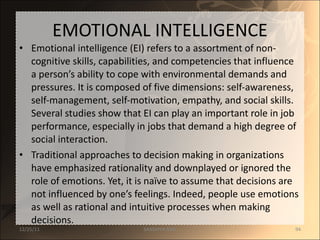
  • 87.
    Six Universal EmotionsHappiness Surprise Fear Sadness Anger Disgust 12/25/11 SANDHYA ANIL
  • 88.
    Research has identifiedsix universal emotions: anger, fear, sadness, happiness, disgust, and surprise. These emotions can be conceptualized as existing along a continuum. The closer any two emotions are on this continuum, the more people are likely to confuse them. For example, happiness and surprise are often mistaken, but happiness and disgust are rarely confused. People give different responses to identical emotion-provoking stimuli. In some cases, this can be attributed to the individual’s personality. Other times it is a result of the job requirements. 12/25/11 SANDHYA ANIL
  • 89.
    12/25/11 SANDHYA ANILEmotionless People Other Key Issues Gender and Emotions Culture and Emotions
  • 90.
    Some people findit hard to express their emotions and to understand the emotions of others. Psychologists call this condition alexithymia (Greek for lack of emotion). Does their inability to express emotions or read others mean that they will be poor workers? Not necessarily. While they are ill-suited for sales or managerial positions, they may be excellent computer programmers. 12/25/11 SANDHYA ANIL
  • 91.
    It is widelyassumed that women are more “in touch” with their feelings than men. Is this assumption true? Evidence confirms that women and men differ in their emotional abilities. Women show greater emotional expression than men; they experience emotions more intensely and display them more frequently; they are more comfortable expressing their emotions; and they are better at reading nonverbal cues. Three possible explanations for these differences have been offered: (1) men and women are socialized differently; (2) women have more innate ability to read others and express their emotions; and (3) women have a greater need for social approval and display more positive emotions. 12/25/11 SANDHYA ANIL
  • 92.
    What is acceptablein one culture may be unusual or dysfunctional in another culture. And cultures interpret emotions differently. There tends to be high agreement on what emotions mean within cultures but not between them. Studies show that some cultures lack words for such standard emotions as anxiety, depression, or guilt, for instance, do not have a word directly equivalent to sadness. 12/25/11 SANDHYA ANIL
  • 93.
    Emotional Intelligence (EI)Decision Making Motivation Leadership Interpersonal Conflict 12/25/11 SANDHYA ANIL OB Applications
  • 94.
    EMOTIONAL INTELLIGENCE Emotionalintelligence (EI) refers to a assortment of non-cognitive skills, capabilities, and competencies that influence a person’s ability to cope with environmental demands and pressures. It is composed of five dimensions: self-awareness, self-management, self-motivation, empathy, and social skills. Several studies show that EI can play an important role in job performance, especially in jobs that demand a high degree of social interaction. Traditional approaches to decision making in organizations have emphasized rationality and downplayed or ignored the role of emotions. Yet, it is naïve to assume that decisions are not influenced by one’s feelings. Indeed, people use emotions as well as rational and intuitive processes when making decisions. 12/25/11 SANDHYA ANIL
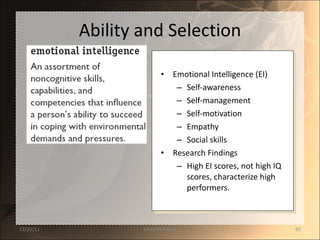
  • 95.
    Ability and SelectionEmotional Intelligence (EI) Self-awareness Self-management Self-motivation Empathy Social skills Research Findings High EI scores, not high IQ scores, characterize high performers. 12/25/11 SANDHYA ANIL
  • 96.
  • 97.
    Every employee expendsphysical and mental labor on the job. But most jobs require emotional labor . This is when an employee expresses organizationally desired emotions during interpersonal transactions. Emotional labor creates dilemmas for employees when their job requires that they exhibit emotions which are incongruous with their true feelings. Felt emotions are a person’s actual emotions. Displayed emotions are considered appropriate in a given job. The key point is that felt and displayed emotions are often quite different. 12/25/11 SANDHYA ANIL
  • 98.
    OB Applications ofUnderstanding Emotions Ability and Selection Emotions affect employee effectiveness. Decision Making Emotions are an important part of the decision-making process in organizations. Motivation Emotional commitment to work and high motivation are strongly linked. Leadership Emotions are important to acceptance of messages from organizational leaders. 12/25/11 SANDHYA ANIL
  • 99.
    OB Applications ofUnderstanding Emotions Interpersonal Conflict Conflict in the workplace and individual emotions are strongly intertwined. Deviant Workplace Behaviors Negative emotions can lead to employee deviance in the form of actions that violate established norms and threaten the organization and its members. Productivity failures Property theft and destruction Political actions Personal aggression 12/25/11 SANDHYA ANIL
  • 100.
    ATTITUDES An attitude is a hypothetical construct that represents an individual's degree of like or dislike for an item. Attitudes are generally positive or negative views of a person, place, thing, or event—this is often referred to as the attitude object. People can also be conflicted or ambivalent toward an object, meaning that they simultaneously possess both positive and negative attitudes toward the item in question. 12/25/11 SANDHYA ANIL
  • 101.
    Definitions “Attitudes are likes and dislikes” According to Bem “ Attitude is learned predispositions to respond to an object or class of object in a consistently favorable or unfavorable way” According to Allport 12/25/11 SANDHYA ANIL
  • 102.
    SOURCES OF ATTITUDEAttitudes are acquired from parents, teachers and members of the peer group. The genetic make-up of a child initially determines his personality and attitudes. However, as the child begins his schooling and interacts with people, his attitudes are influenced by the people whom he admires, respects or fears. Individuals are more willing to modify their behavior and shape their attitude to align with the behavior of people whom they look up to. This is the reason why companies have their products endorsed by popular personalities such as leading cricket players and film stars. Such endorsement helps develop a positive attitude toward their products among the public. 12/25/11 SANDHYA ANIL
  • 103.
    CONT….. People aregenerally not as steadfast about their attitudes as they are about their values. Thus, the attitudes of people can be easily influenced and altered. Attitudes can be changed by various means: by providing new information, by coercion or threat, by resolving differences, and by involving people (dissatisfied with a situation in the organization) in problem solving. It is only natural for employees to have a hostile attitude toward change in the organization. However, if the management helps employees understand the competitive threat the organization is facing and makes them realize the need for change and organization development, the employees will, most likely, overcome their hostile attitude and agree to bring about change in the organization. 12/25/11 SANDHYA ANIL
  • 104.
    CONT…… Attitudes canalso be changed by providing the right type of feedback to employees. If a manager always makes only negative remarks in his feedback to employees, the employees may develop a negative attitude towards the job and workplace. The manager should therefore be trained to give objective feedback (which includes both positive and negative points) in a manner that does not de-motivating employees. This will help change the attitude of employees towards their job and work environment and will go a long way in preventing job dissatisfaction and turnover. 12/25/11 SANDHYA ANIL
  • 105.
    Personal experience People come into contact with objects in their everyday environment. Some are familiar while others are new. We evaluate the new and reevaluate the old and this evaluation process assists in developing attitudes toward objects. 12/25/11 SANDHYA ANIL
  • 106.
    CONT….. Needs: Becauseneeds differ and also vary over time, people can develop different attitudes toward the same object at different points in their life. Selective perception: We have seen that people operate on their personal interpretation of reality. Personality is another factor influencing how people process their direct experiences with objects. How aggressive passive introverted extroverted and so on that people are will affect the attitudes they form. 12/25/11 SANDHYA ANIL
  • 107.
    Group Associations All people are influenced to one degree or another by other members in the groups to which they belong. Attitudes are one target for this influence. Our attitudes toward products ethics warfare and a multitude of other subjects are influenced strongly by groups that we value and with which we do or wish to associate. Several groups, including family, work, and peer groups, and cultural and sub-cultural groups, are important in affecting a person’s attitude development. 12/25/11 SANDHYA ANIL
  • 108.
    Influential Others A individual’s attitude can be formed and changed through personal contact with influential persons such as respected friends relatives and experts. Opinion leaders are examples of people who are respected by their followers and who may strongly influence the attitudes. 12/25/11 SANDHYA ANIL
  • 109.
    TYPES OF ATTITUDEJob satisfaction Job involvement Organizational commitment 12/25/11 SANDHYA ANIL
  • 110.
    Job Satisfaction Oneof the tasks of managers is to provide satisfaction to employees from their respective jobs. The term Job-satisfaction refers to an individual’s general attitude towards his job. A person with high job satisfaction holds positive attitude towards his job, while a person who is dissatisfied with his job holds a negative attitude more often than not they mean job satisfaction. In fact, the two terms are used interchangeably. 12/25/11 SANDHYA ANIL
  • 111.
    Job Involvement Theterm job involvement refers to the degree to which a person identifies psychologically with his job and considers his perceived performance level important to his self worth. A person with a high degree of involvement will identify with his job and will care about the kind of work he does on his job. 12/25/11 SANDHYA ANIL
  • 112.
    Organizational Commitment Ifjob involvement refers to one’s identification with particular job, organizational commitments means one’s involvement with his employing organization. Being another name for organizational loyalty, organizational commitment results in a stable work force. As with job involvement, attitude is an important variable in determining organizational commitment. 12/25/11 SANDHYA ANIL
  • 113.
    Cognitive dissonance theoryOne obstacle to the change of attitude is the attitude theory of balance and consistency. That is, human beings prefer their attitudes bout people, and things to be in line (i.e., balanced, consistent) with their behaviors towards each other objects. When attitudes or behaviors are not consistence, people usually seek to reduce the inconsistency rewarding internally. Leon Festinger has developed a theory in support of attitude consistency called cognitive dissonance. Festinger’s theory states that dissonance makes an individual feel uncomfortable. This feeling makes the individual try to reduce dissonance. 12/25/11 SANDHYA ANIL
  • 114.
    Cont….. Cognitive dissonancealso occurs when a person behaves in fashion that is inconsistent with his or her attitude. For example, a person may realize that smoking and overeating are dangerous, yet continue to do both. Because the attitude and behaviors are not consistent with each other, the person probably will experience a certain amount of tension and discomfort and may engage in dissonance reduction, seeking ways to reduce the dissonance and tension it causes. The dissonance associated with smoking might be resolved rationalizing.” Just a pack a day will not affect my health”, or “I can quit when I have to do”. With regard to overrating, the person may decide to go on a diet “Next week”. In general, the person attempts to change the attitude, alter the behavior, or perceptually distort the circumstances to reduce tension and discomfort. 12/25/11 SANDHYA ANIL
  • 115.
    Cont…….. In theorganizational setting cognitive dissonance occur when an employee desires to leave the present job as there is no use in continuing and working hard. The individual may rationalize his or her stay with such explanations as, “Organisation is not bad, after all”, or “what is the alternative?” The second barrier to change of attitude is prior commitments. This occurs when people feel a commitment to a particular course of action and are unwilling to change. 12/25/11 SANDHYA ANIL
  • 116.
    Cont……… The thirdbarrier results from insufficient information. Sometimes people see no reason why they should change their attitudes. The boss may not like a subordinate’s negative attitude, but the latter may be quite pleased with his behaviour. Unless the boss can show the individual why a negative attitude is detrimental to career progress or salary increases of some other personal objective, the subordinates may continue to have negative. 12/25/11 SANDHYA ANIL
  • 117.
    Ways of Changing(Change of Attitudes) 1. Providing New Information : New information will help change attitudes. Negative attitudes are mainly formed owing to lack of or insufficient information. Workers generally become pro-union because of the ignorance about the good intentions of the management. Once they come to know how the management cares for the welfare of the workers, they change their attitude and might turn pro-management. 2. Use of Fear : Fear can change attitude. However, the change depends on the degree of fear. For example, if low levels of fear arousal are used, people often ignore them. The warnings are not strong enough to warrant attention. If moderate levels of fear arousal are used, people often become aware of the situation and will change their attitude. 12/25/11 SANDHYA ANIL
  • 118.
    Cont…… 3. Influenceof Friends or Peers : Change of attitude can come about through persuasion of friends or peers. Credibility of the others, especially peers, is important to effect change. Peers with high creditability shall exercise significant influence on change. The same is not true with peers who have low credibility. 4. The co-opting Approach : Co-opting is another way of changing attitude. This means taking people who are dissatisfied with a situation and getting them involved in improving things. 5. Others: Research has shown that an individual is more likely to change a privately held attitude than one he has stated publicly. It is, therefore, necessary that a situation is avoided where the individual makes his attitude public prior to change attempt. 12/25/11 SANDHYA ANIL
  • 119.
    Cont….. The individualfrom a culturally deprived environment, who holds an array of hostile attitudes, may change when he is given opportunities for education. A person form a privileged subculture, who has always held to a democratic attitude, may become negative towards some group because of one unfortunate experience. Again, through continued association with others holding similar attitude, one can be influenced in a positive or negative direction. Here the attitude of both the reference group and the social climate are important. 12/25/11 SANDHYA ANIL
  • 120.
    Values Value isgenerally used in two different ways: as a characteristic of an object or as an attribute possessed by an individual & through desirable. A value system is viewed as a relatively permanent perceptual frame work which influences the nature of an individual's behavior. The values are the attributes possessed by an individual & thought desirable. Values are similar to attitude but are more permanent & well built in nature. 12/25/11 SANDHYA ANIL
  • 121.
    A valuesystem is a set of consistent values and measures. A principle value is a foundation upon which other values and measures of integrity are based. Those values which are not physiologically determined and normally considered objective, such as a desire to avoid physical pain, seek pleasure, etc., are considered subjective, vary across individuals and cultures and are in many ways aligned with belief and belief systems. 12/25/11 SANDHYA ANIL
  • 122.
    Values Definition: “ Values are global beliefs that guide actions & judgments across a variety of situations.” The Characteristics of values are: Values provide standards of competence & morality Values are fewer in number than attitudes Values are relatively permanent & resistance to change Values are most central to the core of the person 12/25/11 SANDHYA ANIL
  • 123.
    Values Importance ofvalues: Values lay the foundation for the understanding of attitude and motivation Personal value system influence the perception of individuals Value system influences perception Value system influences decision making & solution to various problems Values influence the attitude & behavior. 12/25/11 SANDHYA ANIL
  • 124.
    Values Types ofvalues: An extensive research conducted by the noted psychologist Miltion Rokeach identifies two basic types of values: Terminal values – a terminal value is an ultimate goal in a desired status or outcome. These lead to the ends to be achieved. Eg., comfortable life, wisdom, pleasure, salvation, equality, freedom etc. 12/25/11 SANDHYA ANIL
  • 125.
    Values Instrumental values:It relates to means for achieving desired ends. It is a tool for acquiring a terminal value. E.g., Ambition, capable, clean, loving, logical etc. Formation of values: Values are learned & acquired primarily through experience with people & institutions. Values are also taught & reinforced in schools, religious organizations & social group. 12/25/11 SANDHYA ANIL
  • 126.
    Mean value ofExecutives, Union Members & Activists ( Top five) 12/25/11 SANDHYA ANIL Executives Union Members Activists Terminal Instrumental Terminal Instrumental Terminal Instrumental Self-respect Honest Family Security Responsible Equality Honest Family-security Responsible Freedom Honest A world of peace Helpful Freedom Capable Happiness Courage's Family Security Courage's A sense of accomplishment Ambitious Self-respect Independent Self respect Responsible Happiness Independent Mature love Capable Freedom Capable
  • 127.
    SOURCES OF OURVALUE SYSTEM SOCIAL FACTORS PERSONAL FACTORS CULTURAL FACTORS RELIGIOUS FACTORS LIFE EXPERIENCE ROLE DEMANDS 12/25/11 SANDHYA ANIL
  • 128.
    LOYALTY AND EHTHICALBEHAVIOUR Over the last thirty years, a variety of definitions for loyalty have appeared in the organizational literature. Some descriptions can be traced to earlier on the relationship between firms and their employees (Lawrence, 1958; Whyte, 1956), which emphasized the devotion of workers to their organizations as reflected in their compliance with instructions from supervisors. Other definitions have emerged more recently from research on organizational commitment (Meyer and Allen, 1991; Mowday et al., 1982; O'Reilly and Chatman, 1986) and related variables (Bhappu, 2000; Werhane, 1999a), in which loyalty has sometimes been used as a synonym for one or more forms of commitment. 12/25/11 SANDHYA ANIL
  • 129.
    Cont……. Today, definitionsof loyalty range from specific to broad, and capture attitudes and behaviors involving a variety of foci (Butler and Cantrell, 1984; Fletcher, 1993). As the set of definitions continues to expand, it becomes increasingly difficult to determine exactly what is meant by "loyalty" and how it should be measured. This leads to contradictory findings about the presence or absence of loyalty in organizations and makes it more difficult to identify loyalty's antecedents and outcomes. 12/25/11 SANDHYA ANIL
  • 130.
    Cont……. First, thenotion that loyal individuals select values highlights the fact that loyalty involves a voluntary decision about what standards to use in evaluating potential courses of action in the workplace. Second, Allport's (1933) suggestion that loyalty involves adherence indicates the importance of on going behavior among loyal individuals. Finally, his view that loyalty involves adherence to some principle of conduct we consider good emphasizes loyalty's moral nature. Though a variety of definitions for morality exist, they generally refer to behavior that conforms to principles of right conduct (Dunfee, 2001). By evaluating various principles of conduct and adhering to those viewed as good, the loyal individual engages in moral judgment prior to action. 12/25/11 SANDHYA ANIL
  • 131.
    Cont…… The inclusionof "moral principles" in the new definition is based on Oldenquist's (1982) conceptualization of loyalty. It is meant to suggest that a loyal individual decides upon appropriate courses of action by focusing on a community's moral principles. 12/25/11 SANDHYA ANIL
  • 132.
    Learning in OrganizationsDefinition: A relatively permanent change in knowledge or behavior that results from practice or experience. 12/25/11 SANDHYA ANIL
  • 133.
    The Learning OrganizationOrganizational learning is the process through which managers instill in all members of an organization a desire to find new ways to improve organizational effectiveness. Five activities are central to a learning organization: Encouragement of personal mastery or high self-efficacy. Development of complex schemas to understand work activities. Encouragement of learning in groups and teams. Communicating a shared vision for the organization as a whole. Encouraging systematic thinking. 12/25/11 SANDHYA ANIL
  • 134.
    Cont….. Knowledge management is the ability to capitalize on the knowledge possessed by organizational members which is not necessarily written down anywhere or codified in formal documents. 12/25/11 SANDHYA ANIL
  • 135.
    THEORIES OF LEARNINGThe behavioral orientation The cognitive orientation The humanistic orientation The social/situational orientation 12/25/11 SANDHYA ANIL
  • 136.
    Few Prominent Theories Classical conditioning Operant conditioning Cognitive learning Social learning theories 12/25/11 SANDHYA ANIL
  • 137.
    Operant Conditioning Learningthat takes place when the learner recognizes the connection between a behavior and its consequences. Individuals learn to operate on their environment, to behave in certain ways to achieve desirable consequences or avoid undesirable consequences. 12/25/11 SANDHYA ANIL
  • 138.
    Insert Figure 5.1here 12/25/11 SANDHYA ANIL
  • 139.
    Reinforcement Reinforcement: Increasing the probability that a desired behavior will occur again in the future by applying consequences that depend on the behavior in question. Positive Reinforcement: The administration of positive consequences to workers who perform desired behaviors. Pay, promotions, interesting work, praise, awards Negative Reinforcement: The removal of negative consequences when workers perform desired behaviors. Nagging, complaining 12/25/11 SANDHYA ANIL
  • 140.
    Reinforcement Schedules ContinuousReinforcement : Occurs after every occurrence of a behavior. Partial Reinforcement : Occurs only a portion of the time that behavior occurs. Differences: Continuous reinforcement can result in faster learning of desired behaviors. Behaviors learned using partial reinforcement are likely to last longer. 12/25/11 SANDHYA ANIL
  • 141.
    Reinforcement Schedules Fixed-IntervalSchedule : The period of time between the occurrence of each instance of reinforcement is fixed or set. Variable-Interval Schedule : The amount of time between reinforcements varies around a constant average. Fixed-Ratio Schedule : A certain number of desired behaviors must occur before reinforcement is provided. Variable-Ratio Schedule : The number of desired behaviors that must occur before reinforcement varies around a constant average. 12/25/11 SANDHYA ANIL
  • 142.
    Extinction and PunishmentExtinction : Removing a consequence that is currently reinforcing an undesirable behavior in an effort to decrease the probability that the behavior will occur again in the future. Punishment : Administering negative consequences to workers who perform undesirable behaviors in an effort to decrease the probability that the behavior will occur again in the future. Verbal reprimands, docking pay, loss of privileges 12/25/11 SANDHYA ANIL
  • 143.
    Negative Reinforcement vs.Punishment These two concepts are often confused; however, they differ from each other in two important ways. First difference: Punishment reduces the probability of an undesired behavior. Negative reinforcement increases the probability of a desired behavior. Second difference: Punishment involves administering a negative consequence when an undesired behavior occurs. Negative reinforcement entails removing a negative consequence when a desired behavior occurs. 12/25/11 SANDHYA ANIL
  • 144.
    Classical Conditioning Example…Learning that results from pairing two events in the environment. Learn to associate a neutral event with another event or stimulus from the environment. 12/25/11 SANDHYA ANIL
  • 145.
    Classical Conditioning Pavlov:Paired neutral stimulus (tone/bell) with coming of food. What occurred when bell alone was sounded? What is the difference between when the dog salivated to food versus the bell? Food – naturally causes salivation Tone/bell – learned to associate with food – causes salivation. 12/25/11 SANDHYA ANIL
  • 146.
    Classical Conditioning ClassicalConditioning Terms: Two parts: response (action that takes place) stimulus (cause of action) Response: salivation Stimulus: food, bell/tone How do we differentiate between food/salivation and bell/salivation? 12/25/11 SANDHYA ANIL
  • 147.
    Classical Conditioning ClassicalConditioning Terms Food and salivation: a. Unconditioned Stimuli and Response UCS (food) & UCR (salivation) occurs naturally, automatically, unconditionally. NOT learned, like reflex 12/25/11 SANDHYA ANIL
  • 148.
    Classical Conditioning ClassicalConditioning Terms Bell and Salivation: b. Conditioned Stimuli and Response CS (tone/bell) & CR (salivation) originally NEUTRAL stimulus, that, after being paired with UCS , triggers CR. learned, NOT automatic. not naturally occurring. 12/25/11 SANDHYA ANIL
  • 149.
  • 150.
    Classical Conditioning ConditioningProcesses and Principles a. Acquisition : initial stage of learning. b. Extinction : diminishing of a CR. When CS is no longer paired with UCS, eventually, the CS ALONE will not elicit the CR. c. Spontaneous Recovery : The reappearance, after a rest period, of an extinguished CR. (What does this suggest?) 12/25/11 SANDHYA ANIL
  • 151.
    Classical Conditioning Exampleof Little Albert (Watson). d. Generalization : when a CS is paired with a UCS, stimuli similar to CS can evoke similar responses (like CR). e. Discrimination : learned ability to distinguish between two stimuli. How could an animal be trained to discriminate between stimuli? 12/25/11 SANDHYA ANIL
  • 152.
    Classical Conditioning Limitsand concerns with original theory. From CC – early psychologists concluded: Any organism can be conditioned to any stimulus. a. Influence of biological predispositions (Garcia & Koelling, 1966). Only study observable responses/behavior. No mention of mental processes (dogs were passive, mechanical, mindless) Behaviorism : only study observable behavior, no thoughts, cognition, etc. Couldn’t use terms: expectation, prediction 12/25/11 SANDHYA ANIL
  • 153.
    Social Learning TheoryA learning theory that takes into account the fact that thoughts and feelings influence learning. Necessary components include Vicarious learning Self-control Self-efficacy 12/25/11 SANDHYA ANIL
  • 154.
    Insert Figure 5.3here 12/25/11 SANDHYA ANIL
  • 155.
    Vicarious Learning Learningthat occurs when one person (the learner) learns a behavior by watching another person (the model) perform the behavior. Conditions required for vicarious learning to take place: Learner observes the model when the model is performing the behavior Learner accurately perceives model’s behavior Learner must remember the behavior Learner must have the skills and abilities to perform the behavior Learner must see that the model receives reinforcement for the behavior in question 12/25/11 SANDHYA ANIL
  • 156.
    Cont….. Learners canalso learn from situations in which models get punished. Role models can be positive or negative. 12/25/11 SANDHYA ANIL
  • 157.
    Self-Control Self-discipline thatallows a person to learn to perform a behavior even though there is no external pressure to do so. Conditions indicating a person is using self-control: Individual is engaging in a low-probability behavior Self-reinforce are available to the learner The learner sets goals that determine when self-reinforcement takes place The learner administers reinforcers when the goal is achieved 12/25/11 SANDHYA ANIL
  • 158.
    Self-Efficacy A person’sbelief about his or her ability to perform a particular behavior successfully. Not the same as self-esteem Self-efficacy affects learning in three ways: The activities and goals that individuals choose for themselves The effort that individuals exert The persistence with which a person tries to master new and sometimes difficult tasks 12/25/11 SANDHYA ANIL
  • 159.
    Cont…… Four sourcesof self-efficacy: Past performance Vicarious experience or observation of others Verbal persuasion Individuals’ readings of their internal physiological states 12/25/11 SANDHYA ANIL
  • 160.
    Cognitive Theory JeanPiaget Interaction with the environment Development of ‘schemata’ Active nature of learning Discovery learning 12/25/11 SANDHYA ANIL
  • 161.
    Cont….. Jean Piagetwas a Swiss psychologist who developed an interest in how children think. He proposed that childrens' thought processes develop from birth through a series of stages. He stated that children think in a different way to adults. He felt that the child had to progress through the stages by interacting with their environment . He proposed the notion of schema - a set of interrelated ideas about a concept. These schemas (or schemata) develop from the basic reflexes that the infant is born with, through the interaction with their environment. 12/25/11 SANDHYA ANIL
  • 162.
    Cont…. So ababy is born with a sucking reflex, which is applied to any object that the baby grasps; in doing so the baby notices and absorbs other characteristics of the object Piaget focused on the active nature of learning. The individual is naturally interested in exploring the environment and will learn through discovery. Piaget never applied his ideas to education, but others have. Discovery learning focuses on the active nature of the learner, using interaction with the environment. The teacher must set up an appropriate environment to ensure that learning occurs. 12/25/11 SANDHYA ANIL
  • 163.
    Cont…. Discovery learningis one of the most important of the learning approaches because it can be highly motivating and can help children to structure what they are learning. It is also one of the most difficult to use well and creating situations in which children can make discoveries which are within their capacity is a fascinating professional task. (Dean J.1983) 12/25/11 SANDHYA ANIL
  • 164.
    Organizational application Employeediscipline Developing training programmes Creating mentoring programmes Self management 12/25/11 SANDHYA ANIL

Editor's Notes