PERSONALITY
Prepared By:-Harshika Kapoor
Aayush Vyas
Aditya Singhai
Mohit Garg
Kartik Phophalia
Ashwani Singh
Akash Kapil
B.Com. LL.B. Batch 1
Definition of Personality?
 Personality refers to the relatively
enduring characteristics that
differentiate one person from another
and that lead people to act in a
consistent and predictable manner, both
in different situations and over extended
periods of time.
 Personality is defined as: the enduring
or lasting patterns of behavior and
thought (across time and situation).
Personality
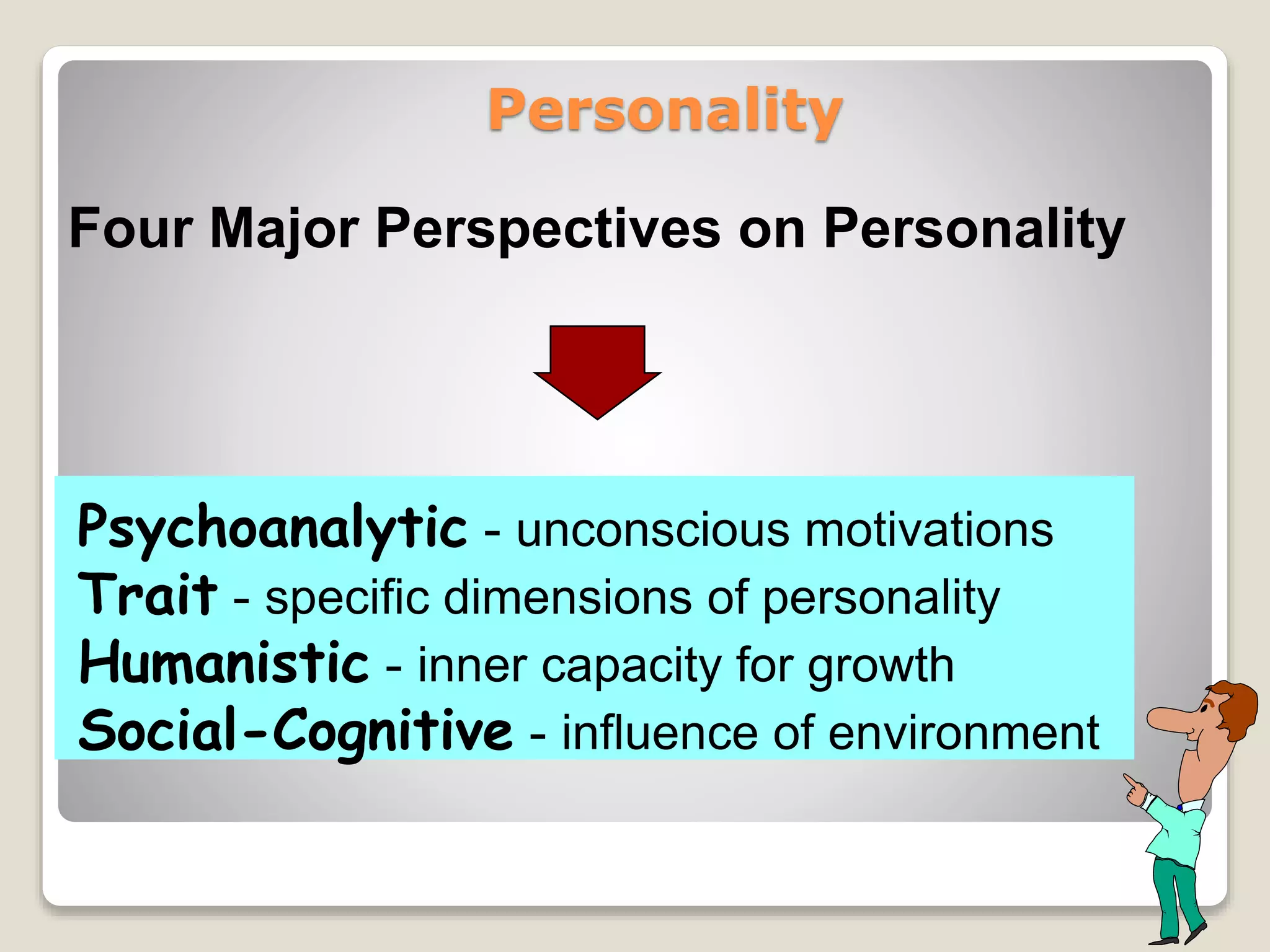
Four Major Perspectives on Personality
Psychoanalytic - unconscious motivations
Trait - specific dimensions of personality
Humanistic - inner capacity for growth
Social-Cognitive - influence of environment
What Is Big Five Model?
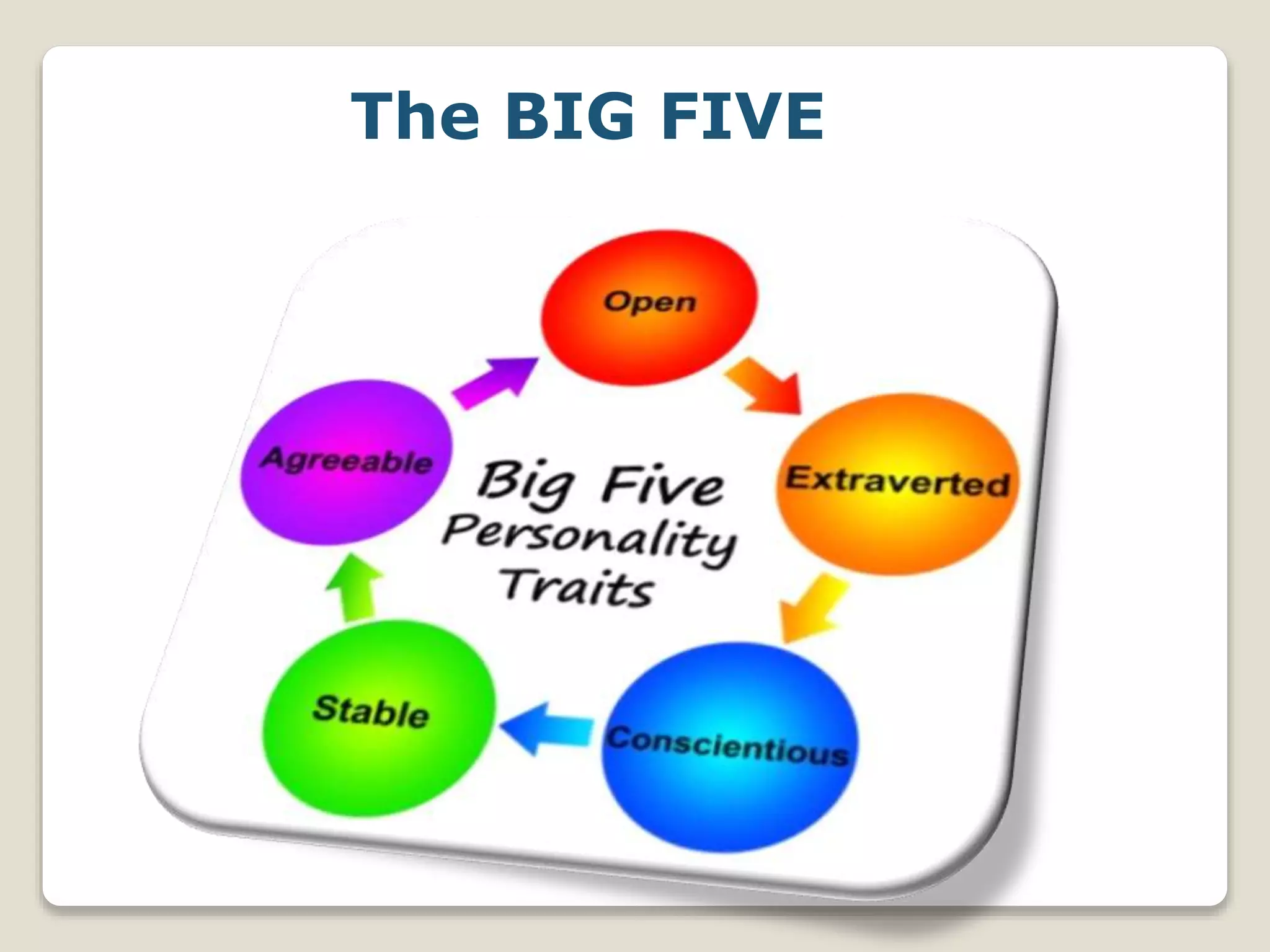
 In psychology, the Big Five personality
traits are five broad domains or dimensions
of personality that are used to describe human
personality. The theory based on the Big Five
factors is called the Five Factor Model.
The BIG FIVE
6
The Big Five Model of
Personality
 Extraversion: The tendency to experience
positive emotional states and feel good about
oneself and the world around one.
 Emotional stability : The tendency to
experience negative emotional states and view
oneself and the world around one negatively.
 Agreeableness: The tendency to get along
well with others.
 Conscientiousness: The extent to which a
person is careful, scrupulous, and persevering.
 Openness to Experience: The extent to
which a person is original, has broad interests,
and is willing to take risks.
MBTI
The Myers–Briggs Type Indicator (MBTI) is an
introspective self-report questionnaire designed to indicate
psychological preferences in how people perceive the world
and make decisions.
Myers Briggs Personality Types
The phrase Myers Briggs is most often used to describe
a personality theory developed by Isabel Briggs
Myers and her mother Katherine Briggs. It explains
some of the main differences between people and is
often used to help choose a career, improve
relationships, develop leadership skills, etc.
 Extraverted and Introverted - The first pair of styles is concerned
with the direction of your energy. If you prefer to direct your energy to
deal with people, things, situations, or "the outer world", then your
preference is for Extraversion. If you prefer to direct your energy to deal
with ideas, information, explanations or beliefs, or "the inner world", then
your preference is for Introversion.
 Sensing and Intuition - The second pair concerns the type of
information/things that you process. If you prefer to deal with facts, what
you know, to have clarity, or to describe what you see, then your
preference is for Sensing. If you prefer to deal with ideas, look into the
unknown, to generate new possibilities or to anticipate what isn't obvious,
then your preference is for Intuition. The letter N is used for intuition
because I has already been allocated to Introversion.
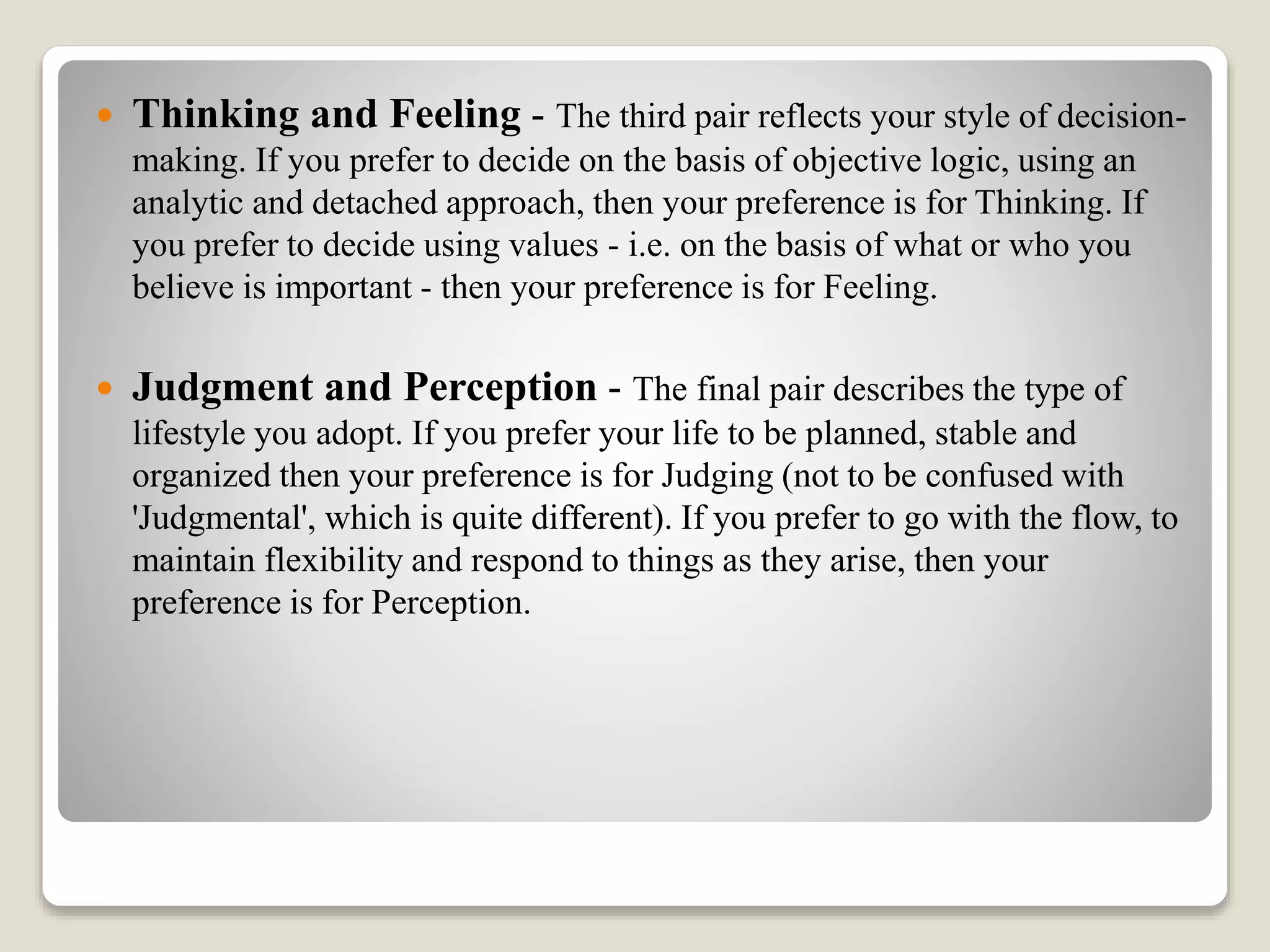
 Thinking and Feeling - The third pair reflects your style of decision-
making. If you prefer to decide on the basis of objective logic, using an
analytic and detached approach, then your preference is for Thinking. If
you prefer to decide using values - i.e. on the basis of what or who you
believe is important - then your preference is for Feeling.
 Judgment and Perception - The final pair describes the type of
lifestyle you adopt. If you prefer your life to be planned, stable and
organized then your preference is for Judging (not to be confused with
'Judgmental', which is quite different). If you prefer to go with the flow, to
maintain flexibility and respond to things as they arise, then your
preference is for Perception.
JOB SATISFACTION
•Job Satisfaction refers to how well job provides
fulfilment of a need or want, or how well it serves as a
means of enjoyment.
•Job satisfaction is a degree to which individuals feels
positively or negatively about their jobs.
THEORIES OF JOB SATIFACTION…
There are numerous theories attempting to
explain job satisfaction, but three
conceptual frameworks seems to be more
prominent.
 Content theories
 Process theories
 Situational theories
 Content Theories suggests that job satisfaction occurs when
one’s need for growth and self-actualization are met by the
individual’s job
 Abraham Maslow “Hierarchy of Need”
 Frederick Herzberg “ Two Factor Theory”
• Process Theories attempts to explain job satisfaction by
looking at expectancies and values. These theory of job satisfaction
suggests that workers’ select their behaviour in order to meet their
needs.
• Situational Theories the situational occurrence theory
emerged in 1992, when Quarstein, McAfee, and Glassman stated that
job satisfaction is determined by two factors: Situational
Characteristics and Situational Occurrences. Within this theoretical
framework, job satisfaction is a product of both situational factors
and situational occurrences.
MANAGERIAL IMPLICATION :-
 There are certain traits of personality that are essential for
employee’s behaviour, which may be desirable for an
organization to run its operations successfully.
 Some individuals may be more sociable and carry an outgoing
personality and prefer work environment that is more social
and friendly. This personality trait does not immediately affect
their behavior at work, but might harm their work psychology
in the long run.
 The individual behaviour is influenced more by the job
expectations rather than individual behavioural preferences. it
has been observed that the individual personality exercises a
tremendous influence on that. This often leads to difficult
management situations in an organization.
 Personality is at the centre of how we interact with each other on
a daily basis. It provides a framework for understanding why our
lives look like our own, and not like our neighbours.
 People who stand high in certain factors like: extraversion,
emotional stability performs well and likely to be motivated
more.
 When an organisation select new employees for the job then they
have to look to the personality of the employees. Ex.- a person
who is very extrovert, so this is the duty of the employers to
identify his strength and give him a kind of job by which his
personality defers from the other and benefit the business.
 An extrovert are the employees who will work on several
committees at a time, even if the committees have little in
common..
THANK YOU…

What is Personality under organisational behaviour

  • 1.
    PERSONALITY Prepared By:-Harshika Kapoor AayushVyas Aditya Singhai Mohit Garg Kartik Phophalia Ashwani Singh Akash Kapil B.Com. LL.B. Batch 1
  • 2.
    Definition of Personality? Personality refers to the relatively enduring characteristics that differentiate one person from another and that lead people to act in a consistent and predictable manner, both in different situations and over extended periods of time.  Personality is defined as: the enduring or lasting patterns of behavior and thought (across time and situation).
  • 3.
    Personality Four Major Perspectiveson Personality Psychoanalytic - unconscious motivations Trait - specific dimensions of personality Humanistic - inner capacity for growth Social-Cognitive - influence of environment
  • 4.
    What Is BigFive Model?  In psychology, the Big Five personality traits are five broad domains or dimensions of personality that are used to describe human personality. The theory based on the Big Five factors is called the Five Factor Model.
  • 5.
  • 6.
    6 The Big FiveModel of Personality  Extraversion: The tendency to experience positive emotional states and feel good about oneself and the world around one.  Emotional stability : The tendency to experience negative emotional states and view oneself and the world around one negatively.  Agreeableness: The tendency to get along well with others.  Conscientiousness: The extent to which a person is careful, scrupulous, and persevering.  Openness to Experience: The extent to which a person is original, has broad interests, and is willing to take risks.
  • 7.
    MBTI The Myers–Briggs TypeIndicator (MBTI) is an introspective self-report questionnaire designed to indicate psychological preferences in how people perceive the world and make decisions. Myers Briggs Personality Types The phrase Myers Briggs is most often used to describe a personality theory developed by Isabel Briggs Myers and her mother Katherine Briggs. It explains some of the main differences between people and is often used to help choose a career, improve relationships, develop leadership skills, etc.
  • 8.
     Extraverted andIntroverted - The first pair of styles is concerned with the direction of your energy. If you prefer to direct your energy to deal with people, things, situations, or "the outer world", then your preference is for Extraversion. If you prefer to direct your energy to deal with ideas, information, explanations or beliefs, or "the inner world", then your preference is for Introversion.  Sensing and Intuition - The second pair concerns the type of information/things that you process. If you prefer to deal with facts, what you know, to have clarity, or to describe what you see, then your preference is for Sensing. If you prefer to deal with ideas, look into the unknown, to generate new possibilities or to anticipate what isn't obvious, then your preference is for Intuition. The letter N is used for intuition because I has already been allocated to Introversion.
  • 9.
     Thinking andFeeling - The third pair reflects your style of decision- making. If you prefer to decide on the basis of objective logic, using an analytic and detached approach, then your preference is for Thinking. If you prefer to decide using values - i.e. on the basis of what or who you believe is important - then your preference is for Feeling.  Judgment and Perception - The final pair describes the type of lifestyle you adopt. If you prefer your life to be planned, stable and organized then your preference is for Judging (not to be confused with 'Judgmental', which is quite different). If you prefer to go with the flow, to maintain flexibility and respond to things as they arise, then your preference is for Perception.
  • 10.
    JOB SATISFACTION •Job Satisfactionrefers to how well job provides fulfilment of a need or want, or how well it serves as a means of enjoyment. •Job satisfaction is a degree to which individuals feels positively or negatively about their jobs.
  • 11.
    THEORIES OF JOBSATIFACTION… There are numerous theories attempting to explain job satisfaction, but three conceptual frameworks seems to be more prominent.  Content theories  Process theories  Situational theories
  • 12.
     Content Theoriessuggests that job satisfaction occurs when one’s need for growth and self-actualization are met by the individual’s job  Abraham Maslow “Hierarchy of Need”  Frederick Herzberg “ Two Factor Theory” • Process Theories attempts to explain job satisfaction by looking at expectancies and values. These theory of job satisfaction suggests that workers’ select their behaviour in order to meet their needs. • Situational Theories the situational occurrence theory emerged in 1992, when Quarstein, McAfee, and Glassman stated that job satisfaction is determined by two factors: Situational Characteristics and Situational Occurrences. Within this theoretical framework, job satisfaction is a product of both situational factors and situational occurrences.
  • 13.
    MANAGERIAL IMPLICATION :- There are certain traits of personality that are essential for employee’s behaviour, which may be desirable for an organization to run its operations successfully.  Some individuals may be more sociable and carry an outgoing personality and prefer work environment that is more social and friendly. This personality trait does not immediately affect their behavior at work, but might harm their work psychology in the long run.  The individual behaviour is influenced more by the job expectations rather than individual behavioural preferences. it has been observed that the individual personality exercises a tremendous influence on that. This often leads to difficult management situations in an organization.
  • 14.
     Personality isat the centre of how we interact with each other on a daily basis. It provides a framework for understanding why our lives look like our own, and not like our neighbours.  People who stand high in certain factors like: extraversion, emotional stability performs well and likely to be motivated more.  When an organisation select new employees for the job then they have to look to the personality of the employees. Ex.- a person who is very extrovert, so this is the duty of the employers to identify his strength and give him a kind of job by which his personality defers from the other and benefit the business.  An extrovert are the employees who will work on several committees at a time, even if the committees have little in common..
  • 15.

Editor's Notes