Ishu Mann
MBA -1 SEM.
Learning
Objectives
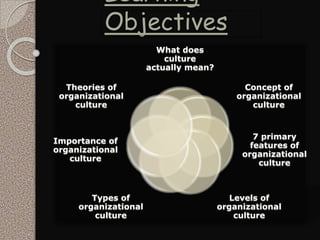
What does
culture
actually mean?
Concept of
organizational
culture
7 primary
features of
organizational
culture
Levels of
organizational
culture
Types of
organizational
culture
Importance of
organizational
culture
Theories of
organizational
culture
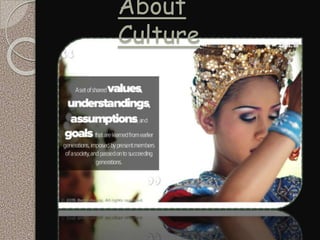
About
Culture
Organizational culture is a system of shared
assumptions, values, and beliefs, which governs
how people behave in organizations.
These shared values have a strong influence on
the people in the organization and dictate how
they dress, act, and perform their jobs.
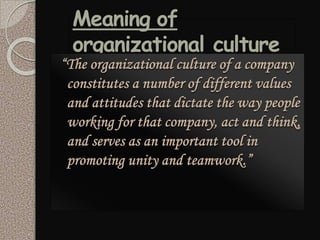
Meaning of
organizational culture
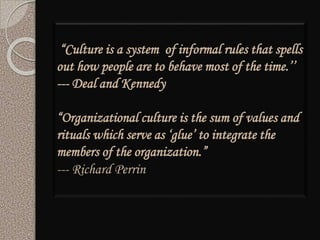
“Culture is a system of informal rules that spells
out how people are to behave most of the time.’’
--- Deal and Kennedy
“Organizational culture is the sum of values and
rituals which serve as ‘glue’ to integrate the
members of the organization.”
--- Richard Perrin
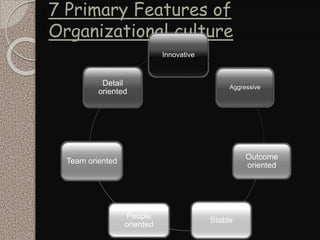
7 Primary Features of
Organizational culture
Innovative
Aggressive
Outcome
oriented
Stable
People
oriented
Team oriented
Detail
oriented
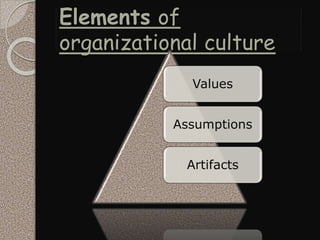
Elements of
organizational culture
Values
Assumptions
Artifacts
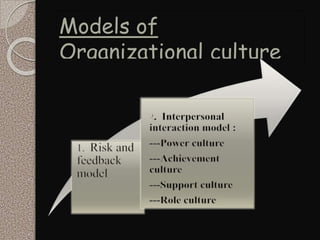
Models of
Organizational culture
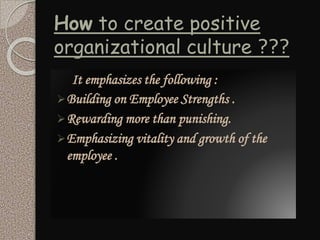
How to create positive
organizational culture ???
It emphasizes the following :
Building on Employee Strengths .
Rewarding more than punishing.
Emphasizing vitality and growth of the
employee .
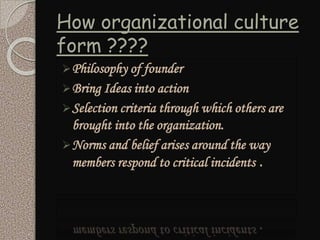
How organizational culture
form ????
Philosophy of founder
Bring Ideas into action
Selection criteria through which others are
brought into the organization.
Norms and belief arises around the way
members respond to critical incidents .
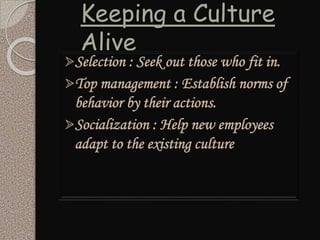
Keeping a Culture
Alive
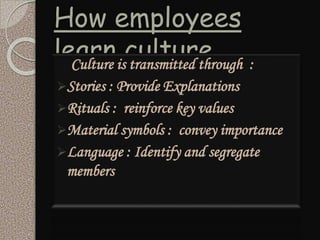
How employees
learn cultureCulture is transmitted through :
Stories : Provide Explanations
Rituals : reinforce key values
Material symbols : convey importance
Language : Identify and segregate
members
Types of Organizational
Culture
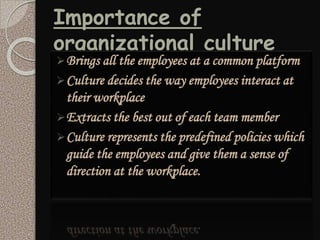
Importance of
organizational culture
Brings all the employees at a common platform
Culture decides the way employees interact at
their workplace
Extracts the best out of each team member
Culture represents the predefined policies which
guide the employees and give them a sense of
direction at the workplace.
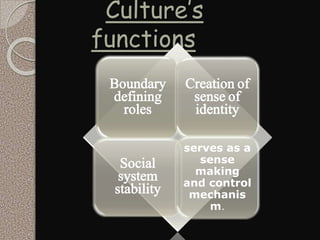
Culture’s
functions
Boundary
defining
roles
Creation of
sense of
identity
Social
system
stability
serves as a
sense
making
and control
mechanis
m.
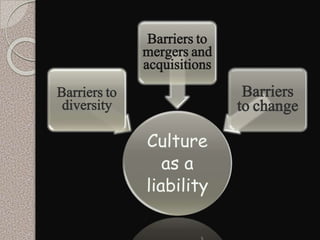
Culture
as a
liability
Barriers to
diversity
Barriers to
mergers and
acquisitions
Barriers
to change
Best ever example of
great culture in
organizations ;
 It would almost seem wrong not to mention Google
on a list of companies with great culture.
 Google has been synonymous with culture for years,
and sets the tone for many of the perks and benefits
startups are now known for. Free meals, employee
trips and parties, financial bonuses, open
presentations by high-level executives, gyms, a dog-
friendly environment and so on.
 Googlers are known to be driven, talented and
among the best of the best.
Conclusion drawn at
last…..
Remember ,that the best culture makes all
employees feel safe and welcome, never excluded
or uncomfortable.
Focusing on "culture fit” alone makes it difficult
to hire and welcome employees who are different
than the prevailing culture, even if they’d be an
asset and great counterbalance at your company.
Organization culture

Organization culture