A Framework for the HRD 
Process
2 
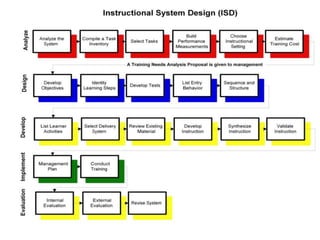
A Framework for the HRD Process 
HRD efforts should use the following four 
phases (or stages): 
Needs assessment 
Design 
Implementation 
Evaluation
3 
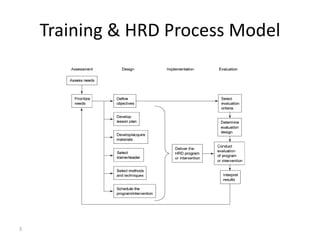
Training & HRD Process Model
4 
Needs Assessment Phase 
Establishing HRD priorities 
Defining specific training and objectives 
Establishing evaluation criteria
5 
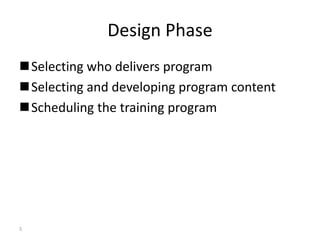
Design Phase 
 Selecting who delivers program 
Selecting and developing program content 
Scheduling the training program
6 
Implementation Phase 
Implementing or delivering the program
7 
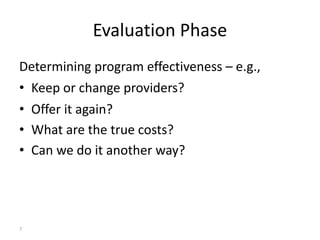
Evaluation Phase 
Determining program effectiveness – e.g., 
• Keep or change providers? 
• Offer it again? 
• What are the true costs? 
• Can we do it another way?
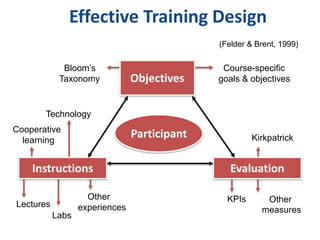
Effective Training Design 
Objectives 
Participant 
Evaluation 
Bloom’s 
Taxonomy 
Course-specific 
goals & objectives 
Cooperative 
learning 
Lectures 
Labs 
Other 
experiences 
KPIs 
Instructions 
Other 
measures 
Technology 
(Felder & Brent, 1999) 
Kirkpatrick
Background 
In 1956, Benjamin Bloom, a professor at the University of 
Chicago, shared his famous "Taxonomy of Educational 
Objectives". 
Bloom identified six levels of cognitive complexity that have 
been used over the past four decades to make sure that 
instruction stimulates and develops students' higher-order 
thinking skills.
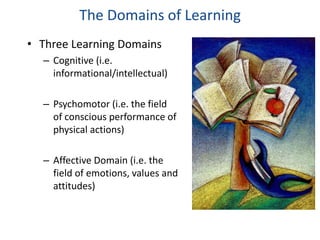
The Domains of Learning 
• Three Learning Domains 
– Cognitive (i.e. 
informational/intellectual) 
– Psychomotor (i.e. the field 
of conscious performance of 
physical actions) 
– Affective Domain (i.e. the 
field of emotions, values and 
attitudes)
Cognitive
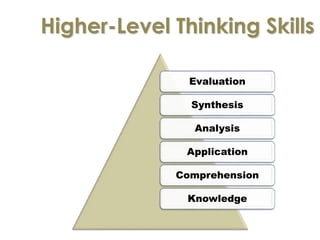
Higher-Level Thinking Skills 
Evaluation 
Synthesis 
Analysis 
Application 
Comprehension 
Knowledge
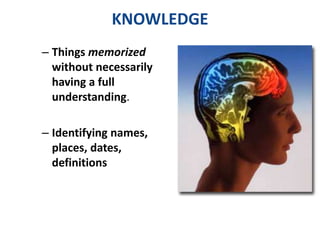
KNOWLEDGE 
– Things memorized 
without necessarily 
having a full 
understanding. 
– Identifying names, 
places, dates, 
definitions
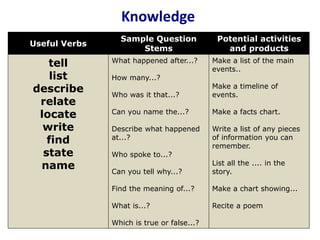
Knowledge 
Useful Verbs 
Sample Question 
Stems 
Potential activities 
and products 
tell 
list 
describe 
relate 
locate 
write 
find 
state 
name 
What happened after...? 
How many...? 
Who was it that...? 
Can you name the...? 
Describe what happened 
at...? 
Who spoke to...? 
Can you tell why...? 
Find the meaning of...? 
What is...? 
Which is true or false...? 
Make a list of the main 
events.. 
Make a timeline of 
events. 
Make a facts chart. 
Write a list of any pieces 
of information you can 
remember. 
List all the .... in the 
story. 
Make a chart showing... 
Recite a poem
COMPREHENSION 
– You understand 
information enough to 
explain it in your own 
words. 
– Explaining, summarizing, 
describing,
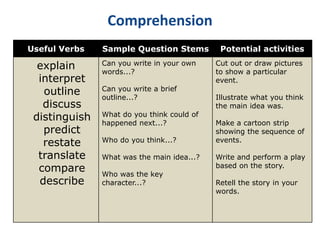
Comprehension 
Useful Verbs Sample Question Stems Potential activities 
explain 
interpret 
outline 
discuss 
distinguish 
predict 
restate 
translate 
compare 
describe 
Can you write in your own 
words...? 
Can you write a brief 
outline...? 
What do you think could of 
happened next...? 
Who do you think...? 
What was the main idea...? 
Who was the key 
character...? 
Cut out or draw pictures 
to show a particular 
event. 
Illustrate what you think 
the main idea was. 
Make a cartoon strip 
showing the sequence of 
events. 
Write and perform a play 
based on the story. 
Retell the story in your 
words.
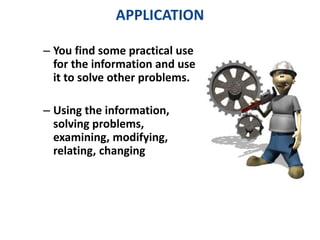
APPLICATION 
– You find some practical use 
for the information and use 
it to solve other problems. 
– Using the information, 
solving problems, 
examining, modifying, 
relating, changing
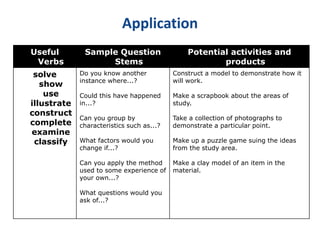
Application 
Useful 
Verbs 
Sample Question 
Stems 
Potential activities and 
products 
solve 
show 
use 
illustrate 
construct 
complete 
examine 
classify 
Do you know another 
instance where...? 
Could this have happened 
in...? 
Can you group by 
characteristics such as...? 
What factors would you 
change if...? 
Can you apply the method 
used to some experience of 
your own...? 
What questions would you 
ask of...? 
Construct a model to demonstrate how it 
will work. 
Make a scrapbook about the areas of 
study. 
Take a collection of photographs to 
demonstrate a particular point. 
Make up a puzzle game suing the ideas 
from the study area. 
Make a clay model of an item in the 
material.
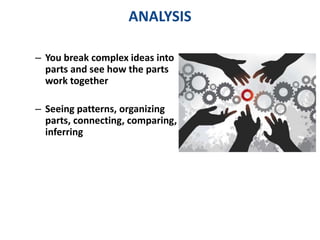
ANALYSIS 
– You break complex ideas into 
parts and see how the parts 
work together 
– Seeing patterns, organizing 
parts, connecting, comparing, 
inferring
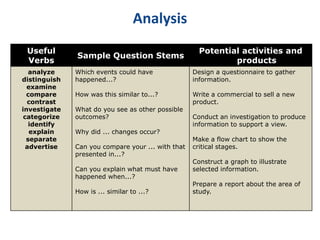
Analysis 
Useful 
Verbs 
Sample Question Stems 
Potential activities and 
products 
analyze 
distinguish 
examine 
compare 
contrast 
investigate 
categorize 
identify 
explain 
separate 
advertise 
Which events could have 
happened...? 
How was this similar to...? 
What do you see as other possible 
outcomes? 
Why did ... changes occur? 
Can you compare your ... with that 
presented in...? 
Can you explain what must have 
happened when...? 
How is ... similar to ...? 
Design a questionnaire to gather 
information. 
Write a commercial to sell a new 
product. 
Conduct an investigation to produce 
information to support a view. 
Make a flow chart to show the 
critical stages. 
Construct a graph to illustrate 
selected information. 
Prepare a report about the area of 
study.
SYNTHESIS 
– You make connections 
with things you already 
know. 
– drawing conclusions, 
making predictions, 
designing, inventing, 
generalizing
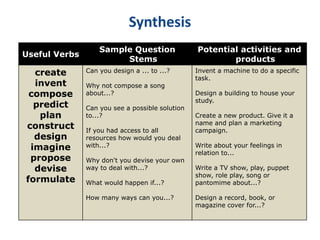
Synthesis 
Useful Verbs 
Sample Question 
Stems 
Potential activities and 
products 
create 
invent 
compose 
predict 
plan 
construct 
design 
imagine 
propose 
devise 
formulate 
Can you design a ... to ...? 
Why not compose a song 
about...? 
Can you see a possible solution 
to...? 
If you had access to all 
resources how would you deal 
with...? 
Why don't you devise your own 
way to deal with...? 
What would happen if...? 
How many ways can you...? 
Invent a machine to do a specific 
task. 
Design a building to house your 
study. 
Create a new product. Give it a 
name and plan a marketing 
campaign. 
Write about your feelings in 
relation to... 
Write a TV show, play, puppet 
show, role play, song or 
pantomime about...? 
Design a record, book, or 
magazine cover for...?
EVALUATION 
– You judge something's 
worth 
– assessing, ranking, 
grading, testing 
recommending, 
explaining, 
supporting, 
convincing
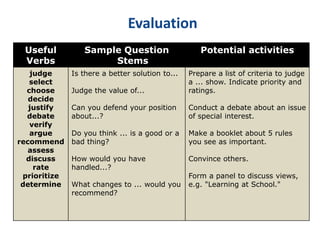
Evaluation 
Useful 
Verbs 
Sample Question 
Stems 
Potential activities 
judge 
select 
choose 
decide 
justify 
debate 
verify 
argue 
recommend 
assess 
discuss 
rate 
prioritize 
determine 
Is there a better solution to... 
Judge the value of... 
Can you defend your position 
about...? 
Do you think ... is a good or a 
bad thing? 
How would you have 
handled...? 
What changes to ... would you 
recommend? 
Prepare a list of criteria to judge 
a ... show. Indicate priority and 
ratings. 
Conduct a debate about an issue 
of special interest. 
Make a booklet about 5 rules 
you see as important. 
Convince others. 
Form a panel to discuss views, 
e.g. "Learning at School."
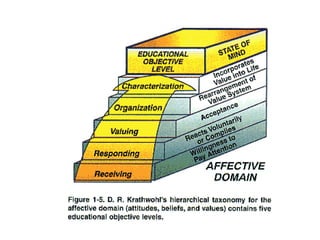
Affective Domain
Affective Domain 
 Bloom's Taxonomy second domain. 
 Affective Domain, was detailed by Bloom, 
Krathwhol and Masia in 1964. 
 This Domain advocates the structure and 
sequence for developing attitude. 
 Affective Domain provides a framework for 
assessing and evaluating the effectiveness of 
training, lesson design and delivery. 
 It also Evaluates the retention by and affect upon 
the learner.
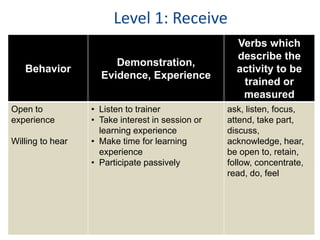
Level 1: Receive 
Behavior 
Demonstration, 
Evidence, Experience 
Verbs which 
describe the 
activity to be 
trained or 
measured 
Open to 
experience 
Willing to hear 
• Listen to trainer 
• Take interest in session or 
learning experience 
• Make time for learning 
experience 
• Participate passively 
ask, listen, focus, 
attend, take part, 
discuss, 
acknowledge, hear, 
be open to, retain, 
follow, concentrate, 
read, do, feel
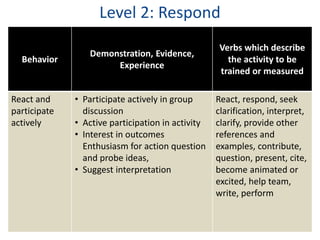
Level 2: Respond 
Behavior 
Demonstration, Evidence, 
Experience 
Verbs which describe 
the activity to be 
trained or measured 
React and 
participate 
actively 
• Participate actively in group 
discussion 
• Active participation in activity 
• Interest in outcomes 
Enthusiasm for action question 
and probe ideas, 
• Suggest interpretation 
React, respond, seek 
clarification, interpret, 
clarify, provide other 
references and 
examples, contribute, 
question, present, cite, 
become animated or 
excited, help team, 
write, perform
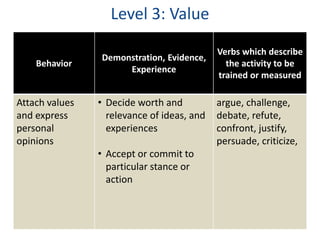
Level 3: Value 
Behavior 
Demonstration, Evidence, 
Experience 
Verbs which describe 
the activity to be 
trained or measured 
Attach values 
and express 
personal 
opinions 
• Decide worth and 
relevance of ideas, and 
experiences 
• Accept or commit to 
particular stance or 
action 
argue, challenge, 
debate, refute, 
confront, justify, 
persuade, criticize,
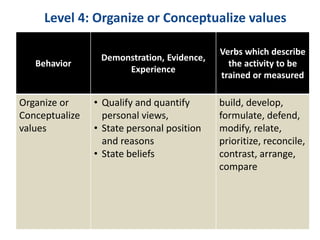
Level 4: Organize or Conceptualize values 
Behavior 
Demonstration, Evidence, 
Experience 
Verbs which describe 
the activity to be 
trained or measured 
Organize or 
Conceptualize 
values 
• Qualify and quantify 
personal views, 
• State personal position 
and reasons 
• State beliefs 
build, develop, 
formulate, defend, 
modify, relate, 
prioritize, reconcile, 
contrast, arrange, 
compare
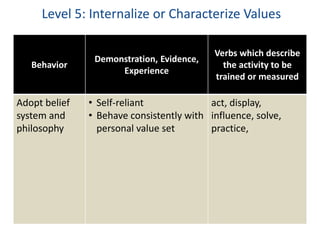
Level 5: Internalize or Characterize Values 
Behavior 
Demonstration, Evidence, 
Experience 
Verbs which describe 
the activity to be 
trained or measured 
Adopt belief 
system and 
philosophy 
• Self-reliant 
• Behave consistently with 
personal value set 
act, display, 
influence, solve, 
practice,
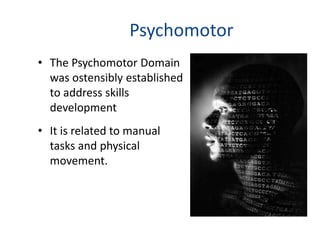
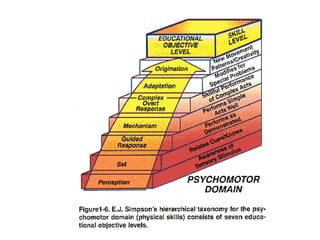
Psychomotor 
• The Psychomotor Domain 
was ostensibly established 
to address skills 
development 
• It is related to manual 
tasks and physical 
movement.
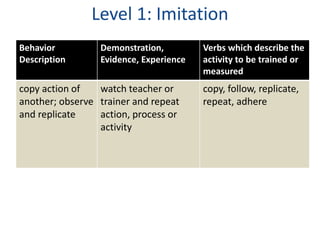
Level 1: Imitation 
Behavior 
Description 
Demonstration, 
Evidence, Experience 
Verbs which describe the 
activity to be trained or 
measured 
copy action of 
another; observe 
and replicate 
watch teacher or 
trainer and repeat 
action, process or 
activity 
copy, follow, replicate, 
repeat, adhere
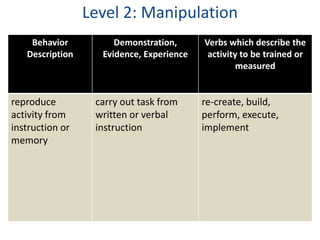
Level 2: Manipulation 
Behavior 
Description 
Demonstration, 
Evidence, Experience 
Verbs which describe the 
activity to be trained or 
measured 
reproduce 
activity from 
instruction or 
memory 
carry out task from 
written or verbal 
instruction 
re-create, build, 
perform, execute, 
implement
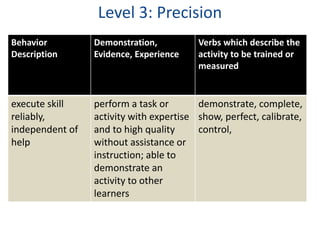
Level 3: Precision 
Behavior 
Description 
Demonstration, 
Evidence, Experience 
Verbs which describe the 
activity to be trained or 
measured 
execute skill 
reliably, 
independent of 
help 
perform a task or 
activity with expertise 
and to high quality 
without assistance or 
instruction; able to 
demonstrate an 
activity to other 
learners 
demonstrate, complete, 
show, perfect, calibrate, 
control,
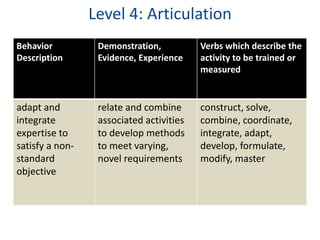
Level 4: Articulation 
Behavior 
Description 
Demonstration, 
Evidence, Experience 
Verbs which describe the 
activity to be trained or 
measured 
adapt and 
integrate 
expertise to 
satisfy a non-standard 
objective 
relate and combine 
associated activities 
to develop methods 
to meet varying, 
novel requirements 
construct, solve, 
combine, coordinate, 
integrate, adapt, 
develop, formulate, 
modify, master
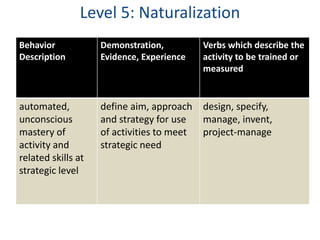
Level 5: Naturalization 
Behavior 
Description 
Demonstration, 
Evidence, Experience 
Verbs which describe the 
activity to be trained or 
measured 
automated, 
unconscious 
mastery of 
activity and 
related skills at 
strategic level 
define aim, approach 
and strategy for use 
of activities to meet 
strategic need 
design, specify, 
manage, invent, 
project-manage
Instruction 
Methods
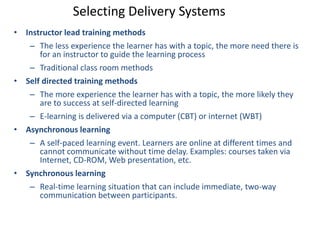
Selecting Delivery Systems 
• Instructor lead training methods 
– The less experience the learner has with a topic, the more need there is 
for an instructor to guide the learning process 
– Traditional class room methods 
• Self directed training methods 
– The more experience the learner has with a topic, the more likely they 
are to success at self-directed learning 
– E-learning is delivered via a computer (CBT) or internet (WBT) 
• Asynchronous learning 
– A self-paced learning event. Learners are online at different times and 
cannot communicate without time delay. Examples: courses taken via 
Internet, CD-ROM, Web presentation, etc. 
• Synchronous learning 
– Real-time learning situation that can include immediate, two-way 
communication between participants.
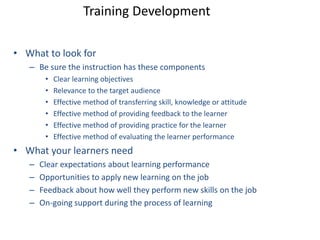
Training Development 
• What to look for 
– Be sure the instruction has these components 
• Clear learning objectives 
• Relevance to the target audience 
• Effective method of transferring skill, knowledge or attitude 
• Effective method of providing feedback to the learner 
• Effective method of providing practice for the learner 
• Effective method of evaluating the learner performance 
• What your learners need 
– Clear expectations about learning performance 
– Opportunities to apply new learning on the job 
– Feedback about how well they perform new skills on the job 
– On-going support during the process of learning
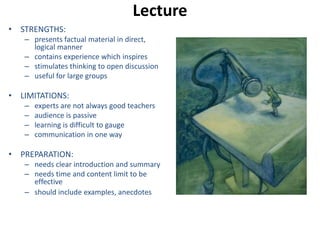
Lecture 
• STRENGTHS: 
– presents factual material in direct, 
logical manner 
– contains experience which inspires 
– stimulates thinking to open discussion 
– useful for large groups 
• LIMITATIONS: 
– experts are not always good teachers 
– audience is passive 
– learning is difficult to gauge 
– communication in one way 
• PREPARATION: 
– needs clear introduction and summary 
– needs time and content limit to be 
effective 
– should include examples, anecdotes
Videotapes 
• STRENGTHS: 
– entertaining way of teaching content and 
raising issues 
– keep group's attention 
– looks professional 
– stimulates discussion 
• LIMITATIONS: 
– can raise too many issues to have a 
focused discussion 
– discussion may not have full participation 
– only as effective as following discussion 
• PREPARATION: 
– need to set up equipment 
– effective only if facilitator prepares 
questions to discuss after the show
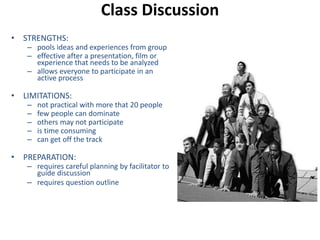
Class Discussion 
• STRENGTHS: 
– pools ideas and experiences from group 
– effective after a presentation, film or 
experience that needs to be analyzed 
– allows everyone to participate in an 
active process 
• LIMITATIONS: 
– not practical with more that 20 people 
– few people can dominate 
– others may not participate 
– is time consuming 
– can get off the track 
• PREPARATION: 
– requires careful planning by facilitator to 
guide discussion 
– requires question outline
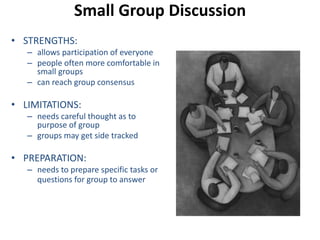
Small Group Discussion 
• STRENGTHS: 
– allows participation of everyone 
– people often more comfortable in 
small groups 
– can reach group consensus 
• LIMITATIONS: 
– needs careful thought as to 
purpose of group 
– groups may get side tracked 
• PREPARATION: 
– needs to prepare specific tasks or 
questions for group to answer
Case Studies 
• STRENGTHS: 
– develops analytic and problem solving 
skills 
– allows for exploration of solutions for 
complex issues 
– allows student to apply new knowledge 
and skills 
• LIMITATIONS: 
– people may not see relevance to own 
situation 
– insufficient information can lead to 
inappropriate results 
• PREPARATION: 
– case must be clearly defined in some 
cases 
– case study must be prepared
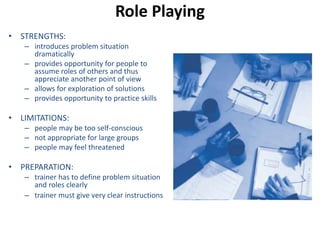
Role Playing 
• STRENGTHS: 
– introduces problem situation 
dramatically 
– provides opportunity for people to 
assume roles of others and thus 
appreciate another point of view 
– allows for exploration of solutions 
– provides opportunity to practice skills 
• LIMITATIONS: 
– people may be too self-conscious 
– not appropriate for large groups 
– people may feel threatened 
• PREPARATION: 
– trainer has to define problem situation 
and roles clearly 
– trainer must give very clear instructions

A framework for the hrd process

  • 1.
    A Framework forthe HRD Process
  • 2.
    2 A Frameworkfor the HRD Process HRD efforts should use the following four phases (or stages): Needs assessment Design Implementation Evaluation
  • 3.
    3 Training &HRD Process Model
  • 4.
    4 Needs AssessmentPhase Establishing HRD priorities Defining specific training and objectives Establishing evaluation criteria
  • 5.
    5 Design Phase  Selecting who delivers program Selecting and developing program content Scheduling the training program
  • 6.
    6 Implementation Phase Implementing or delivering the program
  • 7.
    7 Evaluation Phase Determining program effectiveness – e.g., • Keep or change providers? • Offer it again? • What are the true costs? • Can we do it another way?
  • 8.
    Effective Training Design Objectives Participant Evaluation Bloom’s Taxonomy Course-specific goals & objectives Cooperative learning Lectures Labs Other experiences KPIs Instructions Other measures Technology (Felder & Brent, 1999) Kirkpatrick
  • 9.
    Background In 1956,Benjamin Bloom, a professor at the University of Chicago, shared his famous "Taxonomy of Educational Objectives". Bloom identified six levels of cognitive complexity that have been used over the past four decades to make sure that instruction stimulates and develops students' higher-order thinking skills.
  • 10.
    The Domains ofLearning • Three Learning Domains – Cognitive (i.e. informational/intellectual) – Psychomotor (i.e. the field of conscious performance of physical actions) – Affective Domain (i.e. the field of emotions, values and attitudes)
  • 11.
  • 12.
    Higher-Level Thinking Skills Evaluation Synthesis Analysis Application Comprehension Knowledge
  • 13.
    KNOWLEDGE – Thingsmemorized without necessarily having a full understanding. – Identifying names, places, dates, definitions
  • 14.
    Knowledge Useful Verbs Sample Question Stems Potential activities and products tell list describe relate locate write find state name What happened after...? How many...? Who was it that...? Can you name the...? Describe what happened at...? Who spoke to...? Can you tell why...? Find the meaning of...? What is...? Which is true or false...? Make a list of the main events.. Make a timeline of events. Make a facts chart. Write a list of any pieces of information you can remember. List all the .... in the story. Make a chart showing... Recite a poem
  • 15.
    COMPREHENSION – Youunderstand information enough to explain it in your own words. – Explaining, summarizing, describing,
  • 16.
    Comprehension Useful VerbsSample Question Stems Potential activities explain interpret outline discuss distinguish predict restate translate compare describe Can you write in your own words...? Can you write a brief outline...? What do you think could of happened next...? Who do you think...? What was the main idea...? Who was the key character...? Cut out or draw pictures to show a particular event. Illustrate what you think the main idea was. Make a cartoon strip showing the sequence of events. Write and perform a play based on the story. Retell the story in your words.
  • 17.
    APPLICATION – Youfind some practical use for the information and use it to solve other problems. – Using the information, solving problems, examining, modifying, relating, changing
  • 18.
    Application Useful Verbs Sample Question Stems Potential activities and products solve show use illustrate construct complete examine classify Do you know another instance where...? Could this have happened in...? Can you group by characteristics such as...? What factors would you change if...? Can you apply the method used to some experience of your own...? What questions would you ask of...? Construct a model to demonstrate how it will work. Make a scrapbook about the areas of study. Take a collection of photographs to demonstrate a particular point. Make up a puzzle game suing the ideas from the study area. Make a clay model of an item in the material.
  • 19.
    ANALYSIS – Youbreak complex ideas into parts and see how the parts work together – Seeing patterns, organizing parts, connecting, comparing, inferring
  • 20.
    Analysis Useful Verbs Sample Question Stems Potential activities and products analyze distinguish examine compare contrast investigate categorize identify explain separate advertise Which events could have happened...? How was this similar to...? What do you see as other possible outcomes? Why did ... changes occur? Can you compare your ... with that presented in...? Can you explain what must have happened when...? How is ... similar to ...? Design a questionnaire to gather information. Write a commercial to sell a new product. Conduct an investigation to produce information to support a view. Make a flow chart to show the critical stages. Construct a graph to illustrate selected information. Prepare a report about the area of study.
  • 21.
    SYNTHESIS – Youmake connections with things you already know. – drawing conclusions, making predictions, designing, inventing, generalizing
  • 22.
    Synthesis Useful Verbs Sample Question Stems Potential activities and products create invent compose predict plan construct design imagine propose devise formulate Can you design a ... to ...? Why not compose a song about...? Can you see a possible solution to...? If you had access to all resources how would you deal with...? Why don't you devise your own way to deal with...? What would happen if...? How many ways can you...? Invent a machine to do a specific task. Design a building to house your study. Create a new product. Give it a name and plan a marketing campaign. Write about your feelings in relation to... Write a TV show, play, puppet show, role play, song or pantomime about...? Design a record, book, or magazine cover for...?
  • 23.
    EVALUATION – Youjudge something's worth – assessing, ranking, grading, testing recommending, explaining, supporting, convincing
  • 24.
    Evaluation Useful Verbs Sample Question Stems Potential activities judge select choose decide justify debate verify argue recommend assess discuss rate prioritize determine Is there a better solution to... Judge the value of... Can you defend your position about...? Do you think ... is a good or a bad thing? How would you have handled...? What changes to ... would you recommend? Prepare a list of criteria to judge a ... show. Indicate priority and ratings. Conduct a debate about an issue of special interest. Make a booklet about 5 rules you see as important. Convince others. Form a panel to discuss views, e.g. "Learning at School."
  • 25.
  • 26.
    Affective Domain Bloom's Taxonomy second domain.  Affective Domain, was detailed by Bloom, Krathwhol and Masia in 1964.  This Domain advocates the structure and sequence for developing attitude.  Affective Domain provides a framework for assessing and evaluating the effectiveness of training, lesson design and delivery.  It also Evaluates the retention by and affect upon the learner.
  • 28.
    Level 1: Receive Behavior Demonstration, Evidence, Experience Verbs which describe the activity to be trained or measured Open to experience Willing to hear • Listen to trainer • Take interest in session or learning experience • Make time for learning experience • Participate passively ask, listen, focus, attend, take part, discuss, acknowledge, hear, be open to, retain, follow, concentrate, read, do, feel
  • 29.
    Level 2: Respond Behavior Demonstration, Evidence, Experience Verbs which describe the activity to be trained or measured React and participate actively • Participate actively in group discussion • Active participation in activity • Interest in outcomes Enthusiasm for action question and probe ideas, • Suggest interpretation React, respond, seek clarification, interpret, clarify, provide other references and examples, contribute, question, present, cite, become animated or excited, help team, write, perform
  • 30.
    Level 3: Value Behavior Demonstration, Evidence, Experience Verbs which describe the activity to be trained or measured Attach values and express personal opinions • Decide worth and relevance of ideas, and experiences • Accept or commit to particular stance or action argue, challenge, debate, refute, confront, justify, persuade, criticize,
  • 31.
    Level 4: Organizeor Conceptualize values Behavior Demonstration, Evidence, Experience Verbs which describe the activity to be trained or measured Organize or Conceptualize values • Qualify and quantify personal views, • State personal position and reasons • State beliefs build, develop, formulate, defend, modify, relate, prioritize, reconcile, contrast, arrange, compare
  • 32.
    Level 5: Internalizeor Characterize Values Behavior Demonstration, Evidence, Experience Verbs which describe the activity to be trained or measured Adopt belief system and philosophy • Self-reliant • Behave consistently with personal value set act, display, influence, solve, practice,
  • 33.
    Psychomotor • ThePsychomotor Domain was ostensibly established to address skills development • It is related to manual tasks and physical movement.
  • 35.
    Level 1: Imitation Behavior Description Demonstration, Evidence, Experience Verbs which describe the activity to be trained or measured copy action of another; observe and replicate watch teacher or trainer and repeat action, process or activity copy, follow, replicate, repeat, adhere
  • 36.
    Level 2: Manipulation Behavior Description Demonstration, Evidence, Experience Verbs which describe the activity to be trained or measured reproduce activity from instruction or memory carry out task from written or verbal instruction re-create, build, perform, execute, implement
  • 37.
    Level 3: Precision Behavior Description Demonstration, Evidence, Experience Verbs which describe the activity to be trained or measured execute skill reliably, independent of help perform a task or activity with expertise and to high quality without assistance or instruction; able to demonstrate an activity to other learners demonstrate, complete, show, perfect, calibrate, control,
  • 38.
    Level 4: Articulation Behavior Description Demonstration, Evidence, Experience Verbs which describe the activity to be trained or measured adapt and integrate expertise to satisfy a non-standard objective relate and combine associated activities to develop methods to meet varying, novel requirements construct, solve, combine, coordinate, integrate, adapt, develop, formulate, modify, master
  • 39.
    Level 5: Naturalization Behavior Description Demonstration, Evidence, Experience Verbs which describe the activity to be trained or measured automated, unconscious mastery of activity and related skills at strategic level define aim, approach and strategy for use of activities to meet strategic need design, specify, manage, invent, project-manage
  • 40.
  • 42.
    Selecting Delivery Systems • Instructor lead training methods – The less experience the learner has with a topic, the more need there is for an instructor to guide the learning process – Traditional class room methods • Self directed training methods – The more experience the learner has with a topic, the more likely they are to success at self-directed learning – E-learning is delivered via a computer (CBT) or internet (WBT) • Asynchronous learning – A self-paced learning event. Learners are online at different times and cannot communicate without time delay. Examples: courses taken via Internet, CD-ROM, Web presentation, etc. • Synchronous learning – Real-time learning situation that can include immediate, two-way communication between participants.
  • 43.
    Training Development •What to look for – Be sure the instruction has these components • Clear learning objectives • Relevance to the target audience • Effective method of transferring skill, knowledge or attitude • Effective method of providing feedback to the learner • Effective method of providing practice for the learner • Effective method of evaluating the learner performance • What your learners need – Clear expectations about learning performance – Opportunities to apply new learning on the job – Feedback about how well they perform new skills on the job – On-going support during the process of learning
  • 44.
    Lecture • STRENGTHS: – presents factual material in direct, logical manner – contains experience which inspires – stimulates thinking to open discussion – useful for large groups • LIMITATIONS: – experts are not always good teachers – audience is passive – learning is difficult to gauge – communication in one way • PREPARATION: – needs clear introduction and summary – needs time and content limit to be effective – should include examples, anecdotes
  • 45.
    Videotapes • STRENGTHS: – entertaining way of teaching content and raising issues – keep group's attention – looks professional – stimulates discussion • LIMITATIONS: – can raise too many issues to have a focused discussion – discussion may not have full participation – only as effective as following discussion • PREPARATION: – need to set up equipment – effective only if facilitator prepares questions to discuss after the show
  • 46.
    Class Discussion •STRENGTHS: – pools ideas and experiences from group – effective after a presentation, film or experience that needs to be analyzed – allows everyone to participate in an active process • LIMITATIONS: – not practical with more that 20 people – few people can dominate – others may not participate – is time consuming – can get off the track • PREPARATION: – requires careful planning by facilitator to guide discussion – requires question outline
  • 47.
    Small Group Discussion • STRENGTHS: – allows participation of everyone – people often more comfortable in small groups – can reach group consensus • LIMITATIONS: – needs careful thought as to purpose of group – groups may get side tracked • PREPARATION: – needs to prepare specific tasks or questions for group to answer
  • 48.
    Case Studies •STRENGTHS: – develops analytic and problem solving skills – allows for exploration of solutions for complex issues – allows student to apply new knowledge and skills • LIMITATIONS: – people may not see relevance to own situation – insufficient information can lead to inappropriate results • PREPARATION: – case must be clearly defined in some cases – case study must be prepared
  • 49.
    Role Playing •STRENGTHS: – introduces problem situation dramatically – provides opportunity for people to assume roles of others and thus appreciate another point of view – allows for exploration of solutions – provides opportunity to practice skills • LIMITATIONS: – people may be too self-conscious – not appropriate for large groups – people may feel threatened • PREPARATION: – trainer has to define problem situation and roles clearly – trainer must give very clear instructions