Foundation of individual
      behavior
           by

    Atif Ahmed
     Zain Iqbal
   Muhammad Rashid
    Mariam Nadir
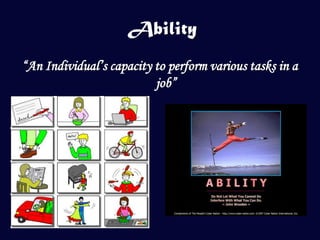
Ability
“An Individual’s capacity to perform various tasks in a
                          job”
Types of abilities
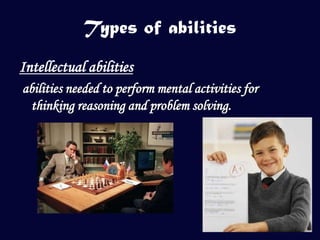
Intellectual abilities
abilities needed to perform mental activities for
 thinking reasoning and problem solving.
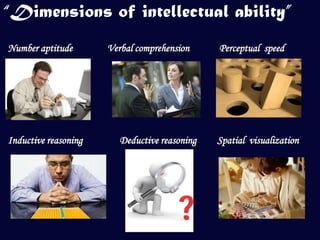
“Dimensions of intellectual ability”
Number aptitude       Verbal comprehension     Perceptual speed


Inductive reasoning      Deductive reasoning   Spatial visualization
“Dimensions of intellectual ability”

    Memory
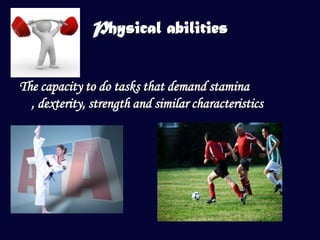
Physical abilities


The capacity to do tasks that demand stamina
  , dexterity, strength and similar characteristics
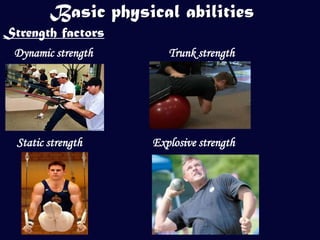
Basic physical abilities
Strength factors
 Dynamic strength       Trunk strength


  Static strength    Explosive strength
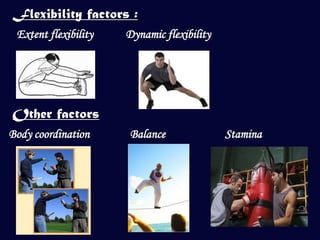
Flexibility factors :
 Extent flexibility   Dynamic flexibility


Other factors
Body coordination     Balance               Stamina
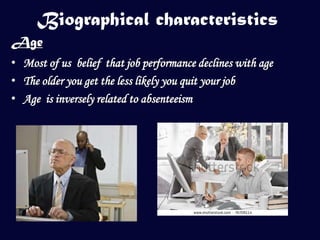
Biographical characteristics
Age
‱ Most of us belief that job performance declines with age
‱ The older you get the less likely you quit your job
‱ Age is inversely related to absenteeism
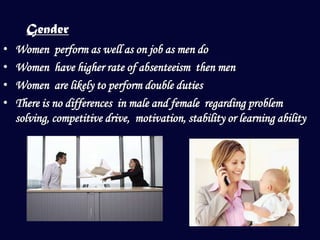
Gender
‱   Women perform as well as on job as men do
‱   Women have higher rate of absenteeism then men
‱   Women are likely to perform double duties
‱   There is no differences in male and female regarding problem
    solving, competitive drive, motivation, stability or learning ability
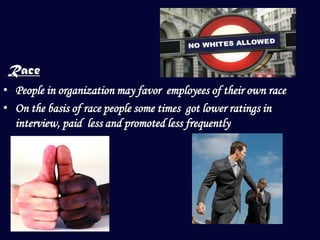
Race
‱ People in organization may favor employees of their own race
‱ On the basis of race people some times got lower ratings in
  interview, paid less and promoted less frequently
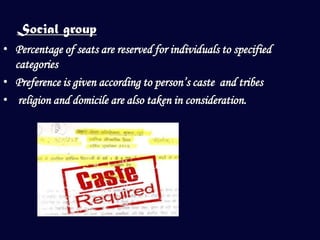
Social group
‱ Percentage of seats are reserved for individuals to specified
  categories
‱ Preference is given according to person’s caste and tribes
‱ religion and domicile are also taken in consideration.
Other biographical characteristics

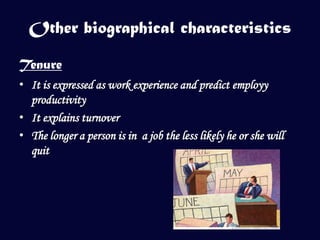
Tenure
‱ It is expressed as work experience and predict employy
  productivity
‱ It explains turnover
‱ The longer a person is in a job the less likely he or she will
  quit
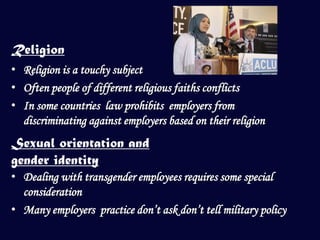
Religion
‱ Religion is a touchy subject
‱ Often people of different religious faiths conflicts
‱ In some countries law prohibits employers from
  discriminating against employers based on their religion
Sexual orientation and
gender identity
‱ Dealing with transgender employees requires some special
  consideration
‱ Many employers practice don’t ask don’t tell military policy
Learning
 “Learning is any relatively permanent change in behavior occurs as a
                            result of experience”


Direct experience
‱ Something affect you directly
‱ You gone through with any pleasant or unfavorable situation

Indirect experience
‱ When you are not the direct victim
‱ Someone else gone through with any unfavorable or pleasant
  situation and you learn from them
Theories of learning
1. Classical conditioning
2. Operant conditioning
3. Social learning
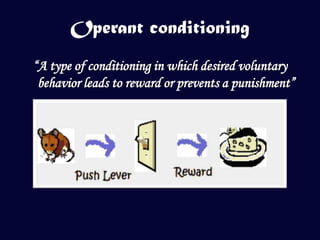
Operant conditioning
“A type of conditioning in which desired voluntary
 behavior leads to reward or prevents a punishment”
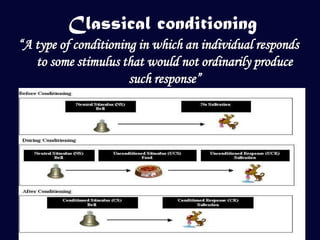
Classical conditioning
“A type of conditioning in which an individual responds
   to some stimulus that would not ordinarily produce
                      such response”
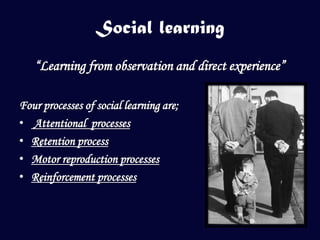
Social learning
   “Learning from observation and direct experience”

Four processes of social learning are;
‱ Attentional processes
‱ Retention process
‱ Motor reproduction processes
‱ Reinforcement processes
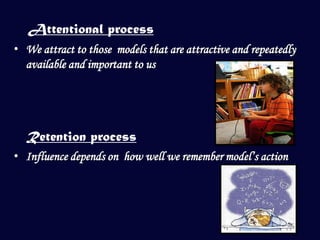
Attentional process
‱ We attract to those models that are attractive and repeatedly
  available and important to us


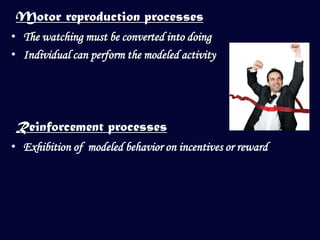
  Retention process
‱ Influence depends on how well we remember model’s action
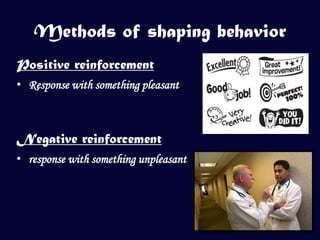
Motor reproduction processes
‱ The watching must be converted into doing
‱ Individual can perform the modeled activity


 Reinforcement processes
‱ Exhibition of modeled behavior on incentives or reward
Methods of shaping behavior
Positive reinforcement
‱ Response with something pleasant


Negative reinforcement
‱ response with something unpleasant
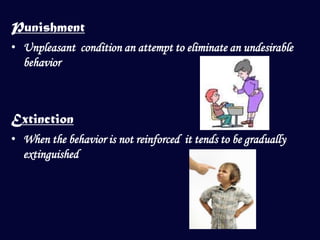
Punishment
‱ Unpleasant condition an attempt to eliminate an undesirable
  behavior


Extinction
‱ When the behavior is not reinforced it tends to be gradually
  extinguished

Foundation of individual behaviour

  • 1.
    Foundation of individual behavior by Atif Ahmed Zain Iqbal Muhammad Rashid Mariam Nadir
  • 2.
    Ability “An Individual’s capacityto perform various tasks in a job”
  • 3.
    Types of abilities Intellectualabilities abilities needed to perform mental activities for thinking reasoning and problem solving.
  • 4.
    “Dimensions of intellectualability” Number aptitude Verbal comprehension Perceptual speed Inductive reasoning Deductive reasoning Spatial visualization
  • 5.
  • 6.
    Physical abilities The capacityto do tasks that demand stamina , dexterity, strength and similar characteristics
  • 7.
    Basic physical abilities Strengthfactors Dynamic strength Trunk strength Static strength Explosive strength
  • 8.
    Flexibility factors : Extent flexibility Dynamic flexibility Other factors Body coordination Balance Stamina
  • 9.
    Biographical characteristics Age ‱ Mostof us belief that job performance declines with age ‱ The older you get the less likely you quit your job ‱ Age is inversely related to absenteeism
  • 10.
    Gender ‱ Women perform as well as on job as men do ‱ Women have higher rate of absenteeism then men ‱ Women are likely to perform double duties ‱ There is no differences in male and female regarding problem solving, competitive drive, motivation, stability or learning ability
  • 11.
    Race ‱ People inorganization may favor employees of their own race ‱ On the basis of race people some times got lower ratings in interview, paid less and promoted less frequently
  • 12.
    Social group ‱ Percentageof seats are reserved for individuals to specified categories ‱ Preference is given according to person’s caste and tribes ‱ religion and domicile are also taken in consideration.
  • 13.
    Other biographical characteristics Tenure ‱It is expressed as work experience and predict employy productivity ‱ It explains turnover ‱ The longer a person is in a job the less likely he or she will quit
  • 14.
    Religion ‱ Religion isa touchy subject ‱ Often people of different religious faiths conflicts ‱ In some countries law prohibits employers from discriminating against employers based on their religion Sexual orientation and gender identity ‱ Dealing with transgender employees requires some special consideration ‱ Many employers practice don’t ask don’t tell military policy
  • 15.
    Learning “Learning isany relatively permanent change in behavior occurs as a result of experience” Direct experience ‱ Something affect you directly ‱ You gone through with any pleasant or unfavorable situation Indirect experience ‱ When you are not the direct victim ‱ Someone else gone through with any unfavorable or pleasant situation and you learn from them
  • 16.
    Theories of learning 1.Classical conditioning 2. Operant conditioning 3. Social learning
  • 17.
    Operant conditioning “A typeof conditioning in which desired voluntary behavior leads to reward or prevents a punishment”
  • 18.
    Classical conditioning “A typeof conditioning in which an individual responds to some stimulus that would not ordinarily produce such response”
  • 19.
    Social learning “Learning from observation and direct experience” Four processes of social learning are; ‱ Attentional processes ‱ Retention process ‱ Motor reproduction processes ‱ Reinforcement processes
  • 20.
    Attentional process ‱ Weattract to those models that are attractive and repeatedly available and important to us Retention process ‱ Influence depends on how well we remember model’s action
  • 21.
    Motor reproduction processes ‱The watching must be converted into doing ‱ Individual can perform the modeled activity Reinforcement processes ‱ Exhibition of modeled behavior on incentives or reward
  • 22.
    Methods of shapingbehavior Positive reinforcement ‱ Response with something pleasant Negative reinforcement ‱ response with something unpleasant
  • 23.
    Punishment ‱ Unpleasant conditionan attempt to eliminate an undesirable behavior Extinction ‱ When the behavior is not reinforced it tends to be gradually extinguished