Lecture 2
Individual Differences:
Personality and Ability
2-1Copyright © 2012 Pearson Education, Inc. Publishing as Prentice Hall
Personality
Individual Differences
LEARNING OUTCOMES
Define personality.
Explain what determines personality
and its importance to managers in term
of personality job fit.
 Explain the personality traits.
 Discuss the attributes of personality.
 Relate aspects of personality to jobs
Learning Objectives
• Understand the nature of personality and how it is determined
by both nature and nurture
• Describe the Big Five personality traits and their implication
for understanding behaviour in organisations
• Appreciate the ways in which other personality traits, in
addition to the Big Five, influence employees’ behaviours in
organisations
• Describe the different kinds of abilities that employees use to
perform their jobs
• Appreciate how organisations manage ability through
selection, placement, and training
2-4Copyright © 2012 Pearson Education, Inc. Publishing as Prentice Hall
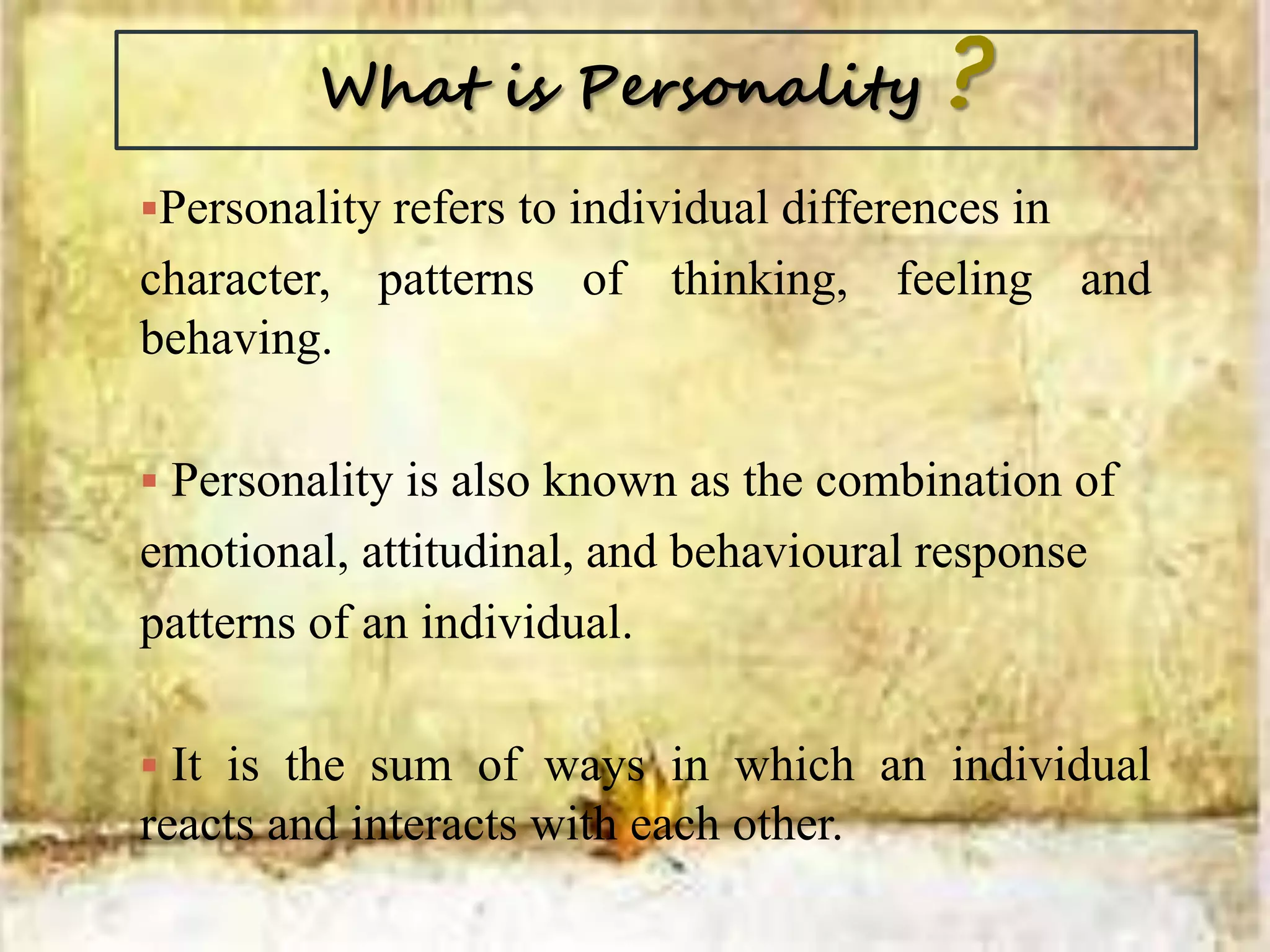
What is Personality ?
Personality refers to individual differences in
character, patterns of thinking, feeling and
behaving.
 Personality is also known as the combination of
emotional, attitudinal, and behavioural response
patterns of an individual.
 It is the sum of ways in which an individual
reacts and interacts with each other.
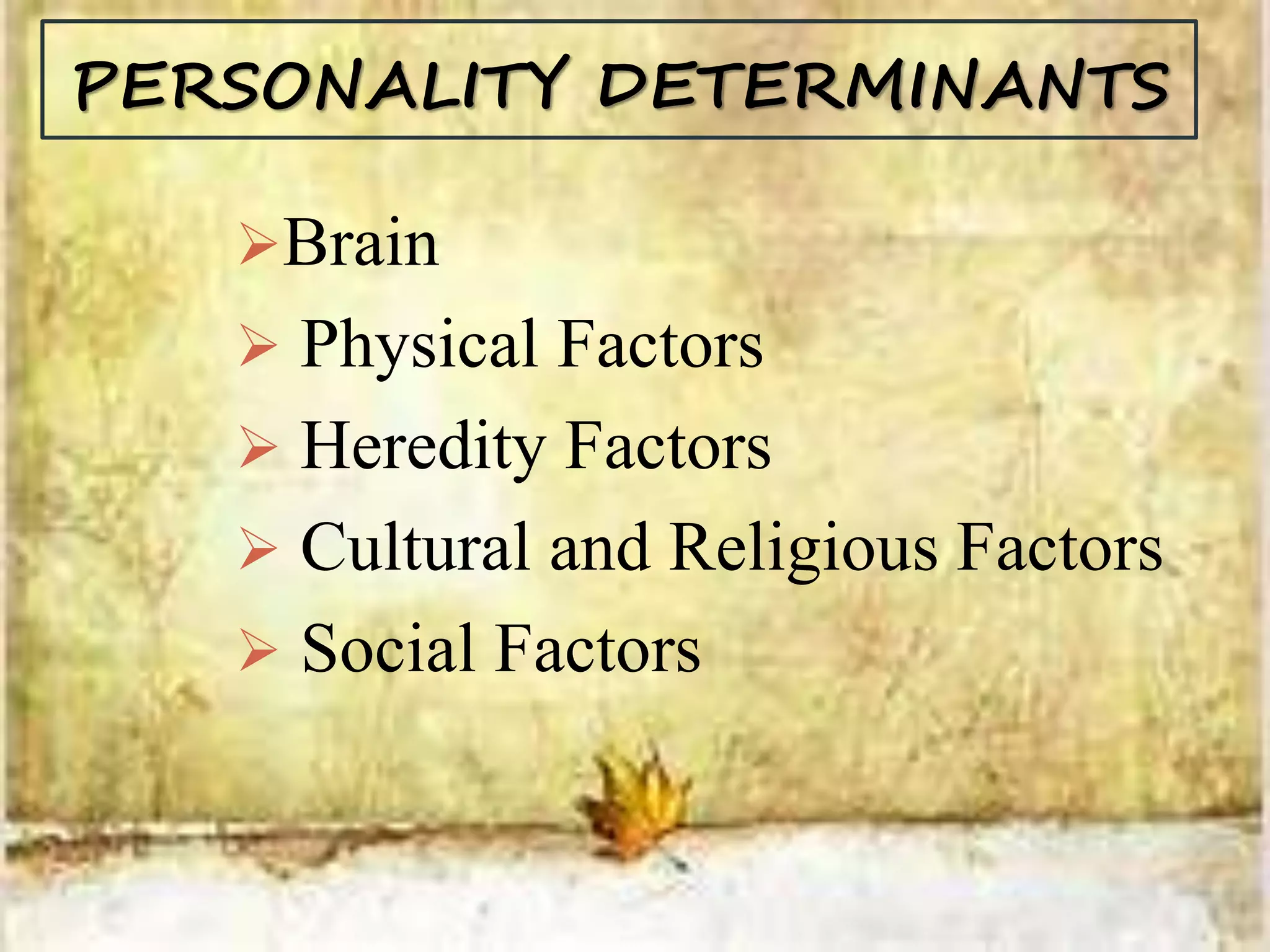
PERSONALITY DETERMINANTS
Brain
 Physical Factors
 Heredity Factors
 Cultural and Religious Factors
 Social Factors
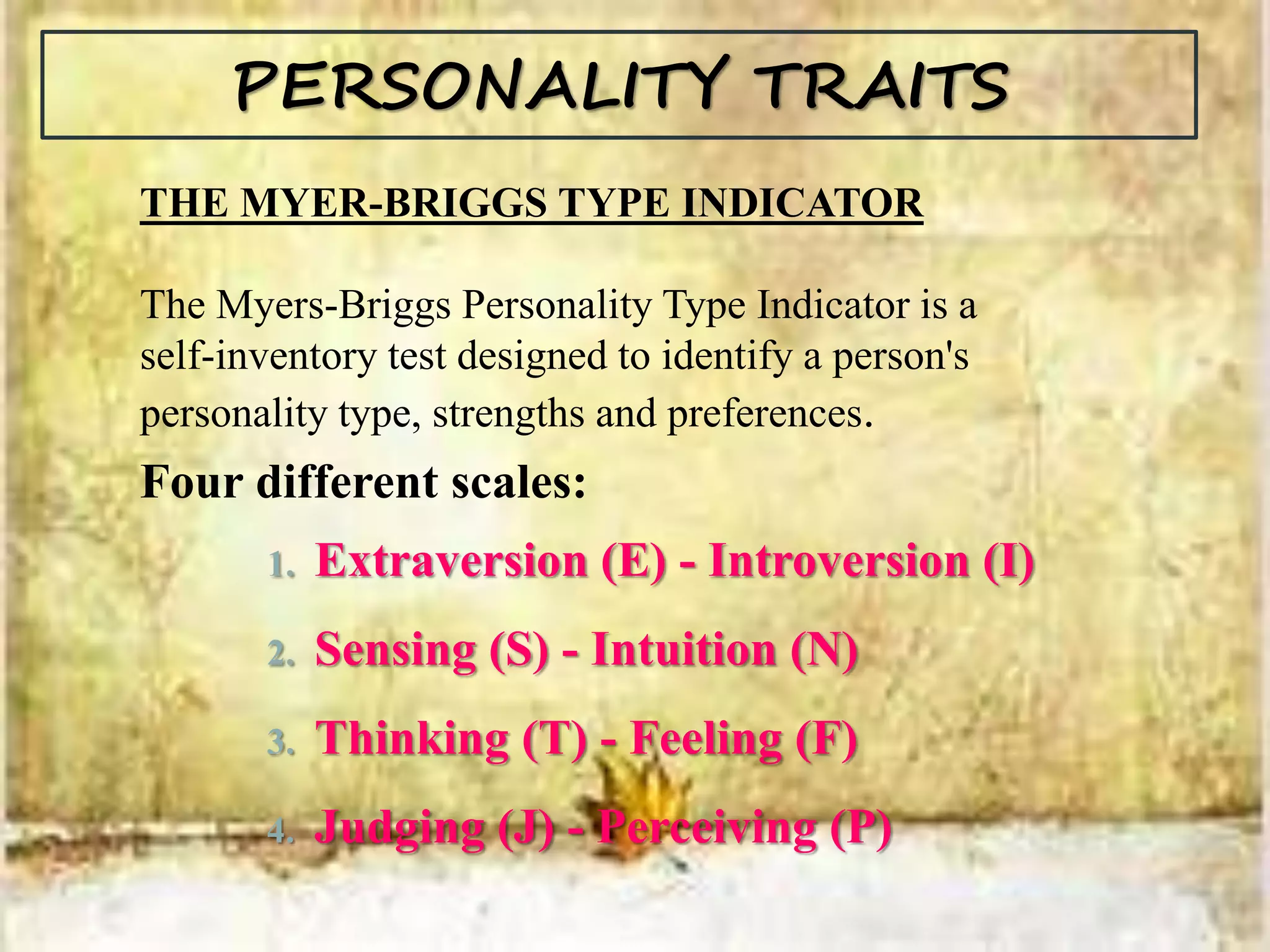
PERSONALITY TRAITS
THE MYER-BRIGGS TYPE INDICATOR
The Myers-Briggs Personality Type Indicator is a
self-inventory test designed to identify a person's
personality type, strengths and preferences.
Four different scales:
1. Extraversion (E) - Introversion (I)
2. Sensing (S) - Intuition (N)
3. Thinking (T) - Feeling (F)
4. Judging (J) - Perceiving (P)
ATTRIBUTES OF PERSONALITY
Locus of Control
Machiavellianism
Self-Esteem
Risk Taking
Type A-Type B Personality
Locus of Control
LOCUS OF CONTROL
Internal and external locus of control
 Research has found the following trends:
•Males tend to be more internal than females
•As people get older they tend to become more
internal
•People higher up in organizational structures tend
to be more internal
MACHIAVELLIANISM
It refers to the degree to which an individual is
practical in his approach, maintains an emotional
distance from others and believes that ends justify the
means.
 Research has revealed that individuals who score
high on Mach are good at manipulating others and try
to win by any means.
 They do not need to be persuaded to work but
instead are able to successfully persuade others.
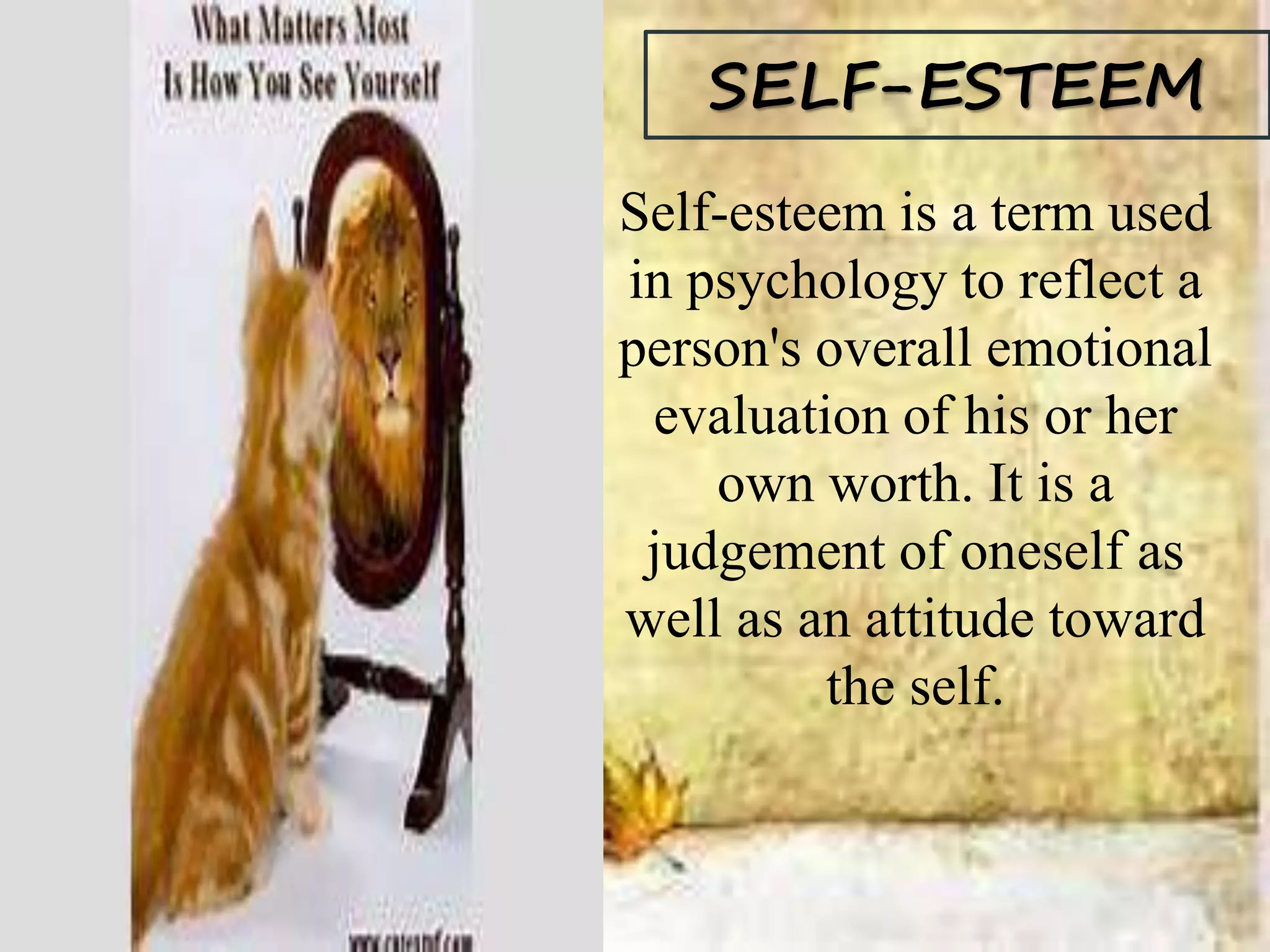
SELF-ESTEEM
Self-esteem is a term used
in psychology to reflect a
person's overall emotional
evaluation of his or her
own worth. It is a
judgement of oneself as
well as an attitude toward
the self.
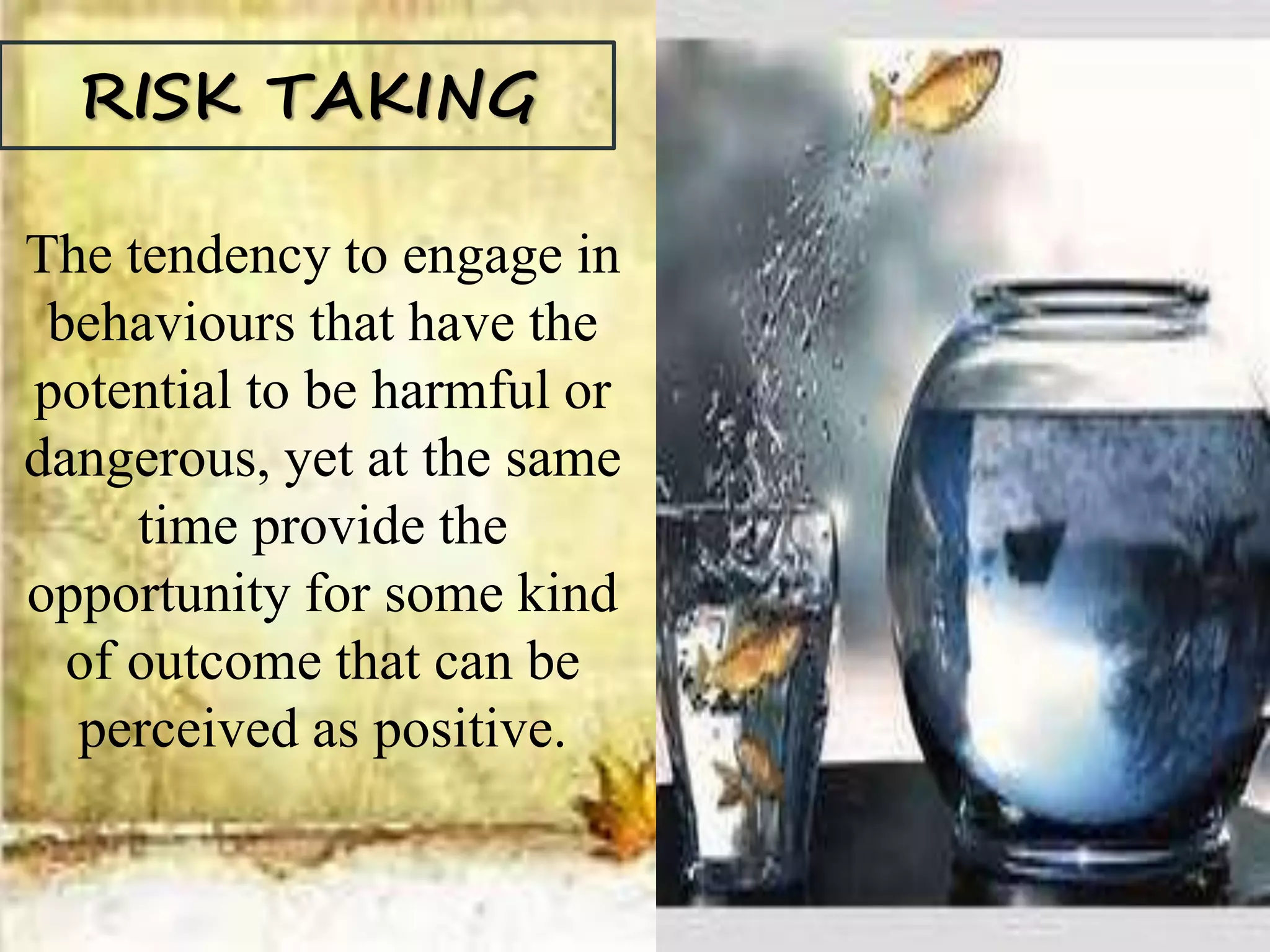
RISK TAKING
The tendency to engage in
behaviours that have the
potential to be harmful or
dangerous, yet at the same
time provide the
opportunity for some kind
of outcome that can be
perceived as positive.
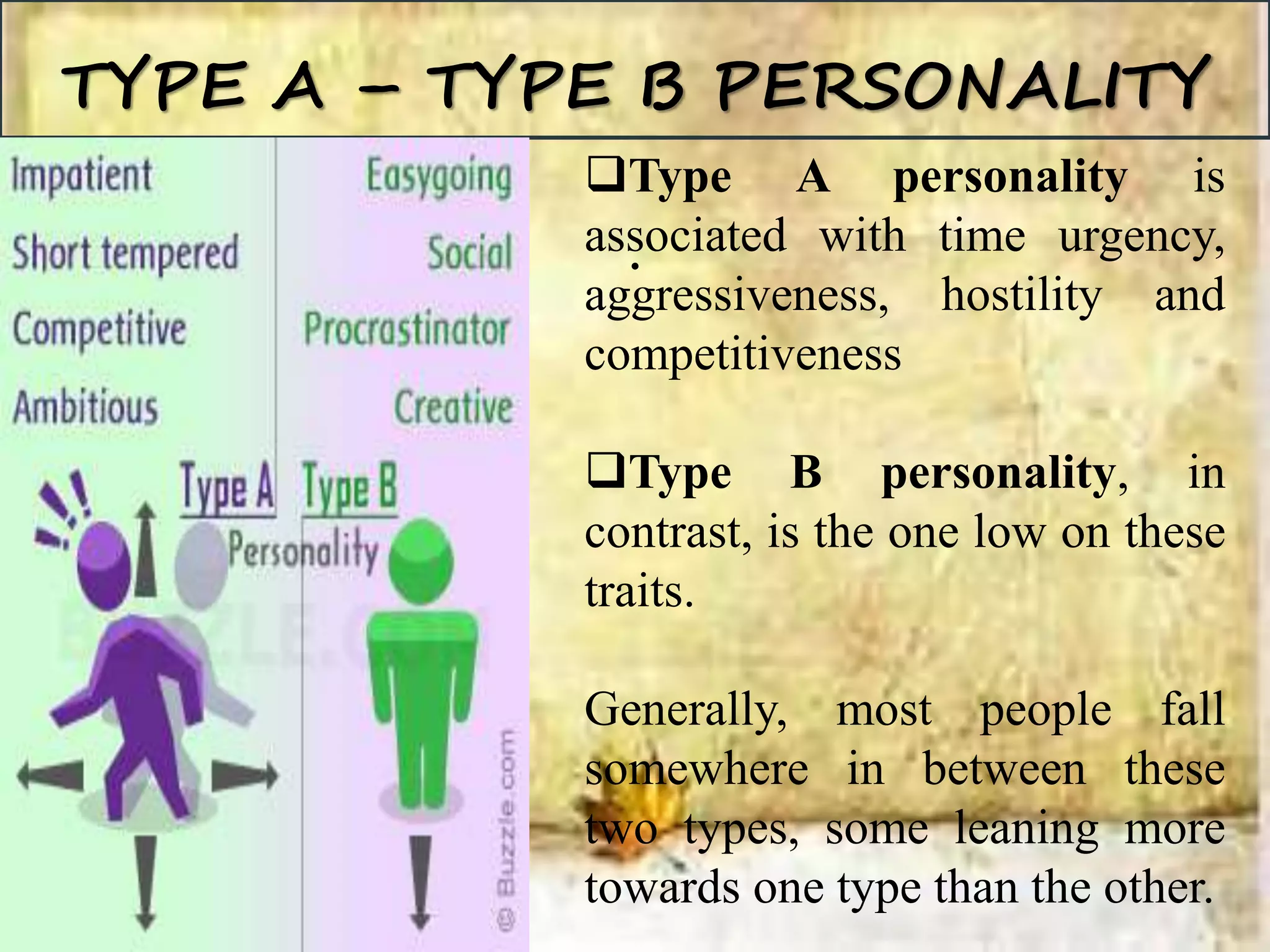
TYPE A – TYPE B PERSONALITY
.
Type A personality is
associated with time urgency,
aggressiveness, hostility and
competitiveness
Type B personality, in
contrast, is the one low on these
traits.
Generally, most people fall
somewhere in between these
two types, some leaning more
towards one type than the other.
Achieving A PERSONALITY
Job Fit Theory
Hollands theory is centred on the notion that most
people fit into one of six (6) personality types:
Realistic (Doer)
Investigative (Thinker)
Artistic (Creator)
Social (Helper)
Enterprising (Persuader)
Conventional(Organizer)
Achieving A PERSONALITY
Job Fit Theory
Hollands theory is centred on the notion that most people fit
into one of Six(6) personality types:
1. Realistic (Doer)
Prefers physical activities that require skill, strength and
coordination. Traits include being genuine, stable, conforming
and practical. Example professions include architect, farmer and
engineer.
2. Investigative (Thinker)
Prefers working with theory and information, thinking,
organizing and understanding. Traits include being analytical,
curious and independent. Example professions include lawyer,
mathematician and professor..
Achieving A PERSONALITY
Job Fit Theory
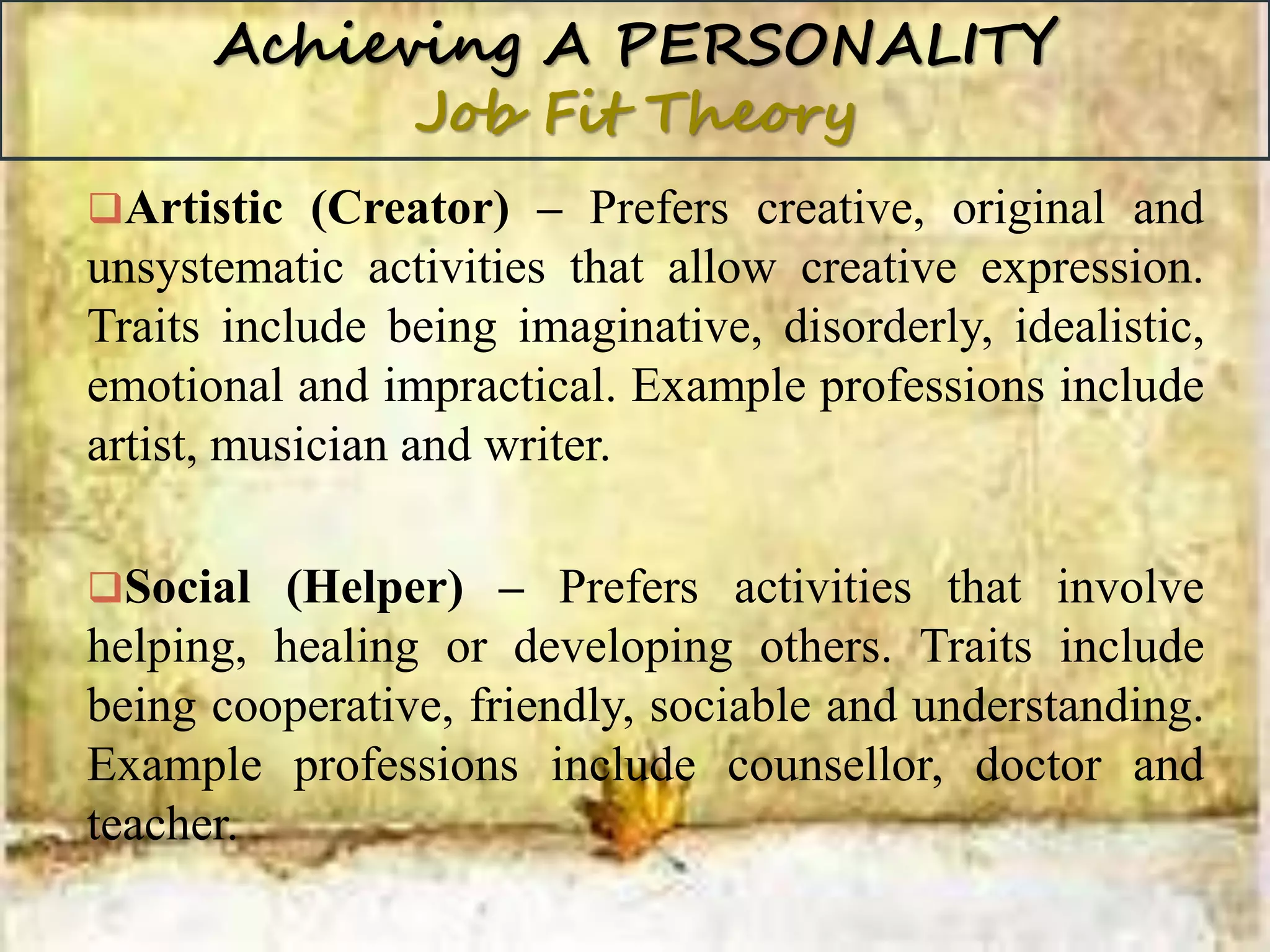
Artistic (Creator) – Prefers creative, original and
unsystematic activities that allow creative expression.
Traits include being imaginative, disorderly, idealistic,
emotional and impractical. Example professions include
artist, musician and writer.
Social (Helper) – Prefers activities that involve
helping, healing or developing others. Traits include
being cooperative, friendly, sociable and understanding.
Example professions include counsellor, doctor and
teacher.
Achieving A PERSONALITY
Job Fit Theory
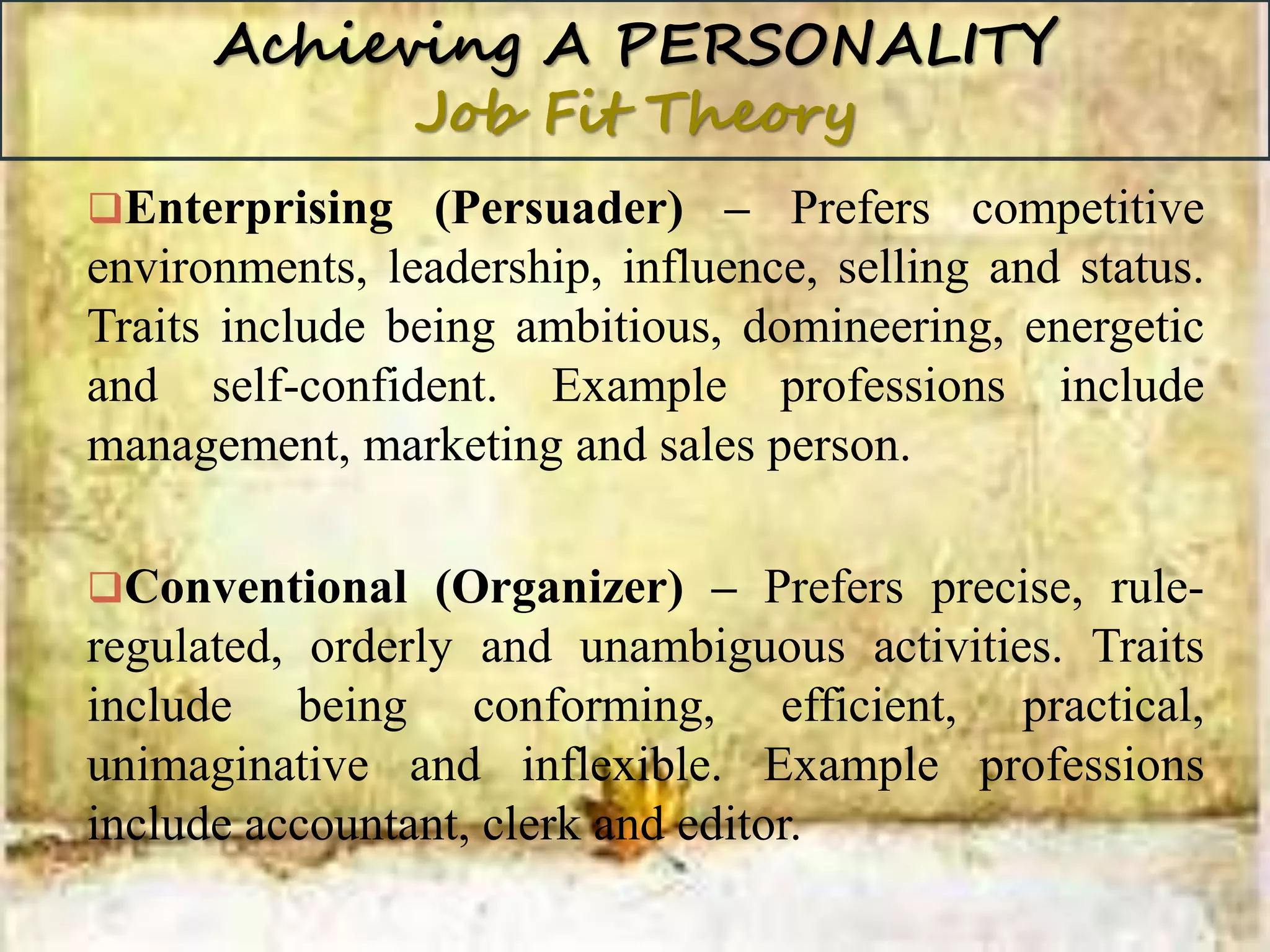
Enterprising (Persuader) – Prefers competitive
environments, leadership, influence, selling and status.
Traits include being ambitious, domineering, energetic
and self-confident. Example professions include
management, marketing and sales person.
Conventional (Organizer) – Prefers precise, rule-
regulated, orderly and unambiguous activities. Traits
include being conforming, efficient, practical,
unimaginative and inflexible. Example professions
include accountant, clerk and editor.
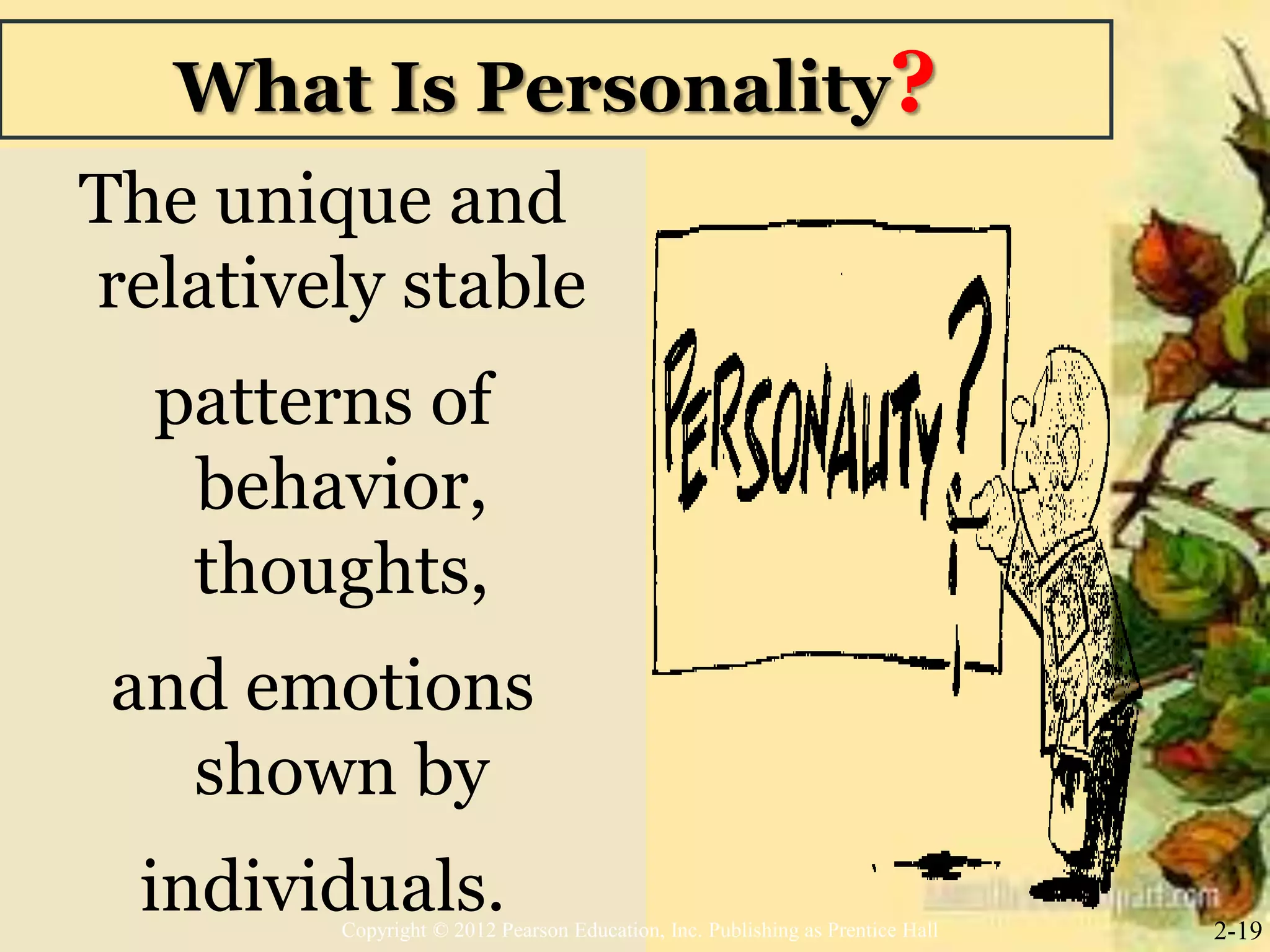
What Is Personality?
The unique and
relatively stable
patterns of
behavior,
thoughts,
and emotions
shown by
individuals. 2-19Copyright © 2012 Pearson Education, Inc. Publishing as Prentice Hall
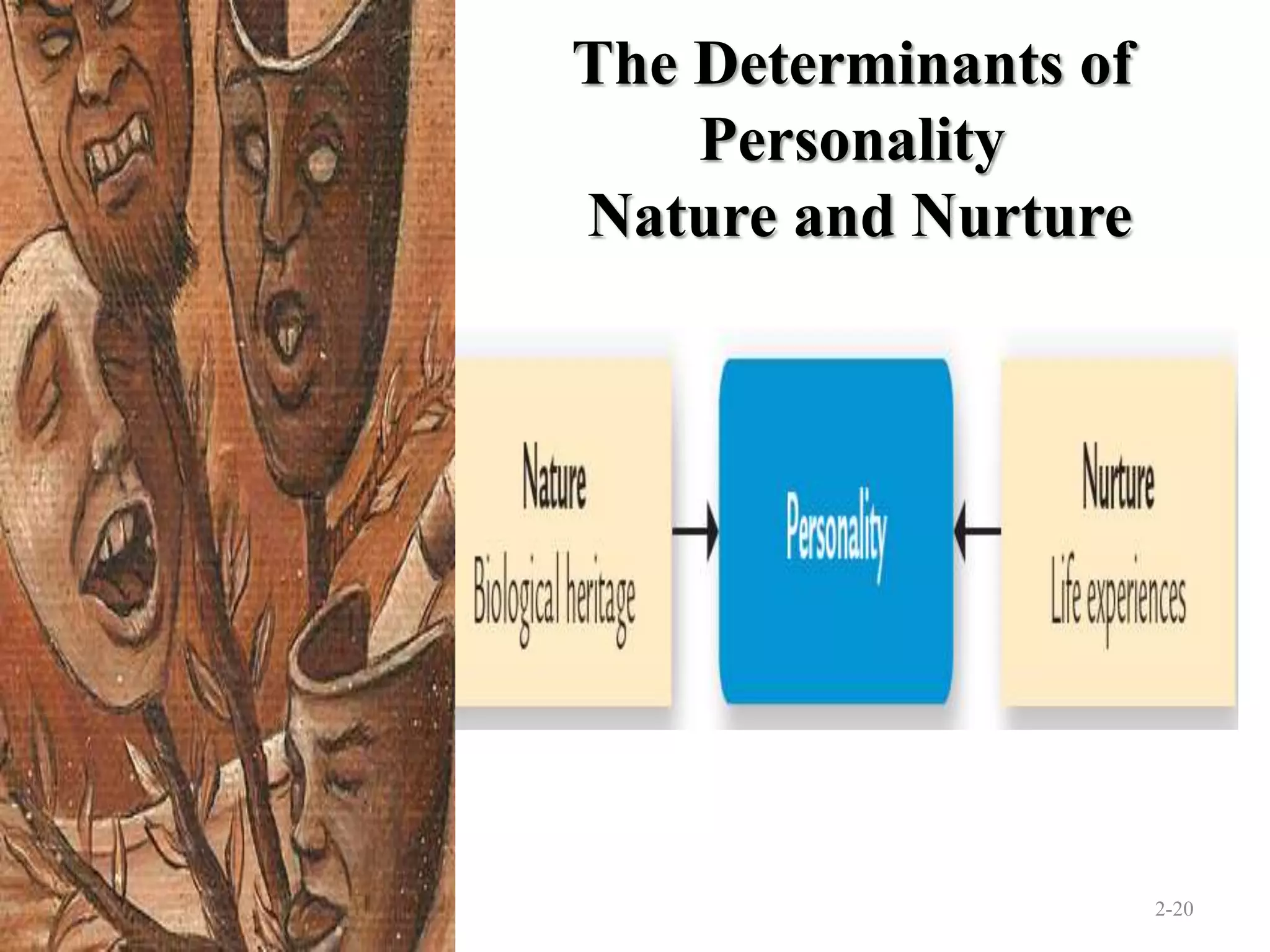
The Determinants of
Personality
Nature and Nurture
2-20
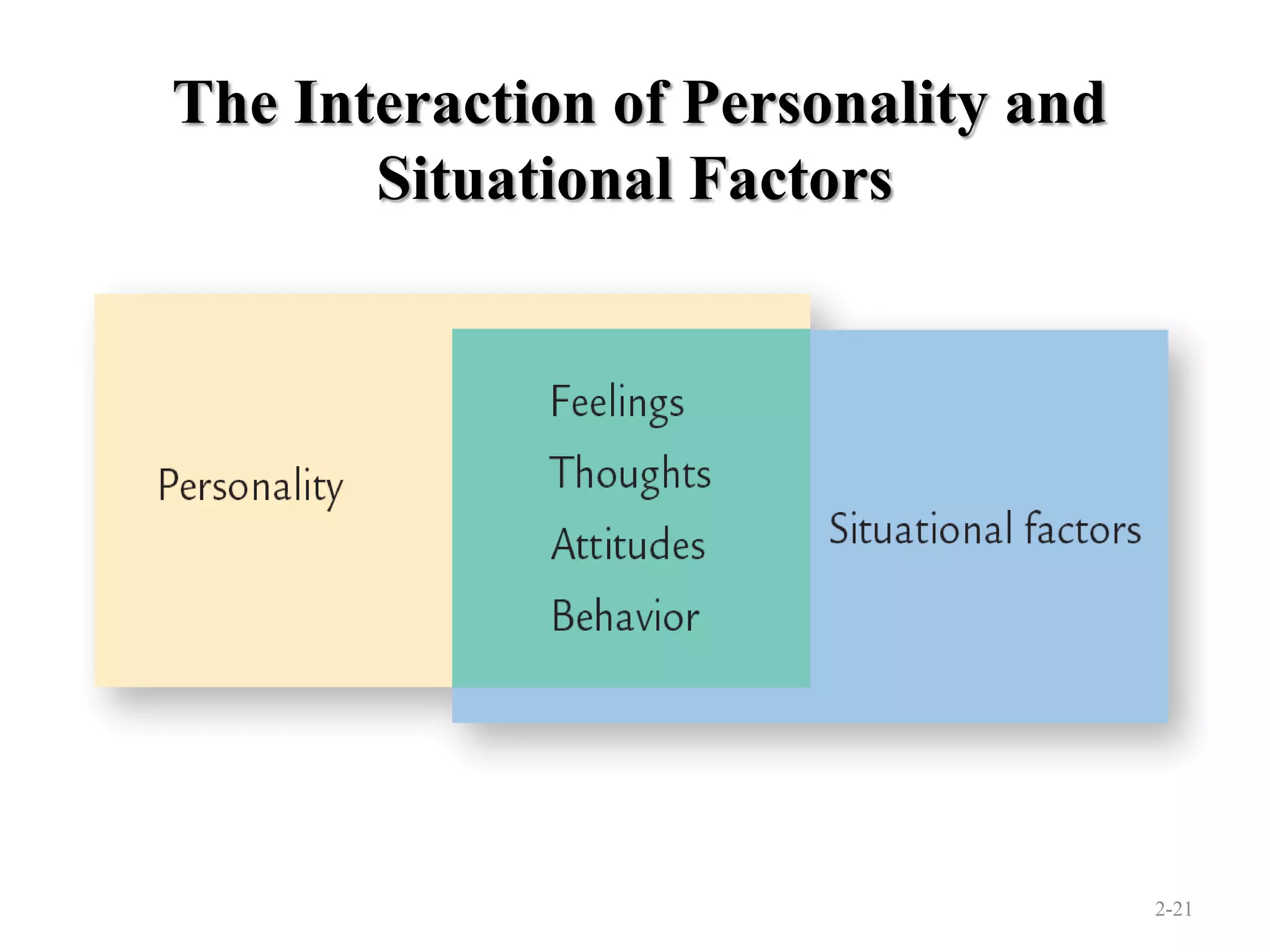
The Interaction of Personality and
Situational Factors
2-21
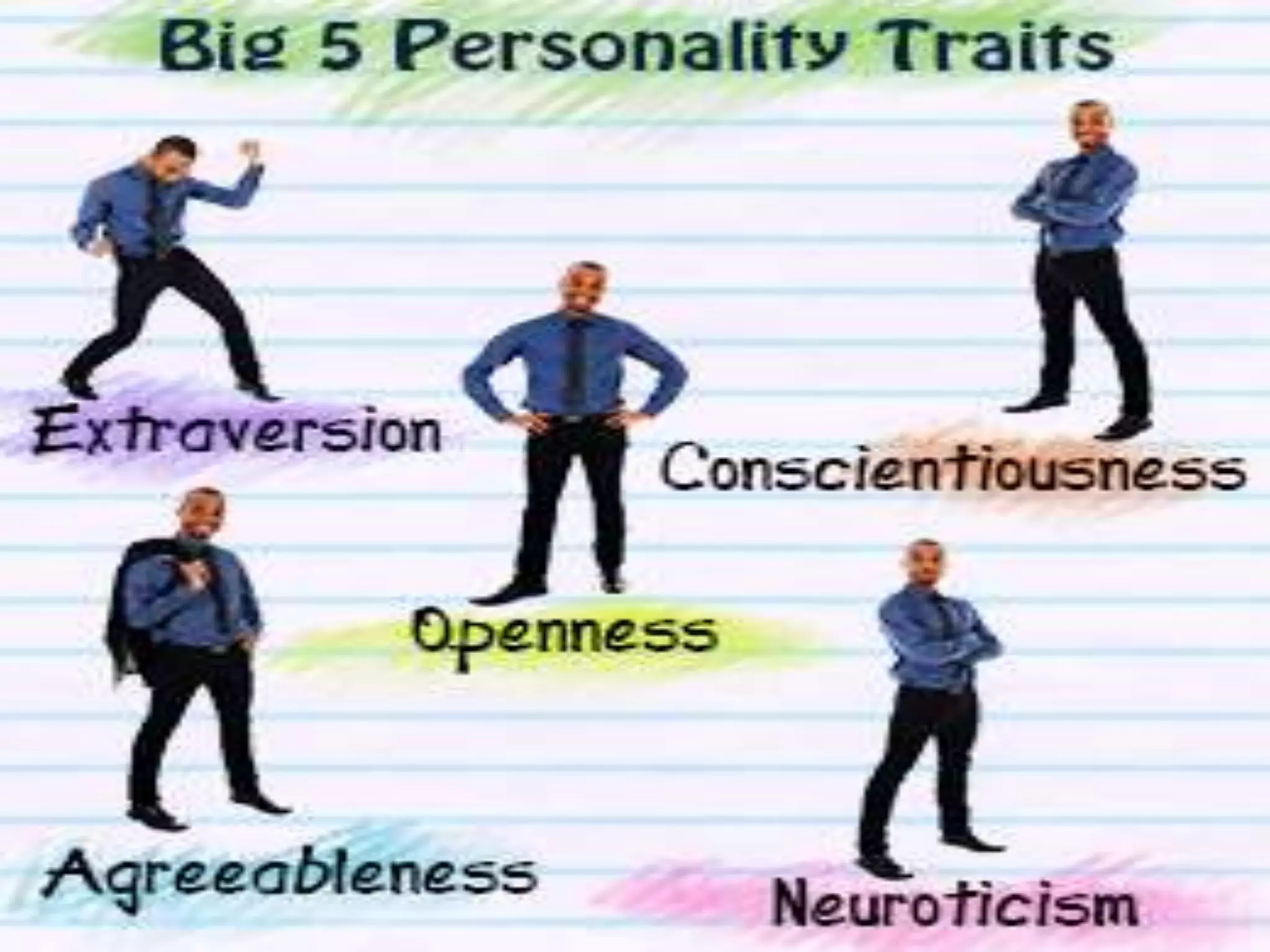
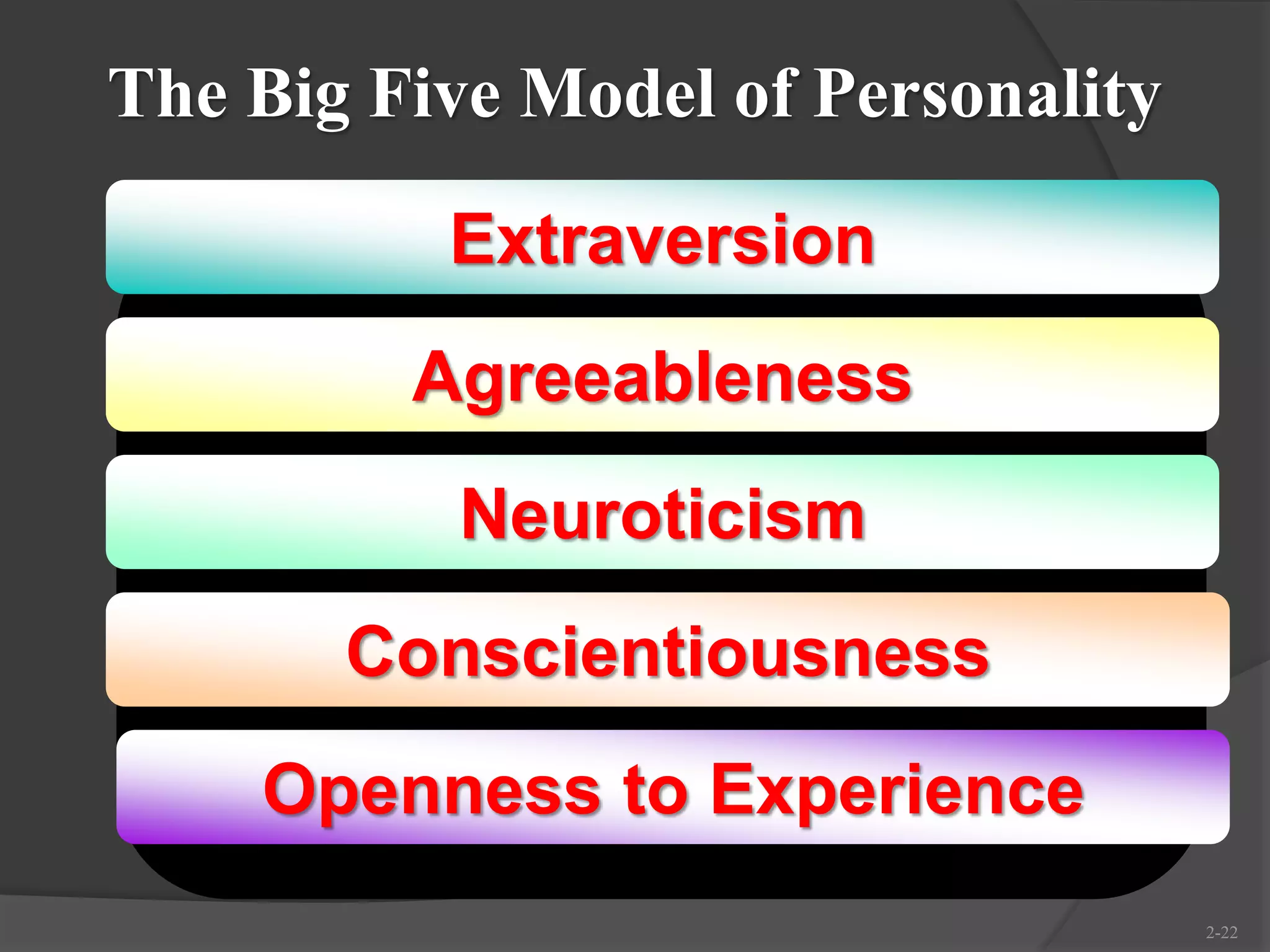
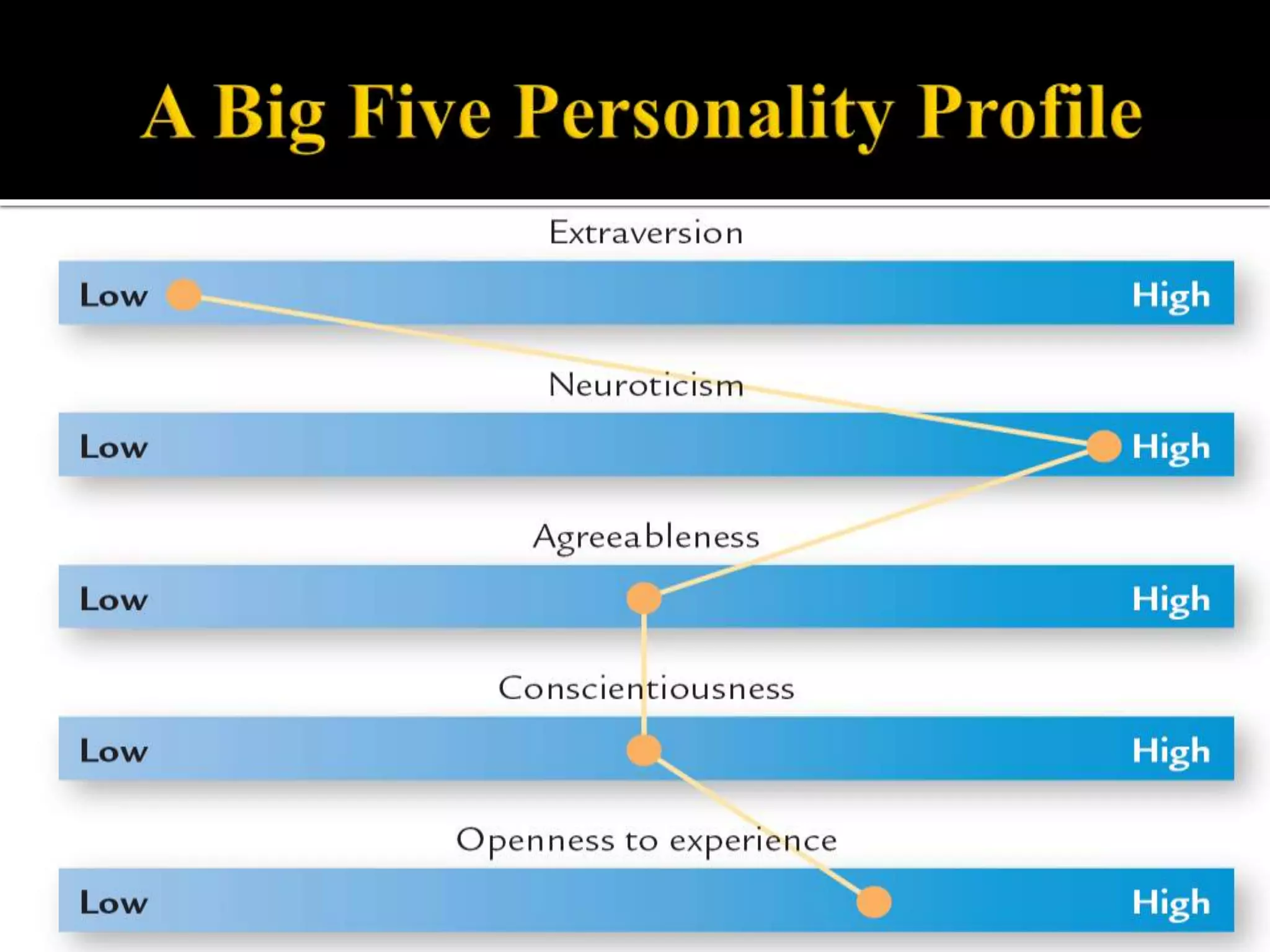
The Big Five Model of Personality
2-22
Extraversion
Neuroticism
Conscientiousness
Agreeableness
Openness to Experience
2-23
Extraversion
24
•/
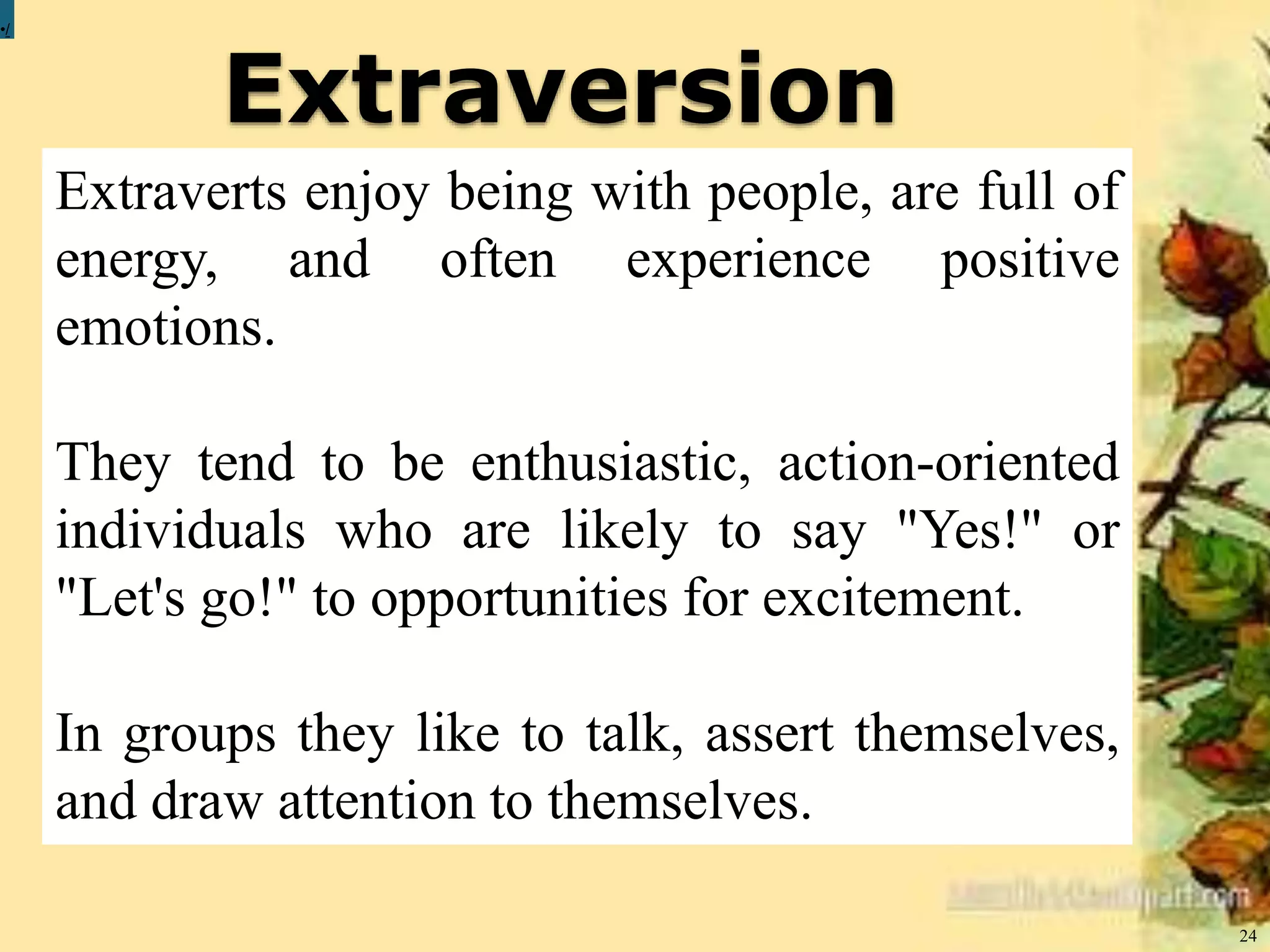
Extraverts enjoy being with people, are full of
energy, and often experience positive
emotions.
They tend to be enthusiastic, action-oriented
individuals who are likely to say "Yes!" or
"Let's go!" to opportunities for excitement.
In groups they like to talk, assert themselves,
and draw attention to themselves.
Extraversion-Example
25
•/
•I am the life of the party.
•I don't mind being the center of
attention.
•I feel comfortable around people.
•I start conversations.
•I talk to a lot of different people at
parties.
Agreeableness
26
•/
•Agreeableness reflects individual differences in
concern with cooperation and social harmony.
•Agreeable individuals value getting along with
others. They are therefore considerate, friendly,
generous, helpful, and willing to compromise their
interests with others’.
•Agreeable people also have an optimistic view of
human nature. They believe people are basically
honest, decent, and trustworthy.
Agreeableness-Example
27
•/
•I am interested in people.
•I feel others’ emotions.
•I have a soft heart.
•I make people feel at ease.
•I sympathize with others’ feelings.
•I take time out for others.
Conscientiousness
28
•/
•Conscientious individuals avoid trouble and
achieve high levels of success through
purposeful planning and persistence. They are
also positively regarded by others as
intelligent and reliable.
•On the negative side, they can be compulsive
perfectionists and workaholics. Furthermore,
extremely conscientious individuals might be
regarded as stuffy and boring.
Conscientiousness-
Example
29
•/
•I am always prepared.
•I am exacting in my work.
•I follow a schedule.
•I get chores done right away.
•I like order.
•I pay attention to details.
Neuroticism
30
•/
•Tendency to experience negative emotions. Those who score
high on Neuroticism may experience primarily one specific
negative feeling such as anxiety, anger, or depression, but are
likely to experience several of these emotions.
•People high in Neuroticism are emotionally reactive. They
respond emotionally to events that would not affect most people,
and their reactions tend to be more intense than normal. They are
more likely to interpret ordinary situations as threatening, and
minor frustrations as hopelessly difficult. Their negative
emotional reactions tend to persist for unusually long periods of
time, which means they are often in a bad mood.
•These problems in emotional regulation can diminish a
neurotic's ability to think clearly, make decisions, and cope
effectively with stress.
Neuroticism-Example
31
•/
•I am easily disturbed.
•I change my mood a lot.
•I get irritated easily.
•I get stressed out easily.
•I get upset easily.
•I have frequent mood swings.
•I often feel blue.
•I worry about things.
Openness to Experience
32
•/
Personality trait that captures the extent to which
an individual is
 original,
 open to a wide variety of stimuli,
 has broad interests, and is
 willing to take risks as opposed to being narrow-
minded and cautious
Openness to Experience
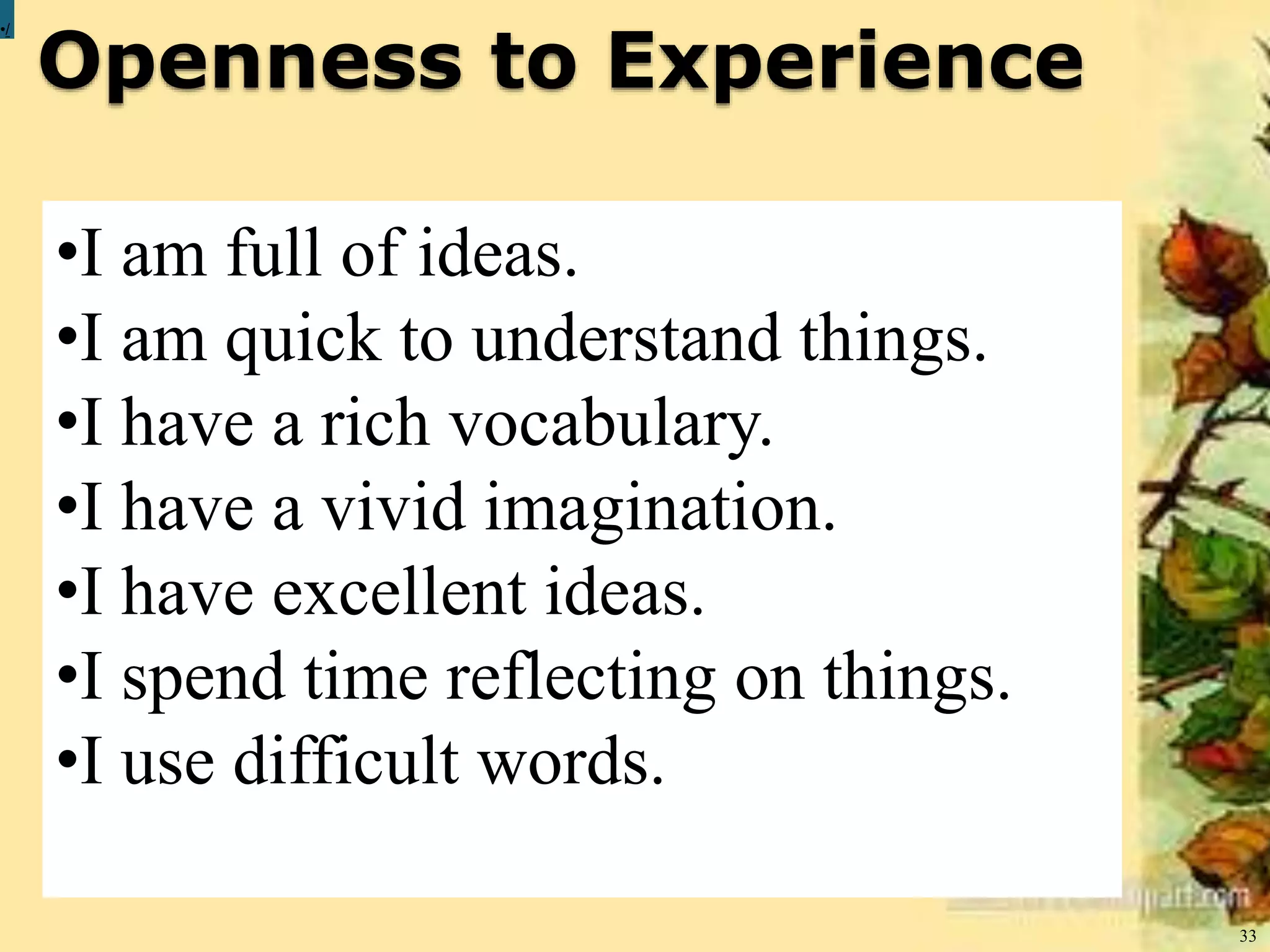
33
•/
•I am full of ideas.
•I am quick to understand things.
•I have a rich vocabulary.
•I have a vivid imagination.
•I have excellent ideas.
•I spend time reflecting on things.
•I use difficult words.
Applicability to Organizational Behavior
Copyright © 2012 Pearson Education, Inc. Publishing as Prentice Hall 34
•/
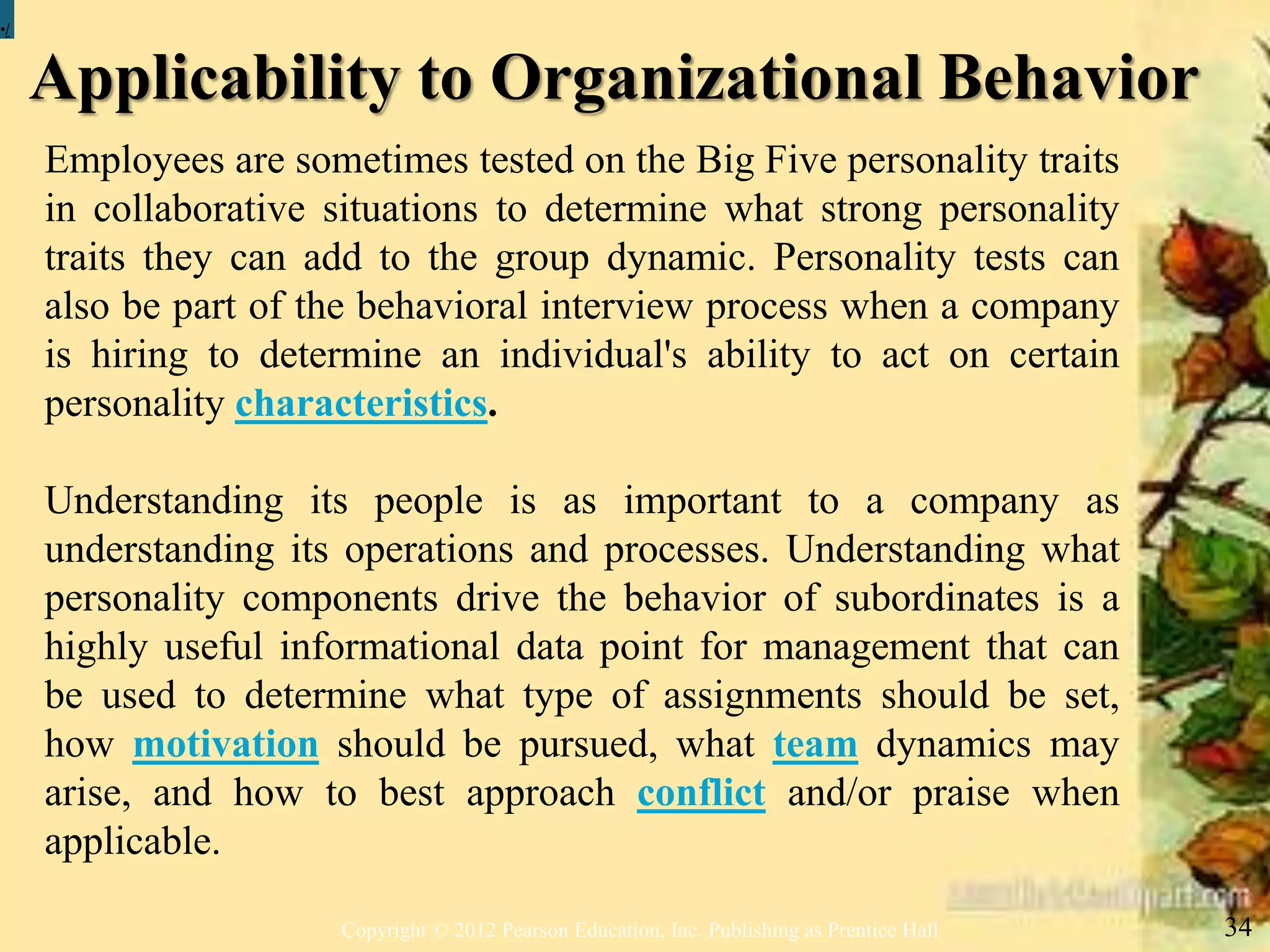
Employees are sometimes tested on the Big Five personality traits
in collaborative situations to determine what strong personality
traits they can add to the group dynamic. Personality tests can
also be part of the behavioral interview process when a company
is hiring to determine an individual's ability to act on certain
personality characteristics.
Understanding its people is as important to a company as
understanding its operations and processes. Understanding what
personality components drive the behavior of subordinates is a
highly useful informational data point for management that can
be used to determine what type of assignments should be set,
how motivation should be pursued, what team dynamics may
arise, and how to best approach conflict and/or praise when
applicable.
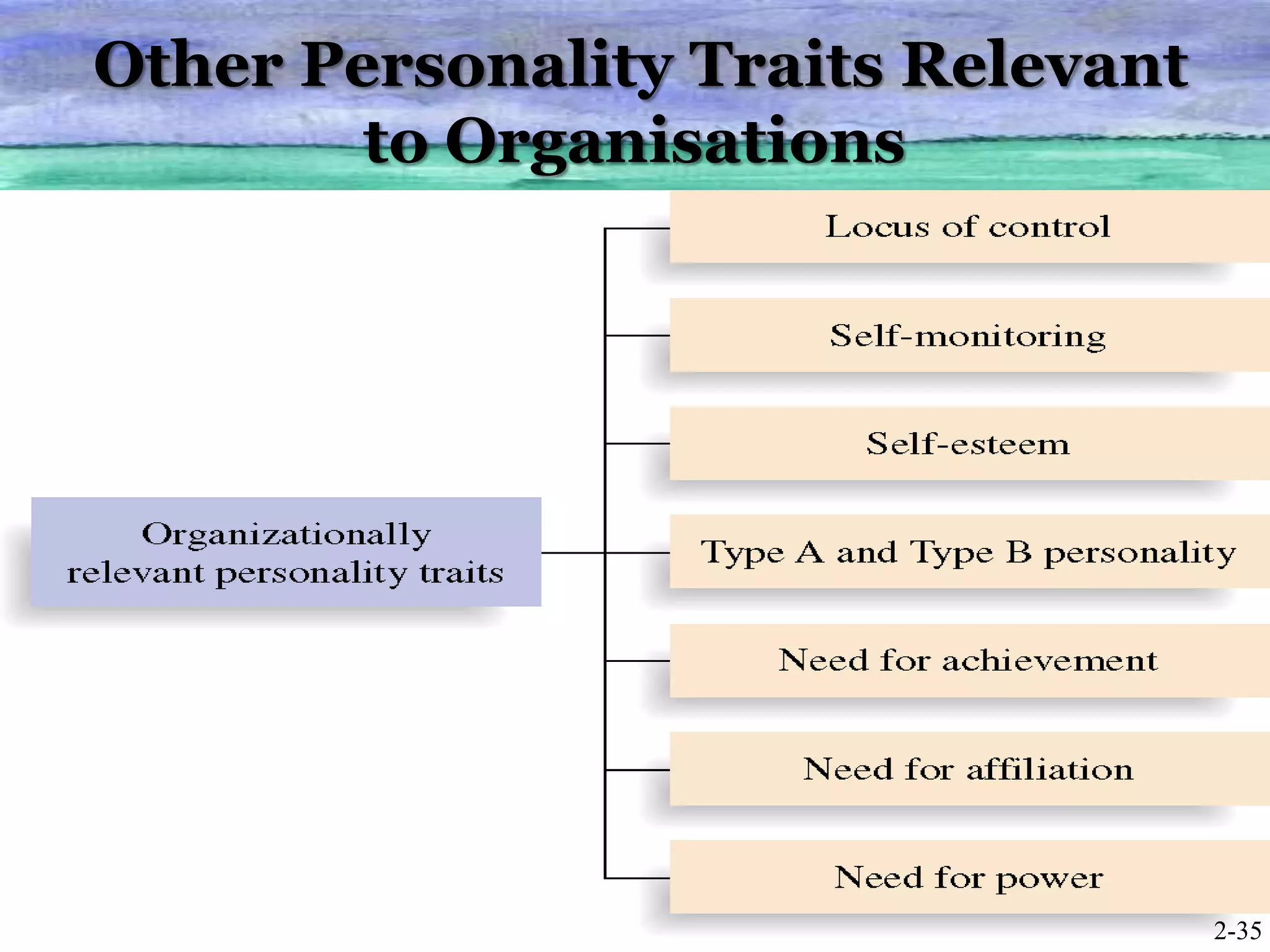
Other Personality Traits Relevant
to Organisations
2-35
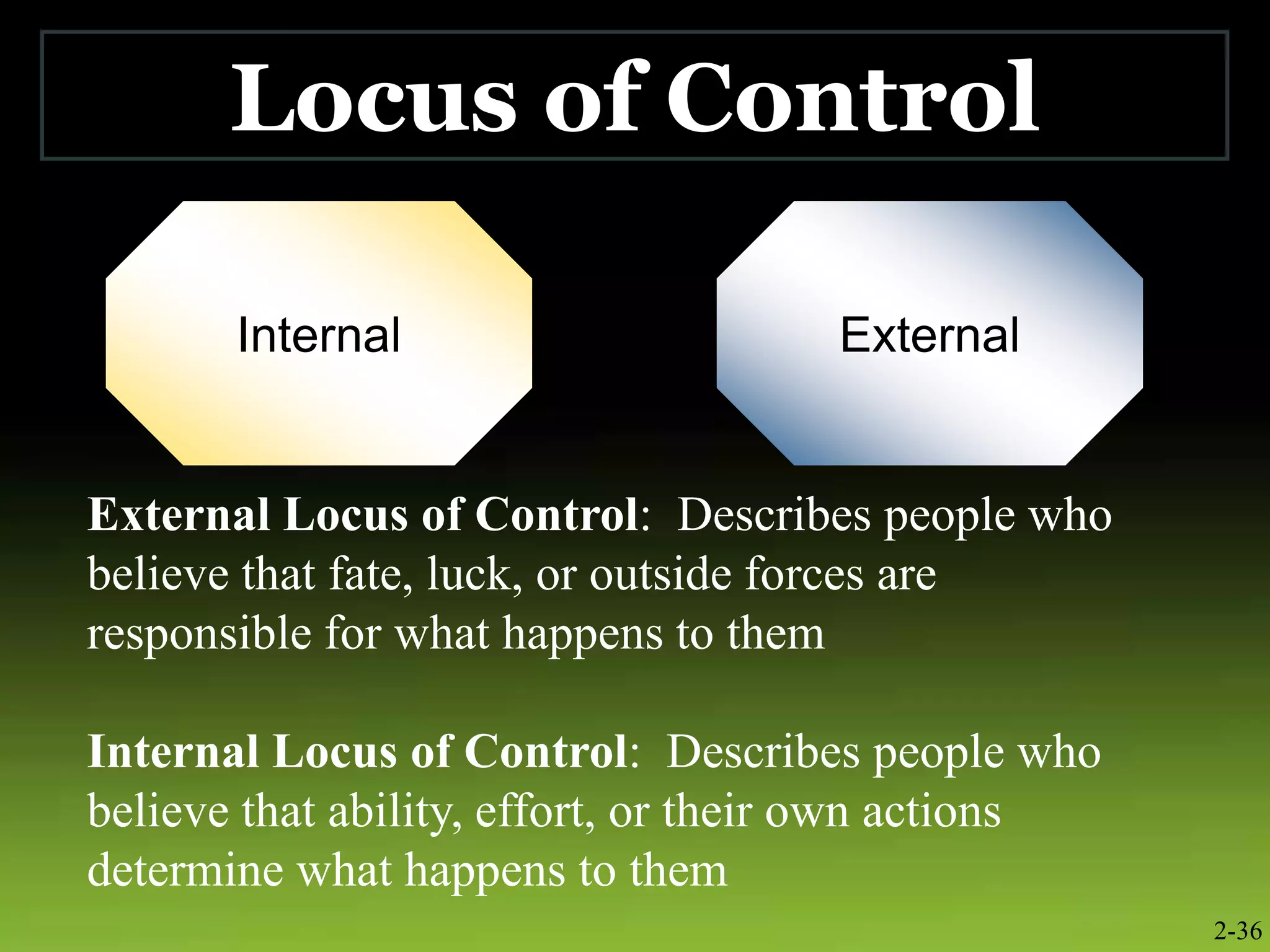
Locus of Control
Internal External
2-36
External Locus of Control: Describes people who
believe that fate, luck, or outside forces are
responsible for what happens to them
Internal Locus of Control: Describes people who
believe that ability, effort, or their own actions
determine what happens to them
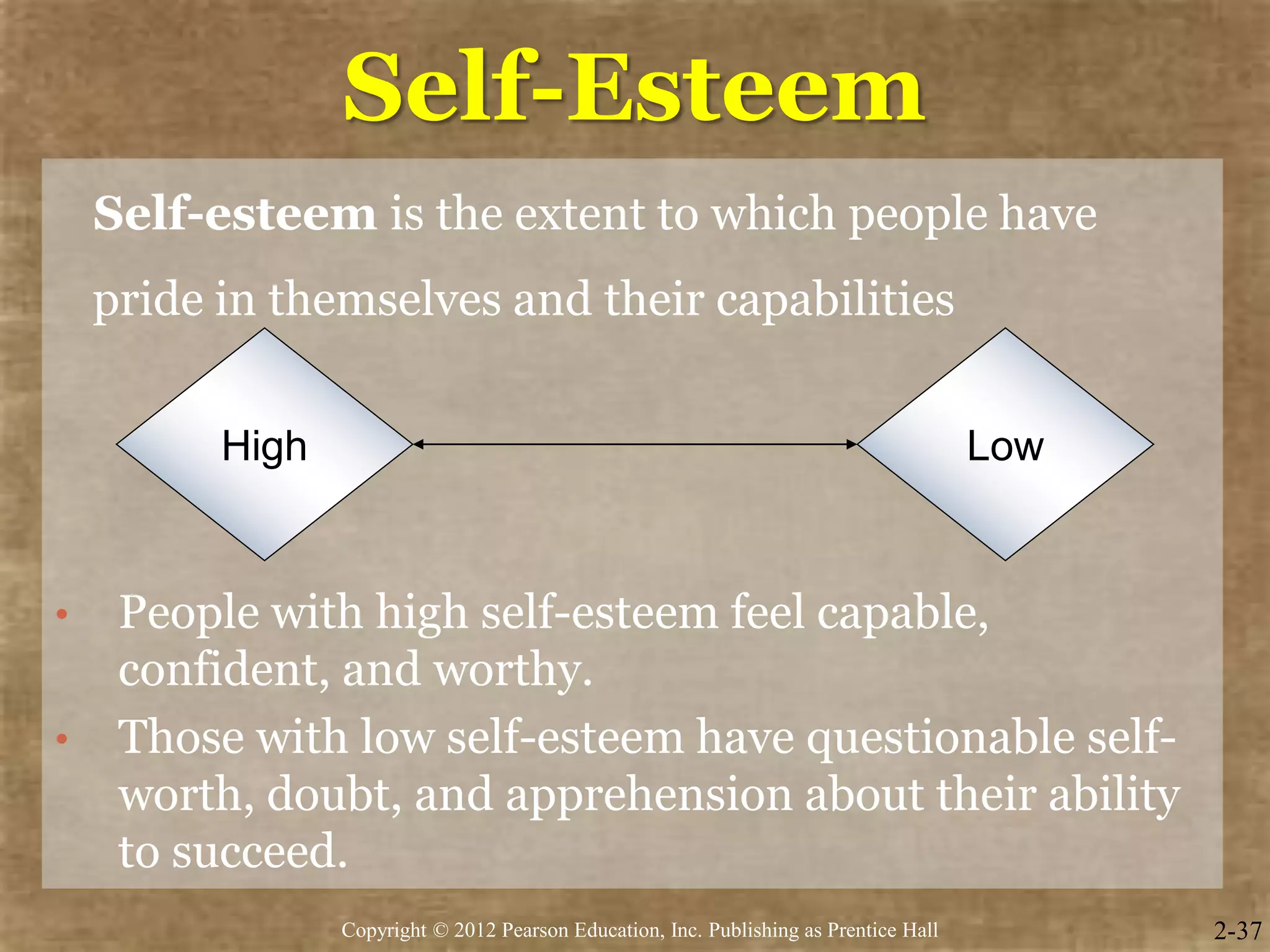
Self-Esteem
Self-esteem is the extent to which people have
pride in themselves and their capabilities
• People with high self-esteem feel capable,
confident, and worthy.
• Those with low self-esteem have questionable self-
worth, doubt, and apprehension about their ability
to succeed.
High Low
2-37Copyright © 2012 Pearson Education, Inc. Publishing as Prentice Hall
Type A vs. Type B Personality
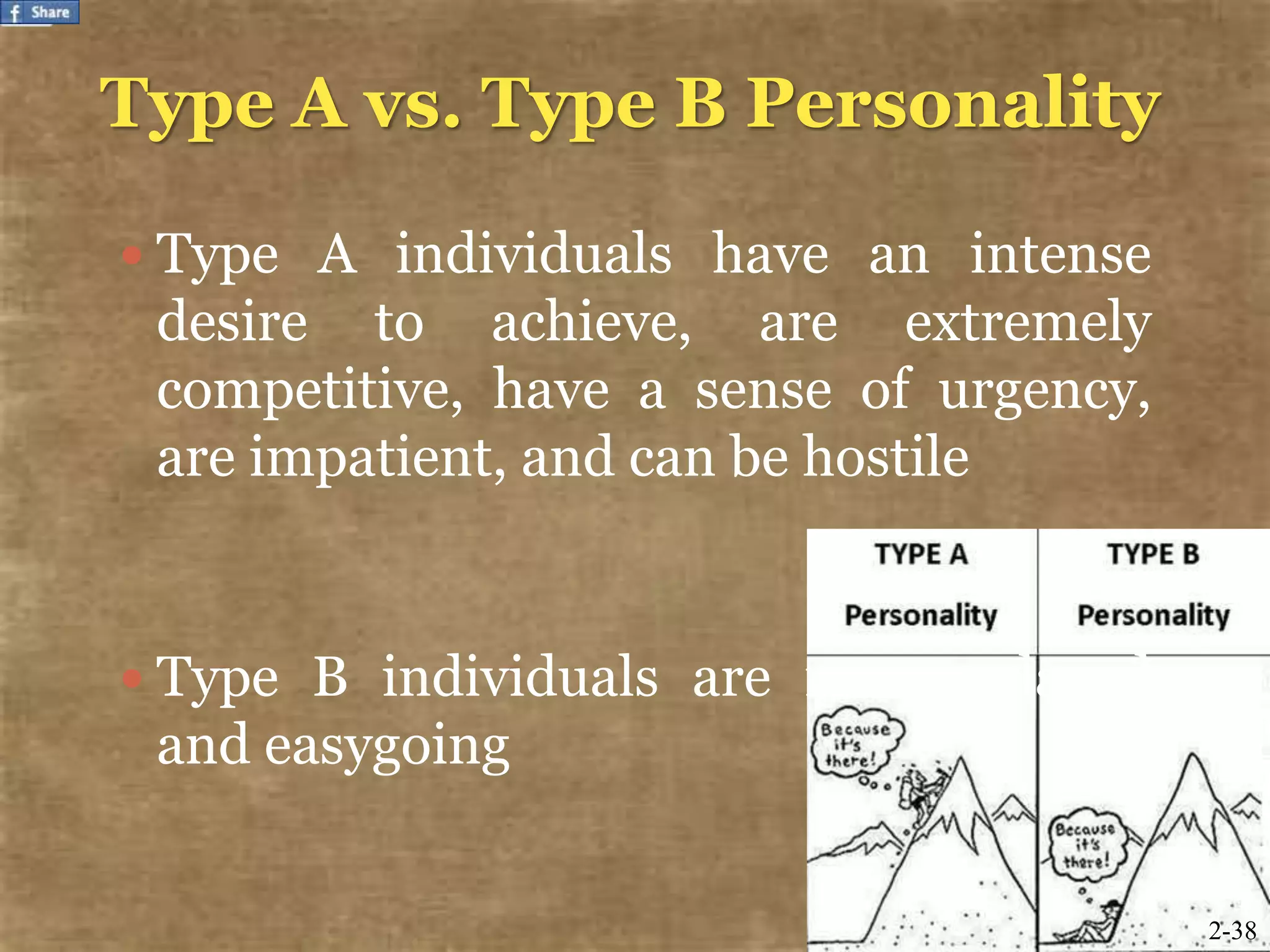
 Type A individuals have an intense
desire to achieve, are extremely
competitive, have a sense of urgency,
are impatient, and can be hostile
 Type B individuals are more relaxed
and easygoing
2-38
The Nature of Ability
• Ability: The mental or physical capacity to
do something.
• Ability determines the level of performance
an employee can achieve.
• Types of ability
 Cognitive ability
 Physical ability
• Motor skill
• Physical skill
 Emotional intelligence
2-39Copyright © 2012 Pearson Education, Inc. Publishing as Prentice Hall
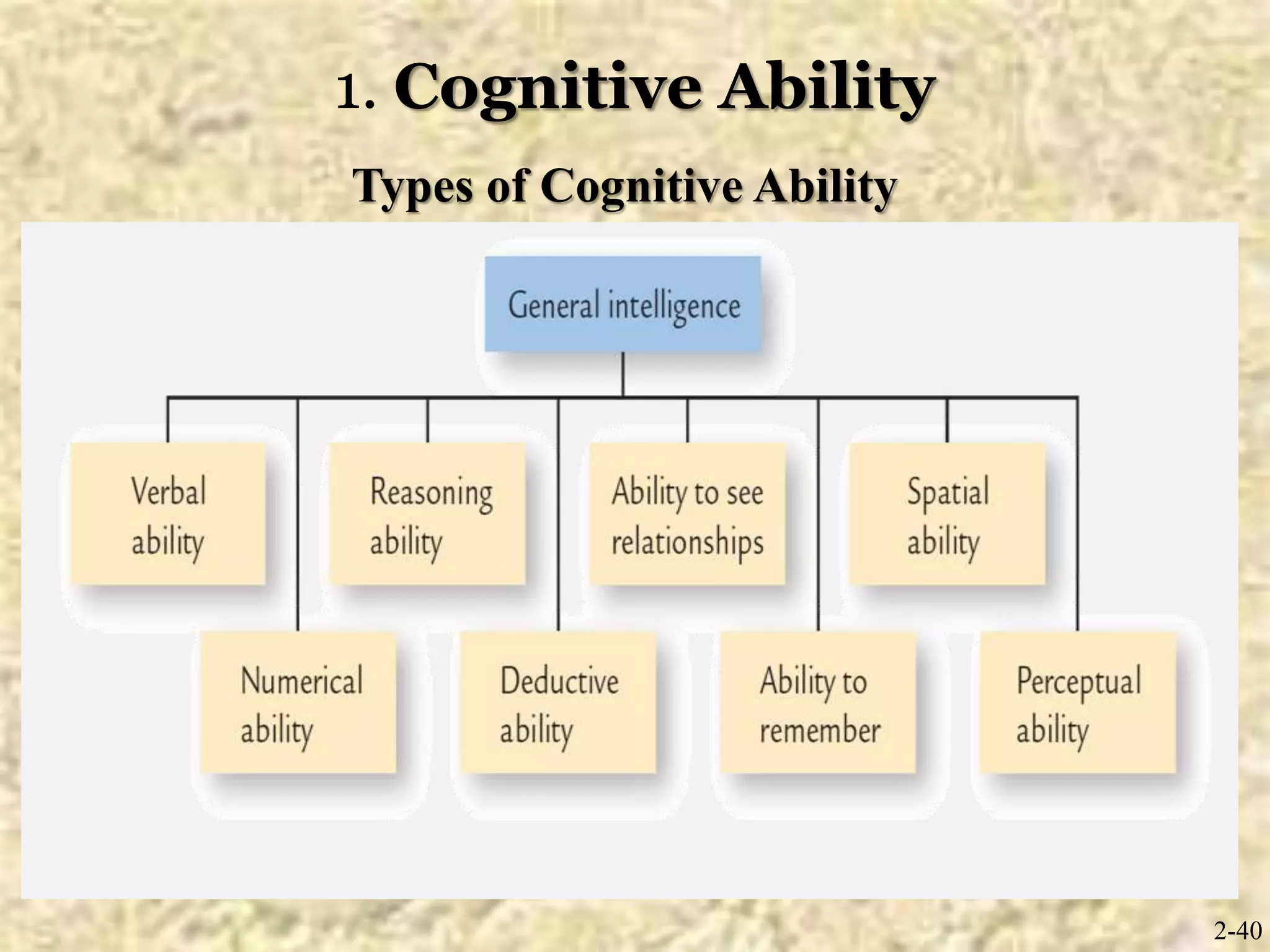
1. Cognitive Ability
2-40
Types of Cognitive Ability
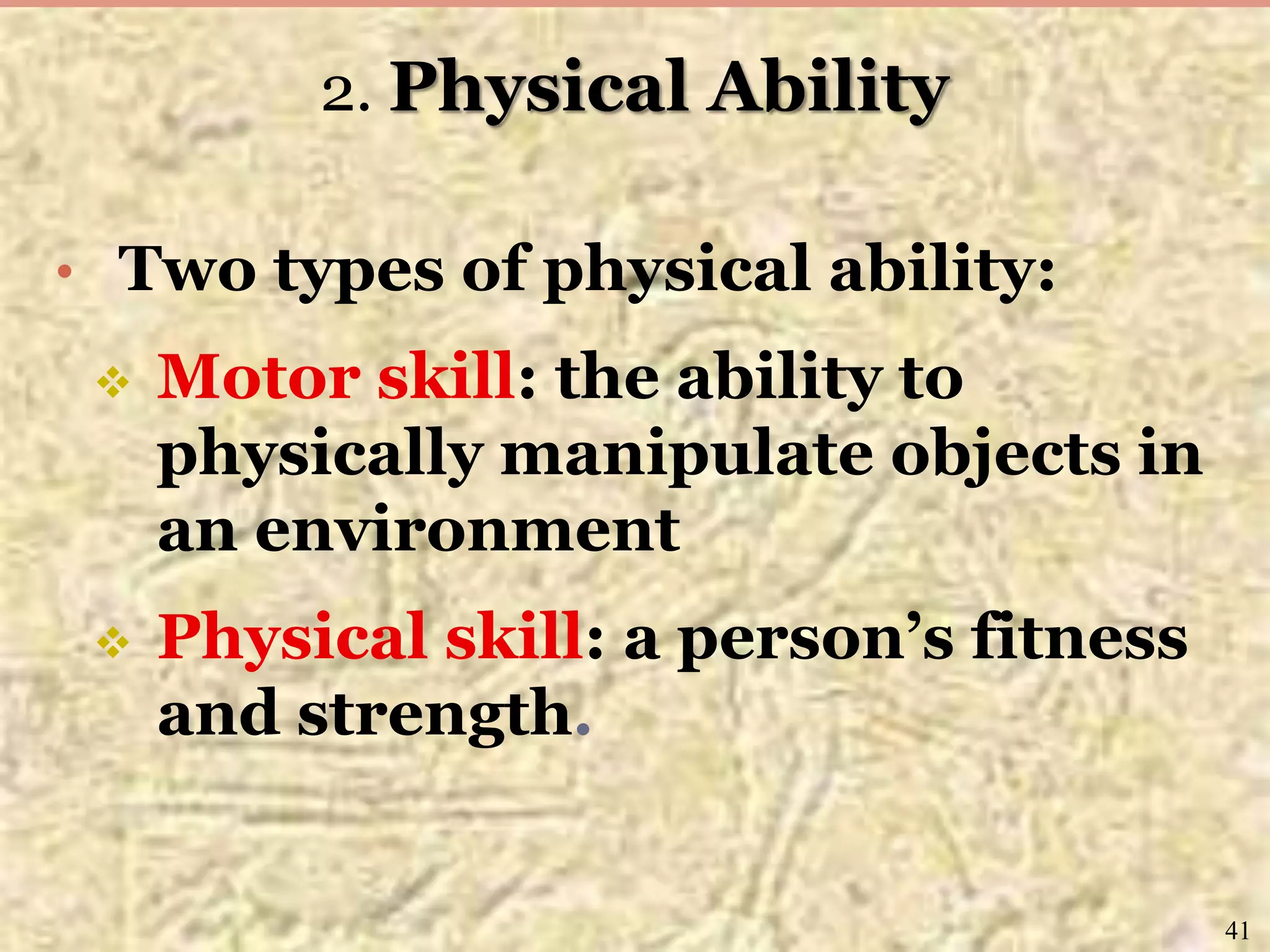
2. Physical Ability
• Two types of physical ability:
 Motor skill: the ability to
physically manipulate objects in
an environment
 Physical skill: a person’s fitness
and strength.
41
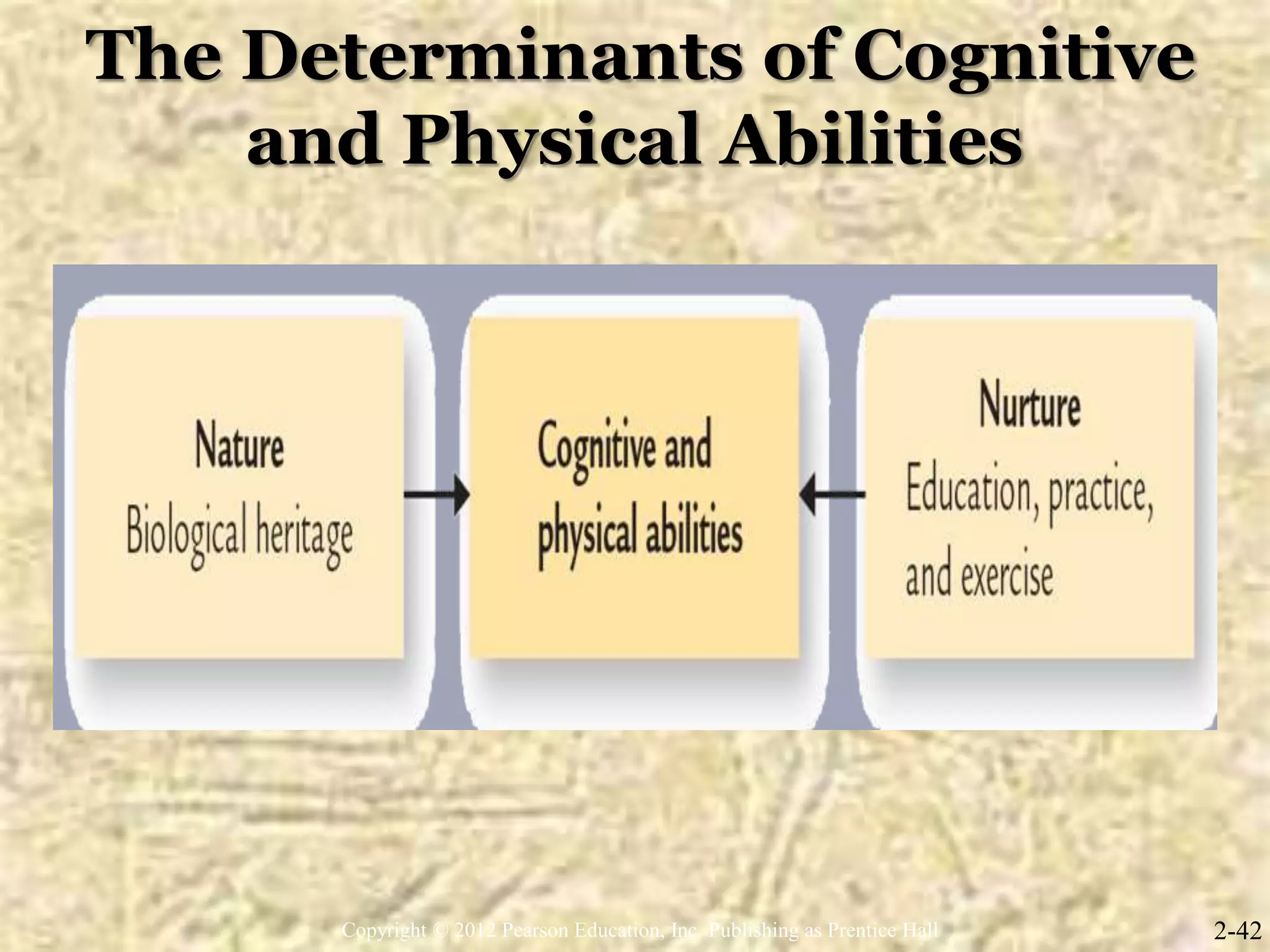
The Determinants of Cognitive
and Physical Abilities
2-42Copyright © 2012 Pearson Education, Inc. Publishing as Prentice Hall
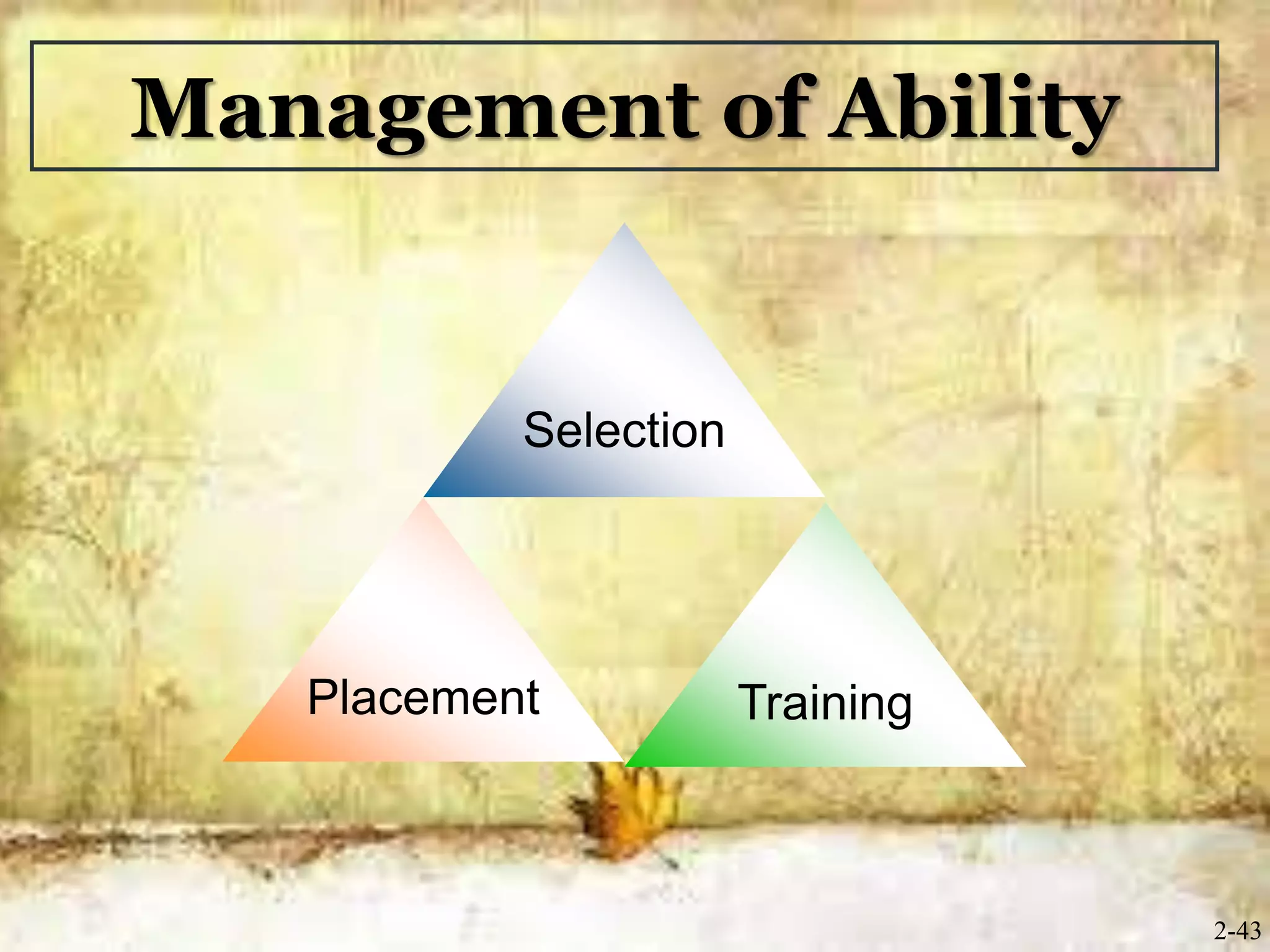
Management of Ability
Selection
Placement Training
2-43
Personality Test
http://www.youthink.com/quiz.cfm?
obj_id=124804
http://psychcentral.com/quizzes/pers
onality.htm
44
Questions
(Personality)
1. Explain what determines personality?
2. What were the six personality types identified
by Holland?
3. Why is it important to match between
personality and the career an individual
chooses?
4. “Heredity determines personality” Provide your
arguments.
Values, Attitutes, Moods and
Emotions
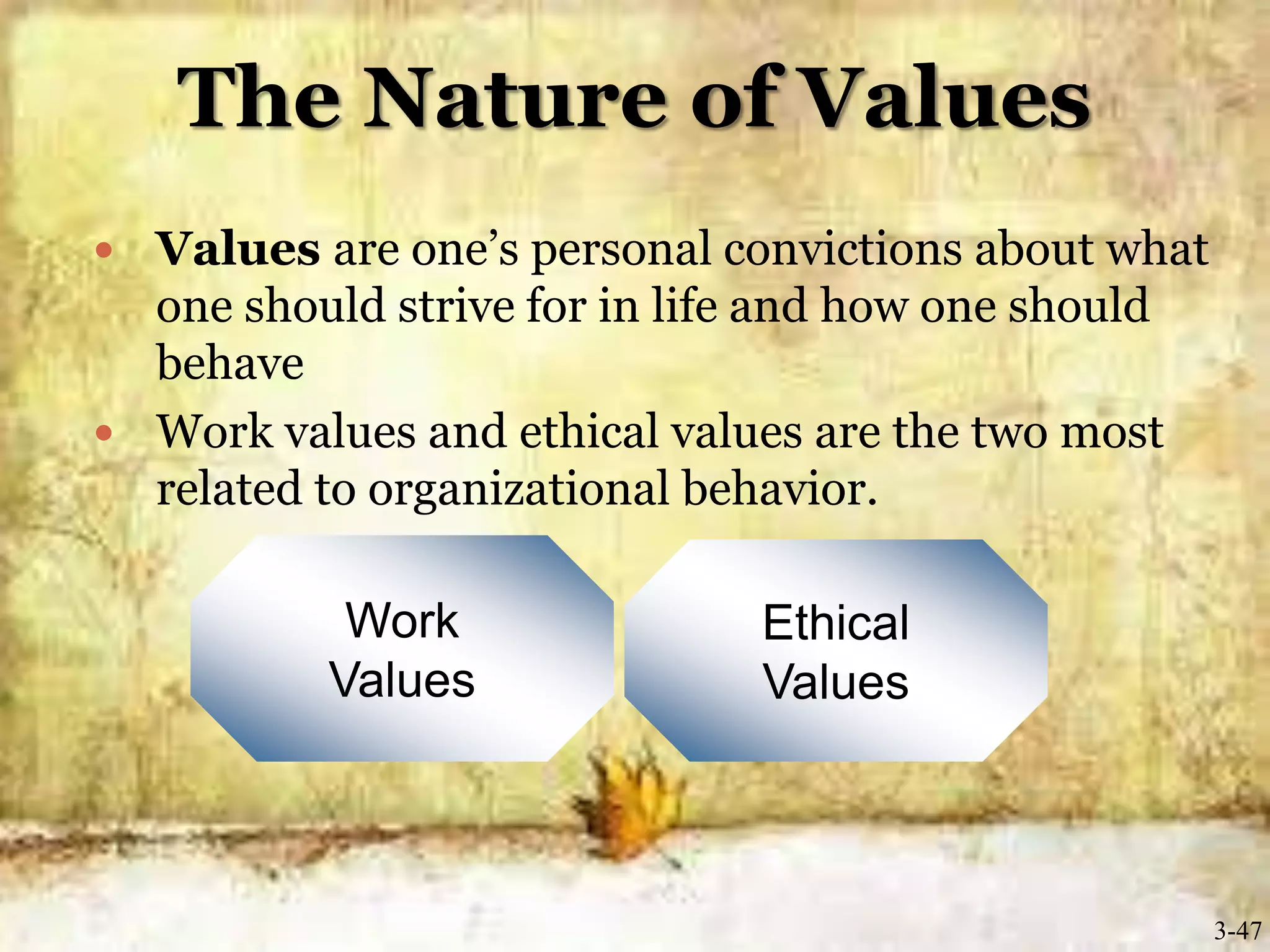
The Nature of Values
 Values are one’s personal convictions about what
one should strive for in life and how one should
behave
 Work values and ethical values are the two most
related to organizational behavior.
Work
Values
Ethical
Values
3-47
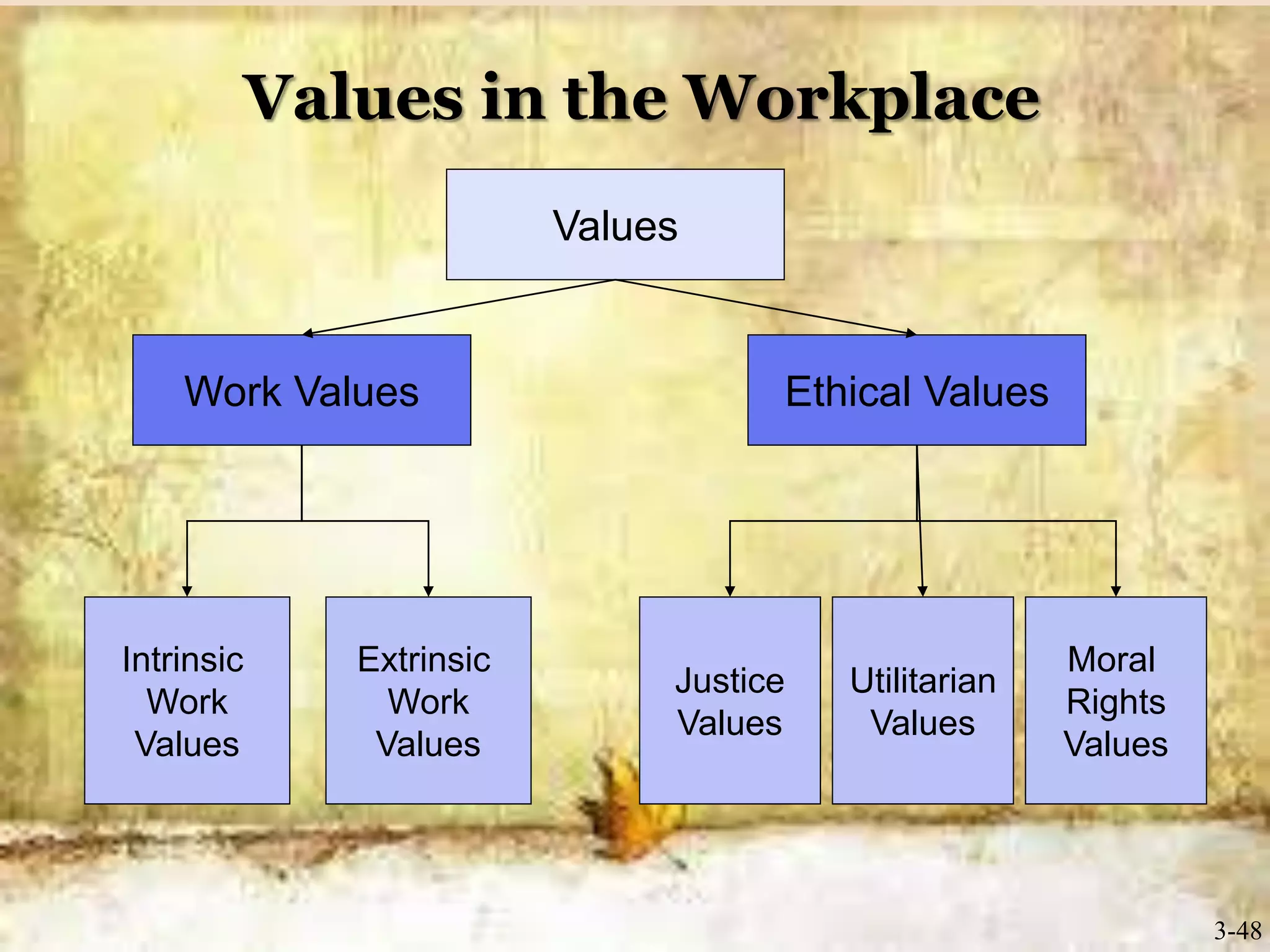
Values in the Workplace
3-48
Values
Work Values Ethical Values
Intrinsic
Work
Values
Extrinsic
Work
Values
Justice
Values
Utilitarian
Values
Moral
Rights
Values
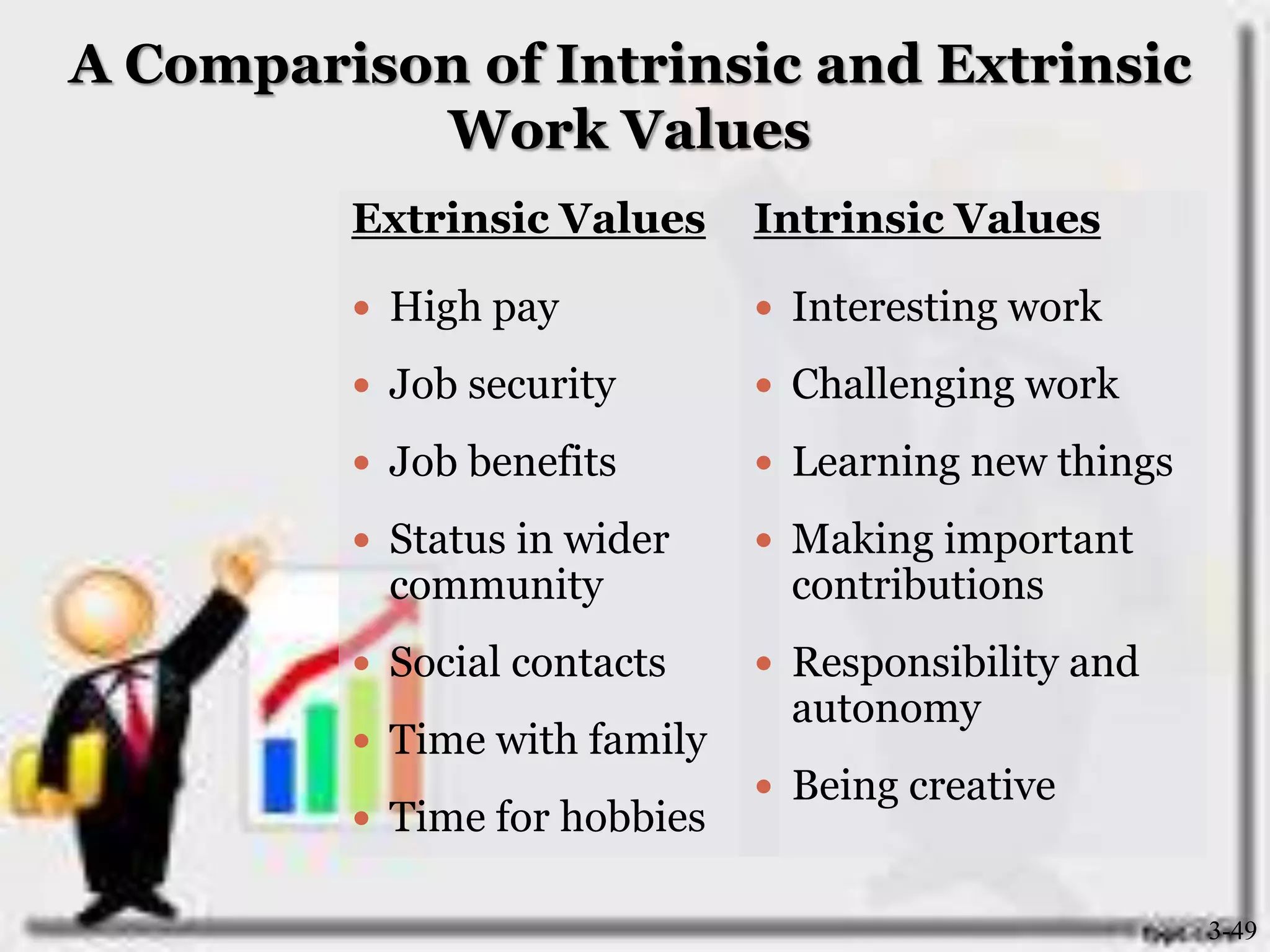
A Comparison of Intrinsic and Extrinsic
Work Values
Extrinsic Values
 High pay
 Job security
 Job benefits
 Status in wider
community
 Social contacts
 Time with family
 Time for hobbies
Intrinsic Values
 Interesting work
 Challenging work
 Learning new things
 Making important
contributions
 Responsibility and
autonomy
 Being creative
3-49
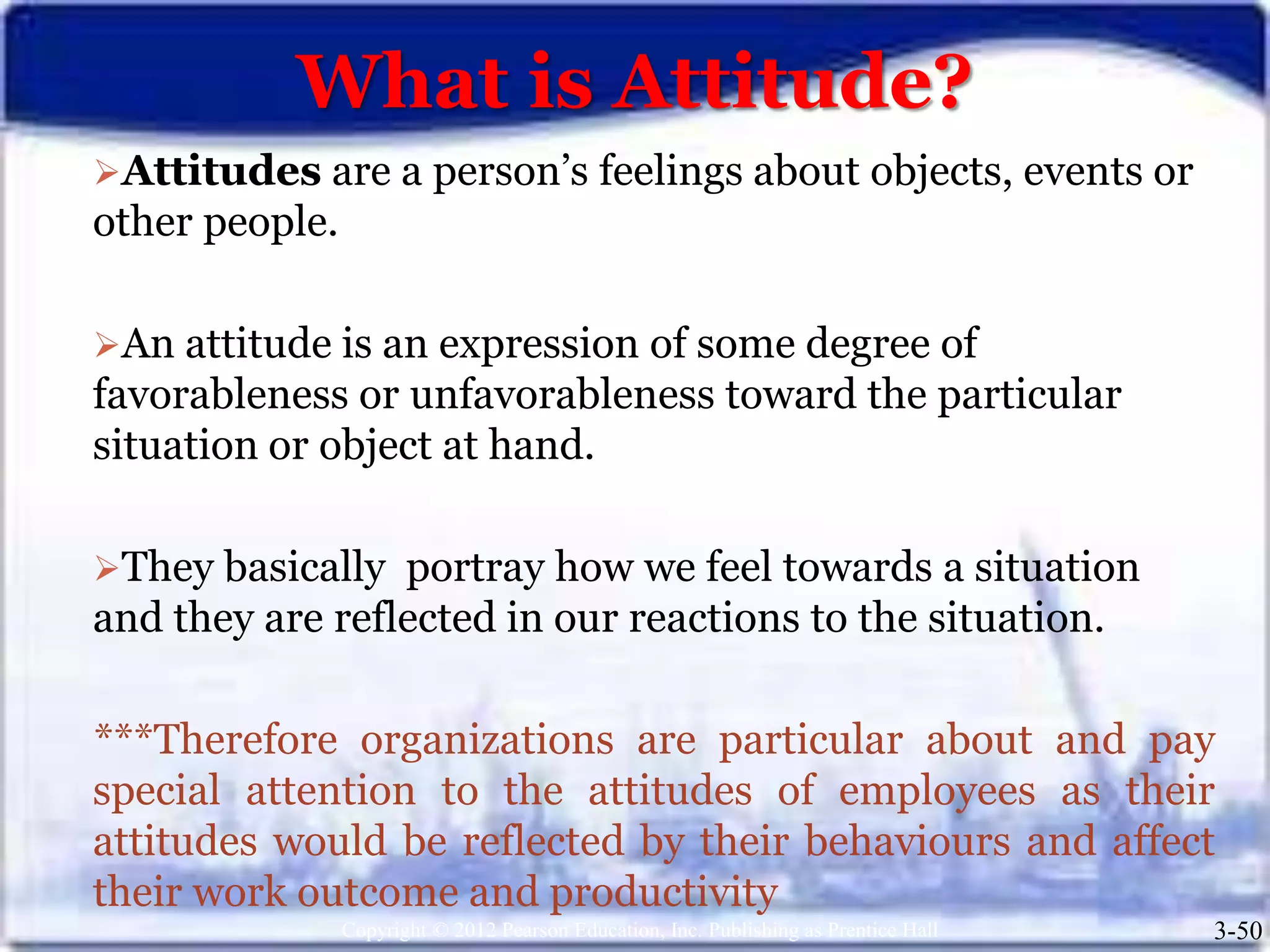
What is Attitude?
Copyright © 2012 Pearson Education, Inc. Publishing as Prentice Hall 3-50
Attitudes are a person’s feelings about objects, events or
other people.
An attitude is an expression of some degree of
favorableness or unfavorableness toward the particular
situation or object at hand.
They basically portray how we feel towards a situation
and they are reflected in our reactions to the situation.
***Therefore organizations are particular about and pay
special attention to the attitudes of employees as their
attitudes would be reflected by their behaviours and affect
their work outcome and productivity
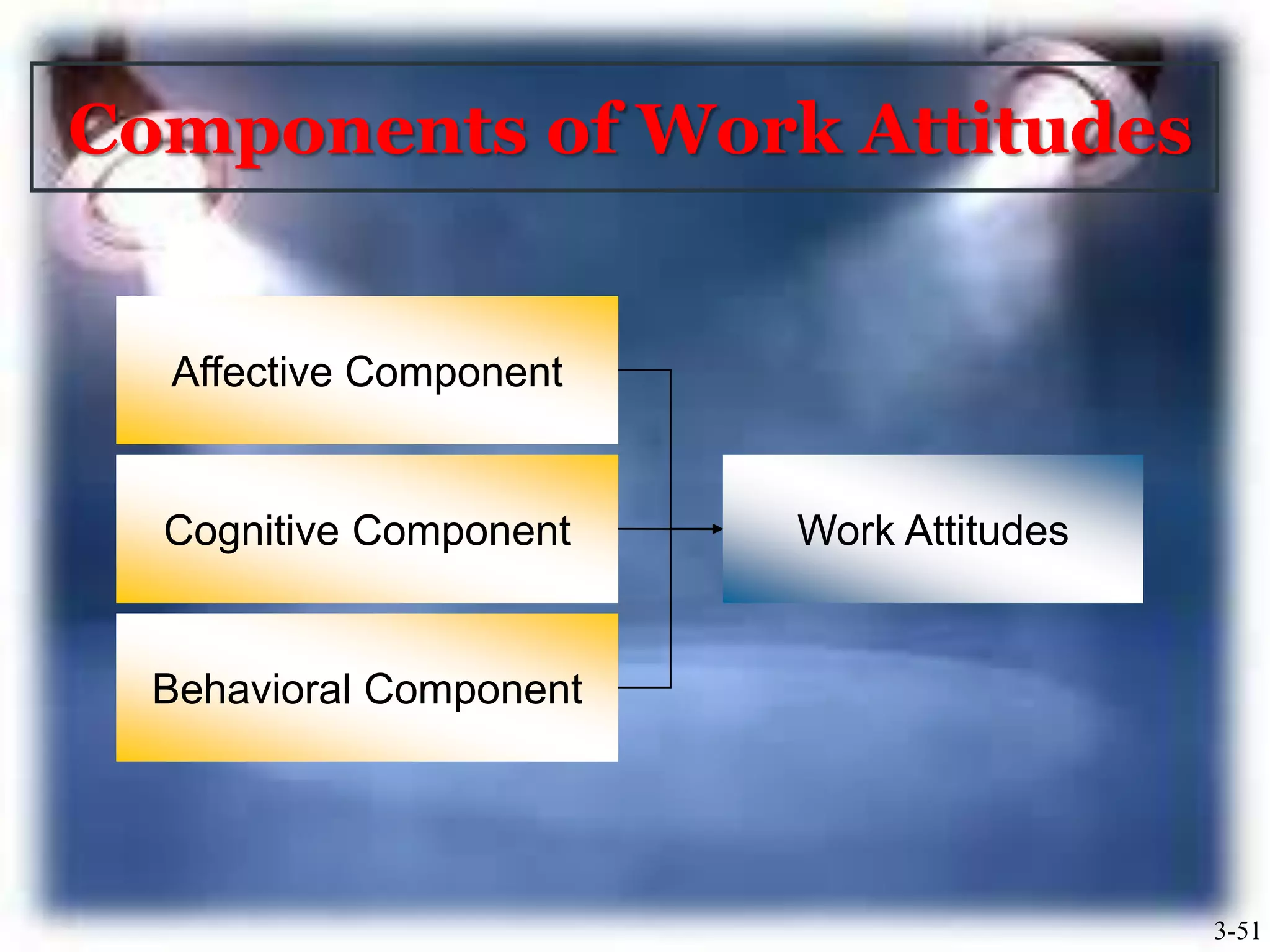
Components of Work Attitudes
Affective Component
Behavioral Component
Cognitive Component Work Attitudes
3-51
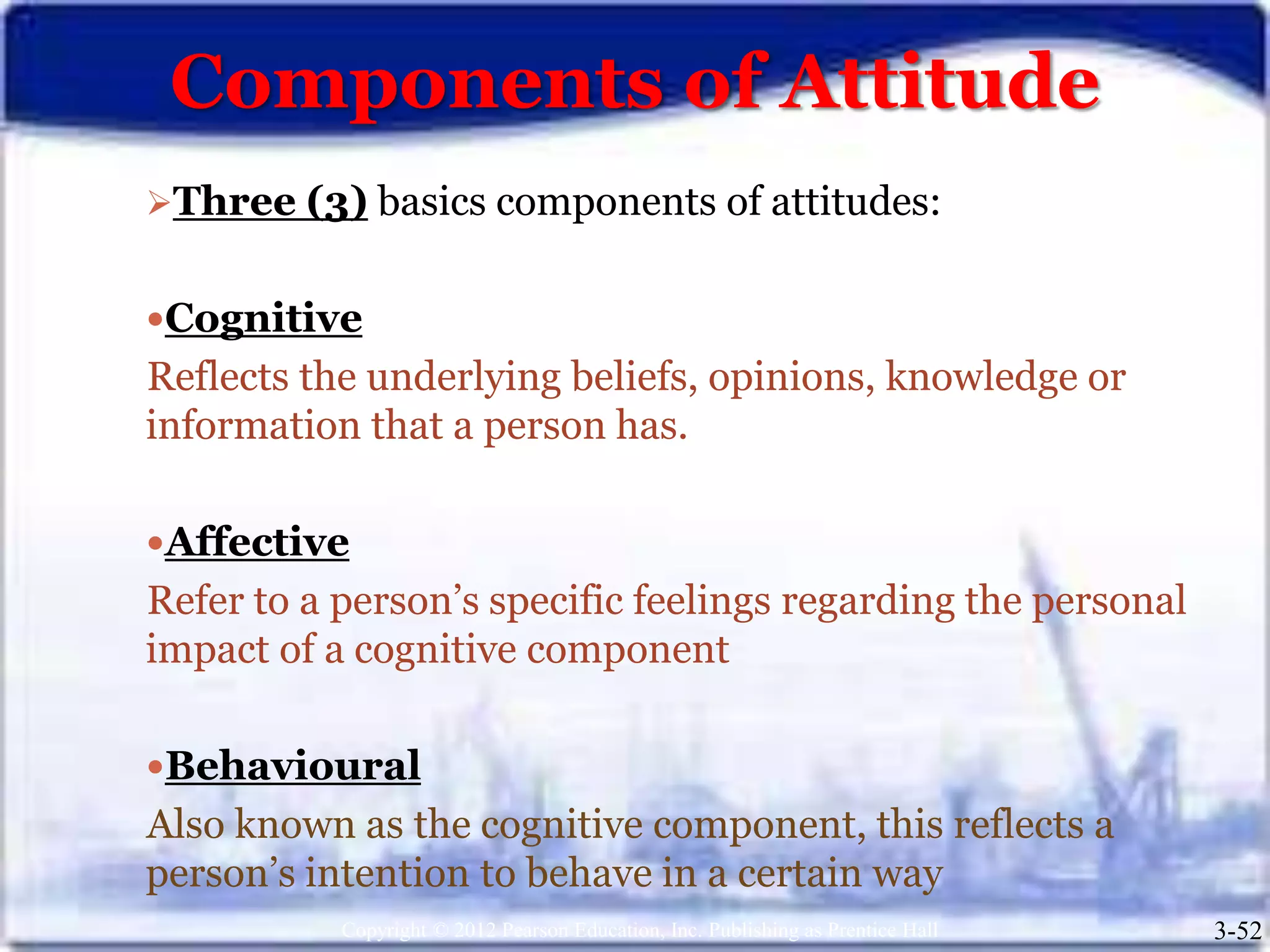
Components of Attitude
Copyright © 2012 Pearson Education, Inc. Publishing as Prentice Hall 3-52
Three (3) basics components of attitudes:
Cognitive
Reflects the underlying beliefs, opinions, knowledge or
information that a person has.
Affective
Refer to a person’s specific feelings regarding the personal
impact of a cognitive component
Behavioural
Also known as the cognitive component, this reflects a
person’s intention to behave in a certain way
Job Satisfaction
• Job satisfaction (the collection of feelings
and beliefs that people have about their
current jobs) is one of the most important
and well-researched work attitudes in
organizational behavior.
• Job satisfaction affects a wide range of
behaviors and contribute to employees’
levels of well-being.
53
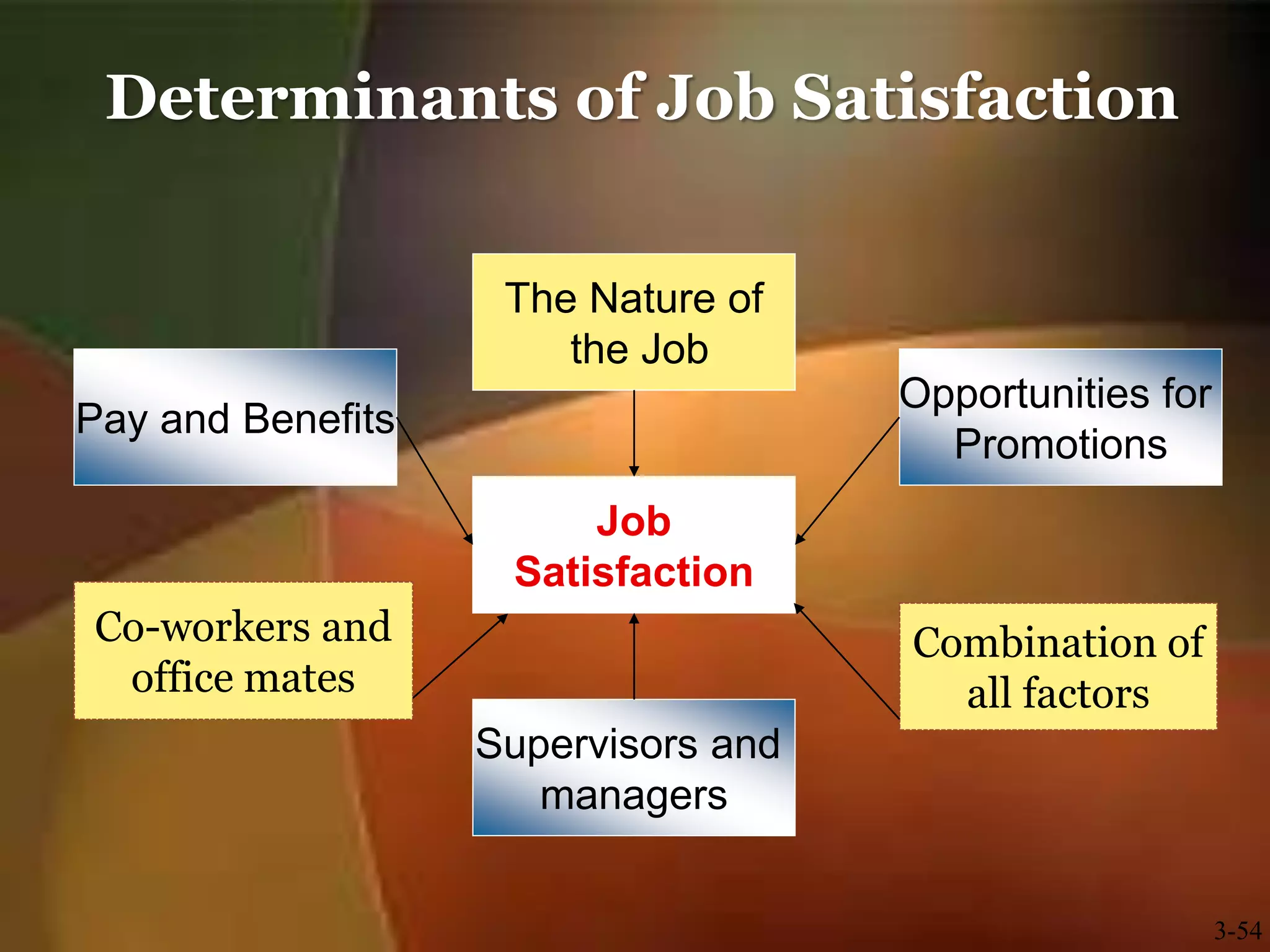
Determinants of Job Satisfaction
3-54
Job
Satisfaction
Pay and Benefits
The Nature of
the Job
Opportunities for
Promotions
Supervisors and
managers
Co-workers and
office mates
Combination of
all factors
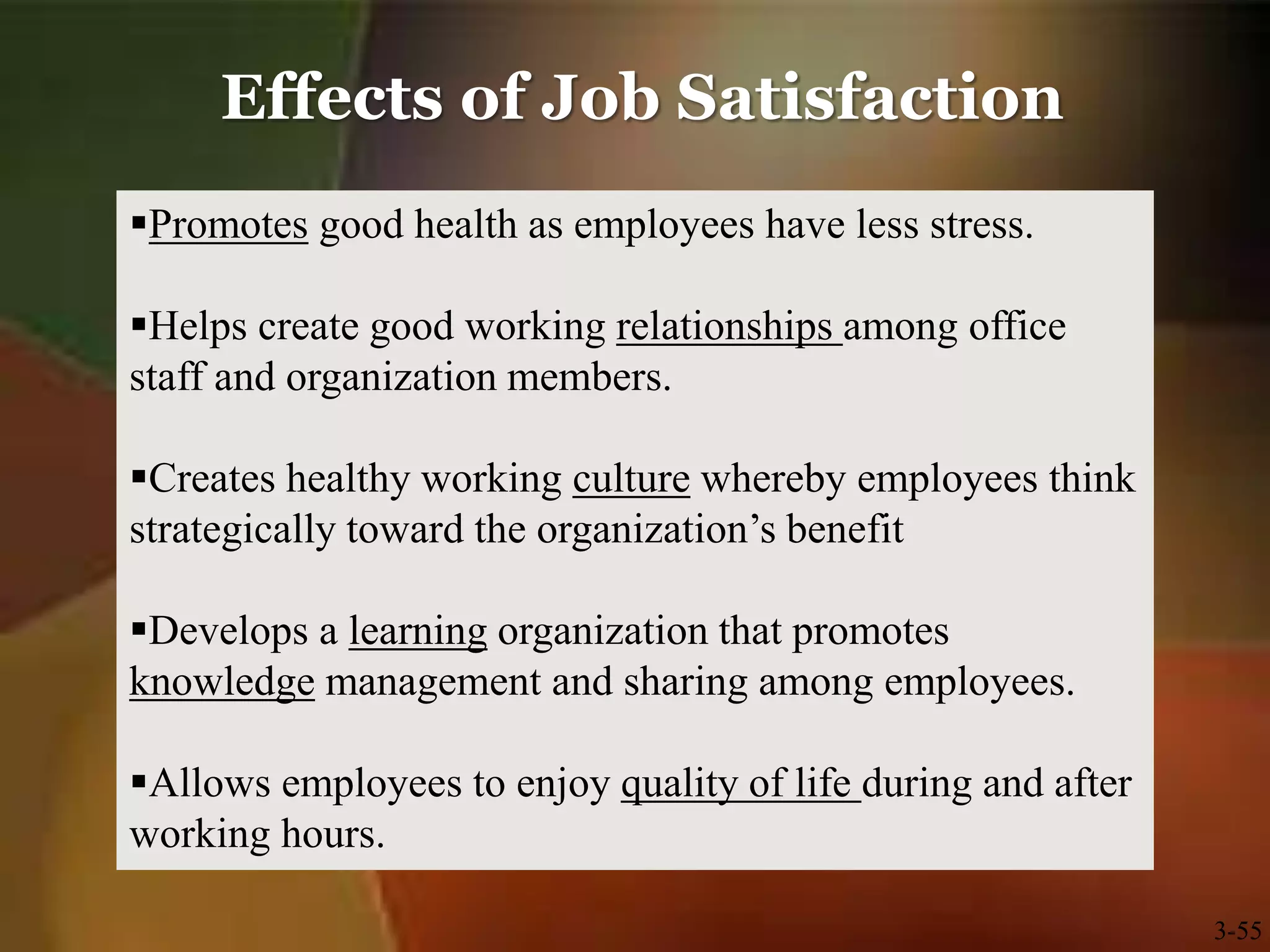
Effects of Job Satisfaction
3-55
Promotes good health as employees have less stress.
Helps create good working relationships among office
staff and organization members.
Creates healthy working culture whereby employees think
strategically toward the organization’s benefit
Develops a learning organization that promotes
knowledge management and sharing among employees.
Allows employees to enjoy quality of life during and after
working hours.
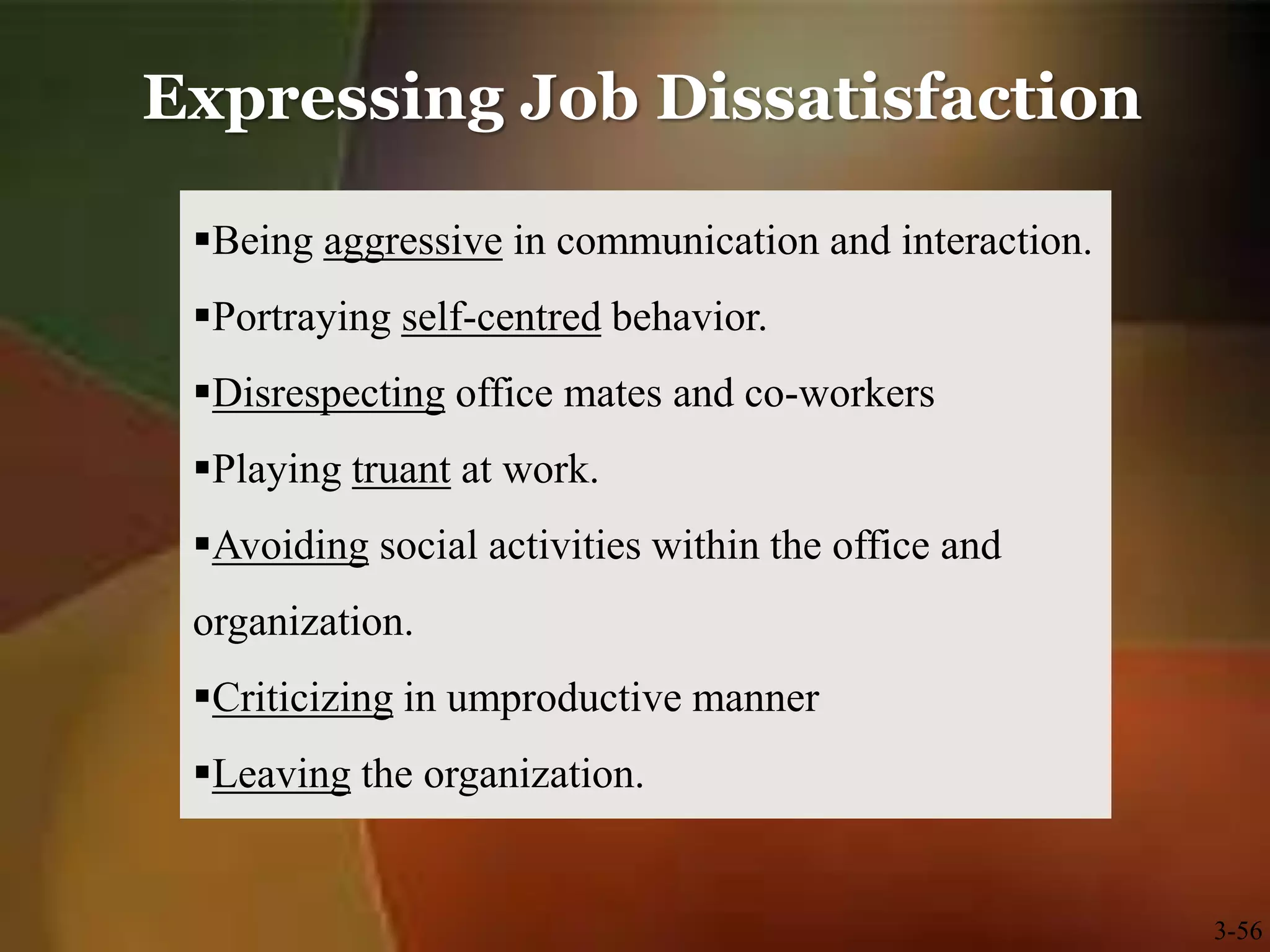
Expressing Job Dissatisfaction
3-56
Being aggressive in communication and interaction.
Portraying self-centred behavior.
Disrespecting office mates and co-workers
Playing truant at work.
Avoiding social activities within the office and
organization.
Criticizing in umproductive manner
Leaving the organization.
Emotions and Moods
57
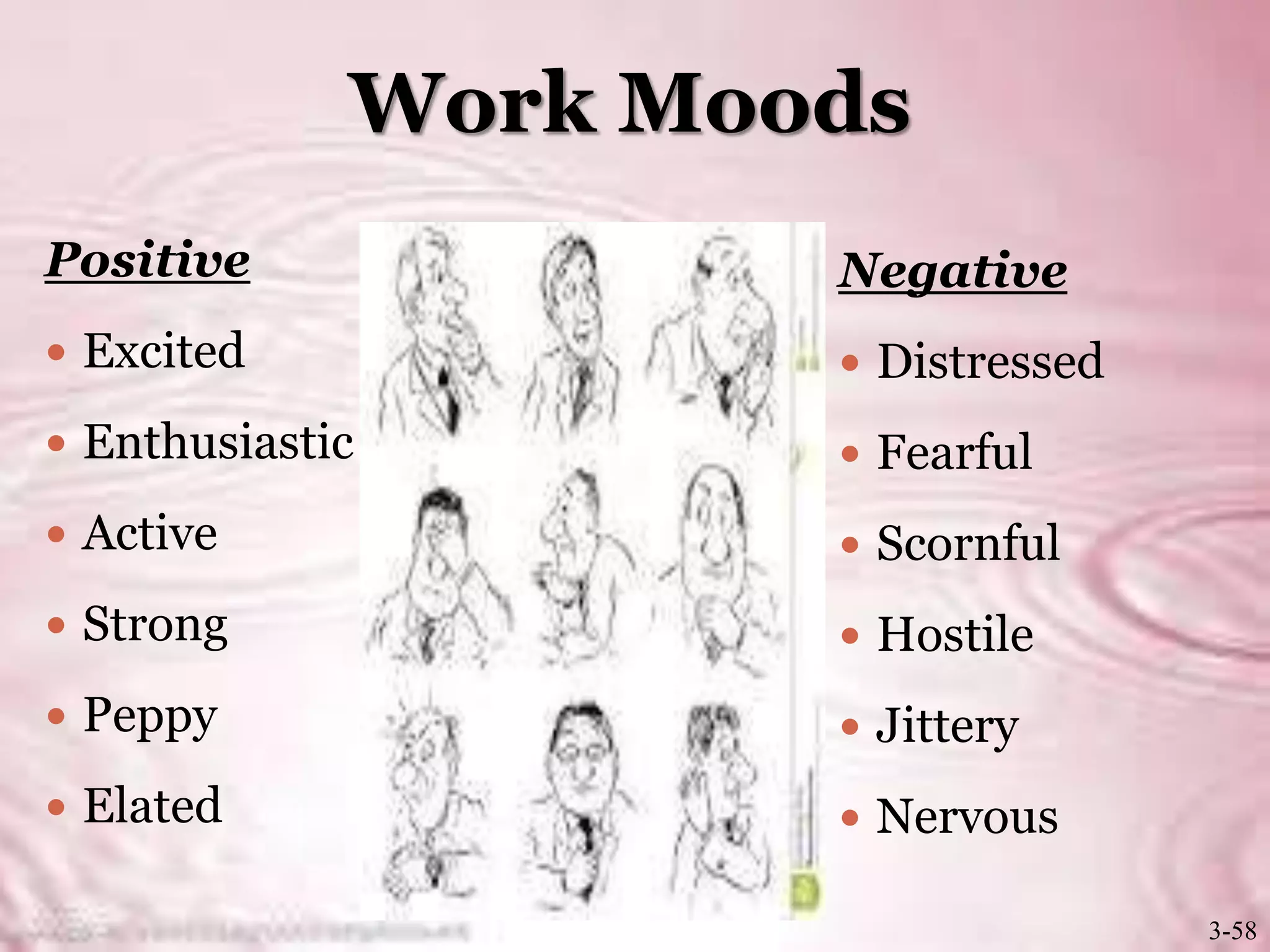
Work Moods
Positive
 Excited
 Enthusiastic
 Active
 Strong
 Peppy
 Elated
Negative
 Distressed
 Fearful
 Scornful
 Hostile
 Jittery
 Nervous
3-58
Sources of Emotions and Moods
•Personality
•Weather
•Stress
•Social activities
•Sleep
•Exercise
•Age
•Gender
59
Emotions
 Emotions: Intense, short-lived feelings
that are linked to specific cause or
antecedent
 Researchers have identified basic
emotions that have universal nonverbal
expressions such as anger, disgust,
sadness, fear, surprise, happiness, and
pride.
3-60
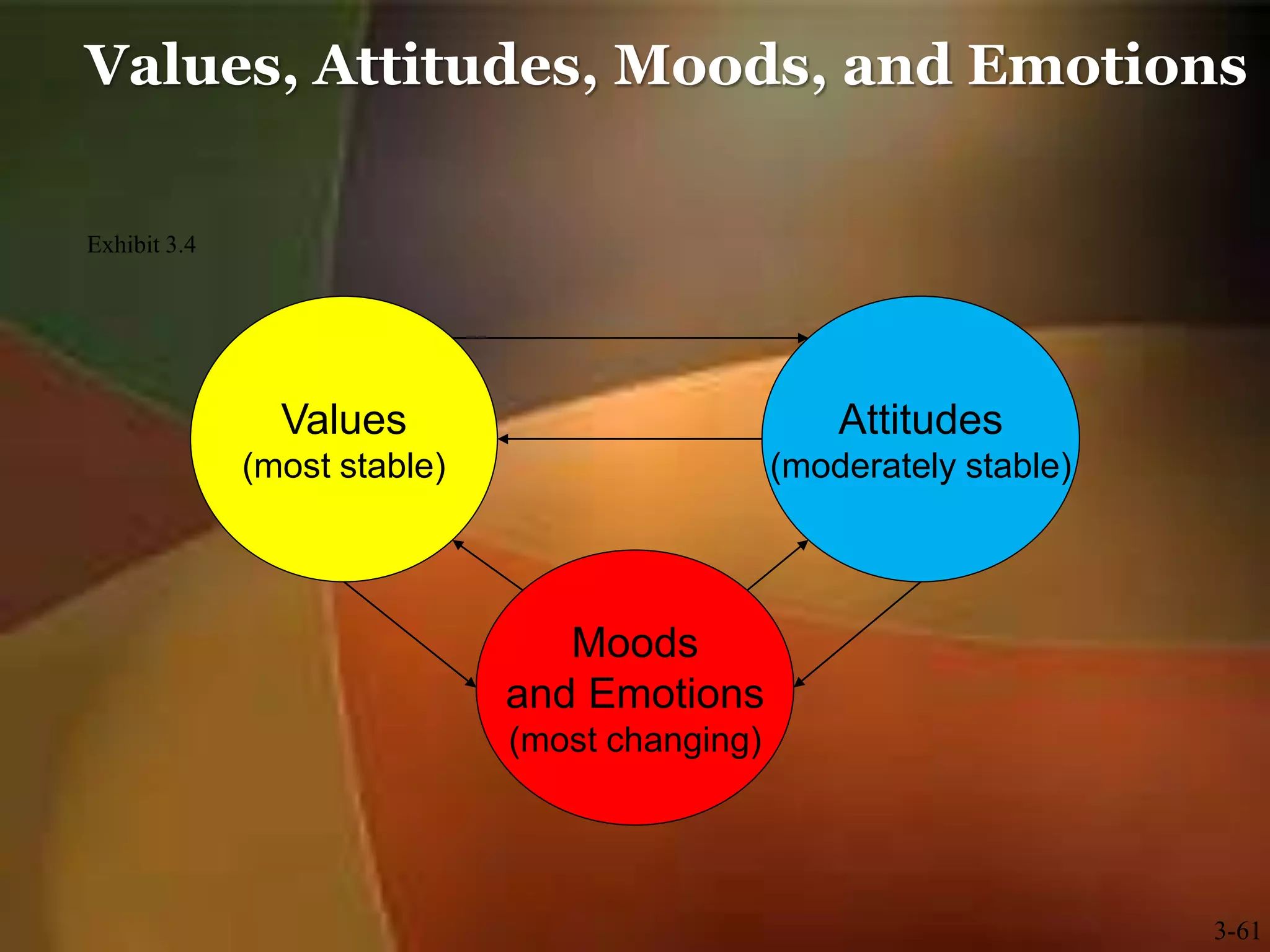
Values, Attitudes, Moods, and Emotions
Values
(most stable)
Attitudes
(moderately stable)
Moods
and Emotions
(most changing)
3-61
Exhibit 3.4
Revision Questions
• Describe the Big Five personality traits and their
implication for understanding behavior in organizations.
• Describe the different kinds of abilities that employees use
to perform their jobs.
• Identify three of the organizationally relevant personality
traits you think would affect performance on this job, and
expalin why you think they are likely to be important.
• How can an organization train jobholders to raise levels of
these abilities?
62

PD Lecture 2 individual differences-personality, ability, values, attitudes, moods, emotions, perception, attribution, and the management of diversity

  • 1.
    Lecture 2 Individual Differences: Personalityand Ability 2-1Copyright © 2012 Pearson Education, Inc. Publishing as Prentice Hall
  • 2.
  • 3.
    LEARNING OUTCOMES Define personality. Explainwhat determines personality and its importance to managers in term of personality job fit.  Explain the personality traits.  Discuss the attributes of personality.  Relate aspects of personality to jobs
  • 4.
    Learning Objectives • Understandthe nature of personality and how it is determined by both nature and nurture • Describe the Big Five personality traits and their implication for understanding behaviour in organisations • Appreciate the ways in which other personality traits, in addition to the Big Five, influence employees’ behaviours in organisations • Describe the different kinds of abilities that employees use to perform their jobs • Appreciate how organisations manage ability through selection, placement, and training 2-4Copyright © 2012 Pearson Education, Inc. Publishing as Prentice Hall
  • 5.
    What is Personality? Personality refers to individual differences in character, patterns of thinking, feeling and behaving.  Personality is also known as the combination of emotional, attitudinal, and behavioural response patterns of an individual.  It is the sum of ways in which an individual reacts and interacts with each other.
  • 6.
    PERSONALITY DETERMINANTS Brain  PhysicalFactors  Heredity Factors  Cultural and Religious Factors  Social Factors
  • 7.
    PERSONALITY TRAITS THE MYER-BRIGGSTYPE INDICATOR The Myers-Briggs Personality Type Indicator is a self-inventory test designed to identify a person's personality type, strengths and preferences. Four different scales: 1. Extraversion (E) - Introversion (I) 2. Sensing (S) - Intuition (N) 3. Thinking (T) - Feeling (F) 4. Judging (J) - Perceiving (P)
  • 9.
    ATTRIBUTES OF PERSONALITY Locusof Control Machiavellianism Self-Esteem Risk Taking Type A-Type B Personality
  • 10.
    Locus of Control LOCUSOF CONTROL Internal and external locus of control  Research has found the following trends: •Males tend to be more internal than females •As people get older they tend to become more internal •People higher up in organizational structures tend to be more internal
  • 11.
    MACHIAVELLIANISM It refers tothe degree to which an individual is practical in his approach, maintains an emotional distance from others and believes that ends justify the means.  Research has revealed that individuals who score high on Mach are good at manipulating others and try to win by any means.  They do not need to be persuaded to work but instead are able to successfully persuade others.
  • 12.
    SELF-ESTEEM Self-esteem is aterm used in psychology to reflect a person's overall emotional evaluation of his or her own worth. It is a judgement of oneself as well as an attitude toward the self.
  • 13.
    RISK TAKING The tendencyto engage in behaviours that have the potential to be harmful or dangerous, yet at the same time provide the opportunity for some kind of outcome that can be perceived as positive.
  • 14.
    TYPE A –TYPE B PERSONALITY . Type A personality is associated with time urgency, aggressiveness, hostility and competitiveness Type B personality, in contrast, is the one low on these traits. Generally, most people fall somewhere in between these two types, some leaning more towards one type than the other.
  • 15.
    Achieving A PERSONALITY JobFit Theory Hollands theory is centred on the notion that most people fit into one of six (6) personality types: Realistic (Doer) Investigative (Thinker) Artistic (Creator) Social (Helper) Enterprising (Persuader) Conventional(Organizer)
  • 16.
    Achieving A PERSONALITY JobFit Theory Hollands theory is centred on the notion that most people fit into one of Six(6) personality types: 1. Realistic (Doer) Prefers physical activities that require skill, strength and coordination. Traits include being genuine, stable, conforming and practical. Example professions include architect, farmer and engineer. 2. Investigative (Thinker) Prefers working with theory and information, thinking, organizing and understanding. Traits include being analytical, curious and independent. Example professions include lawyer, mathematician and professor..
  • 17.
    Achieving A PERSONALITY JobFit Theory Artistic (Creator) – Prefers creative, original and unsystematic activities that allow creative expression. Traits include being imaginative, disorderly, idealistic, emotional and impractical. Example professions include artist, musician and writer. Social (Helper) – Prefers activities that involve helping, healing or developing others. Traits include being cooperative, friendly, sociable and understanding. Example professions include counsellor, doctor and teacher.
  • 18.
    Achieving A PERSONALITY JobFit Theory Enterprising (Persuader) – Prefers competitive environments, leadership, influence, selling and status. Traits include being ambitious, domineering, energetic and self-confident. Example professions include management, marketing and sales person. Conventional (Organizer) – Prefers precise, rule- regulated, orderly and unambiguous activities. Traits include being conforming, efficient, practical, unimaginative and inflexible. Example professions include accountant, clerk and editor.
  • 19.
    What Is Personality? Theunique and relatively stable patterns of behavior, thoughts, and emotions shown by individuals. 2-19Copyright © 2012 Pearson Education, Inc. Publishing as Prentice Hall
  • 20.
  • 21.
    The Interaction ofPersonality and Situational Factors 2-21
  • 22.
    The Big FiveModel of Personality 2-22 Extraversion Neuroticism Conscientiousness Agreeableness Openness to Experience
  • 23.
  • 24.
    Extraversion 24 •/ Extraverts enjoy beingwith people, are full of energy, and often experience positive emotions. They tend to be enthusiastic, action-oriented individuals who are likely to say "Yes!" or "Let's go!" to opportunities for excitement. In groups they like to talk, assert themselves, and draw attention to themselves.
  • 25.
    Extraversion-Example 25 •/ •I am thelife of the party. •I don't mind being the center of attention. •I feel comfortable around people. •I start conversations. •I talk to a lot of different people at parties.
  • 26.
    Agreeableness 26 •/ •Agreeableness reflects individualdifferences in concern with cooperation and social harmony. •Agreeable individuals value getting along with others. They are therefore considerate, friendly, generous, helpful, and willing to compromise their interests with others’. •Agreeable people also have an optimistic view of human nature. They believe people are basically honest, decent, and trustworthy.
  • 27.
    Agreeableness-Example 27 •/ •I am interestedin people. •I feel others’ emotions. •I have a soft heart. •I make people feel at ease. •I sympathize with others’ feelings. •I take time out for others.
  • 28.
    Conscientiousness 28 •/ •Conscientious individuals avoidtrouble and achieve high levels of success through purposeful planning and persistence. They are also positively regarded by others as intelligent and reliable. •On the negative side, they can be compulsive perfectionists and workaholics. Furthermore, extremely conscientious individuals might be regarded as stuffy and boring.
  • 29.
    Conscientiousness- Example 29 •/ •I am alwaysprepared. •I am exacting in my work. •I follow a schedule. •I get chores done right away. •I like order. •I pay attention to details.
  • 30.
    Neuroticism 30 •/ •Tendency to experiencenegative emotions. Those who score high on Neuroticism may experience primarily one specific negative feeling such as anxiety, anger, or depression, but are likely to experience several of these emotions. •People high in Neuroticism are emotionally reactive. They respond emotionally to events that would not affect most people, and their reactions tend to be more intense than normal. They are more likely to interpret ordinary situations as threatening, and minor frustrations as hopelessly difficult. Their negative emotional reactions tend to persist for unusually long periods of time, which means they are often in a bad mood. •These problems in emotional regulation can diminish a neurotic's ability to think clearly, make decisions, and cope effectively with stress.
  • 31.
    Neuroticism-Example 31 •/ •I am easilydisturbed. •I change my mood a lot. •I get irritated easily. •I get stressed out easily. •I get upset easily. •I have frequent mood swings. •I often feel blue. •I worry about things.
  • 32.
    Openness to Experience 32 •/ Personalitytrait that captures the extent to which an individual is  original,  open to a wide variety of stimuli,  has broad interests, and is  willing to take risks as opposed to being narrow- minded and cautious
  • 33.
    Openness to Experience 33 •/ •Iam full of ideas. •I am quick to understand things. •I have a rich vocabulary. •I have a vivid imagination. •I have excellent ideas. •I spend time reflecting on things. •I use difficult words.
  • 34.
    Applicability to OrganizationalBehavior Copyright © 2012 Pearson Education, Inc. Publishing as Prentice Hall 34 •/ Employees are sometimes tested on the Big Five personality traits in collaborative situations to determine what strong personality traits they can add to the group dynamic. Personality tests can also be part of the behavioral interview process when a company is hiring to determine an individual's ability to act on certain personality characteristics. Understanding its people is as important to a company as understanding its operations and processes. Understanding what personality components drive the behavior of subordinates is a highly useful informational data point for management that can be used to determine what type of assignments should be set, how motivation should be pursued, what team dynamics may arise, and how to best approach conflict and/or praise when applicable.
  • 35.
    Other Personality TraitsRelevant to Organisations 2-35
  • 36.
    Locus of Control InternalExternal 2-36 External Locus of Control: Describes people who believe that fate, luck, or outside forces are responsible for what happens to them Internal Locus of Control: Describes people who believe that ability, effort, or their own actions determine what happens to them
  • 37.
    Self-Esteem Self-esteem is theextent to which people have pride in themselves and their capabilities • People with high self-esteem feel capable, confident, and worthy. • Those with low self-esteem have questionable self- worth, doubt, and apprehension about their ability to succeed. High Low 2-37Copyright © 2012 Pearson Education, Inc. Publishing as Prentice Hall
  • 38.
    Type A vs.Type B Personality  Type A individuals have an intense desire to achieve, are extremely competitive, have a sense of urgency, are impatient, and can be hostile  Type B individuals are more relaxed and easygoing 2-38
  • 39.
    The Nature ofAbility • Ability: The mental or physical capacity to do something. • Ability determines the level of performance an employee can achieve. • Types of ability  Cognitive ability  Physical ability • Motor skill • Physical skill  Emotional intelligence 2-39Copyright © 2012 Pearson Education, Inc. Publishing as Prentice Hall
  • 40.
    1. Cognitive Ability 2-40 Typesof Cognitive Ability
  • 41.
    2. Physical Ability •Two types of physical ability:  Motor skill: the ability to physically manipulate objects in an environment  Physical skill: a person’s fitness and strength. 41
  • 42.
    The Determinants ofCognitive and Physical Abilities 2-42Copyright © 2012 Pearson Education, Inc. Publishing as Prentice Hall
  • 43.
  • 44.
  • 45.
    Questions (Personality) 1. Explain whatdetermines personality? 2. What were the six personality types identified by Holland? 3. Why is it important to match between personality and the career an individual chooses? 4. “Heredity determines personality” Provide your arguments.
  • 46.
  • 47.
    The Nature ofValues  Values are one’s personal convictions about what one should strive for in life and how one should behave  Work values and ethical values are the two most related to organizational behavior. Work Values Ethical Values 3-47
  • 48.
    Values in theWorkplace 3-48 Values Work Values Ethical Values Intrinsic Work Values Extrinsic Work Values Justice Values Utilitarian Values Moral Rights Values
  • 49.
    A Comparison ofIntrinsic and Extrinsic Work Values Extrinsic Values  High pay  Job security  Job benefits  Status in wider community  Social contacts  Time with family  Time for hobbies Intrinsic Values  Interesting work  Challenging work  Learning new things  Making important contributions  Responsibility and autonomy  Being creative 3-49
  • 50.
    What is Attitude? Copyright© 2012 Pearson Education, Inc. Publishing as Prentice Hall 3-50 Attitudes are a person’s feelings about objects, events or other people. An attitude is an expression of some degree of favorableness or unfavorableness toward the particular situation or object at hand. They basically portray how we feel towards a situation and they are reflected in our reactions to the situation. ***Therefore organizations are particular about and pay special attention to the attitudes of employees as their attitudes would be reflected by their behaviours and affect their work outcome and productivity
  • 51.
    Components of WorkAttitudes Affective Component Behavioral Component Cognitive Component Work Attitudes 3-51
  • 52.
    Components of Attitude Copyright© 2012 Pearson Education, Inc. Publishing as Prentice Hall 3-52 Three (3) basics components of attitudes: Cognitive Reflects the underlying beliefs, opinions, knowledge or information that a person has. Affective Refer to a person’s specific feelings regarding the personal impact of a cognitive component Behavioural Also known as the cognitive component, this reflects a person’s intention to behave in a certain way
  • 53.
    Job Satisfaction • Jobsatisfaction (the collection of feelings and beliefs that people have about their current jobs) is one of the most important and well-researched work attitudes in organizational behavior. • Job satisfaction affects a wide range of behaviors and contribute to employees’ levels of well-being. 53
  • 54.
    Determinants of JobSatisfaction 3-54 Job Satisfaction Pay and Benefits The Nature of the Job Opportunities for Promotions Supervisors and managers Co-workers and office mates Combination of all factors
  • 55.
    Effects of JobSatisfaction 3-55 Promotes good health as employees have less stress. Helps create good working relationships among office staff and organization members. Creates healthy working culture whereby employees think strategically toward the organization’s benefit Develops a learning organization that promotes knowledge management and sharing among employees. Allows employees to enjoy quality of life during and after working hours.
  • 56.
    Expressing Job Dissatisfaction 3-56 Beingaggressive in communication and interaction. Portraying self-centred behavior. Disrespecting office mates and co-workers Playing truant at work. Avoiding social activities within the office and organization. Criticizing in umproductive manner Leaving the organization.
  • 57.
  • 58.
    Work Moods Positive  Excited Enthusiastic  Active  Strong  Peppy  Elated Negative  Distressed  Fearful  Scornful  Hostile  Jittery  Nervous 3-58
  • 59.
    Sources of Emotionsand Moods •Personality •Weather •Stress •Social activities •Sleep •Exercise •Age •Gender 59
  • 60.
    Emotions  Emotions: Intense,short-lived feelings that are linked to specific cause or antecedent  Researchers have identified basic emotions that have universal nonverbal expressions such as anger, disgust, sadness, fear, surprise, happiness, and pride. 3-60
  • 61.
    Values, Attitudes, Moods,and Emotions Values (most stable) Attitudes (moderately stable) Moods and Emotions (most changing) 3-61 Exhibit 3.4
  • 62.
    Revision Questions • Describethe Big Five personality traits and their implication for understanding behavior in organizations. • Describe the different kinds of abilities that employees use to perform their jobs. • Identify three of the organizationally relevant personality traits you think would affect performance on this job, and expalin why you think they are likely to be important. • How can an organization train jobholders to raise levels of these abilities? 62