Copyright © 2005 Thomson Business & Professional Publishing.
All rights reserved.
ROBERT L. MATHIS
JOHN H. JACKSON
PowerPoint Presentation by Charlie Cook
The University of West Alabama
Performance ManagementPerformance Management
and Appraisaland Appraisal
Chapter 11Chapter 11
SECTION 3SECTION 3
Training and DevelopingTraining and Developing
Human ResourcesHuman Resources
Copyright © 2005 Thomson Business & Professional 11–2
Learning ObjectivesLearning ObjectivesLearning ObjectivesLearning Objectives
• After you have read this chapter, you should be able to:
 Identify the components of performance management systems.
 Distinguish between performance management and
performance appraisal, and between job criteria and
performance standards.
 Explain the administrative and developmental uses of
performance appraisal.
 Describe the advantages and disadvantages of multisource
(360°) appraisals.
 Discuss the importance of training managers and employees
about performance appraisal, and give examples of several rater
errors.
 Identify several concerns about appraisal feedback and ways to
make it more effective.
Copyright © 2005 Thomson Business & Professional 11–3
Nature of Performance ManagementNature of Performance ManagementNature of Performance ManagementNature of Performance Management
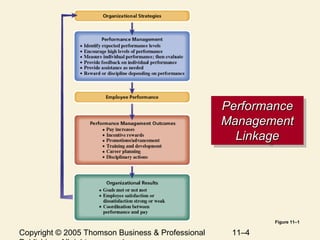
• Performance Management
Processes used to identify, encourage, measure,
evaluate, improve, and reward employee
performance
 Provide information to employees about their performance.
 Clarify organizational performance expectations.
 Identify the development steps that are needed to enhance
employee performance.
 Document performance for personnel actions.
 Provide rewards for achieving performance objectives.
Copyright © 2005 Thomson Business & Professional 11–4
PerformancePerformance
ManagementManagement
LinkageLinkage
PerformancePerformance
ManagementManagement
LinkageLinkage
Figure 11–1
Copyright © 2005 Thomson Business & Professional 11–5
Difference Between PerformanceDifference Between Performance
Management and Performance AppraisalsManagement and Performance Appraisals
Difference Between PerformanceDifference Between Performance
Management and Performance AppraisalsManagement and Performance Appraisals
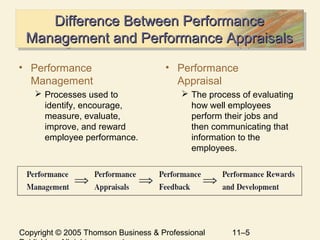
• Performance
Management
 Processes used to
identify, encourage,
measure, evaluate,
improve, and reward
employee performance.
• Performance
Appraisal
 The process of evaluating
how well employees
perform their jobs and
then communicating that
information to the
employees.
Copyright © 2005 Thomson Business & Professional 11–6
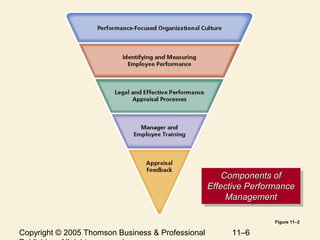
Components ofComponents of
Effective PerformanceEffective Performance
ManagementManagement
Components ofComponents of
Effective PerformanceEffective Performance
ManagementManagement
Figure 11–2
Copyright © 2005 Thomson Business & Professional 11–7
Identifying and Measuring
Employee Performance
Identifying and Measuring
Employee Performance
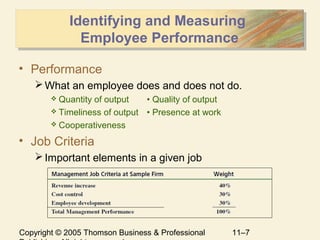
• Performance
What an employee does and does not do.
 Quantity of output • Quality of output
 Timeliness of output • Presence at work
 Cooperativeness
• Job Criteria
Important elements in a given job
Copyright © 2005 Thomson Business & Professional 11–8
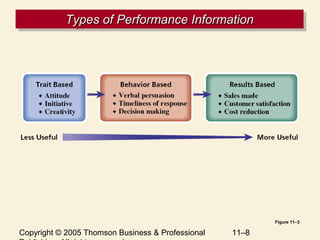
Types of Performance InformationTypes of Performance InformationTypes of Performance InformationTypes of Performance Information
Figure 11–3
Copyright © 2005 Thomson Business & Professional 11–9
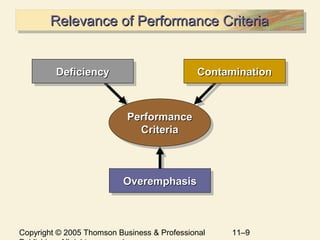
Relevance of Performance CriteriaRelevance of Performance CriteriaRelevance of Performance CriteriaRelevance of Performance Criteria
OveremphasisOveremphasisOveremphasisOveremphasis
DeficiencyDeficiencyDeficiencyDeficiency ContaminationContaminationContaminationContamination
PerformancePerformance
CriteriaCriteria
PerformancePerformance
CriteriaCriteria
Copyright © 2005 Thomson Business & Professional 11–10
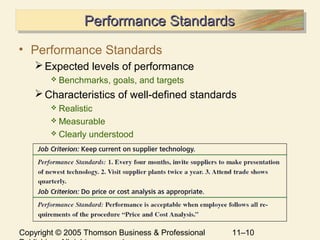
Performance StandardsPerformance StandardsPerformance StandardsPerformance Standards
• Performance Standards
Expected levels of performance
 Benchmarks, goals, and targets
Characteristics of well-defined standards
 Realistic
 Measurable
 Clearly understood
Copyright © 2005 Thomson Business & Professional 11–11
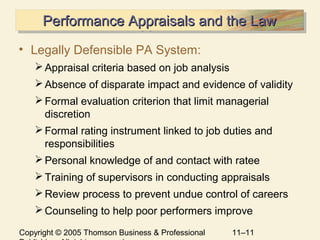
Performance Appraisals and the LawPerformance Appraisals and the LawPerformance Appraisals and the LawPerformance Appraisals and the Law
• Legally Defensible PA System:
Appraisal criteria based on job analysis
Absence of disparate impact and evidence of validity
Formal evaluation criterion that limit managerial
discretion
Formal rating instrument linked to job duties and
responsibilities
Personal knowledge of and contact with ratee
Training of supervisors in conducting appraisals
Review process to prevent undue control of careers
Counseling to help poor performers improve
Copyright © 2005 Thomson Business & Professional 11–12
Uses of Performance AppraisalUses of Performance AppraisalUses of Performance AppraisalUses of Performance Appraisal
• Performance Appraisal (PA)
The process of evaluating how well employees
perform their jobs when compared to a set of
standards, and then communicating the information to
employees.
Informal Appraisal
 Day-to-day contacts, largely undocumented
Systematic Appraisal
 Formal contact at regular time intervals, usually documented
Copyright © 2005 Thomson Business & Professional 11–13
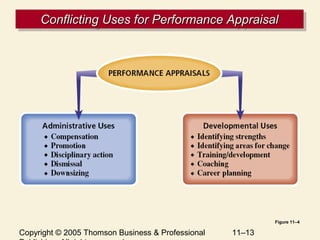
Conflicting Uses for Performance AppraisalConflicting Uses for Performance AppraisalConflicting Uses for Performance AppraisalConflicting Uses for Performance Appraisal
Figure 11–4
Copyright © 2005 Thomson Business & Professional 11–14
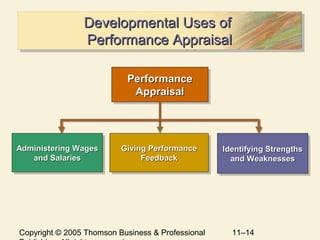
Developmental Uses ofDevelopmental Uses of
Performance AppraisalPerformance Appraisal
Developmental Uses ofDevelopmental Uses of
Performance AppraisalPerformance Appraisal
PerformancePerformance
AppraisalAppraisal
PerformancePerformance
AppraisalAppraisal
Giving PerformanceGiving Performance
FeedbackFeedback
Giving PerformanceGiving Performance
FeedbackFeedback
Administering WagesAdministering Wages
and Salariesand Salaries
Administering WagesAdministering Wages
and Salariesand Salaries
Identifying StrengthsIdentifying Strengths
and Weaknessesand Weaknesses
Identifying StrengthsIdentifying Strengths
and Weaknessesand Weaknesses
Copyright © 2005 Thomson Business & Professional 11–15
Uses of Performance Appraisal (cont’d)Uses of Performance Appraisal (cont’d)Uses of Performance Appraisal (cont’d)Uses of Performance Appraisal (cont’d)
• Criticisms of Performance Appraisal
Focus is too much on the individual and does little to
develop employees.
Employees and supervisors believe the appraisal
process is seriously flawed.
Appraisals are inconsistent, short-term oriented,
subjective, and useful only at the extremes of
performance.
Copyright © 2005 Thomson Business & Professional 11–16
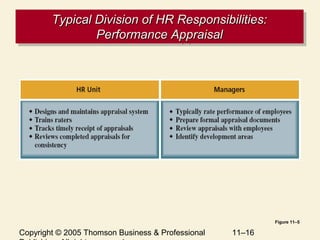
Typical Division of HR Responsibilities:Typical Division of HR Responsibilities:
Performance AppraisalPerformance Appraisal
Typical Division of HR Responsibilities:Typical Division of HR Responsibilities:
Performance AppraisalPerformance Appraisal
Figure 11–5
Copyright © 2005 Thomson Business & Professional 11–17
Who Conducts AppraisalsWho Conducts AppraisalsWho Conducts AppraisalsWho Conducts Appraisals
• Supervisors who rate their subordinates
• Employees who rate their supervisors
• Team members who rate each other
• Employees’ self-appraisal
• Outside sources rating employees
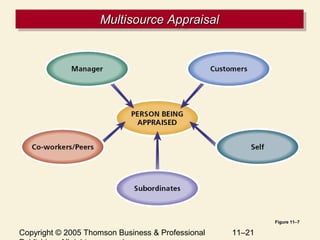
• Multisource (360° feedback) appraisal
Copyright © 2005 Thomson Business & Professional 11–18
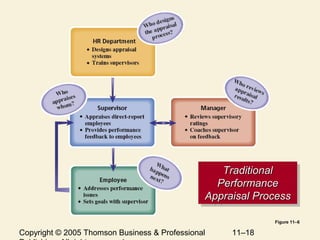
TraditionalTraditional
PerformancePerformance
Appraisal ProcessAppraisal Process
TraditionalTraditional
PerformancePerformance
Appraisal ProcessAppraisal Process
Figure 11–6
Copyright © 2005 Thomson Business & Professional 11–19
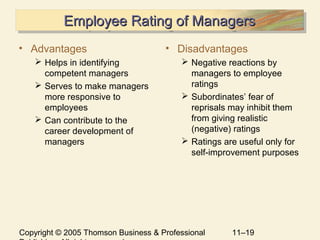
Employee Rating of ManagersEmployee Rating of ManagersEmployee Rating of ManagersEmployee Rating of Managers
• Advantages
 Helps in identifying
competent managers
 Serves to make managers
more responsive to
employees
 Can contribute to the
career development of
managers
• Disadvantages
 Negative reactions by
managers to employee
ratings
 Subordinates’ fear of
reprisals may inhibit them
from giving realistic
(negative) ratings
 Ratings are useful only for
self-improvement purposes
Copyright © 2005 Thomson Business & Professional 11–20
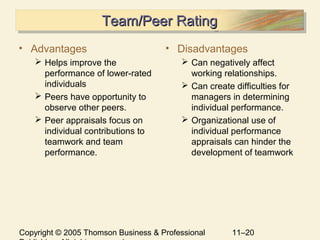
Team/Peer RatingTeam/Peer RatingTeam/Peer RatingTeam/Peer Rating
• Advantages
 Helps improve the
performance of lower-rated
individuals
 Peers have opportunity to
observe other peers.
 Peer appraisals focus on
individual contributions to
teamwork and team
performance.
• Disadvantages
 Can negatively affect
working relationships.
 Can create difficulties for
managers in determining
individual performance.
 Organizational use of
individual performance
appraisals can hinder the
development of teamwork
Copyright © 2005 Thomson Business & Professional 11–21
Multisource AppraisalMultisource AppraisalMultisource AppraisalMultisource Appraisal
Figure 11–7
Copyright © 2005 Thomson Business & Professional 11–22
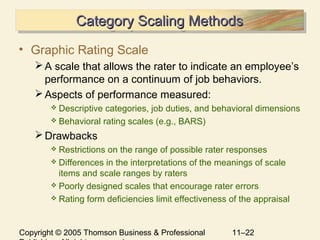
Category Scaling MethodsCategory Scaling MethodsCategory Scaling MethodsCategory Scaling Methods
• Graphic Rating Scale
A scale that allows the rater to indicate an employee’s
performance on a continuum of job behaviors.
Aspects of performance measured:
 Descriptive categories, job duties, and behavioral dimensions
 Behavioral rating scales (e.g., BARS)
Drawbacks
 Restrictions on the range of possible rater responses
 Differences in the interpretations of the meanings of scale
items and scale ranges by raters
 Poorly designed scales that encourage rater errors
 Rating form deficiencies limit effectiveness of the appraisal
Copyright © 2005 Thomson Business & Professional 11–23
SampleSample
PerformancePerformance
AppraisalAppraisal
FormForm
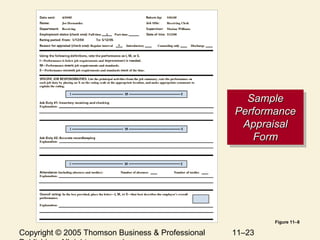
SampleSample
PerformancePerformance
AppraisalAppraisal
FormForm
Figure 11–8
Copyright © 2005 Thomson Business & Professional 11–24
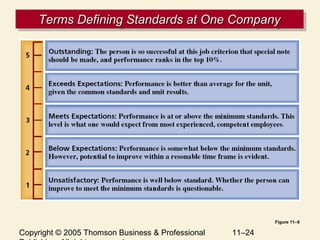
Terms Defining Standards at One CompanyTerms Defining Standards at One CompanyTerms Defining Standards at One CompanyTerms Defining Standards at One Company
Figure 11–9
Copyright © 2005 Thomson Business & Professional 11–25
Behavioral/Objective MethodsBehavioral/Objective MethodsBehavioral/Objective MethodsBehavioral/Objective Methods
• Behavioral Rating Approach
Assesses employees’ behaviors instead of other
characteristics
Consists of a series of scales created by:
 Identifying important job dimensions
 Creating statements describing a range of desired and
undesirable behaviors (anchors)
Types of behavioral scales
 Behaviorally anchored rating scales (BARS)
 Behavioral observation scales (BOS)
 Behavioral expectation scales (BES)
Copyright © 2005 Thomson Business & Professional 11–26
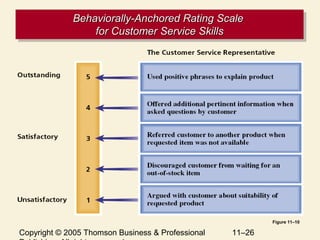
Behaviorally-Anchored Rating ScaleBehaviorally-Anchored Rating Scale
for Customer Service Skillsfor Customer Service Skills
Behaviorally-Anchored Rating ScaleBehaviorally-Anchored Rating Scale
for Customer Service Skillsfor Customer Service Skills
Figure 11–10
Copyright © 2005 Thomson Business & Professional 11–27
Category Rating Methods (cont’d)Category Rating Methods (cont’d)Category Rating Methods (cont’d)Category Rating Methods (cont’d)
• Checklists
A performance appraisal tool that uses a list of
statements or work behaviors that are checked by
raters.
 Can be quantified by applying weights to individual checklist
items.
Drawbacks
 Interpretation of item meanings by raters
 Weighting creates problems in appraisal interpretation
 Assignment of weights to items by persons other than the
raters
Copyright © 2005 Thomson Business & Professional 11–28
Comparative MethodsComparative MethodsComparative MethodsComparative Methods
• Ranking
A listing of all employees from highest to lowest in
performance.
Drawbacks
 Does not show size of differences in performance between
employees
 Implies that lowest-ranked employees are unsatisfactory
performers.
 Becomes an unwieldy process if the group to be ranked is
large.
Copyright © 2005 Thomson Business & Professional 11–29
Comparative Methods (cont’d)Comparative Methods (cont’d)Comparative Methods (cont’d)Comparative Methods (cont’d)
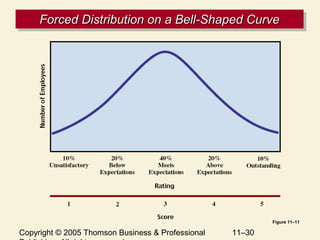
• Forced Distribution
Performance appraisal method in which ratings of
employees are distributed along a bell-shaped curve.
Drawbacks
 Assumes a normal distribution of performance.
 Resistance by managers to placing individuals in the lowest
or highest groups.
 Providing explanation for placement in a higher or lower
grouping can be difficult.
 Is not readily applicable to small groups of employees.
Copyright © 2005 Thomson Business & Professional 11–30
Forced Distribution on a Bell-Shaped CurveForced Distribution on a Bell-Shaped CurveForced Distribution on a Bell-Shaped CurveForced Distribution on a Bell-Shaped Curve
Figure 11–11
Copyright © 2005 Thomson Business & Professional 11–31
Narrative MethodsNarrative MethodsNarrative MethodsNarrative Methods
• Critical Incident
Manager keeps a written record of highly favorable
and unfavorable employee actions.
Drawbacks
 Variations in how managers define a “critical incident”
 Time involved in documenting employee actions
 Most employee actions are not observed and may become
different if observed
 Employee concerns about manager’s “black books”
Copyright © 2005 Thomson Business & Professional 11–32
Narrative Methods (cont’d)Narrative Methods (cont’d)Narrative Methods (cont’d)Narrative Methods (cont’d)
• Essay
Manager writes a short essay describing an
employee’s performance.
Drawback
 Depends on the managers’ writing skills and their ability to
express themselves.
Copyright © 2005 Thomson Business & Professional 11–33
Management by Objectives (MBO)Management by Objectives (MBO)Management by Objectives (MBO)Management by Objectives (MBO)
• Management by Objectives
Specifying the performance goals that an individual
and his or her manager agree the employee will to try
to attain within an appropriate length of time.
• Key MBO Ideas
Employee involvement creates higher levels of
commitment and performance.
Encourages employees to work effectively toward
achieving desired results.
Performance measures should be measurable and
should define results.
Copyright © 2005 Thomson Business & Professional 11–34
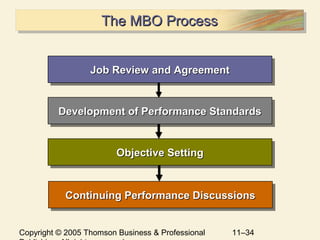
The MBO ProcessThe MBO ProcessThe MBO ProcessThe MBO Process
Job Review and AgreementJob Review and AgreementJob Review and AgreementJob Review and Agreement
Development of Performance StandardsDevelopment of Performance StandardsDevelopment of Performance StandardsDevelopment of Performance Standards
Objective SettingObjective SettingObjective SettingObjective Setting
Continuing Performance DiscussionsContinuing Performance DiscussionsContinuing Performance DiscussionsContinuing Performance Discussions
Copyright © 2005 Thomson Business & Professional 11–35
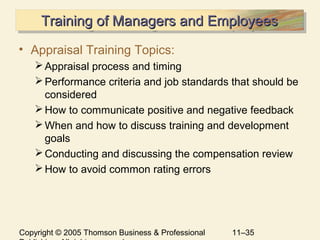
Training of Managers and EmployeesTraining of Managers and EmployeesTraining of Managers and EmployeesTraining of Managers and Employees
• Appraisal Training Topics:
Appraisal process and timing
Performance criteria and job standards that should be
considered
How to communicate positive and negative feedback
When and how to discuss training and development
goals
Conducting and discussing the compensation review
How to avoid common rating errors
Copyright © 2005 Thomson Business & Professional 11–36
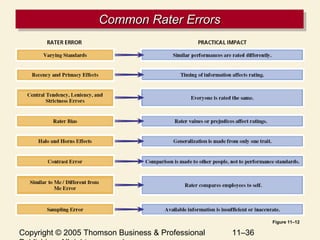
Common Rater ErrorsCommon Rater ErrorsCommon Rater ErrorsCommon Rater Errors
Figure 11–12
Copyright © 2005 Thomson Business & Professional 11–37
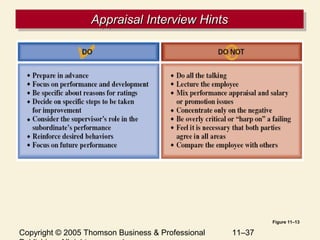
Appraisal Interview HintsAppraisal Interview HintsAppraisal Interview HintsAppraisal Interview Hints
Figure 11–13
Copyright © 2005 Thomson Business & Professional 11–38
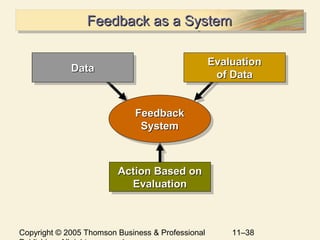
Feedback as a SystemFeedback as a SystemFeedback as a SystemFeedback as a System
Action Based onAction Based on
EvaluationEvaluation
Action Based onAction Based on
EvaluationEvaluation
DataDataDataData EvaluationEvaluation
of Dataof Data
EvaluationEvaluation
of Dataof Data
FeedbackFeedback
SystemSystem
FeedbackFeedback
SystemSystem
Copyright © 2005 Thomson Business & Professional 11–39
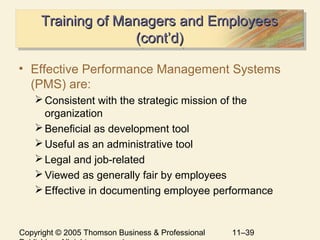
Training of Managers and EmployeesTraining of Managers and Employees
(cont’d)(cont’d)
Training of Managers and EmployeesTraining of Managers and Employees
(cont’d)(cont’d)
• Effective Performance Management Systems
(PMS) are:
Consistent with the strategic mission of the
organization
Beneficial as development tool
Useful as an administrative tool
Legal and job-related
Viewed as generally fair by employees
Effective in documenting employee performance

Chapter 11 Performance Management and Appraisal

  • 1.
    Copyright © 2005Thomson Business & Professional Publishing. All rights reserved. ROBERT L. MATHIS JOHN H. JACKSON PowerPoint Presentation by Charlie Cook The University of West Alabama Performance ManagementPerformance Management and Appraisaland Appraisal Chapter 11Chapter 11 SECTION 3SECTION 3 Training and DevelopingTraining and Developing Human ResourcesHuman Resources
  • 2.
    Copyright © 2005Thomson Business & Professional 11–2 Learning ObjectivesLearning ObjectivesLearning ObjectivesLearning Objectives • After you have read this chapter, you should be able to:  Identify the components of performance management systems.  Distinguish between performance management and performance appraisal, and between job criteria and performance standards.  Explain the administrative and developmental uses of performance appraisal.  Describe the advantages and disadvantages of multisource (360°) appraisals.  Discuss the importance of training managers and employees about performance appraisal, and give examples of several rater errors.  Identify several concerns about appraisal feedback and ways to make it more effective.
  • 3.
    Copyright © 2005Thomson Business & Professional 11–3 Nature of Performance ManagementNature of Performance ManagementNature of Performance ManagementNature of Performance Management • Performance Management Processes used to identify, encourage, measure, evaluate, improve, and reward employee performance  Provide information to employees about their performance.  Clarify organizational performance expectations.  Identify the development steps that are needed to enhance employee performance.  Document performance for personnel actions.  Provide rewards for achieving performance objectives.
  • 4.
    Copyright © 2005Thomson Business & Professional 11–4 PerformancePerformance ManagementManagement LinkageLinkage PerformancePerformance ManagementManagement LinkageLinkage Figure 11–1
  • 5.
    Copyright © 2005Thomson Business & Professional 11–5 Difference Between PerformanceDifference Between Performance Management and Performance AppraisalsManagement and Performance Appraisals Difference Between PerformanceDifference Between Performance Management and Performance AppraisalsManagement and Performance Appraisals • Performance Management  Processes used to identify, encourage, measure, evaluate, improve, and reward employee performance. • Performance Appraisal  The process of evaluating how well employees perform their jobs and then communicating that information to the employees.
  • 6.
    Copyright © 2005Thomson Business & Professional 11–6 Components ofComponents of Effective PerformanceEffective Performance ManagementManagement Components ofComponents of Effective PerformanceEffective Performance ManagementManagement Figure 11–2
  • 7.
    Copyright © 2005Thomson Business & Professional 11–7 Identifying and Measuring Employee Performance Identifying and Measuring Employee Performance • Performance What an employee does and does not do.  Quantity of output • Quality of output  Timeliness of output • Presence at work  Cooperativeness • Job Criteria Important elements in a given job
  • 8.
    Copyright © 2005Thomson Business & Professional 11–8 Types of Performance InformationTypes of Performance InformationTypes of Performance InformationTypes of Performance Information Figure 11–3
  • 9.
    Copyright © 2005Thomson Business & Professional 11–9 Relevance of Performance CriteriaRelevance of Performance CriteriaRelevance of Performance CriteriaRelevance of Performance Criteria OveremphasisOveremphasisOveremphasisOveremphasis DeficiencyDeficiencyDeficiencyDeficiency ContaminationContaminationContaminationContamination PerformancePerformance CriteriaCriteria PerformancePerformance CriteriaCriteria
  • 10.
    Copyright © 2005Thomson Business & Professional 11–10 Performance StandardsPerformance StandardsPerformance StandardsPerformance Standards • Performance Standards Expected levels of performance  Benchmarks, goals, and targets Characteristics of well-defined standards  Realistic  Measurable  Clearly understood
  • 11.
    Copyright © 2005Thomson Business & Professional 11–11 Performance Appraisals and the LawPerformance Appraisals and the LawPerformance Appraisals and the LawPerformance Appraisals and the Law • Legally Defensible PA System: Appraisal criteria based on job analysis Absence of disparate impact and evidence of validity Formal evaluation criterion that limit managerial discretion Formal rating instrument linked to job duties and responsibilities Personal knowledge of and contact with ratee Training of supervisors in conducting appraisals Review process to prevent undue control of careers Counseling to help poor performers improve
  • 12.
    Copyright © 2005Thomson Business & Professional 11–12 Uses of Performance AppraisalUses of Performance AppraisalUses of Performance AppraisalUses of Performance Appraisal • Performance Appraisal (PA) The process of evaluating how well employees perform their jobs when compared to a set of standards, and then communicating the information to employees. Informal Appraisal  Day-to-day contacts, largely undocumented Systematic Appraisal  Formal contact at regular time intervals, usually documented
  • 13.
    Copyright © 2005Thomson Business & Professional 11–13 Conflicting Uses for Performance AppraisalConflicting Uses for Performance AppraisalConflicting Uses for Performance AppraisalConflicting Uses for Performance Appraisal Figure 11–4
  • 14.
    Copyright © 2005Thomson Business & Professional 11–14 Developmental Uses ofDevelopmental Uses of Performance AppraisalPerformance Appraisal Developmental Uses ofDevelopmental Uses of Performance AppraisalPerformance Appraisal PerformancePerformance AppraisalAppraisal PerformancePerformance AppraisalAppraisal Giving PerformanceGiving Performance FeedbackFeedback Giving PerformanceGiving Performance FeedbackFeedback Administering WagesAdministering Wages and Salariesand Salaries Administering WagesAdministering Wages and Salariesand Salaries Identifying StrengthsIdentifying Strengths and Weaknessesand Weaknesses Identifying StrengthsIdentifying Strengths and Weaknessesand Weaknesses
  • 15.
    Copyright © 2005Thomson Business & Professional 11–15 Uses of Performance Appraisal (cont’d)Uses of Performance Appraisal (cont’d)Uses of Performance Appraisal (cont’d)Uses of Performance Appraisal (cont’d) • Criticisms of Performance Appraisal Focus is too much on the individual and does little to develop employees. Employees and supervisors believe the appraisal process is seriously flawed. Appraisals are inconsistent, short-term oriented, subjective, and useful only at the extremes of performance.
  • 16.
    Copyright © 2005Thomson Business & Professional 11–16 Typical Division of HR Responsibilities:Typical Division of HR Responsibilities: Performance AppraisalPerformance Appraisal Typical Division of HR Responsibilities:Typical Division of HR Responsibilities: Performance AppraisalPerformance Appraisal Figure 11–5
  • 17.
    Copyright © 2005Thomson Business & Professional 11–17 Who Conducts AppraisalsWho Conducts AppraisalsWho Conducts AppraisalsWho Conducts Appraisals • Supervisors who rate their subordinates • Employees who rate their supervisors • Team members who rate each other • Employees’ self-appraisal • Outside sources rating employees • Multisource (360° feedback) appraisal
  • 18.
    Copyright © 2005Thomson Business & Professional 11–18 TraditionalTraditional PerformancePerformance Appraisal ProcessAppraisal Process TraditionalTraditional PerformancePerformance Appraisal ProcessAppraisal Process Figure 11–6
  • 19.
    Copyright © 2005Thomson Business & Professional 11–19 Employee Rating of ManagersEmployee Rating of ManagersEmployee Rating of ManagersEmployee Rating of Managers • Advantages  Helps in identifying competent managers  Serves to make managers more responsive to employees  Can contribute to the career development of managers • Disadvantages  Negative reactions by managers to employee ratings  Subordinates’ fear of reprisals may inhibit them from giving realistic (negative) ratings  Ratings are useful only for self-improvement purposes
  • 20.
    Copyright © 2005Thomson Business & Professional 11–20 Team/Peer RatingTeam/Peer RatingTeam/Peer RatingTeam/Peer Rating • Advantages  Helps improve the performance of lower-rated individuals  Peers have opportunity to observe other peers.  Peer appraisals focus on individual contributions to teamwork and team performance. • Disadvantages  Can negatively affect working relationships.  Can create difficulties for managers in determining individual performance.  Organizational use of individual performance appraisals can hinder the development of teamwork
  • 21.
    Copyright © 2005Thomson Business & Professional 11–21 Multisource AppraisalMultisource AppraisalMultisource AppraisalMultisource Appraisal Figure 11–7
  • 22.
    Copyright © 2005Thomson Business & Professional 11–22 Category Scaling MethodsCategory Scaling MethodsCategory Scaling MethodsCategory Scaling Methods • Graphic Rating Scale A scale that allows the rater to indicate an employee’s performance on a continuum of job behaviors. Aspects of performance measured:  Descriptive categories, job duties, and behavioral dimensions  Behavioral rating scales (e.g., BARS) Drawbacks  Restrictions on the range of possible rater responses  Differences in the interpretations of the meanings of scale items and scale ranges by raters  Poorly designed scales that encourage rater errors  Rating form deficiencies limit effectiveness of the appraisal
  • 23.
    Copyright © 2005Thomson Business & Professional 11–23 SampleSample PerformancePerformance AppraisalAppraisal FormForm SampleSample PerformancePerformance AppraisalAppraisal FormForm Figure 11–8
  • 24.
    Copyright © 2005Thomson Business & Professional 11–24 Terms Defining Standards at One CompanyTerms Defining Standards at One CompanyTerms Defining Standards at One CompanyTerms Defining Standards at One Company Figure 11–9
  • 25.
    Copyright © 2005Thomson Business & Professional 11–25 Behavioral/Objective MethodsBehavioral/Objective MethodsBehavioral/Objective MethodsBehavioral/Objective Methods • Behavioral Rating Approach Assesses employees’ behaviors instead of other characteristics Consists of a series of scales created by:  Identifying important job dimensions  Creating statements describing a range of desired and undesirable behaviors (anchors) Types of behavioral scales  Behaviorally anchored rating scales (BARS)  Behavioral observation scales (BOS)  Behavioral expectation scales (BES)
  • 26.
    Copyright © 2005Thomson Business & Professional 11–26 Behaviorally-Anchored Rating ScaleBehaviorally-Anchored Rating Scale for Customer Service Skillsfor Customer Service Skills Behaviorally-Anchored Rating ScaleBehaviorally-Anchored Rating Scale for Customer Service Skillsfor Customer Service Skills Figure 11–10
  • 27.
    Copyright © 2005Thomson Business & Professional 11–27 Category Rating Methods (cont’d)Category Rating Methods (cont’d)Category Rating Methods (cont’d)Category Rating Methods (cont’d) • Checklists A performance appraisal tool that uses a list of statements or work behaviors that are checked by raters.  Can be quantified by applying weights to individual checklist items. Drawbacks  Interpretation of item meanings by raters  Weighting creates problems in appraisal interpretation  Assignment of weights to items by persons other than the raters
  • 28.
    Copyright © 2005Thomson Business & Professional 11–28 Comparative MethodsComparative MethodsComparative MethodsComparative Methods • Ranking A listing of all employees from highest to lowest in performance. Drawbacks  Does not show size of differences in performance between employees  Implies that lowest-ranked employees are unsatisfactory performers.  Becomes an unwieldy process if the group to be ranked is large.
  • 29.
    Copyright © 2005Thomson Business & Professional 11–29 Comparative Methods (cont’d)Comparative Methods (cont’d)Comparative Methods (cont’d)Comparative Methods (cont’d) • Forced Distribution Performance appraisal method in which ratings of employees are distributed along a bell-shaped curve. Drawbacks  Assumes a normal distribution of performance.  Resistance by managers to placing individuals in the lowest or highest groups.  Providing explanation for placement in a higher or lower grouping can be difficult.  Is not readily applicable to small groups of employees.
  • 30.
    Copyright © 2005Thomson Business & Professional 11–30 Forced Distribution on a Bell-Shaped CurveForced Distribution on a Bell-Shaped CurveForced Distribution on a Bell-Shaped CurveForced Distribution on a Bell-Shaped Curve Figure 11–11
  • 31.
    Copyright © 2005Thomson Business & Professional 11–31 Narrative MethodsNarrative MethodsNarrative MethodsNarrative Methods • Critical Incident Manager keeps a written record of highly favorable and unfavorable employee actions. Drawbacks  Variations in how managers define a “critical incident”  Time involved in documenting employee actions  Most employee actions are not observed and may become different if observed  Employee concerns about manager’s “black books”
  • 32.
    Copyright © 2005Thomson Business & Professional 11–32 Narrative Methods (cont’d)Narrative Methods (cont’d)Narrative Methods (cont’d)Narrative Methods (cont’d) • Essay Manager writes a short essay describing an employee’s performance. Drawback  Depends on the managers’ writing skills and their ability to express themselves.
  • 33.
    Copyright © 2005Thomson Business & Professional 11–33 Management by Objectives (MBO)Management by Objectives (MBO)Management by Objectives (MBO)Management by Objectives (MBO) • Management by Objectives Specifying the performance goals that an individual and his or her manager agree the employee will to try to attain within an appropriate length of time. • Key MBO Ideas Employee involvement creates higher levels of commitment and performance. Encourages employees to work effectively toward achieving desired results. Performance measures should be measurable and should define results.
  • 34.
    Copyright © 2005Thomson Business & Professional 11–34 The MBO ProcessThe MBO ProcessThe MBO ProcessThe MBO Process Job Review and AgreementJob Review and AgreementJob Review and AgreementJob Review and Agreement Development of Performance StandardsDevelopment of Performance StandardsDevelopment of Performance StandardsDevelopment of Performance Standards Objective SettingObjective SettingObjective SettingObjective Setting Continuing Performance DiscussionsContinuing Performance DiscussionsContinuing Performance DiscussionsContinuing Performance Discussions
  • 35.
    Copyright © 2005Thomson Business & Professional 11–35 Training of Managers and EmployeesTraining of Managers and EmployeesTraining of Managers and EmployeesTraining of Managers and Employees • Appraisal Training Topics: Appraisal process and timing Performance criteria and job standards that should be considered How to communicate positive and negative feedback When and how to discuss training and development goals Conducting and discussing the compensation review How to avoid common rating errors
  • 36.
    Copyright © 2005Thomson Business & Professional 11–36 Common Rater ErrorsCommon Rater ErrorsCommon Rater ErrorsCommon Rater Errors Figure 11–12
  • 37.
    Copyright © 2005Thomson Business & Professional 11–37 Appraisal Interview HintsAppraisal Interview HintsAppraisal Interview HintsAppraisal Interview Hints Figure 11–13
  • 38.
    Copyright © 2005Thomson Business & Professional 11–38 Feedback as a SystemFeedback as a SystemFeedback as a SystemFeedback as a System Action Based onAction Based on EvaluationEvaluation Action Based onAction Based on EvaluationEvaluation DataDataDataData EvaluationEvaluation of Dataof Data EvaluationEvaluation of Dataof Data FeedbackFeedback SystemSystem FeedbackFeedback SystemSystem
  • 39.
    Copyright © 2005Thomson Business & Professional 11–39 Training of Managers and EmployeesTraining of Managers and Employees (cont’d)(cont’d) Training of Managers and EmployeesTraining of Managers and Employees (cont’d)(cont’d) • Effective Performance Management Systems (PMS) are: Consistent with the strategic mission of the organization Beneficial as development tool Useful as an administrative tool Legal and job-related Viewed as generally fair by employees Effective in documenting employee performance