Nutrients - Mechanism of uptake
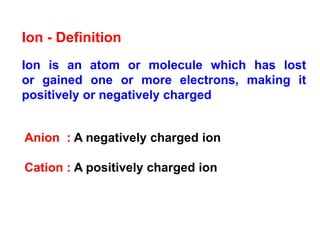
Ion is an atom or molecule which has lost
or gained one or more electrons, making it
positively or negatively charged
Ion - Definition
Anion : A negatively charged ion
Cation : A positively charged ion
Root takes up nutrients as ions through
meristamatic region
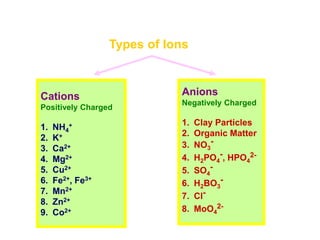
Types of Ions
Cations
Positively Charged
1. NH4
+
2. K+
3. Ca2+
4. Mg2+
5. Cu2+
6. Fe2+, Fe3+
7. Mn2+
8. Zn2+
9. Co2+
Anions
Negatively Charged
1. Clay Particles
2. Organic Matter
3. NO3
-
4. H2PO4
-, HPO4
2-
5. SO4
-
6. H2BO3
-
7. Cl-
8. MoO4
2-
ION EXCHANGE
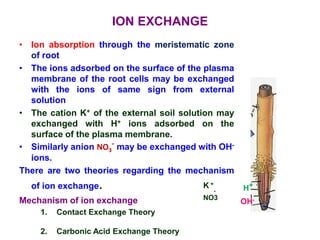
• Ion absorption through the meristematic zone
of root
• The ions adsorbed on the surface of the plasma
membrane of the root cells may be exchanged
with the ions of same sign from external
solution
• The cation K+ of the external soil solution may
exchanged with H+ ions adsorbed on the
surface of the plasma membrane.
• Similarly anion NO3
- may be exchanged with OH-
ions.
There are two theories regarding the mechanism
of ion exchange.
Mechanism of ion exchange
1. Contact Exchange Theory
2. Carbonic Acid Exchange Theory
K +
-
NO3
H+
OH-
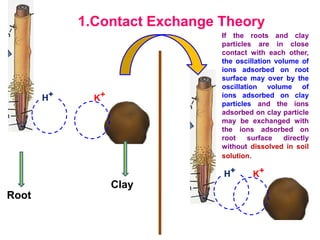
1.Contact Exchange Theory
H+ K+
H+ K+
Root
Clay
If the roots and clay
particles are in close
contact with each other,
the oscillation volume of
ions adsorbed on root
surface may over by the
oscillation volume of
ions adsorbed on clay
particles and the ions
adsorbed on clay particle
may be exchanged with
the ions adsorbed on
root surface directly
without dissolved in soil
solution.
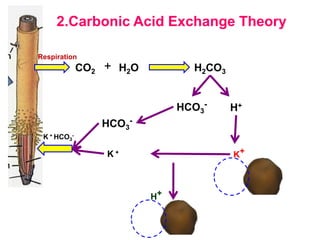
2.Carbonic Acid Exchange Theory
CO2 H2O H2CO3
H+
HCO3
-
K+
K +
HCO3
-
+
H+
K + HCO3
-
Respiration
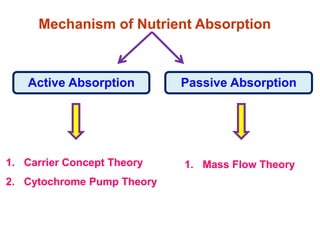
Mechanism of Nutrient Absorption
1. Carrier Concept Theory
2. Cytochrome Pump Theory
Active Absorption Passive Absorption
1. Mass Flow Theory
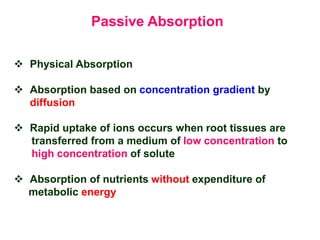
Passive Absorption
 Physical Absorption
 Absorption based on concentration gradient by
diffusion
 Rapid uptake of ions occurs when root tissues are
transferred from a medium of low concentration to
high concentration of solute
 Absorption of nutrients without expenditure of
metabolic energy
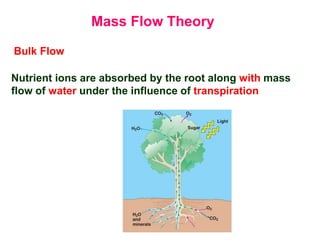
Nutrient ions are absorbed by the root along with mass
flow of water under the influence of transpiration
Mass Flow Theory
Bulk Flow
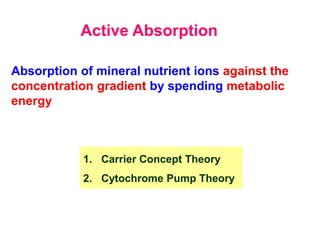
Active Absorption
Absorption of mineral nutrient ions against the
concentration gradient by spending metabolic
energy
1. Carrier Concept Theory
2. Cytochrome Pump Theory
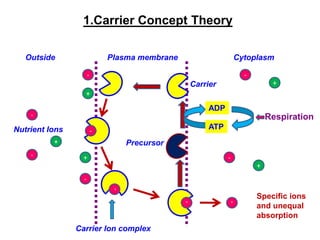
1.Carrier Concept Theory
ATP
ADP
Respiration
+
-
+
+
-
-
-
-
+
+
-
-
Plasma membrane
Outside Cytoplasm
Nutrient Ions
Carrier Ion complex
Precursor
Carrier
Specific ions
and unequal
absorption
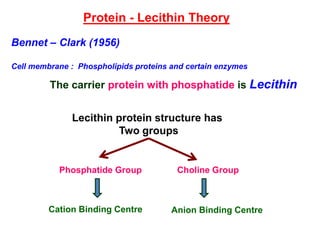
Protein - Lecithin Theory
Bennet – Clark (1956)
Cell membrane : Phospholipids proteins and certain enzymes
The carrier protein with phosphatide is Lecithin
Lecithin protein structure has
Two groups
Phosphatide Group Choline Group
Cation Binding Centre Anion Binding Centre
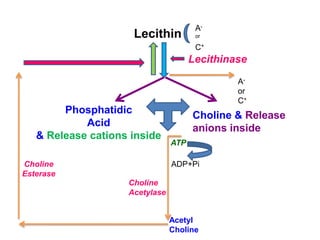
Lecithin
Phosphatidic
Acid
& Release cations inside
Choline & Release
anions inside
Lecithinase
Choline
Acetylase
Acetyl
Choline
Choline
Esterase
ATP
ADP+Pi
A-
or
C+
A-
or
C+
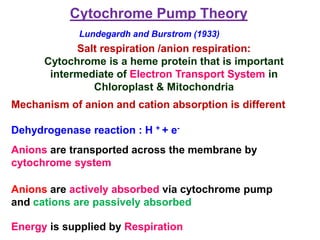
Cytochrome Pump Theory
Salt respiration /anion respiration:
Cytochrome is a heme protein that is important
intermediate of Electron Transport System in
Chloroplast & Mitochondria
Lundegardh and Burstrom (1933)
Anions are transported across the membrane by
cytochrome system
Energy is supplied by Respiration
Anions are actively absorbed via cytochrome pump
and cations are passively absorbed
Mechanism of anion and cation absorption is different
Dehydrogenase reaction : H + + e-
Fe2+
Fe3+
Fe3+
Fe2+
Fe2+
Fe3+
e- e-
Dehydrogenase
Reactions
H+
C+
C+
A-
A-
A-
A-
A-
A-
H
H2O
O2
Active
Passive
Cytochrome Pump Theory
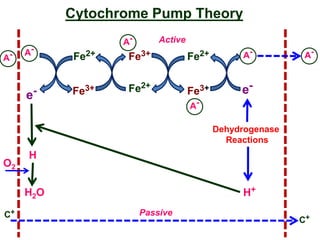
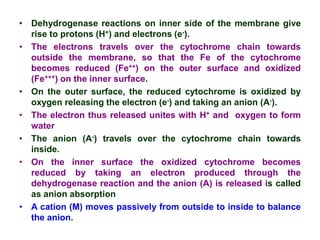
• Dehydrogenase reactions on inner side of the membrane give
rise to protons (H+) and electrons (e-).
• The electrons travels over the cytochrome chain towards
outside the membrane, so that the Fe of the cytochrome
becomes reduced (Fe++) on the outer surface and oxidized
(Fe+++) on the inner surface.
• On the outer surface, the reduced cytochrome is oxidized by
oxygen releasing the electron (e-) and taking an anion (A-).
• The electron thus released unites with H+ and oxygen to form
water
• The anion (A-) travels over the cytochrome chain towards
inside.
• On the inner surface the oxidized cytochrome becomes
reduced by taking an electron produced through the
dehydrogenase reaction and the anion (A) is released is called
as anion absorption
• A cation (M) moves passively from outside to inside to balance
the anion.
Once absorption of ion take place either by
active or by passive, Ions entered into the
epidermis and cell to cell by
• Apoplastic path way
• Symplastic pathway
• Transmembrane pathway and then enter into xylem
Donnan’s equilibrium
Indiffusible or fixed ions
• Certain pre existing ions inside the cell which cannot diffuse outside
through membrane.
• Suppose there are certain fixed anions in the cell which is in
contact with outer solution containing anions and cations.
• Normally equal number of anions and cations would have
diffused into the cell through an electrical potential to balance
each other, but to balance the fixed anions more cations will
diffuse into the cell. This equilibrium is known as Donnan’s
equilibrium
• There are fixed cations inside the cell, the Donan’s equilibrium will
result in the accumulation of anions inside the cell
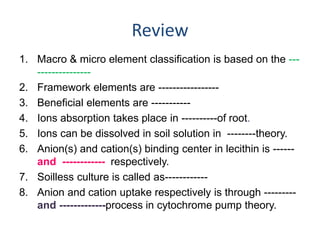
Review
1. Macro & micro element classification is based on the ---
---------------
2. Framework elements are -----------------
3. Beneficial elements are -----------
4. Ions absorption takes place in ----------of root.
5. Ions can be dissolved in soil solution in --------theory.
6. Anion(s) and cation(s) binding center in lecithin is ------
and ------------ respectively.
7. Soilless culture is called as------------
8. Anion and cation uptake respectively is through ---------
and -------------process in cytochrome pump theory.
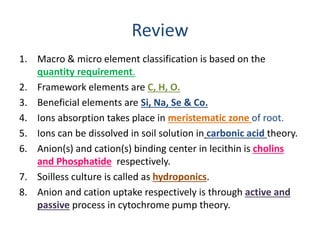
Review
1. Macro & micro element classification is based on the
quantity requirement.
2. Framework elements are C, H, O.
3. Beneficial elements are Si, Na, Se & Co.
4. Ions absorption takes place in meristematic zone of root.
5. Ions can be dissolved in soil solution in carbonic acid theory.
6. Anion(s) and cation(s) binding center in lecithin is cholins
and Phosphatide respectively.
7. Soilless culture is called as hydroponics.
8. Anion and cation uptake respectively is through active and
passive process in cytochrome pump theory.

nutrient absorb.ppt

  • 1.
  • 2.
    Ion is anatom or molecule which has lost or gained one or more electrons, making it positively or negatively charged Ion - Definition Anion : A negatively charged ion Cation : A positively charged ion
  • 3.
    Root takes upnutrients as ions through meristamatic region Types of Ions Cations Positively Charged 1. NH4 + 2. K+ 3. Ca2+ 4. Mg2+ 5. Cu2+ 6. Fe2+, Fe3+ 7. Mn2+ 8. Zn2+ 9. Co2+ Anions Negatively Charged 1. Clay Particles 2. Organic Matter 3. NO3 - 4. H2PO4 -, HPO4 2- 5. SO4 - 6. H2BO3 - 7. Cl- 8. MoO4 2-
  • 4.
    ION EXCHANGE • Ionabsorption through the meristematic zone of root • The ions adsorbed on the surface of the plasma membrane of the root cells may be exchanged with the ions of same sign from external solution • The cation K+ of the external soil solution may exchanged with H+ ions adsorbed on the surface of the plasma membrane. • Similarly anion NO3 - may be exchanged with OH- ions. There are two theories regarding the mechanism of ion exchange. Mechanism of ion exchange 1. Contact Exchange Theory 2. Carbonic Acid Exchange Theory K + - NO3 H+ OH-
  • 5.
    1.Contact Exchange Theory H+K+ H+ K+ Root Clay If the roots and clay particles are in close contact with each other, the oscillation volume of ions adsorbed on root surface may over by the oscillation volume of ions adsorbed on clay particles and the ions adsorbed on clay particle may be exchanged with the ions adsorbed on root surface directly without dissolved in soil solution.
  • 6.
    2.Carbonic Acid ExchangeTheory CO2 H2O H2CO3 H+ HCO3 - K+ K + HCO3 - + H+ K + HCO3 - Respiration
  • 7.
    Mechanism of NutrientAbsorption 1. Carrier Concept Theory 2. Cytochrome Pump Theory Active Absorption Passive Absorption 1. Mass Flow Theory
  • 8.
    Passive Absorption  PhysicalAbsorption  Absorption based on concentration gradient by diffusion  Rapid uptake of ions occurs when root tissues are transferred from a medium of low concentration to high concentration of solute  Absorption of nutrients without expenditure of metabolic energy
  • 9.
    Nutrient ions areabsorbed by the root along with mass flow of water under the influence of transpiration Mass Flow Theory Bulk Flow
  • 10.
    Active Absorption Absorption ofmineral nutrient ions against the concentration gradient by spending metabolic energy 1. Carrier Concept Theory 2. Cytochrome Pump Theory
  • 11.
    1.Carrier Concept Theory ATP ADP Respiration + - + + - - - - + + - - Plasmamembrane Outside Cytoplasm Nutrient Ions Carrier Ion complex Precursor Carrier Specific ions and unequal absorption
  • 12.
    Protein - LecithinTheory Bennet – Clark (1956) Cell membrane : Phospholipids proteins and certain enzymes The carrier protein with phosphatide is Lecithin Lecithin protein structure has Two groups Phosphatide Group Choline Group Cation Binding Centre Anion Binding Centre
  • 13.
    Lecithin Phosphatidic Acid & Release cationsinside Choline & Release anions inside Lecithinase Choline Acetylase Acetyl Choline Choline Esterase ATP ADP+Pi A- or C+ A- or C+
  • 14.
    Cytochrome Pump Theory Saltrespiration /anion respiration: Cytochrome is a heme protein that is important intermediate of Electron Transport System in Chloroplast & Mitochondria Lundegardh and Burstrom (1933) Anions are transported across the membrane by cytochrome system Energy is supplied by Respiration Anions are actively absorbed via cytochrome pump and cations are passively absorbed Mechanism of anion and cation absorption is different Dehydrogenase reaction : H + + e-
  • 15.
  • 16.
    • Dehydrogenase reactionson inner side of the membrane give rise to protons (H+) and electrons (e-). • The electrons travels over the cytochrome chain towards outside the membrane, so that the Fe of the cytochrome becomes reduced (Fe++) on the outer surface and oxidized (Fe+++) on the inner surface. • On the outer surface, the reduced cytochrome is oxidized by oxygen releasing the electron (e-) and taking an anion (A-). • The electron thus released unites with H+ and oxygen to form water • The anion (A-) travels over the cytochrome chain towards inside. • On the inner surface the oxidized cytochrome becomes reduced by taking an electron produced through the dehydrogenase reaction and the anion (A) is released is called as anion absorption • A cation (M) moves passively from outside to inside to balance the anion.
  • 17.
    Once absorption ofion take place either by active or by passive, Ions entered into the epidermis and cell to cell by • Apoplastic path way • Symplastic pathway • Transmembrane pathway and then enter into xylem
  • 18.
    Donnan’s equilibrium Indiffusible orfixed ions • Certain pre existing ions inside the cell which cannot diffuse outside through membrane. • Suppose there are certain fixed anions in the cell which is in contact with outer solution containing anions and cations. • Normally equal number of anions and cations would have diffused into the cell through an electrical potential to balance each other, but to balance the fixed anions more cations will diffuse into the cell. This equilibrium is known as Donnan’s equilibrium • There are fixed cations inside the cell, the Donan’s equilibrium will result in the accumulation of anions inside the cell
  • 20.
    Review 1. Macro &micro element classification is based on the --- --------------- 2. Framework elements are ----------------- 3. Beneficial elements are ----------- 4. Ions absorption takes place in ----------of root. 5. Ions can be dissolved in soil solution in --------theory. 6. Anion(s) and cation(s) binding center in lecithin is ------ and ------------ respectively. 7. Soilless culture is called as------------ 8. Anion and cation uptake respectively is through --------- and -------------process in cytochrome pump theory.
  • 21.
    Review 1. Macro &micro element classification is based on the quantity requirement. 2. Framework elements are C, H, O. 3. Beneficial elements are Si, Na, Se & Co. 4. Ions absorption takes place in meristematic zone of root. 5. Ions can be dissolved in soil solution in carbonic acid theory. 6. Anion(s) and cation(s) binding center in lecithin is cholins and Phosphatide respectively. 7. Soilless culture is called as hydroponics. 8. Anion and cation uptake respectively is through active and passive process in cytochrome pump theory.