Dr. NAVEENKUMAR K.L
Assistant Professor
Dept. Of Genetics and Plant Breeding
UAHS Shivamogga
Centers of Origin of Crop Plants
Centres of Origin of Crop Plants
 Cultivated plants are not distributed uniformly throughout
the world.
 Some of the of the crop species show greater variability
and their wild relatives in certain areas of the world
 In 1926, N. I. Vavilov proposed Centres of Origin
Primary centres of origin: crop plants evolved from wild
species in the areas showing greater diversity and called
them as Primary centres of origin
Secondary centres of origin: in some areas although certain
crops show diversity but did not originate there
Why study of origin of crops is important?
1. Search for resistance to diseases and pests.
2. Helps in directing efforts towards crop improvement
Eg: *In sugarcane S. Barberi and S. Sinensis are the result of
crosses between S. officinarum x S. Sportaneum As a result,
nobalization of canes in sugarcane took place.
*In wheat A B D genomes have come from three different wild Sp.
namely T. monococcum, T. speltoids & T. squarrosa to give rise to
cultivated hexaploid.
3. Useful in development of new crops
4. Useful in making collections
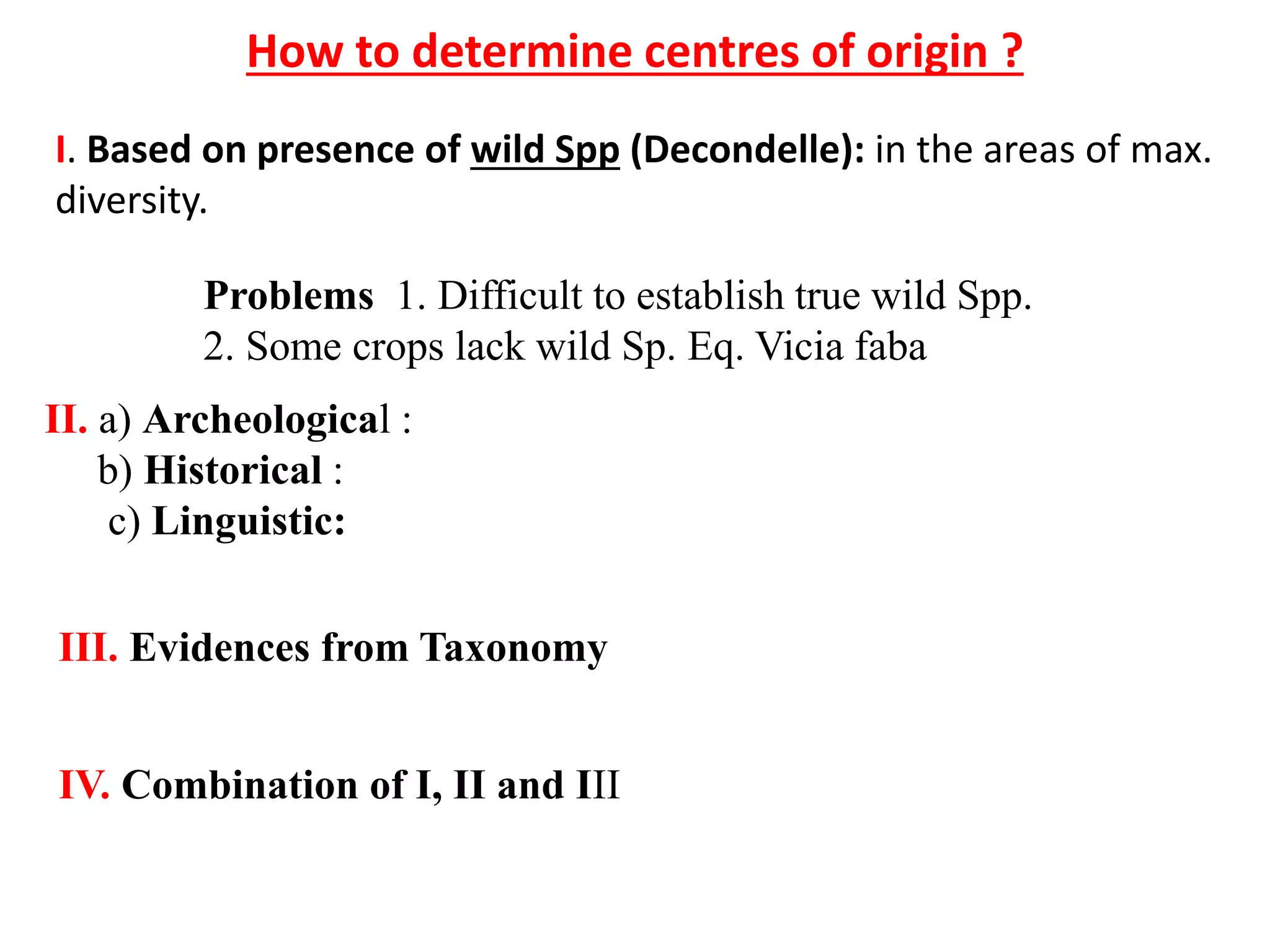
How to determine centres of origin ?
I. Based on presence of wild Spp (Decondelle): in the areas of max.
diversity.
Problems 1. Difficult to establish true wild Spp.
2. Some crops lack wild Sp. Eq. Vicia faba
II. a) Archeological :
b) Historical :
c) Linguistic:
III. Evidences from Taxonomy
IV. Combination of I, II and III
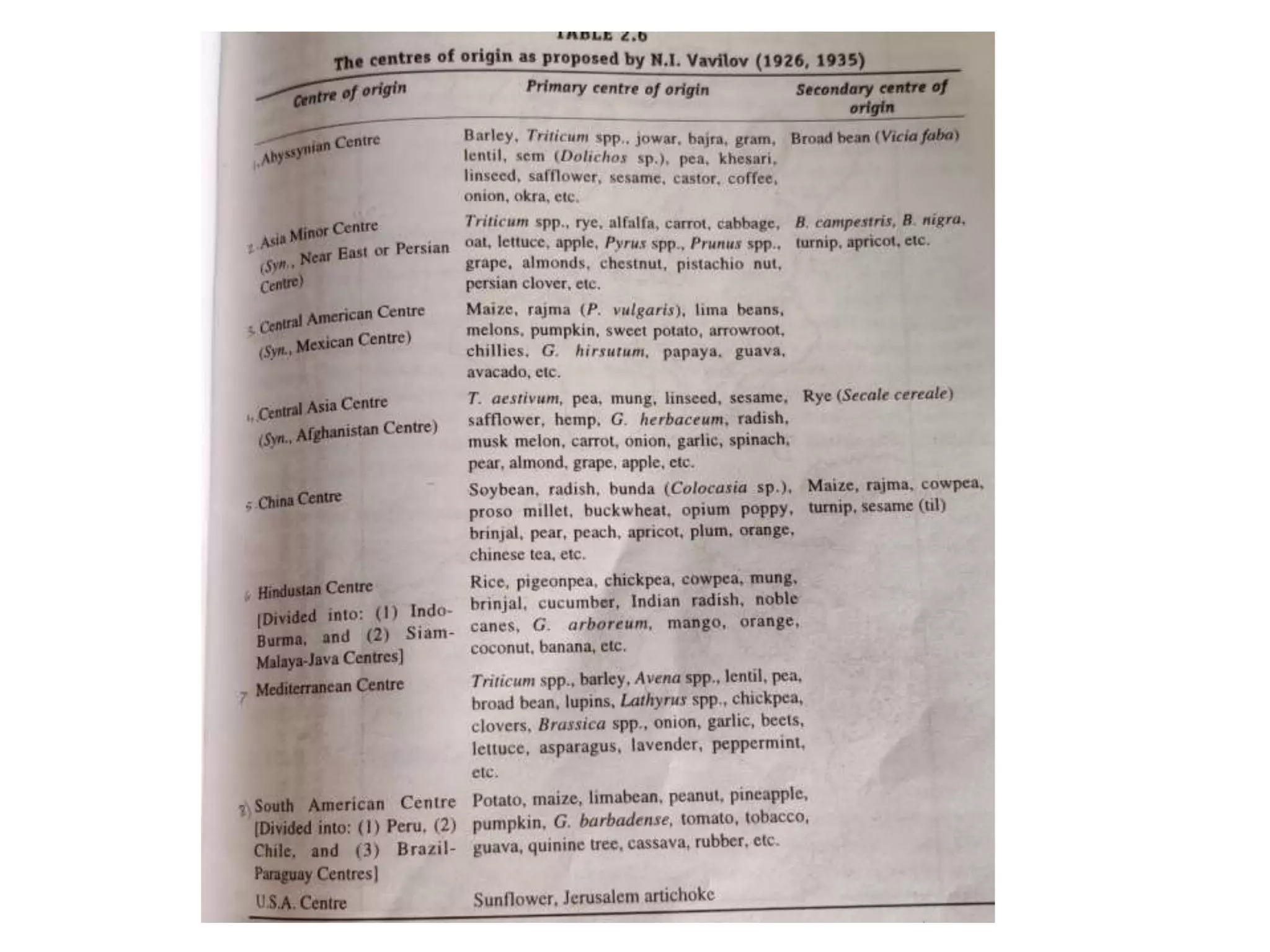
9. USA centre: Sunflower and H. tuberoses
Centres of Origin
Centers of Origin of Crop Plants
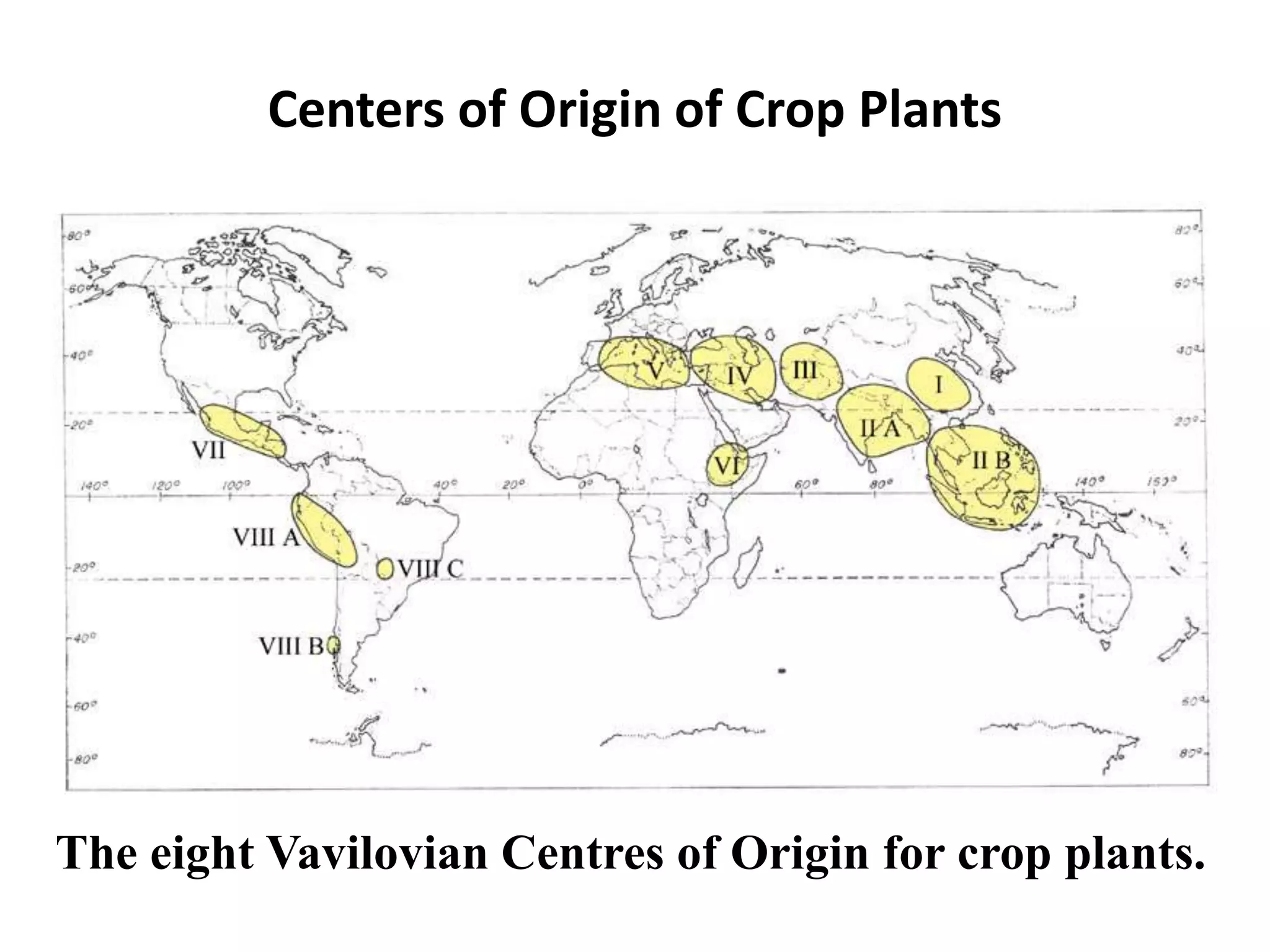
The eight Vavilovian Centres of Origin for crop plants.
 The largest independent center which includes
the mountainous regions of central and western
China, and adjacent lowlands.
OLD WORLD
1. Apricot
2. Peach
3. Soybean
4. Adzuki bean
5. Velvet bean
6. Chinese yam
7. Radish
8. Chinese cabbage
9. Onion
10. Cucumber
 A total of 136 endemic plants are listed, among which
are a few known to us as important crops.
II.
This area has two sub-centers.
A. Main Center (Hindustan): Includes Assam and
Burma, but not Northwest India, Punjab, Northwest
Frontier Provinces.
1. Rice
2. Chickpea
3. Pigeon pea
4. Urd bean
5. Mung bean
6. Cowpea
7. Eggplant
8. Mango
9. Tamarind
 Agro ecological zones of India -20
(for planning of agricultural development s well as sustainable
use of plant genetic resources for enhancement of crop
production and productivity)
 Biogeographic classification of India -10 Zones
(Based on geography climate and pattern of vegetation).
 Agro-climatic zones of India-15
(Based on the criteria of homogeneity in agrocharactestics –
Rain fall, temperature, soil, cropping and farming system)
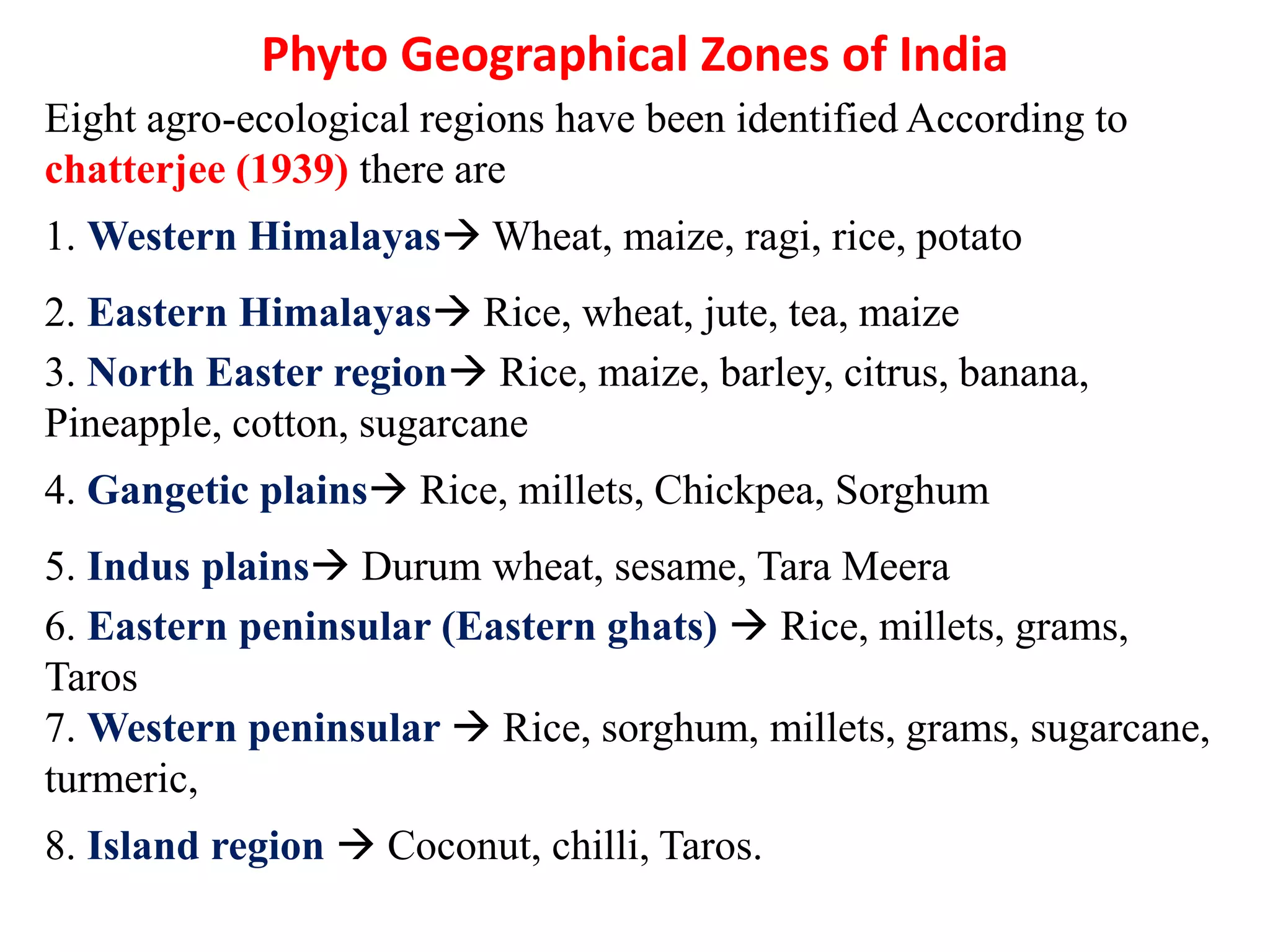
Eight agro-ecological regions have been identified According to
chatterjee (1939) there are
1. Western Himalayas Wheat, maize, ragi, rice, potato
2. Eastern Himalayas Rice, wheat, jute, tea, maize
3. North Easter region Rice, maize, barley, citrus, banana,
Pineapple, cotton, sugarcane
4. Gangetic plains Rice, millets, Chickpea, Sorghum
5. Indus plains Durum wheat, sesame, Tara Meera
6. Eastern peninsular (Eastern ghats)  Rice, millets, grams,
Taros
7. Western peninsular  Rice, sorghum, millets, grams, sugarcane,
turmeric,
8. Island region  Coconut, chilli, Taros.
Phyto Geographical Zones of India
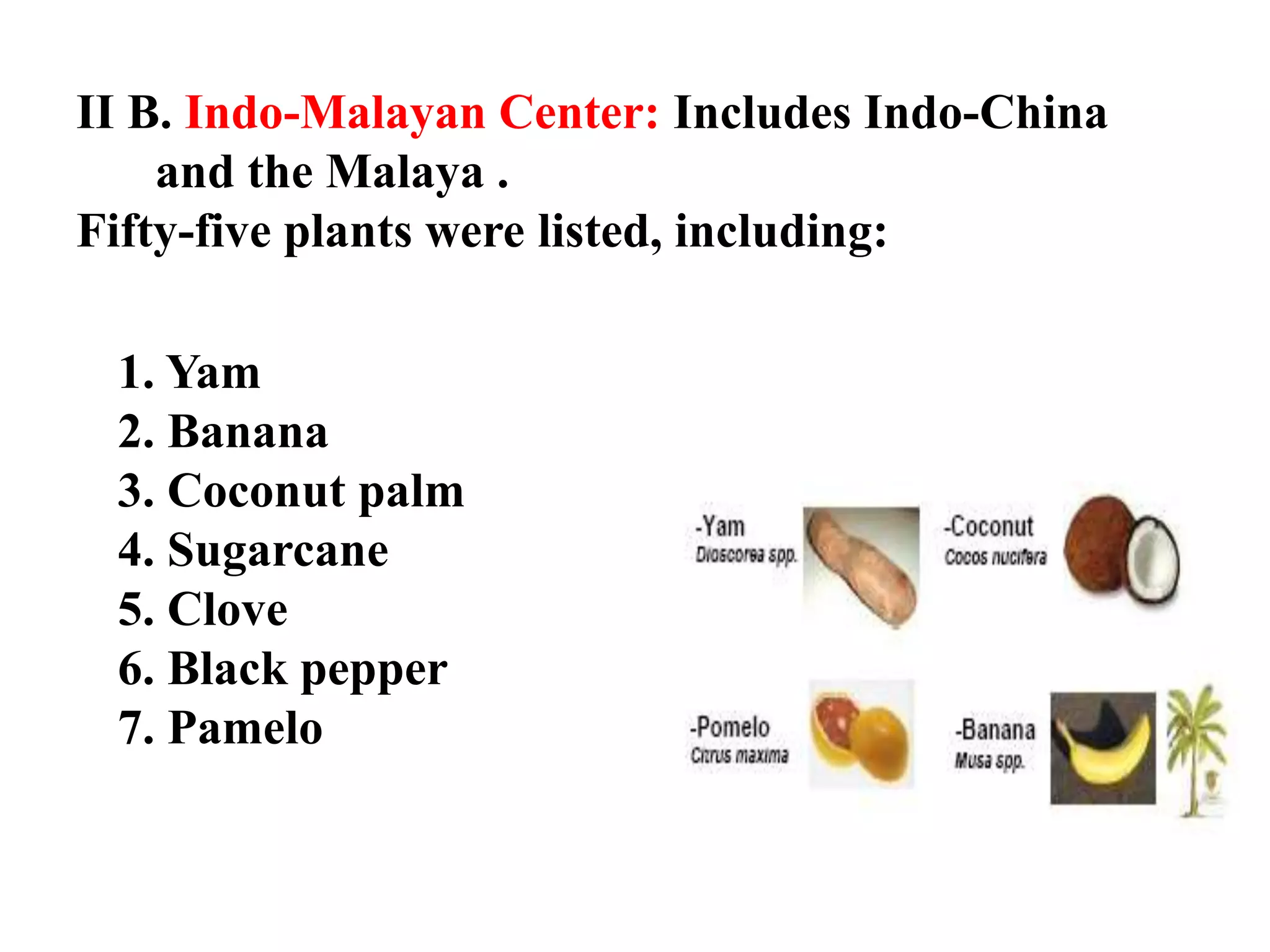
II B. Indo-Malayan Center: Includes Indo-China
and the Malaya .
Fifty-five plants were listed, including:
1. Yam
2. Banana
3. Coconut palm
4. Sugarcane
5. Clove
6. Black pepper
7. Pamelo
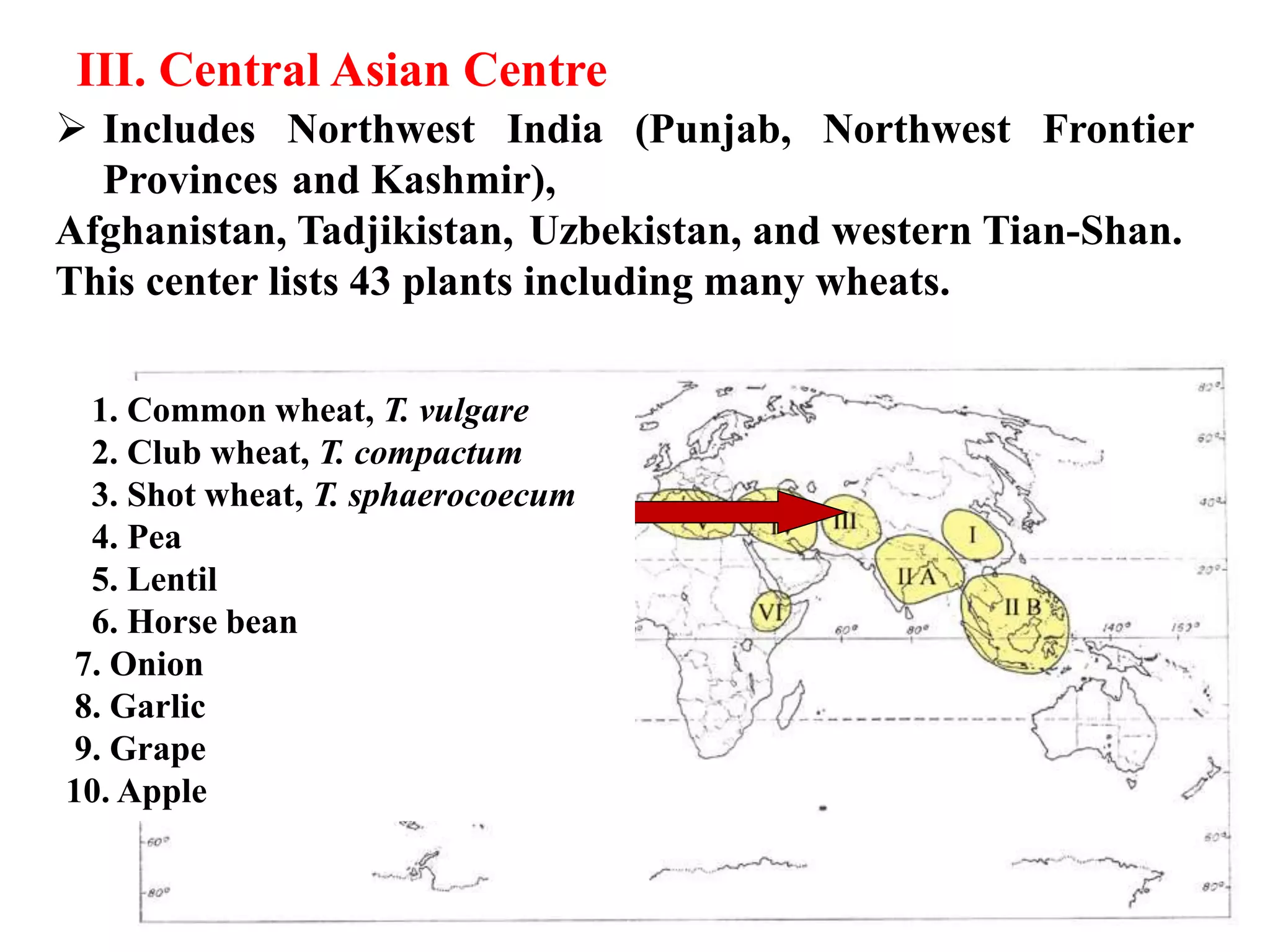
 Includes Northwest India (Punjab, Northwest Frontier
Provinces and Kashmir),
Afghanistan, Tadjikistan, Uzbekistan, and western Tian-Shan.
This center lists 43 plants including many wheats.
1. Common wheat, T. vulgare
2. Club wheat, T. compactum
3. Shot wheat, T. sphaerocoecum
4. Pea
5. Lentil
6. Horse bean
7. Onion
8. Garlic
9. Grape
10. Apple
III. Central Asian Centre
I Includes interior of Asia Minor (Anatolian peninsula in
Asian part of turkey), Iran and the highlands of
Turkmenistan.
This region lists 83 species including 9 species of wheat.
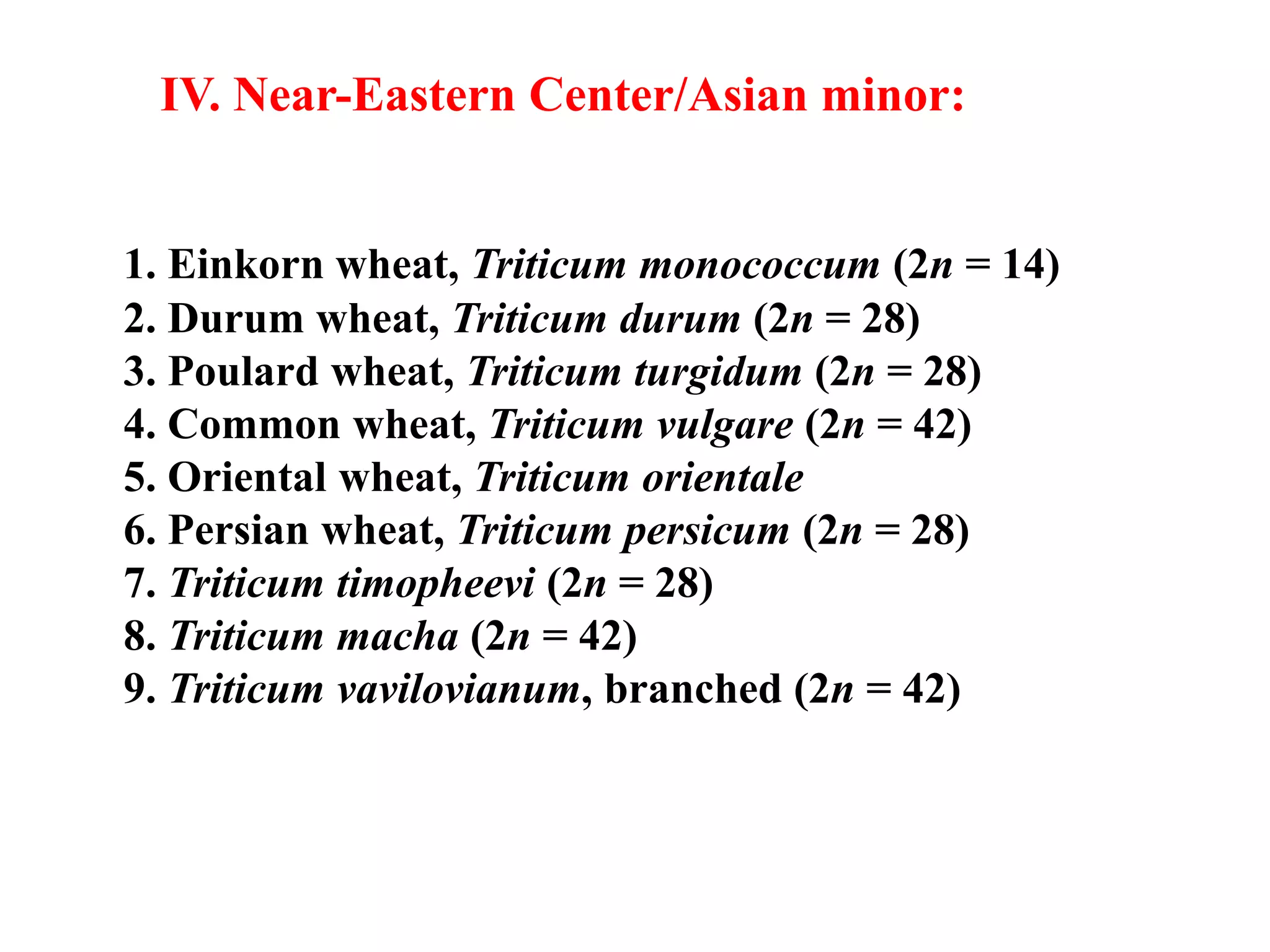
IV. Near-Eastern Center/Asian minor:
1. Einkorn wheat, Triticum monococcum (2n = 14)
2. Durum wheat, Triticum durum (2n = 28)
3. Poulard wheat, Triticum turgidum (2n = 28)
4. Common wheat, Triticum vulgare (2n = 42)
5. Oriental wheat, Triticum orientale
6. Persian wheat, Triticum persicum (2n = 28)
7. Triticum timopheevi (2n = 28)
8. Triticum macha (2n = 42)
9. Triticum vavilovianum, branched (2n = 42)
IV. Near-Eastern Center/Asian minor:
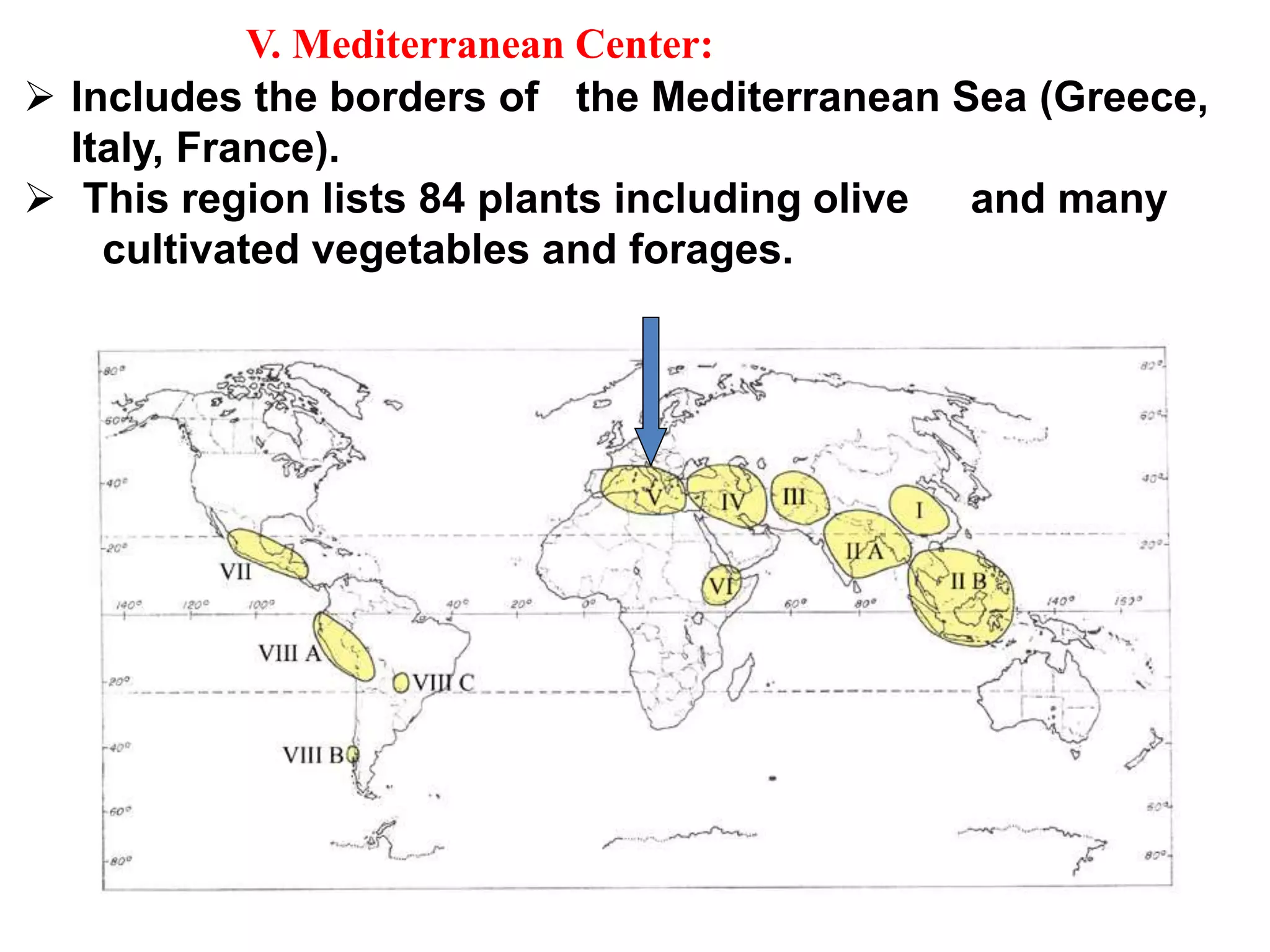
 Includes the borders of the Mediterranean Sea (Greece,
Italy, France). :
 This region lists 84 plants including olive and many
cultivated vegetables and forages.
V. Mediterranean Center:
1. Durum wheat, Triticum durum expansum
2. Emmer, Triticum dicoccum (one of the centers)
3. Pea, Pisum sativum (large seeded varieties)
4. Lupine
5. Black mustard
6. Olive
7. Cabbage
8. Lettuce
9. Asparagus
10. Celery
V. Mediterranean Center:
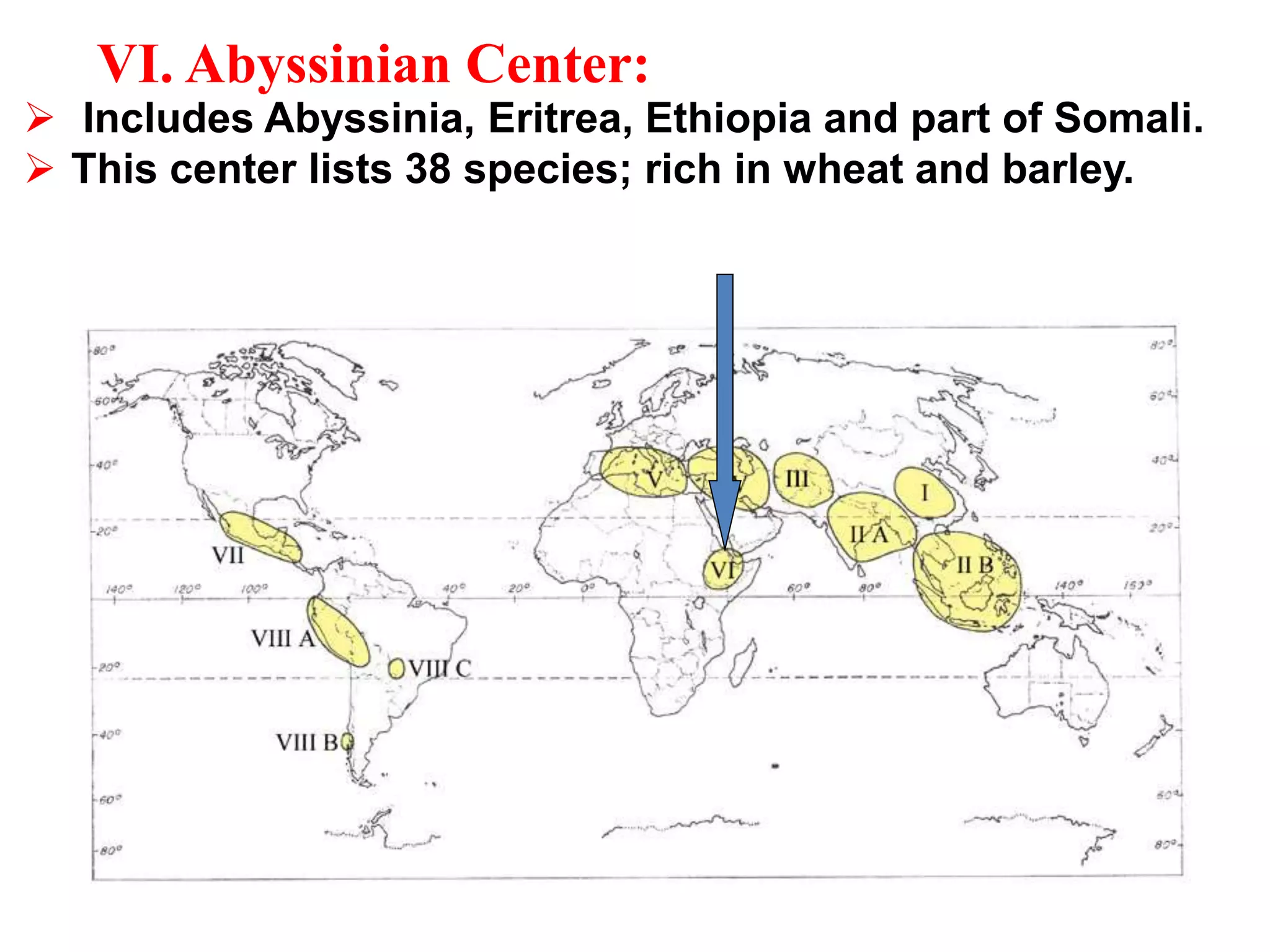
 Includes Abyssinia, Eritrea, Ethiopia and part of Somali.
 This center lists 38 species; rich in wheat and barley.
VI. Abyssinian Center:
1. Abyssinian hard wheat, Triticum durum abyssinicum
2. Grain sorghum, Andropogon sorghum
3. Pearl millet, Pennisetum spicatum
4. Cowpea, Vigna sinensis
5. Flax, Linum usitatissimum
6. Sesame, Sesamum indicum (basic center)
7. Castor bean, Ricinus communis (a center)
VI. Abyssinian Center:
VII. South Mexican and Central American Centre:
Includes southern sections of Mexico, Guatemala,
Honduras and Costa Rica.
NEW WORLD
1. Maize, Zea mays
2. Common bean, Phaseolus vulgaris
3. Lima bean, Phaseolus lunatus
4. Sweetpotato
5. Pepper, Capsicum annuum, C. frutescens
6. Papaya, Carica papaya
7. Guava, Psidium guayava
8. Cashew, Anacardium occidentale
VII. South Mexican and Central American Centre:
VIII. South American Center:
1. Andean potato
2. Pepper
3. Tomato
4. Pumpkin
5. Egyptian cotton
6. Guava
7. Tobacco
Two sub-centers are found.
A. Peruvian, Ecuadorean, Bolivian Center: Comprised
mainly the high mountainous areas of Peru, Bolivia,
Ecuador.
VIII B. Brazilian-Paraguayan Center
1. Cassava
2. Groundnut
3. Rubber
4. Pineapple
5. Cashew
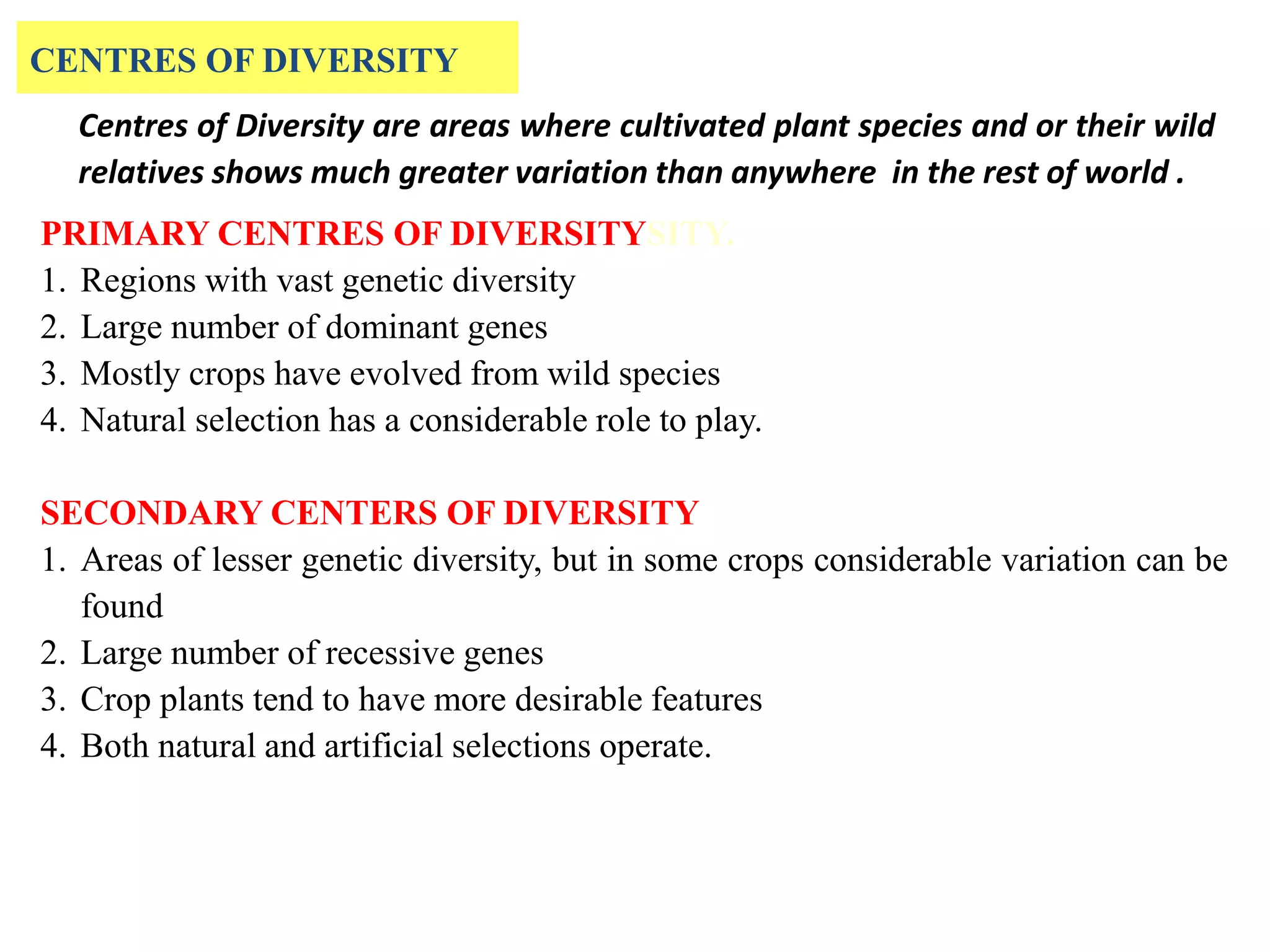
PRIMARY CENTRES OF DIVERSITYSITY.
1. Regions with vast genetic diversity
2. Large number of dominant genes
3. Mostly crops have evolved from wild species
4. Natural selection has a considerable role to play.
SECONDARY CENTERS OF DIVERSITY
1. Areas of lesser genetic diversity, but in some crops considerable variation can be
found
2. Large number of recessive genes
3. Crop plants tend to have more desirable features
4. Both natural and artificial selections operate.
CENTRES OF DIVERSITY
Centres of Diversity are areas where cultivated plant species and or their wild
relatives shows much greater variation than anywhere in the rest of world .
MICROCENTERS (Harlan 1951): are the small areas within
the centres of diversity exhibiting tremendous genetic
diversity of some crop plants.
1. Small areas within the pco/sco exhibiting tremendous genetic
diversity.
2. Crop evolution tends to proceed at a faster rate in such areas
3. Important for plant collection & experimental study of
evolution of cultivated species.
Nuclear centres:Hawkes (1983) -4
Linked the nuclear centres with the archaeological evidence to
provide strong proofs of agricultural origins
Zevan and Zhukovsky (1975)-proposed 12 mega gene centres.
1. Chinese – Japanese 7. Mediterranian
2. Indo-chinese Indonesian 8. European Siberian
3. Australian 9. African region
4. Hindustan 10. South American region
5. Central Asian 11. Central American
6. Near East-region 12. North American
MEGACENTERS: Centres where the place where cultivated
plant species exhibit diversity and micro gene centre is place
where wild species occur.
* Zhukovsky (Student of N I Vavilov)
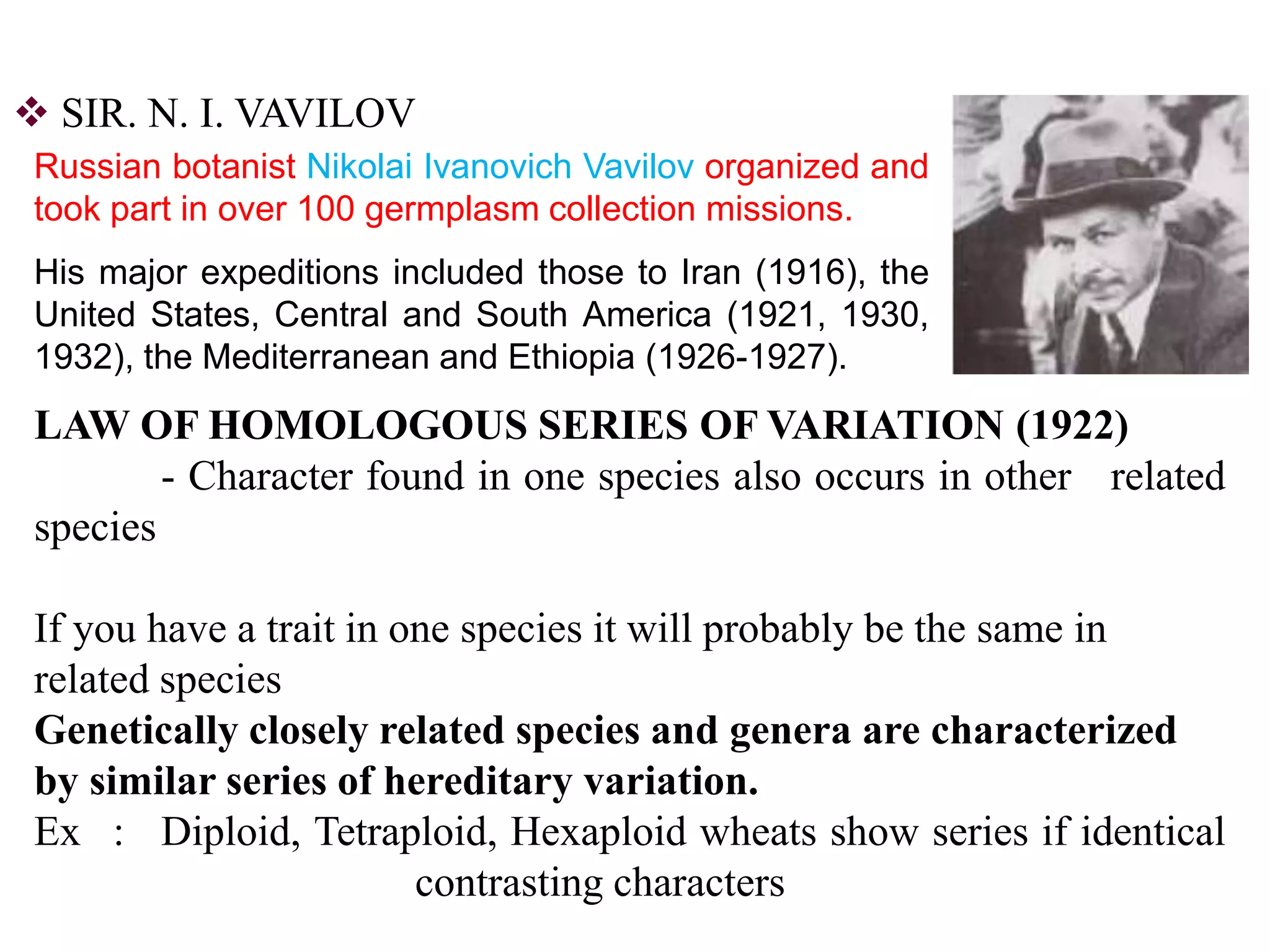
 SIR. N. I. VAVILOV
Russian botanist Nikolai Ivanovich Vavilov organized and
took part in over 100 germplasm collection missions.
His major expeditions included those to Iran (1916), the
United States, Central and South America (1921, 1930,
1932), the Mediterranean and Ethiopia (1926-1927).
LAW OF HOMOLOGOUS SERIES OF VARIATION (1922)
- Character found in one species also occurs in other related
species
If you have a trait in one species it will probably be the same in
related species
Genetically closely related species and genera are characterized
by similar series of hereditary variation.
Ex : Diploid, Tetraploid, Hexaploid wheats show series if identical
contrasting characters
Domestication
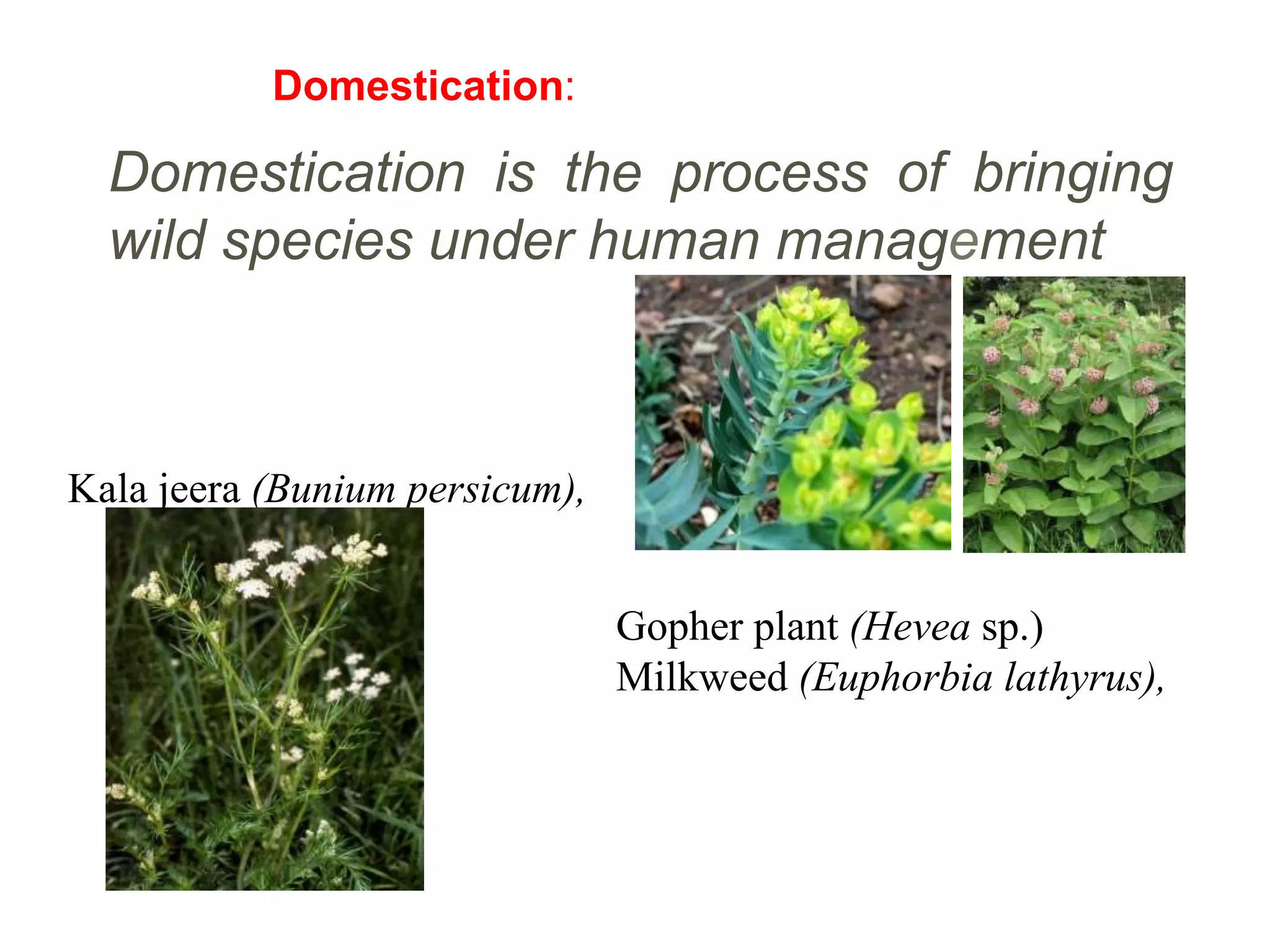
Domestication is the process of bringing
wild species under human management
Gopher plant (Hevea sp.)
Milkweed (Euphorbia lathyrus),
Kala jeera (Bunium persicum),
Domestication:
Selection under Domestication
When different genotypes present in a population
reproduce at different rates, it is called selection.
 Selection is grouped into two types, on the
basis of the agency responsible for it.
 A population may be simply defined as the group of
individuals, which mate or can mate freely with each other.
1.Natural
2.Artificial
Natural Selection:The selection that occurs due to natural
forces like climate, soil, biological factors (e.g., diseases,
insect pests, etc.) and other factors of the environment is
called natural selection.
In 1962, Nichlson proposed that natural selection may be
seen to operate through two mechanisms,
viz.; (l) environmental selection and (2) competition.
Environmental selection acts against all such genotypes
that are unable to cope with the environmental stresses.
Natural selection through competition occurs in crop
populations where a plant takes up more water, nutrients or light
than another at the expense of the other.
Artificial Selection: is carried out by man and is confined to
domesticated species. It allows only the selected plants to
reproduce, ordinarily .makes plants more useful to man and
generally leads to a marked decline in genetic variability in the
selected progenies/populations.
Types of Selection
(1)Directional selection,
(2) Stabilizing selection
(3) Disruptive selection.
Directional Selection: When individuals having the extreme
phenotype for a trait or a group of traits are selected for, it is
called directional selection.
Eg. Heavy metal tolerance
Stabilizing Selection: When selection favours the
intermediate phenotype and acts against the extreme
phenotypes, it is termed as stabilizing selection
Disruptive Selection: In each 'ecological niche' a different
'phenotypic optima' is selected for so that the population
ultimately consists of two or more recognizable forms; such a
selection is called disruptive selection..
Plant Introduction
Plant Introduction
Taking a genotype or group of genotypes of a plant into a
new area or region where they are not grown previously.
It may be introduction of new variety, wild relatives of crop
species or new plant species
It may be between countries or within a country
Ex: bIntroduction of Potato and tomato into India
y: Introduction of Wheat in West Bengal and Rice in
Punjab
Types of Plant Introduction
• Primary Introduction:
– Introduced genotype is directly released for commercial
cultivation without any alteration.
– Ex: Semi-dwarf wheat varieties, Sonora 64, Lerma Rojo,
• Secondary Introduction:
– The introduced variety is improved by selection or hybridization
with local genotypes to transfer one or few characters from
introduced variety into local variety.
– Ex: Wheat varieties, Kalyan sona and Sonalika
Purpose of Plant Introduction
1. Entirely new crop: To bring under cultivation
New crop species which is not under cultivation
Ex: Maize, Potato, Tomato in India
2. New Varieties:
3. Utilization in crop improvement
programme
4. Utilization in scientific studies: To study
origin, evolution, biosystematics of crop plants.
5. Used for Aesthetic value: Ornamental crops
6. To protect from pest and disease:
Introduction of coffee from south Africa to South
America to protect from leaf rust.
Merits of Plant Introduction
1. It provides entirely new crop
2. New variety either by primary or secondary
introduction
3. To protect variability from genetic erosion
4. Quick and economical method of crop
improvement
5. Crop species may be free from disease and pest in
new areas
Demerits of Plant Introduction
• Introduction of
– New weeds: Argemone mexicana, Phylaris minor
etc into India
– Diseases: Late blight of potato from Europe,
Coffee rust, bunchy top of Banana
– Insect pest: Potato tuber moth, Woolly aphid of
apple
• Ornamentals-turned-weeds
– Water hyacinth and Lantana camara
Acclimatization
• Factors affecting acclimatization:
– Mode of pollination
• Cross pollinated crops adapt faster than self pollinated
crops
– Extent of genetic variability
• Higher the variability faster the adaptability
– Duration of life cycle
• Annual crops acclimatize faster than perennials
• It is the ability of a crop or crop variety to
become adapted to new climatic conditions

centres of origin GPB202

  • 1.
    Dr. NAVEENKUMAR K.L AssistantProfessor Dept. Of Genetics and Plant Breeding UAHS Shivamogga Centers of Origin of Crop Plants
  • 2.
    Centres of Originof Crop Plants  Cultivated plants are not distributed uniformly throughout the world.  Some of the of the crop species show greater variability and their wild relatives in certain areas of the world  In 1926, N. I. Vavilov proposed Centres of Origin Primary centres of origin: crop plants evolved from wild species in the areas showing greater diversity and called them as Primary centres of origin Secondary centres of origin: in some areas although certain crops show diversity but did not originate there
  • 3.
    Why study oforigin of crops is important? 1. Search for resistance to diseases and pests. 2. Helps in directing efforts towards crop improvement Eg: *In sugarcane S. Barberi and S. Sinensis are the result of crosses between S. officinarum x S. Sportaneum As a result, nobalization of canes in sugarcane took place. *In wheat A B D genomes have come from three different wild Sp. namely T. monococcum, T. speltoids & T. squarrosa to give rise to cultivated hexaploid. 3. Useful in development of new crops 4. Useful in making collections
  • 4.
    How to determinecentres of origin ? I. Based on presence of wild Spp (Decondelle): in the areas of max. diversity. Problems 1. Difficult to establish true wild Spp. 2. Some crops lack wild Sp. Eq. Vicia faba II. a) Archeological : b) Historical : c) Linguistic: III. Evidences from Taxonomy IV. Combination of I, II and III
  • 5.
    9. USA centre:Sunflower and H. tuberoses Centres of Origin
  • 6.
    Centers of Originof Crop Plants The eight Vavilovian Centres of Origin for crop plants.
  • 8.
     The largestindependent center which includes the mountainous regions of central and western China, and adjacent lowlands. OLD WORLD 1. Apricot 2. Peach 3. Soybean 4. Adzuki bean 5. Velvet bean 6. Chinese yam 7. Radish 8. Chinese cabbage 9. Onion 10. Cucumber  A total of 136 endemic plants are listed, among which are a few known to us as important crops.
  • 9.
    II. This area hastwo sub-centers. A. Main Center (Hindustan): Includes Assam and Burma, but not Northwest India, Punjab, Northwest Frontier Provinces. 1. Rice 2. Chickpea 3. Pigeon pea 4. Urd bean 5. Mung bean 6. Cowpea 7. Eggplant 8. Mango 9. Tamarind
  • 10.
     Agro ecologicalzones of India -20 (for planning of agricultural development s well as sustainable use of plant genetic resources for enhancement of crop production and productivity)  Biogeographic classification of India -10 Zones (Based on geography climate and pattern of vegetation).  Agro-climatic zones of India-15 (Based on the criteria of homogeneity in agrocharactestics – Rain fall, temperature, soil, cropping and farming system)
  • 11.
    Eight agro-ecological regionshave been identified According to chatterjee (1939) there are 1. Western Himalayas Wheat, maize, ragi, rice, potato 2. Eastern Himalayas Rice, wheat, jute, tea, maize 3. North Easter region Rice, maize, barley, citrus, banana, Pineapple, cotton, sugarcane 4. Gangetic plains Rice, millets, Chickpea, Sorghum 5. Indus plains Durum wheat, sesame, Tara Meera 6. Eastern peninsular (Eastern ghats)  Rice, millets, grams, Taros 7. Western peninsular  Rice, sorghum, millets, grams, sugarcane, turmeric, 8. Island region  Coconut, chilli, Taros. Phyto Geographical Zones of India
  • 12.
    II B. Indo-MalayanCenter: Includes Indo-China and the Malaya . Fifty-five plants were listed, including: 1. Yam 2. Banana 3. Coconut palm 4. Sugarcane 5. Clove 6. Black pepper 7. Pamelo
  • 13.
     Includes NorthwestIndia (Punjab, Northwest Frontier Provinces and Kashmir), Afghanistan, Tadjikistan, Uzbekistan, and western Tian-Shan. This center lists 43 plants including many wheats. 1. Common wheat, T. vulgare 2. Club wheat, T. compactum 3. Shot wheat, T. sphaerocoecum 4. Pea 5. Lentil 6. Horse bean 7. Onion 8. Garlic 9. Grape 10. Apple III. Central Asian Centre
  • 14.
    I Includes interiorof Asia Minor (Anatolian peninsula in Asian part of turkey), Iran and the highlands of Turkmenistan. This region lists 83 species including 9 species of wheat. IV. Near-Eastern Center/Asian minor:
  • 15.
    1. Einkorn wheat,Triticum monococcum (2n = 14) 2. Durum wheat, Triticum durum (2n = 28) 3. Poulard wheat, Triticum turgidum (2n = 28) 4. Common wheat, Triticum vulgare (2n = 42) 5. Oriental wheat, Triticum orientale 6. Persian wheat, Triticum persicum (2n = 28) 7. Triticum timopheevi (2n = 28) 8. Triticum macha (2n = 42) 9. Triticum vavilovianum, branched (2n = 42) IV. Near-Eastern Center/Asian minor:
  • 16.
     Includes theborders of the Mediterranean Sea (Greece, Italy, France). :  This region lists 84 plants including olive and many cultivated vegetables and forages. V. Mediterranean Center:
  • 17.
    1. Durum wheat,Triticum durum expansum 2. Emmer, Triticum dicoccum (one of the centers) 3. Pea, Pisum sativum (large seeded varieties) 4. Lupine 5. Black mustard 6. Olive 7. Cabbage 8. Lettuce 9. Asparagus 10. Celery V. Mediterranean Center:
  • 18.
     Includes Abyssinia,Eritrea, Ethiopia and part of Somali.  This center lists 38 species; rich in wheat and barley. VI. Abyssinian Center:
  • 19.
    1. Abyssinian hardwheat, Triticum durum abyssinicum 2. Grain sorghum, Andropogon sorghum 3. Pearl millet, Pennisetum spicatum 4. Cowpea, Vigna sinensis 5. Flax, Linum usitatissimum 6. Sesame, Sesamum indicum (basic center) 7. Castor bean, Ricinus communis (a center) VI. Abyssinian Center:
  • 20.
    VII. South Mexicanand Central American Centre: Includes southern sections of Mexico, Guatemala, Honduras and Costa Rica. NEW WORLD
  • 21.
    1. Maize, Zeamays 2. Common bean, Phaseolus vulgaris 3. Lima bean, Phaseolus lunatus 4. Sweetpotato 5. Pepper, Capsicum annuum, C. frutescens 6. Papaya, Carica papaya 7. Guava, Psidium guayava 8. Cashew, Anacardium occidentale VII. South Mexican and Central American Centre:
  • 22.
    VIII. South AmericanCenter: 1. Andean potato 2. Pepper 3. Tomato 4. Pumpkin 5. Egyptian cotton 6. Guava 7. Tobacco Two sub-centers are found. A. Peruvian, Ecuadorean, Bolivian Center: Comprised mainly the high mountainous areas of Peru, Bolivia, Ecuador.
  • 23.
    VIII B. Brazilian-ParaguayanCenter 1. Cassava 2. Groundnut 3. Rubber 4. Pineapple 5. Cashew
  • 24.
    PRIMARY CENTRES OFDIVERSITYSITY. 1. Regions with vast genetic diversity 2. Large number of dominant genes 3. Mostly crops have evolved from wild species 4. Natural selection has a considerable role to play. SECONDARY CENTERS OF DIVERSITY 1. Areas of lesser genetic diversity, but in some crops considerable variation can be found 2. Large number of recessive genes 3. Crop plants tend to have more desirable features 4. Both natural and artificial selections operate. CENTRES OF DIVERSITY Centres of Diversity are areas where cultivated plant species and or their wild relatives shows much greater variation than anywhere in the rest of world .
  • 25.
    MICROCENTERS (Harlan 1951):are the small areas within the centres of diversity exhibiting tremendous genetic diversity of some crop plants. 1. Small areas within the pco/sco exhibiting tremendous genetic diversity. 2. Crop evolution tends to proceed at a faster rate in such areas 3. Important for plant collection & experimental study of evolution of cultivated species. Nuclear centres:Hawkes (1983) -4 Linked the nuclear centres with the archaeological evidence to provide strong proofs of agricultural origins
  • 26.
    Zevan and Zhukovsky(1975)-proposed 12 mega gene centres. 1. Chinese – Japanese 7. Mediterranian 2. Indo-chinese Indonesian 8. European Siberian 3. Australian 9. African region 4. Hindustan 10. South American region 5. Central Asian 11. Central American 6. Near East-region 12. North American MEGACENTERS: Centres where the place where cultivated plant species exhibit diversity and micro gene centre is place where wild species occur. * Zhukovsky (Student of N I Vavilov)
  • 27.
     SIR. N.I. VAVILOV Russian botanist Nikolai Ivanovich Vavilov organized and took part in over 100 germplasm collection missions. His major expeditions included those to Iran (1916), the United States, Central and South America (1921, 1930, 1932), the Mediterranean and Ethiopia (1926-1927). LAW OF HOMOLOGOUS SERIES OF VARIATION (1922) - Character found in one species also occurs in other related species If you have a trait in one species it will probably be the same in related species Genetically closely related species and genera are characterized by similar series of hereditary variation. Ex : Diploid, Tetraploid, Hexaploid wheats show series if identical contrasting characters
  • 28.
  • 29.
    Domestication is theprocess of bringing wild species under human management Gopher plant (Hevea sp.) Milkweed (Euphorbia lathyrus), Kala jeera (Bunium persicum), Domestication:
  • 30.
    Selection under Domestication Whendifferent genotypes present in a population reproduce at different rates, it is called selection.  Selection is grouped into two types, on the basis of the agency responsible for it.  A population may be simply defined as the group of individuals, which mate or can mate freely with each other. 1.Natural 2.Artificial
  • 31.
    Natural Selection:The selectionthat occurs due to natural forces like climate, soil, biological factors (e.g., diseases, insect pests, etc.) and other factors of the environment is called natural selection. In 1962, Nichlson proposed that natural selection may be seen to operate through two mechanisms, viz.; (l) environmental selection and (2) competition. Environmental selection acts against all such genotypes that are unable to cope with the environmental stresses.
  • 32.
    Natural selection throughcompetition occurs in crop populations where a plant takes up more water, nutrients or light than another at the expense of the other. Artificial Selection: is carried out by man and is confined to domesticated species. It allows only the selected plants to reproduce, ordinarily .makes plants more useful to man and generally leads to a marked decline in genetic variability in the selected progenies/populations. Types of Selection (1)Directional selection, (2) Stabilizing selection (3) Disruptive selection.
  • 33.
    Directional Selection: Whenindividuals having the extreme phenotype for a trait or a group of traits are selected for, it is called directional selection. Eg. Heavy metal tolerance Stabilizing Selection: When selection favours the intermediate phenotype and acts against the extreme phenotypes, it is termed as stabilizing selection Disruptive Selection: In each 'ecological niche' a different 'phenotypic optima' is selected for so that the population ultimately consists of two or more recognizable forms; such a selection is called disruptive selection..
  • 34.
  • 35.
    Plant Introduction Taking agenotype or group of genotypes of a plant into a new area or region where they are not grown previously. It may be introduction of new variety, wild relatives of crop species or new plant species It may be between countries or within a country Ex: bIntroduction of Potato and tomato into India y: Introduction of Wheat in West Bengal and Rice in Punjab
  • 36.
    Types of PlantIntroduction • Primary Introduction: – Introduced genotype is directly released for commercial cultivation without any alteration. – Ex: Semi-dwarf wheat varieties, Sonora 64, Lerma Rojo, • Secondary Introduction: – The introduced variety is improved by selection or hybridization with local genotypes to transfer one or few characters from introduced variety into local variety. – Ex: Wheat varieties, Kalyan sona and Sonalika
  • 37.
    Purpose of PlantIntroduction 1. Entirely new crop: To bring under cultivation New crop species which is not under cultivation Ex: Maize, Potato, Tomato in India 2. New Varieties: 3. Utilization in crop improvement programme 4. Utilization in scientific studies: To study origin, evolution, biosystematics of crop plants. 5. Used for Aesthetic value: Ornamental crops 6. To protect from pest and disease: Introduction of coffee from south Africa to South America to protect from leaf rust.
  • 38.
    Merits of PlantIntroduction 1. It provides entirely new crop 2. New variety either by primary or secondary introduction 3. To protect variability from genetic erosion 4. Quick and economical method of crop improvement 5. Crop species may be free from disease and pest in new areas
  • 39.
    Demerits of PlantIntroduction • Introduction of – New weeds: Argemone mexicana, Phylaris minor etc into India – Diseases: Late blight of potato from Europe, Coffee rust, bunchy top of Banana – Insect pest: Potato tuber moth, Woolly aphid of apple • Ornamentals-turned-weeds – Water hyacinth and Lantana camara
  • 40.
    Acclimatization • Factors affectingacclimatization: – Mode of pollination • Cross pollinated crops adapt faster than self pollinated crops – Extent of genetic variability • Higher the variability faster the adaptability – Duration of life cycle • Annual crops acclimatize faster than perennials • It is the ability of a crop or crop variety to become adapted to new climatic conditions