NITROGEN AND ITS
ROLE IN PLANT
NUTRITION
A LECTURE BY
ALLAH DAD KHAN
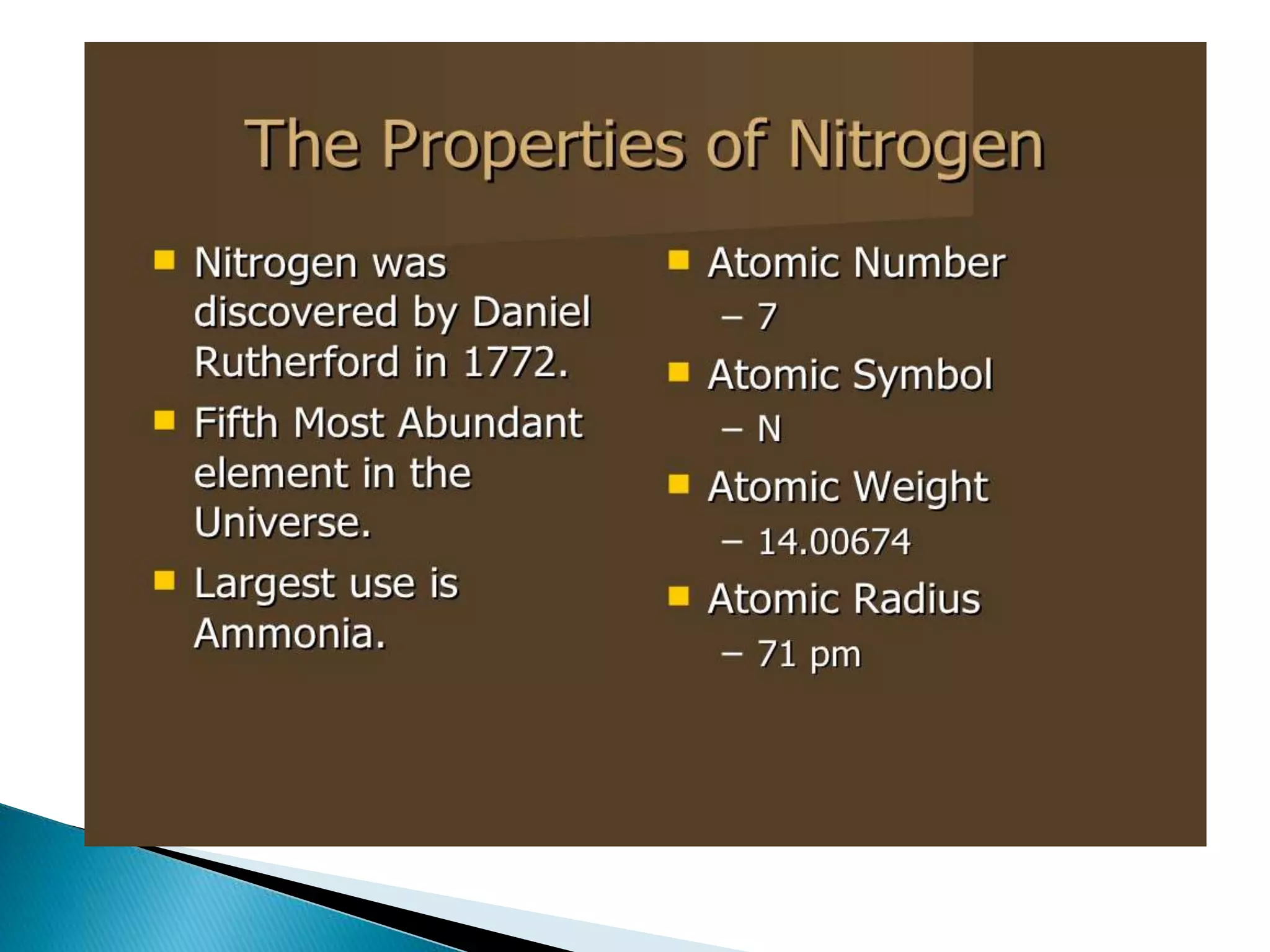
 This is the most important plant nutrient, at least in terms of
producing a reliable and large increase in growth.
 Most of the advances in agricultural production since the 1940s
have been won by vast increases in nitrogen application.
 More N => more growth, typically soft fast sappy growth, deep
green foliage. Our crops have been described as “nitrogen
green”, referring to their force-fed status and colour.
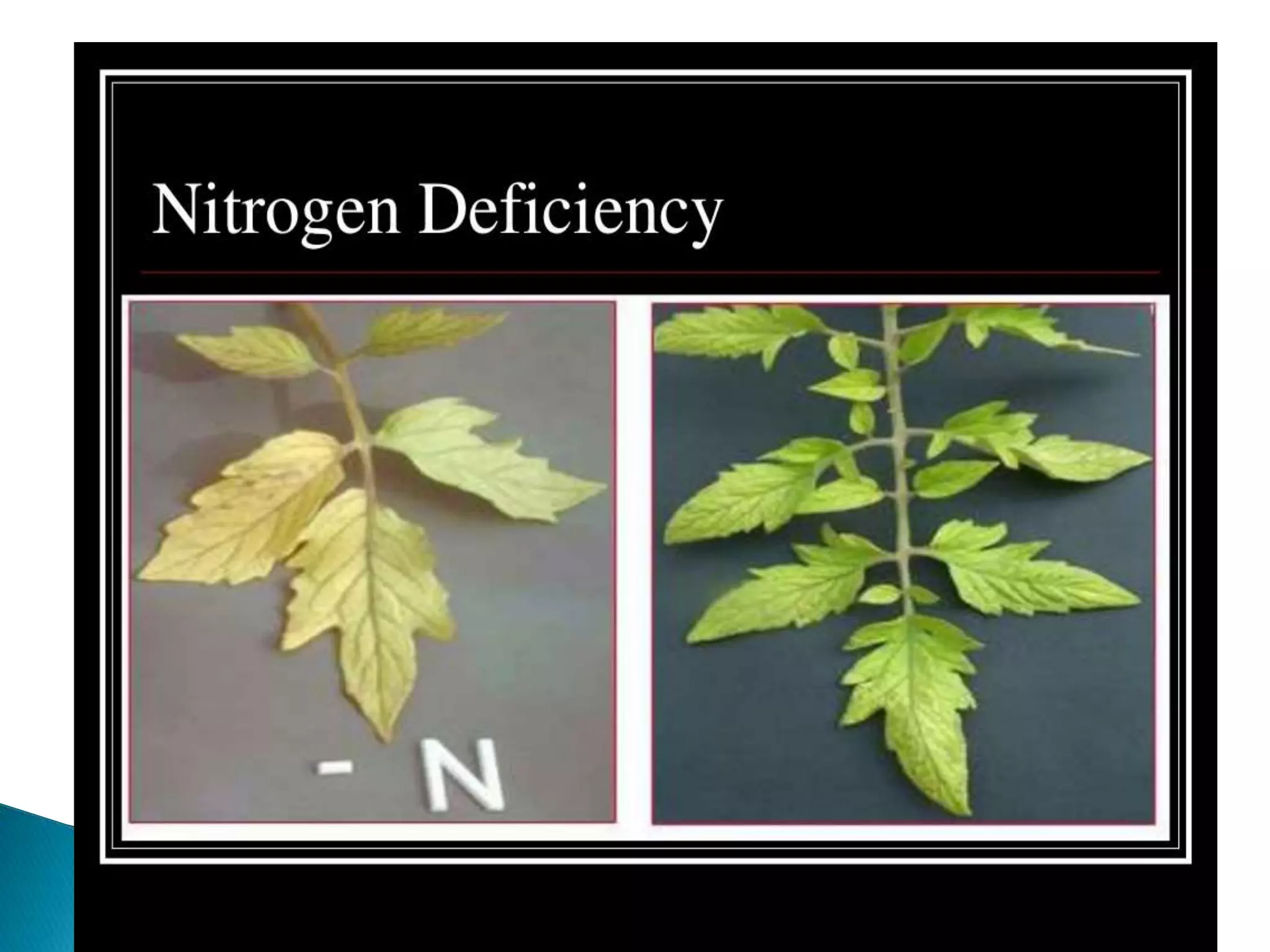
 Deficiency of N => stunting, yellowness and general poor
growth.
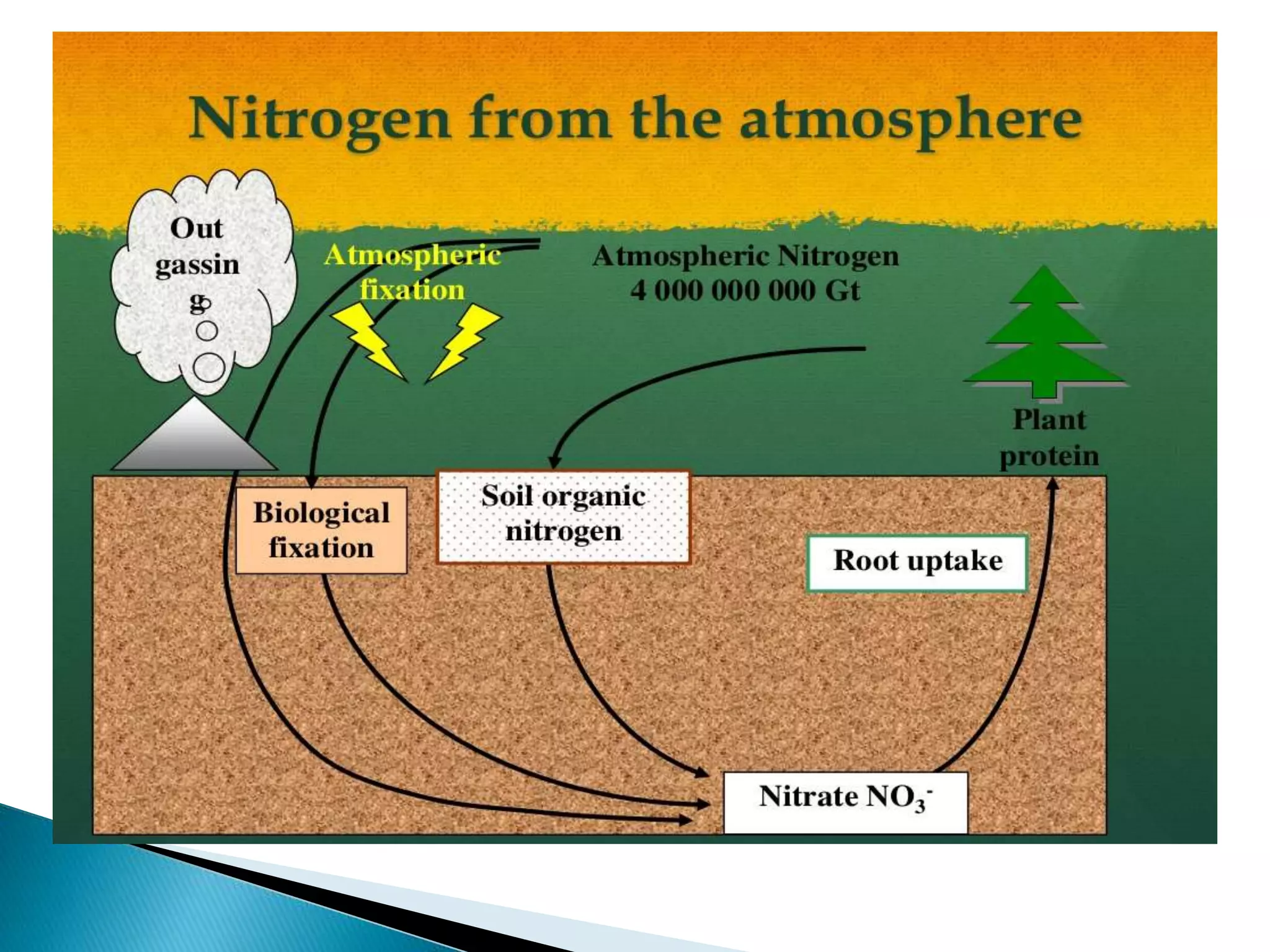
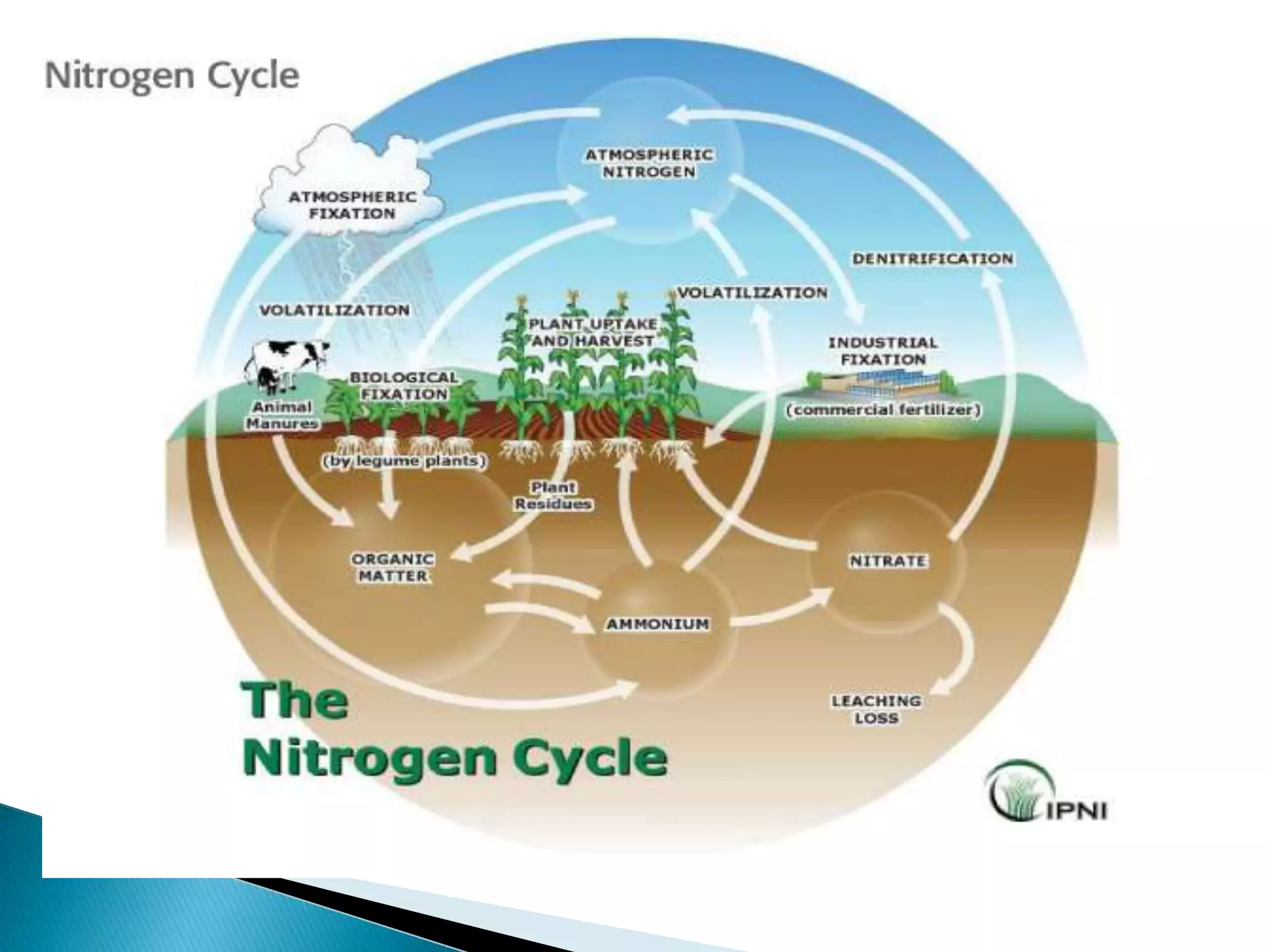
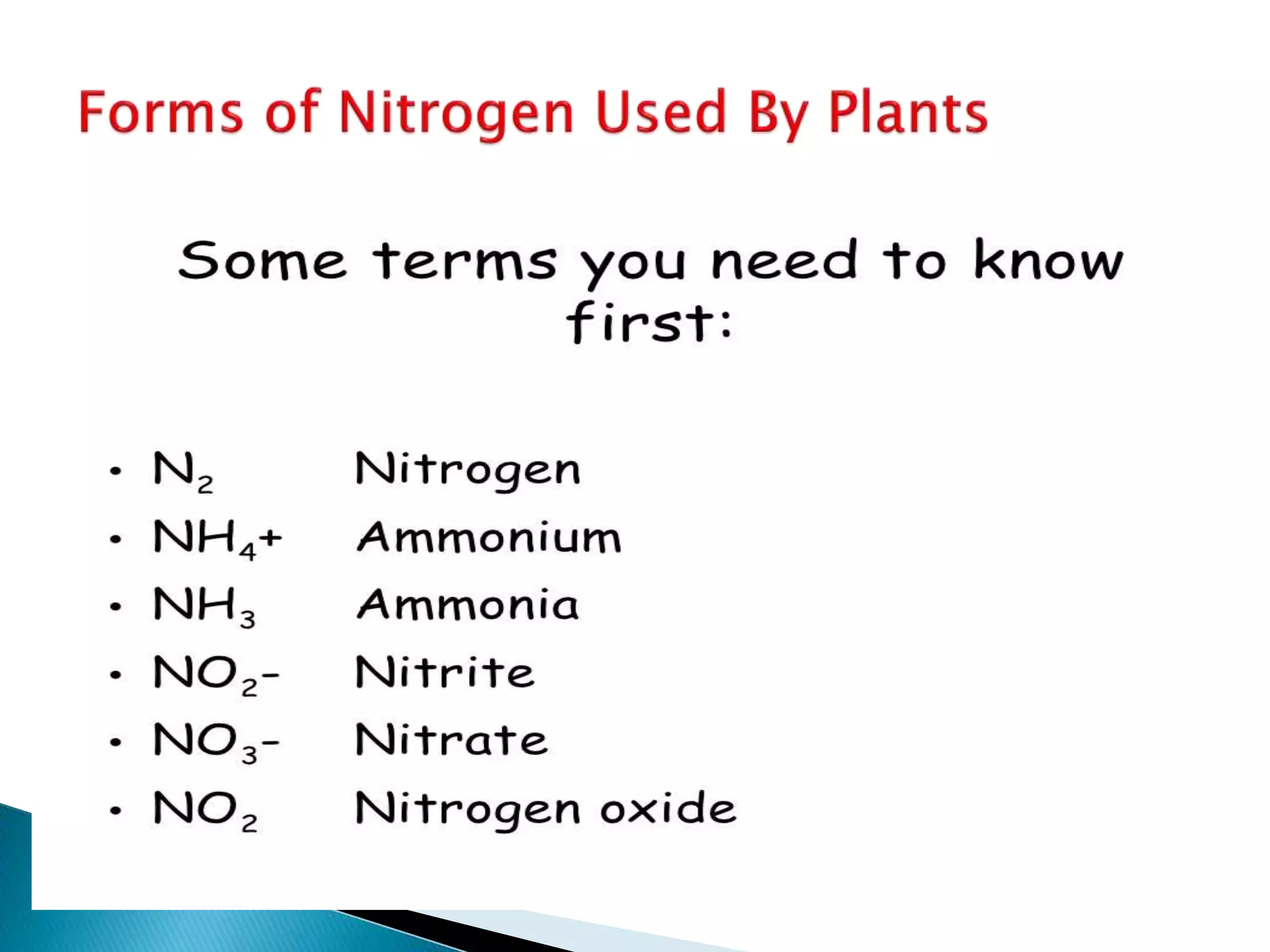
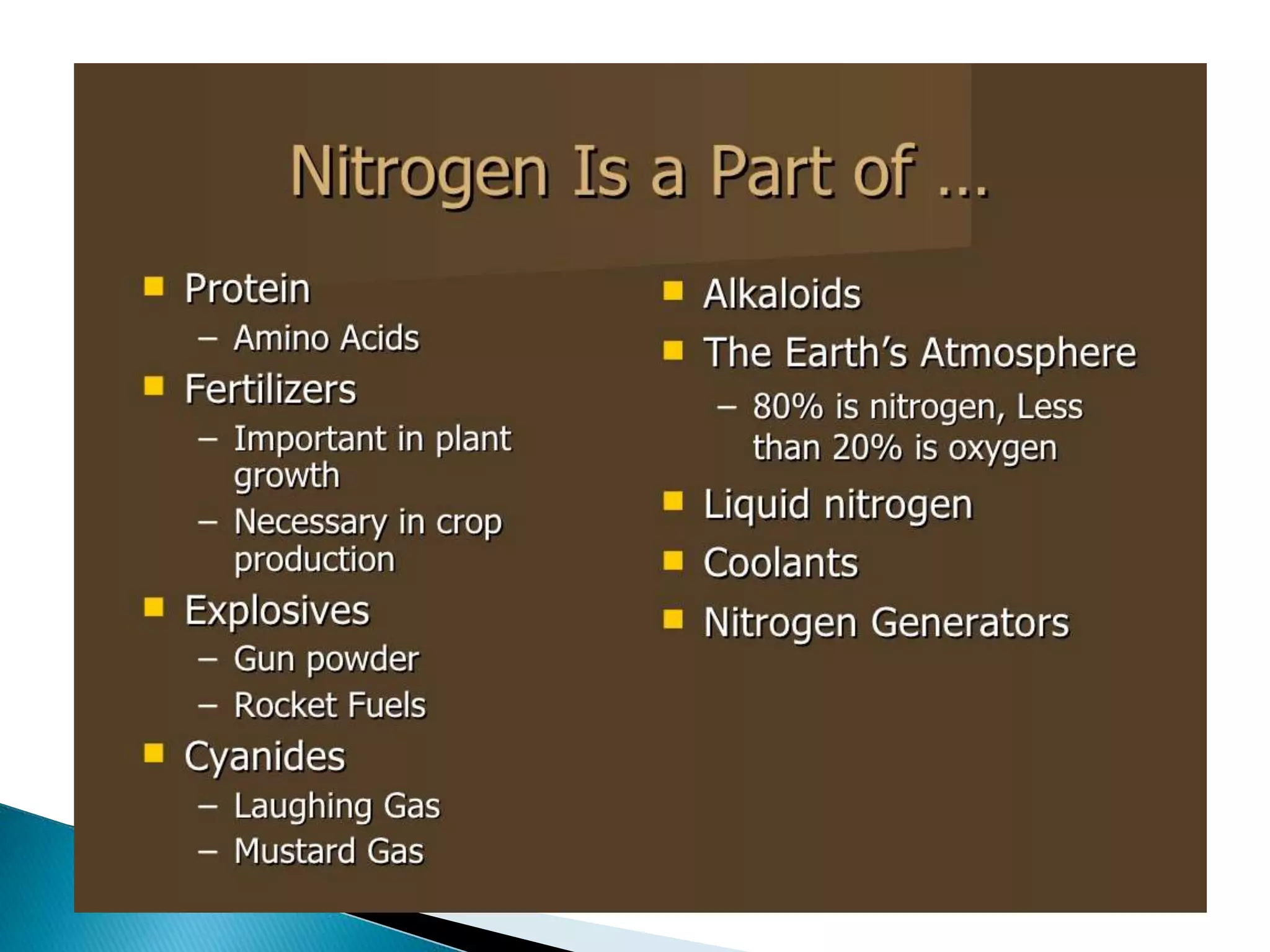
 It is everywhere, all the time, but in the
useless form of an inert gas N2
 It also comes in 2 useful forms: ammonia NH3
( ammonium NH4
+), and nitrate NO3
-.
 These take part in a well known cycle, that
you are strongly advised to learn:
Healthy plants often contain 3 to 4 percent nitrogen in their above-ground
tissues. This is a much higher concentration compared to other nutrients.
Nitrogen is so vital because it is a major component of chlorophyll, the compound by
which plants use sunlight energy to produce sugars from water and carbon dioxide
i.e., photosynthesis). nitrogen is a significant component of nucleic acids
such as DNA, the genetic material that allows cells (and eventually whole plants) to
grow and reproduce. Without nitrogen, there would be no life as we know it.
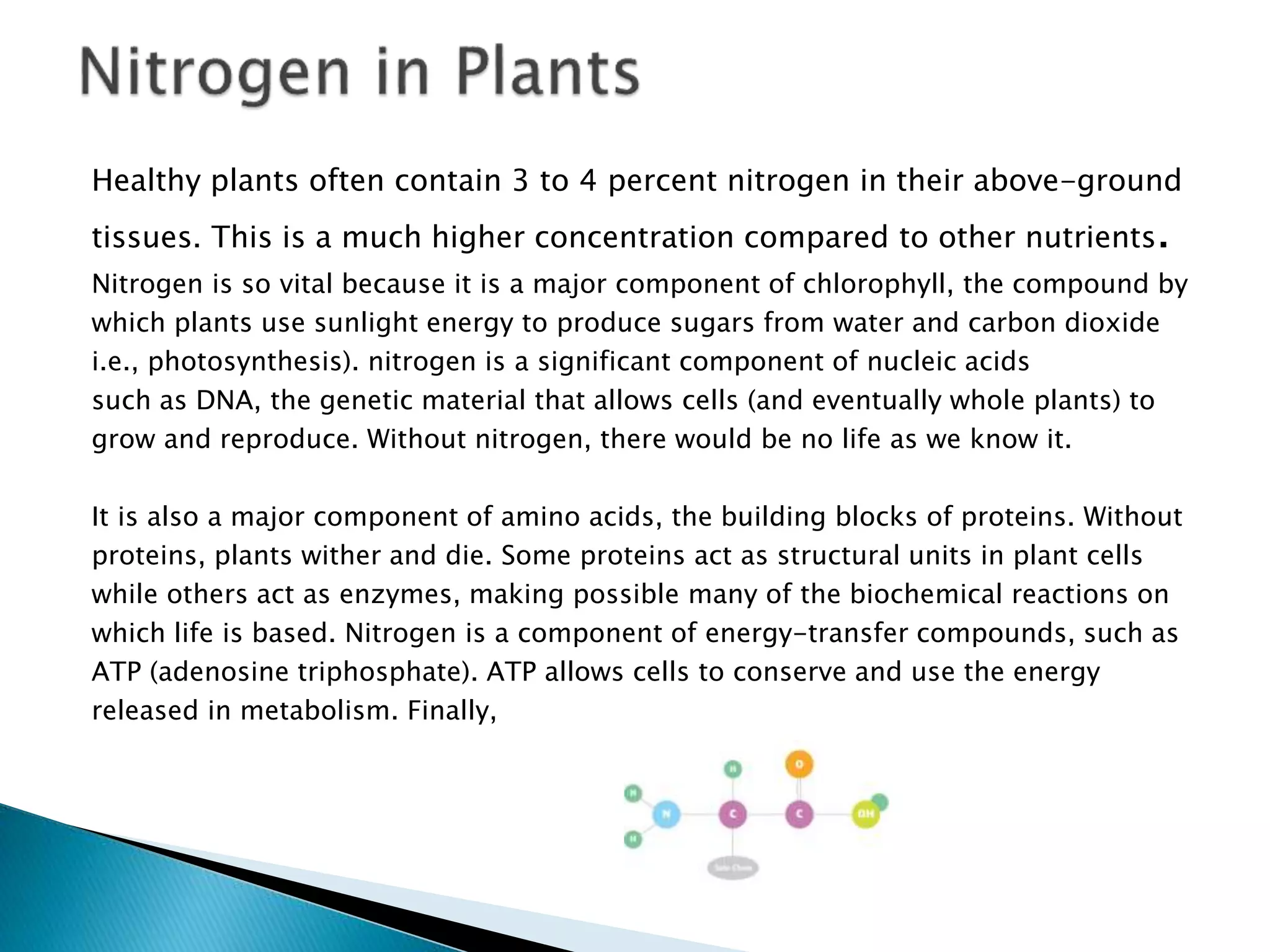
It is also a major component of amino acids, the building blocks of proteins. Without
proteins, plants wither and die. Some proteins act as structural units in plant cells
while others act as enzymes, making possible many of the biochemical reactions on
which life is based. Nitrogen is a component of energy-transfer compounds, such as
ATP (adenosine triphosphate). ATP allows cells to conserve and use the energy
released in metabolism. Finally,
 Soil nitrogen exists in three general forms:
organic nitrogen compounds, ammonium (NH4+)
ions and nitrate (NO3-) ions.
 At any given time, 95 to 99 percent of the
potentially available nitrogen in the soil is in
organic forms, either in plant and animal
residues, in the relatively stable soil organic
matter, or in living soil organisms, mainly
microbes such as bacteria. This nitrogen is not
directly available to plants, but some can be
converted to available forms by microorganisms.
A very small amount of organic nitrogen may
exist in soluble organic compounds, such as
urea, that may be slightly available to plants.
Atmospheric nitrogen is a major source of
nitrogen in soils. In the atmosphere, it exists
in the very inert N2 form and must be
converted before it becomes useful in the
soil. The quantity of nitrogen added to the
soil in this manner is directly related to
thunderstorm activity, but most areas
probably receive no more than 20 lb
nitrogen/acre per year from this source.
 Bacteria such as Rhizobia that infect (nodulate)
the roots of, and receive much food energy from,
legume plants can fix much more nitrogen per
year (some well over 100 lb nitrogen/acre). When
the quantity of nitrogen fixed by Rhizobia
exceeds that needed by the microbes themselves,
it is released for use by the host legume plant.
This is why well-nodulated legumes do not often
respond to additions of nitrogen fertilizer. They
are already receiving enough from the bacteria.
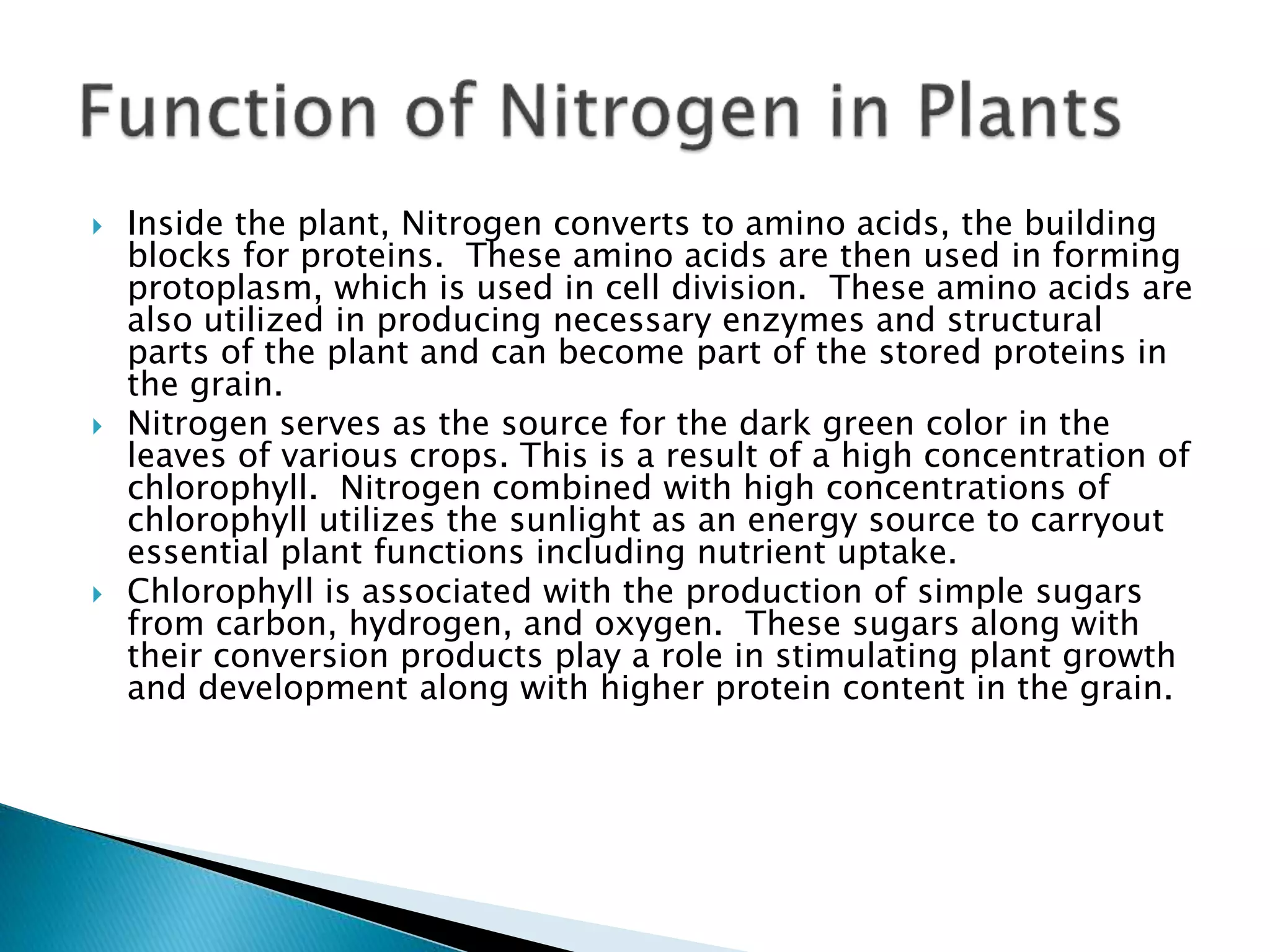
 Inside the plant, Nitrogen converts to amino acids, the building
blocks for proteins. These amino acids are then used in forming
protoplasm, which is used in cell division. These amino acids are
also utilized in producing necessary enzymes and structural
parts of the plant and can become part of the stored proteins in
the grain.
 Nitrogen serves as the source for the dark green color in the
leaves of various crops. This is a result of a high concentration of
chlorophyll. Nitrogen combined with high concentrations of
chlorophyll utilizes the sunlight as an energy source to carryout
essential plant functions including nutrient uptake.
 Chlorophyll is associated with the production of simple sugars
from carbon, hydrogen, and oxygen. These sugars along with
their conversion products play a role in stimulating plant growth
and development along with higher protein content in the grain.
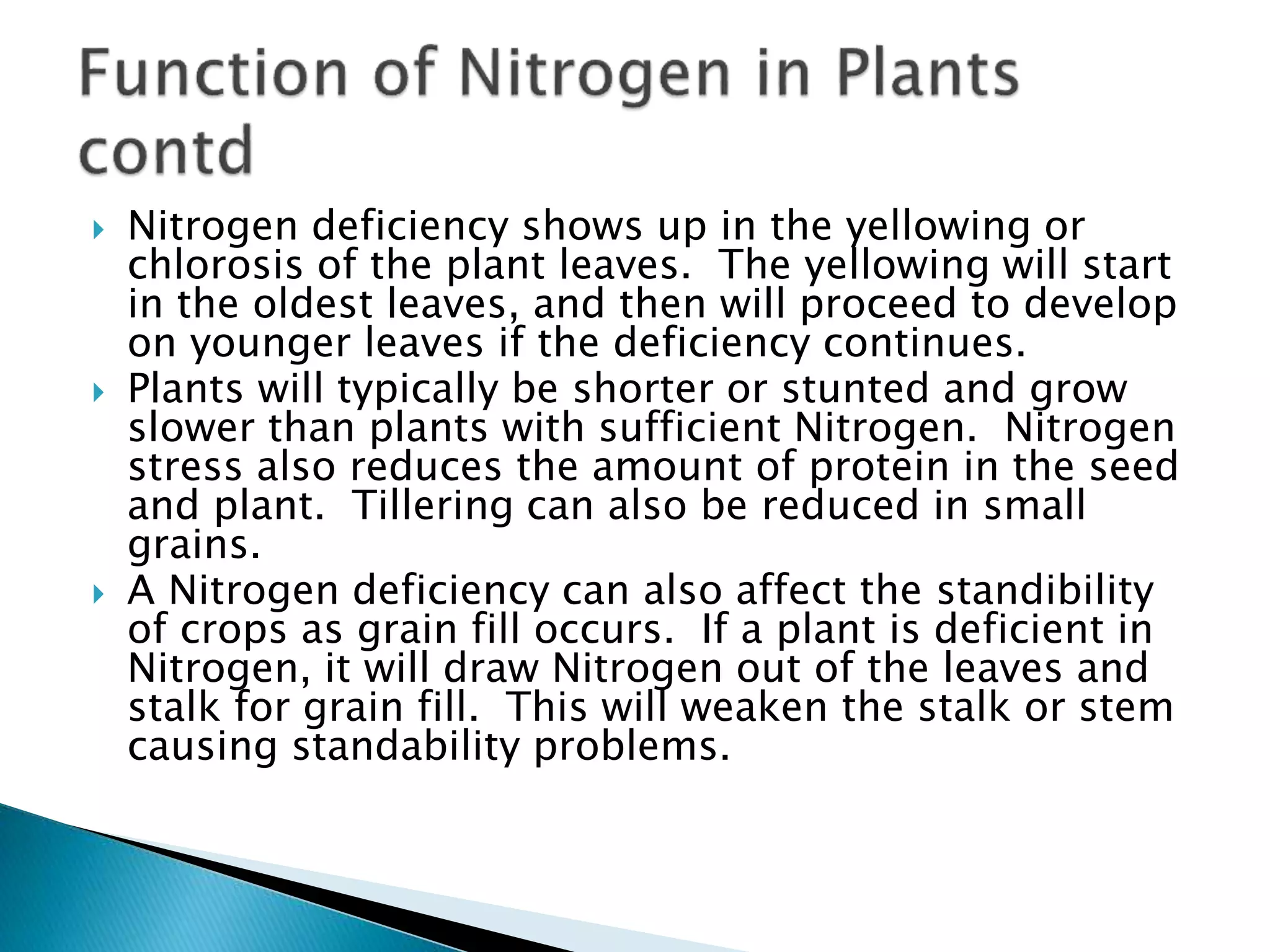
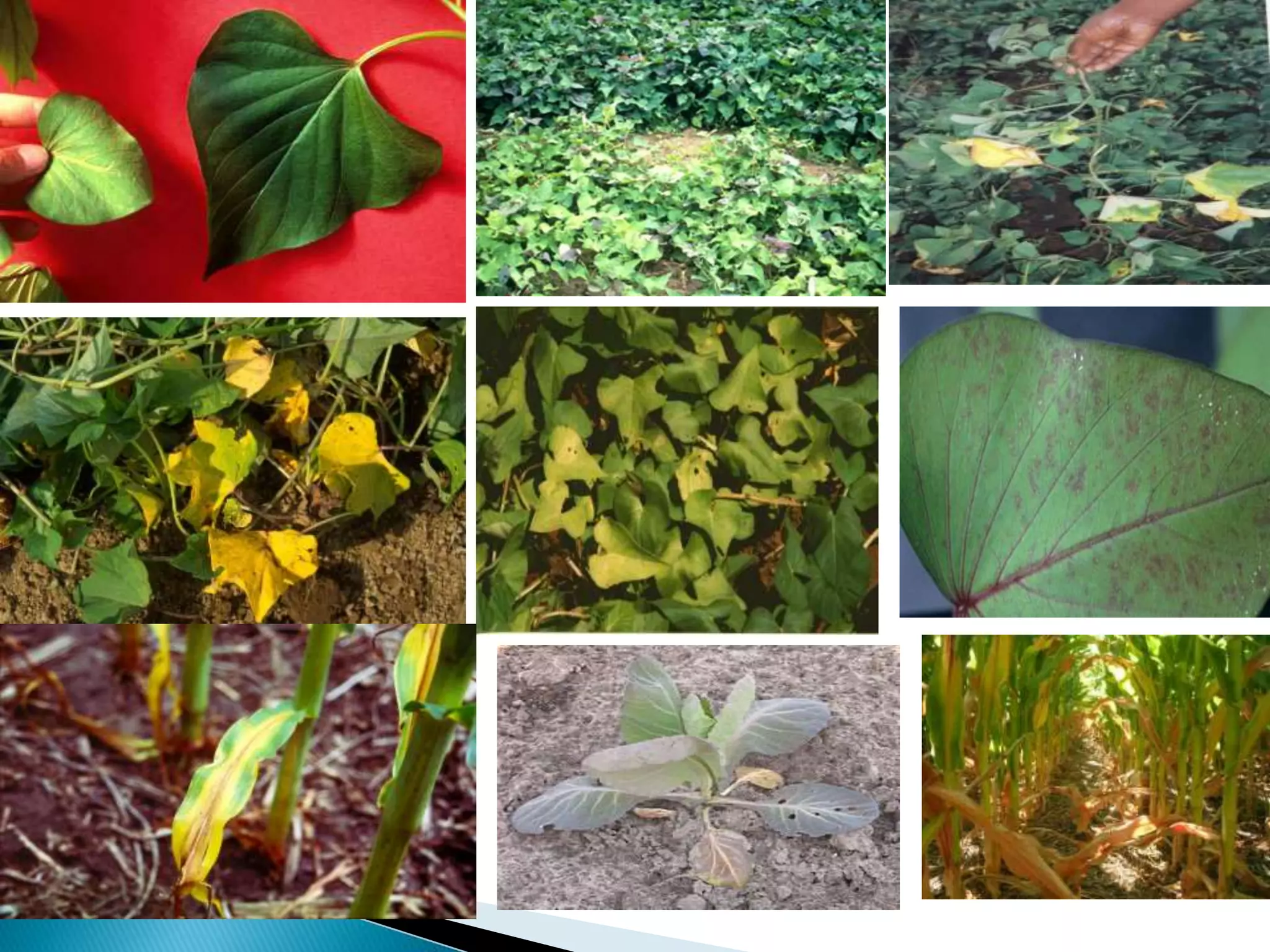
 Nitrogen deficiency shows up in the yellowing or
chlorosis of the plant leaves. The yellowing will start
in the oldest leaves, and then will proceed to develop
on younger leaves if the deficiency continues.
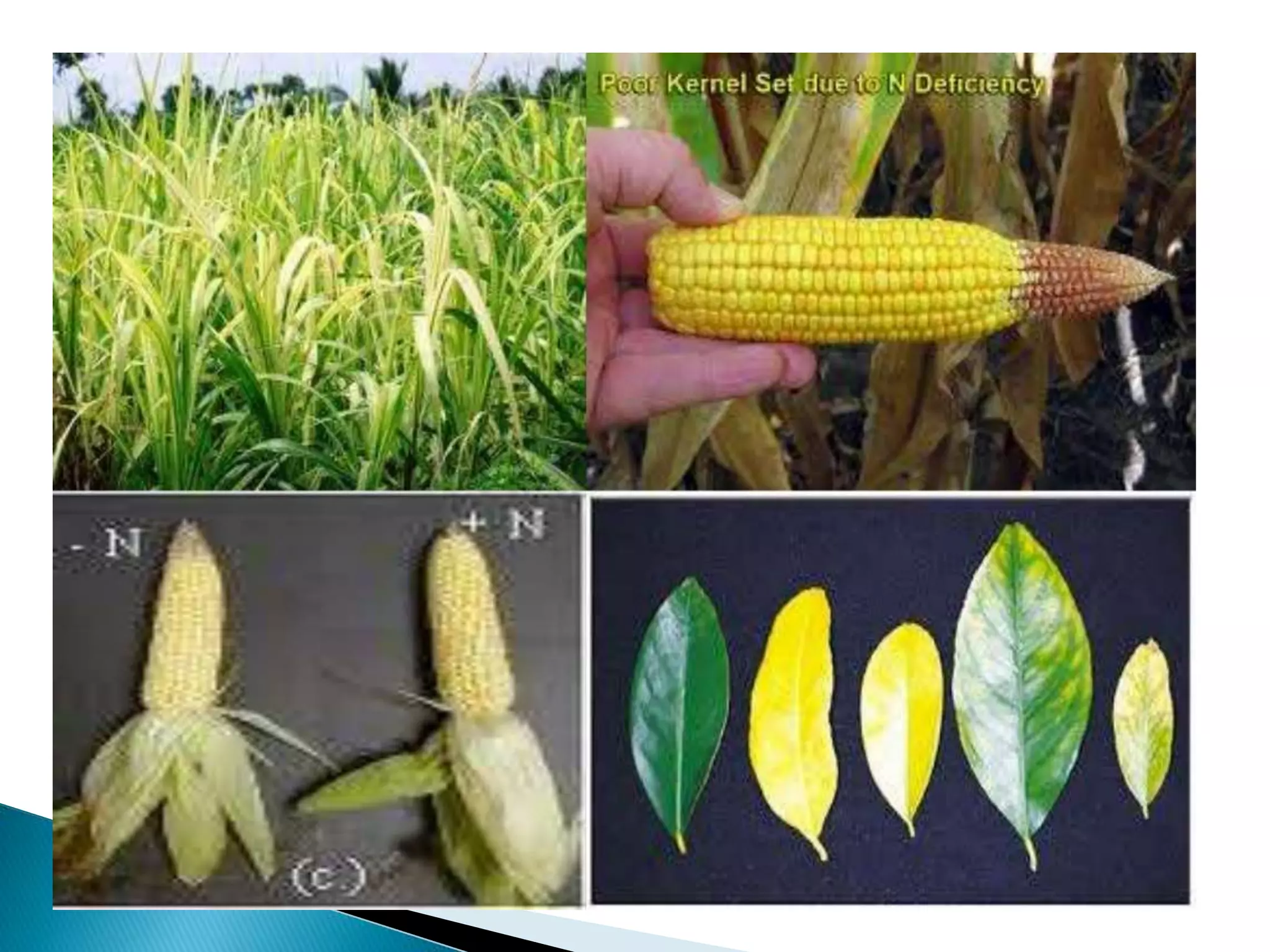
 Plants will typically be shorter or stunted and grow
slower than plants with sufficient Nitrogen. Nitrogen
stress also reduces the amount of protein in the seed
and plant. Tillering can also be reduced in small
grains.
 A Nitrogen deficiency can also affect the standibility
of crops as grain fill occurs. If a plant is deficient in
Nitrogen, it will draw Nitrogen out of the leaves and
stalk for grain fill. This will weaken the stalk or stem
causing standability problems.
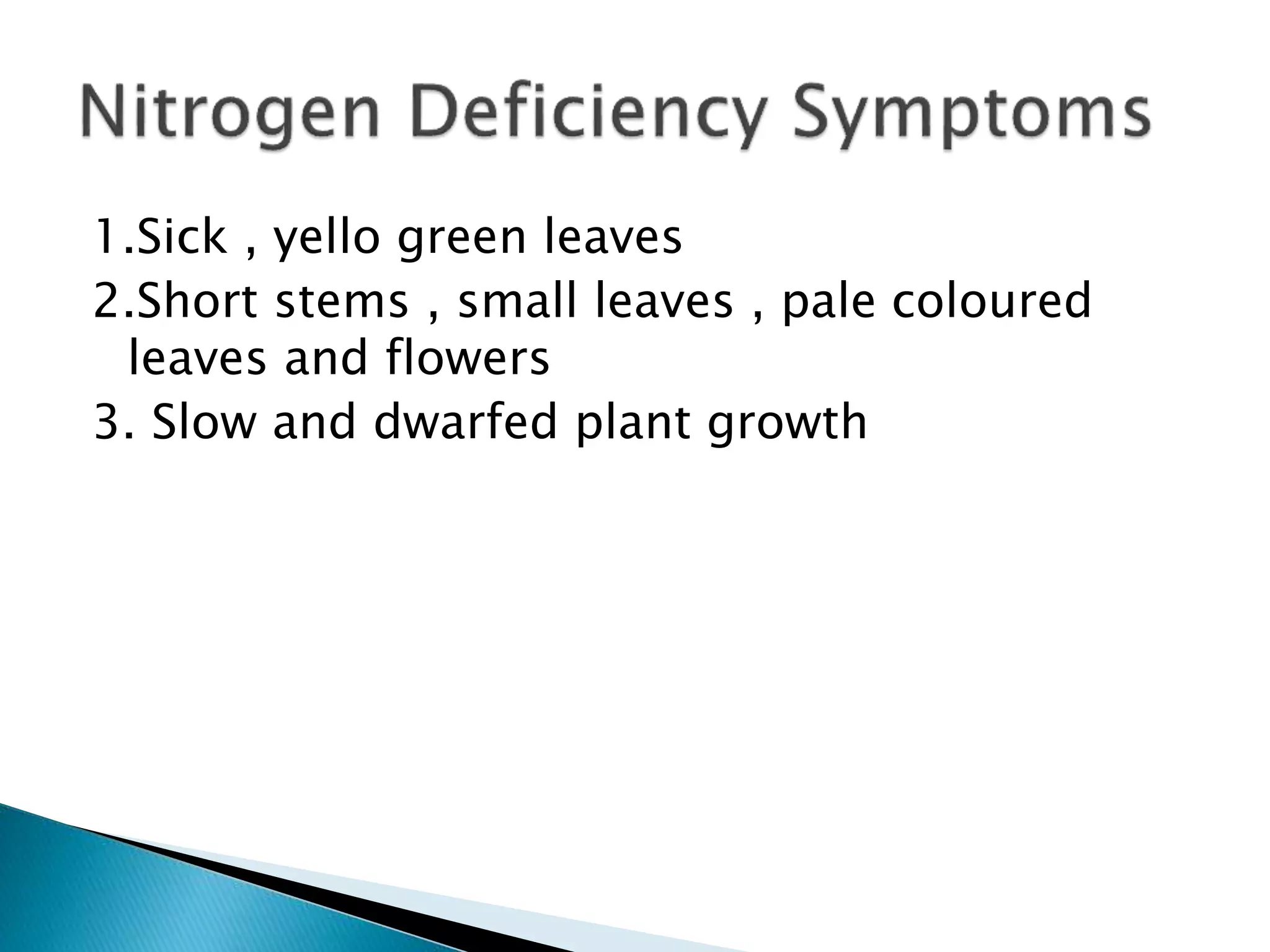
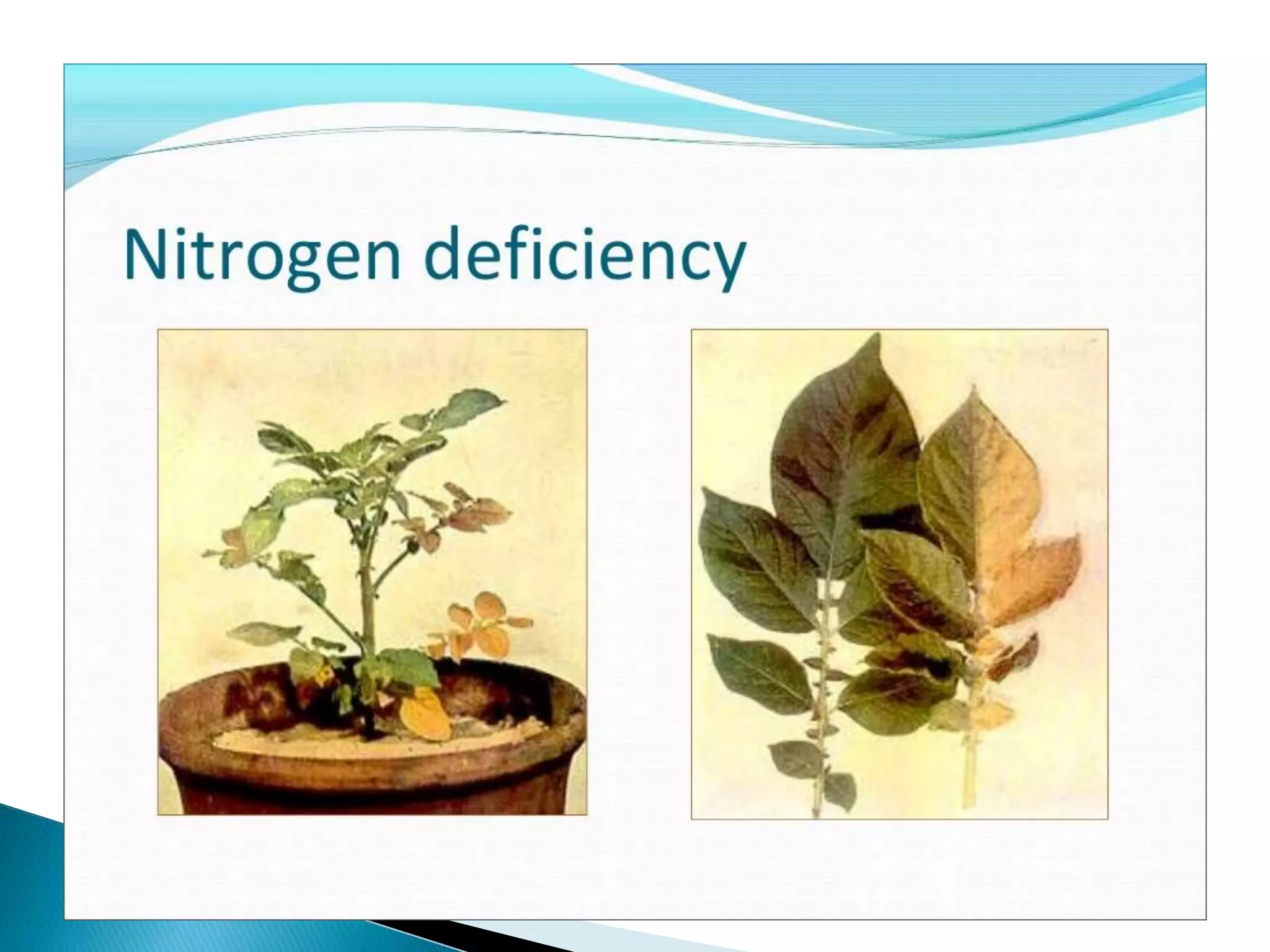
1.Sick , yello green leaves
2.Short stems , small leaves , pale coloured
leaves and flowers
3. Slow and dwarfed plant growth
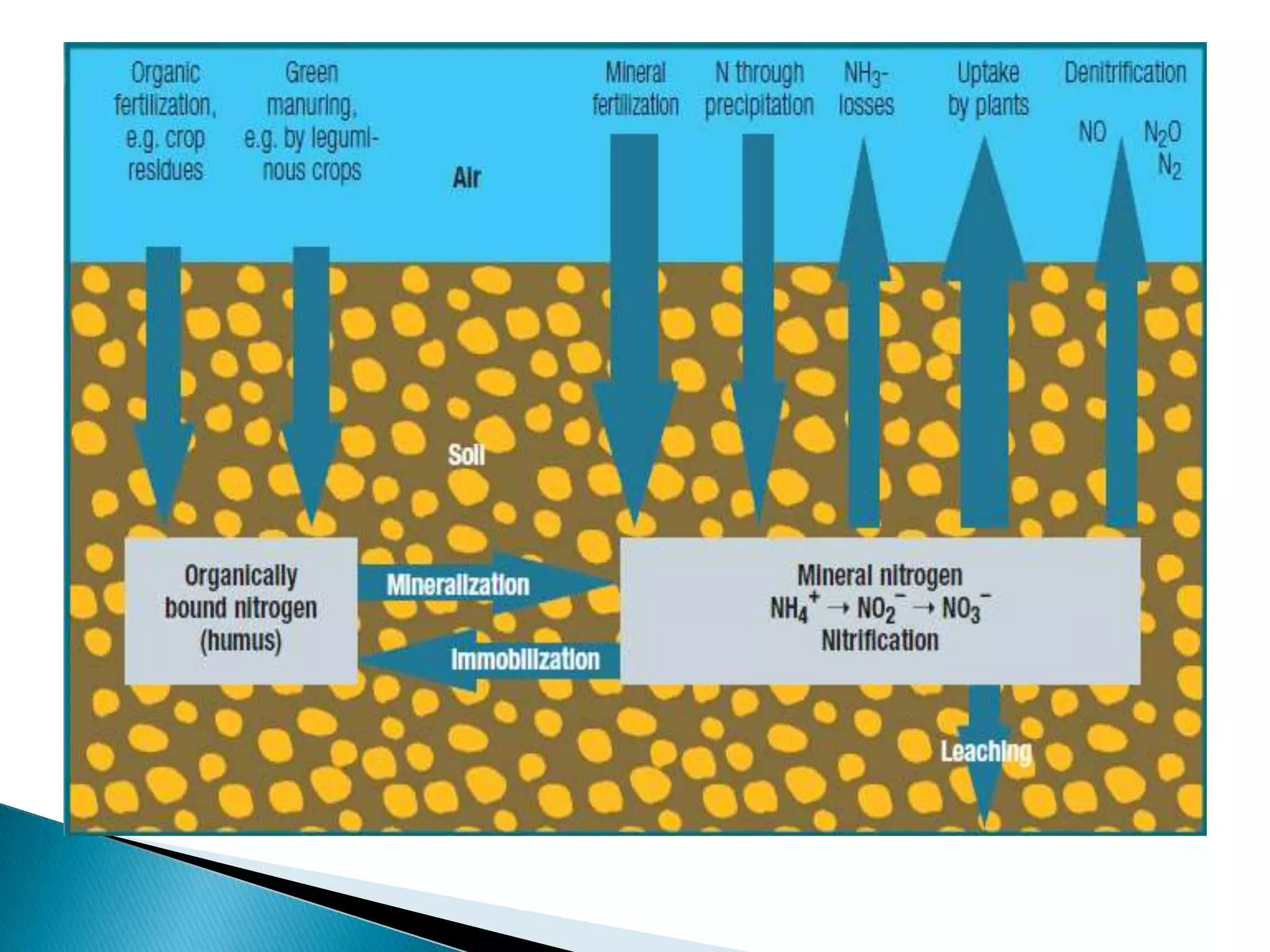
The heart of the nitrogen cycle is the
conversion of inorganic to organic nitrogen,
and vice versa. As microorganisms grow, they
remove H4+ and NO3- from the soil’s
inorganic, available nitrogen pool, converting
it to organic nitrogen in a process called
immobilization. When these organisms die
and are decomposed by others, excess NH4+
can be released back to the inorganic pool in
a process called mineralization
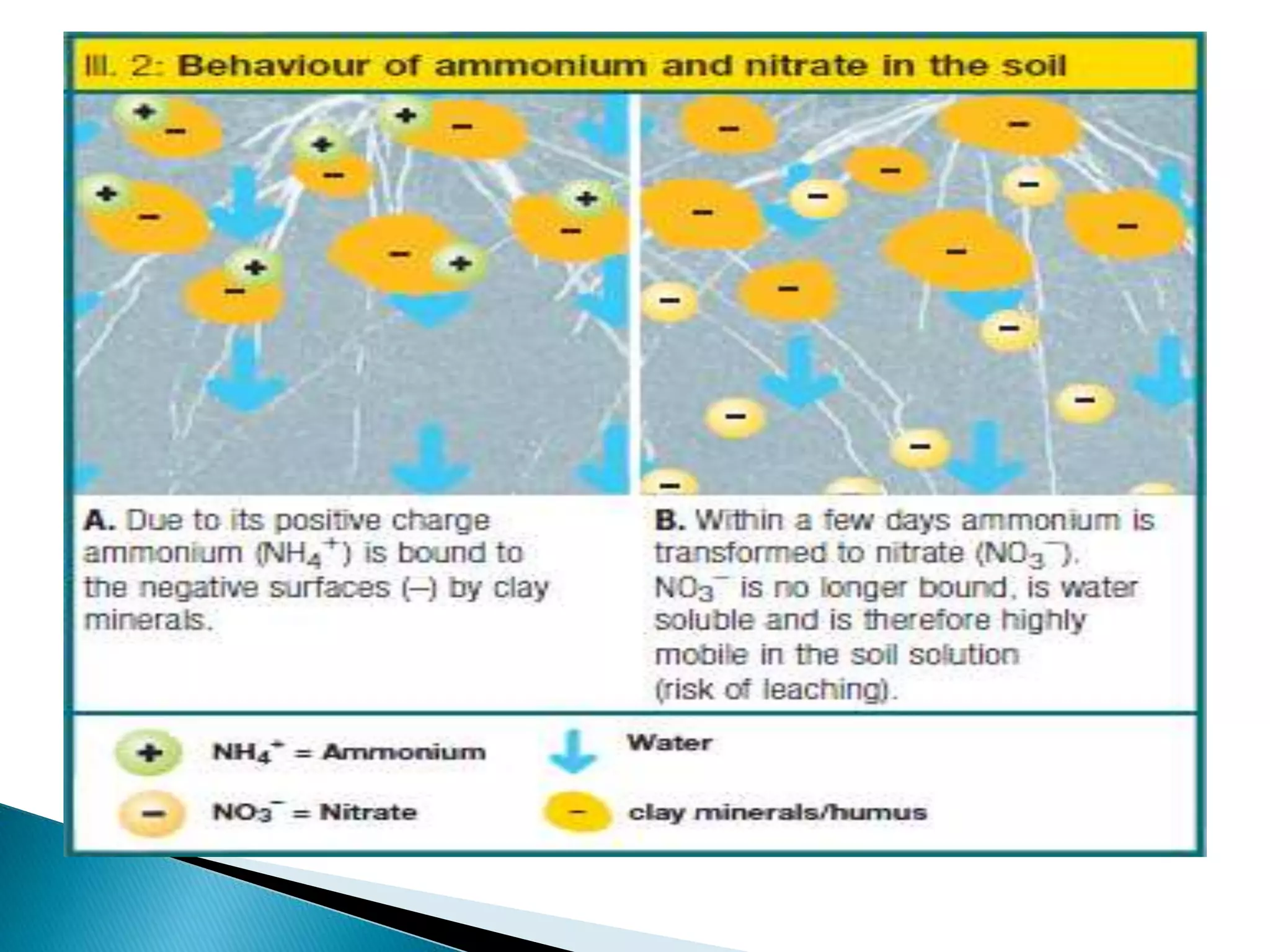
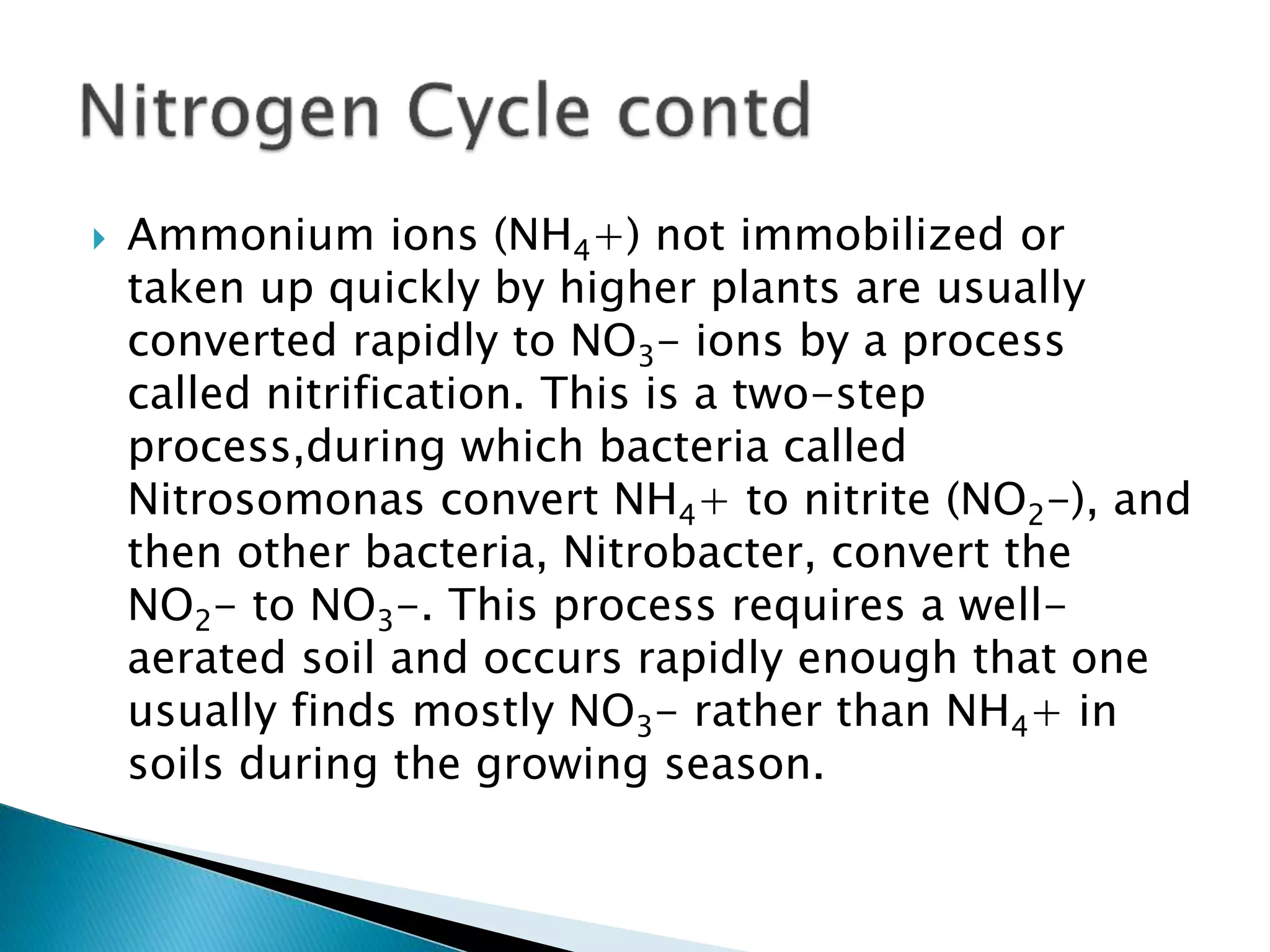
 Ammonium ions (NH4+) not immobilized or
taken up quickly by higher plants are usually
converted rapidly to NO3- ions by a process
called nitrification. This is a two-step
process,during which bacteria called
Nitrosomonas convert NH4+ to nitrite (NO2-), and
then other bacteria, Nitrobacter, convert the
NO2- to NO3-. This process requires a well-
aerated soil and occurs rapidly enough that one
usually finds mostly NO3- rather than NH4+ in
soils during the growing season.
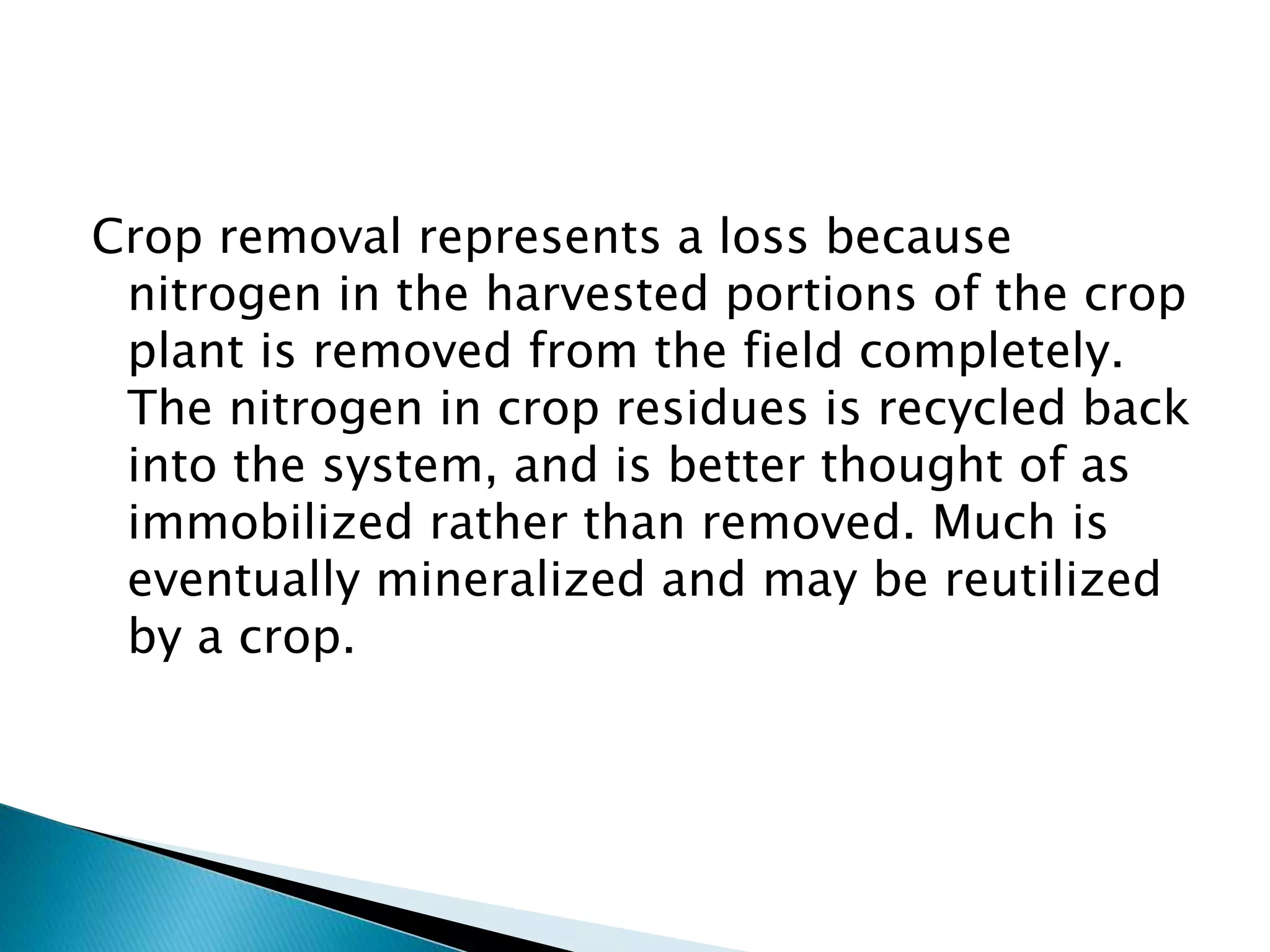
Crop removal represents a loss because
nitrogen in the harvested portions of the crop
plant is removed from the field completely.
The nitrogen in crop residues is recycled back
into the system, and is better thought of as
immobilized rather than removed. Much is
eventually mineralized and may be reutilized
by a crop.
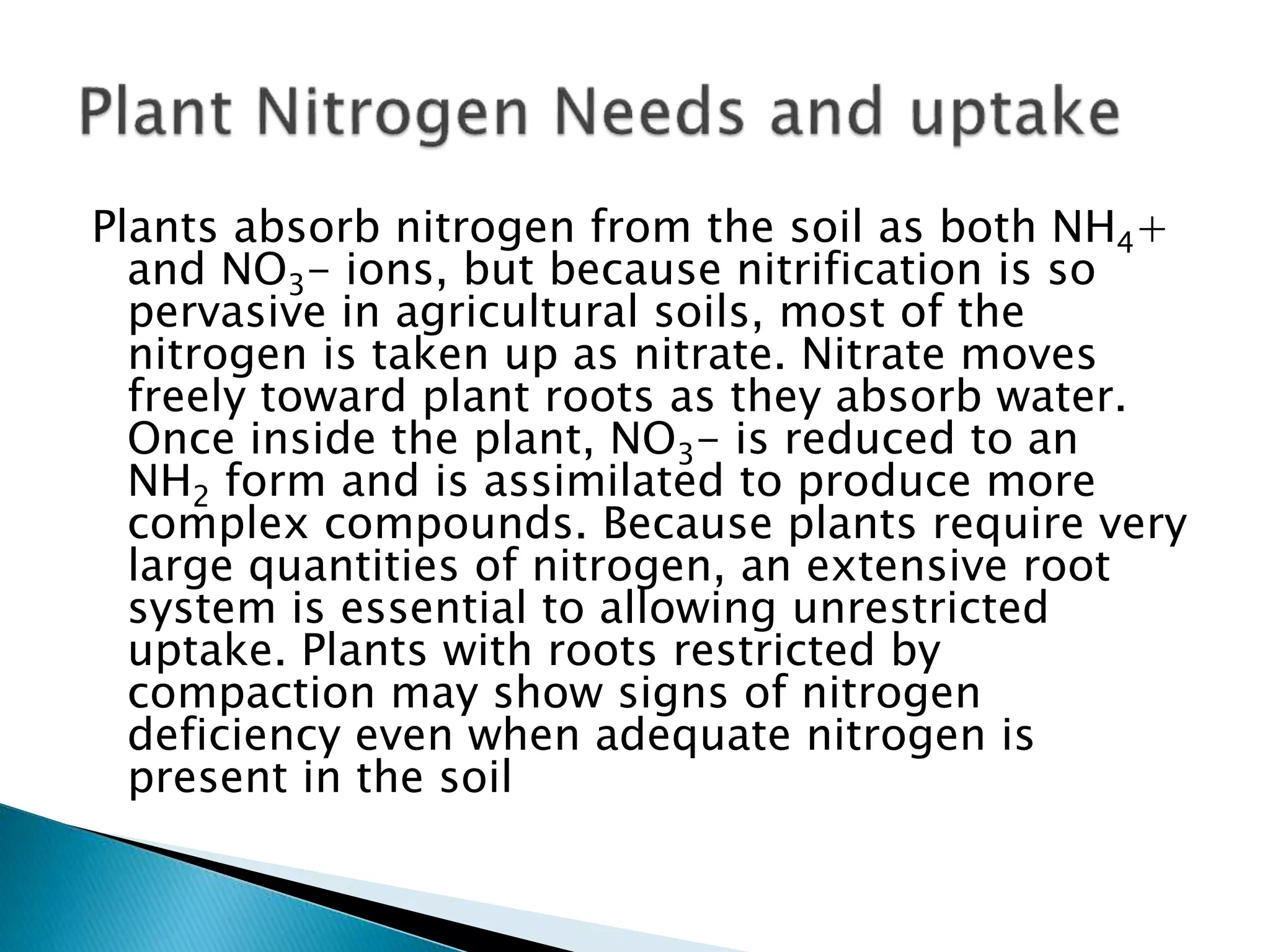
Plants absorb nitrogen from the soil as both NH4+
and NO3- ions, but because nitrification is so
pervasive in agricultural soils, most of the
nitrogen is taken up as nitrate. Nitrate moves
freely toward plant roots as they absorb water.
Once inside the plant, NO3- is reduced to an
NH2 form and is assimilated to produce more
complex compounds. Because plants require very
large quantities of nitrogen, an extensive root
system is essential to allowing unrestricted
uptake. Plants with roots restricted by
compaction may show signs of nitrogen
deficiency even when adequate nitrogen is
present in the soil
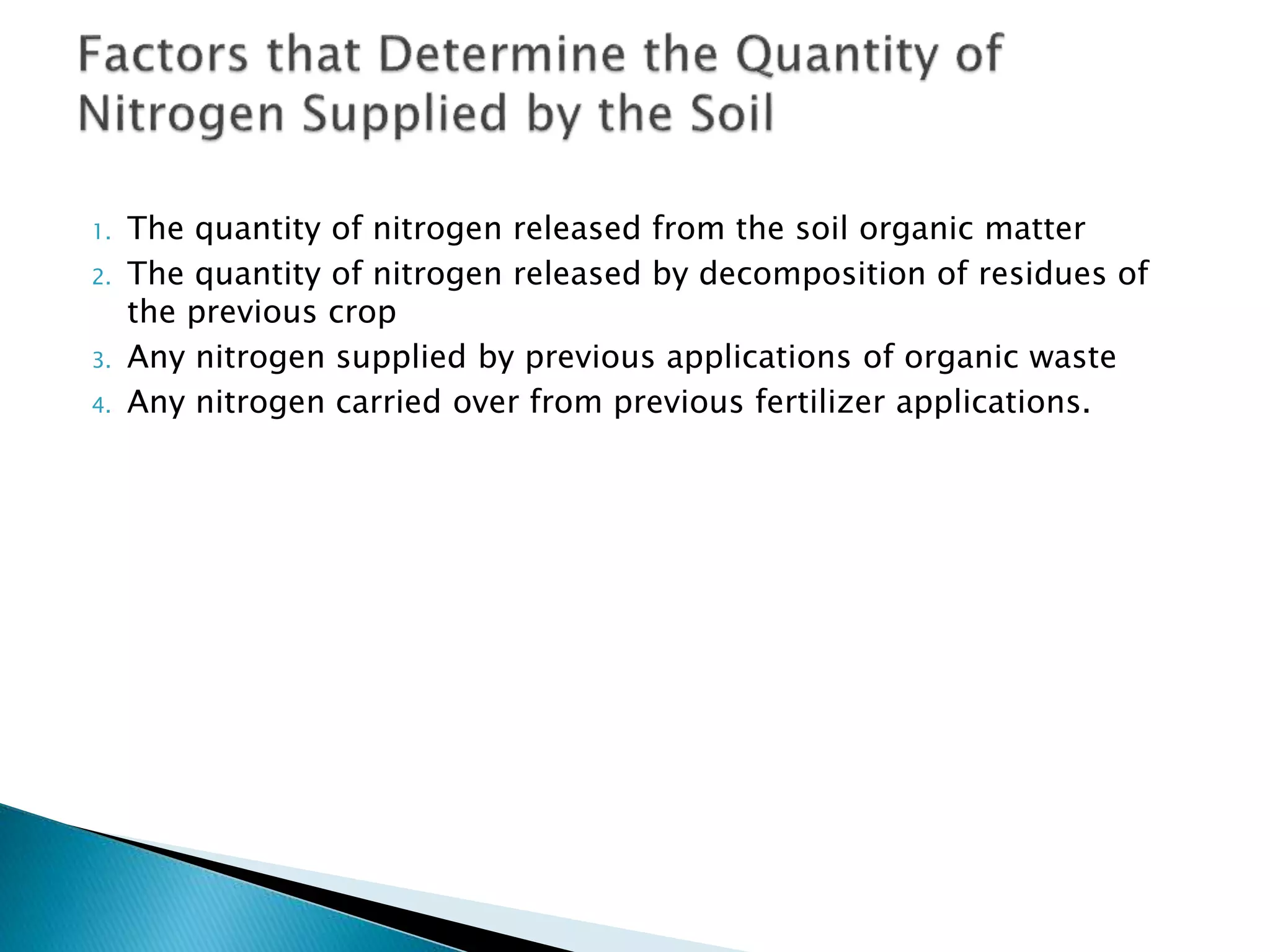
1. The quantity of nitrogen released from the soil organic matter
2. The quantity of nitrogen released by decomposition of residues of
the previous crop
3. Any nitrogen supplied by previous applications of organic waste
4. Any nitrogen carried over from previous fertilizer applications.
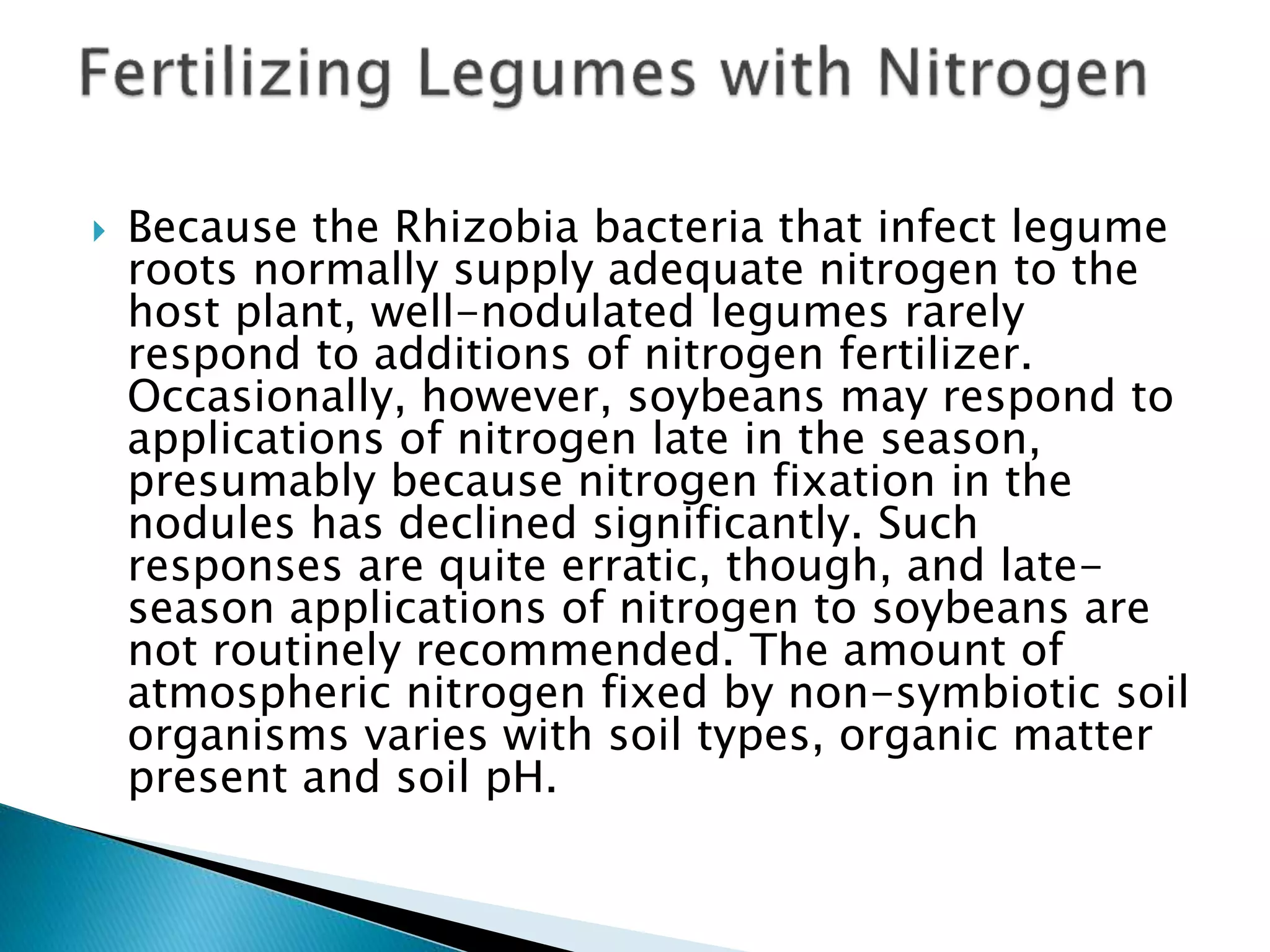
 Because the Rhizobia bacteria that infect legume
roots normally supply adequate nitrogen to the
host plant, well-nodulated legumes rarely
respond to additions of nitrogen fertilizer.
Occasionally, however, soybeans may respond to
applications of nitrogen late in the season,
presumably because nitrogen fixation in the
nodules has declined significantly. Such
responses are quite erratic, though, and late-
season applications of nitrogen to soybeans are
not routinely recommended. The amount of
atmospheric nitrogen fixed by non-symbiotic soil
organisms varies with soil types, organic matter
present and soil pH.
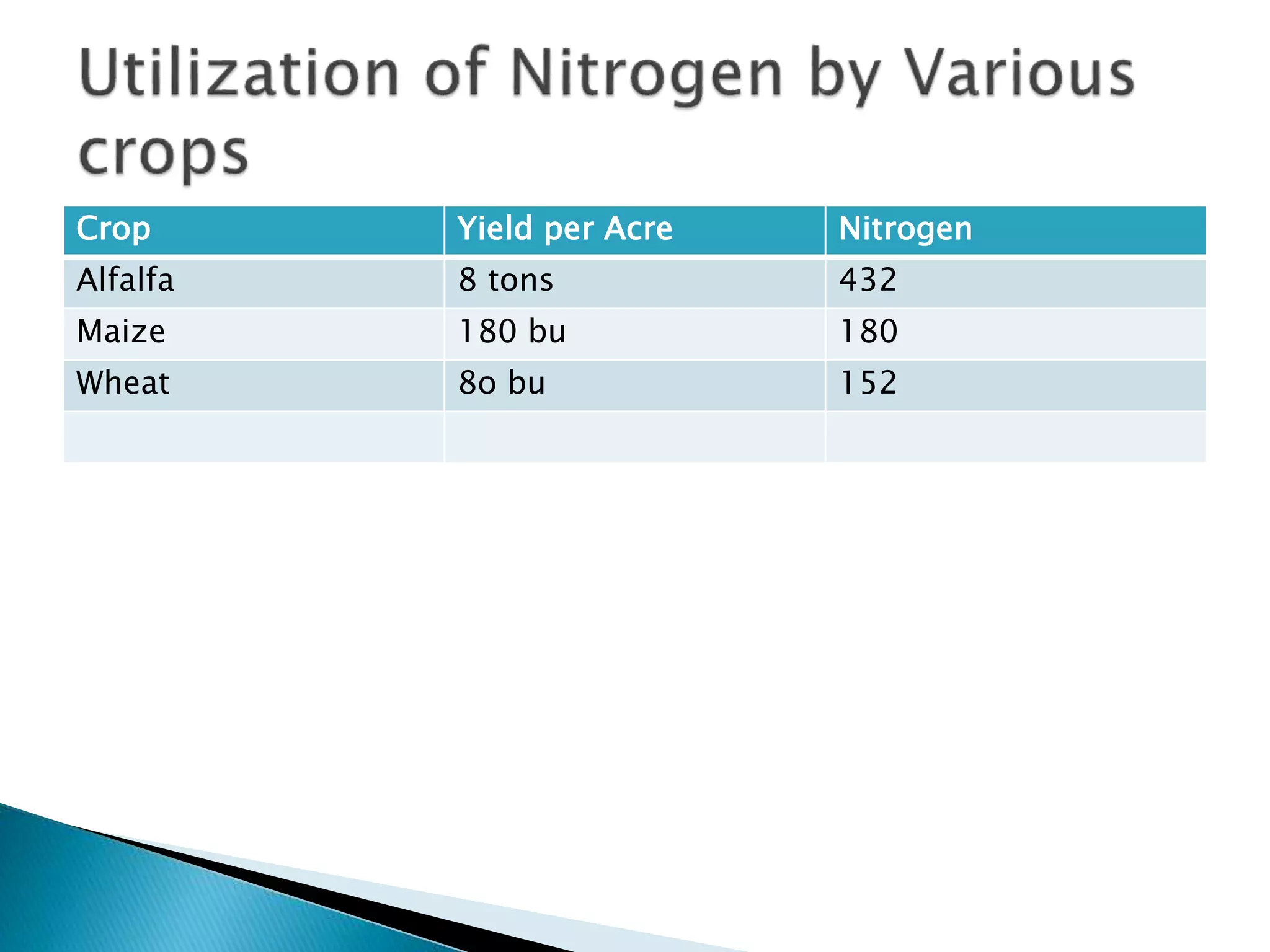
Crop Yield per Acre Nitrogen
Alfalfa 8 tons 432
Maize 180 bu 180
Wheat 8o bu 152
Nitrogen and its role  in Plant Nutrition Lecture  by Allah Dad Khan

Nitrogen and its role in Plant Nutrition Lecture by Allah Dad Khan

  • 2.
    NITROGEN AND ITS ROLEIN PLANT NUTRITION A LECTURE BY ALLAH DAD KHAN
  • 3.
     This isthe most important plant nutrient, at least in terms of producing a reliable and large increase in growth.  Most of the advances in agricultural production since the 1940s have been won by vast increases in nitrogen application.  More N => more growth, typically soft fast sappy growth, deep green foliage. Our crops have been described as “nitrogen green”, referring to their force-fed status and colour.  Deficiency of N => stunting, yellowness and general poor growth.
  • 4.
     It iseverywhere, all the time, but in the useless form of an inert gas N2  It also comes in 2 useful forms: ammonia NH3 ( ammonium NH4 +), and nitrate NO3 -.  These take part in a well known cycle, that you are strongly advised to learn:
  • 5.
    Healthy plants oftencontain 3 to 4 percent nitrogen in their above-ground tissues. This is a much higher concentration compared to other nutrients. Nitrogen is so vital because it is a major component of chlorophyll, the compound by which plants use sunlight energy to produce sugars from water and carbon dioxide i.e., photosynthesis). nitrogen is a significant component of nucleic acids such as DNA, the genetic material that allows cells (and eventually whole plants) to grow and reproduce. Without nitrogen, there would be no life as we know it. It is also a major component of amino acids, the building blocks of proteins. Without proteins, plants wither and die. Some proteins act as structural units in plant cells while others act as enzymes, making possible many of the biochemical reactions on which life is based. Nitrogen is a component of energy-transfer compounds, such as ATP (adenosine triphosphate). ATP allows cells to conserve and use the energy released in metabolism. Finally,
  • 6.
     Soil nitrogenexists in three general forms: organic nitrogen compounds, ammonium (NH4+) ions and nitrate (NO3-) ions.  At any given time, 95 to 99 percent of the potentially available nitrogen in the soil is in organic forms, either in plant and animal residues, in the relatively stable soil organic matter, or in living soil organisms, mainly microbes such as bacteria. This nitrogen is not directly available to plants, but some can be converted to available forms by microorganisms. A very small amount of organic nitrogen may exist in soluble organic compounds, such as urea, that may be slightly available to plants.
  • 7.
    Atmospheric nitrogen isa major source of nitrogen in soils. In the atmosphere, it exists in the very inert N2 form and must be converted before it becomes useful in the soil. The quantity of nitrogen added to the soil in this manner is directly related to thunderstorm activity, but most areas probably receive no more than 20 lb nitrogen/acre per year from this source.
  • 8.
     Bacteria suchas Rhizobia that infect (nodulate) the roots of, and receive much food energy from, legume plants can fix much more nitrogen per year (some well over 100 lb nitrogen/acre). When the quantity of nitrogen fixed by Rhizobia exceeds that needed by the microbes themselves, it is released for use by the host legume plant. This is why well-nodulated legumes do not often respond to additions of nitrogen fertilizer. They are already receiving enough from the bacteria.
  • 14.
     Inside theplant, Nitrogen converts to amino acids, the building blocks for proteins. These amino acids are then used in forming protoplasm, which is used in cell division. These amino acids are also utilized in producing necessary enzymes and structural parts of the plant and can become part of the stored proteins in the grain.  Nitrogen serves as the source for the dark green color in the leaves of various crops. This is a result of a high concentration of chlorophyll. Nitrogen combined with high concentrations of chlorophyll utilizes the sunlight as an energy source to carryout essential plant functions including nutrient uptake.  Chlorophyll is associated with the production of simple sugars from carbon, hydrogen, and oxygen. These sugars along with their conversion products play a role in stimulating plant growth and development along with higher protein content in the grain.
  • 15.
     Nitrogen deficiencyshows up in the yellowing or chlorosis of the plant leaves. The yellowing will start in the oldest leaves, and then will proceed to develop on younger leaves if the deficiency continues.  Plants will typically be shorter or stunted and grow slower than plants with sufficient Nitrogen. Nitrogen stress also reduces the amount of protein in the seed and plant. Tillering can also be reduced in small grains.  A Nitrogen deficiency can also affect the standibility of crops as grain fill occurs. If a plant is deficient in Nitrogen, it will draw Nitrogen out of the leaves and stalk for grain fill. This will weaken the stalk or stem causing standability problems.
  • 16.
    1.Sick , yellogreen leaves 2.Short stems , small leaves , pale coloured leaves and flowers 3. Slow and dwarfed plant growth
  • 21.
    The heart ofthe nitrogen cycle is the conversion of inorganic to organic nitrogen, and vice versa. As microorganisms grow, they remove H4+ and NO3- from the soil’s inorganic, available nitrogen pool, converting it to organic nitrogen in a process called immobilization. When these organisms die and are decomposed by others, excess NH4+ can be released back to the inorganic pool in a process called mineralization
  • 22.
     Ammonium ions(NH4+) not immobilized or taken up quickly by higher plants are usually converted rapidly to NO3- ions by a process called nitrification. This is a two-step process,during which bacteria called Nitrosomonas convert NH4+ to nitrite (NO2-), and then other bacteria, Nitrobacter, convert the NO2- to NO3-. This process requires a well- aerated soil and occurs rapidly enough that one usually finds mostly NO3- rather than NH4+ in soils during the growing season.
  • 23.
    Crop removal representsa loss because nitrogen in the harvested portions of the crop plant is removed from the field completely. The nitrogen in crop residues is recycled back into the system, and is better thought of as immobilized rather than removed. Much is eventually mineralized and may be reutilized by a crop.
  • 25.
    Plants absorb nitrogenfrom the soil as both NH4+ and NO3- ions, but because nitrification is so pervasive in agricultural soils, most of the nitrogen is taken up as nitrate. Nitrate moves freely toward plant roots as they absorb water. Once inside the plant, NO3- is reduced to an NH2 form and is assimilated to produce more complex compounds. Because plants require very large quantities of nitrogen, an extensive root system is essential to allowing unrestricted uptake. Plants with roots restricted by compaction may show signs of nitrogen deficiency even when adequate nitrogen is present in the soil
  • 26.
    1. The quantityof nitrogen released from the soil organic matter 2. The quantity of nitrogen released by decomposition of residues of the previous crop 3. Any nitrogen supplied by previous applications of organic waste 4. Any nitrogen carried over from previous fertilizer applications.
  • 27.
     Because theRhizobia bacteria that infect legume roots normally supply adequate nitrogen to the host plant, well-nodulated legumes rarely respond to additions of nitrogen fertilizer. Occasionally, however, soybeans may respond to applications of nitrogen late in the season, presumably because nitrogen fixation in the nodules has declined significantly. Such responses are quite erratic, though, and late- season applications of nitrogen to soybeans are not routinely recommended. The amount of atmospheric nitrogen fixed by non-symbiotic soil organisms varies with soil types, organic matter present and soil pH.
  • 28.
    Crop Yield perAcre Nitrogen Alfalfa 8 tons 432 Maize 180 bu 180 Wheat 8o bu 152