SODIC SOILS AND THEIR
MANAGEMENT
Mode of formation of sodic soils
 The mechanisms responsible for the formation of sodium
carbonate in soils which characterize sodic (alkali) soils
have been discussed in several standard works (Kelly, 1951;
Bazilevich, 1965).
 Groundwater containing carbonate and bicarbonate is one
of the chief contributing factors in the formation of sodic
soils in many regions.
 The soils are reported to have formed by desalinization in
the absence of enough divalent cations in some parts of the
Nile Delta, by high carbonate and bicarbonate water in Wadi
Tumilat and by denitrification and sulphate reduction under
anaerobic conditions in Wadi-El-Natroun (Elgabaly, 1971).
 Reduction of sulphate ions under anaerobic conditions and
in the presence of organic matter was reported to result in
the formation of sodium carbonate (Whittig and Janitzky,
1963).
 According to Bhargava et al. (1980) the alternate wet and dry
seasons and the topographic (drainage) conditions appeared to
be the contributing factors in the formation of vast areas of sodic
soils in the Indo-Gangetic plains of India.
 During the wet season water containing products of alumino-
silicate weathering accumulated in the low lying areas.
 In the ensuing dry season, as a result of evaporation, the soil
solution is concentrated resulting in some precipitation of the
divalent cations, causing an increase in the proportion of sodium
ions in the soil solution and on the exchange complex with
simultaneous increase in pH.
 This process repeated over years resulted in the formation of
sodic soils.
 Beek and Breemen (1973) pointed out that highly sodic soils could
be developed in a closed basin with an excess of evaporation over
precipitation if the inflowing water has a positive residual sodicity.
 Similarly, groundwater containing residual sodicity could result in
the formation of sodic soils when the groundwater table is near
the surface and contributes substantially to evaporation.
Characteristics of sodic soils
 The chief characteristic of sodic soils from the
agricultural stand point is that they contain
sufficient exchangeable sodium to adversely affect
the growth of most crop plants.
 For the purpose of definition, sodic soils are those
which have an exchangeable sodium percentage
(ESP) of more than 15.
 Excess exchangeable sodium has an adverse effect
on the physical and nutritional properties of the soil,
with consequent reduction in crop growth,
significantly or entirely.
 The soils lack appreciable quantities of neutral
soluble salts but contain measurable to appreciable
quantities of salts capable of alkaline hydrolysis,
e.g. sodium carbonate.
 The electrical conductivity of saturation soil extracts
are, therefore, likely to be variable but are often less
than 4 dS/m at 25 °C.
 The pH of saturated soil pastes is 8.2 or more and in
extreme cases may be above 10.5.
 Dispersed and dissolved organic matter present in the
soil solution of highly sodic soils may be deposited on
the soil surface by evaporation causing a dark surface
which is why these soils have also been termed as
black sodic soils.
 Under field conditions after an irrigation or rainfall,
sodic soils typically have convex surfaces.
 The soil a few centimetres below the surface may be
saturated with water while at the same time the
surface is dry and hard
 Upon dehydration cracks 1-2 cm across and several
centimetres deep form and close when wetted.
 The cracks, generally, appear at the same place on
the surface each time the soil dries unless it has
been disturbed mechanically.
 The principal cause of alkaline reaction of soils is
the hydrolysis of either the exchangeable cations or
of such salts as CaCO3, MgCO3, Na3CO3, etc.
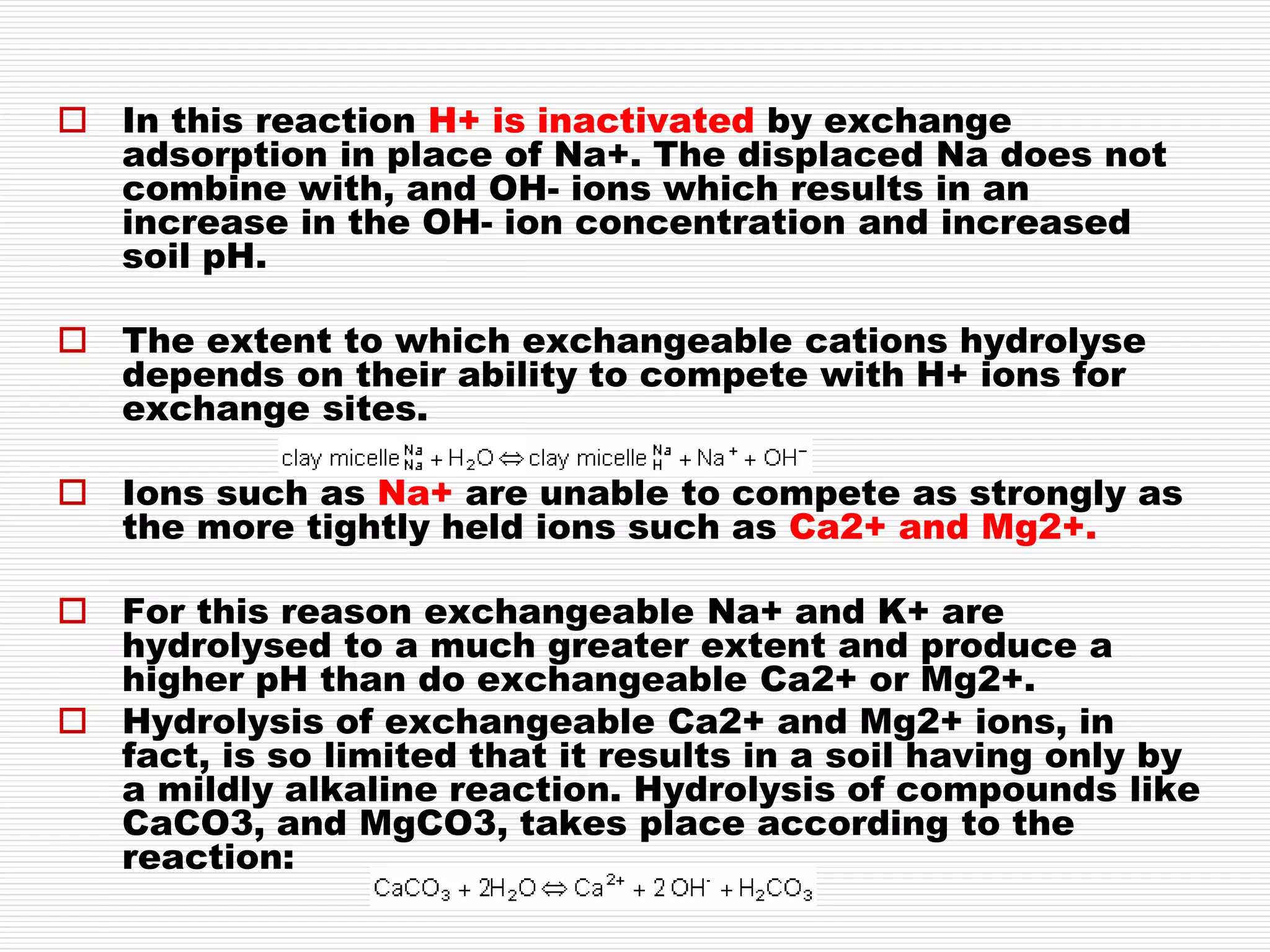
Hydrolysis of the exchangeable cations takes place
according to the following reactions
 In this reaction H+ is inactivated by exchange
adsorption in place of Na+. The displaced Na does not
combine with, and OH- ions which results in an
increase in the OH- ion concentration and increased
soil pH.
 The extent to which exchangeable cations hydrolyse
depends on their ability to compete with H+ ions for
exchange sites.
 Ions such as Na+ are unable to compete as strongly as
the more tightly held ions such as Ca2+ and Mg2+.
 For this reason exchangeable Na+ and K+ are
hydrolysed to a much greater extent and produce a
higher pH than do exchangeable Ca2+ or Mg2+.
 Hydrolysis of exchangeable Ca2+ and Mg2+ ions, in
fact, is so limited that it results in a soil having only by
a mildly alkaline reaction. Hydrolysis of compounds like
CaCO3, and MgCO3, takes place according to the
reaction:
 This is due to the higher solubility of Na2CO3 and
therefore the greater potential for hydrolysis.
According to Cruz-Romero and Coleman (1975)
exchangeable sodium and CaCO3 react in low CO2 -
low neutral salt environments to produce high pH
and appreciable concentrations of Na2CO3.
 Since the soils of arid and semi-arid regions nearly
always contain some calcium carbonate, a build up
in the exchangeable sodium in the absence of an
appreciable quantity of neutral soluble salts will
always result in high pH; the exact value depending
on the concentration of Na2CO3, formed or the level
of ESP.
 In this reaction H+ from water is inactivated through
combination with carbonate to form weakly ionized
carbonic acid.
 Hydroxyl ions are not inactivated through
combination with Ca2+ resulting in an alkaline
solution.
 The hydrolysis of CaCO3 and of MgCO3, is limited due
to their low solubilities and therefore they tend to
produce a pH in soils no higher than about 8.0 to 8.2.
 Soils containing measurable quantities of Na2CO3,
have a pH of more than 8.2; the pH increases with
increasing amounts of Na2CO3, and may be as high
as 10.0 to 10.5.
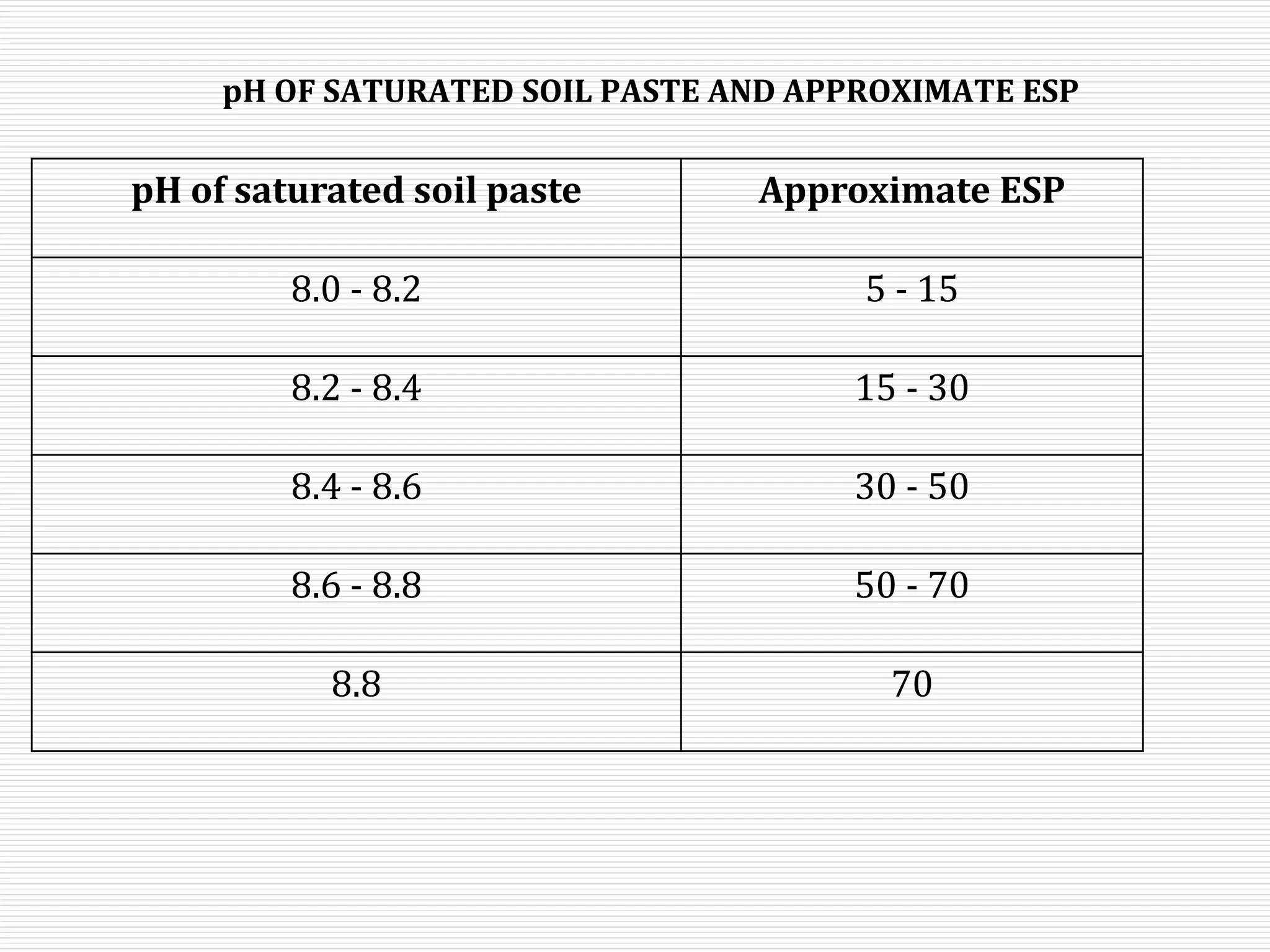
Relationship between the pH of saturated soil paste, and exchangeable
sodium percentage (ESP) (Abrol et al., 1980)
pH OF SATURATED SOIL PASTE AND APPROXIMATE ESP
pH of saturated soil paste Approximate ESP
8.0 - 8.2 5 - 15
8.2 - 8.4 15 - 30
8.4 - 8.6 30 - 50
8.6 - 8.8 50 - 70
8.8 70
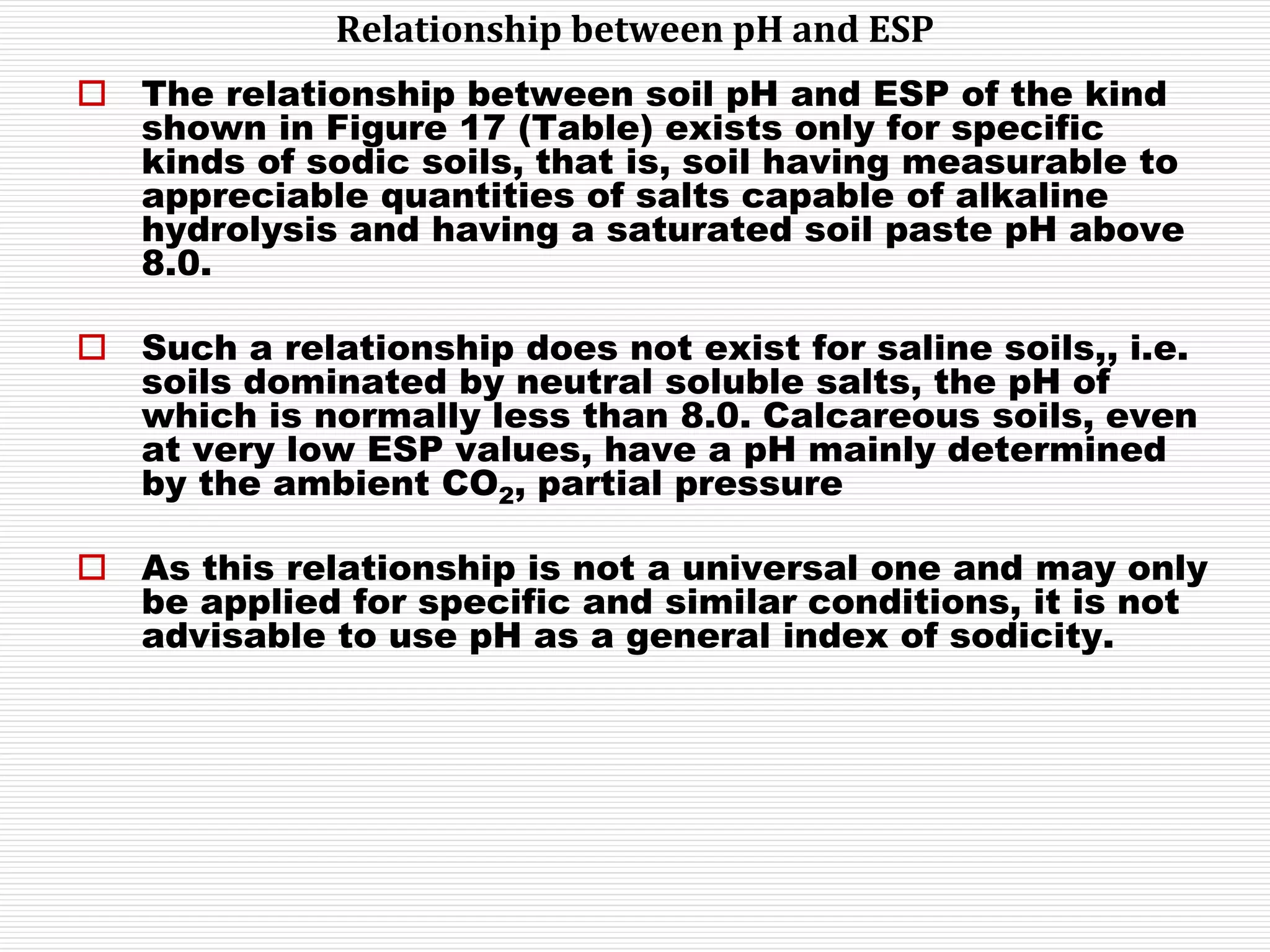
Relationship between pH and ESP
 The relationship between soil pH and ESP of the kind
shown in Figure 17 (Table) exists only for specific
kinds of sodic soils, that is, soil having measurable to
appreciable quantities of salts capable of alkaline
hydrolysis and having a saturated soil paste pH above
8.0.
 Such a relationship does not exist for saline soils,, i.e.
soils dominated by neutral soluble salts, the pH of
which is normally less than 8.0. Calcareous soils, even
at very low ESP values, have a pH mainly determined
by the ambient CO2, partial pressure
 As this relationship is not a universal one and may only
be applied for specific and similar conditions, it is not
advisable to use pH as a general index of sodicity.
For the purposes of definition, US Salinity Laboratory
researchers (Richards 1954) had suggested a saturated
soil paste pH of 8.5 or more for characterizing soils as
‘alkali’. In later publications however, the US scientists
preferred the term ‘sodic’ to ‘alkali’ and in the definition
of sodic soil a reference to soil pH was omitted.
As already discussed, there is a relationship between pH
and soil sodicity for soils containing calcium carbonate
as do most soils of semi-arid regions.
Studies (Gupta et al., 1982, 1983) have also shown that
pH strongly influences the soil physico-chemical
behaviour as distinct from the effect of exchangeable
sodium on soil properties.
For this reason these workers suggest that pH should be
an integral part of the definition of sodic soils.
 An ESP of 15 is generally recognized as a limit
above which the soils are characterized as sodic
(alkali) (Richards, 1954).
 This limit, though tentative, has been increasingly
found useful because many soils show a sharp
deterioration in physical properties around or above
this ESP (Abrol et al., 1978; Acharya and Abrol,
1978; Varallyay, 1977; Gardner et al., 1959),
although for some soils a lower ESP (6) has been
suggested as a limiting value (Northcote and Skene,
1972).
 A survey of published data (Abrol et al., 1980)
showed that for sodic soils, most often an ESP of 15
to 20 is associated with a saturation paste pH of
8.2.
 For diagnostic purposes therefore it was suggested
that a saturation paste pH of 8.2 will be more
realistic than the value of 8.5 which is nearly always
associated with higher values of ESP.
Measuring sodicity/alkali status of soils
pH measurement
 pH measurement is a significant
diagnosis of salt-affected soils but
dependence of pH value upon the soil-
water ratio of the suspension in which
it is measured is frequently ignored in
the reports and pH data are given
with no indication of the dilution factor
used.
 Interpretation of such data is difficult,
even impossible, pH data in Table
were measured on a saturated soil
paste and Figure gives the
relationship between pH of saturated
soil paste and pH of 1:2 soil-water
suspension.
 It is seen that pH of 1:2 soil-water
suspension is greater than the pH of
saturated soil paste by about 1 unit.
 Thus for characterizing soils as sodic,
if the pH is measured in 1:2 soil-water
suspension, the limiting pH value will
be about 9.0 instead of 8.2 as
suggested above.
Relationship between pH of saturation paste, pHs
and pH of 1:2 soil-water suspension, pH2 for soil of
varying ESP2
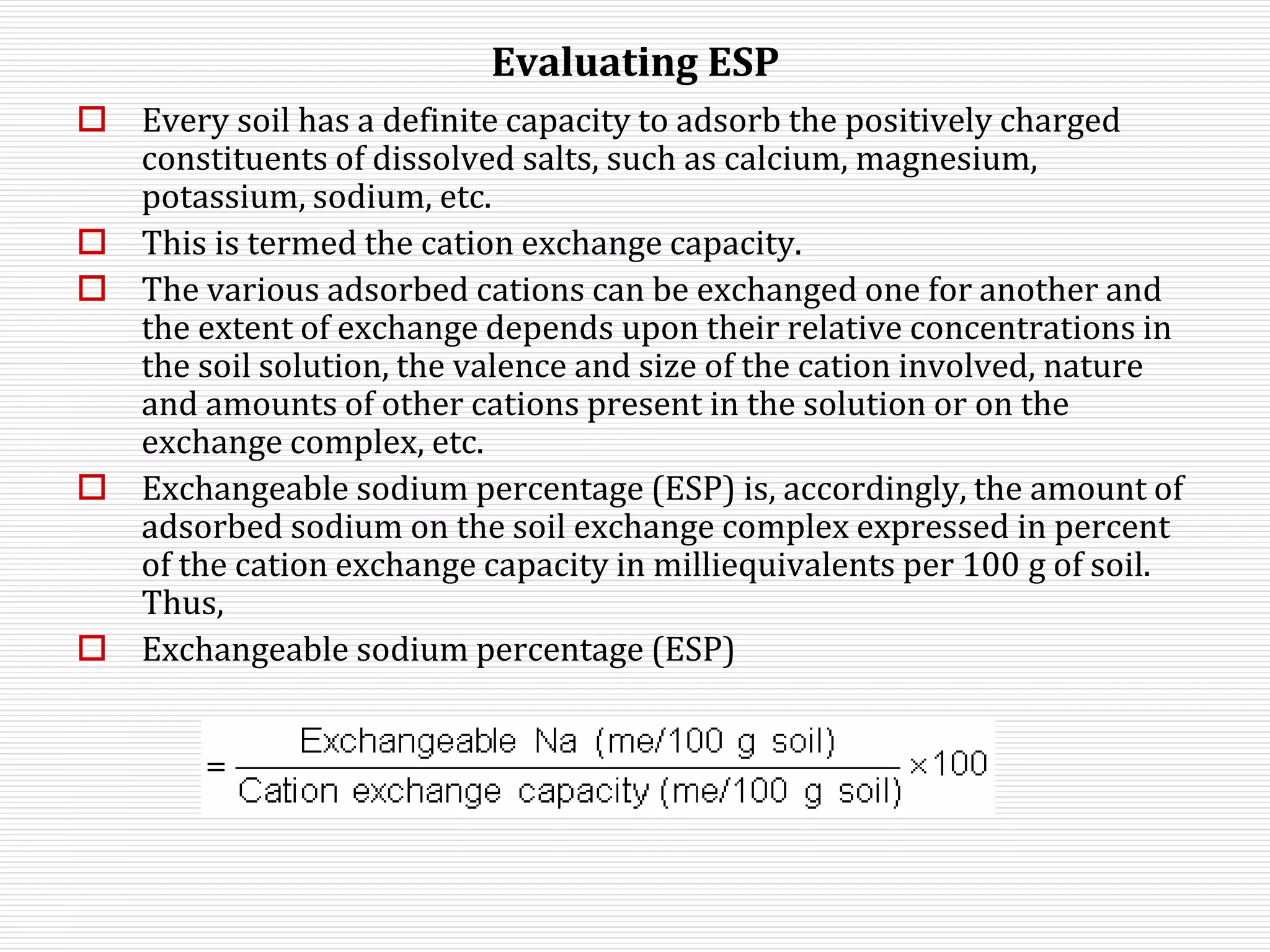
Evaluating ESP
 Every soil has a definite capacity to adsorb the positively charged
constituents of dissolved salts, such as calcium, magnesium,
potassium, sodium, etc.
 This is termed the cation exchange capacity.
 The various adsorbed cations can be exchanged one for another and
the extent of exchange depends upon their relative concentrations in
the soil solution, the valence and size of the cation involved, nature
and amounts of other cations present in the solution or on the
exchange complex, etc.
 Exchangeable sodium percentage (ESP) is, accordingly, the amount of
adsorbed sodium on the soil exchange complex expressed in percent
of the cation exchange capacity in milliequivalents per 100 g of soil.
Thus,
 Exchangeable sodium percentage (ESP)
SAR as an index of sodicity hazards
 Experimental determination of exchangeable sodium
percentage is tedious, time consuming and subject
to errors.
 Incomplete removal of index salt solution during the
washing step of CEC determinations can lead to high
CEC values and therefore low ESP estimates.
 Similarly, hydrolysis of exchangeable cations during
the removal of the index salt solution, fixing of
ammonium ions from the index or replacement
solution by the soil minerals and the dissolution of
calcium carbonate or gypsum in the index or
replacing solutions can all lead to low values of
cation exchange capacity and therefore to high ESP
estimates.
 Problems of CEC and ESP determinations are also
encountered in soils of high pH containing zeolite
minerals.
These minerals, e.g. analcime, contain replaceable
monovalent cations in their lattice which are readily
replaced by monovalent cations used as the index or
replacement cation resulting in unusually high values of
ESP (Gupta et al., 1984).
To overcome some of these difficulties several workers
prefer to obtain an estimate of the exchangeable sodium
percentage from an analysis of the saturated soil
extract.
Workers at the US Salinity Laboratory (Richards 1954)
proposed that the sodium adsorption ratio (SAR) of the
soil solution adequately defines the soil sodicity problem
and is quantitatively related to the exchangeable sodium
percentage of the soils. Sodium adsorption ratio, SAR, is
defined by the equation:
where all concentrations are in mmol (+)/litre.
 Although some studies have shown that grouping
calcium and magnesium in the above equation is not
strictly valid, there appears only little loss of
accuracy when this is done.
 Further, in many laboratories of the world calcium
plus magnesium in the soil extracts and waters are
estimated in a single determination - thus it is
convenient to group these two elements together for
the calculation of SAR.
 The calcium plus magnesium concentration is divided
by two because most ion exchange equations express
concentrations as mol/litre or mmol/litre rather than
mmol (+)/1.
 The exchangeable sodium status of soils can be
predicted fairly well from the SAR of the saturated
soil extract since the two are related by the
expression:
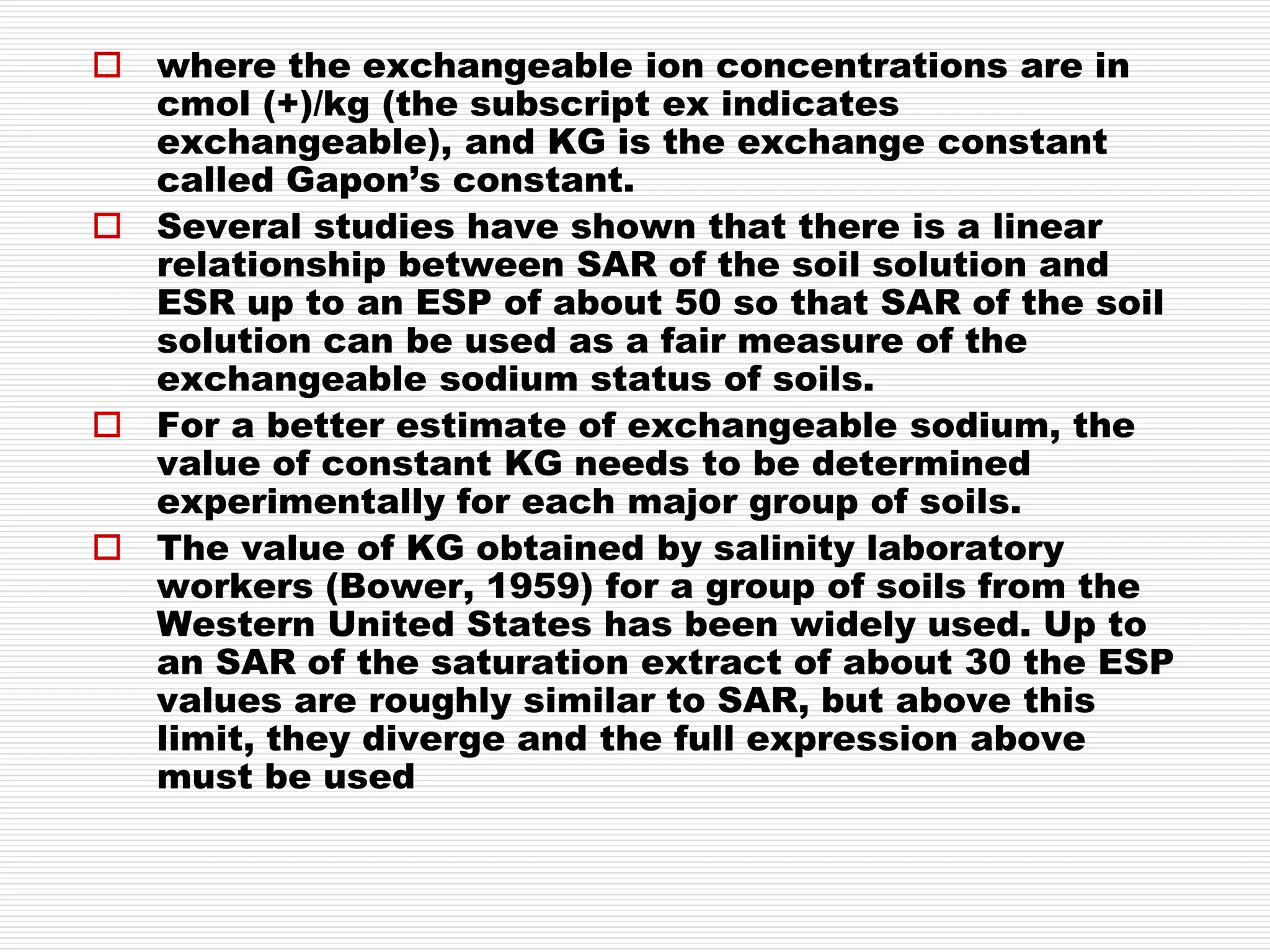
 where the exchangeable ion concentrations are in
cmol (+)/kg (the subscript ex indicates
exchangeable), and KG is the exchange constant
called Gapon’s constant.
 Several studies have shown that there is a linear
relationship between SAR of the soil solution and
ESR up to an ESP of about 50 so that SAR of the soil
solution can be used as a fair measure of the
exchangeable sodium status of soils.
 For a better estimate of exchangeable sodium, the
value of constant KG needs to be determined
experimentally for each major group of soils.
 The value of KG obtained by salinity laboratory
workers (Bower, 1959) for a group of soils from the
Western United States has been widely used. Up to
an SAR of the saturation extract of about 30 the ESP
values are roughly similar to SAR, but above this
limit, they diverge and the full expression above
must be used
Sodic soils and plant growth
 Plant growth is adversely affected in sodic soils due to
one or more of the following factors:
1.Excess exchangeable sodium in sodic soils has a
marked influence on the physical soil properties.
• As the proportion of exchangeable sodium
increases, the soil tends to become more
dispersed which results in the breakdown of soil
aggregates and lowers the permeability of the soil
to air and water (Figure 20).
• Dispersion also results in the formation of dense,
impermeable surface crusts that hinder the
emergence of seedlings.
2.Accumulation of certain elements in plants at toxic
levels may result in plant injury or reduced growth
and even death (specific ion effects). Elements more
commonly toxic in sodic soils include sodium,
molybdenum and boron.
1.A second effect of excess exchangeable sodium
on plant growth is through its effect on soil pH.
• Although high pH of sodic soils has no direct
adverse effect on plant growth per se, it
frequently results in lowering the availability of
some essential plant nutrients.
• For example, the concentration of the
elements calcium and magnesium in the soil
solution is reduced as the pH increases due to
formation of relatively insoluble calcium and
magnesium carbonates by reaction with
soluble carbonate of sodium, etc. and results in
their deficiency for plant growth.
• Similarly, the solubility in soils and availability
to plants of several other essential nutrient
elements, e.g. P, Fe, Mn and Zn, are likely to be
affected.
Schematic diagram showing the relative hydraulic conductivity of a
soil as affected by increasing ESP
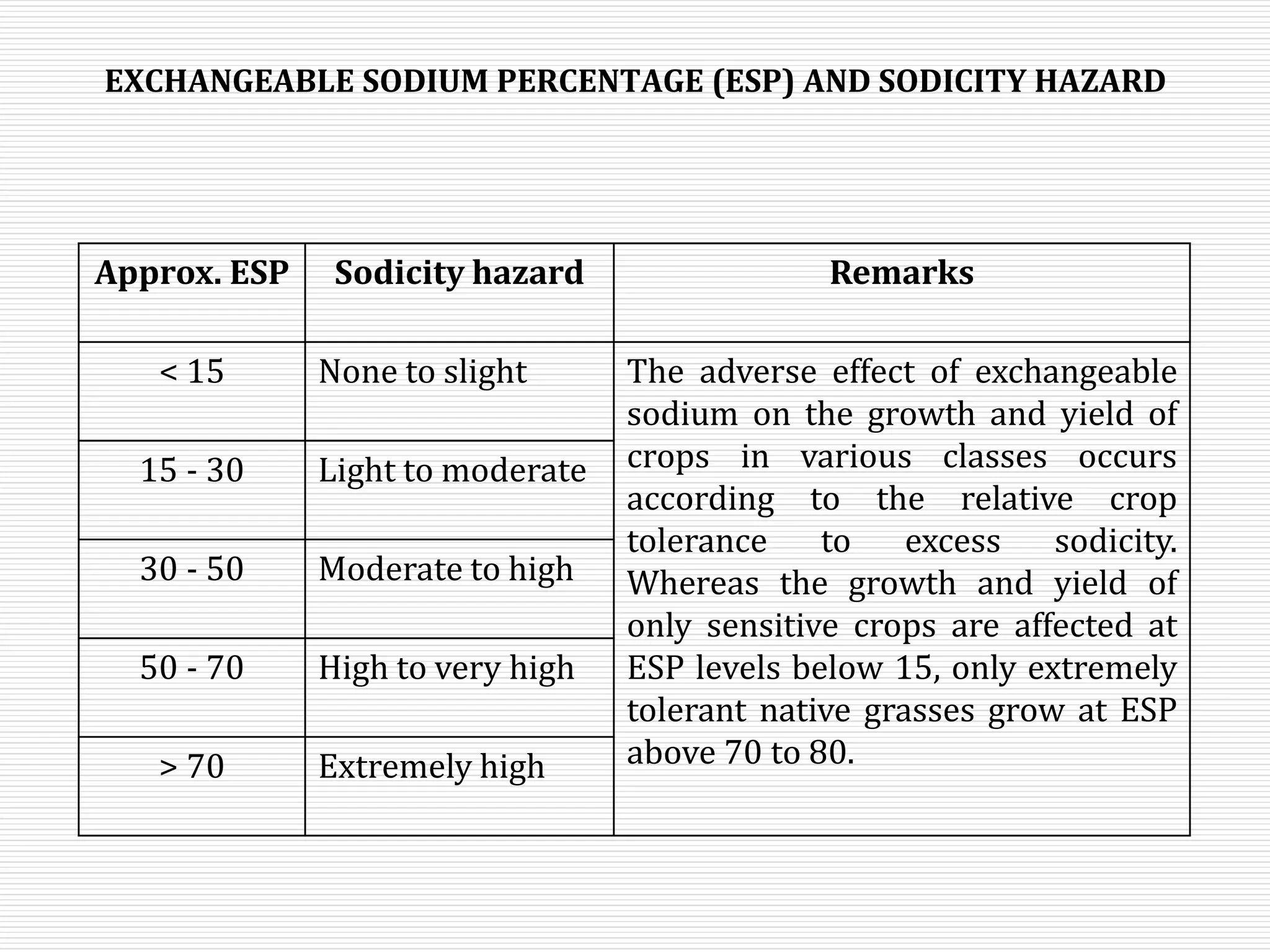
EXCHANGEABLE SODIUM PERCENTAGE (ESP) AND SODICITY HAZARD
Approx. ESP Sodicity hazard Remarks
< 15 None to slight The adverse effect of exchangeable
sodium on the growth and yield of
crops in various classes occurs
according to the relative crop
tolerance to excess sodicity.
Whereas the growth and yield of
only sensitive crops are affected at
ESP levels below 15, only extremely
tolerant native grasses grow at ESP
above 70 to 80.
15 - 30 Light to moderate
30 - 50 Moderate to high
50 - 70 High to very high
> 70 Extremely high
Reclamation and management
Amendments
 Basically, reclamation or improvement of sodic soils requires the
removal of part or most of the exchangeable sodium and its
replacement by the more favourable calcium ions in the root zone.
 This can be accomplished in many ways, the best dictated by local
conditions, available resources and the kind of crops to be grown
on the reclaimed soils.
 If the cultivator can spend very little for reclamation and the
amendments are expensive or not available, and he is willing to
wait many years before he can get good crop yields, soil can still
be reclaimed but at a slow rate by long-continued irrigated
cropping, ideally including a rice crop and sodic tolerant crops in
the cropping sequence, along with the incorporation of organic
residues and/or farmyard manure.
 For reasonably quick results cropping must be preceded by the
application of chemical soil amendments followed by leaching for
removal of salts derived from the reaction of the amendment with
the sodic soil.
Soil amendments
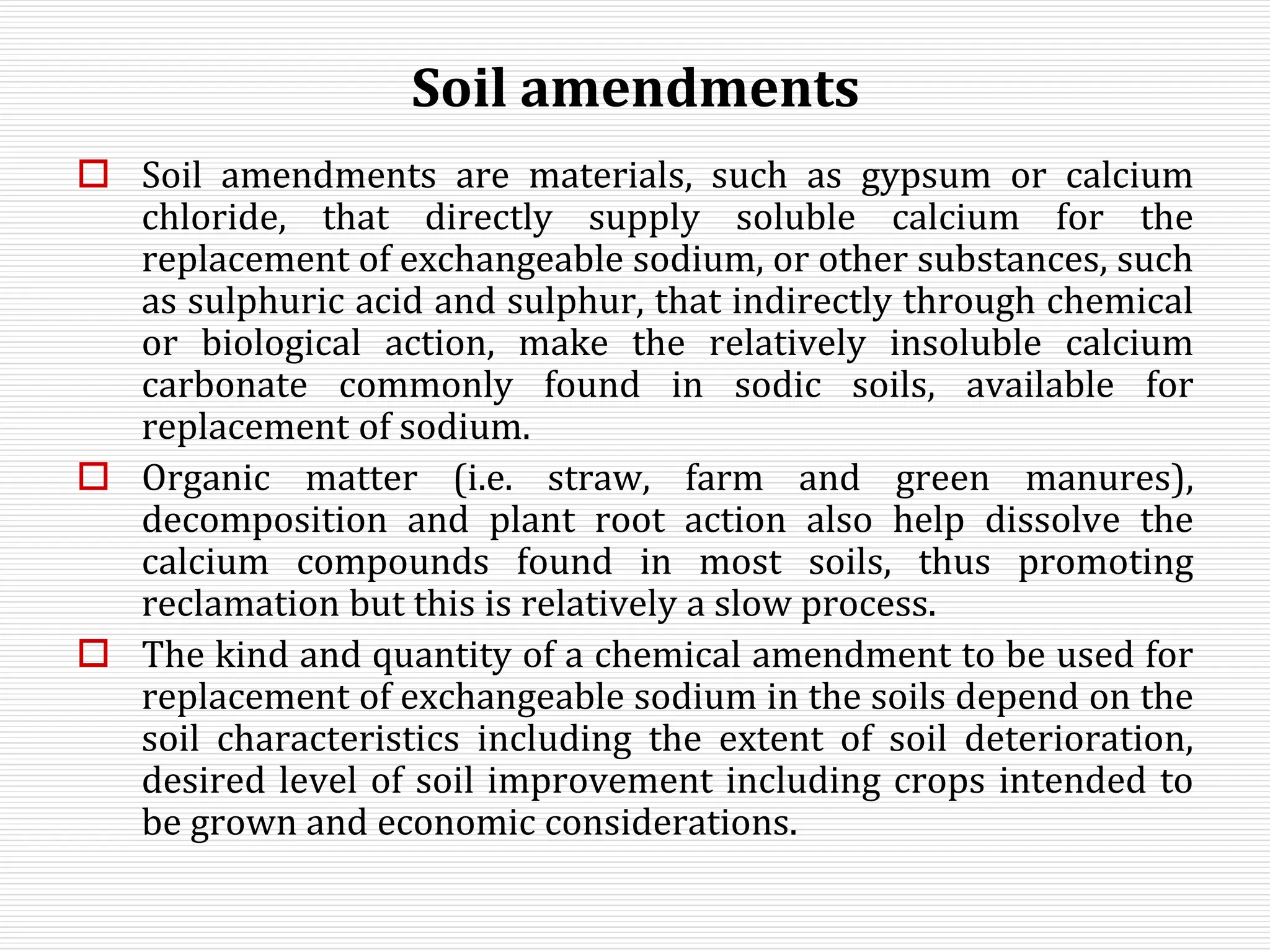
 Soil amendments are materials, such as gypsum or calcium
chloride, that directly supply soluble calcium for the
replacement of exchangeable sodium, or other substances, such
as sulphuric acid and sulphur, that indirectly through chemical
or biological action, make the relatively insoluble calcium
carbonate commonly found in sodic soils, available for
replacement of sodium.
 Organic matter (i.e. straw, farm and green manures),
decomposition and plant root action also help dissolve the
calcium compounds found in most soils, thus promoting
reclamation but this is relatively a slow process.
 The kind and quantity of a chemical amendment to be used for
replacement of exchangeable sodium in the soils depend on the
soil characteristics including the extent of soil deterioration,
desired level of soil improvement including crops intended to
be grown and economic considerations.
1. Kind of amendments
Chemical amendments for sodic soil reclamation can be
broadly grouped into three categories:
1. Soluble calcium salts, e.g. gypsum, calcium
chloride.
2. Acids or acid forming substances, e.g. sulphuric
acid, iron sulphate, aluminium sulphate, lime-
sulphur, sulphur, pyrite, etc.
3. Calcium salts of low solubility, e.g. ground
limestone.
 The suitability of one or another amendment for sodic soil
reclamation will largely depend on the nature of the soil
and cost considerations. Ground limestone, CaCO3, is an
effective amendment only in soils having pH below about
7.0 because its solubility rapidly decreases as the soil pH
increases .
 It is apparent that the effectiveness of limestone as an
amendment is markedly decreased at pH values above
7.0.
 Some soils that contain excess exchangeable sodium
also contain appreciable quantities of exchangeable
hydrogen and therefore have an acidic reaction, e.g.
degraded sodic soils.
Lime reacts in such soils according to the reaction:
Na, H - clay micelle + CaCO3 Ca - clay micelle
+ NaHCO3
However, lime is not an effective amendment for most
sodic soils as their pH is always high.
In fact, sodic soils contain measurable to appreciable
quantities of sodium carbonate which imparts to
these soils a high pH, always more than 8.2 when
measured on a saturated soil paste, and up to 10.8
or so when appreciable quantities of free sodium
carbonate are present.
In such soils only amendments comprising soluble
calcium salts or acids or acid-forming substances
are beneficial.
The following chemical equations illustrate the manner
in which some of the amendments react in these
soils.
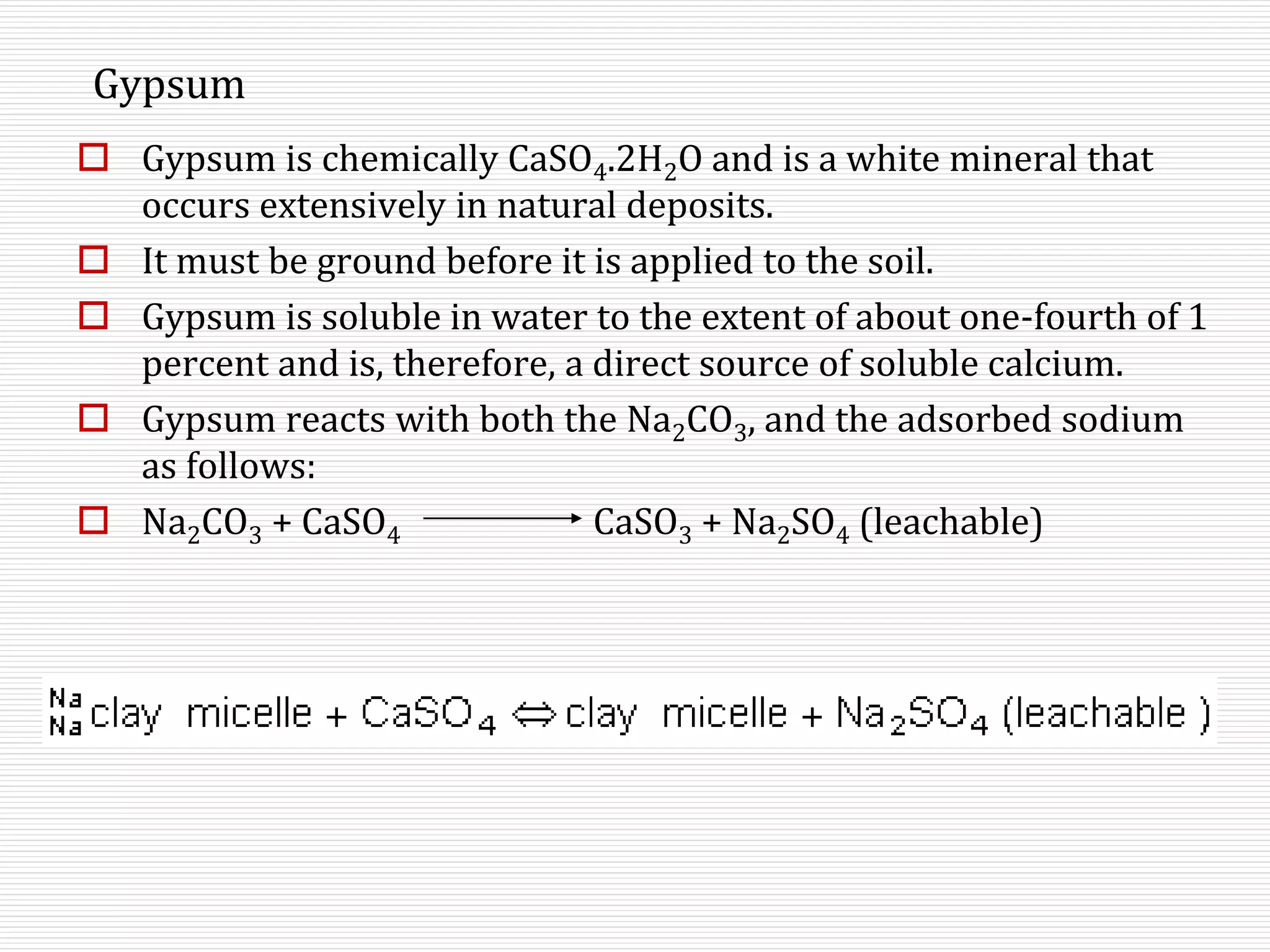
Gypsum
 Gypsum is chemically CaSO4.2H2O and is a white mineral that
occurs extensively in natural deposits.
 It must be ground before it is applied to the soil.
 Gypsum is soluble in water to the extent of about one-fourth of 1
percent and is, therefore, a direct source of soluble calcium.
 Gypsum reacts with both the Na2CO3, and the adsorbed sodium
as follows:
 Na2CO3 + CaSO4 CaSO3 + Na2SO4 (leachable)
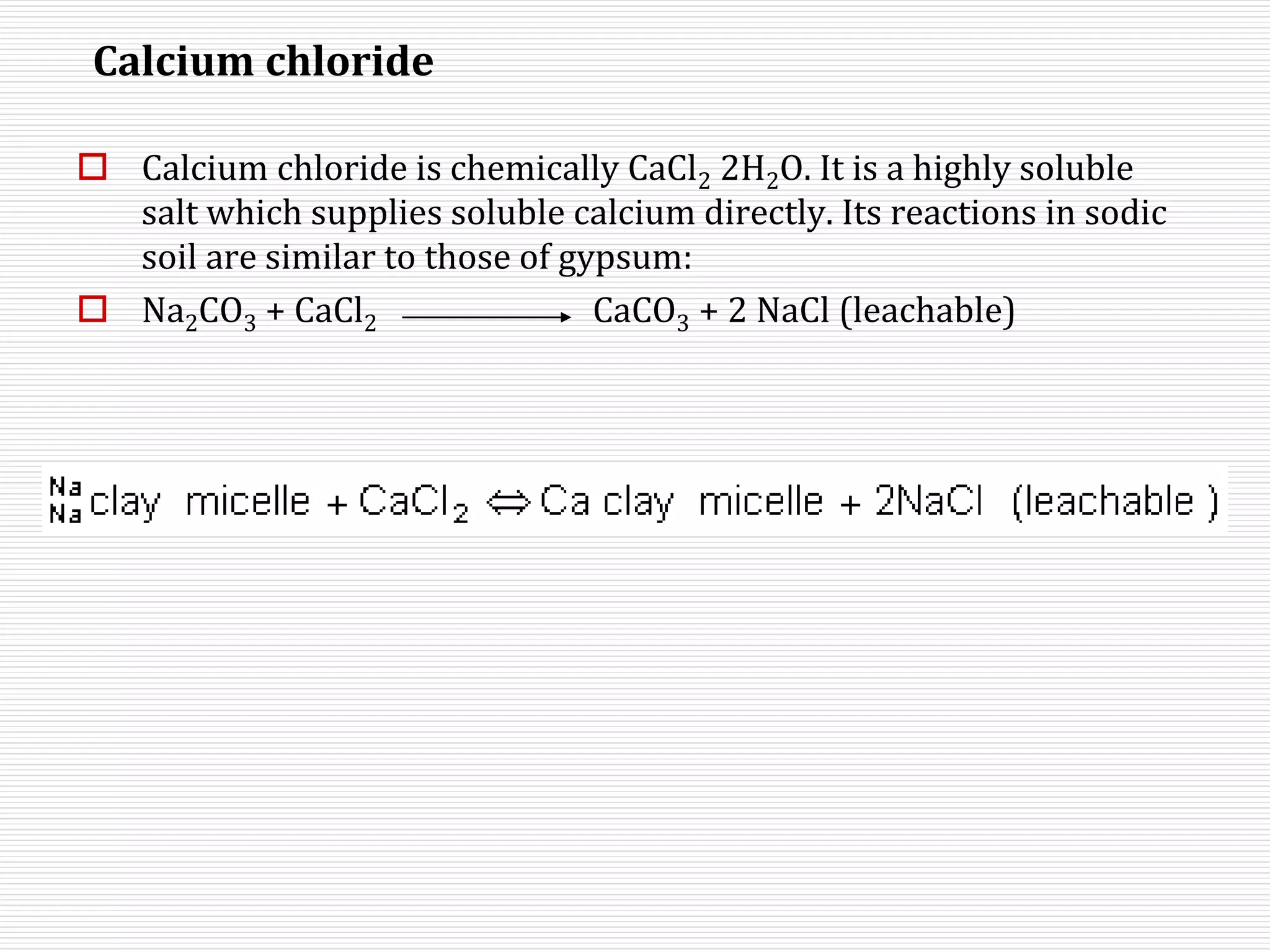
Calcium chloride
 Calcium chloride is chemically CaCl2 2H2O. It is a highly soluble
salt which supplies soluble calcium directly. Its reactions in sodic
soil are similar to those of gypsum:
 Na2CO3 + CaCl2 CaCO3 + 2 NaCl (leachable)
Sulphuric acid
 Sulphuric acid is chemically H2SO4. It is an oily corrosive liquid and is
usually about 95 percent pure. Upon application to soils containing
calcium carbonate it immediately reacts to form calcium sulphate and
thus provides soluble calcium indirectly. Chemical reactions involved
are:
 Na2CO3 + H2SO4 CO2 + H2O + Na2SO4 (leachable)
 CaCO3 + H2SO4 CaSO4 + H2O + CO2
Iron sulphate and aluminium sulphate (alum)
 Iron sulphate and aluminium sulphate (alum) Chemically these
compounds are FeSO4.7H2O and Al2(SO4)3.18H2O respectively.
 Both these solid granular materials usually have a high degree of
purity and are soluble in water.
 When applied to soils, these compounds dissolve in soil water and
hydrolyse to form sulphuric acid, which in turn supplies soluble
calcium through its reaction with lime present in sodic soils.
 Chemical reactions involved are:
 FeSO4 + 2H2O H2SO4 + Fe (OH)2
 H2SO4 + CaCO3 CaSO4 + H2O + CO2
 Similar reactions are responsible for the improvement of sodic soils
when aluminium sulphate is used as an amendment.
Sulphur (S)
 Sulphur is a yellow powder ranging in purity from 50 percent to
more than 99 percent.
 It is not soluble in water and does not supply calcium directly for
replacement of adsorbed sodium.
 When applied for sodic soil reclamation, sulphur has to undergo
oxidation to form sulphuric acid which in turn reacts with lime
present in the soil to form soluble calcium in the form of calcium
sulphate:
 2 S + 3 O2 2 SO3 (microbiological oxidation)
 SO3 + H2O H2SO4
 H2SO4 + CaCO3 CaSO4 + H2O + CO2
Pyrite
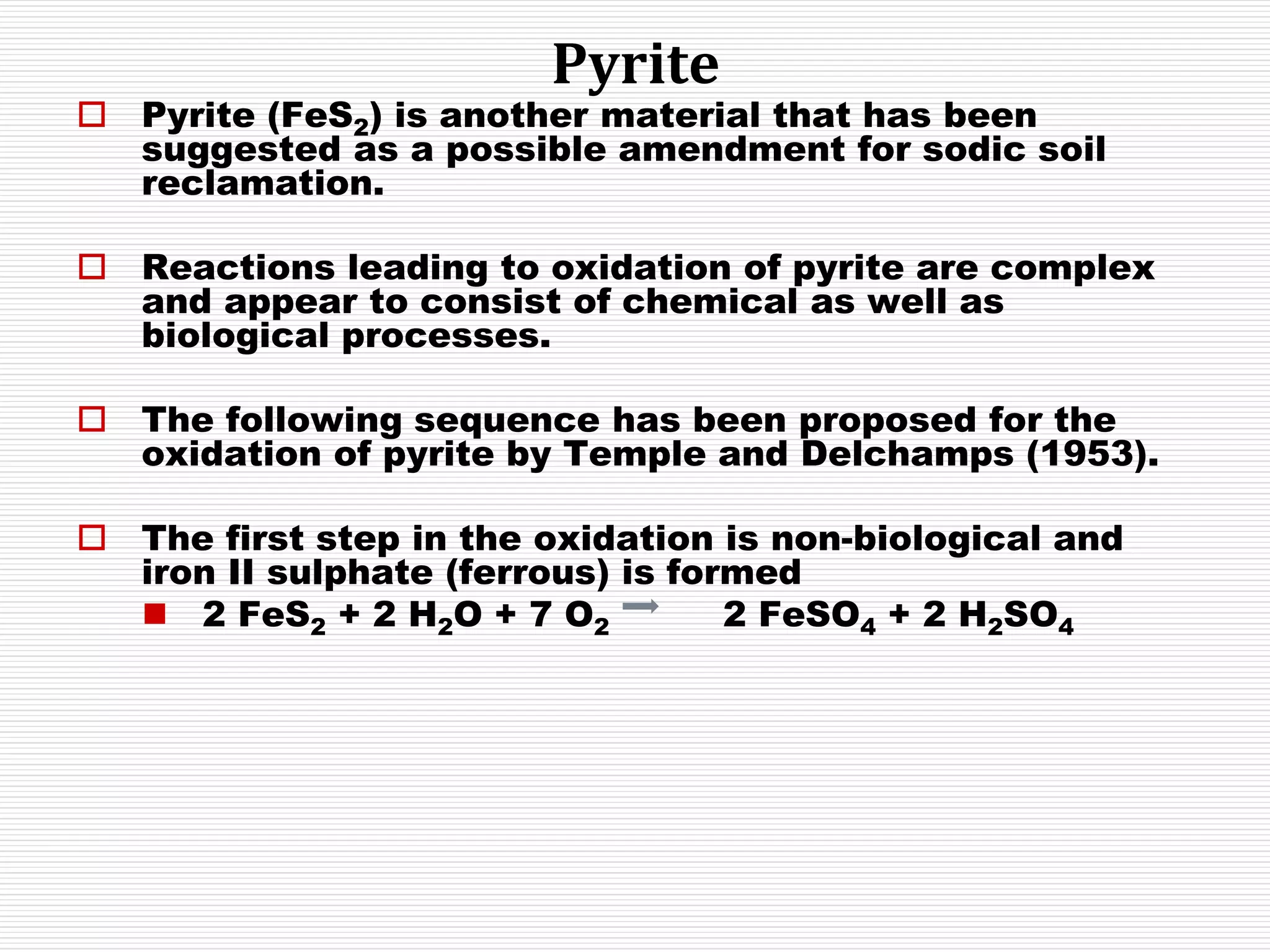
 Pyrite (FeS2) is another material that has been
suggested as a possible amendment for sodic soil
reclamation.
 Reactions leading to oxidation of pyrite are complex
and appear to consist of chemical as well as
biological processes.
 The following sequence has been proposed for the
oxidation of pyrite by Temple and Delchamps (1953).
 The first step in the oxidation is non-biological and
iron II sulphate (ferrous) is formed
 2 FeS2 + 2 H2O + 7 O2 2 FeSO4 + 2 H2SO4
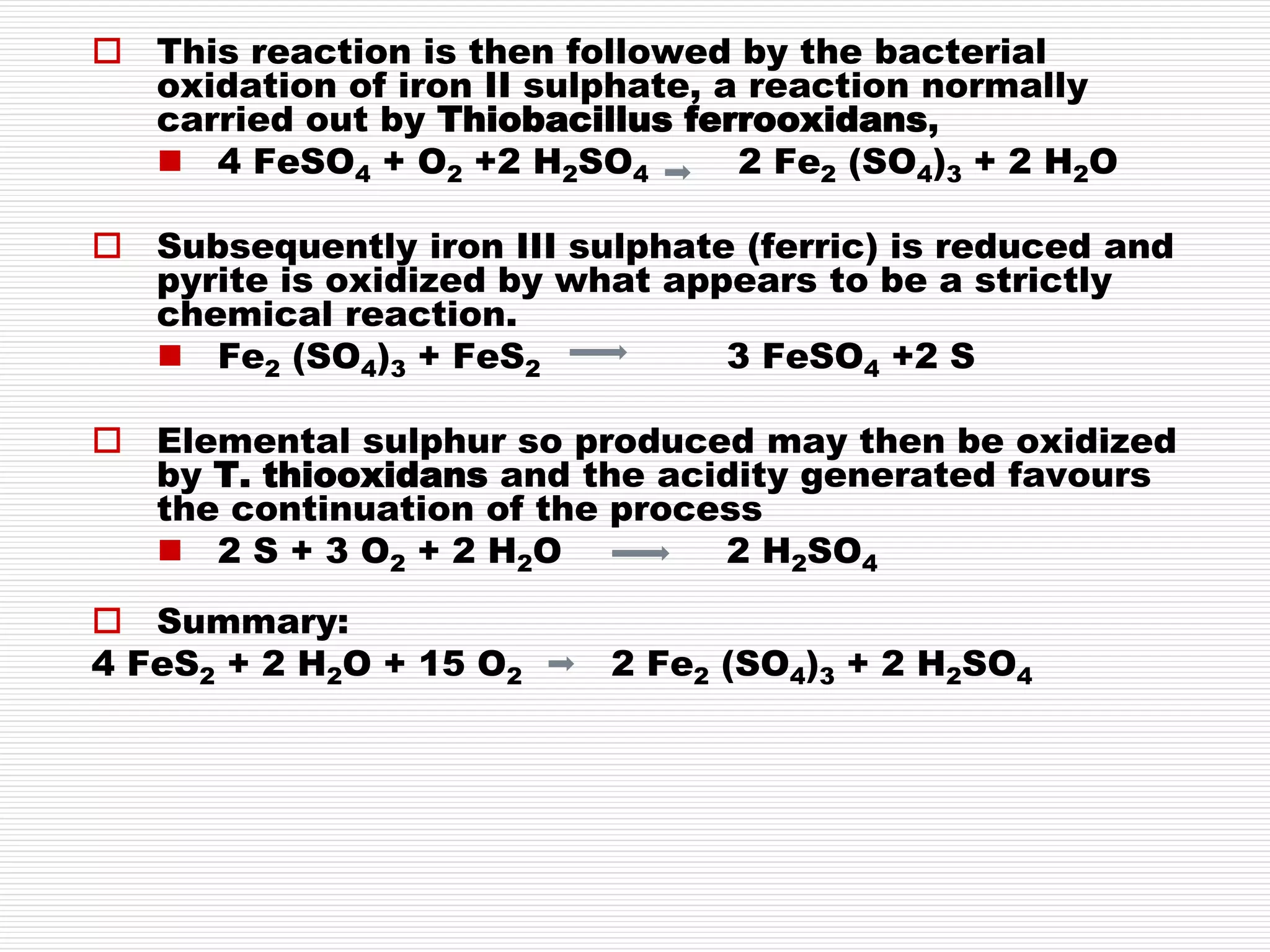
 This reaction is then followed by the bacterial
oxidation of iron II sulphate, a reaction normally
carried out by Thiobacillus ferrooxidans,
 4 FeSO4 + O2 +2 H2SO4 2 Fe2 (SO4)3 + 2 H2O
 Subsequently iron III sulphate (ferric) is reduced and
pyrite is oxidized by what appears to be a strictly
chemical reaction.
 Fe2 (SO4)3 + FeS2 3 FeSO4 +2 S
 Elemental sulphur so produced may then be oxidized
by T. thiooxidans and the acidity generated favours
the continuation of the process
 2 S + 3 O2 + 2 H2O 2 H2SO4
 Summary:
4 FeS2 + 2 H2O + 15 O2 2 Fe2 (SO4)3 + 2 H2SO4
Others
 In some localities cheap acidic industrial wastes may
be available which can be profitably used for sodic
soil improvement.
 Pressmud, a waste product from sugar factories, is
one such material commonly used for soil
improvement.
 Pressmud contains either lime or some gypsum
depending on whether the sugar factory is adopting
carbonation or a sulphitation process for the
clarification of juice.
 It also contains variable quantities of organic matter.
Choice of amendments
 The choice of an amendment at any place will depend
upon its relative effectiveness as judged from
improvement of soil properties and crop growth and
the relative costs involved.
 The time required for an amendment to react in the
soil and effectively replace adsorbed sodium is also a
consideration in the choice of an amendment.
 Because of its high solubility in water, calcium
chloride is the most readily available source of
soluble calcium but it has rarely been used for
reclamation on an extensive scale because of its high
cost.
 Similarly iron and aluminium sulphates are usually too
costly and have not been used for any large-scale
improvement of sodic soils in the past.
 Because amendments like sulphur and pyrite must
first be oxidized to sulphuric acid by soil
microorganisms before they are available for
reaction, the amendments are relatively slow
acting.
 Being cheapest and most abundantly available,
gypsum is the most widely used amendment.
 Sulphuric acid has also been used extensively in
some parts of the world, particularly in western
United States and parts of USSR.
 Several studies have attempted to evaluate the
effectiveness of various amendments under varying
soil and climatic conditions.
Quantity of amendments
 The quantity of an amendment necessary to reclaim
sodic soil depends on the total quantity of sodium
that must be replaced.
 This, in turn, depends on such factors as
 the soil texture
 mineralogical make up of the clay,
 extent of soil deterioration as measured by
exchangeable sodium percentage (ESP)
 and the crops intended to be grown
 The relative tolerance of a crop to exchangeable
sodium and its normal rooting depth will largely
determine the soil depth up to which excess
adsorbed sodium must be replaced for satisfactory
crop growth.
Quantity of amendments
 If a quantitative exchange of applied soluble calcium for
adsorbed sodium is assumed, replacement of each mole of
adsorbed sodium per 100 g soil will require half a mole of
soluble calcium.
 The quantity of pure gypsum required to supply half a
cmole of calcium per kg soil for the upper 15 cm soil
depth will be
= 0.86/1000 x 2.24 x 106 = 1926 kg / ha
The denominator of 200 in the equation above is based on the fact that 1
cmol (+) of Ca is 200mg.
Note: 1 cmol(+)/kg is the same as 1 meq/100g. A centimole is 1/100th of the “molar weight” of an element, which is the
atomic weight of that element divided by the number of charges on the cation. For example the atomic weight of calcium
(Ca2+) is 40.08g. The number of charges on the cation is two so the equivalent weight is calculated by dividing 40.08 by
2, which equals 20g (rounded off). Dividing this by 100 equals 0. 2g or 200mg which is the centimole for calcium.
Calculation of centimole: = atomic weight / number of charges / 100 Centimole for calcium: = 40.08 g / 2 / 100 = 0.2g
= 200 mg
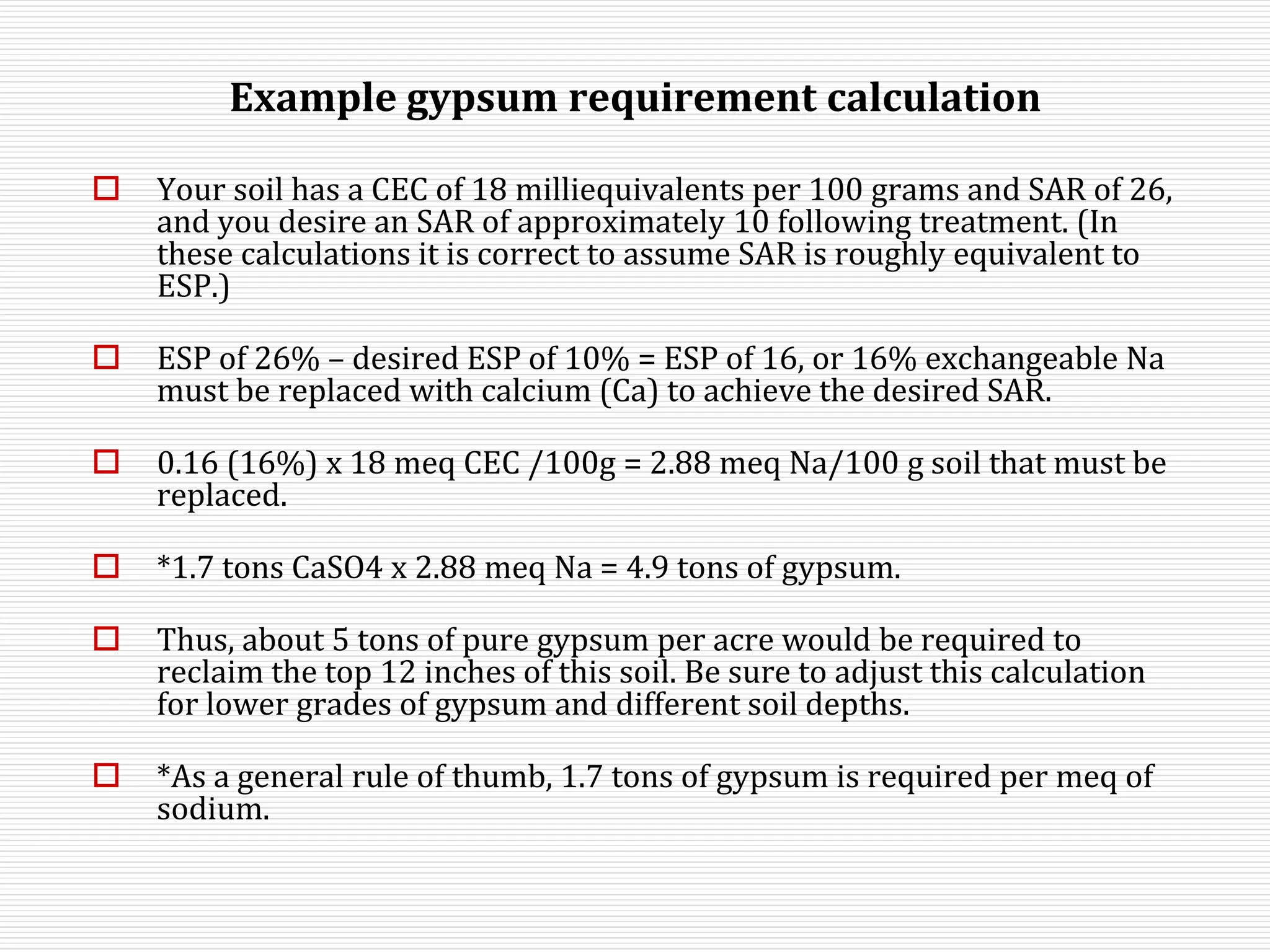
Example gypsum requirement calculation
 Your soil has a CEC of 18 milliequivalents per 100 grams and SAR of 26,
and you desire an SAR of approximately 10 following treatment. (In
these calculations it is correct to assume SAR is roughly equivalent to
ESP.)
 ESP of 26% – desired ESP of 10% = ESP of 16, or 16% exchangeable Na
must be replaced with calcium (Ca) to achieve the desired SAR.
 0.16 (16%) x 18 meq CEC /100g = 2.88 meq Na/100 g soil that must be
replaced.
 *1.7 tons CaSO4 x 2.88 meq Na = 4.9 tons of gypsum.
 Thus, about 5 tons of pure gypsum per acre would be required to
reclaim the top 12 inches of this soil. Be sure to adjust this calculation
for lower grades of gypsum and different soil depths.
 *As a general rule of thumb, 1.7 tons of gypsum is required per meq of
sodium.
Quantity of amendment to be added
 If it is desired to replace greater quantities of adsorbed
sodium, the quantity of gypsum can be accordingly increased.
 Quantities of other amendments can be determined by
reference to Table.
 In many laboratories the quantity of gypsum required for
reclaiming sodic soil is determined by the gypsum
requirement (GR) test suggested by Schoonover (1952).
 The test is performed by mixing a small soil sample (5 g) with
a relatively large volume of saturated gypsum solution and
measuring the calcium lost from the solution after reaction
with soil.
 Sodium salts in an sodic soil are so diluted by this treatment
that nearly complete displacement of exchangeable sodium
by calcium from the gypsum solution occurs.
 The decrease in calcium from the solution when expressed
on the basis of tons of CaSO4.2H2O per 30 cm of soil is the
gypsum requirement of the soil.
Gypsum requirement
 Many sodic soils contain, in addition to excessive
quantities of exchangeable sodium, appreciable
amounts of soluble sodium carbonate.
 In such cases the gypsum requirement test evaluates
the amount of calcium required to replace the
exchangeable sodium plus that required to neutralize
all the soluble sodium carbonate in the soil.
 Some workers (Hausenbuiller, 1978) maintain that
sufficient amendment must be added to react with
both soluble sodium carbonate and exchangeable
sodium to achieve complete reclamation.
 However studies by Abrol and Dahiya (1974) showed
that, when gypsum was surface applied and leached,
only a small fraction of the soluble carbonates
reacted with applied calcium and that a major
fraction of the soluble carbonates leached without
reacting with applied gypsum.
 Under field conditions one irrigation prior to
application of an amendment would further ensure
leaching of soluble carbonates, eliminating the need
of additional quantities of gypsum for neutralizing
the free sodium carbonate.
 For the above reasons, a modification in the method
of determining the gypsum requirement of soils has
been proposed (Abrol et al., 1975).
 In the modified procedure, the soil is washed free of
soluble carbonates with alcohol before proceeding
with the gypsum requirement test.
 The modified procedure gives a more realistic
estimate of the gypsum needs of sodic soils
containing varying amounts of soluble carbonate
 It has been earlier pointed out a relationship
between soil pH and the exchangeable sodium
percentage for some Indian soils.
 Such a relationship was established for sodic soils
of the Indo-Gangetic plains in India (Figure 17), and
based on this a graphical relationship between pH of
1:2 soil-water suspension and the gypsum
requirement of the surface 15 cm depth was
established.
 This is presented in Figure 21. Since pH can be
determined easily and since it is measured on 1:2
soil-water suspension in most Indian laboratories.
 Figure 21 has been found very useful in predicting
the approximate gypsum requirements of some
indian sodic soils. Similar relationships for groups of
like soils may be investigated for estimating the
amendment needs of soils
Relationship between pH of 1:2 soil-water suspension and the gypsum
requirements of sodic soils of the Indo-Gangetic plains. Light, medium and
heavy refer to soils with a clay content of approximately 10, 15 and 20
percent, respectively. A cation exchange capacity of 10 cmol (+)/kg soil is
common for most medium textured soils
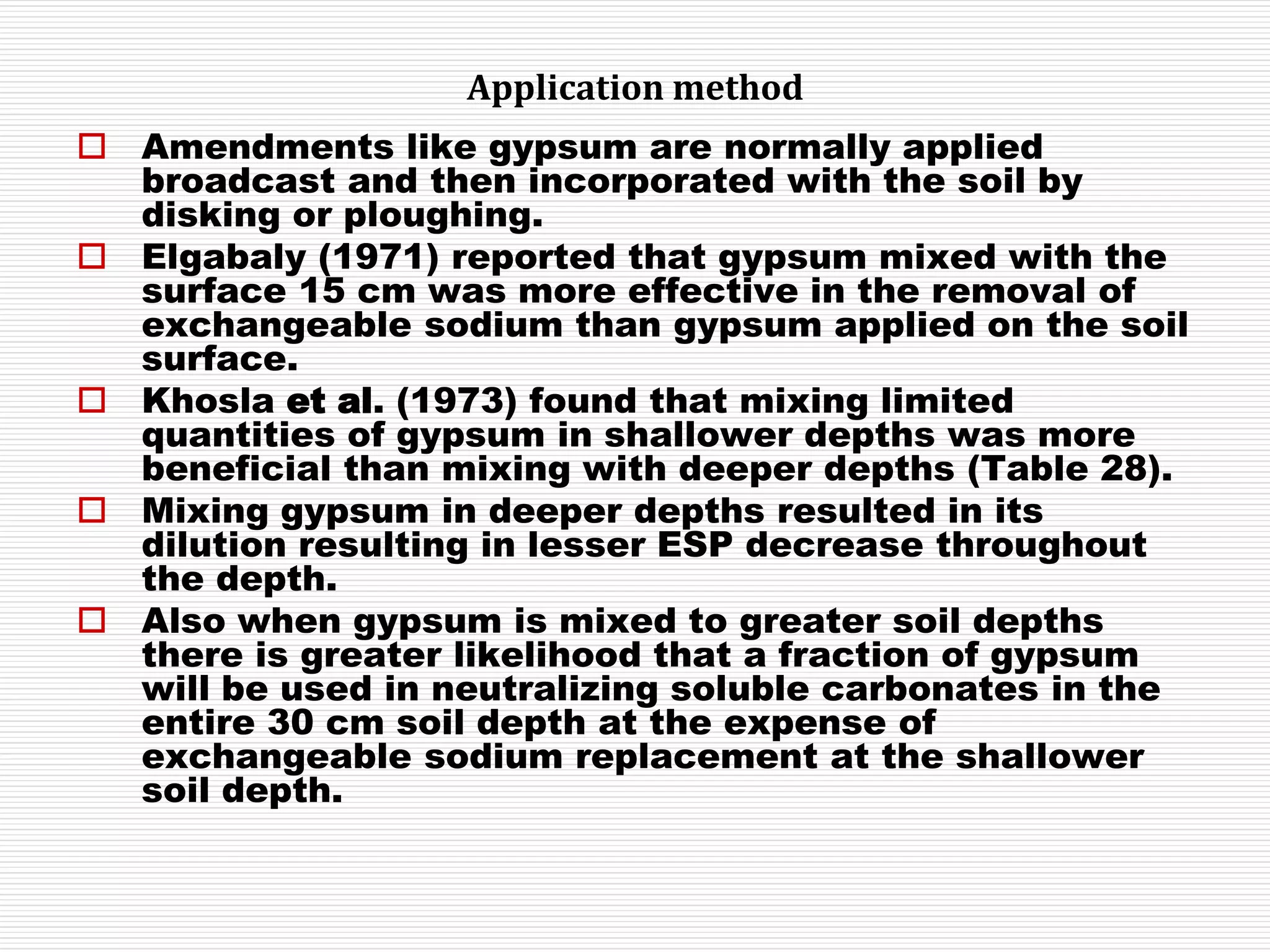
Application method
 Amendments like gypsum are normally applied
broadcast and then incorporated with the soil by
disking or ploughing.
 Elgabaly (1971) reported that gypsum mixed with the
surface 15 cm was more effective in the removal of
exchangeable sodium than gypsum applied on the soil
surface.
 Khosla et al. (1973) found that mixing limited
quantities of gypsum in shallower depths was more
beneficial than mixing with deeper depths (Table 28).
 Mixing gypsum in deeper depths resulted in its
dilution resulting in lesser ESP decrease throughout
the depth.
 Also when gypsum is mixed to greater soil depths
there is greater likelihood that a fraction of gypsum
will be used in neutralizing soluble carbonates in the
entire 30 cm soil depth at the expense of
exchangeable sodium replacement at the shallower
soil depth.
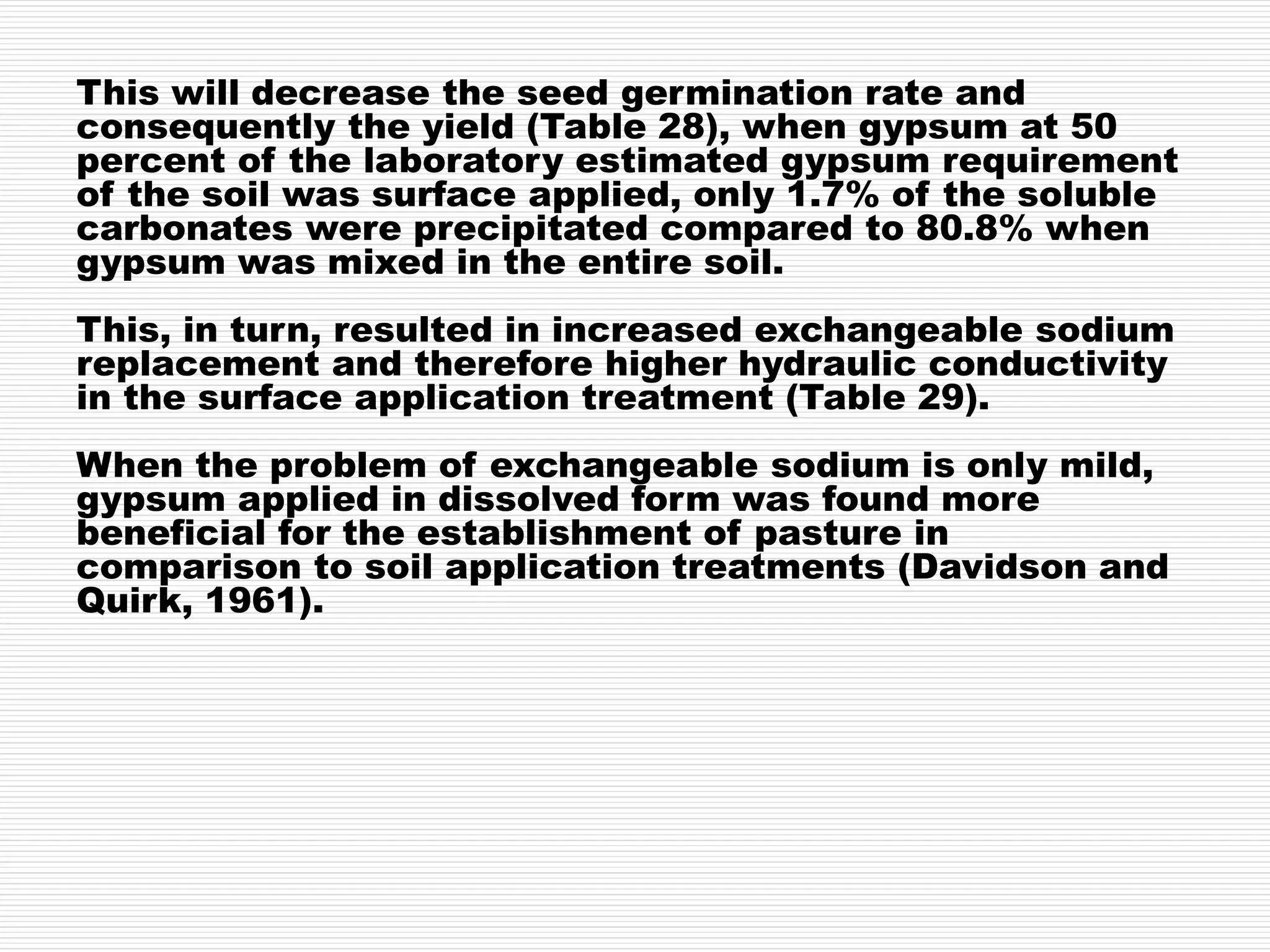
This will decrease the seed germination rate and
consequently the yield (Table 28), when gypsum at 50
percent of the laboratory estimated gypsum requirement
of the soil was surface applied, only 1.7% of the soluble
carbonates were precipitated compared to 80.8% when
gypsum was mixed in the entire soil.
This, in turn, resulted in increased exchangeable sodium
replacement and therefore higher hydraulic conductivity
in the surface application treatment (Table 29).
When the problem of exchangeable sodium is only mild,
gypsum applied in dissolved form was found more
beneficial for the establishment of pasture in
comparison to soil application treatments (Davidson and
Quirk, 1961).
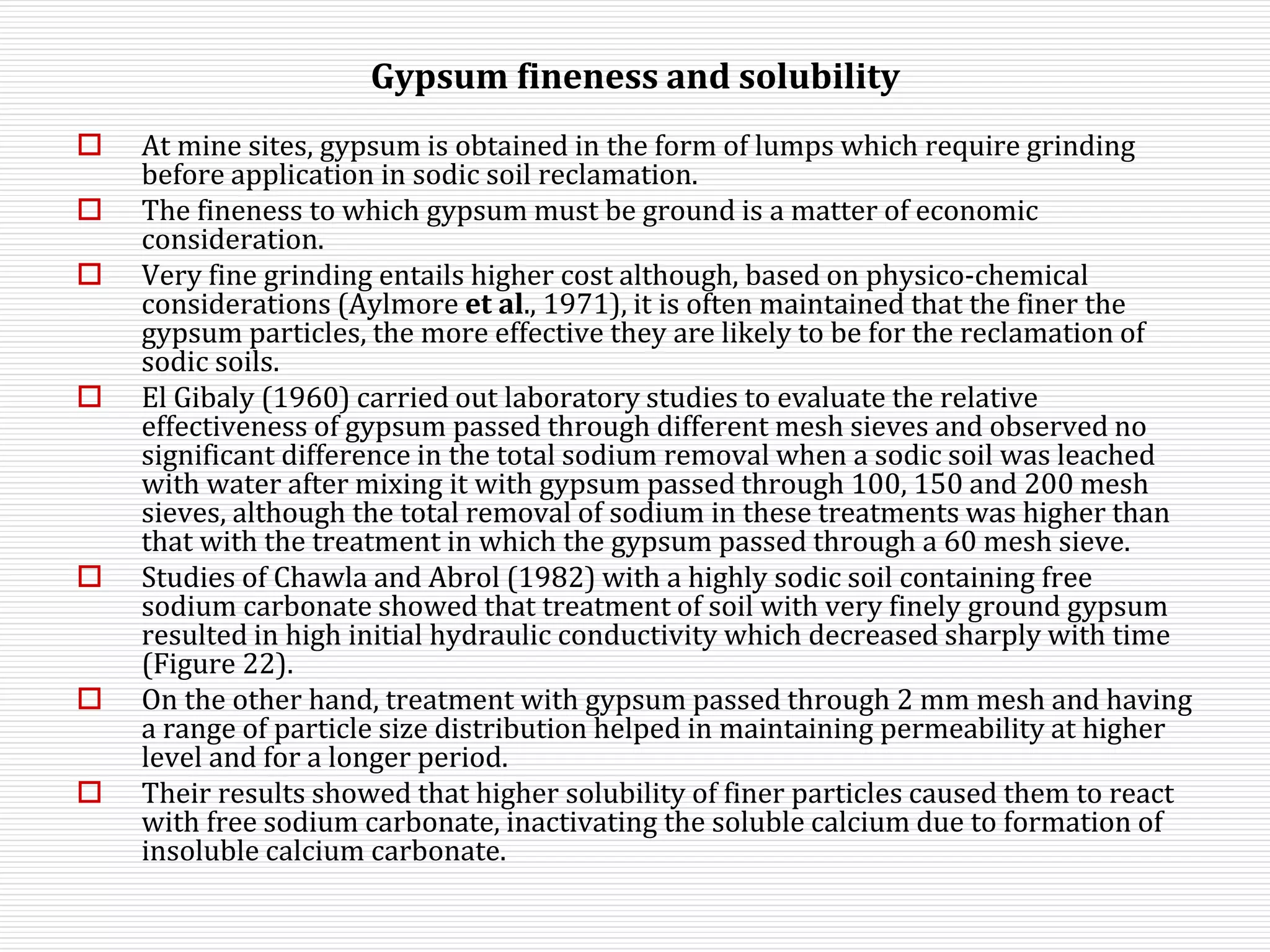
Gypsum fineness and solubility
 At mine sites, gypsum is obtained in the form of lumps which require grinding
before application in sodic soil reclamation.
 The fineness to which gypsum must be ground is a matter of economic
consideration.
 Very fine grinding entails higher cost although, based on physico-chemical
considerations (Aylmore et al., 1971), it is often maintained that the finer the
gypsum particles, the more effective they are likely to be for the reclamation of
sodic soils.
 El Gibaly (1960) carried out laboratory studies to evaluate the relative
effectiveness of gypsum passed through different mesh sieves and observed no
significant difference in the total sodium removal when a sodic soil was leached
with water after mixing it with gypsum passed through 100, 150 and 200 mesh
sieves, although the total removal of sodium in these treatments was higher than
that with the treatment in which the gypsum passed through a 60 mesh sieve.
 Studies of Chawla and Abrol (1982) with a highly sodic soil containing free
sodium carbonate showed that treatment of soil with very finely ground gypsum
resulted in high initial hydraulic conductivity which decreased sharply with time
(Figure 22).
 On the other hand, treatment with gypsum passed through 2 mm mesh and having
a range of particle size distribution helped in maintaining permeability at higher
level and for a longer period.
 Their results showed that higher solubility of finer particles caused them to react
with free sodium carbonate, inactivating the soluble calcium due to formation of
insoluble calcium carbonate.
EQUIVALENT QUANTITIES OF SOME COMMON AMENDMENTS FOR
SODIC SOIL RECLAMATION
Amendment Relative quantity 1/
Gypsum (CaSO4 2H2O) 1.00
Calcium chloride (CaCl2 2 H2O) 0.85
Sulphuric acid (H2SO4) 0.57
Iron sulphate (FeSO4.7 H2O) 1.62
Aluminium sulphate (Al2 (SO4)3.18 H2O) 1.29
Sulphur (S) 0.19
Pyrite (FeS2) - 30% sulphur 0.63
Calcium polysulphide (CaS5) - 24% sulphur 0.77
1/ These quantities are based on 100 percent pure materials. If the material
is not 100 percent pure necessary correction must be made. Thus if gypsum
is only 80 percent pure the quantity to be added will be
tons instead of 1.00 ton.
Crops in sodic soils
 Proper choice of crops during reclamation of sodic
soils is important.
 Growing crops tolerant to excess exchangeable
sodium can ensure reasonable returns during the
initial phases of reclamation or when the crops are
grown with irrigation water having a sodicity hazard.
 Abrol and Bhumbla (1979) reported results of long-
term field studies to evaluate the effect of
exchangeable sodium on the performance of several
field crops.
 Under field conditions, varying levels of exchangeable
sodium were achieved by applying different quantities
of gypsum to a highly sodic soil.
 In these studies gypsum was applied only once
initially.
 Data on actual crop yields as a result of application of
different levels of gypsum are presented in Table 31,
and Figure 23 (a and b) depicts the relationship
between exchangeable sodium percentage and the
yield of selected crops. .
These data bring out that there are wide variations in
the tolerance of crops to sodic conditions: rice and
dhaincha appear to be tolerant, wheat and bajra are
only moderately tolerant and legume crops like mash
and lentil are relatively sensitive to excess
exchangeable sodium (Table 31).
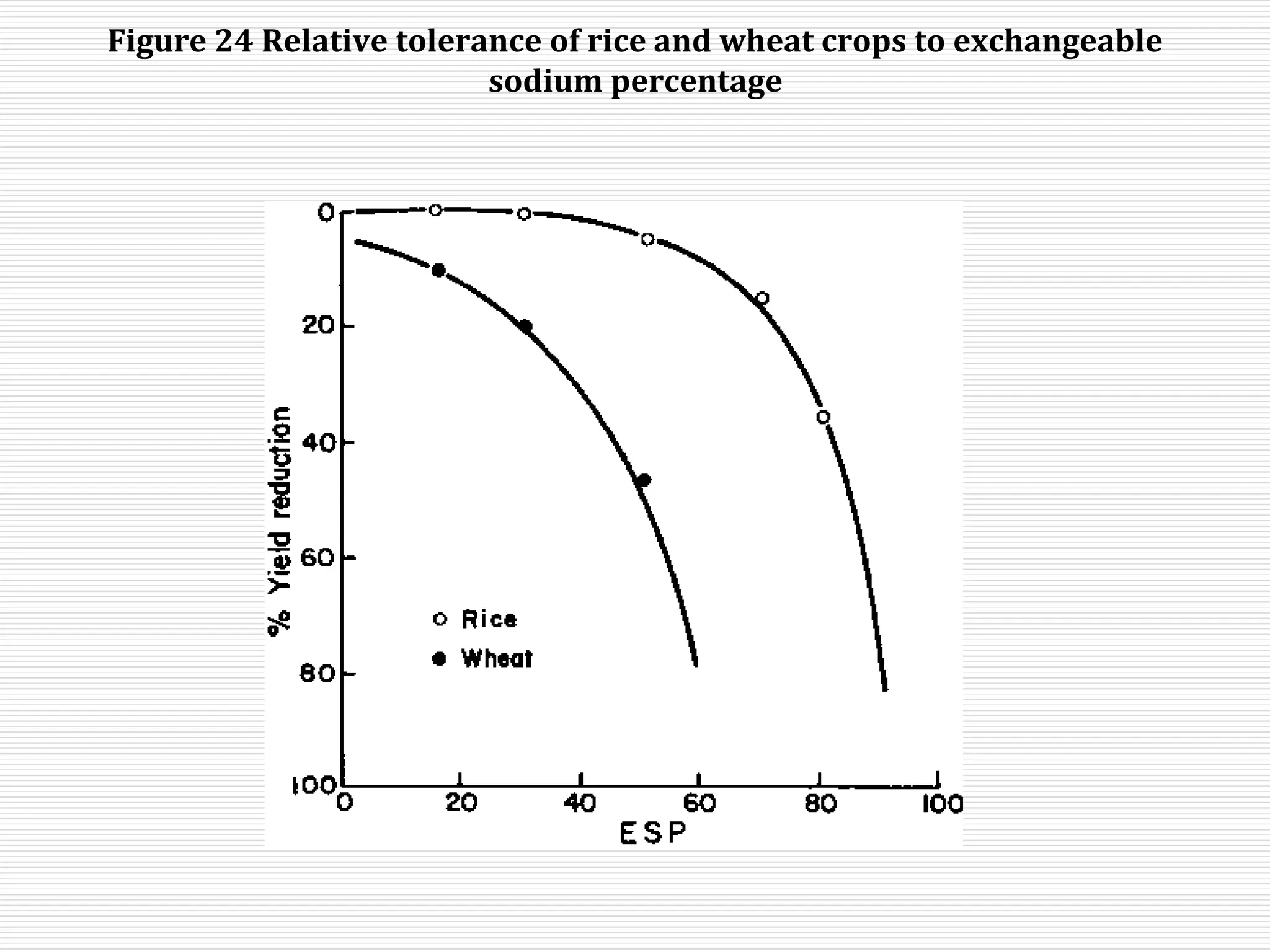
Relative tolerance of rice and wheat are clearly brought
out in Figure 24 which shows that at an ESP of about 50
the yield of rice was virtually unaffected, while the
wheat crop almost failed at this high ESP (Plates 6 and
7).
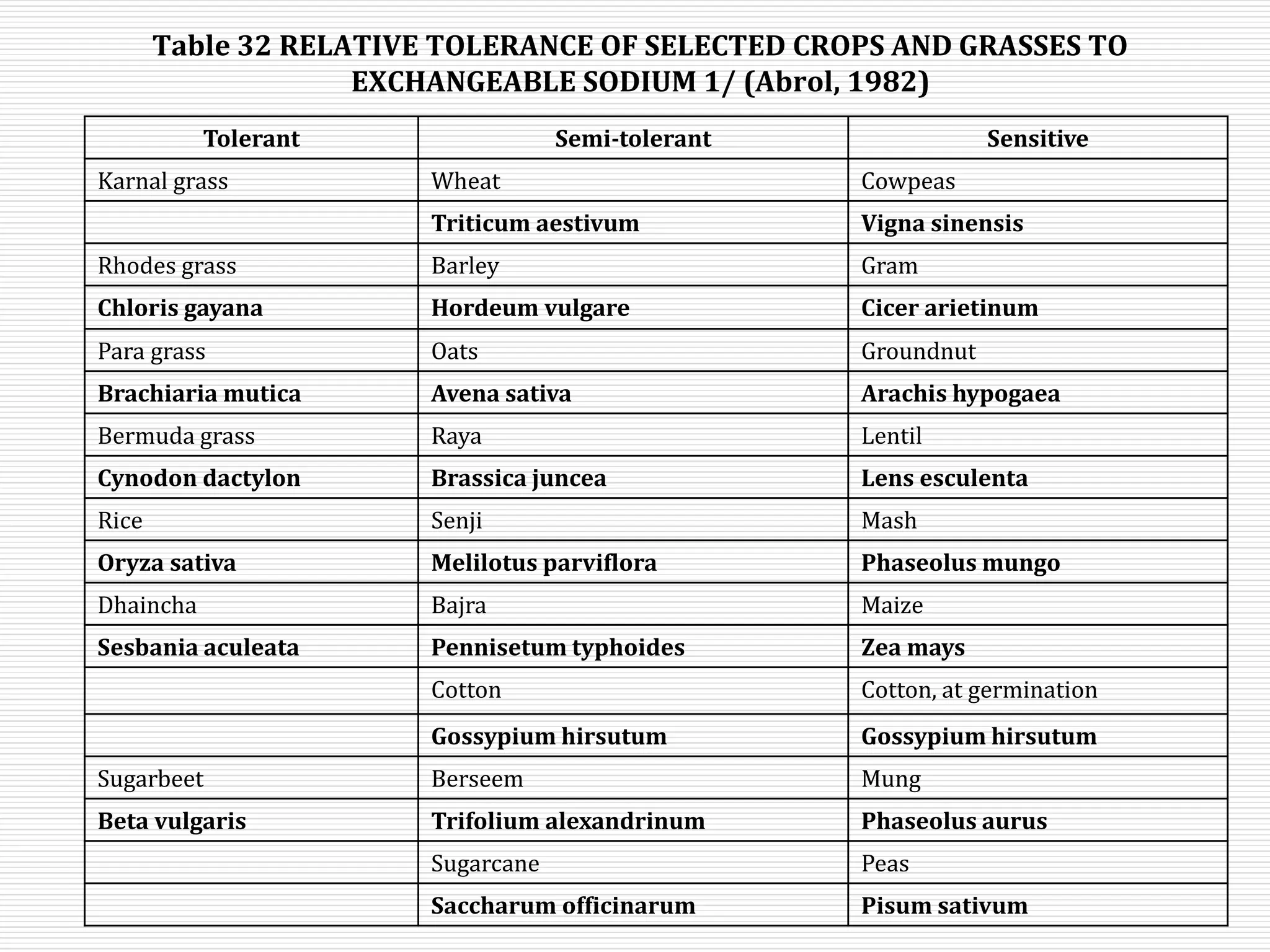
Based on these and other studies (Chhabra et al., 1979;
Singh et al., 1979, 1980, 1981) crops are listed in Table
32 according to their relative tolerance to
exchangeable sodium.
It has been observed that, generally, crops that are
able to withstand excess moisture conditions resulting
in short-term oxygen deficiencies are also more
tolerant of sodic conditions because the excess
exchangeable sodium adversely affects crop growth
chiefly through its adverse effect on soil physical
properties.
Figure 23 Relationship between exchangeable sodium percentage
(ESP) and the yield of selected crops (Abrol and Bhumbla, 1979) (A)
Figure 23 Relationship between exchangeable sodium percentage
(ESP) and the yield of selected crops (Abrol and Bhumbla, 1979) (B)
Figure 24 Relative tolerance of rice and wheat crops to exchangeable
sodium percentage
Table 32 RELATIVE TOLERANCE OF SELECTED CROPS AND GRASSES TO
EXCHANGEABLE SODIUM 1/ (Abrol, 1982)
Tolerant Semi-tolerant Sensitive
Karnal grass Wheat Cowpeas
Triticum aestivum Vigna sinensis
Rhodes grass Barley Gram
Chloris gayana Hordeum vulgare Cicer arietinum
Para grass Oats Groundnut
Brachiaria mutica Avena sativa Arachis hypogaea
Bermuda grass Raya Lentil
Cynodon dactylon Brassica juncea Lens esculenta
Rice Senji Mash
Oryza sativa Melilotus parviflora Phaseolus mungo
Dhaincha Bajra Maize
Sesbania aculeata Pennisetum typhoides Zea mays
Cotton Cotton, at germination
Gossypium hirsutum Gossypium hirsutum
Sugarbeet Berseem Mung
Beta vulgaris Trifolium alexandrinum Phaseolus aurus
Sugarcane Peas
Saccharum officinarum Pisum sativum
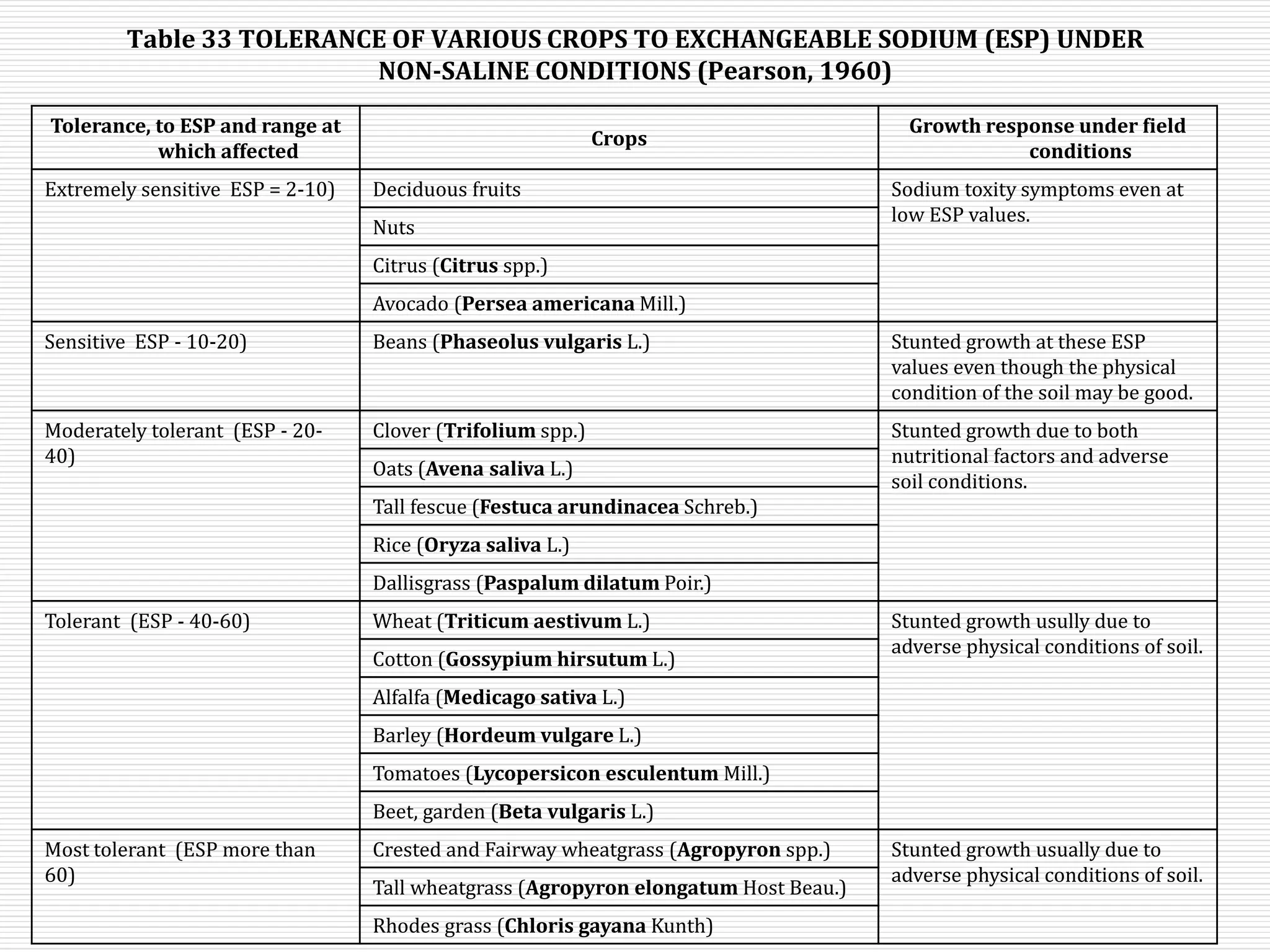
Table 33 TOLERANCE OF VARIOUS CROPS TO EXCHANGEABLE SODIUM (ESP) UNDER
NON-SALINE CONDITIONS (Pearson, 1960)
Tolerance, to ESP and range at
which affected
Crops
Growth response under field
conditions
Extremely sensitive ESP = 2-10) Deciduous fruits Sodium toxity symptoms even at
low ESP values.
Nuts
Citrus (Citrus spp.)
Avocado (Persea americana Mill.)
Sensitive ESP - 10-20) Beans (Phaseolus vulgaris L.) Stunted growth at these ESP
values even though the physical
condition of the soil may be good.
Moderately tolerant (ESP - 20-
40)
Clover (Trifolium spp.) Stunted growth due to both
nutritional factors and adverse
soil conditions.
Oats (Avena saliva L.)
Tall fescue (Festuca arundinacea Schreb.)
Rice (Oryza saliva L.)
Dallisgrass (Paspalum dilatum Poir.)
Tolerant (ESP - 40-60) Wheat (Triticum aestivum L.) Stunted growth usully due to
adverse physical conditions of soil.
Cotton (Gossypium hirsutum L.)
Alfalfa (Medicago sativa L.)
Barley (Hordeum vulgare L.)
Tomatoes (Lycopersicon esculentum Mill.)
Beet, garden (Beta vulgaris L.)
Most tolerant (ESP more than
60)
Crested and Fairway wheatgrass (Agropyron spp.) Stunted growth usually due to
adverse physical conditions of soil.
Tall wheatgrass (Agropyron elongatum Host Beau.)
Rhodes grass (Chloris gayana Kunth)
Rice as a reclamative crop
 The high tolerance of rice to exchangeable sodium
arises chiefly because of its ability to withstand, and
in fact its need for, a layer of water on the field
throughout the growing season.
 Also, the high pH of sodic soils is reduced under
continuous flooding. Thus, Ponnamperuma and his
colleagues observed pH to decrease from 8.8 to 7
twelve weeks after flooding.
 This was ascribed to evolution of large quantities of
carbon dioxide from bacterial action and its
accumulation because of restricted diffusion of gases
in flooded soils (Ponnamperuma, 1965;
Ponnamperuma et al. 1966).
 The low permeability of sodic soils is a further
advantage to rice because losses of water due to
deep percolation are restricted, although in most
cases they are sufficient to leach soluble salts
resulting from the exchange of sodium present in the
root zone.
These factors make rice an ideal crop during the
reclamation of sodic soils and it can enhance the
reclamation process considerably.
Apart from being tolerant to high sodicity, growing rice
results in continuous soil improvement through
reduction in soil sodicity.
In conclusion, its relatively shallow and superficial root
system, its high sodicity tolerance and reclamative
action together with the need and possibility of storing
a large fraction of the rain water makes rice an ideal
crop during reclamation of sodic soils.
Grasses
 Grasses are, in general, more tolerant of sodic
conditions than most field crops.
 Field and greenhouse studies have shown that Karnal
grass (Diplachne fusca), Rhodes grass (Chloris
gayana). Para grass (Brachiaria mutica) and Bermuda
grass (Cynodon dactylon) are highly tolerant of sodic
conditions and can be successfully grown in sodic
soils (Ashok Kumar and Abrol 1979, 1983).
 Karnal grass grows extremely well in soils of very
high ESP (80 to 90) even when no amendment is
applied.
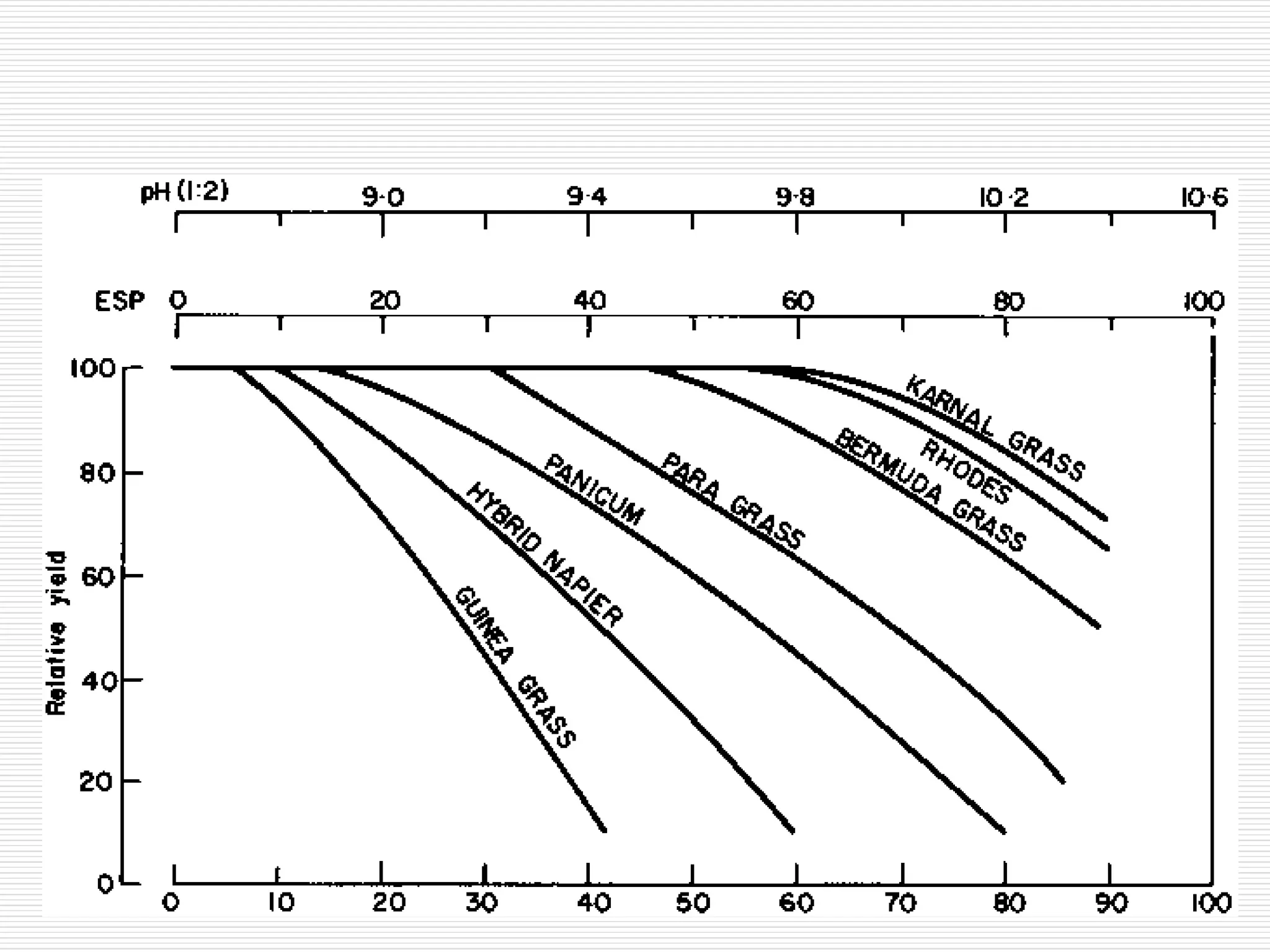
 Yield of five grasses in response to three levels of
gypsum application in a highly sodic soil (ESP is 90)
relative to their respective yields under normal, non-
sodic soil conditions (taken as 100) are shown in
Figure 25.
 Karnal grass gave high yield even in the control plots
(no gypsum) indicating its high tolerance of sodic
conditions (Plate 8). Rhodes grass yielded next
highest.
Karnal grass and para grass are also highly tolerant to
ponded water conditions, typically obtained in sodic soil
areas during the rainy season and even after each
irrigation.
In fact the yield of these two grasses increased with
submergence up to 8 days following each irrigation in
greenhouse studies (Figure 26) and this factor makes
these grasses extremely suitable for sodic soil
conditions.
When grasses are grown there is a continuous decrease
in soil sodicity with time and an improvement in soil
physical properties due to the biological action of grass
roots.
Thus growing tolerant grasses will not only provide
much needed forage but also improve the soils resulting
in increased absorption of rain water, reduced runoff
and soil losses due to erosion. Figure 27 depicts the
relative tolerance to exchangeable sodium of a few
selected grasses.
Figure 26 Effect of periodic submergence (2, 4 and 8 days) on the
relative yield of selected grasses (Ashok Kumar and Abrol, 1983)
Trees
 The recent emphasis on the concentration of and
need for additional sources of energy has demanded
that a sizeable fraction of available land resources be
diverted to forestry.
 Since there is keen competition for good land for
producing food crops, there is a greater possibility for
utilizing relatively marginal lands for forestry.
 Sodic soils constitute one such group. Earlier
attempts to grow trees in highly sodic soils were
largely a failure. Field studies by Yadav et al. (1975),
however showed that species like Eucalyptus hybrid,
Prosopis juliflora and Acacia nilotica could be grown
in highly sodic soils if the seedlings were planted in
pits 90 cm deep and 90 cm diameter after the pit soil
had been amended with gypsum and manure.
More recently, Sandhu and Abrol (1981) demonstrated
that if the tree seedlings were planted in auger holes 15
cm diameter and 150 cm deep, filled with a mixture of
original soil, 2 kg gypsum and 7 to 8 kg manure,
seedlings made excellent growth and there was 100
percent survival.
In this technique a favourable environment is created for
root growth and penetration; the roots nearly bypass the
sodicity and problems of hard subsurface soil layers and
proliferate in the zone of continuous moisture
availability (Plate 9).
Using this technique a large number of auger holes can
be made mechanically with a tractor-operated auger
(Plate 10).
Research to find techniques suited to particular soil,
climatic and prevailing socio-economic conditions and a
search for better-suited tree species will provide the
necessary stimulus for organizing the much needed
forestry programmes in such marginal lands
Crop varieties
 Even within the same crop there are large variations between
crop varieties in their tolerance to sodic soil conditions.
 Although there have been several studies aimed at identifying
genotypes and breeding new crop varieties tolerant of salinity
conditions, there appears only limited effort in this direction
with regard to sodic soils.
 Mishra and Bhattacharya (1980) compared the performance of
a few tall indica genotypes known for their tolerance to salinity
and a high yielding semi-dwarf rice variety IR 8 in soils of
varying sodicities in a pot culture experiment.
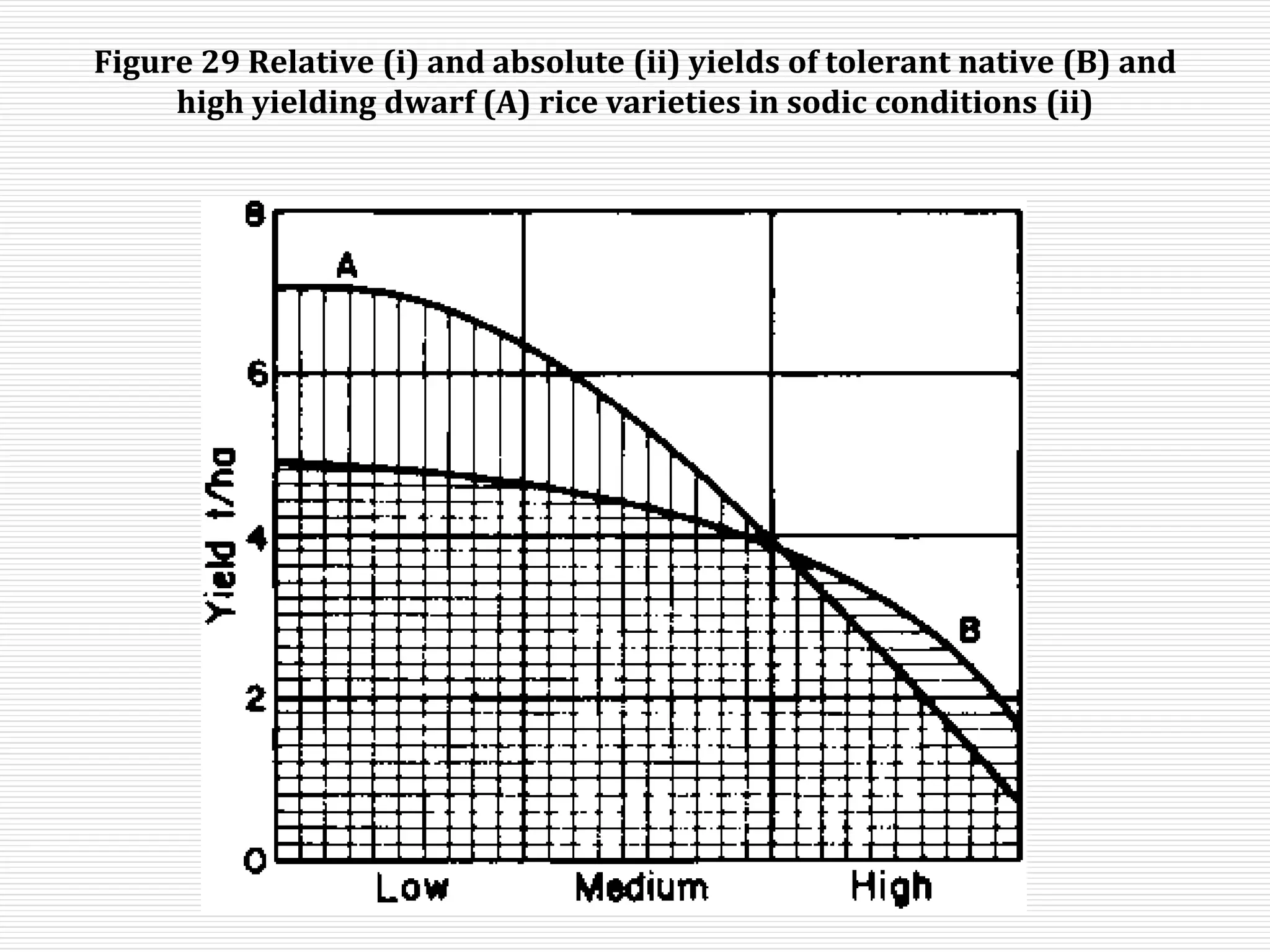
 Varieties CSR 1, CSR 2 and CSR 3 though low yielders in normal
soils of low ESP levels tended to yield more than the variety IR
8 at very high ESP levels.
 Some of the observed trends are shown in Figure 29.
 Since the absolute yield of a crop will be a major consideration
for most farmers, it is seen from Figure 29 that over a large
sodicity range the improved high yielding varieties would
perform better than the relatively tolerant native ones.
Figure 29 Relative (i) and absolute (ii) yields of tolerant native (B) and
high yielding dwarf (A) rice varieties in sodic conditions (i)
Figure 29 Relative (i) and absolute (ii) yields of tolerant native (B) and
high yielding dwarf (A) rice varieties in sodic conditions (ii)
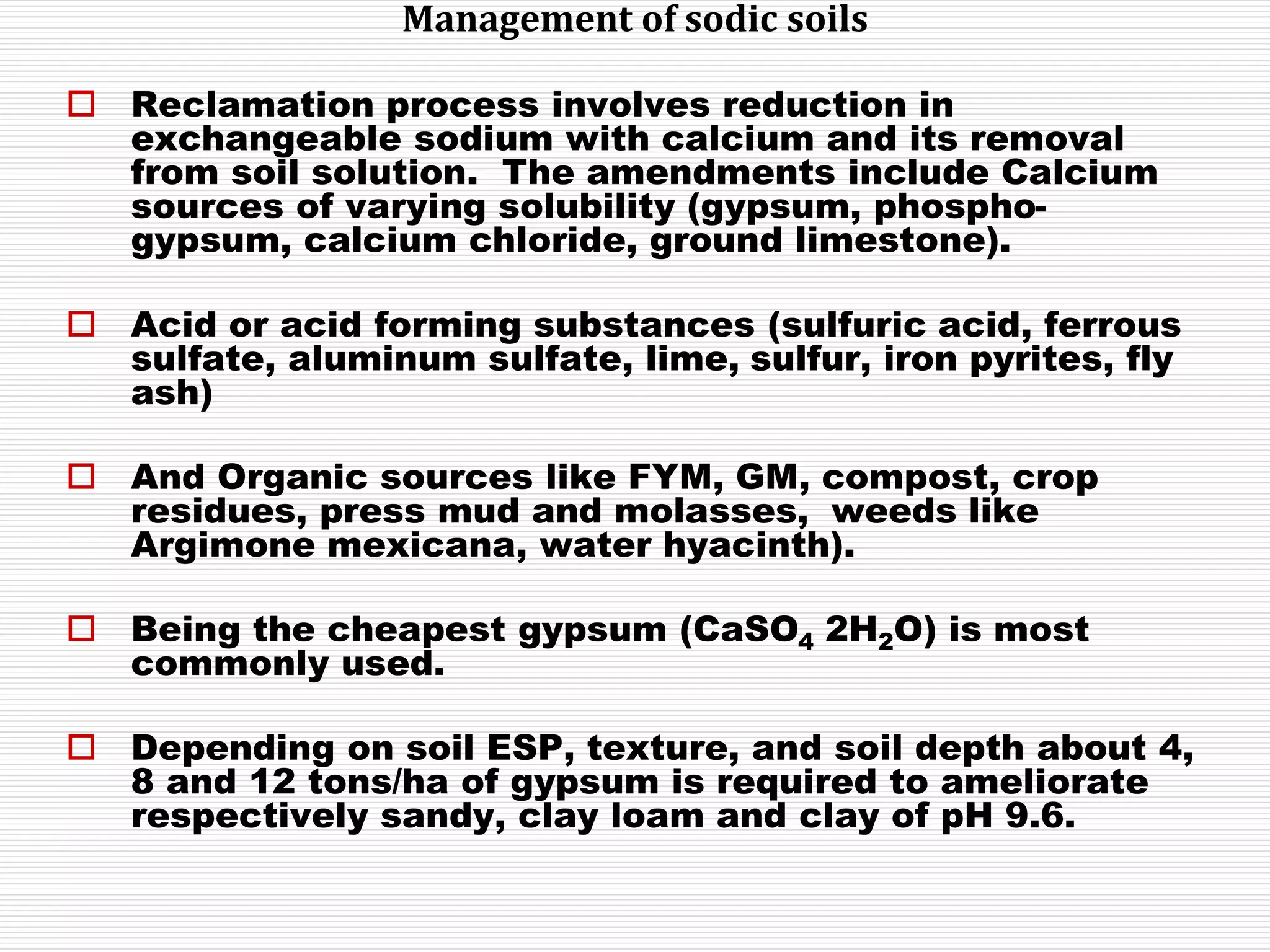
Management of sodic soils
 Management of sodic soils involves three approaches
1. improvement of soil condition by chemical reclamation,
2. crop choice and genetic modification of plants and
3. cultural/agronomic manipulations including land shaping,
water and fertilizer management.
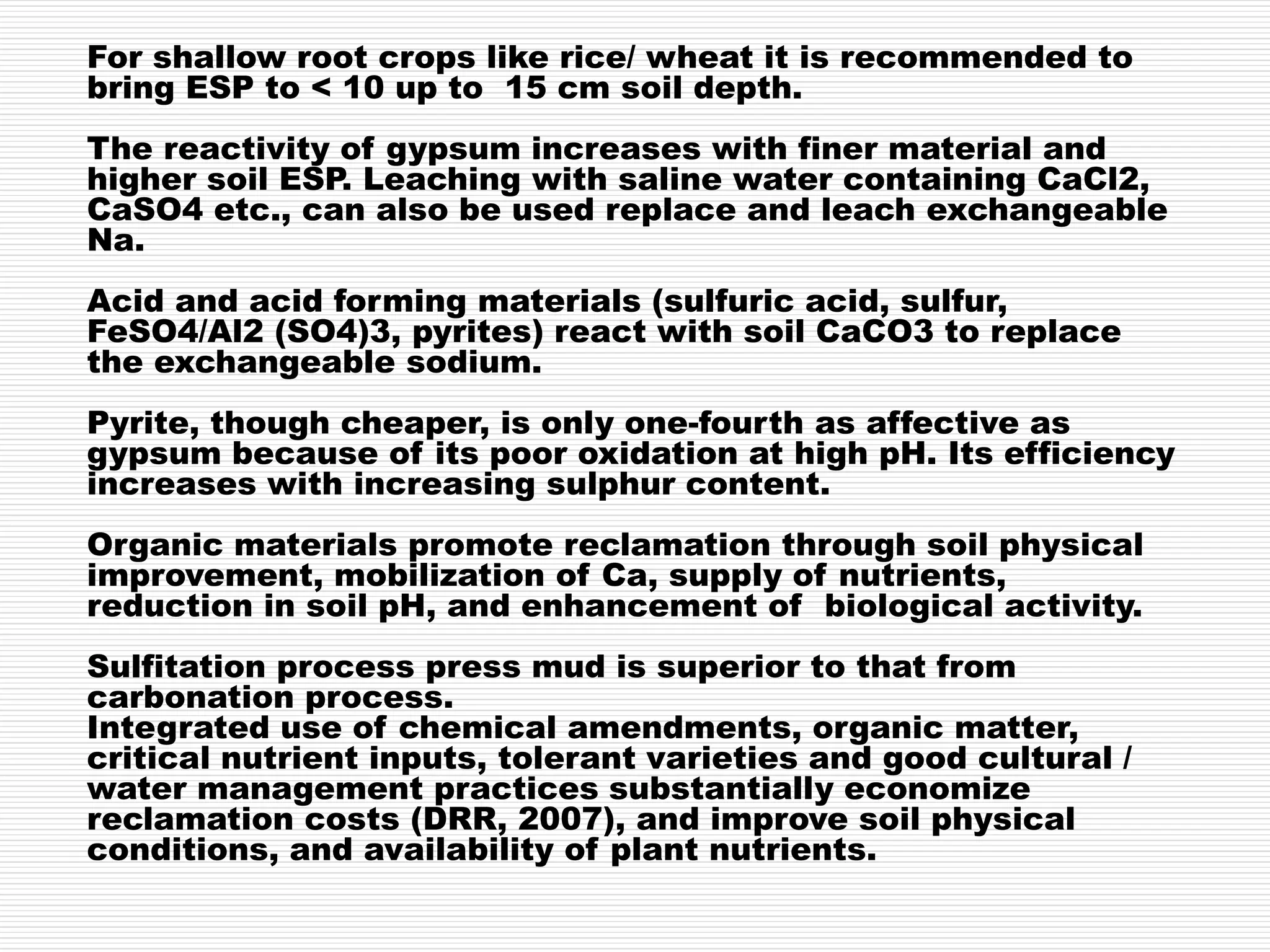
Management of sodic soils
 Reclamation process involves reduction in
exchangeable sodium with calcium and its removal
from soil solution. The amendments include Calcium
sources of varying solubility (gypsum, phospho-
gypsum, calcium chloride, ground limestone).
 Acid or acid forming substances (sulfuric acid, ferrous
sulfate, aluminum sulfate, lime, sulfur, iron pyrites, fly
ash)
 And Organic sources like FYM, GM, compost, crop
residues, press mud and molasses, weeds like
Argimone mexicana, water hyacinth).
 Being the cheapest gypsum (CaSO4 2H2O) is most
commonly used.
 Depending on soil ESP, texture, and soil depth about 4,
8 and 12 tons/ha of gypsum is required to ameliorate
respectively sandy, clay loam and clay of pH 9.6.
For shallow root crops like rice/ wheat it is recommended to
bring ESP to < 10 up to 15 cm soil depth.
The reactivity of gypsum increases with finer material and
higher soil ESP. Leaching with saline water containing CaCl2,
CaSO4 etc., can also be used replace and leach exchangeable
Na.
Acid and acid forming materials (sulfuric acid, sulfur,
FeSO4/Al2 (SO4)3, pyrites) react with soil CaCO3 to replace
the exchangeable sodium.
Pyrite, though cheaper, is only one-fourth as affective as
gypsum because of its poor oxidation at high pH. Its efficiency
increases with increasing sulphur content.
Organic materials promote reclamation through soil physical
improvement, mobilization of Ca, supply of nutrients,
reduction in soil pH, and enhancement of biological activity.
Sulfitation process press mud is superior to that from
carbonation process.
Integrated use of chemical amendments, organic matter,
critical nutrient inputs, tolerant varieties and good cultural /
water management practices substantially economize
reclamation costs (DRR, 2007), and improve soil physical
conditions, and availability of plant nutrients.
 Rice is tolerant to alkalinity up to ESP of 50. Continuous
growing of rice hastens soil reclamation through removal
of exchangeable sodium by mobilizing native CaCO3,
decreases soil pH through root respiration.
 Application of double the dose of Zn (100 kg ZnSO4 /ha)
initially and later normal dose is recommended.
 Cultural management practices include planting older
(>30 days) seedlings, 4-6 seedlings/hill, deep ploughing up
to 100 cm to break hard pans for water movement and
root penetration, application of 25% more N.
 Improve water uptake and root penetration requires
frequent irrigation with less quantity of irrigation water .
 Tolerant rice varieties such as CSR 13, CSR 23, Vikas,
CSR 27, CSR 30, Kalanamak, etc enhance rice
productivity in such soils.
 Agro forestry systems like silviculture, silvipasture, fodder
grasses (Kannal grass, paragrass, Bermuda grass), salt
tolerant trees lke Albizia procera, Acacia sps .having high
ESP tolerance are alternate economic options.
Nutrient requirements of crops
 High levels of exchangeable sodium and accompanying high pH
of sodic soils affect the transformations and availability of
several essential plant nutrients. For this reason, optimum
crop production in sodic soils calls for special fertilizer
management practices compared to soils unaffected by
sodicity. Our knowledge of the nutrient relations of crops in
sodic soils is limited and generalizations can be made only with
caution.
Nitrogen management in sodic soils
 Nitrogen Owing to their low organic matter content, sodic
soils are generally deficient in available nitrogen.
 Further, excess sodium on the soil exchange complex
imparts structural instability to the soil giving these soils
characteristic, poor physical properties.
 The infiltration rate of the soils is low and the soils have
restricted internal drainage.
 For this reason the surface soil layers remain nearly
saturated for prolonged periods following irrigation or rain
resulting in temporary anaerobic conditions.
 Dutch work with potatoes (Van Hoorn, 1958) showed that
under conditions of poor soil structure, twice as much
nitrogen was needed as when under conditions of good soil
structure.
 In a number of field trials at the Central Soil Salinity
Research Institute, Karnal, India (Annual Reports 1970 to
1980), responses of rice and wheat grown in sodic soils
were studied to levels of applied nitrogen.
 These studies showed that crops grown in sodic soils
generally responded to higher levels of N application
compared to crops grown in non-sodic soils but otherwise
similar soil and climatic conditions.
 Based on these results it is generally recommended that
crops grown in sodic soils be fertilized at 25 percent excess
over the rates recommended for normal soils.
Similarly, between two irrigation cycles, water movement to
plant roots from subsurface soil layers is restricted causing
the surface soil layers to dry too soon.
Thus the surface soil layers experience extremes of the water
regime during the crop growth period.
Patrick and Wyatt (1964) reviewing the literature on elemental
nitrogen losses from soil concluded that losses were likely to
be highest under alternate aerobic and anaerobic conditions,
a situation exactly met within sodic soils.
High pH of sodic soils and poor soil physical conditions are
also likely to adversely affect the transformations and
availability of applied nitrogenous fertilizers.
In view of the above factors, crop yields in sodic soils are
adversely affected unless additional nitrogen is applied to
compensate for losses due to denitrification, volatilization,
etc.
 The general trend of phosphorus availability in
relation to pH and degree of sodium saturation was
shown (Figure 32) by Pratt and Thorne (1947) based
on measurements made in clay suspensions.
 Chhabra et al. (1980) analysed a large number of soil
samples from barren sodic soils and reported that
these soils generally contained high amounts of
extractable phosphorus and that there was a positive
correlation between soluble P status and the
electrical conductivity of the soil.
 Presence of sodium carbonate in these soils resulted
in the formation of soluble sodium phosphates and
hence a positive correlation between electrical
conductivity and soluble P status.
Phosphorus management in sodic soils
However, when a soil contains significant amounts of
sodium carbonate (and also soluble P) most of the soil
calcium is in the calcium carbonate form and not
available to the plants resulting in complete crop
failures.
When an amendment, say gypsum, is applied to improve
sodic soils, the soluble sodium-phosphates are
converted to less soluble Ca-phosphates.
Chhabra and Abrol (1981) observed that crops grown in
freshly reclaimed sodic soils did not respond to applied
P fertilizers for 4-5 years because of their high available
P status.
These studies have clearly shown that proper
evaluation of the fertilizer needs of crops grown in
sodic soils could considerably reduce the cost of crop
production in these soils.
Figure 32 Solubility of phosphate in water from suspensions of
bentonite clay of varying levels of sodium saturation (Pratt and
Thorne, 1948)
 Several studies have shown that increasing soil sodicity
resulted in reduced uptake of potassium by most crops (Singh
et al., 1979, 1980, 1981) although the opposite was true for
some other crops (Chhabra et al., 1979; Martin and Bingham,
1954).
 The significance of reduced uptake of potassium with
increasing ESP (Table 37) in K fertilization needs of crops has
been investigated in detail.
 Lack of response to applied K in sodic soils observed in some
studies at Karnal was attributed to the presence in the soil of K-
bearing minerals which could supply sufficient K to meet the
crop requirements (Pal and Mondal, 1980).
Potassium management in sodic soils
 Increasing soil sodicity nearly always results in an increased
uptake of sodium and decreased uptake of calcium by plants
(Table 38).
 However, as can be seen from the data, with an increase in
ESP the increase in sodium concentration of plants is usually
much larger compared to the decrease in the calcium
concentration.
 For this reason the plants often accumulate sodium in toxic
quantities before the calcium becomes limiting for plant
growth.
 However, when the exchangeable sodium levels are very
high, calcium is often the first limiting nutrient, for example
when the soils contain appreciable quantities of free sodium
carbonate and the soil pH is high such that application of
amendments is absolutely necessary.
Calcium management in sodic soils
 High pH, low organic matter content and presence of
calcium carbonate strongly modify the availability of
micronutrients to plants grown in sodic soils.
 Zinc deficiency has been widely reported for crops
grown in sodic soils (Plate 11) and is accentuated
when an amendment is applied to a Zn-deficient sodic
soil (Singh et al. 1982).
 Several field studies have shown significant increase
in crop yields due to application of zinc.
 Field studies by Singh et al. (1982) (Table 39) showed
that application of 10 kg ZnSO4/ha was sufficient to
mitigate the deficiency of Zn in rice grown in an
amended, highly sodic soil.
 Next to zinc, iron is often the limiting micronutrient in
sodic soils due to high pH and presence of calcium
carbonate.
Micronutrients management in sodic soils
Addition of iron salts to correct the deficiency was generally
not useful unless it was accompanied by changes in the
oxidation status of the soil brought about by prolonged
submergence and addition of organic matter (Katyal and
Sharma, 1980). Swarup (1980) showed a marked increase in
the extractable Fe and Mn status of a sodic soil upon
submergence up to 60 days; the increase was more when
organic materials like rice husk or farmyard manure were
incorporated in the soil.
Boron and molybdenum are not likely to be limiting elements
for plant nutrition in sodic soils. In fact, they are often likely to
be present in the toxic range.
Kanwar and Singh (1961) observed a positive correlation
between water soluble boron and the pH and EC of soils. In a
laboratory study Gupta and Chandra (1972) observed a marked
reduction in the water soluble boron content of a highly sodic
soil upon addition of gypsum.
At high pH and sodicity, boron is present as highly soluble
sodium metaborate which upon addition of gypsum is
converted to relatively insoluble calcium metaborate
 Reduced uptake of boron by grasses (Table 40) with
decreasing ESP due to gypsum application was also
reported by Ashok Kumar and Abrol (1982).
 As with B, solubility of Mo increases with pH
(Pasricha and Randhawa, 1971) and for this reason
forage grown on sodic soils is likely to accumulate
Mo in excessive quantities, which may prove toxic
to the animals feeding on them.
 Chhabra et al. (1980) and Gupta et al. (1982) studied
the effect of sodicity on the solubility of fluoride, an
element important from the animal nutrition
viewpoint.
 Water extractable fluoride increased with increasing
sodicity and pH (Figure 33), the latter having a more
important role in determining the behaviour of
fluoride in soils. It was further shown that the F
content of plants increased with increasing ESP and
decreased with application of P fertilizer (Singh et
al. 1979, 1980).
Nutrient mgt in salt affected soils
 Problem in sodic soil and soils irrigated with sodic water
 High alkalinity
 Exchangeable Na
 Presence of CaCO3
 Poor air-water relations
 Deficiency of Ca ( both soluble and Exchangeable)
 Na –antagonistic effect on absorption of Ca
 Problem in saline soil
 Excessive neutral salts
 Cl and SO4 of Na , Ca, Mg and K
 High osmotic stress
 Low physiological availability of water
 Toxic effects of individual ions
 Affects nutrient availability by modifying retention , fixation,
transformation , uptake and absorption of nutrients.
 Reduced nutrient metabolism due to water stress.
 Nitrogen
 Low organic carbon
 Poor in total and available N
 Excessive losses of N due to NH4 volatalisation, denitrification
and leaching.
 Reduced uptake of NO3 due to antagonostic effect of Cl and
SO4 and high leaching losses of NO3
 Inefficient utilisation of N for grain production.
 Poor crop growth due to nutritional and cationic imbalances
within the plant and hence poor crop response of applied
fertilizers.
 Decreased rate of nitrification due to high salinity and direct
toxic effects of Cl on microbial activity.
 Poor symbiotic N fixation due to toxic effects of salts on
Rhizobia leading to drastic reduction in nodulation.
 Reduced activity of Urease and decrease hydrolysis of urea.
 Bhumbla ( 1974) observed that complete hydrolysis of urea in
a soil having pH 9.8 was delayed by four days as compared to
pH 8.6
 Flooding-ammonification-10-60 % of applied N
loss through volatalisation.
 High alkalinity and high amounts of CaCO3
favours ammonia volatalization losses in sodic
soil.
 Rao and Batra ( 1983) -62 % of N applied to
alkali soil ( pH-10.2) was lost in a span of 10
days, while the loss was 0.2 % in normal soil
( pH 7.8)
 Application of 25 % extra dose of N.
 Split application of N
 Application of S, Neem coated urea, prilled
urea
 Application of organic manures, green manures
combined with gypsum.
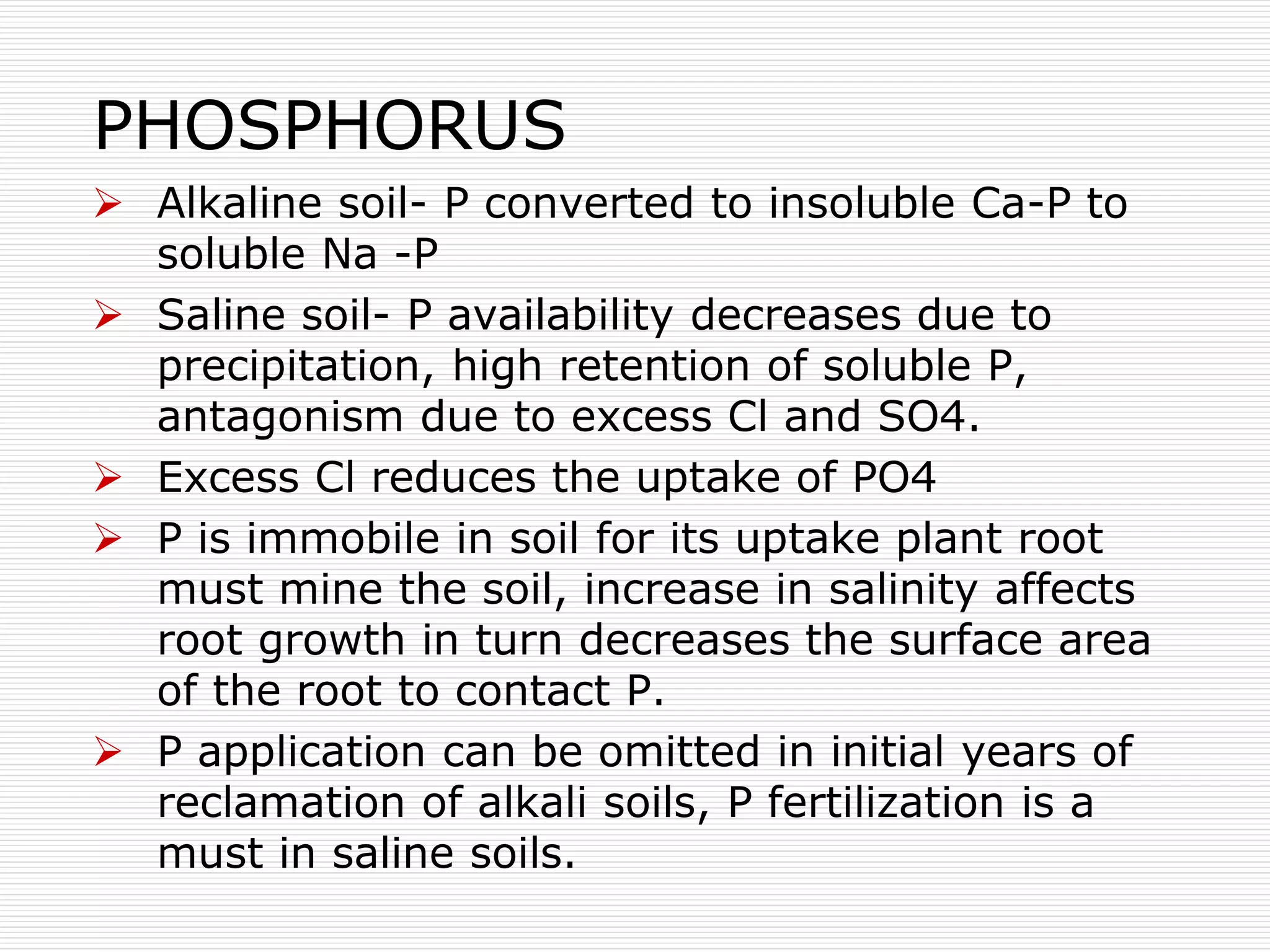
PHOSPHORUS
 Alkaline soil- P converted to insoluble Ca-P to
soluble Na -P
 Saline soil- P availability decreases due to
precipitation, high retention of soluble P,
antagonism due to excess Cl and SO4.
 Excess Cl reduces the uptake of PO4
 P is immobile in soil for its uptake plant root
must mine the soil, increase in salinity affects
root growth in turn decreases the surface area
of the root to contact P.
 P application can be omitted in initial years of
reclamation of alkali soils, P fertilization is a
must in saline soils.
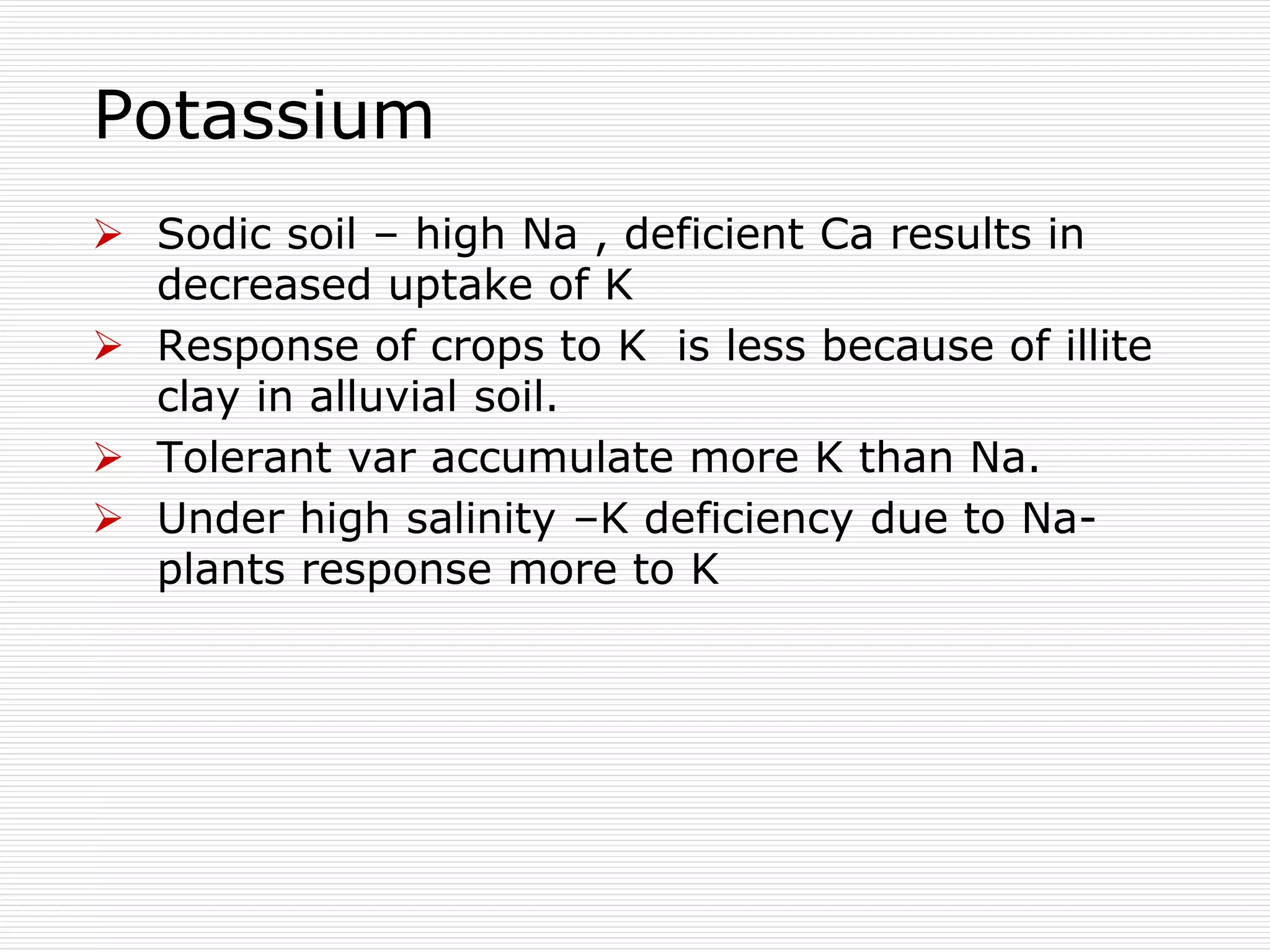
Potassium
 Sodic soil – high Na , deficient Ca results in
decreased uptake of K
 Response of crops to K is less because of illite
clay in alluvial soil.
 Tolerant var accumulate more K than Na.
 Under high salinity –K deficiency due to Na-
plants response more to K
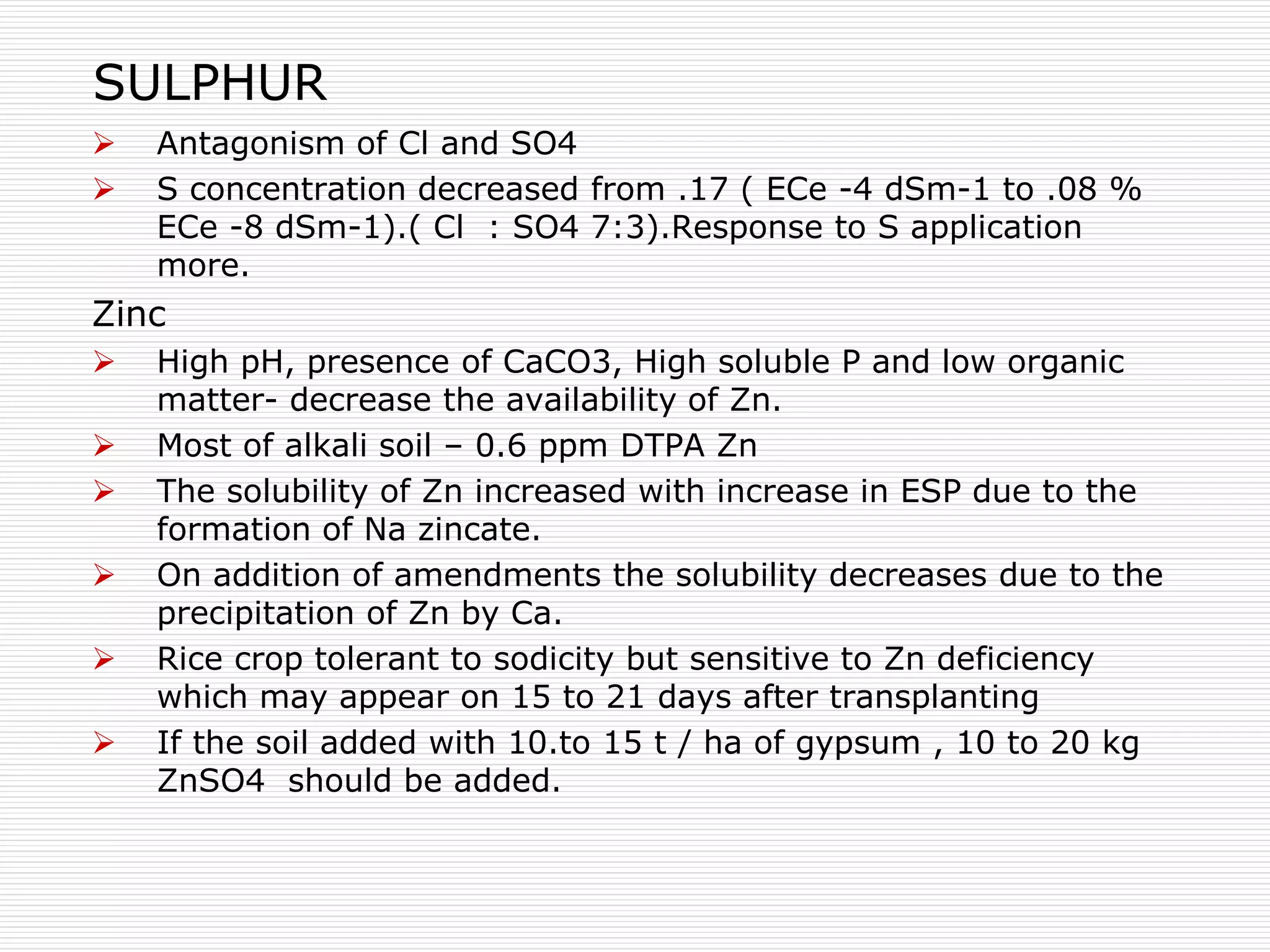
SULPHUR
 Antagonism of Cl and SO4
 S concentration decreased from .17 ( ECe -4 dSm-1 to .08 %
ECe -8 dSm-1).( Cl : SO4 7:3).Response to S application
more.
Zinc
 High pH, presence of CaCO3, High soluble P and low organic
matter- decrease the availability of Zn.
 Most of alkali soil – 0.6 ppm DTPA Zn
 The solubility of Zn increased with increase in ESP due to the
formation of Na zincate.
 On addition of amendments the solubility decreases due to the
precipitation of Zn by Ca.
 Rice crop tolerant to sodicity but sensitive to Zn deficiency
which may appear on 15 to 21 days after transplanting
 If the soil added with 10.to 15 t / ha of gypsum , 10 to 20 kg
ZnSO4 should be added.
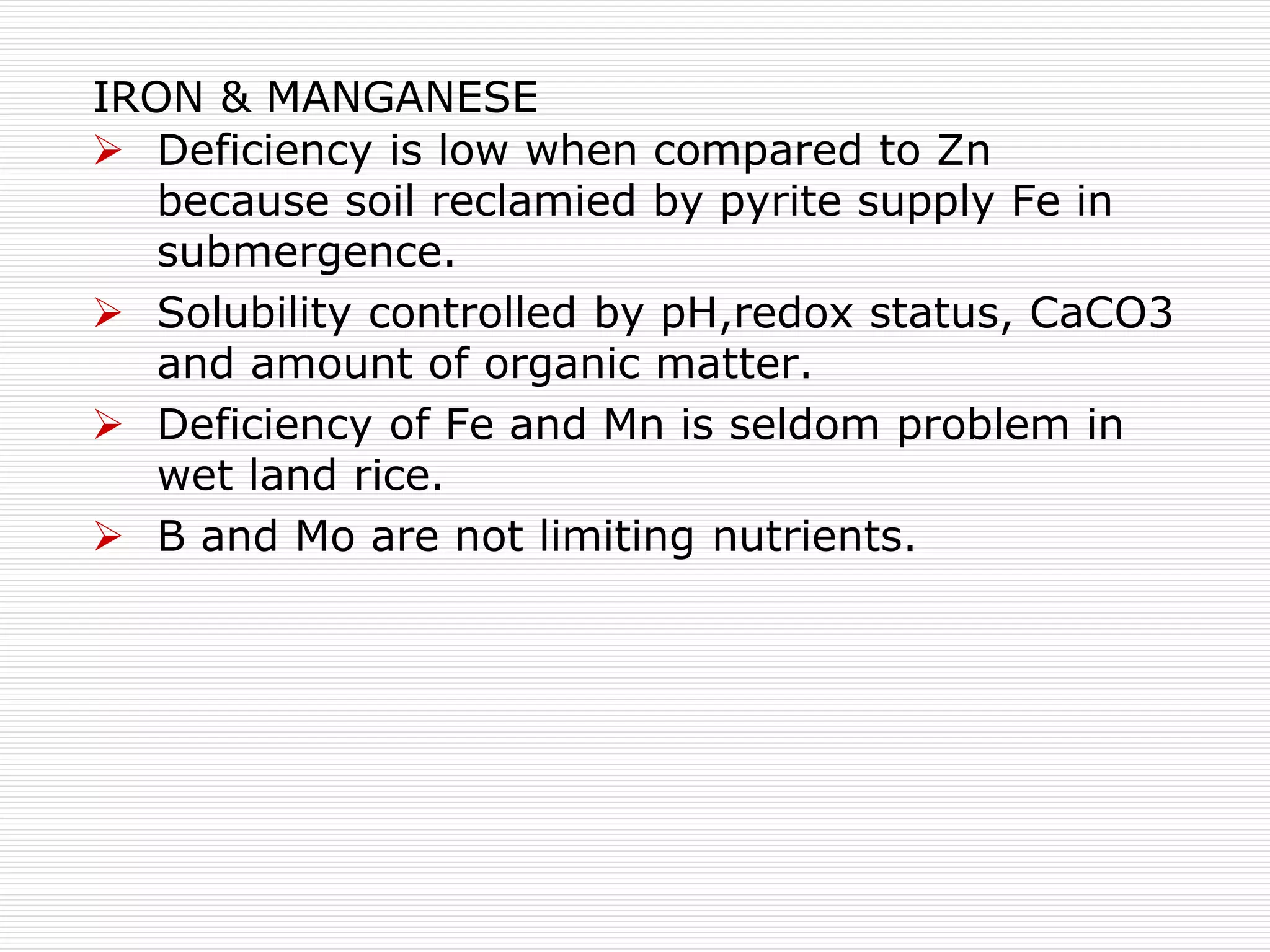
IRON & MANGANESE
 Deficiency is low when compared to Zn
because soil reclamied by pyrite supply Fe in
submergence.
 Solubility controlled by pH,redox status, CaCO3
and amount of organic matter.
 Deficiency of Fe and Mn is seldom problem in
wet land rice.
 B and Mo are not limiting nutrients.
Drainage
 Irrigation is the most effective means of stabilizing agricultural
production in areas where the rainfall is either inadequate for
meeting the crop requirements or the distribution is erratic.
 Before the introduction to an area of large quantities of water
through irrigation, there exists a water balance between the
rainfall on the one hand and stream flow, groundwater table,
evaporation and transpiration on the other.
 This balance is seriously disturbed when additional quantities of
water are artificially spread on the land to grow agricultural
crops, introducing additional factors of groundwater recharge
from seepage from canals, distributors and field channels, most
of which are unlined, and from the irrigation water let on to the
fields over and above the quantities actually utilized by the crops,
etc.
 As a result of these, the groundwater table rises.
 There are numerous instances throughout the world, where
consequent upon the introduction of canal irrigation, the water
table has risen considerably within 10 years to less than 2 m.
Once the groundwater table is close to the soil surface, due to
evaporation from the surface, appreciable movement of the
groundwater takes place resulting in the accumulation of salts
in the root zone.
A schematic relationship between depth of groundwater and
evaporation from the soil surface is shown in Figure.
This relationship is significant and shows that there is a
critical depth of water table above which there is a sharp
increase in the evaporation rate and therefore soil salinization.
In general, the critical depth of water table ranges between
1.5 to 3.0 metres depending on soil characteristics, root zone
of crops, salt content of groundwater, etc:
To ensure a salt-free root zone, evaporation from the
groundwater must be prevented thus keeping the groundwater
table below the depth that will cause rapid soil salinization.
Provision of adequate drainage measures is the only way to
control the groundwater table.
Subsurface drainage problems may also arise due to the
presence, at some soil depth, of a clay barrier, a hardpan, bed
rock, or even a subsoil textural change.
Surface drainage
 In surface drainage, ditches are provided so that
excess water will run off before it enters the soil.
 However the water intake rates of soils should be
kept as high as possible so that water which could be
stored will not be drained off.
 Field ditches empty into collecting ditches built to
follow a natural water course.
 A natural grade or fall is needed to carry the water
away from the area to be drained.
 The location of areas needing surface drainage can
be determined by observing where water is standing
on the ground after heavy rain.
 Field ditches and collection or outlet ditches should
be large enough to remove at least 5 cm of water in
24 hours from a level to a gently sloping land.
 The capacity of a drainage system should be based
on the amount and frequency of heavy rains.
How quickly water runs into ditches depends on the rate of
rainfall, land slope and the condition of the soil surface
including the plant cover.
The area that a ditch can satisfactorily drain depends on how
quickly water runs into the ditch, the size of the ditch, its
grade or slope and its irregularity.
The latter is measured by the roughness and the contents of
debris and growing vegetation in the ditch. In relatively level
areas (slope < 0.2%) a collecting ditch may be installed along
one side and shallow v-shaped field ditches constructed to
discharge into this collecting ditch.
Field ditches used to discharge water into collecting ditches
should be laid out parallel to each other 20 to 60 m apart.
They should be 30 to 45 cm deep depending upon the depth of
the collecting ditch.
Care should be taken to avoid sharp curves in the ditches to
lessen erosion of the banks
Subsurface drainage
 If the natural subsurface drainage is insufficient to carry the
excess water and dissolved salts away from an area without the
groundwater table rising to a point where root aeration is affected
adversely and the groundwater contributes appreciably to soil
salinization, it may be necessary to install an artificial drainage
system for the control of the groundwater table at a specified safe
depth.
 The principal types of drainage systems may consist of horizontal
relief drains such as open ditches, buried tiles or perforated pipes
or in some cases pumped drainage wells.
Open ditches
 Open drainage ditches are advantageous for removing large
volumes of either surface or subsoil water from land and for use
where the water table is near the surface and the slope is too
slight for proper installation of tile drains.
 Where subsurface tile drains are uneconomic or physically
impossible, as in many heavy clay soils and where the topography
is nearly flat, open drains may be the only practical means of
draining the land.
 Open ditches also serve as outlets for tile drains where their depth
is sufficient and other conditions are favourable.
 The chief disadvantage of open drains is that they occupy land
that might otherwise be put to cultivation; open ditches across
cultivated fields also obstruct farming operations and are a danger
to the livestock and are more costly to maintain than the
subsurface covered drains.
 Open drains become ineffective due to growth of weeds, collapse
of banks resulting in partial filling with soil material, etc., and
must be periodically cleaned
Mole drains
 Mole drains are channels left by a bullet shaped device pulled
through the soil, they have been used successfully for shallow
subsurface drainage of heavy clay soils in many, relatively
humid, parts of Europe but have been found impractical with
soils of coarser texture.
 Mole drains are generally cheaper to install than tile or plastic
tubings but may last only for two or three years.
 In addition to being temporary, mole drains are generally
shallow and have not been used extensively where salinity build
up from the groundwater table is a major problem.
Other subsurface drains
 These include any type of buried conduit with open
joints or perforations that collect and convey excess
water from the soil.
 The conduits may be made from clay, concrete,
plastic or other synthetic material but clay and
concrete tiles have been the most widely used.
 Clay tiles are generally manufactured in 30 and 60 cm
lengths and have an inside diameter of 10 to 25 cm.
 They are made from surface clay or shale, which is
pulverized, extruded through a die, dried and then
burnt in a kiln.
 Clay tiles are not affected by acid or sodic soils but
those made from surface clay or poorly burnt tiles are
subject to deterioration by freezing and thawing
action.
Good quality clay tiles have been found to last
indefinitely in the soil.
Concrete tiles are made from sand and gravel
aggregate and steam or water-cured to obtain the
desired strength.
Concrete tiles are resistant to freezing and thawing but
may be subject to deterioration in acid and sodic soils.
For such soils the tiles should be made with cement
having a special chemical composition.
Water enters the tiles at the butt joints or spaces
between adjacent sections. Both clay and concrete
tiles may have fitted ends and be perforated for easier
entry of water.
Filter materials
 These are sometimes placed around subsurface drains primarily
to prevent the inflow of soil into the drains which may cause
failure, and/or to increase the effective diameter or area of
openings in the drains which increases inflow rate. Two types of
materials are generally used:
 thin sheets such as of fibre glass or spun nylon, and
 sand and gravel envelopes or other porous granular
materials.
 The thin sheet filters may be sealed on to the plastic tubing at the
manufacturing site or they may be installed above and/or below
the drains as they are being laid.
 Granular materials should be placed above or below the drains
during installation.
 Such materials must have the proper gradation of sizes to prevent
the inflow of soil.
Cultural practices
 Practices that can enhance the reclamation of sodic soils considerably
include:
 Mulching –
 In the initial years when the concentration of soluble salts is high in
the surface soil layers, mulching can considerably help leach soluble
salts, reduce ESP and obtain higher yields of tolerant crops.
 Increasing depth of rice husk resulted in increased and deeper
leaching of salts and significant improvement in the yield of the
following rice crop. Thus, wherever feasible, mulching to reduce
downward flux of soluble salts should be encouraged.
 Continuous cropping –
 Fallowing encourages upward movement of salts.
 Once reclamation of sodic soils is started it is advisable to crop the
land all the time.
 Continuous cropping, particularly when rice is one of the crops in the
sequence, improves the soil, reducing ESP with time to a gradually
increasing depth.
 As has been discussed earlier, the beneficial effects of growing rice
can largely be attributed to the submerged conditions during its
growth which provide effective leaching of exchange products
formed during the growing period.
Package of practices recommended by
CSSRI for reclamation of sodic soil.
 Land leveling and bunding of fields and providing 35-40 cm
high bunds to check outflow and entry of water.
 Strong bunding is essential preserve and utilise rain water for
leaching salts.
 Suitable surface drains should be provided.
 Installation of tube wells to ensure timely irrigation .
 Quantify the gypsum requirement.
 Apply gypsum powder in the well ploughed and levelled field
one month before and mixed in the upper 8-10 cm soils.
 Allow water stagnation for 10- 15 days before transplanting
rice as a first crop.
 In the initial stage grow CSR 10 , Later on CSR 13, CSR 30 etc.
 For rice crop 35-40 days old seedlings grown on the normal
soil and 3-4 plants per hill. Seed rate 40-50 kg /ha
 Apply 25 % more N and ZnSO4 25 kg/ ha.
 P and K need not to apply during initial years
of reclamation
( 5-6 years).
 Grow wheat in winter season.
 5-6 irrigations for wheat crop.
 Summer season –grow sesbania
 The field should not allow fallow during
reclamation period
 After few years of continuous cropping other
crops may be introduced to diversify the
cropping system.
sodic-soil-formation-reclamation.ppt

sodic-soil-formation-reclamation.ppt

  • 1.
    SODIC SOILS ANDTHEIR MANAGEMENT
  • 2.
    Mode of formationof sodic soils  The mechanisms responsible for the formation of sodium carbonate in soils which characterize sodic (alkali) soils have been discussed in several standard works (Kelly, 1951; Bazilevich, 1965).  Groundwater containing carbonate and bicarbonate is one of the chief contributing factors in the formation of sodic soils in many regions.  The soils are reported to have formed by desalinization in the absence of enough divalent cations in some parts of the Nile Delta, by high carbonate and bicarbonate water in Wadi Tumilat and by denitrification and sulphate reduction under anaerobic conditions in Wadi-El-Natroun (Elgabaly, 1971).  Reduction of sulphate ions under anaerobic conditions and in the presence of organic matter was reported to result in the formation of sodium carbonate (Whittig and Janitzky, 1963).
  • 3.
     According toBhargava et al. (1980) the alternate wet and dry seasons and the topographic (drainage) conditions appeared to be the contributing factors in the formation of vast areas of sodic soils in the Indo-Gangetic plains of India.  During the wet season water containing products of alumino- silicate weathering accumulated in the low lying areas.  In the ensuing dry season, as a result of evaporation, the soil solution is concentrated resulting in some precipitation of the divalent cations, causing an increase in the proportion of sodium ions in the soil solution and on the exchange complex with simultaneous increase in pH.  This process repeated over years resulted in the formation of sodic soils.  Beek and Breemen (1973) pointed out that highly sodic soils could be developed in a closed basin with an excess of evaporation over precipitation if the inflowing water has a positive residual sodicity.  Similarly, groundwater containing residual sodicity could result in the formation of sodic soils when the groundwater table is near the surface and contributes substantially to evaporation.
  • 4.
    Characteristics of sodicsoils  The chief characteristic of sodic soils from the agricultural stand point is that they contain sufficient exchangeable sodium to adversely affect the growth of most crop plants.  For the purpose of definition, sodic soils are those which have an exchangeable sodium percentage (ESP) of more than 15.  Excess exchangeable sodium has an adverse effect on the physical and nutritional properties of the soil, with consequent reduction in crop growth, significantly or entirely.  The soils lack appreciable quantities of neutral soluble salts but contain measurable to appreciable quantities of salts capable of alkaline hydrolysis, e.g. sodium carbonate.
  • 5.
     The electricalconductivity of saturation soil extracts are, therefore, likely to be variable but are often less than 4 dS/m at 25 °C.  The pH of saturated soil pastes is 8.2 or more and in extreme cases may be above 10.5.  Dispersed and dissolved organic matter present in the soil solution of highly sodic soils may be deposited on the soil surface by evaporation causing a dark surface which is why these soils have also been termed as black sodic soils.  Under field conditions after an irrigation or rainfall, sodic soils typically have convex surfaces.  The soil a few centimetres below the surface may be saturated with water while at the same time the surface is dry and hard
  • 6.
     Upon dehydrationcracks 1-2 cm across and several centimetres deep form and close when wetted.  The cracks, generally, appear at the same place on the surface each time the soil dries unless it has been disturbed mechanically.  The principal cause of alkaline reaction of soils is the hydrolysis of either the exchangeable cations or of such salts as CaCO3, MgCO3, Na3CO3, etc. Hydrolysis of the exchangeable cations takes place according to the following reactions
  • 7.
     In thisreaction H+ is inactivated by exchange adsorption in place of Na+. The displaced Na does not combine with, and OH- ions which results in an increase in the OH- ion concentration and increased soil pH.  The extent to which exchangeable cations hydrolyse depends on their ability to compete with H+ ions for exchange sites.  Ions such as Na+ are unable to compete as strongly as the more tightly held ions such as Ca2+ and Mg2+.  For this reason exchangeable Na+ and K+ are hydrolysed to a much greater extent and produce a higher pH than do exchangeable Ca2+ or Mg2+.  Hydrolysis of exchangeable Ca2+ and Mg2+ ions, in fact, is so limited that it results in a soil having only by a mildly alkaline reaction. Hydrolysis of compounds like CaCO3, and MgCO3, takes place according to the reaction:
  • 8.
     This isdue to the higher solubility of Na2CO3 and therefore the greater potential for hydrolysis. According to Cruz-Romero and Coleman (1975) exchangeable sodium and CaCO3 react in low CO2 - low neutral salt environments to produce high pH and appreciable concentrations of Na2CO3.  Since the soils of arid and semi-arid regions nearly always contain some calcium carbonate, a build up in the exchangeable sodium in the absence of an appreciable quantity of neutral soluble salts will always result in high pH; the exact value depending on the concentration of Na2CO3, formed or the level of ESP.
  • 9.
     In thisreaction H+ from water is inactivated through combination with carbonate to form weakly ionized carbonic acid.  Hydroxyl ions are not inactivated through combination with Ca2+ resulting in an alkaline solution.  The hydrolysis of CaCO3 and of MgCO3, is limited due to their low solubilities and therefore they tend to produce a pH in soils no higher than about 8.0 to 8.2.  Soils containing measurable quantities of Na2CO3, have a pH of more than 8.2; the pH increases with increasing amounts of Na2CO3, and may be as high as 10.0 to 10.5.
  • 10.
    Relationship between thepH of saturated soil paste, and exchangeable sodium percentage (ESP) (Abrol et al., 1980)
  • 11.
    pH OF SATURATEDSOIL PASTE AND APPROXIMATE ESP pH of saturated soil paste Approximate ESP 8.0 - 8.2 5 - 15 8.2 - 8.4 15 - 30 8.4 - 8.6 30 - 50 8.6 - 8.8 50 - 70 8.8 70
  • 12.
    Relationship between pHand ESP  The relationship between soil pH and ESP of the kind shown in Figure 17 (Table) exists only for specific kinds of sodic soils, that is, soil having measurable to appreciable quantities of salts capable of alkaline hydrolysis and having a saturated soil paste pH above 8.0.  Such a relationship does not exist for saline soils,, i.e. soils dominated by neutral soluble salts, the pH of which is normally less than 8.0. Calcareous soils, even at very low ESP values, have a pH mainly determined by the ambient CO2, partial pressure  As this relationship is not a universal one and may only be applied for specific and similar conditions, it is not advisable to use pH as a general index of sodicity.
  • 13.
    For the purposesof definition, US Salinity Laboratory researchers (Richards 1954) had suggested a saturated soil paste pH of 8.5 or more for characterizing soils as ‘alkali’. In later publications however, the US scientists preferred the term ‘sodic’ to ‘alkali’ and in the definition of sodic soil a reference to soil pH was omitted. As already discussed, there is a relationship between pH and soil sodicity for soils containing calcium carbonate as do most soils of semi-arid regions. Studies (Gupta et al., 1982, 1983) have also shown that pH strongly influences the soil physico-chemical behaviour as distinct from the effect of exchangeable sodium on soil properties. For this reason these workers suggest that pH should be an integral part of the definition of sodic soils.
  • 14.
     An ESPof 15 is generally recognized as a limit above which the soils are characterized as sodic (alkali) (Richards, 1954).  This limit, though tentative, has been increasingly found useful because many soils show a sharp deterioration in physical properties around or above this ESP (Abrol et al., 1978; Acharya and Abrol, 1978; Varallyay, 1977; Gardner et al., 1959), although for some soils a lower ESP (6) has been suggested as a limiting value (Northcote and Skene, 1972).  A survey of published data (Abrol et al., 1980) showed that for sodic soils, most often an ESP of 15 to 20 is associated with a saturation paste pH of 8.2.  For diagnostic purposes therefore it was suggested that a saturation paste pH of 8.2 will be more realistic than the value of 8.5 which is nearly always associated with higher values of ESP.
  • 15.
    Measuring sodicity/alkali statusof soils pH measurement  pH measurement is a significant diagnosis of salt-affected soils but dependence of pH value upon the soil- water ratio of the suspension in which it is measured is frequently ignored in the reports and pH data are given with no indication of the dilution factor used.  Interpretation of such data is difficult, even impossible, pH data in Table were measured on a saturated soil paste and Figure gives the relationship between pH of saturated soil paste and pH of 1:2 soil-water suspension.  It is seen that pH of 1:2 soil-water suspension is greater than the pH of saturated soil paste by about 1 unit.  Thus for characterizing soils as sodic, if the pH is measured in 1:2 soil-water suspension, the limiting pH value will be about 9.0 instead of 8.2 as suggested above. Relationship between pH of saturation paste, pHs and pH of 1:2 soil-water suspension, pH2 for soil of varying ESP2
  • 16.
    Evaluating ESP  Everysoil has a definite capacity to adsorb the positively charged constituents of dissolved salts, such as calcium, magnesium, potassium, sodium, etc.  This is termed the cation exchange capacity.  The various adsorbed cations can be exchanged one for another and the extent of exchange depends upon their relative concentrations in the soil solution, the valence and size of the cation involved, nature and amounts of other cations present in the solution or on the exchange complex, etc.  Exchangeable sodium percentage (ESP) is, accordingly, the amount of adsorbed sodium on the soil exchange complex expressed in percent of the cation exchange capacity in milliequivalents per 100 g of soil. Thus,  Exchangeable sodium percentage (ESP)
  • 17.
    SAR as anindex of sodicity hazards  Experimental determination of exchangeable sodium percentage is tedious, time consuming and subject to errors.  Incomplete removal of index salt solution during the washing step of CEC determinations can lead to high CEC values and therefore low ESP estimates.  Similarly, hydrolysis of exchangeable cations during the removal of the index salt solution, fixing of ammonium ions from the index or replacement solution by the soil minerals and the dissolution of calcium carbonate or gypsum in the index or replacing solutions can all lead to low values of cation exchange capacity and therefore to high ESP estimates.  Problems of CEC and ESP determinations are also encountered in soils of high pH containing zeolite minerals.
  • 18.
    These minerals, e.g.analcime, contain replaceable monovalent cations in their lattice which are readily replaced by monovalent cations used as the index or replacement cation resulting in unusually high values of ESP (Gupta et al., 1984). To overcome some of these difficulties several workers prefer to obtain an estimate of the exchangeable sodium percentage from an analysis of the saturated soil extract. Workers at the US Salinity Laboratory (Richards 1954) proposed that the sodium adsorption ratio (SAR) of the soil solution adequately defines the soil sodicity problem and is quantitatively related to the exchangeable sodium percentage of the soils. Sodium adsorption ratio, SAR, is defined by the equation: where all concentrations are in mmol (+)/litre.
  • 19.
     Although somestudies have shown that grouping calcium and magnesium in the above equation is not strictly valid, there appears only little loss of accuracy when this is done.  Further, in many laboratories of the world calcium plus magnesium in the soil extracts and waters are estimated in a single determination - thus it is convenient to group these two elements together for the calculation of SAR.  The calcium plus magnesium concentration is divided by two because most ion exchange equations express concentrations as mol/litre or mmol/litre rather than mmol (+)/1.  The exchangeable sodium status of soils can be predicted fairly well from the SAR of the saturated soil extract since the two are related by the expression:
  • 20.
     where theexchangeable ion concentrations are in cmol (+)/kg (the subscript ex indicates exchangeable), and KG is the exchange constant called Gapon’s constant.  Several studies have shown that there is a linear relationship between SAR of the soil solution and ESR up to an ESP of about 50 so that SAR of the soil solution can be used as a fair measure of the exchangeable sodium status of soils.  For a better estimate of exchangeable sodium, the value of constant KG needs to be determined experimentally for each major group of soils.  The value of KG obtained by salinity laboratory workers (Bower, 1959) for a group of soils from the Western United States has been widely used. Up to an SAR of the saturation extract of about 30 the ESP values are roughly similar to SAR, but above this limit, they diverge and the full expression above must be used
  • 21.
    Sodic soils andplant growth  Plant growth is adversely affected in sodic soils due to one or more of the following factors: 1.Excess exchangeable sodium in sodic soils has a marked influence on the physical soil properties. • As the proportion of exchangeable sodium increases, the soil tends to become more dispersed which results in the breakdown of soil aggregates and lowers the permeability of the soil to air and water (Figure 20). • Dispersion also results in the formation of dense, impermeable surface crusts that hinder the emergence of seedlings. 2.Accumulation of certain elements in plants at toxic levels may result in plant injury or reduced growth and even death (specific ion effects). Elements more commonly toxic in sodic soils include sodium, molybdenum and boron.
  • 22.
    1.A second effectof excess exchangeable sodium on plant growth is through its effect on soil pH. • Although high pH of sodic soils has no direct adverse effect on plant growth per se, it frequently results in lowering the availability of some essential plant nutrients. • For example, the concentration of the elements calcium and magnesium in the soil solution is reduced as the pH increases due to formation of relatively insoluble calcium and magnesium carbonates by reaction with soluble carbonate of sodium, etc. and results in their deficiency for plant growth. • Similarly, the solubility in soils and availability to plants of several other essential nutrient elements, e.g. P, Fe, Mn and Zn, are likely to be affected.
  • 23.
    Schematic diagram showingthe relative hydraulic conductivity of a soil as affected by increasing ESP
  • 24.
    EXCHANGEABLE SODIUM PERCENTAGE(ESP) AND SODICITY HAZARD Approx. ESP Sodicity hazard Remarks < 15 None to slight The adverse effect of exchangeable sodium on the growth and yield of crops in various classes occurs according to the relative crop tolerance to excess sodicity. Whereas the growth and yield of only sensitive crops are affected at ESP levels below 15, only extremely tolerant native grasses grow at ESP above 70 to 80. 15 - 30 Light to moderate 30 - 50 Moderate to high 50 - 70 High to very high > 70 Extremely high
  • 25.
    Reclamation and management Amendments Basically, reclamation or improvement of sodic soils requires the removal of part or most of the exchangeable sodium and its replacement by the more favourable calcium ions in the root zone.  This can be accomplished in many ways, the best dictated by local conditions, available resources and the kind of crops to be grown on the reclaimed soils.  If the cultivator can spend very little for reclamation and the amendments are expensive or not available, and he is willing to wait many years before he can get good crop yields, soil can still be reclaimed but at a slow rate by long-continued irrigated cropping, ideally including a rice crop and sodic tolerant crops in the cropping sequence, along with the incorporation of organic residues and/or farmyard manure.  For reasonably quick results cropping must be preceded by the application of chemical soil amendments followed by leaching for removal of salts derived from the reaction of the amendment with the sodic soil.
  • 26.
    Soil amendments  Soilamendments are materials, such as gypsum or calcium chloride, that directly supply soluble calcium for the replacement of exchangeable sodium, or other substances, such as sulphuric acid and sulphur, that indirectly through chemical or biological action, make the relatively insoluble calcium carbonate commonly found in sodic soils, available for replacement of sodium.  Organic matter (i.e. straw, farm and green manures), decomposition and plant root action also help dissolve the calcium compounds found in most soils, thus promoting reclamation but this is relatively a slow process.  The kind and quantity of a chemical amendment to be used for replacement of exchangeable sodium in the soils depend on the soil characteristics including the extent of soil deterioration, desired level of soil improvement including crops intended to be grown and economic considerations.
  • 27.
    1. Kind ofamendments Chemical amendments for sodic soil reclamation can be broadly grouped into three categories: 1. Soluble calcium salts, e.g. gypsum, calcium chloride. 2. Acids or acid forming substances, e.g. sulphuric acid, iron sulphate, aluminium sulphate, lime- sulphur, sulphur, pyrite, etc. 3. Calcium salts of low solubility, e.g. ground limestone.  The suitability of one or another amendment for sodic soil reclamation will largely depend on the nature of the soil and cost considerations. Ground limestone, CaCO3, is an effective amendment only in soils having pH below about 7.0 because its solubility rapidly decreases as the soil pH increases .  It is apparent that the effectiveness of limestone as an amendment is markedly decreased at pH values above 7.0.  Some soils that contain excess exchangeable sodium also contain appreciable quantities of exchangeable hydrogen and therefore have an acidic reaction, e.g. degraded sodic soils.
  • 28.
    Lime reacts insuch soils according to the reaction: Na, H - clay micelle + CaCO3 Ca - clay micelle + NaHCO3 However, lime is not an effective amendment for most sodic soils as their pH is always high. In fact, sodic soils contain measurable to appreciable quantities of sodium carbonate which imparts to these soils a high pH, always more than 8.2 when measured on a saturated soil paste, and up to 10.8 or so when appreciable quantities of free sodium carbonate are present. In such soils only amendments comprising soluble calcium salts or acids or acid-forming substances are beneficial. The following chemical equations illustrate the manner in which some of the amendments react in these soils.
  • 29.
    Gypsum  Gypsum ischemically CaSO4.2H2O and is a white mineral that occurs extensively in natural deposits.  It must be ground before it is applied to the soil.  Gypsum is soluble in water to the extent of about one-fourth of 1 percent and is, therefore, a direct source of soluble calcium.  Gypsum reacts with both the Na2CO3, and the adsorbed sodium as follows:  Na2CO3 + CaSO4 CaSO3 + Na2SO4 (leachable)
  • 30.
    Calcium chloride  Calciumchloride is chemically CaCl2 2H2O. It is a highly soluble salt which supplies soluble calcium directly. Its reactions in sodic soil are similar to those of gypsum:  Na2CO3 + CaCl2 CaCO3 + 2 NaCl (leachable)
  • 31.
    Sulphuric acid  Sulphuricacid is chemically H2SO4. It is an oily corrosive liquid and is usually about 95 percent pure. Upon application to soils containing calcium carbonate it immediately reacts to form calcium sulphate and thus provides soluble calcium indirectly. Chemical reactions involved are:  Na2CO3 + H2SO4 CO2 + H2O + Na2SO4 (leachable)  CaCO3 + H2SO4 CaSO4 + H2O + CO2
  • 32.
    Iron sulphate andaluminium sulphate (alum)  Iron sulphate and aluminium sulphate (alum) Chemically these compounds are FeSO4.7H2O and Al2(SO4)3.18H2O respectively.  Both these solid granular materials usually have a high degree of purity and are soluble in water.  When applied to soils, these compounds dissolve in soil water and hydrolyse to form sulphuric acid, which in turn supplies soluble calcium through its reaction with lime present in sodic soils.  Chemical reactions involved are:  FeSO4 + 2H2O H2SO4 + Fe (OH)2  H2SO4 + CaCO3 CaSO4 + H2O + CO2  Similar reactions are responsible for the improvement of sodic soils when aluminium sulphate is used as an amendment.
  • 33.
    Sulphur (S)  Sulphuris a yellow powder ranging in purity from 50 percent to more than 99 percent.  It is not soluble in water and does not supply calcium directly for replacement of adsorbed sodium.  When applied for sodic soil reclamation, sulphur has to undergo oxidation to form sulphuric acid which in turn reacts with lime present in the soil to form soluble calcium in the form of calcium sulphate:  2 S + 3 O2 2 SO3 (microbiological oxidation)  SO3 + H2O H2SO4  H2SO4 + CaCO3 CaSO4 + H2O + CO2
  • 34.
    Pyrite  Pyrite (FeS2)is another material that has been suggested as a possible amendment for sodic soil reclamation.  Reactions leading to oxidation of pyrite are complex and appear to consist of chemical as well as biological processes.  The following sequence has been proposed for the oxidation of pyrite by Temple and Delchamps (1953).  The first step in the oxidation is non-biological and iron II sulphate (ferrous) is formed  2 FeS2 + 2 H2O + 7 O2 2 FeSO4 + 2 H2SO4
  • 35.
     This reactionis then followed by the bacterial oxidation of iron II sulphate, a reaction normally carried out by Thiobacillus ferrooxidans,  4 FeSO4 + O2 +2 H2SO4 2 Fe2 (SO4)3 + 2 H2O  Subsequently iron III sulphate (ferric) is reduced and pyrite is oxidized by what appears to be a strictly chemical reaction.  Fe2 (SO4)3 + FeS2 3 FeSO4 +2 S  Elemental sulphur so produced may then be oxidized by T. thiooxidans and the acidity generated favours the continuation of the process  2 S + 3 O2 + 2 H2O 2 H2SO4  Summary: 4 FeS2 + 2 H2O + 15 O2 2 Fe2 (SO4)3 + 2 H2SO4
  • 36.
    Others  In somelocalities cheap acidic industrial wastes may be available which can be profitably used for sodic soil improvement.  Pressmud, a waste product from sugar factories, is one such material commonly used for soil improvement.  Pressmud contains either lime or some gypsum depending on whether the sugar factory is adopting carbonation or a sulphitation process for the clarification of juice.  It also contains variable quantities of organic matter.
  • 37.
    Choice of amendments The choice of an amendment at any place will depend upon its relative effectiveness as judged from improvement of soil properties and crop growth and the relative costs involved.  The time required for an amendment to react in the soil and effectively replace adsorbed sodium is also a consideration in the choice of an amendment.  Because of its high solubility in water, calcium chloride is the most readily available source of soluble calcium but it has rarely been used for reclamation on an extensive scale because of its high cost.  Similarly iron and aluminium sulphates are usually too costly and have not been used for any large-scale improvement of sodic soils in the past.
  • 38.
     Because amendmentslike sulphur and pyrite must first be oxidized to sulphuric acid by soil microorganisms before they are available for reaction, the amendments are relatively slow acting.  Being cheapest and most abundantly available, gypsum is the most widely used amendment.  Sulphuric acid has also been used extensively in some parts of the world, particularly in western United States and parts of USSR.  Several studies have attempted to evaluate the effectiveness of various amendments under varying soil and climatic conditions.
  • 39.
    Quantity of amendments The quantity of an amendment necessary to reclaim sodic soil depends on the total quantity of sodium that must be replaced.  This, in turn, depends on such factors as  the soil texture  mineralogical make up of the clay,  extent of soil deterioration as measured by exchangeable sodium percentage (ESP)  and the crops intended to be grown  The relative tolerance of a crop to exchangeable sodium and its normal rooting depth will largely determine the soil depth up to which excess adsorbed sodium must be replaced for satisfactory crop growth.
  • 40.
    Quantity of amendments If a quantitative exchange of applied soluble calcium for adsorbed sodium is assumed, replacement of each mole of adsorbed sodium per 100 g soil will require half a mole of soluble calcium.  The quantity of pure gypsum required to supply half a cmole of calcium per kg soil for the upper 15 cm soil depth will be = 0.86/1000 x 2.24 x 106 = 1926 kg / ha The denominator of 200 in the equation above is based on the fact that 1 cmol (+) of Ca is 200mg. Note: 1 cmol(+)/kg is the same as 1 meq/100g. A centimole is 1/100th of the “molar weight” of an element, which is the atomic weight of that element divided by the number of charges on the cation. For example the atomic weight of calcium (Ca2+) is 40.08g. The number of charges on the cation is two so the equivalent weight is calculated by dividing 40.08 by 2, which equals 20g (rounded off). Dividing this by 100 equals 0. 2g or 200mg which is the centimole for calcium. Calculation of centimole: = atomic weight / number of charges / 100 Centimole for calcium: = 40.08 g / 2 / 100 = 0.2g = 200 mg
  • 41.
    Example gypsum requirementcalculation  Your soil has a CEC of 18 milliequivalents per 100 grams and SAR of 26, and you desire an SAR of approximately 10 following treatment. (In these calculations it is correct to assume SAR is roughly equivalent to ESP.)  ESP of 26% – desired ESP of 10% = ESP of 16, or 16% exchangeable Na must be replaced with calcium (Ca) to achieve the desired SAR.  0.16 (16%) x 18 meq CEC /100g = 2.88 meq Na/100 g soil that must be replaced.  *1.7 tons CaSO4 x 2.88 meq Na = 4.9 tons of gypsum.  Thus, about 5 tons of pure gypsum per acre would be required to reclaim the top 12 inches of this soil. Be sure to adjust this calculation for lower grades of gypsum and different soil depths.  *As a general rule of thumb, 1.7 tons of gypsum is required per meq of sodium.
  • 42.
    Quantity of amendmentto be added  If it is desired to replace greater quantities of adsorbed sodium, the quantity of gypsum can be accordingly increased.  Quantities of other amendments can be determined by reference to Table.  In many laboratories the quantity of gypsum required for reclaiming sodic soil is determined by the gypsum requirement (GR) test suggested by Schoonover (1952).  The test is performed by mixing a small soil sample (5 g) with a relatively large volume of saturated gypsum solution and measuring the calcium lost from the solution after reaction with soil.  Sodium salts in an sodic soil are so diluted by this treatment that nearly complete displacement of exchangeable sodium by calcium from the gypsum solution occurs.  The decrease in calcium from the solution when expressed on the basis of tons of CaSO4.2H2O per 30 cm of soil is the gypsum requirement of the soil.
  • 43.
    Gypsum requirement  Manysodic soils contain, in addition to excessive quantities of exchangeable sodium, appreciable amounts of soluble sodium carbonate.  In such cases the gypsum requirement test evaluates the amount of calcium required to replace the exchangeable sodium plus that required to neutralize all the soluble sodium carbonate in the soil.  Some workers (Hausenbuiller, 1978) maintain that sufficient amendment must be added to react with both soluble sodium carbonate and exchangeable sodium to achieve complete reclamation.  However studies by Abrol and Dahiya (1974) showed that, when gypsum was surface applied and leached, only a small fraction of the soluble carbonates reacted with applied calcium and that a major fraction of the soluble carbonates leached without reacting with applied gypsum.
  • 44.
     Under fieldconditions one irrigation prior to application of an amendment would further ensure leaching of soluble carbonates, eliminating the need of additional quantities of gypsum for neutralizing the free sodium carbonate.  For the above reasons, a modification in the method of determining the gypsum requirement of soils has been proposed (Abrol et al., 1975).  In the modified procedure, the soil is washed free of soluble carbonates with alcohol before proceeding with the gypsum requirement test.  The modified procedure gives a more realistic estimate of the gypsum needs of sodic soils containing varying amounts of soluble carbonate
  • 45.
     It hasbeen earlier pointed out a relationship between soil pH and the exchangeable sodium percentage for some Indian soils.  Such a relationship was established for sodic soils of the Indo-Gangetic plains in India (Figure 17), and based on this a graphical relationship between pH of 1:2 soil-water suspension and the gypsum requirement of the surface 15 cm depth was established.  This is presented in Figure 21. Since pH can be determined easily and since it is measured on 1:2 soil-water suspension in most Indian laboratories.  Figure 21 has been found very useful in predicting the approximate gypsum requirements of some indian sodic soils. Similar relationships for groups of like soils may be investigated for estimating the amendment needs of soils
  • 46.
    Relationship between pHof 1:2 soil-water suspension and the gypsum requirements of sodic soils of the Indo-Gangetic plains. Light, medium and heavy refer to soils with a clay content of approximately 10, 15 and 20 percent, respectively. A cation exchange capacity of 10 cmol (+)/kg soil is common for most medium textured soils
  • 47.
    Application method  Amendmentslike gypsum are normally applied broadcast and then incorporated with the soil by disking or ploughing.  Elgabaly (1971) reported that gypsum mixed with the surface 15 cm was more effective in the removal of exchangeable sodium than gypsum applied on the soil surface.  Khosla et al. (1973) found that mixing limited quantities of gypsum in shallower depths was more beneficial than mixing with deeper depths (Table 28).  Mixing gypsum in deeper depths resulted in its dilution resulting in lesser ESP decrease throughout the depth.  Also when gypsum is mixed to greater soil depths there is greater likelihood that a fraction of gypsum will be used in neutralizing soluble carbonates in the entire 30 cm soil depth at the expense of exchangeable sodium replacement at the shallower soil depth.
  • 48.
    This will decreasethe seed germination rate and consequently the yield (Table 28), when gypsum at 50 percent of the laboratory estimated gypsum requirement of the soil was surface applied, only 1.7% of the soluble carbonates were precipitated compared to 80.8% when gypsum was mixed in the entire soil. This, in turn, resulted in increased exchangeable sodium replacement and therefore higher hydraulic conductivity in the surface application treatment (Table 29). When the problem of exchangeable sodium is only mild, gypsum applied in dissolved form was found more beneficial for the establishment of pasture in comparison to soil application treatments (Davidson and Quirk, 1961).
  • 49.
    Gypsum fineness andsolubility  At mine sites, gypsum is obtained in the form of lumps which require grinding before application in sodic soil reclamation.  The fineness to which gypsum must be ground is a matter of economic consideration.  Very fine grinding entails higher cost although, based on physico-chemical considerations (Aylmore et al., 1971), it is often maintained that the finer the gypsum particles, the more effective they are likely to be for the reclamation of sodic soils.  El Gibaly (1960) carried out laboratory studies to evaluate the relative effectiveness of gypsum passed through different mesh sieves and observed no significant difference in the total sodium removal when a sodic soil was leached with water after mixing it with gypsum passed through 100, 150 and 200 mesh sieves, although the total removal of sodium in these treatments was higher than that with the treatment in which the gypsum passed through a 60 mesh sieve.  Studies of Chawla and Abrol (1982) with a highly sodic soil containing free sodium carbonate showed that treatment of soil with very finely ground gypsum resulted in high initial hydraulic conductivity which decreased sharply with time (Figure 22).  On the other hand, treatment with gypsum passed through 2 mm mesh and having a range of particle size distribution helped in maintaining permeability at higher level and for a longer period.  Their results showed that higher solubility of finer particles caused them to react with free sodium carbonate, inactivating the soluble calcium due to formation of insoluble calcium carbonate.
  • 50.
    EQUIVALENT QUANTITIES OFSOME COMMON AMENDMENTS FOR SODIC SOIL RECLAMATION Amendment Relative quantity 1/ Gypsum (CaSO4 2H2O) 1.00 Calcium chloride (CaCl2 2 H2O) 0.85 Sulphuric acid (H2SO4) 0.57 Iron sulphate (FeSO4.7 H2O) 1.62 Aluminium sulphate (Al2 (SO4)3.18 H2O) 1.29 Sulphur (S) 0.19 Pyrite (FeS2) - 30% sulphur 0.63 Calcium polysulphide (CaS5) - 24% sulphur 0.77 1/ These quantities are based on 100 percent pure materials. If the material is not 100 percent pure necessary correction must be made. Thus if gypsum is only 80 percent pure the quantity to be added will be tons instead of 1.00 ton.
  • 51.
    Crops in sodicsoils  Proper choice of crops during reclamation of sodic soils is important.  Growing crops tolerant to excess exchangeable sodium can ensure reasonable returns during the initial phases of reclamation or when the crops are grown with irrigation water having a sodicity hazard.  Abrol and Bhumbla (1979) reported results of long- term field studies to evaluate the effect of exchangeable sodium on the performance of several field crops.  Under field conditions, varying levels of exchangeable sodium were achieved by applying different quantities of gypsum to a highly sodic soil.  In these studies gypsum was applied only once initially.  Data on actual crop yields as a result of application of different levels of gypsum are presented in Table 31, and Figure 23 (a and b) depicts the relationship between exchangeable sodium percentage and the yield of selected crops. .
  • 52.
    These data bringout that there are wide variations in the tolerance of crops to sodic conditions: rice and dhaincha appear to be tolerant, wheat and bajra are only moderately tolerant and legume crops like mash and lentil are relatively sensitive to excess exchangeable sodium (Table 31). Relative tolerance of rice and wheat are clearly brought out in Figure 24 which shows that at an ESP of about 50 the yield of rice was virtually unaffected, while the wheat crop almost failed at this high ESP (Plates 6 and 7). Based on these and other studies (Chhabra et al., 1979; Singh et al., 1979, 1980, 1981) crops are listed in Table 32 according to their relative tolerance to exchangeable sodium. It has been observed that, generally, crops that are able to withstand excess moisture conditions resulting in short-term oxygen deficiencies are also more tolerant of sodic conditions because the excess exchangeable sodium adversely affects crop growth chiefly through its adverse effect on soil physical properties.
  • 53.
    Figure 23 Relationshipbetween exchangeable sodium percentage (ESP) and the yield of selected crops (Abrol and Bhumbla, 1979) (A)
  • 54.
    Figure 23 Relationshipbetween exchangeable sodium percentage (ESP) and the yield of selected crops (Abrol and Bhumbla, 1979) (B)
  • 55.
    Figure 24 Relativetolerance of rice and wheat crops to exchangeable sodium percentage
  • 56.
    Table 32 RELATIVETOLERANCE OF SELECTED CROPS AND GRASSES TO EXCHANGEABLE SODIUM 1/ (Abrol, 1982) Tolerant Semi-tolerant Sensitive Karnal grass Wheat Cowpeas Triticum aestivum Vigna sinensis Rhodes grass Barley Gram Chloris gayana Hordeum vulgare Cicer arietinum Para grass Oats Groundnut Brachiaria mutica Avena sativa Arachis hypogaea Bermuda grass Raya Lentil Cynodon dactylon Brassica juncea Lens esculenta Rice Senji Mash Oryza sativa Melilotus parviflora Phaseolus mungo Dhaincha Bajra Maize Sesbania aculeata Pennisetum typhoides Zea mays Cotton Cotton, at germination Gossypium hirsutum Gossypium hirsutum Sugarbeet Berseem Mung Beta vulgaris Trifolium alexandrinum Phaseolus aurus Sugarcane Peas Saccharum officinarum Pisum sativum
  • 57.
    Table 33 TOLERANCEOF VARIOUS CROPS TO EXCHANGEABLE SODIUM (ESP) UNDER NON-SALINE CONDITIONS (Pearson, 1960) Tolerance, to ESP and range at which affected Crops Growth response under field conditions Extremely sensitive ESP = 2-10) Deciduous fruits Sodium toxity symptoms even at low ESP values. Nuts Citrus (Citrus spp.) Avocado (Persea americana Mill.) Sensitive ESP - 10-20) Beans (Phaseolus vulgaris L.) Stunted growth at these ESP values even though the physical condition of the soil may be good. Moderately tolerant (ESP - 20- 40) Clover (Trifolium spp.) Stunted growth due to both nutritional factors and adverse soil conditions. Oats (Avena saliva L.) Tall fescue (Festuca arundinacea Schreb.) Rice (Oryza saliva L.) Dallisgrass (Paspalum dilatum Poir.) Tolerant (ESP - 40-60) Wheat (Triticum aestivum L.) Stunted growth usully due to adverse physical conditions of soil. Cotton (Gossypium hirsutum L.) Alfalfa (Medicago sativa L.) Barley (Hordeum vulgare L.) Tomatoes (Lycopersicon esculentum Mill.) Beet, garden (Beta vulgaris L.) Most tolerant (ESP more than 60) Crested and Fairway wheatgrass (Agropyron spp.) Stunted growth usually due to adverse physical conditions of soil. Tall wheatgrass (Agropyron elongatum Host Beau.) Rhodes grass (Chloris gayana Kunth)
  • 58.
    Rice as areclamative crop  The high tolerance of rice to exchangeable sodium arises chiefly because of its ability to withstand, and in fact its need for, a layer of water on the field throughout the growing season.  Also, the high pH of sodic soils is reduced under continuous flooding. Thus, Ponnamperuma and his colleagues observed pH to decrease from 8.8 to 7 twelve weeks after flooding.  This was ascribed to evolution of large quantities of carbon dioxide from bacterial action and its accumulation because of restricted diffusion of gases in flooded soils (Ponnamperuma, 1965; Ponnamperuma et al. 1966).  The low permeability of sodic soils is a further advantage to rice because losses of water due to deep percolation are restricted, although in most cases they are sufficient to leach soluble salts resulting from the exchange of sodium present in the root zone.
  • 59.
    These factors makerice an ideal crop during the reclamation of sodic soils and it can enhance the reclamation process considerably. Apart from being tolerant to high sodicity, growing rice results in continuous soil improvement through reduction in soil sodicity. In conclusion, its relatively shallow and superficial root system, its high sodicity tolerance and reclamative action together with the need and possibility of storing a large fraction of the rain water makes rice an ideal crop during reclamation of sodic soils.
  • 60.
    Grasses  Grasses are,in general, more tolerant of sodic conditions than most field crops.  Field and greenhouse studies have shown that Karnal grass (Diplachne fusca), Rhodes grass (Chloris gayana). Para grass (Brachiaria mutica) and Bermuda grass (Cynodon dactylon) are highly tolerant of sodic conditions and can be successfully grown in sodic soils (Ashok Kumar and Abrol 1979, 1983).  Karnal grass grows extremely well in soils of very high ESP (80 to 90) even when no amendment is applied.  Yield of five grasses in response to three levels of gypsum application in a highly sodic soil (ESP is 90) relative to their respective yields under normal, non- sodic soil conditions (taken as 100) are shown in Figure 25.  Karnal grass gave high yield even in the control plots (no gypsum) indicating its high tolerance of sodic conditions (Plate 8). Rhodes grass yielded next highest.
  • 61.
    Karnal grass andpara grass are also highly tolerant to ponded water conditions, typically obtained in sodic soil areas during the rainy season and even after each irrigation. In fact the yield of these two grasses increased with submergence up to 8 days following each irrigation in greenhouse studies (Figure 26) and this factor makes these grasses extremely suitable for sodic soil conditions. When grasses are grown there is a continuous decrease in soil sodicity with time and an improvement in soil physical properties due to the biological action of grass roots. Thus growing tolerant grasses will not only provide much needed forage but also improve the soils resulting in increased absorption of rain water, reduced runoff and soil losses due to erosion. Figure 27 depicts the relative tolerance to exchangeable sodium of a few selected grasses.
  • 63.
    Figure 26 Effectof periodic submergence (2, 4 and 8 days) on the relative yield of selected grasses (Ashok Kumar and Abrol, 1983)
  • 65.
    Trees  The recentemphasis on the concentration of and need for additional sources of energy has demanded that a sizeable fraction of available land resources be diverted to forestry.  Since there is keen competition for good land for producing food crops, there is a greater possibility for utilizing relatively marginal lands for forestry.  Sodic soils constitute one such group. Earlier attempts to grow trees in highly sodic soils were largely a failure. Field studies by Yadav et al. (1975), however showed that species like Eucalyptus hybrid, Prosopis juliflora and Acacia nilotica could be grown in highly sodic soils if the seedlings were planted in pits 90 cm deep and 90 cm diameter after the pit soil had been amended with gypsum and manure.
  • 66.
    More recently, Sandhuand Abrol (1981) demonstrated that if the tree seedlings were planted in auger holes 15 cm diameter and 150 cm deep, filled with a mixture of original soil, 2 kg gypsum and 7 to 8 kg manure, seedlings made excellent growth and there was 100 percent survival. In this technique a favourable environment is created for root growth and penetration; the roots nearly bypass the sodicity and problems of hard subsurface soil layers and proliferate in the zone of continuous moisture availability (Plate 9). Using this technique a large number of auger holes can be made mechanically with a tractor-operated auger (Plate 10). Research to find techniques suited to particular soil, climatic and prevailing socio-economic conditions and a search for better-suited tree species will provide the necessary stimulus for organizing the much needed forestry programmes in such marginal lands
  • 67.
    Crop varieties  Evenwithin the same crop there are large variations between crop varieties in their tolerance to sodic soil conditions.  Although there have been several studies aimed at identifying genotypes and breeding new crop varieties tolerant of salinity conditions, there appears only limited effort in this direction with regard to sodic soils.  Mishra and Bhattacharya (1980) compared the performance of a few tall indica genotypes known for their tolerance to salinity and a high yielding semi-dwarf rice variety IR 8 in soils of varying sodicities in a pot culture experiment.  Varieties CSR 1, CSR 2 and CSR 3 though low yielders in normal soils of low ESP levels tended to yield more than the variety IR 8 at very high ESP levels.  Some of the observed trends are shown in Figure 29.  Since the absolute yield of a crop will be a major consideration for most farmers, it is seen from Figure 29 that over a large sodicity range the improved high yielding varieties would perform better than the relatively tolerant native ones.
  • 68.
    Figure 29 Relative(i) and absolute (ii) yields of tolerant native (B) and high yielding dwarf (A) rice varieties in sodic conditions (i)
  • 69.
    Figure 29 Relative(i) and absolute (ii) yields of tolerant native (B) and high yielding dwarf (A) rice varieties in sodic conditions (ii)
  • 70.
    Management of sodicsoils  Management of sodic soils involves three approaches 1. improvement of soil condition by chemical reclamation, 2. crop choice and genetic modification of plants and 3. cultural/agronomic manipulations including land shaping, water and fertilizer management.
  • 71.
    Management of sodicsoils  Reclamation process involves reduction in exchangeable sodium with calcium and its removal from soil solution. The amendments include Calcium sources of varying solubility (gypsum, phospho- gypsum, calcium chloride, ground limestone).  Acid or acid forming substances (sulfuric acid, ferrous sulfate, aluminum sulfate, lime, sulfur, iron pyrites, fly ash)  And Organic sources like FYM, GM, compost, crop residues, press mud and molasses, weeds like Argimone mexicana, water hyacinth).  Being the cheapest gypsum (CaSO4 2H2O) is most commonly used.  Depending on soil ESP, texture, and soil depth about 4, 8 and 12 tons/ha of gypsum is required to ameliorate respectively sandy, clay loam and clay of pH 9.6.
  • 72.
    For shallow rootcrops like rice/ wheat it is recommended to bring ESP to < 10 up to 15 cm soil depth. The reactivity of gypsum increases with finer material and higher soil ESP. Leaching with saline water containing CaCl2, CaSO4 etc., can also be used replace and leach exchangeable Na. Acid and acid forming materials (sulfuric acid, sulfur, FeSO4/Al2 (SO4)3, pyrites) react with soil CaCO3 to replace the exchangeable sodium. Pyrite, though cheaper, is only one-fourth as affective as gypsum because of its poor oxidation at high pH. Its efficiency increases with increasing sulphur content. Organic materials promote reclamation through soil physical improvement, mobilization of Ca, supply of nutrients, reduction in soil pH, and enhancement of biological activity. Sulfitation process press mud is superior to that from carbonation process. Integrated use of chemical amendments, organic matter, critical nutrient inputs, tolerant varieties and good cultural / water management practices substantially economize reclamation costs (DRR, 2007), and improve soil physical conditions, and availability of plant nutrients.
  • 73.
     Rice istolerant to alkalinity up to ESP of 50. Continuous growing of rice hastens soil reclamation through removal of exchangeable sodium by mobilizing native CaCO3, decreases soil pH through root respiration.  Application of double the dose of Zn (100 kg ZnSO4 /ha) initially and later normal dose is recommended.  Cultural management practices include planting older (>30 days) seedlings, 4-6 seedlings/hill, deep ploughing up to 100 cm to break hard pans for water movement and root penetration, application of 25% more N.  Improve water uptake and root penetration requires frequent irrigation with less quantity of irrigation water .  Tolerant rice varieties such as CSR 13, CSR 23, Vikas, CSR 27, CSR 30, Kalanamak, etc enhance rice productivity in such soils.  Agro forestry systems like silviculture, silvipasture, fodder grasses (Kannal grass, paragrass, Bermuda grass), salt tolerant trees lke Albizia procera, Acacia sps .having high ESP tolerance are alternate economic options.
  • 74.
    Nutrient requirements ofcrops  High levels of exchangeable sodium and accompanying high pH of sodic soils affect the transformations and availability of several essential plant nutrients. For this reason, optimum crop production in sodic soils calls for special fertilizer management practices compared to soils unaffected by sodicity. Our knowledge of the nutrient relations of crops in sodic soils is limited and generalizations can be made only with caution.
  • 75.
    Nitrogen management insodic soils  Nitrogen Owing to their low organic matter content, sodic soils are generally deficient in available nitrogen.  Further, excess sodium on the soil exchange complex imparts structural instability to the soil giving these soils characteristic, poor physical properties.  The infiltration rate of the soils is low and the soils have restricted internal drainage.  For this reason the surface soil layers remain nearly saturated for prolonged periods following irrigation or rain resulting in temporary anaerobic conditions.  Dutch work with potatoes (Van Hoorn, 1958) showed that under conditions of poor soil structure, twice as much nitrogen was needed as when under conditions of good soil structure.  In a number of field trials at the Central Soil Salinity Research Institute, Karnal, India (Annual Reports 1970 to 1980), responses of rice and wheat grown in sodic soils were studied to levels of applied nitrogen.  These studies showed that crops grown in sodic soils generally responded to higher levels of N application compared to crops grown in non-sodic soils but otherwise similar soil and climatic conditions.  Based on these results it is generally recommended that crops grown in sodic soils be fertilized at 25 percent excess over the rates recommended for normal soils.
  • 76.
    Similarly, between twoirrigation cycles, water movement to plant roots from subsurface soil layers is restricted causing the surface soil layers to dry too soon. Thus the surface soil layers experience extremes of the water regime during the crop growth period. Patrick and Wyatt (1964) reviewing the literature on elemental nitrogen losses from soil concluded that losses were likely to be highest under alternate aerobic and anaerobic conditions, a situation exactly met within sodic soils. High pH of sodic soils and poor soil physical conditions are also likely to adversely affect the transformations and availability of applied nitrogenous fertilizers. In view of the above factors, crop yields in sodic soils are adversely affected unless additional nitrogen is applied to compensate for losses due to denitrification, volatilization, etc.
  • 77.
     The generaltrend of phosphorus availability in relation to pH and degree of sodium saturation was shown (Figure 32) by Pratt and Thorne (1947) based on measurements made in clay suspensions.  Chhabra et al. (1980) analysed a large number of soil samples from barren sodic soils and reported that these soils generally contained high amounts of extractable phosphorus and that there was a positive correlation between soluble P status and the electrical conductivity of the soil.  Presence of sodium carbonate in these soils resulted in the formation of soluble sodium phosphates and hence a positive correlation between electrical conductivity and soluble P status. Phosphorus management in sodic soils
  • 78.
    However, when asoil contains significant amounts of sodium carbonate (and also soluble P) most of the soil calcium is in the calcium carbonate form and not available to the plants resulting in complete crop failures. When an amendment, say gypsum, is applied to improve sodic soils, the soluble sodium-phosphates are converted to less soluble Ca-phosphates. Chhabra and Abrol (1981) observed that crops grown in freshly reclaimed sodic soils did not respond to applied P fertilizers for 4-5 years because of their high available P status. These studies have clearly shown that proper evaluation of the fertilizer needs of crops grown in sodic soils could considerably reduce the cost of crop production in these soils.
  • 79.
    Figure 32 Solubilityof phosphate in water from suspensions of bentonite clay of varying levels of sodium saturation (Pratt and Thorne, 1948)
  • 80.
     Several studieshave shown that increasing soil sodicity resulted in reduced uptake of potassium by most crops (Singh et al., 1979, 1980, 1981) although the opposite was true for some other crops (Chhabra et al., 1979; Martin and Bingham, 1954).  The significance of reduced uptake of potassium with increasing ESP (Table 37) in K fertilization needs of crops has been investigated in detail.  Lack of response to applied K in sodic soils observed in some studies at Karnal was attributed to the presence in the soil of K- bearing minerals which could supply sufficient K to meet the crop requirements (Pal and Mondal, 1980). Potassium management in sodic soils
  • 81.
     Increasing soilsodicity nearly always results in an increased uptake of sodium and decreased uptake of calcium by plants (Table 38).  However, as can be seen from the data, with an increase in ESP the increase in sodium concentration of plants is usually much larger compared to the decrease in the calcium concentration.  For this reason the plants often accumulate sodium in toxic quantities before the calcium becomes limiting for plant growth.  However, when the exchangeable sodium levels are very high, calcium is often the first limiting nutrient, for example when the soils contain appreciable quantities of free sodium carbonate and the soil pH is high such that application of amendments is absolutely necessary. Calcium management in sodic soils
  • 82.
     High pH,low organic matter content and presence of calcium carbonate strongly modify the availability of micronutrients to plants grown in sodic soils.  Zinc deficiency has been widely reported for crops grown in sodic soils (Plate 11) and is accentuated when an amendment is applied to a Zn-deficient sodic soil (Singh et al. 1982).  Several field studies have shown significant increase in crop yields due to application of zinc.  Field studies by Singh et al. (1982) (Table 39) showed that application of 10 kg ZnSO4/ha was sufficient to mitigate the deficiency of Zn in rice grown in an amended, highly sodic soil.  Next to zinc, iron is often the limiting micronutrient in sodic soils due to high pH and presence of calcium carbonate. Micronutrients management in sodic soils
  • 83.
    Addition of ironsalts to correct the deficiency was generally not useful unless it was accompanied by changes in the oxidation status of the soil brought about by prolonged submergence and addition of organic matter (Katyal and Sharma, 1980). Swarup (1980) showed a marked increase in the extractable Fe and Mn status of a sodic soil upon submergence up to 60 days; the increase was more when organic materials like rice husk or farmyard manure were incorporated in the soil. Boron and molybdenum are not likely to be limiting elements for plant nutrition in sodic soils. In fact, they are often likely to be present in the toxic range. Kanwar and Singh (1961) observed a positive correlation between water soluble boron and the pH and EC of soils. In a laboratory study Gupta and Chandra (1972) observed a marked reduction in the water soluble boron content of a highly sodic soil upon addition of gypsum. At high pH and sodicity, boron is present as highly soluble sodium metaborate which upon addition of gypsum is converted to relatively insoluble calcium metaborate
  • 84.
     Reduced uptakeof boron by grasses (Table 40) with decreasing ESP due to gypsum application was also reported by Ashok Kumar and Abrol (1982).  As with B, solubility of Mo increases with pH (Pasricha and Randhawa, 1971) and for this reason forage grown on sodic soils is likely to accumulate Mo in excessive quantities, which may prove toxic to the animals feeding on them.  Chhabra et al. (1980) and Gupta et al. (1982) studied the effect of sodicity on the solubility of fluoride, an element important from the animal nutrition viewpoint.  Water extractable fluoride increased with increasing sodicity and pH (Figure 33), the latter having a more important role in determining the behaviour of fluoride in soils. It was further shown that the F content of plants increased with increasing ESP and decreased with application of P fertilizer (Singh et al. 1979, 1980).
  • 85.
    Nutrient mgt insalt affected soils  Problem in sodic soil and soils irrigated with sodic water  High alkalinity  Exchangeable Na  Presence of CaCO3  Poor air-water relations  Deficiency of Ca ( both soluble and Exchangeable)  Na –antagonistic effect on absorption of Ca  Problem in saline soil  Excessive neutral salts  Cl and SO4 of Na , Ca, Mg and K  High osmotic stress  Low physiological availability of water  Toxic effects of individual ions  Affects nutrient availability by modifying retention , fixation, transformation , uptake and absorption of nutrients.  Reduced nutrient metabolism due to water stress.
  • 86.
     Nitrogen  Loworganic carbon  Poor in total and available N  Excessive losses of N due to NH4 volatalisation, denitrification and leaching.  Reduced uptake of NO3 due to antagonostic effect of Cl and SO4 and high leaching losses of NO3  Inefficient utilisation of N for grain production.  Poor crop growth due to nutritional and cationic imbalances within the plant and hence poor crop response of applied fertilizers.  Decreased rate of nitrification due to high salinity and direct toxic effects of Cl on microbial activity.  Poor symbiotic N fixation due to toxic effects of salts on Rhizobia leading to drastic reduction in nodulation.  Reduced activity of Urease and decrease hydrolysis of urea.  Bhumbla ( 1974) observed that complete hydrolysis of urea in a soil having pH 9.8 was delayed by four days as compared to pH 8.6
  • 87.
     Flooding-ammonification-10-60 %of applied N loss through volatalisation.  High alkalinity and high amounts of CaCO3 favours ammonia volatalization losses in sodic soil.  Rao and Batra ( 1983) -62 % of N applied to alkali soil ( pH-10.2) was lost in a span of 10 days, while the loss was 0.2 % in normal soil ( pH 7.8)  Application of 25 % extra dose of N.  Split application of N  Application of S, Neem coated urea, prilled urea  Application of organic manures, green manures combined with gypsum.
  • 88.
    PHOSPHORUS  Alkaline soil-P converted to insoluble Ca-P to soluble Na -P  Saline soil- P availability decreases due to precipitation, high retention of soluble P, antagonism due to excess Cl and SO4.  Excess Cl reduces the uptake of PO4  P is immobile in soil for its uptake plant root must mine the soil, increase in salinity affects root growth in turn decreases the surface area of the root to contact P.  P application can be omitted in initial years of reclamation of alkali soils, P fertilization is a must in saline soils.
  • 89.
    Potassium  Sodic soil– high Na , deficient Ca results in decreased uptake of K  Response of crops to K is less because of illite clay in alluvial soil.  Tolerant var accumulate more K than Na.  Under high salinity –K deficiency due to Na- plants response more to K
  • 90.
    SULPHUR  Antagonism ofCl and SO4  S concentration decreased from .17 ( ECe -4 dSm-1 to .08 % ECe -8 dSm-1).( Cl : SO4 7:3).Response to S application more. Zinc  High pH, presence of CaCO3, High soluble P and low organic matter- decrease the availability of Zn.  Most of alkali soil – 0.6 ppm DTPA Zn  The solubility of Zn increased with increase in ESP due to the formation of Na zincate.  On addition of amendments the solubility decreases due to the precipitation of Zn by Ca.  Rice crop tolerant to sodicity but sensitive to Zn deficiency which may appear on 15 to 21 days after transplanting  If the soil added with 10.to 15 t / ha of gypsum , 10 to 20 kg ZnSO4 should be added.
  • 91.
    IRON & MANGANESE Deficiency is low when compared to Zn because soil reclamied by pyrite supply Fe in submergence.  Solubility controlled by pH,redox status, CaCO3 and amount of organic matter.  Deficiency of Fe and Mn is seldom problem in wet land rice.  B and Mo are not limiting nutrients.
  • 92.
    Drainage  Irrigation isthe most effective means of stabilizing agricultural production in areas where the rainfall is either inadequate for meeting the crop requirements or the distribution is erratic.  Before the introduction to an area of large quantities of water through irrigation, there exists a water balance between the rainfall on the one hand and stream flow, groundwater table, evaporation and transpiration on the other.  This balance is seriously disturbed when additional quantities of water are artificially spread on the land to grow agricultural crops, introducing additional factors of groundwater recharge from seepage from canals, distributors and field channels, most of which are unlined, and from the irrigation water let on to the fields over and above the quantities actually utilized by the crops, etc.  As a result of these, the groundwater table rises.  There are numerous instances throughout the world, where consequent upon the introduction of canal irrigation, the water table has risen considerably within 10 years to less than 2 m.
  • 93.
    Once the groundwatertable is close to the soil surface, due to evaporation from the surface, appreciable movement of the groundwater takes place resulting in the accumulation of salts in the root zone. A schematic relationship between depth of groundwater and evaporation from the soil surface is shown in Figure. This relationship is significant and shows that there is a critical depth of water table above which there is a sharp increase in the evaporation rate and therefore soil salinization. In general, the critical depth of water table ranges between 1.5 to 3.0 metres depending on soil characteristics, root zone of crops, salt content of groundwater, etc: To ensure a salt-free root zone, evaporation from the groundwater must be prevented thus keeping the groundwater table below the depth that will cause rapid soil salinization. Provision of adequate drainage measures is the only way to control the groundwater table. Subsurface drainage problems may also arise due to the presence, at some soil depth, of a clay barrier, a hardpan, bed rock, or even a subsoil textural change.
  • 94.
    Surface drainage  Insurface drainage, ditches are provided so that excess water will run off before it enters the soil.  However the water intake rates of soils should be kept as high as possible so that water which could be stored will not be drained off.  Field ditches empty into collecting ditches built to follow a natural water course.  A natural grade or fall is needed to carry the water away from the area to be drained.  The location of areas needing surface drainage can be determined by observing where water is standing on the ground after heavy rain.  Field ditches and collection or outlet ditches should be large enough to remove at least 5 cm of water in 24 hours from a level to a gently sloping land.  The capacity of a drainage system should be based on the amount and frequency of heavy rains.
  • 95.
    How quickly waterruns into ditches depends on the rate of rainfall, land slope and the condition of the soil surface including the plant cover. The area that a ditch can satisfactorily drain depends on how quickly water runs into the ditch, the size of the ditch, its grade or slope and its irregularity. The latter is measured by the roughness and the contents of debris and growing vegetation in the ditch. In relatively level areas (slope < 0.2%) a collecting ditch may be installed along one side and shallow v-shaped field ditches constructed to discharge into this collecting ditch. Field ditches used to discharge water into collecting ditches should be laid out parallel to each other 20 to 60 m apart. They should be 30 to 45 cm deep depending upon the depth of the collecting ditch. Care should be taken to avoid sharp curves in the ditches to lessen erosion of the banks
  • 96.
    Subsurface drainage  Ifthe natural subsurface drainage is insufficient to carry the excess water and dissolved salts away from an area without the groundwater table rising to a point where root aeration is affected adversely and the groundwater contributes appreciably to soil salinization, it may be necessary to install an artificial drainage system for the control of the groundwater table at a specified safe depth.  The principal types of drainage systems may consist of horizontal relief drains such as open ditches, buried tiles or perforated pipes or in some cases pumped drainage wells.
  • 97.
    Open ditches  Opendrainage ditches are advantageous for removing large volumes of either surface or subsoil water from land and for use where the water table is near the surface and the slope is too slight for proper installation of tile drains.  Where subsurface tile drains are uneconomic or physically impossible, as in many heavy clay soils and where the topography is nearly flat, open drains may be the only practical means of draining the land.  Open ditches also serve as outlets for tile drains where their depth is sufficient and other conditions are favourable.  The chief disadvantage of open drains is that they occupy land that might otherwise be put to cultivation; open ditches across cultivated fields also obstruct farming operations and are a danger to the livestock and are more costly to maintain than the subsurface covered drains.  Open drains become ineffective due to growth of weeds, collapse of banks resulting in partial filling with soil material, etc., and must be periodically cleaned
  • 98.
    Mole drains  Moledrains are channels left by a bullet shaped device pulled through the soil, they have been used successfully for shallow subsurface drainage of heavy clay soils in many, relatively humid, parts of Europe but have been found impractical with soils of coarser texture.  Mole drains are generally cheaper to install than tile or plastic tubings but may last only for two or three years.  In addition to being temporary, mole drains are generally shallow and have not been used extensively where salinity build up from the groundwater table is a major problem.
  • 99.
    Other subsurface drains These include any type of buried conduit with open joints or perforations that collect and convey excess water from the soil.  The conduits may be made from clay, concrete, plastic or other synthetic material but clay and concrete tiles have been the most widely used.  Clay tiles are generally manufactured in 30 and 60 cm lengths and have an inside diameter of 10 to 25 cm.  They are made from surface clay or shale, which is pulverized, extruded through a die, dried and then burnt in a kiln.  Clay tiles are not affected by acid or sodic soils but those made from surface clay or poorly burnt tiles are subject to deterioration by freezing and thawing action.
  • 100.
    Good quality claytiles have been found to last indefinitely in the soil. Concrete tiles are made from sand and gravel aggregate and steam or water-cured to obtain the desired strength. Concrete tiles are resistant to freezing and thawing but may be subject to deterioration in acid and sodic soils. For such soils the tiles should be made with cement having a special chemical composition. Water enters the tiles at the butt joints or spaces between adjacent sections. Both clay and concrete tiles may have fitted ends and be perforated for easier entry of water.
  • 101.
    Filter materials  Theseare sometimes placed around subsurface drains primarily to prevent the inflow of soil into the drains which may cause failure, and/or to increase the effective diameter or area of openings in the drains which increases inflow rate. Two types of materials are generally used:  thin sheets such as of fibre glass or spun nylon, and  sand and gravel envelopes or other porous granular materials.  The thin sheet filters may be sealed on to the plastic tubing at the manufacturing site or they may be installed above and/or below the drains as they are being laid.  Granular materials should be placed above or below the drains during installation.  Such materials must have the proper gradation of sizes to prevent the inflow of soil.
  • 102.
    Cultural practices  Practicesthat can enhance the reclamation of sodic soils considerably include:  Mulching –  In the initial years when the concentration of soluble salts is high in the surface soil layers, mulching can considerably help leach soluble salts, reduce ESP and obtain higher yields of tolerant crops.  Increasing depth of rice husk resulted in increased and deeper leaching of salts and significant improvement in the yield of the following rice crop. Thus, wherever feasible, mulching to reduce downward flux of soluble salts should be encouraged.  Continuous cropping –  Fallowing encourages upward movement of salts.  Once reclamation of sodic soils is started it is advisable to crop the land all the time.  Continuous cropping, particularly when rice is one of the crops in the sequence, improves the soil, reducing ESP with time to a gradually increasing depth.  As has been discussed earlier, the beneficial effects of growing rice can largely be attributed to the submerged conditions during its growth which provide effective leaching of exchange products formed during the growing period.
  • 103.
    Package of practicesrecommended by CSSRI for reclamation of sodic soil.  Land leveling and bunding of fields and providing 35-40 cm high bunds to check outflow and entry of water.  Strong bunding is essential preserve and utilise rain water for leaching salts.  Suitable surface drains should be provided.  Installation of tube wells to ensure timely irrigation .  Quantify the gypsum requirement.  Apply gypsum powder in the well ploughed and levelled field one month before and mixed in the upper 8-10 cm soils.  Allow water stagnation for 10- 15 days before transplanting rice as a first crop.  In the initial stage grow CSR 10 , Later on CSR 13, CSR 30 etc.  For rice crop 35-40 days old seedlings grown on the normal soil and 3-4 plants per hill. Seed rate 40-50 kg /ha
  • 104.
     Apply 25% more N and ZnSO4 25 kg/ ha.  P and K need not to apply during initial years of reclamation ( 5-6 years).  Grow wheat in winter season.  5-6 irrigations for wheat crop.  Summer season –grow sesbania  The field should not allow fallow during reclamation period  After few years of continuous cropping other crops may be introduced to diversify the cropping system.