Sink Source 
Relationship
Sink source relationship 
• sink source relationship is a 
process involved in translocation 
of photosynthetic products in 
plants
Definition 
• In plants , there is considerable 
movement of various substances from 
regions of supply(source) to region of 
utilization or storage(sink).
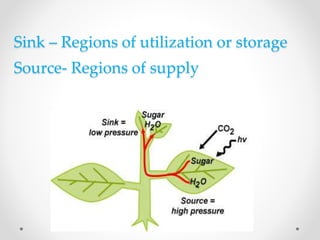
Sink – Regions of utilization or storage 
Source- Regions of supply
Substances translocate in the 
phloem 
Mainly Sucrose 
Organic substance like, 
amino acids 
vitamins 
growth substances 
Inorganic substance like, 
phosphate ions, etc….
Important point 
• Phloem translocation always occur from 
source to sink. It takes place bi-directionally 
• The speed of phloem sop is relatively very 
high 
• The amount of sugar that is trans located 
also relatively high 
• The transport taken place according to the 
hydrostatic pressure
Mechanism Of 
Phloem 
Translocation
Translocation Pathway 
3 major steps 
• Phloem loading 
• Mass flow 
• Phloem unloading
Phloem loading 
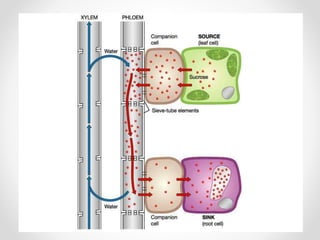
• Sucrose produce in the mesophyll 
cells (source) is actively loaded 
using ATP into the sieve tubes in 
the phloem of the veinlet of the 
leaf through transfer cells. This is 
called Phloem loading.
Mass flow 
• The process of phloem loading 
increases the solute potential of 
the sieve tube and decreases the 
water potential of the sieve tube. 
Then water enters the sieve tubes 
by endosmosis from the xylem. So 
a high hydrostatic pressure is 
created.
• Sucrose solution is then 
transported to storage organ or 
growing point (sink) actively or 
passively by mass flow.
Phloem Unloading 
• At the storage organ (sink) sucrose 
actively enters to the storage 
organ or growing point through 
transfer cells 
• This is called phloem unloading
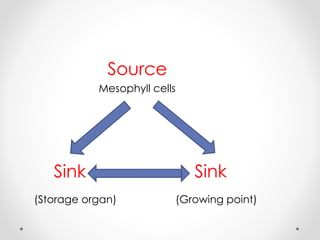
Source 
Mesophyll cells 
Sink Sink 
(Storage organ) (Growing point)
Factors determining 
assimilate/ dry matter 
partitioning
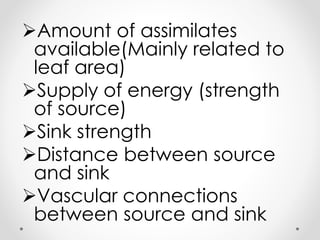
Amount of assimilates 
available(Mainly related to 
leaf area) 
Supply of energy (strength 
of source) 
Sink strength 
Distance between source 
and sink 
Vascular connections 
between source and sink
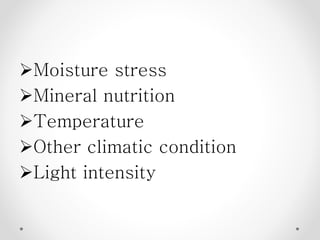
Moisture stress 
Mineral nutrition 
Temperature 
Other climatic condition 
Light intensity
Sinksource relationship

Sinksource relationship

  • 1.
  • 2.
    Sink source relationship • sink source relationship is a process involved in translocation of photosynthetic products in plants
  • 3.
    Definition • Inplants , there is considerable movement of various substances from regions of supply(source) to region of utilization or storage(sink).
  • 4.
    Sink – Regionsof utilization or storage Source- Regions of supply
  • 5.
    Substances translocate inthe phloem Mainly Sucrose Organic substance like, amino acids vitamins growth substances Inorganic substance like, phosphate ions, etc….
  • 6.
    Important point •Phloem translocation always occur from source to sink. It takes place bi-directionally • The speed of phloem sop is relatively very high • The amount of sugar that is trans located also relatively high • The transport taken place according to the hydrostatic pressure
  • 7.
    Mechanism Of Phloem Translocation
  • 8.
    Translocation Pathway 3major steps • Phloem loading • Mass flow • Phloem unloading
  • 9.
    Phloem loading •Sucrose produce in the mesophyll cells (source) is actively loaded using ATP into the sieve tubes in the phloem of the veinlet of the leaf through transfer cells. This is called Phloem loading.
  • 10.
    Mass flow •The process of phloem loading increases the solute potential of the sieve tube and decreases the water potential of the sieve tube. Then water enters the sieve tubes by endosmosis from the xylem. So a high hydrostatic pressure is created.
  • 11.
    • Sucrose solutionis then transported to storage organ or growing point (sink) actively or passively by mass flow.
  • 12.
    Phloem Unloading •At the storage organ (sink) sucrose actively enters to the storage organ or growing point through transfer cells • This is called phloem unloading
  • 14.
    Source Mesophyll cells Sink Sink (Storage organ) (Growing point)
  • 15.
    Factors determining assimilate/dry matter partitioning
  • 16.
    Amount of assimilates available(Mainly related to leaf area) Supply of energy (strength of source) Sink strength Distance between source and sink Vascular connections between source and sink
  • 17.
    Moisture stress Mineralnutrition Temperature Other climatic condition Light intensity