WATER STRESS
PRESENTED BY :- PATEL CHARMI J.
M.Sc. ( BOTANY ) SEM :- 3
PAPER CBO :- 501
DEPARTMENT OF LIFE SCIENCES, H.N.G.U., PATAN.
• Content :-
 Introduction
 Definition and types of stress
 Environmental conditions that can cause stress
 Water stress and their types
 Effects of drought on plants
 Water logging
 Plant response to water stress
 Resistance of plant to stress
• Introduction :-
 Every plant has some requirements of some physical
factors, like, light, temperature, air, water, etc. And
fore some chemical factors, for example, inorganic
nutrients, organic molecules etc. In optimum amount
and in available form at a right time as its nutritional
requirements for its proper growth and development.
 Any deviation from this optimal condition of any factor
essential for its growth will lead to aberrant change in
physiological processes and due to this plant body will
experience tension and this state can be referred as
plant under stress.
• Definition of stress :-
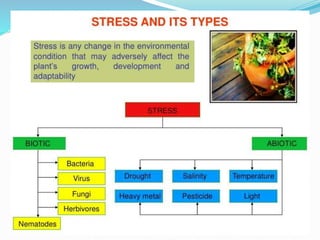
 ‘stress’ in plants can be defined as any external
factor that negatively influences plant growth,
productivity, reproductive capacity or survival.
 This includes a wide range of factors which can
be broadly divided into two main categories.
1. Abiotic or environmental stress factor
2. Biotic or biological stress factor
• Environmental conditions that
can cause stress :-
 Water-logging
 Drought
 High or low temperature
 Excessive soil salinity
 Inadequate mineral in the soil
 Too much or too little light
1. Abiotic stress :- abiotic stress is
defined as the negative impact of non-
living factors on the living organisms in
a specific environment.
2. Biotic stress :- biotic stress is stress
that occurs as a result of damage done to an
organism by other living organisms, such as
bacteria, viruses, fungi, parasites, beneficial
and harmful insects, weeds and cultivated or
native plants.
• Water stress :-
• Two conditions of water availability are termed as
follows :
1. Drought :- it is a meteorological term that means a
lack of precipitation over a prolonged period time.
According to an agronomist drought refers to a
situation where any area receives annual rainfall less
than average rainfall it receives generally. Here, an
amount of rainfall may create a situation of drought
in an area but in another it may be sufficient. While
a physiologist refers drought to a situation where
transpiration rate exceeds absorption rate so plant
experience a stress. Thus, drought has different
meaning for different disciplines.
2. Water logging :- it refers to a condition where
water is present in excess amount than its optimum
requirement. its excess creates an anaerobic
situation in rhizophere due to which a plant
experience stress.
• Effects of drought on plants
:-
• Effects of drought on growth :-
Drought has profound effects on growth, yield and
plant quality.
The first effect of the stress may well be a loss of
turgor that affects the rate of cell expansion and
ultimate cell size.
The water potential in plants is the sum of turgor
potential, osmotic potential and matric potential.
Loss of turgor is probably the process most sensitive
to water stress.
The result is a decrease of growth rate of stem
elongation, of leaf expansion and of stomal aperture.
• Effects of water stress on
ultrastructure of a cell :-
The acid and alkaline lipases that are released
destroy membranes in plants susceptible to
stress.
Release of hydrolases that act on substrates that
are normally protected by isolation in
compartments.
Under mild stress in corn the tonoplast may lose
structure releasing the vacuolar contents.
Chloroplast brust when they come into contact
with the vacuolar sap and do not recover activity
upon rehydration.
After reaching the point of no return,
rehydration aggravates the damage.
• Effects of water stress on photosynthesis :-
The effects of water stress on photosynthesis are
not well understood.
Under water stressed conditions that cause closure
of stomatas, radiant energy continues to be
intercepted and absorbed by leaves.
Reducing substances are produced that ordinarily
would be used in reducing the carbon of co2 but
with stomatas closed.
With limited co2 available the reducing compounds
must either be stored and accumulate or be used.
The subsequent use of carbohydrate reserves result
in a deficiency of carbon compounds for both
growth and maintenance processes.
• Nitrogen metabolism under water stress :-
 Nitrogen reductase activity declines in water stressed
leaves.
 The decrease may be related to a lowered
translocation of nitrate in the xylem.
 Nitrate reductase activity is the result of loss of
enzyme activity, decreased rate of enzyme synthesis or
an increased rate of enzyme degradation.
 Free proline may accumulate in plants under water
stress.
 Protein synthesis is also affected by water stress. Even
under mild stress there is a shift from polyribosome
content to monoribosomes that are inactive in protein
synthesis.
• Water logging :-
Creation of anaerobic environment in the
vicinity of roots is the first and foremost effect
of waterlogging, from which plants and
especially plant roots, cannot obtain oxygen.
Soils at field capacity have 10 to 30% of the
volume composed of air filled spaces but the
percentage decreases as water content decreases.
So the oxygen supply is greatly reduced, cause
death of the plant
The water logged roots could export some
factors that caused closure of stomatas.
• Other symptoms associated with
flooding injury are :-
Pattern of yellowing leaves from base to
the top of plant
Drooping of the petioles while plant is still
turgid.
Leaf epinasty
Hypertrophy ( a swelling of cells )
New root formation from the stems
Wilting under severe conditions of flooding
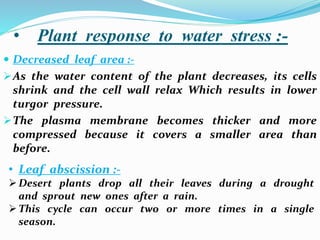
• Plant response to water stress :-
 Decreased leaf area :-
As the water content of the plant decreases, its cells
shrink and the cell wall relax Which results in lower
turgor pressure.
The plasma membrane becomes thicker and more
compressed because it covers a smaller area than
before.
• Leaf abscission :-
Desert plants drop all their leaves during a drought
and sprout new ones after a rain.
This cycle can occur two or more times in a single
season.
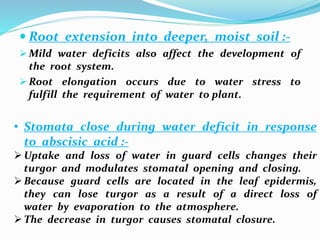
 Root extension into deeper, moist soil :-
 Mild water deficits also affect the development of
the root system.
 Root elongation occurs due to water stress to
fulfill the requirement of water to plant.
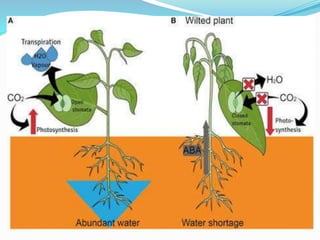
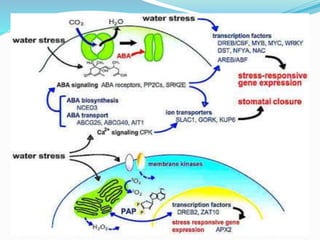
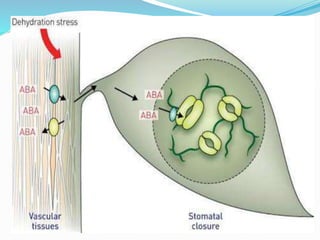
• Stomata close during water deficit in response
to abscisic acid :-
Uptake and loss of water in guard cells changes their
turgor and modulates stomatal opening and closing.
Because guard cells are located in the leaf epidermis,
they can lose turgor as a result of a direct loss of
water by evaporation to the atmosphere.
The decrease in turgor causes stomatal closure.
ABA is synthesized at a higher rate, and more ABA
accumulates in the leaf apoplast.
Chemical signals from the root system may affect
the stomatal responses to water stress.
The mechanism of ABA induced stomatal closure.
Stomatal conductance is often much more closely
related to soil water status than to leaf water
status.
Wax deposition on the leaf surface :-
A common development response to water stress is
the production of a thicker cuticle that reduces water
loss from the epidermis.
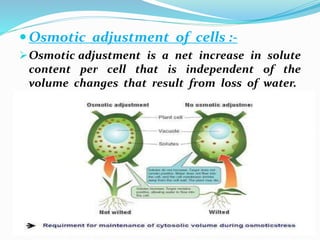
 Osmotic adjustment of cells :-
Osmotic adjustment is a net increase in solute
content per cell that is independent of the
volume changes that result from loss of water.
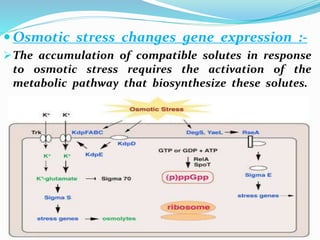
 Osmotic stress changes gene expression :-
The accumulation of compatible solutes in response
to osmotic stress requires the activation of the
metabolic pathway that biosynthesize these solutes.
• Resistance of plant to stress
:-
 Resistance or sensitivity of plants to
stress depend on :-
The species of plant
The genotype
Development age
• Changes in gene expression to stress
:-
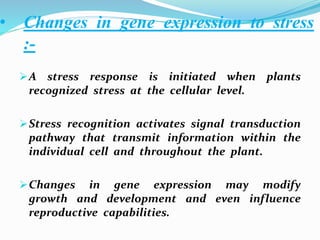
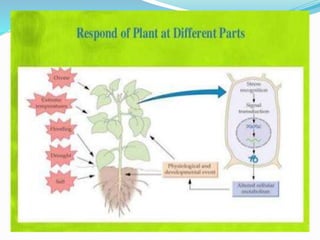
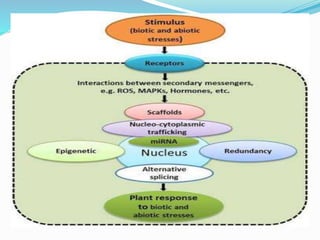
A stress response is initiated when plants
recognized stress at the cellular level.
Stress recognition activates signal transduction
pathway that transmit information within the
individual cell and throughout the plant.
Changes in gene expression may modify
growth and development and even influence
reproductive capabilities.
• Gene expression results in :-
Increase amounts of specific mRNA
Enhance translation
Stabilize proteins
Altered protein activity
A combination of the above
• References :-
 Plant physiology
By Lincoln Taiz and Eduargo zeiger
• Plant physiology fundamental and applications
By Aravind Kumar and S.S.Purohit
• www.google.com
Thank you

Water stress

  • 1.
    WATER STRESS PRESENTED BY:- PATEL CHARMI J. M.Sc. ( BOTANY ) SEM :- 3 PAPER CBO :- 501 DEPARTMENT OF LIFE SCIENCES, H.N.G.U., PATAN.
  • 2.
    • Content :- Introduction  Definition and types of stress  Environmental conditions that can cause stress  Water stress and their types  Effects of drought on plants  Water logging  Plant response to water stress  Resistance of plant to stress
  • 3.
    • Introduction :- Every plant has some requirements of some physical factors, like, light, temperature, air, water, etc. And fore some chemical factors, for example, inorganic nutrients, organic molecules etc. In optimum amount and in available form at a right time as its nutritional requirements for its proper growth and development.  Any deviation from this optimal condition of any factor essential for its growth will lead to aberrant change in physiological processes and due to this plant body will experience tension and this state can be referred as plant under stress.
  • 4.
    • Definition ofstress :-  ‘stress’ in plants can be defined as any external factor that negatively influences plant growth, productivity, reproductive capacity or survival.  This includes a wide range of factors which can be broadly divided into two main categories. 1. Abiotic or environmental stress factor 2. Biotic or biological stress factor
  • 6.
    • Environmental conditionsthat can cause stress :-  Water-logging  Drought  High or low temperature  Excessive soil salinity  Inadequate mineral in the soil  Too much or too little light
  • 7.
    1. Abiotic stress:- abiotic stress is defined as the negative impact of non- living factors on the living organisms in a specific environment. 2. Biotic stress :- biotic stress is stress that occurs as a result of damage done to an organism by other living organisms, such as bacteria, viruses, fungi, parasites, beneficial and harmful insects, weeds and cultivated or native plants.
  • 8.
    • Water stress:- • Two conditions of water availability are termed as follows : 1. Drought :- it is a meteorological term that means a lack of precipitation over a prolonged period time. According to an agronomist drought refers to a situation where any area receives annual rainfall less than average rainfall it receives generally. Here, an amount of rainfall may create a situation of drought in an area but in another it may be sufficient. While a physiologist refers drought to a situation where transpiration rate exceeds absorption rate so plant experience a stress. Thus, drought has different meaning for different disciplines.
  • 9.
    2. Water logging:- it refers to a condition where water is present in excess amount than its optimum requirement. its excess creates an anaerobic situation in rhizophere due to which a plant experience stress.
  • 10.
    • Effects ofdrought on plants :- • Effects of drought on growth :- Drought has profound effects on growth, yield and plant quality. The first effect of the stress may well be a loss of turgor that affects the rate of cell expansion and ultimate cell size. The water potential in plants is the sum of turgor potential, osmotic potential and matric potential. Loss of turgor is probably the process most sensitive to water stress. The result is a decrease of growth rate of stem elongation, of leaf expansion and of stomal aperture.
  • 11.
    • Effects ofwater stress on ultrastructure of a cell :- The acid and alkaline lipases that are released destroy membranes in plants susceptible to stress. Release of hydrolases that act on substrates that are normally protected by isolation in compartments. Under mild stress in corn the tonoplast may lose structure releasing the vacuolar contents. Chloroplast brust when they come into contact with the vacuolar sap and do not recover activity upon rehydration. After reaching the point of no return, rehydration aggravates the damage.
  • 12.
    • Effects ofwater stress on photosynthesis :- The effects of water stress on photosynthesis are not well understood. Under water stressed conditions that cause closure of stomatas, radiant energy continues to be intercepted and absorbed by leaves. Reducing substances are produced that ordinarily would be used in reducing the carbon of co2 but with stomatas closed. With limited co2 available the reducing compounds must either be stored and accumulate or be used. The subsequent use of carbohydrate reserves result in a deficiency of carbon compounds for both growth and maintenance processes.
  • 14.
    • Nitrogen metabolismunder water stress :-  Nitrogen reductase activity declines in water stressed leaves.  The decrease may be related to a lowered translocation of nitrate in the xylem.  Nitrate reductase activity is the result of loss of enzyme activity, decreased rate of enzyme synthesis or an increased rate of enzyme degradation.  Free proline may accumulate in plants under water stress.  Protein synthesis is also affected by water stress. Even under mild stress there is a shift from polyribosome content to monoribosomes that are inactive in protein synthesis.
  • 15.
    • Water logging:- Creation of anaerobic environment in the vicinity of roots is the first and foremost effect of waterlogging, from which plants and especially plant roots, cannot obtain oxygen. Soils at field capacity have 10 to 30% of the volume composed of air filled spaces but the percentage decreases as water content decreases. So the oxygen supply is greatly reduced, cause death of the plant The water logged roots could export some factors that caused closure of stomatas.
  • 16.
    • Other symptomsassociated with flooding injury are :- Pattern of yellowing leaves from base to the top of plant Drooping of the petioles while plant is still turgid. Leaf epinasty Hypertrophy ( a swelling of cells ) New root formation from the stems Wilting under severe conditions of flooding
  • 18.
    • Plant responseto water stress :-  Decreased leaf area :- As the water content of the plant decreases, its cells shrink and the cell wall relax Which results in lower turgor pressure. The plasma membrane becomes thicker and more compressed because it covers a smaller area than before. • Leaf abscission :- Desert plants drop all their leaves during a drought and sprout new ones after a rain. This cycle can occur two or more times in a single season.
  • 19.
     Root extensioninto deeper, moist soil :-  Mild water deficits also affect the development of the root system.  Root elongation occurs due to water stress to fulfill the requirement of water to plant. • Stomata close during water deficit in response to abscisic acid :- Uptake and loss of water in guard cells changes their turgor and modulates stomatal opening and closing. Because guard cells are located in the leaf epidermis, they can lose turgor as a result of a direct loss of water by evaporation to the atmosphere. The decrease in turgor causes stomatal closure.
  • 21.
    ABA is synthesizedat a higher rate, and more ABA accumulates in the leaf apoplast. Chemical signals from the root system may affect the stomatal responses to water stress. The mechanism of ABA induced stomatal closure. Stomatal conductance is often much more closely related to soil water status than to leaf water status. Wax deposition on the leaf surface :- A common development response to water stress is the production of a thicker cuticle that reduces water loss from the epidermis.
  • 22.
     Osmotic adjustmentof cells :- Osmotic adjustment is a net increase in solute content per cell that is independent of the volume changes that result from loss of water.
  • 23.
     Osmotic stresschanges gene expression :- The accumulation of compatible solutes in response to osmotic stress requires the activation of the metabolic pathway that biosynthesize these solutes.
  • 24.
    • Resistance ofplant to stress :-  Resistance or sensitivity of plants to stress depend on :- The species of plant The genotype Development age
  • 25.
    • Changes ingene expression to stress :- A stress response is initiated when plants recognized stress at the cellular level. Stress recognition activates signal transduction pathway that transmit information within the individual cell and throughout the plant. Changes in gene expression may modify growth and development and even influence reproductive capabilities.
  • 27.
    • Gene expressionresults in :- Increase amounts of specific mRNA Enhance translation Stabilize proteins Altered protein activity A combination of the above
  • 29.
    • References :- Plant physiology By Lincoln Taiz and Eduargo zeiger • Plant physiology fundamental and applications By Aravind Kumar and S.S.Purohit • www.google.com
  • 30.