
GROWTH
ANALYSIS
VARIOUS
PHYSIOLOGICAL
PARAMETERS
AFFECTING YIELD
Dr Hem C Joshi
WHAT IS
GROWTH
ANALYSIS?
Growth analysis is a mathematical expression of environmental
effects on the growth and development of crop plants
It helps is studying the complex interactions between the plant
growth and environment.
It depends on two values
Total Dry Weight of whole plant material per unit area of the
ground
Total leaf area of the plant per unit area of the ground
HOW TO
MEASURE
GROWTH?
• Fresh Weight- entire plant is harvested, cleaned and then
weighed. Especially important in case of dark grown
seedling.
• Dry Weight- drying the plant materials for 21 to 48 hours
at 70 to 80 degree Celsius and then taking weight.
• Length- used for unidirectionally growing organ with
almost uniform diameter. Advantageous in the sense that
it can be done on the same organ over a period of time
without destroying it.
• Area- particularly for organs like leaf. Can be measured
on a graph paper or through photoelectric devices like
leaf area meter or even through your smartphone using
certain apps
WHAT ARE THE
VARIOUS
PARAMETERS?
• The growth parameters that are commonly used in
agricultural research and the name of the scientists
who proposed the parameters are given below.
• Leaf Area Index (LAI) - Williams (1946) although
term coined by D J Watson
• Leaf Area Ratio (LAR) - Radford (1967)
• Leaf Area Duration - Power et al. (1967)
• Specific Leaf Area - Kvet et al. (1971)
• Specific Leaf Weight - Pearce et al. (1968)
• Net Assimilation Rate - Williams (1946)
• Cumulative Growth Rate - Watson (1956)
• Relative Growth Rate - Williams (1946)
• Harvest Index - Nichiporovich (1951)
 It is the ratio of the leaf of the crop to the ground area over a period of
interval of time
 The value of LAI should be optimum at the maximum ground cover area
at which crop canopy receives maximum solar radiation and hence it
directly affects the TDMA or Total Dry Matter Accumulation.
 LAI at which maximum CGR is recorded is called optimum Lai
 LAI of 4-6 is necessary
 LAI =Total leaf area of a plant/Ground area occupied by the plant (Ratio
of two areas , hence it is unitless)
LAI= Length x width x k (0.75) x no. of leaves per tiller
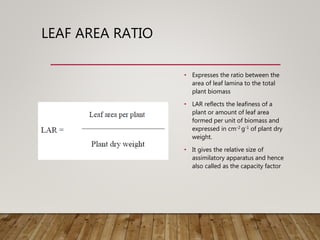
LEAF AREA RATIO
• Expresses the ratio between the
area of leaf lamina to the total
plant biomass
• LAR reflects the leafiness of a
plant or amount of leaf area
formed per unit of biomass and
expressed in cm-2 g-1 of plant dry
weight.
• It gives the relative size of
assimilatory apparatus and hence
also called as the capacity factor
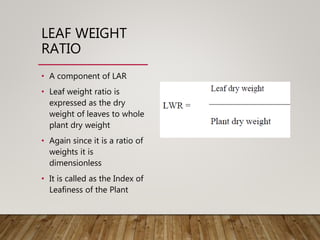
LEAF WEIGHT
RATIO
• A component of LAR
• Leaf weight ratio is
expressed as the dry
weight of leaves to whole
plant dry weight
• Again since it is a ratio of
weights it is
dimensionless
• It is called as the Index of
Leafiness of the Plant
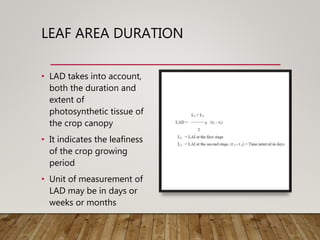
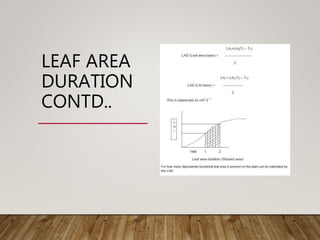
LEAF AREA DURATION
• LAD takes into account,
both the duration and
extent of
photosynthetic tissue of
the crop canopy
• It indicates the leafiness
of the crop growing
period
• Unit of measurement of
LAD may be in days or
weeks or months
LEAF AREA
DURATION
CONTD..
SPECIFIC LEAF AREA
• Specific leaf area is a
measure of the leaf area of
the plant to leaf dry weight
and expressed in cm2g-1
• It is a measure of leaf
density
SPECIFIC LEAF WEIGHT
• It is reverse of SLA. It is a
measure of leaf weight per
unit leaf area. Hence, it is a
ratio expressed as g cm-2
• It is a measure of Relative
thickness of canopy
NET
ASSIMILATORY
RATE
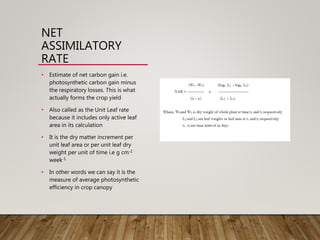
• Estimate of net carbon gain i.e.
photosynthetic carbon gain minus
the respiratory losses. This is what
actually forms the crop yield
• Also called as the Unit Leaf rate
because it includes only active leaf
area in its calculation
• It is the dry matter increment per
unit leaf area or per unit leaf dry
weight per unit of time i.e g cm-2
week-1
• In other words we can say it is the
measure of average photosynthetic
efficiency in crop canopy
CROP GROWTH RATE
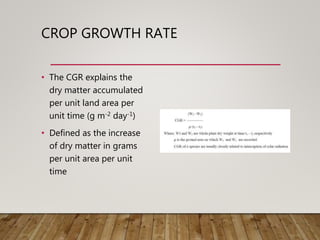
• The CGR explains the
dry matter accumulated
per unit land area per
unit time (g m-2 day-1)
• Defined as the increase
of dry matter in grams
per unit area per unit
time
RELATIVE
GROWTH RATE
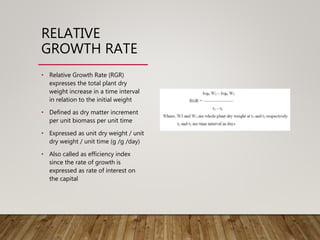
• Relative Growth Rate (RGR)
expresses the total plant dry
weight increase in a time interval
in relation to the initial weight
• Defined as dry matter increment
per unit biomass per unit time
• Expressed as unit dry weight / unit
dry weight / unit time (g /g /day)
• Also called as efficiency index
since the rate of growth is
expressed as rate of interest on
the capital
HARVEST INDEX
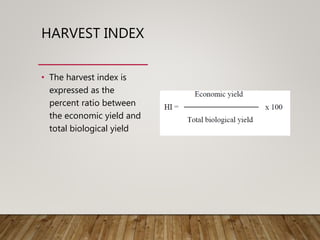
• The harvest index is
expressed as the
percent ratio between
the economic yield and
total biological yield
SOME OTHER IMPORTANT
PARAMETERS
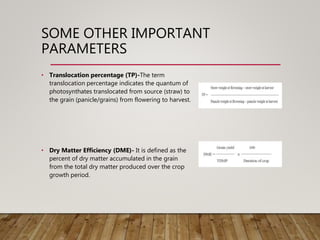
• Translocation percentage (TP)-The term
translocation percentage indicates the quantum of
photosynthates translocated from source (straw) to
the grain (panicle/grains) from flowering to harvest.
• Dry Matter Efficiency (DME)- It is defined as the
percent of dry matter accumulated in the grain
from the total dry matter produced over the crop
growth period.
SOME OTHER IMPORTANT
PARAMETERS
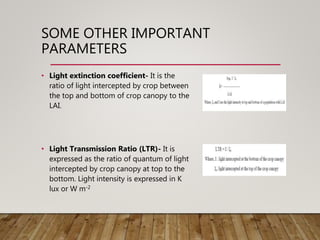
• Light extinction coefficient- It is the
ratio of light intercepted by crop between
the top and bottom of crop canopy to the
LAI.
• Light Transmission Ratio (LTR)- It is
expressed as the ratio of quantum of light
intercepted by crop canopy at top to the
bottom. Light intensity is expressed in K
lux or W m-2
MERITS AND DEMERITS OF CLASSICAL
GROWTH ANALYSIS
MERITS
• Easy assessment of primary
production at ecosystem
level (crop level) of
organization
• Precise study of whole
growth performance in an
integrated manner at
different intervals.
DEMERITS
• Involves destructive
harvesting of sample/
representative sets of
plants or plots
• It is impossible to follow
the same plants
throughout the
experiment

Crop growth analysis

  • 1.
  • 2.
    WHAT IS GROWTH ANALYSIS? Growth analysisis a mathematical expression of environmental effects on the growth and development of crop plants It helps is studying the complex interactions between the plant growth and environment. It depends on two values Total Dry Weight of whole plant material per unit area of the ground Total leaf area of the plant per unit area of the ground
  • 3.
    HOW TO MEASURE GROWTH? • FreshWeight- entire plant is harvested, cleaned and then weighed. Especially important in case of dark grown seedling. • Dry Weight- drying the plant materials for 21 to 48 hours at 70 to 80 degree Celsius and then taking weight. • Length- used for unidirectionally growing organ with almost uniform diameter. Advantageous in the sense that it can be done on the same organ over a period of time without destroying it. • Area- particularly for organs like leaf. Can be measured on a graph paper or through photoelectric devices like leaf area meter or even through your smartphone using certain apps
  • 4.
    WHAT ARE THE VARIOUS PARAMETERS? •The growth parameters that are commonly used in agricultural research and the name of the scientists who proposed the parameters are given below. • Leaf Area Index (LAI) - Williams (1946) although term coined by D J Watson • Leaf Area Ratio (LAR) - Radford (1967) • Leaf Area Duration - Power et al. (1967) • Specific Leaf Area - Kvet et al. (1971) • Specific Leaf Weight - Pearce et al. (1968) • Net Assimilation Rate - Williams (1946) • Cumulative Growth Rate - Watson (1956) • Relative Growth Rate - Williams (1946) • Harvest Index - Nichiporovich (1951)
  • 5.
     It isthe ratio of the leaf of the crop to the ground area over a period of interval of time  The value of LAI should be optimum at the maximum ground cover area at which crop canopy receives maximum solar radiation and hence it directly affects the TDMA or Total Dry Matter Accumulation.  LAI at which maximum CGR is recorded is called optimum Lai  LAI of 4-6 is necessary  LAI =Total leaf area of a plant/Ground area occupied by the plant (Ratio of two areas , hence it is unitless) LAI= Length x width x k (0.75) x no. of leaves per tiller
  • 6.
    LEAF AREA RATIO •Expresses the ratio between the area of leaf lamina to the total plant biomass • LAR reflects the leafiness of a plant or amount of leaf area formed per unit of biomass and expressed in cm-2 g-1 of plant dry weight. • It gives the relative size of assimilatory apparatus and hence also called as the capacity factor
  • 7.
    LEAF WEIGHT RATIO • Acomponent of LAR • Leaf weight ratio is expressed as the dry weight of leaves to whole plant dry weight • Again since it is a ratio of weights it is dimensionless • It is called as the Index of Leafiness of the Plant
  • 8.
    LEAF AREA DURATION •LAD takes into account, both the duration and extent of photosynthetic tissue of the crop canopy • It indicates the leafiness of the crop growing period • Unit of measurement of LAD may be in days or weeks or months
  • 9.
  • 10.
    SPECIFIC LEAF AREA •Specific leaf area is a measure of the leaf area of the plant to leaf dry weight and expressed in cm2g-1 • It is a measure of leaf density SPECIFIC LEAF WEIGHT • It is reverse of SLA. It is a measure of leaf weight per unit leaf area. Hence, it is a ratio expressed as g cm-2 • It is a measure of Relative thickness of canopy
  • 11.
    NET ASSIMILATORY RATE • Estimate ofnet carbon gain i.e. photosynthetic carbon gain minus the respiratory losses. This is what actually forms the crop yield • Also called as the Unit Leaf rate because it includes only active leaf area in its calculation • It is the dry matter increment per unit leaf area or per unit leaf dry weight per unit of time i.e g cm-2 week-1 • In other words we can say it is the measure of average photosynthetic efficiency in crop canopy
  • 12.
    CROP GROWTH RATE •The CGR explains the dry matter accumulated per unit land area per unit time (g m-2 day-1) • Defined as the increase of dry matter in grams per unit area per unit time
  • 13.
    RELATIVE GROWTH RATE • RelativeGrowth Rate (RGR) expresses the total plant dry weight increase in a time interval in relation to the initial weight • Defined as dry matter increment per unit biomass per unit time • Expressed as unit dry weight / unit dry weight / unit time (g /g /day) • Also called as efficiency index since the rate of growth is expressed as rate of interest on the capital
  • 14.
    HARVEST INDEX • Theharvest index is expressed as the percent ratio between the economic yield and total biological yield
  • 15.
    SOME OTHER IMPORTANT PARAMETERS •Translocation percentage (TP)-The term translocation percentage indicates the quantum of photosynthates translocated from source (straw) to the grain (panicle/grains) from flowering to harvest. • Dry Matter Efficiency (DME)- It is defined as the percent of dry matter accumulated in the grain from the total dry matter produced over the crop growth period.
  • 16.
    SOME OTHER IMPORTANT PARAMETERS •Light extinction coefficient- It is the ratio of light intercepted by crop between the top and bottom of crop canopy to the LAI. • Light Transmission Ratio (LTR)- It is expressed as the ratio of quantum of light intercepted by crop canopy at top to the bottom. Light intensity is expressed in K lux or W m-2
  • 17.
    MERITS AND DEMERITSOF CLASSICAL GROWTH ANALYSIS MERITS • Easy assessment of primary production at ecosystem level (crop level) of organization • Precise study of whole growth performance in an integrated manner at different intervals. DEMERITS • Involves destructive harvesting of sample/ representative sets of plants or plots • It is impossible to follow the same plants throughout the experiment