



PSYCHOTHERAPY
DEFINITION
◦ The treatment of emotional or related bodily problems by
psychological means.
◦ It is a process of helping a distressed person, which aims at
facilitating a change in his feelings, attitudes and behaviour by
means of verbal and emotional communication.
DEFINITION
◦ A method of treatment based on the development of intimate (therapeutic)
relationship between client & therapist for the purpose of exploring &
modifying the client behaviour in a satisfying direction.” …By lego
◦ “A process in which a person who wishes to relieve symptoms or resolve
problems in living or seeking personal growth enters in implicit or explicit
contract to interact in a prescribed way with a psychotherapist.” …By –
psychiatric glossary (1980)
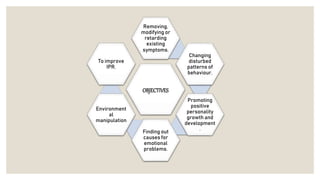
OBJECTIVES
Removing,
modifying or
retarding
existing
symptoms.
Changing
disturbed
patterns of
behaviour.
Promoting
positive
personality
growth and
development
.
Finding out
causes for
emotional
problems.
Environment
al
manipulation
To improve
IPR.
GOALS OF PSYCHOSOCIAL THERAPY
◦ Changing maladaptive behaviour pattern.
◦ Reducing of elimination environmental conditions that may be
causing such a behaviour.
◦ Improving interpersonal & other competencies i.e. communication
skill
◦ Helping the patient to resolve inner conflict & overcome feelings of
handicap
◦ Modifying an individual’s accurate assessment of himself & the
world around him
◦ Helping him to develop a sense of self-identity.
CONTRAINDICATION OF PSYCHOTHERAPY
◦Psychotic patient with severe behaviour disturbance
like excitement.
◦Organic psychosis (in acute phase)
◦Patient’s who are unmotivated & unwilling to accept it.
◦Group psychotherapy in hysteria, hypochondriasis etc.
◦Patient’s who are unlikely to respond, e.g.; personality
disorder , specially antisocial personality.
UNWANTED EFFECT OF PSYCHOTHERAPY
◦Patient may become excessively dependent on therapy or
therapist.
◦Intensive psychotherapy may be distressing to the patient
& result in exacerbation of symptoms & deterioration in
relationship.•
◦Disorder s for which physical treatment would be more
appropriate may be missed
◦Ineffective psychotherapy waste time & money & changes
in patient’s morale.
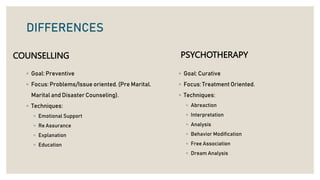
DIFFERENCES
COUNSELLING
◦ Goal: Preventive
◦ Focus: Problems/Issue oriented. (Pre Marital.
Marital and Disaster Counseling).
◦ Techniques:
◦ Emotional Support
◦ Re Assurance
◦ Explanation
◦ Education
PSYCHOTHERAPY
◦ Goal: Curative
◦ Focus: Treatment Oriented.
◦ Techniques:
◦ Abreaction
◦ Interpretation
◦ Analysis
◦ Behavior Modification
◦ Free Association
◦ Dream Analysis
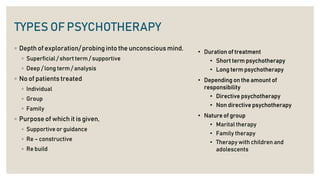
TYPES OF PSYCHOTHERAPY
◦ Depth of exploration/ probing into the unconscious mind.
◦ Superficial / short term / supportive
◦ Deep / long term / analysis
◦ No of patients treated
◦ Individual
◦ Group
◦ Family
◦ Purpose of which it is given,
◦ Supportive or guidance
◦ Re – constructive
◦ Re build
• Duration of treatment
• Short term psychotherapy
• Long term psychotherapy
• Depending on the amount of
responsibility
• Directive psychotherapy
• Non directive psychotherapy
• Nature of group
• Marital therapy
• Family therapy
• Therapy with children and
adolescents
PSYCHOANALYTICAL
THERAPY
 Psychoanalytical therapy was developed by freud.
 It focus on unconscious forces such as repressed
impulses & memories, internal conflicts & childhood
trauma on mental life & adjustment of the individual.
 The most important indication for psychoanalytical
therapy is the presence of longstanding mental conflicts,
which may be unconscious but produce symptoms.
 The aim of therapy is to bring all repressed material to
conscious awareness so that the patient can work towards a
healthy resolution of his problems, which are causing the
symptoms.
 Psychotherapy as a form of therapy is used primarily in
psychoneuroses by bringing about basic modification in the
personality. This is done by establishing a constructive
therapeutic relationship.
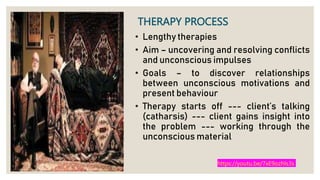
THERAPY PROCESS
• Lengthy therapies
• Aim – uncovering and resolving conflicts
and unconscious impulses
• Goals – to discover relationships
between unconscious motivations and
present behaviour
• Therapy starts off --- client’s talking
(catharsis) --- client gains insight into
the problem --- working through the
unconscious material
https://youtu.be/7xE9ozhls3s
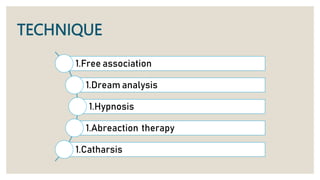
1.Free association
1.Dream analysis
1.Hypnosis
1.Abreaction therapy
1.Catharsis
TECHNIQUE
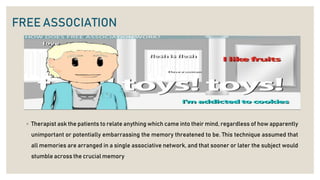
FREE ASSOCIATION
◦ Therapist ask the patients to relate anything which came into their mind, regardless of how apparently
unimportant or potentially embarrassing the memory threatened to be. This technique assumed that
all memories are arranged in a single associative network, and that sooner or later the subject would
stumble across the crucial memory
• Client reports immediately without censoring any feelings or
thoughts
• One of the ways to have access to unconscious wishes, fantasies,
conflicts and motivations
• While the free association goes on, the therapist identifies the
repressed material that is hidden in the unconscious
• Interpretation: analyst identifies , clarifies, and translates the
materials of the client and proceed from the surface to the deeper
level
DREAM ANALYSIS
◦ While one is asleep – defenses are lowered –
repressed materials erupt into the surface
◦ Manifestations – so.. Unacceptable and painful –
expressed in disguised or symbolic form
◦ Manifest content : what a person remembers and
consciously considers - only a partial representation (
real dream )
◦ Latent content : hidden, symbolic and unconscious
motives, wishes and fears
◦ Process of converting the latent content into
manifest content – dream work
◦ “Royal road to the unconscious”
◦ What is important in dreams is the infantile wish
fulfillment represented in them
◦ Freud assumed every dream has a meaning that can
be interpreted by decoding representations of the
unconscious material
◦ Dream symbol = represents some person, thing, or
activity involved in the unconscious process
◦ Dream interpretations
◦ Knife, umbrella, snake = penis
◦ Room, table with food = women
◦ Water = birth, mother
◦ Children playing = masturbation
◦ Fire = bedwetting falling = anxiety
HYPNOSIS
◦ Hypnosis is a superficial or deep trance (a somnolent
state/sleep like) resembling sleep.
◦ It induced in a patient by suggestions of relaxation &
concentrating attention on a single object.
◦ The client becomes highly suggestible, submissive & abandons
control & response to therapist influence.
◦ He can be induced to recall forgotten events, becomes
insensitive to pain, gain relief from tension, anxiety & other
psychological symptoms.
◦ It affects behavioral change & control of attitude
◦ Changes that occur during hypnosis:
◦ The person becomes highly suggestible to the commands of the
therapist.
◦ There is an ability to produce or remove symptoms or perceptions.
◦ Dissociation of a part of the body or emotions.
◦ Amnesia for the events that occurred during the hypnotic state.
◦ This therapy is used in; obesity, hypertension, asthma, smoking,
peptic ulcer, overeating, abreaction of past experiences,
psychosomatic disorders, conversion & dissociative disorders,
habit disorder & anxiety disorder or other addiction disorder.
3. ABREACTION THERAPY
◦Abreaction is a process by which repressed material,
particularly a painful experience or conflict is brought
back to consciousness.
◦The person not only recalls but also relieves the
material, which is accompanied by the appropriate
emotional response.
◦It is most useful in acute neurotic conditions caused by
extreme stress (PTSD, hysteria etc).
Methods:
◦Abreaction can be brought about by strong
encouragement to relieve the stressful events.
◦The procedure is begun with neutral topics at first, &
gradually approaches area of conflict.
◦Abreaction can be done with or without the use of
medication.
CATHARASIS
◦ Catharsis is the act of purging or purification or elimination of a
complex by bringing in to consciousness and affording to
expression
◦ Patient learn to evacuate this problem from the psyche
◦ These therapies are undertaken in one - one basis
◦ The nurses role is encouraging the patient to talk about the
experience and documenting the response carefully
◦ Pity, fear, terror, horror and other negative emotions as the
tragic suffering of the patients are safely exercised and
exorcised.
INDIVIDUAL
PSYCHOTHERAPY
INDIVIDUAL PSYCHOTHERAPY
1.Individual psychotherapy is a method of bringing about change in a person by
exploring his or her feelings, attitude, thinking and behaviour
2.It is conducted on a one to one basis i.e. The therapist treat on client at a time
3.By this therapist helps the patient to come to a
1.greater understanding of himself & to find a way of dealing with his problem.
2.Make personal changes
3.Improve interpersonal relationship
4.Get relief from emotional pain or unhappiness
4.Indication: stress-related disorder, alcohol & drug dependence, sexual
disorder & marital disharmony.
◦Therapy process:
◦The patient is encouraged to discover for himself the
reason for his behavior
◦The therapist listen to the patient and offers explanation
and advise when necessary
◦ By this the therapist helps the patient to understand himself and
find the way of solution to his problem
◦ The relationship between the therapist and the patient passes
through the stages of nurse patient relationship i.e introduction ,
working and termination
APPROACHES
◦ Psychodynamic Therapy:
◦ which focus on increasing your awareness of unconscious
thoughts and behaviors, developing new insights into your
motivations, and resolving conflicts
◦ Cognitive behavioral therapy (CBT),:
◦ which helps you identify unhealthy, negative beliefs and
behaviors and replace them with healthy, positive ones
◦ Humanistic therapy :
◦ is a mental health approach that emphasizes the importance of
being your true self in order to lead the most fulfilling life. It's
based on the principle that everyone has their own unique way of
looking at the world. This view can impact your choices and
actions.
◦ Behavioral therapy:
◦ is an umbrella term for types of therapy that treat mental health
disorders. This form of therapy seeks to identify and help change
potentially self-destructive or unhealthy behaviors. It functions
on the idea that all behaviors are learned and that
unhealthy behaviors can be changed.
SUPPORTIVE
PSYCHOTHERAPY
◦It is a form of “surface therapy”.
◦The therapist helps the patient to relieve emotional distress
& symptoms without probing in to past or attempting to
change or alter the basic personality of the individual.
◦The therapist reinforce the existing defenses used by the
client & utilizes various techniques such as: a. Ventilation b.
Environmental modification or manipulation c. Persuasion
d. Reeducation e. Reassurance f. Abreaction g. Explanation
h. Suggestion i. Reinforcement j. Recreation k. Work as
therapy l. Relaxation
TECHNIQUES
Ventilation
◦ It is the process of allowing the release of bottled emotions.
◦ It helps to express the suppressed emotions.
◦ Patient is allowed to talk whatever comes into his mind.
Abreaction
◦ It is a process of exploring a repressed emotions.
◦ Example: ‘ok’, than what happened?
Reassurance
◦ Supportive approach.
◦ Example: “you do not have a serious problem. I am confident that you will get
well”.
Suggestion
◦ Suggestion is a process by which symptoms relief is achieved through positive
statements made with a degree of firmness and authority.
Persuasion
◦ Persuasion is a procedure in which therapist urges the patient repeatedly to
change his behavior or to try new methods of dealing with his problem.
Reinforcement
◦ Reinforcement or rewards are potent methods to enhance the
desired behavior.
◦ They can be verbal or material in nature.
Recreation
◦ It helps to break the monotony of work.
◦ It is essentially required for the patients who have developed
emotional problems as a result of having to perform monotonous
and hard work.
Explanation
◦ Explanations are provided to remove misconceptions and to provide proper
understanding of a problem.
Work as therapy
◦ When a person engages in work his preoccupation with emotional problems
decreases..
◦ It enhances self – esteem, and helps to resolve conflicts in many
circumstances.
Relaxation
◦ It is especially useful for the anxious individual.
◦ It is an effective intervention for many psychosomatic problems like, ht, pud, ba
and migraine.
◦ Example: yoga and asanas.
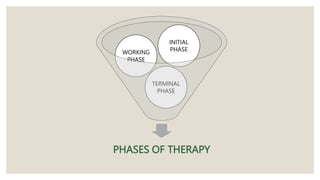
PHASES OF THERAPY
TERMINAL
PHASE
WORKING
PHASE
INITIAL
PHASE
COGNITIVETHERAPY
◦cognitive therapy is a relatively new mode of short-term
psychotherapy.
◦It is developed for treatment of depression and anxiety is
now widely applied to a broad Range of mental
disorders.
◦It is based on the premise that our moods and feelings
are influenced by our thoughts.
◦To improve patient’s abilities to function in the world by
correcting the distorted ways of thinking the cognitive
therapist restructures patients views of themselves,
the world, and future.
◦More realistic thoughts are substituted to reduce
painful feelings such as anxiety, guilt, and
hopelessness.
DEFINITION
Cognitive therapy is a psychotherapy approach based on the idea
that behaviour is secondary to thinking. It focuses on how
patients think about themselves and their world, make changes in
the current ways of thinking and behaviour.
FUNDAMENTAL ASSUMPTIONS
◦ It is based on the premise that the way a person perceives an event
rather than the event itself, determines its relevance and the
response to it.
◦ It is time limited, attempting to cause change rapidly and often within
an established time frame.
◦ Therapeutic change can be effected through an alteration of
idiopathic, dysfunctional modes of thinking, leading to cognitive
change.
◦ These therapies are based on the belief that patient’s are the
architects of their own misfortune and have control over their
thoughts and actions.
◦ They also help the patient learn something about the process of
therapy and develop therapeutic skills applicable to other problems.
◦ It aims at altering the cognitions for effecting a change in behaviour.
◦ It implies that all psychiatric disorders have some amount of
cognition and an improvement in this enhances the patient’s
recovery
Duration of cognitive therapy
◦ atypical cognitive therapy schedule consist of about 15 visits over a three month period.
Indications
◦ Depression
◦ Anxiety disorder
◦ Panic disorder
◦ Phobias
◦ Anticipatory anxiety
◦ For teaching problem solving methods some centres also use cognitive behaviourtherapy
(CBT) for managementof psychotic symptoms such as delusionsand hallucination.
TECHNIQUES OF COGNITIVE BEHAVIOUR THERAPY
There are four main groups of cognitive techniques. They are
the following:
i) Techniques for stopping intrusive cognitions
ii) Techniques to counterbalance faulty cognitions
iii) Techniques for altering cognitions
iv) Techniques to resolve problem directly
I. Techniques for stopping
intrusive cognitions :
these methods aims at
stopping intruding thoughts
through distraction.
Alteration is directed to
another mental act like
doing mental arithmetic or
copying a figure.
II) Techniques to Counterbalance Faulty
Cognitions :
these involves counterbalancing intruding
cognitions and the emotions provoked by
them with another thought. Eg. When an
anxious patient with chest pain becomes
apprehensive thinking that he has a heart
problem; he may be trained to think it is
only muscular pain and does not relate to
the heart
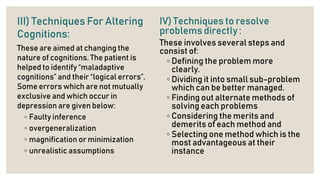
III) Techniques For Altering
Cognitions:
These are aimed at changing the
nature of cognitions. The patient is
helped to identify “maladaptive
cognitions” and their “logical errors”.
Some errors which are not mutually
exclusive and which occur in
depression are given below:
◦ Faulty inference
◦ overgeneralization
◦ magnification or minimization
◦ unrealistic assumptions
IV) Techniques to resolve
problems directly :
These involves several steps and
consist of:
◦ Defining the problem more
clearly.
◦ Dividing it into small sub-problem
which can be better managed.
◦ Finding out alternate methods of
solving each problems
◦ Considering the merits and
demerits of each method and
◦ Selecting one method which is the
most advantageous at their
instance
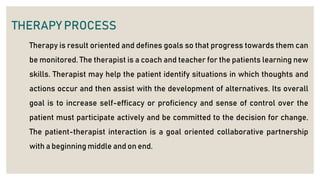
THERAPY PROCESS
Therapy is result oriented and defines goals so that progress towards them can
be monitored. The therapist is a coach and teacher for the patients learning new
skills. Therapist may help the patient identify situations in which thoughts and
actions occur and then assist with the development of alternatives. Its overall
goal is to increase self-efficacy or proficiency and sense of control over the
patient must participate actively and be committed to the decision for change.
The patient-therapist interaction is a goal oriented collaborative partnership
with a beginning middle and on end.

PSYCHOTHERAPY.pptx

  • 1.
  • 2.
    DEFINITION ◦ The treatmentof emotional or related bodily problems by psychological means. ◦ It is a process of helping a distressed person, which aims at facilitating a change in his feelings, attitudes and behaviour by means of verbal and emotional communication.
  • 3.
    DEFINITION ◦ A methodof treatment based on the development of intimate (therapeutic) relationship between client & therapist for the purpose of exploring & modifying the client behaviour in a satisfying direction.” …By lego ◦ “A process in which a person who wishes to relieve symptoms or resolve problems in living or seeking personal growth enters in implicit or explicit contract to interact in a prescribed way with a psychotherapist.” …By – psychiatric glossary (1980)
  • 4.
    OBJECTIVES Removing, modifying or retarding existing symptoms. Changing disturbed patterns of behaviour. Promoting positive personality growthand development . Finding out causes for emotional problems. Environment al manipulation To improve IPR.
  • 5.
    GOALS OF PSYCHOSOCIALTHERAPY ◦ Changing maladaptive behaviour pattern. ◦ Reducing of elimination environmental conditions that may be causing such a behaviour. ◦ Improving interpersonal & other competencies i.e. communication skill ◦ Helping the patient to resolve inner conflict & overcome feelings of handicap ◦ Modifying an individual’s accurate assessment of himself & the world around him ◦ Helping him to develop a sense of self-identity.
  • 6.
    CONTRAINDICATION OF PSYCHOTHERAPY ◦Psychoticpatient with severe behaviour disturbance like excitement. ◦Organic psychosis (in acute phase) ◦Patient’s who are unmotivated & unwilling to accept it. ◦Group psychotherapy in hysteria, hypochondriasis etc. ◦Patient’s who are unlikely to respond, e.g.; personality disorder , specially antisocial personality.
  • 7.
    UNWANTED EFFECT OFPSYCHOTHERAPY ◦Patient may become excessively dependent on therapy or therapist. ◦Intensive psychotherapy may be distressing to the patient & result in exacerbation of symptoms & deterioration in relationship.• ◦Disorder s for which physical treatment would be more appropriate may be missed ◦Ineffective psychotherapy waste time & money & changes in patient’s morale.
  • 8.
    DIFFERENCES COUNSELLING ◦ Goal: Preventive ◦Focus: Problems/Issue oriented. (Pre Marital. Marital and Disaster Counseling). ◦ Techniques: ◦ Emotional Support ◦ Re Assurance ◦ Explanation ◦ Education PSYCHOTHERAPY ◦ Goal: Curative ◦ Focus: Treatment Oriented. ◦ Techniques: ◦ Abreaction ◦ Interpretation ◦ Analysis ◦ Behavior Modification ◦ Free Association ◦ Dream Analysis
  • 9.
    TYPES OF PSYCHOTHERAPY ◦Depth of exploration/ probing into the unconscious mind. ◦ Superficial / short term / supportive ◦ Deep / long term / analysis ◦ No of patients treated ◦ Individual ◦ Group ◦ Family ◦ Purpose of which it is given, ◦ Supportive or guidance ◦ Re – constructive ◦ Re build • Duration of treatment • Short term psychotherapy • Long term psychotherapy • Depending on the amount of responsibility • Directive psychotherapy • Non directive psychotherapy • Nature of group • Marital therapy • Family therapy • Therapy with children and adolescents
  • 10.
  • 11.
     Psychoanalytical therapywas developed by freud.  It focus on unconscious forces such as repressed impulses & memories, internal conflicts & childhood trauma on mental life & adjustment of the individual.  The most important indication for psychoanalytical therapy is the presence of longstanding mental conflicts, which may be unconscious but produce symptoms.
  • 12.
     The aimof therapy is to bring all repressed material to conscious awareness so that the patient can work towards a healthy resolution of his problems, which are causing the symptoms.  Psychotherapy as a form of therapy is used primarily in psychoneuroses by bringing about basic modification in the personality. This is done by establishing a constructive therapeutic relationship.
  • 13.
    THERAPY PROCESS • Lengthytherapies • Aim – uncovering and resolving conflicts and unconscious impulses • Goals – to discover relationships between unconscious motivations and present behaviour • Therapy starts off --- client’s talking (catharsis) --- client gains insight into the problem --- working through the unconscious material https://youtu.be/7xE9ozhls3s
  • 14.
  • 15.
    FREE ASSOCIATION ◦ Therapistask the patients to relate anything which came into their mind, regardless of how apparently unimportant or potentially embarrassing the memory threatened to be. This technique assumed that all memories are arranged in a single associative network, and that sooner or later the subject would stumble across the crucial memory
  • 16.
    • Client reportsimmediately without censoring any feelings or thoughts • One of the ways to have access to unconscious wishes, fantasies, conflicts and motivations • While the free association goes on, the therapist identifies the repressed material that is hidden in the unconscious • Interpretation: analyst identifies , clarifies, and translates the materials of the client and proceed from the surface to the deeper level
  • 17.
    DREAM ANALYSIS ◦ Whileone is asleep – defenses are lowered – repressed materials erupt into the surface ◦ Manifestations – so.. Unacceptable and painful – expressed in disguised or symbolic form ◦ Manifest content : what a person remembers and consciously considers - only a partial representation ( real dream ) ◦ Latent content : hidden, symbolic and unconscious motives, wishes and fears ◦ Process of converting the latent content into manifest content – dream work ◦ “Royal road to the unconscious”
  • 18.
    ◦ What isimportant in dreams is the infantile wish fulfillment represented in them ◦ Freud assumed every dream has a meaning that can be interpreted by decoding representations of the unconscious material ◦ Dream symbol = represents some person, thing, or activity involved in the unconscious process ◦ Dream interpretations ◦ Knife, umbrella, snake = penis ◦ Room, table with food = women ◦ Water = birth, mother ◦ Children playing = masturbation ◦ Fire = bedwetting falling = anxiety
  • 19.
    HYPNOSIS ◦ Hypnosis isa superficial or deep trance (a somnolent state/sleep like) resembling sleep. ◦ It induced in a patient by suggestions of relaxation & concentrating attention on a single object. ◦ The client becomes highly suggestible, submissive & abandons control & response to therapist influence. ◦ He can be induced to recall forgotten events, becomes insensitive to pain, gain relief from tension, anxiety & other psychological symptoms. ◦ It affects behavioral change & control of attitude
  • 20.
    ◦ Changes thatoccur during hypnosis: ◦ The person becomes highly suggestible to the commands of the therapist. ◦ There is an ability to produce or remove symptoms or perceptions. ◦ Dissociation of a part of the body or emotions. ◦ Amnesia for the events that occurred during the hypnotic state. ◦ This therapy is used in; obesity, hypertension, asthma, smoking, peptic ulcer, overeating, abreaction of past experiences, psychosomatic disorders, conversion & dissociative disorders, habit disorder & anxiety disorder or other addiction disorder.
  • 21.
    3. ABREACTION THERAPY ◦Abreactionis a process by which repressed material, particularly a painful experience or conflict is brought back to consciousness. ◦The person not only recalls but also relieves the material, which is accompanied by the appropriate emotional response. ◦It is most useful in acute neurotic conditions caused by extreme stress (PTSD, hysteria etc).
  • 22.
    Methods: ◦Abreaction can bebrought about by strong encouragement to relieve the stressful events. ◦The procedure is begun with neutral topics at first, & gradually approaches area of conflict. ◦Abreaction can be done with or without the use of medication.
  • 23.
    CATHARASIS ◦ Catharsis isthe act of purging or purification or elimination of a complex by bringing in to consciousness and affording to expression ◦ Patient learn to evacuate this problem from the psyche ◦ These therapies are undertaken in one - one basis ◦ The nurses role is encouraging the patient to talk about the experience and documenting the response carefully ◦ Pity, fear, terror, horror and other negative emotions as the tragic suffering of the patients are safely exercised and exorcised.
  • 24.
  • 25.
    INDIVIDUAL PSYCHOTHERAPY 1.Individual psychotherapyis a method of bringing about change in a person by exploring his or her feelings, attitude, thinking and behaviour 2.It is conducted on a one to one basis i.e. The therapist treat on client at a time 3.By this therapist helps the patient to come to a 1.greater understanding of himself & to find a way of dealing with his problem. 2.Make personal changes 3.Improve interpersonal relationship 4.Get relief from emotional pain or unhappiness 4.Indication: stress-related disorder, alcohol & drug dependence, sexual disorder & marital disharmony.
  • 26.
    ◦Therapy process: ◦The patientis encouraged to discover for himself the reason for his behavior ◦The therapist listen to the patient and offers explanation and advise when necessary ◦ By this the therapist helps the patient to understand himself and find the way of solution to his problem ◦ The relationship between the therapist and the patient passes through the stages of nurse patient relationship i.e introduction , working and termination
  • 27.
    APPROACHES ◦ Psychodynamic Therapy: ◦which focus on increasing your awareness of unconscious thoughts and behaviors, developing new insights into your motivations, and resolving conflicts ◦ Cognitive behavioral therapy (CBT),: ◦ which helps you identify unhealthy, negative beliefs and behaviors and replace them with healthy, positive ones
  • 28.
    ◦ Humanistic therapy: ◦ is a mental health approach that emphasizes the importance of being your true self in order to lead the most fulfilling life. It's based on the principle that everyone has their own unique way of looking at the world. This view can impact your choices and actions. ◦ Behavioral therapy: ◦ is an umbrella term for types of therapy that treat mental health disorders. This form of therapy seeks to identify and help change potentially self-destructive or unhealthy behaviors. It functions on the idea that all behaviors are learned and that unhealthy behaviors can be changed.
  • 29.
  • 30.
    ◦It is aform of “surface therapy”. ◦The therapist helps the patient to relieve emotional distress & symptoms without probing in to past or attempting to change or alter the basic personality of the individual. ◦The therapist reinforce the existing defenses used by the client & utilizes various techniques such as: a. Ventilation b. Environmental modification or manipulation c. Persuasion d. Reeducation e. Reassurance f. Abreaction g. Explanation h. Suggestion i. Reinforcement j. Recreation k. Work as therapy l. Relaxation
  • 31.
    TECHNIQUES Ventilation ◦ It isthe process of allowing the release of bottled emotions. ◦ It helps to express the suppressed emotions. ◦ Patient is allowed to talk whatever comes into his mind. Abreaction ◦ It is a process of exploring a repressed emotions. ◦ Example: ‘ok’, than what happened?
  • 32.
    Reassurance ◦ Supportive approach. ◦Example: “you do not have a serious problem. I am confident that you will get well”. Suggestion ◦ Suggestion is a process by which symptoms relief is achieved through positive statements made with a degree of firmness and authority. Persuasion ◦ Persuasion is a procedure in which therapist urges the patient repeatedly to change his behavior or to try new methods of dealing with his problem.
  • 33.
    Reinforcement ◦ Reinforcement orrewards are potent methods to enhance the desired behavior. ◦ They can be verbal or material in nature. Recreation ◦ It helps to break the monotony of work. ◦ It is essentially required for the patients who have developed emotional problems as a result of having to perform monotonous and hard work.
  • 34.
    Explanation ◦ Explanations areprovided to remove misconceptions and to provide proper understanding of a problem. Work as therapy ◦ When a person engages in work his preoccupation with emotional problems decreases.. ◦ It enhances self – esteem, and helps to resolve conflicts in many circumstances. Relaxation ◦ It is especially useful for the anxious individual. ◦ It is an effective intervention for many psychosomatic problems like, ht, pud, ba and migraine. ◦ Example: yoga and asanas.
  • 35.
  • 36.
  • 37.
    ◦cognitive therapy isa relatively new mode of short-term psychotherapy. ◦It is developed for treatment of depression and anxiety is now widely applied to a broad Range of mental disorders. ◦It is based on the premise that our moods and feelings are influenced by our thoughts.
  • 38.
    ◦To improve patient’sabilities to function in the world by correcting the distorted ways of thinking the cognitive therapist restructures patients views of themselves, the world, and future. ◦More realistic thoughts are substituted to reduce painful feelings such as anxiety, guilt, and hopelessness.
  • 39.
    DEFINITION Cognitive therapy isa psychotherapy approach based on the idea that behaviour is secondary to thinking. It focuses on how patients think about themselves and their world, make changes in the current ways of thinking and behaviour.
  • 40.
    FUNDAMENTAL ASSUMPTIONS ◦ Itis based on the premise that the way a person perceives an event rather than the event itself, determines its relevance and the response to it. ◦ It is time limited, attempting to cause change rapidly and often within an established time frame. ◦ Therapeutic change can be effected through an alteration of idiopathic, dysfunctional modes of thinking, leading to cognitive change.
  • 41.
    ◦ These therapiesare based on the belief that patient’s are the architects of their own misfortune and have control over their thoughts and actions. ◦ They also help the patient learn something about the process of therapy and develop therapeutic skills applicable to other problems. ◦ It aims at altering the cognitions for effecting a change in behaviour. ◦ It implies that all psychiatric disorders have some amount of cognition and an improvement in this enhances the patient’s recovery
  • 42.
    Duration of cognitivetherapy ◦ atypical cognitive therapy schedule consist of about 15 visits over a three month period. Indications ◦ Depression ◦ Anxiety disorder ◦ Panic disorder ◦ Phobias ◦ Anticipatory anxiety ◦ For teaching problem solving methods some centres also use cognitive behaviourtherapy (CBT) for managementof psychotic symptoms such as delusionsand hallucination.
  • 43.
    TECHNIQUES OF COGNITIVEBEHAVIOUR THERAPY There are four main groups of cognitive techniques. They are the following: i) Techniques for stopping intrusive cognitions ii) Techniques to counterbalance faulty cognitions iii) Techniques for altering cognitions iv) Techniques to resolve problem directly
  • 44.
    I. Techniques forstopping intrusive cognitions : these methods aims at stopping intruding thoughts through distraction. Alteration is directed to another mental act like doing mental arithmetic or copying a figure. II) Techniques to Counterbalance Faulty Cognitions : these involves counterbalancing intruding cognitions and the emotions provoked by them with another thought. Eg. When an anxious patient with chest pain becomes apprehensive thinking that he has a heart problem; he may be trained to think it is only muscular pain and does not relate to the heart
  • 45.
    III) Techniques ForAltering Cognitions: These are aimed at changing the nature of cognitions. The patient is helped to identify “maladaptive cognitions” and their “logical errors”. Some errors which are not mutually exclusive and which occur in depression are given below: ◦ Faulty inference ◦ overgeneralization ◦ magnification or minimization ◦ unrealistic assumptions IV) Techniques to resolve problems directly : These involves several steps and consist of: ◦ Defining the problem more clearly. ◦ Dividing it into small sub-problem which can be better managed. ◦ Finding out alternate methods of solving each problems ◦ Considering the merits and demerits of each method and ◦ Selecting one method which is the most advantageous at their instance
  • 46.
    THERAPY PROCESS Therapy isresult oriented and defines goals so that progress towards them can be monitored. The therapist is a coach and teacher for the patients learning new skills. Therapist may help the patient identify situations in which thoughts and actions occur and then assist with the development of alternatives. Its overall goal is to increase self-efficacy or proficiency and sense of control over the patient must participate actively and be committed to the decision for change. The patient-therapist interaction is a goal oriented collaborative partnership with a beginning middle and on end.