ORGANIZING
B.KAVITHA M.SC(N)
PROFESSOR
ASWINI COLLEGE OF NURSING
THRISSUR
ORGANIZING is the process of establishing formal authority
Involves setting up the organizational structure through
identification of groupings, roles and relationships
a.Determines staff needed through developing and
maintaining staffing patterns and distributes them in the
various areas as needed
b.Develops job descriptions by defining the qualifications
and functions of personnel
• Organizing is one way which nursing management coordinates
the various activities of a department or a unit so that the staff
can get its work done in an orderly fashion
• Organizing means having qualified people and the right
materials, information and equipment needed to deal with
contingencies
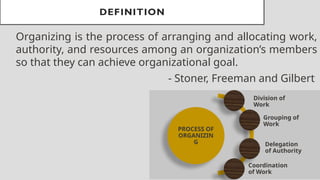
DEFINITION
Organizing is the process of arranging and allocating work,
authority, and resources among an organization’s members
so that they can achieve organizational goal.
- Stoner, Freeman and Gilbert
PROCESS OF
ORGANIZIN
G
Division of
Work
Grouping of
Work
Delegation
of Authority
Coordination
of Work
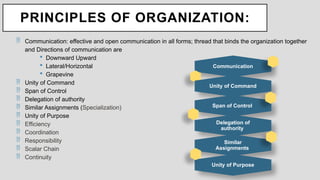
PRINCIPLES OF ORGANIZATION:
 Communication: effective and open communication in all forms; thread that binds the organization together
and Directions of communication are
 Downward Upward
 Lateral/Horizontal
 Grapevine
 Unity of Command
 Span of Control
 Delegation of authority
 Similar Assignments (Specialization)
 Unity of Purpose
 Efficiency
 Coordination
 Responsibility
 Scalar Chain
 Continuity
Communication
Unity of Command
Span of Control
Delegation of
authority
Similar
Assignments
Unity of Purpose
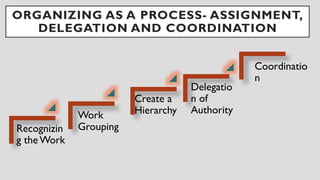
ORGANIZING AS A PROCESS- ASSIGNMENT,
DELEGATION AND COORDINATION
Recognizin
g the Work
Work
Grouping
Create a
Hierarchy
Delegatio
n of
Authority
Coordinatio
n
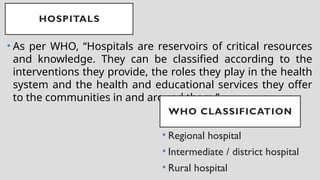
HOSPITALS
• As per WHO, “Hospitals are reservoirs of critical resources
and knowledge. They can be classified according to the
interventions they provide, the roles they play in the health
system and the health and educational services they offer
to the communities in and around them.”
• Regional hospital
• Intermediate / district hospital
• Rural hospital
WHO CLASSIFICATION
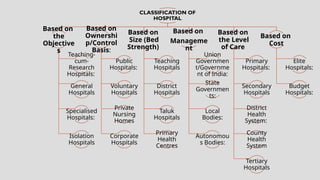
CLASSIFICATION OF
HOSPITAL
Based on
the
Objective
s
Teaching-
cum-
Research
Hospitals:
General
Hospitals
Specialised
Hospitals:
Isolation
Hospitals
Based on
Ownershi
p/Control
Basis:
Public
Hospitals:
Voluntary
Hospitals
Private
Nursing
Homes
Corporate
Hospitals
Based on
Size (Bed
Strength)
Teaching
Hospitals
District
Hospitals
Taluk
Hospitals
Primary
Health
Centres
Based on
Manageme
nt
Union
Governmen
t/Governme
nt of India:
State
Governmen
ts:
Local
Bodies:
Autonomou
s Bodies:
Based on
the Level
of Care
Primary
Hospitals:
Secondary
Hospitals
District
Health
System:
County
Health
System
Tertiary
Hospitals
Based on
Cost
Elite
Hospitals:
Budget
Hospitals:
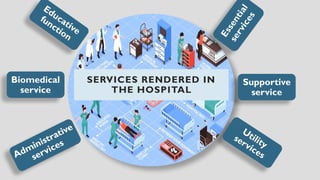
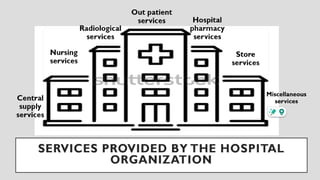
SERVICES RENDERED IN
THE HOSPITAL
E
s
s
e
n
t
i
a
l
s
e
r
v
i
c
e
s
Supportive
service
Utility
services
Administrative
services
Biomedical
service
Educative
function
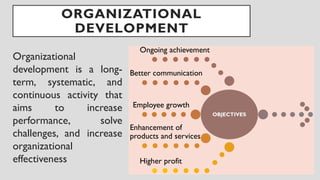
ORGANIZATIONAL
DEVELOPMENT
Organizational
development is a long-
term, systematic, and
continuous activity that
aims to increase
performance, solve
challenges, and increase
organizational
effectiveness
OBJECTIVES
Ongoing achievement
Better communication
Employee growth
Enhancement of
products and services
Higher profit
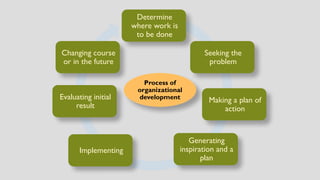
Determine
where work is
to be done
Seeking the
problem
Making a plan of
action
Generating
inspiration and a
plan
Implementing
Evaluating initial
result
Changing course
or in the future
Process of
organizational
development
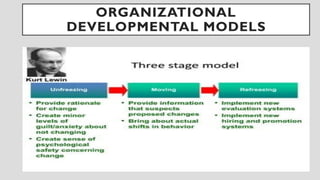
ORGANIZATIONAL
DEVELOPMENTAL MODELS
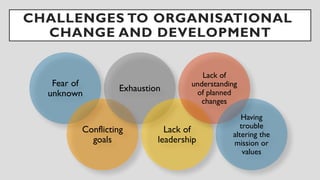
CHALLENGES TO ORGANISATIONAL
CHANGE AND DEVELOPMENT
Fear of
unknown
Conflicting
goals
Exhaustion
Lack of
leadership
Lack of
understanding
of planned
changes
Having
trouble
altering the
mission or
values
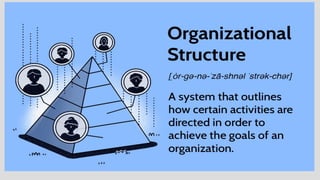
ORGANIZATIONAL
STRUCTURE
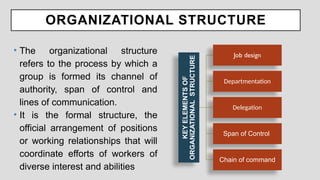
ORGANIZATIONAL STRUCTURE
• The organizational structure
refers to the process by which a
group is formed its channel of
authority, span of control and
lines of communication.
• It is the formal structure, the
official arrangement of positions
or working relationships that will
coordinate efforts of workers of
diverse interest and abilities
KEY
ELEMENTS
OF
ORGANIZATIONAL
STRUCTURE
Job design
Departmentation
Delegation
Span of Control
Chain of command
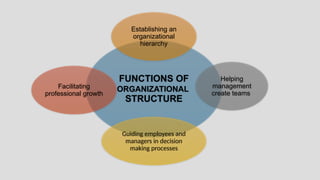
FUNCTIONS OF
ORGANIZATIONAL
STRUCTURE
Establishing an
organizational
hierarchy
Helping
management
create teams
Guiding employees and
managers in decision
making processes
Facilitating
professional growth
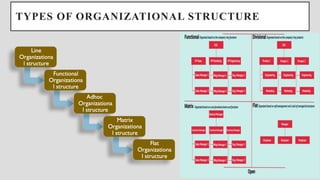
TYPES OF ORGANIZATIONAL STRUCTURE
Line
Organizationa
l structure
Functional
Organizationa
l structure
Adhoc
Organizationa
l structure
Matrix
Organizationa
l structure
Flat
Organizationa
l structure
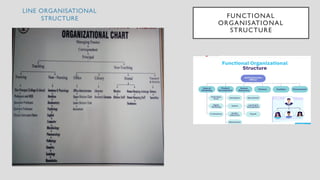
LINE ORGANISATIONAL
STRUCTURE FUNCTIONAL
ORGANISATIONAL
STRUCTURE
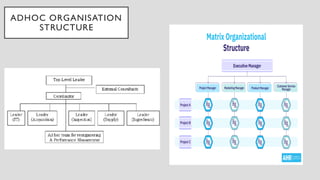
ADHOC ORGANISATION
STRUCTURE
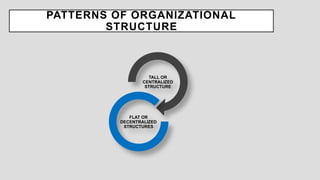
PATTERNS OF ORGANIZATIONAL
STRUCTURE
TALL OR
CENTRALIZED
STRUCTURE
FLAT OR
DECENTRALIZED
STRUCTURES
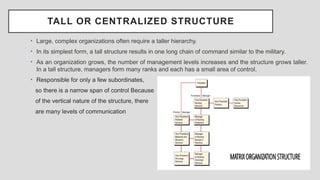
TALL OR CENTRALIZED STRUCTURE
• Large, complex organizations often require a taller hierarchy.
• In its simplest form, a tall structure results in one long chain of command similar to the military.
• As an organization grows, the number of management levels increases and the structure grows taller.
In a tall structure, managers form many ranks and each has a small area of control.
• Responsible for only a few subordinates,
so there is a narrow span of control Because
of the vertical nature of the structure, there
are many levels of communication
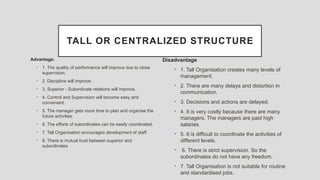
TALL OR CENTRALIZED STRUCTURE
Advantage;
• 1. The quality of performance will improve due to close
supervision.
• 2. Discipline will improve.
• 3. Superior - Subordinate relations will improve.
• 4. Control and Supervision will become easy and
convenient.
• 5. The manager gets more time to plan and organise the
future activities.
• 6. The efforts of subordinates can be easily coordinated.
• 7. Tall Organisation encourages development of staff.
• 8. There is mutual trust between superior and
subordinates
Disadvantage
• 1. Tall Organisation creates many levels of
management.
• 2. There are many delays and distortion in
communication.
• 3. Decisions and actions are delayed.
• 4. It is very costly because there are many
managers. The managers are paid high
salaries.
• 5. It is difficult to coordinate the activities of
different levels.
• 6. There is strict supervision. So the
subordinates do not have any freedom.
• 7. Tall Organisation is not suitable for routine
and standardised jobs.
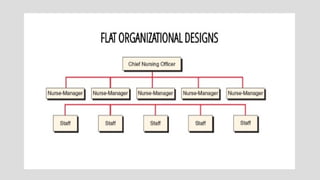
FLAT OR DECENTRALIZED STRUCTURES
1. Flat structures have fewer management levels, with each level controlling a broad area or group.
2. Flat organizations focus on empowering employees rather than adhering to the chain of command.
3. By encouraging autonomy and self-direction, flat structures attempt to tap into employees’ creative
talents and to solve problems by collaboration.
4. Refers to an organizational structure with few or no levels of intervention between management and
staff.
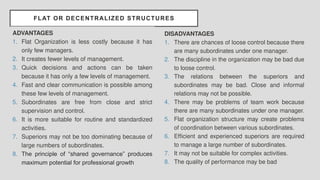
FLAT OR DECENTRALIZED STRUCTURES
ADVANTAGES
1. Flat Organization is less costly because it has
only few managers.
2. It creates fewer levels of management.
3. Quick decisions and actions can be taken
because it has only a few levels of management.
4. Fast and clear communication is possible among
these few levels of management.
5. Subordinates are free from close and strict
supervision and control.
6. It is more suitable for routine and standardized
activities.
7. Superiors may not be too dominating because of
large numbers of subordinates.
8. The principle of “shared governance” produces
maximum potential for professional growth
DISADVANTAGES
1. There are chances of loose control because there
are many subordinates under one manager.
2. The discipline in the organization may be bad due
to loose control.
3. The relations between the superiors and
subordinates may be bad. Close and informal
relations may not be possible.
4. There may be problems of team work because
there are many subordinates under one manager.
5. Flat organization structure may create problems
of coordination between various subordinates.
6. Efficient and experienced superiors are required
to manage a large number of subordinates.
7. It may not be suitable for complex activities.
8. The quality of performance may be bad
TYPES OF
ORGANIZATION
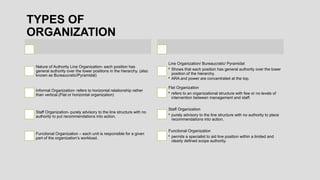
Nature of Authority Line Organization- each position has
general authority over the lower positions in the hierarchy. (also
known as Bureaucratic/Pyramidal)
Informal Organization- refers to horizontal relationship rather
than vertical.(Flat or horizontal organization)
Staff Organization- purely advisory to the line structure with no
authority to put recommendations into action.
Functional Organization – each unit is responsible for a given
part of the organization’s workload.
Line Organization/ Bureaucratic/ Pyramidal
• Shows that each position has general authority over the lower
position of the hierarchy.
• ARA and power are concentrated at the top.
Flat Organization
• refers to an organizational structure with few or no levels of
intervention between management and staff.
Staff Organization
• purely advisory to the line structure with no authority to place
recommendations into action.
Functional Organization
• permits a specialist to aid line position within a limited and
clearly defined scope authority.
ORGANIZATIONAL CHART
• An organizational chart is a usual way of describing a
formal organization using a chart. The chart shows the
flow of authority, responsibility, and communication
among various departments that are located at different
levels of the hierarchy
• An organizational chart is a line drawing showing how
an organization’s parts are linked.
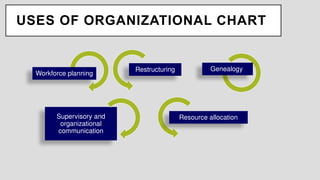
USES OF ORGANIZATIONAL CHART
Supervisory and
organizational
communication
Restructuring
Workforce planning
Resource allocation
Genealogy
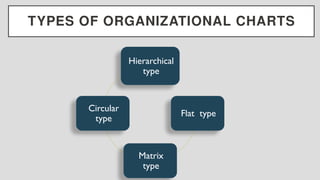
TYPES OF ORGANIZATIONAL CHARTS
Hierarchical
type
Flat type
Matrix
type
Circular
type
TYPES OF ORGANIZATIONAL CHARTS
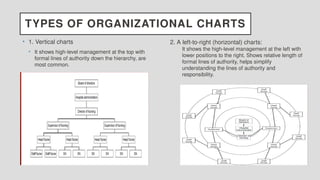
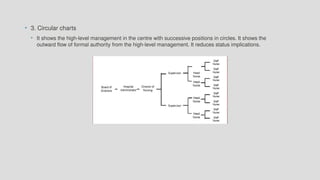
• 1. Vertical charts
• It shows high-level management at the top with
formal lines of authority down the hierarchy, are
most common.
2. A left-to-right (horizontal) charts:
It shows the high-level management at the left with
lower positions to the right. Shows relative length of
formal lines of authority, helps simplify
understanding the lines of authority and
responsibility.
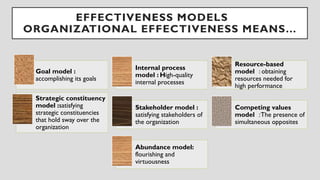
• 3. Circular charts
• It shows the high-level management in the centre with successive positions in circles. It shows the
outward flow of formal authority from the high-level management. It reduces status implications.
FEATURES OF AN ORGANIZATIONAL CHART
• Diagrammatic representation
• Formal organisational structure
• Lines of authority and formal
relationships
• Channel of communication and
departmental linkages
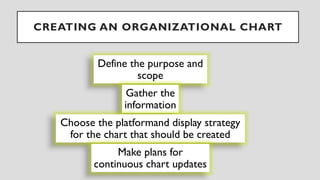
CREATING AN ORGANIZATIONAL CHART
Define the purpose and
scope
Gather the
information
Choose the platformand display strategy
for the chart that should be created
Make plans for
continuous chart updates
ADVANTAGES OF AN ORGANIZATIONAL
CHART
1. It provides a quick visual illustration of the organizational structure.
2. It provides help in organizational planning.
3. It shows lines of formal authority, responsibility and accountability.
4. It clarifies who supervises whom and to whom one is responsible.
5. It emphasizes the important aspect of each position.
6. It facilitates management development and training.
7. It is used to evaluate strengths and weakness of the current
structure.
8. It describes channels of communication.
DISADVANTAGES
• 1. Charts become outdated quickly.
• 2. Does not show informal relationship.
• 3. Does not show duties and responsibilities.
• 4. Poorly prepared charts might create misleading
effects.
ORGANIZATIONAL EFFECTIVENESS
Organizational effectiveness is the extent of growth and
profit by utilizing defined and finite resources without
disturbing internal resources
Leadership
Communi
cation
Accountab
ility
Delivery
Performance
Measurem
ent
STEPS OF ORGANIZATIONAL
EFFECTIVENESS
EFFECTIVENESS MODELS
ORGANIZATIONAL EFFECTIVENESS MEANS…
Goal model :
accomplishing its goals
Internal process
model : High-quality
internal processes
Resource-based
model : obtaining
resources needed for
high performance
Strategic constituency
model :satisfying
strategic constituencies
that hold sway over the
organization
Stakeholder model :
satisfying stakeholders of
the organization
Competing values
model :The presence of
simultaneous opposites
Abundance model:
flourishing and
virtuousness
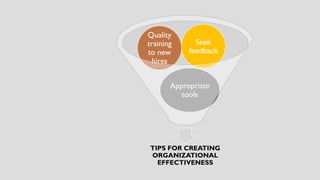
TIPS FOR CREATING
ORGANIZATIONAL
EFFECTIVENESS
Appropriate
tools
Quality
training
to new
hires
Seek
feedback
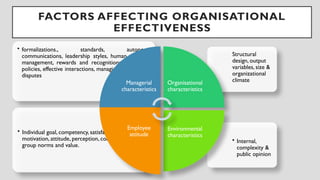
FACTORS AFFECTING ORGANISATIONAL
EFFECTIVENESS
• Internal,
complexity &
public opinion
• Individual goal, competency, satisfaction &
motivation, attitude, perception, commitment and
group norms and value.
Structural
design, output
variables, size &
organizational
climate
• formalizations., standards, autonomy,
communications, leadership styles, human resource
management, rewards and recognitions, promotion
policies, effective interactions, managing conflicts and
disputes
Managerial
characteristics
Organisational
characteristics
Environmental
characteristics
Employee
attitude
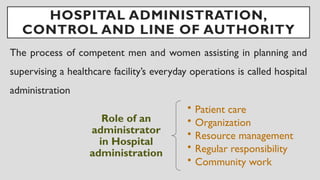
HOSPITAL ADMINISTRATION,
CONTROL AND LINE OF AUTHORITY
The process of competent men and women assisting in planning and
supervising a healthcare facility’s everyday operations is called hospital
administration
Role of an
administrator
in Hospital
administration
• Patient care
• Organization
• Resource management
• Regular responsibility
• Community work
CONTROL AND LINE OF AUTHORITY
Every hospital, indeed, nearly every organization, has a chain of
command. The chain of command is the line of authority and
responsibility along which orders are passed within the nursing
department, the hospital and between different units. The primary
traits of hospital management structure are
• A strict line of authority Ensures effective channel communication
regarding their services
• An environment of command and control permits the
arrangement of certain job divisions and accountability chains
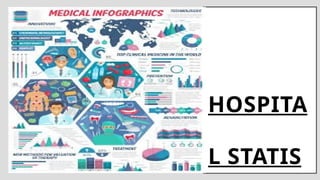
HOSPITA
L STATIS
HOSPITAL STATISTICS
• Hospital Statistics is collecting, processing, analyzing,
and transmitting the information required to manage the
hospital services.
• Information obtained from hospital indoor and outdoor
facilities regarding the quality of care, utilization of
services, quantity of services delivered, workload,
performance evaluation, and other hospital-related
administrative and logistic affairs is called ‘Hospital
Statistics’.
Uses
of
Hospital
Statistics Measure of the health status of the community
Measure of healthcare utilization
Measure of evaluation of quality of care
Guide for planning the future development of the
hospital
Allocation of resources in different areas
Identify deficiencies at various levels; ie. Input, process, and
outcome of services
Evaluate the effectiveness and efficiency of the
administration
Re-orientation of health service delivery
Efforts for improvement of hospital facilities
Comparison of the present and past performance of the
hospital
Appraisal of work performed by the medical, nursing, and
other staff
To conduct research
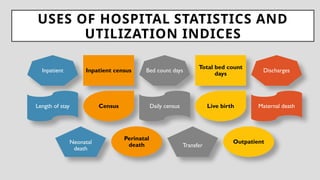
USES OF HOSPITAL STATISTICS AND
UTILIZATION INDICES
Inpatient Inpatient census Bed count days
Total bed count
days
Discharges
Length of stay Census Daily census Live birth Maternal death
Neonatal
death
Perinatal
death Transfer
Outpatient
BED-DAYS OR PATIENT-DAY
S
• A bed-day is a day during which a person is confined to a
bed and in which the patient stays overnight in a
hospital.
• One full day is counted when admission before mid-day
and discharge after mid-day.
• Patient-day should not include data for healthy new born
infants.
• Bed Supply Rate (BSR)(Bed to population ratio) = (No of
Beds available ÷ No of population served) x 1000
• WHO Standard: 5 beds/ 1000 population
BED TURNOVER RATE AVERA
GE
• Bed Turnover Rate :Average is number of patients cared for a bed during
a given period.
• BTR= (No of discharges including deaths for a given period of time ÷
Average bed count for that period of time) x 100
• Indicates:
• An important measure of hospital utilization indices.
• Gives the net effect of changes in Occupancy Rate and Average Length of
Stay (ALS)
• Example: In 2009, there were 2358 discharges in a particular hospital,
and the Number of beds in that hospital was 300.
• Hospital Bed turnover rate = 2358/300 = 7.86
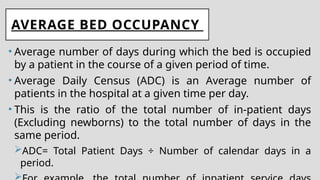
AVERAGE BED OCCUPANCY
• Average number of days during which the bed is occupied
by a patient in the course of a given period of time.
• Average Daily Census (ADC) is an Average number of
patients in the hospital at a given time per day.
• This is the ratio of the total number of in-patient days
(Excluding newborns) to the total number of days in the
same period.
ADC= Total Patient Days ÷ Number of calendar days in a
period.

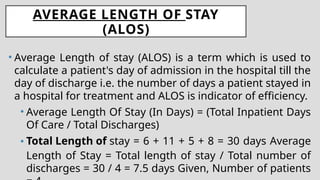
AVERAGE LENGTH OF STAY
(ALOS)
• Average Length of stay (ALOS) is a term which is used to
calculate a patient's day of admission in the hospital till the
day of discharge i.e. the number of days a patient stayed in
a hospital for treatment and ALOS is indicator of efficiency.
• Average Length Of Stay (In Days) = (Total Inpatient Days
Of Care / Total Discharges)
• Total Length of stay = 6 + 11 + 5 + 8 = 30 days Average
Length of Stay = Total length of stay / Total number of
discharges = 30 / 4 = 7.5 days Given, Number of patients
BED OCCUPANCY RATE (BOR)
• BOR is the average occupancy of hospital beds in
percentage. It is the ratio between beds used and beds
provided.
• The beds occupancy rate is calculated based on the
midnight bed census at each hospital.
• Number of patients' day (service days) in a year =
Number of beds x 365 X 100
• [For example, the BOR for Monday is based on the bed census taken at 0000 hrs
Tuesday].
• - 80-85% BOR is ideal for good quality of patient care.
• - 15-20% beds are vacant for emergency, maternity, isolation, intensive care (Dead
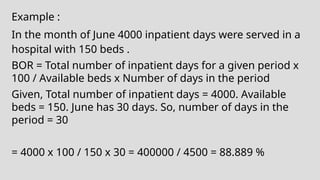
Example :
In the month of June 4000 inpatient days were served in a
hospital with 150 beds .
BOR = Total number of inpatient days for a given period x
100 / Available beds x Number of days in the period
Given, Total number of inpatient days = 4000. Available
beds = 150. June has 30 days. So, number of days in the
period = 30
= 4000 x 100 / 150 x 30 = 400000 / 4500 = 88.889 %
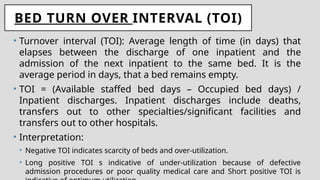
BED TURN OVER INTERVAL (TOI)
• Turnover interval (TOI): Average length of time (in days) that
elapses between the discharge of one inpatient and the
admission of the next inpatient to the same bed. It is the
average period in days, that a bed remains empty.
• TOI = (Available staffed bed days – Occupied bed days) /
Inpatient discharges. Inpatient discharges include deaths,
transfers out to other specialties/significant facilities and
transfers out to other hospitals.
• Interpretation:
• Negative TOI indicates scarcity of beds and over-utilization.
• Long positive TOI s indicative of under-utilization because of defective
admission procedures or poor quality medical care and Short positive TOI is
GROSS DEATH R
ATE
• Gross Death Rate: Ratio of total deaths
to total discharges including deaths. In
general hospital, it should not exceed 3%.
• Gross Death Rate= (Total death in a
period ÷ Total discharge) x 100
• Formula: r = ( n / t ) * 100
• Where, r = (Hospital) Gross Death rate
• n = Number of Deaths of Inpatients in a
Period
• t = Number of Discharges ( Including
Deaths ) in the Same Period
NET DEATH RATE
• A death rate, also known as the institutional
death rate, that does not include deaths,
which occur within 48 hours of admission
(24 hours of admission in some countries).
• Anaesthetic death rate = (No of deaths due to
anesthesia ÷ No of patients anesthetized
during that period) x 5000
• It should be less than 1 in 5000
• Post Operative death rate = (Deaths within
10 days of surgery ÷ Total operations during
that period) x 100
• Usual value is 1-2% (Depending on the
nature of the surgery)
AUTOPSY RAT
E
• Patients who are dead on arrival (DOA) at the hospital and fetal
deaths are excluded from both the numerator and the denominator.
• Autopsy Rate = (Number of pathological autopsies performed ÷
Number of deaths during that period) x 100
• Autopsy Rate of more than 15-20% indicates enquiry type of
medical staff, progressive in outlook.
• Caesarean Section Rate = (Total CS performed ÷ Total live-births
during that period) x 100
• - Normal value is 3-4%.
AVERAGE DAILY INPATIENT CENSUS
• Is the average number of inpatients present for each day for a given period.
• Average daily inpatient census =Total number of inpatients in June/ total
number of days in June
AVERAGE DAILY DISCHARGE CENSUS
• Is the average number of discharges present each day for a given period.
• Average daily discharge census=Total number of discharge in June/ total
number of days in June
NURSING CARE
DELIVERY SYSTEM
• "The process of delivering care to the client by combining
various aspects of nursing service which will fit to various
patient care settings to produce a common outcome of
delivering quality care and meeting the needs of clients."
• “A written delegation of duties to care for a group of
patients by trained personnel assigned to the unit based
on their knowledge, skills, job description, and patients
nursing needs.”
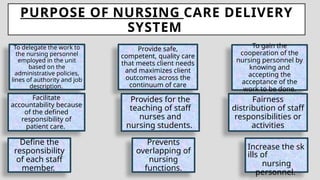
PURPOSE OF NURSING CARE DELIVERY
SYSTEM
To delegate the work to
the nursing personnel
employed in the unit
based on the
administrative policies,
lines of authority and job
description.
Provide safe,
competent, quality care
that meets client needs
and maximizes client
outcomes across the
continuum of care
To gain the
cooperation of the
nursing personnel by
knowing and
accepting the
acceptance of the
work to be done.
Facilitate
accountability because
of the defined
responsibility of
patient care.
Provides for the
teaching of staff
nurses and
nursing students.
Fairness
distribution of staff
responsibilities or
activities
Define the
responsibility
of each staff
member.
Prevents
overlapping of
nursing
functions.
Increase the sk
ills of
nursing
personnel.
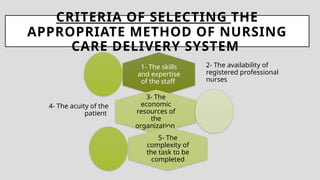
CRITERIA OF SELECTING THE
APPROPRIATE METHOD OF NURSING
CARE DELIVERY SYSTEM
1- The skills
and expertise
of the staff
2- The availability of
registered professional
nurses
3- The
economic
resources of
the
organization
4- The acuity of the
patient
5- The
complexity of
the task to be
completed
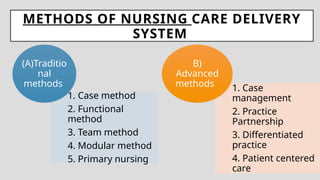
METHODS OF NURSING CARE DELIVERY
SYSTEM
1. Case method
2. Functional
method
3. Team method
4. Modular method
5. Primary nursing
(A)Traditio
nal
methods 1. Case
management
2. Practice
Partnership
3. Differentiated
practice
4. Patient centered
care
B)
Advanced
methods
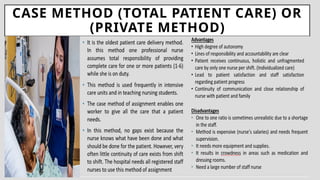
CASE METHOD (TOTAL PATIENT CARE) OR
(PRIVATE METHOD)
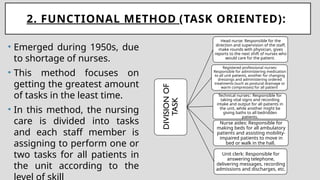
2. FUNCTIONAL METHOD (TASK ORIENTED):
• Emerged during 1950s, due
to shortage of nurses.
• This method focuses on
getting the greatest amount
of tasks in the least time.
• In this method, the nursing
care is divided into tasks
and each staff member is
assigning to perform one or
two tasks for all patients in
the unit according to the DIVISION
OF
TASK
Head nurse: Responsible for the
direction and supervision of the staff,
make rounds with physician, gives
reports to the next shift of nurses who
would care for the patient.
Registered professional nurses:
Responsible for administering medication
to all unit patients, another for changing
dressings and administering ordered
treatments (such as postural drainage or
warm compresses) for all patient
Technical nurses:: Responsible for
taking vital signs and recording
intake and output for all patients in
the unit, while another might be
giving baths to all bedridden
patients.
Nurse aides: Responsible for
making beds for all ambulatory
patients and assisting mobility-
impaired patients to move in
bed or walk in the hall.
Unit clerk: Responsible for
answering telephone,
delivering messages, recording
admissions and discharges, etc.
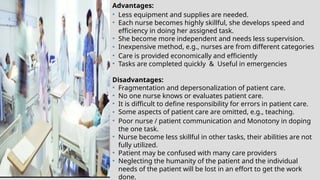
Advantages:
• Less equipment and supplies are needed.
• Each nurse becomes highly skillful, she develops speed and
efficiency in doing her assigned task.
• She become more independent and needs less supervision.
• Inexpensive method, e.g., nurses are from different categories
• Care is provided economically and efficiently
• Tasks are completed quickly & Useful in emergencies
Disadvantages:
• Fragmentation and depersonalization of patient care.
• No one nurse knows or evaluates patient care.
• It is difficult to define responsibility for errors in patient care.
• Some aspects of patient care are omitted, e.g., teaching.
• Poor nurse / patient communication and Monotony in doping
the one task.
• Nurse become less skillful in other tasks, their abilities are not
fully utilized.
• Patient may be confused with many care providers
• Neglecting the humanity of the patient and the individual
needs of the patient will be lost in an effort to get the work
done.
3-TEAM METHOD (DEMOCRATIC TEAM
LEADER)
• The concept of team nursing was introduced in the early
1950s.
• It is a method of nursing an assignment that binds
professional, technical, and nurse aides into small teams.
• This method allows for efficient utilization of technical
and/or nurse’s aides through the direct supervision,
guidance, and teaching of professional nurses.
• The most commonly used model and is still in use today.
The goal of the Team method is for a team to work
democratically.
• The Team Leader must be both a skilled clinician and an
effective group leader Team conferences occur in which the
expertise of every staff member is used to plan the care
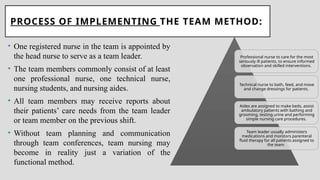
PROCESS OF IMPLEMENTING THE TEAM METHOD:
• One registered nurse in the team is appointed by
the head nurse to serve as a team leader.
• The team members commonly consist of at least
one professional nurse, one technical nurse,
nursing students, and nursing aides.
• All team members may receive reports about
their patients’ care needs from the team leader
or team member on the previous shift.
• Without team planning and communication
through team conferences, team nursing may
become in reality just a variation of the
functional method.
Professional nurse to care for the most
seriously ill patients, to ensure informed
observation and skilled interventions.
Technical nurse to bath, feed, and move
and change dressings for patients.
Aides are assigned to make beds, assist
ambulatory patients with bathing and
grooming, testing urine and performing
simple nursing care procedures.
Team leader usually administers
medications and monitors parenteral
fluid therapy for all patients assigned to
the team.
ADVANTAGES:
1. Availability of professional nurse skills for a
large number of patients.
2.Continuous supervision of less trained
personnel, thus providing better patient care.
3.Increase in the number and duration of
professional nurse-patient interactions.
4. Help in developing leadership skills.
5.Great opportunity for initiative and shared
responsibility.
6. Maximal use of individual abilities
7.Reduction of time spent in performing non-
nursing activities.
8.Total effort of the group is better than that of
each individual member.
9.It promotes nurses sense of belonging.
10.All nurses have contact with the patient; they
share in the planning, and provision of his care.
DISADVANTAGES:
• Most nursing programs do not
prepare nurses for leadership
roles.
• Nurses are more interested in
developing clinical patient care
skills than leadership abilities.
• With staff shortage, it is difficult to
properly apply this method.
• It needs more time by the team
leader to meet and share ideas and
coordinates efforts.
• Needs more supplies and
equipment.
• Can lead to blurred lines of
responsibility , errors and
4-MODULAR NURSING OR DISTRICT
NURSING:
• A modification to team nursing, focusing on the geographic
location of patient rooms and assignment of staff members.
• This is mini-team (two or three members) approach.
• Modular nursing assignment is used when the nursing staff
includes technical and nurse aides, as well as professional
nurses.
• Although two or three persons are assigned to each module,
the greatest responsibility for the care of assigned patients
falls on the professional nurse.
• The professional nurse is also responsible for guiding and
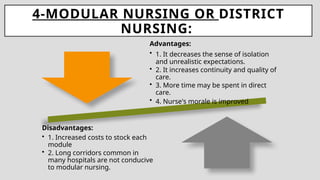
4-MODULAR NURSING OR DISTRICT
NURSING:
Advantages:
• 1. It decreases the sense of isolation
and unrealistic expectations.
• 2. It increases continuity and quality of
care.
• 3. More time may be spent in direct
care.
• 4. Nurse's morale is improved
Disadvantages:
• 1. Increased costs to stock each
module
• 2. Long corridors common in
many hospitals are not conducive
to modular nursing.
6-PRIMARY NURSING
• This method is the best in an agency with an all-
professional nurse staff. It is a comprehensive,
continuous, and coordinated nursing process for
meeting the total needs of each patient.
• A nursing care delivery system in which one nurse is
responsible and accountable for the nursing care of
specific patients for the duration of their stay
• It is also known as relationship-based nursing, developed
in the late 1960’s by Marie Manthey, uses some of the
concepts of total patient care, and brings the RN back to
• The Primary nurse is responsible for 24- hour-a-day
total patient care from admission through discharge.
• When the primary nurse is not on duty, associated
nurse, who follow the care plan established by the
primary nurse, provide care.
• The primary nurse, preferably baccalaureate prepared,
with autonomy, responsibility, and accountable for
meeting outcome criteria, and communicating with the
patient, the physician, the associated nurses, and other
team members.
• Also it is designed for hospitals; it is used in home
health nursing, hospice nursing, and other health care
ADVANTAGES
:
• It decrease the number of people in the chain of
commands
• Reduce the number of error and cost per patient per
day.
• Mobile use auxiliary workers.
• Increase satisfaction of nurse and patient,
• A patient is secured.
• Nurses identify the patient outcome as a result of their
work.
• Patient has fewer complications and a shorter
hospitalization (decreased length of hospital stay).
• Facilitate accountability as the primary nurse is the one
accountable for nursing care activities.
• Decrease in the number of unlicensed personnel.
DISADVANTAGE
S:
• Primary nursing confines a nurse's talent to a
limited number of patients & Time consuming.
• It success depends on the quality of nursing
staff and administrative support.
• It requires excellent communication between
the primary nurse and associate nurses.
• RN may not have the experience or educational
background to provide the total patient care.
• The agency needs to educate staff for an
adequate transmission from the previous role to
the primary role, so it is costly for the agency.
• It requires enough professional nurses to
provide primary nurse care.
• The RN may not accept the 24hour responsibility
for patient care.
• In times of nursing shortage, the primary
nursing may not be the strategy for choice
B) ADVANCED METHODS: 1- PRACTICE
PARTNERSHIP
(CO-PRIMARY NURSING):
• The partnership model, sometimes referred to as co-primary nursing, is a modification of
primary nursing and was designed to make more efficient use of the RN.
• A nursing care delivery system in which senior and junior staff members share patient care
responsibilities.
• Is a more recent concept also introduced by Marie Manthey (1989).
• It can be applied to Primary Nursing and used in team nursing, modular nursing, and total
patient care.
• It offered an efficient way of using the skills of a mix of professional and nonprofessional
staff with different levels of expertise.
• In the partnership model the RN is partnered with an LPN (licensed practical nurses), or
UAP (unlicensed assistive personnel), and the pair work together consistently to care for an
assigned group of patients.
Advantages:
• 1.More continuity of care and accountability for patient care than team and
modular nursing.
• 2.Less expensive for the organization and more satisfying professionally for
the partners than total patient care and primary care.
• 3.The RN can encourage the training and growth of his or her partner.
Disadvantages:
• 1- The potential for the junior member of the team to assume more
responsibility than appropriate.
• 2-The RN may have difficulty delegating to the partner.
• 3-Consistent partnerships are difficult to maintain based on varied staff
scheduled.
2- CASE MANAGEMENT
• As a dynamic and systematic collaborative approach to
providing and coordinating health care service to a
defined population.
• Case management is a process of monitoring an
individual patient’s health care by the case manager, to
maximize positive outcomes and contain costs.
• A model of identifying, coordinating, and monitoring the
implementation of services needed to achieve desired
patient care outcomes within a specified period of time.
• It is a strategy to coordinate care, maintain quality, and
THE CASE MANAGER (CASE
COORDINATOR):
• The case manager is a professional nurse with advanced level of nursing practice and
advanced managerial and communication skills.
• The (ANA) recommended a baccalaureate in nursing with 3 years of clinical experience
as the minimum preparation for a nurse case manager.
• In an acute care setting the case manager has a case load of 10 to 15 patients and follows
patient’s progress through the system from admission to discharge.
• Case manager has responsibility and authority for planning, implementing, coordinating
and evaluating care for the patient throughout the period of illness, regardless of the
patient’s movement among various units and services (such as emergency room, surgical
unit, recovery unit, etc.).
• The case manager ensures that plans are made in advance for the next needed step.
• Through this, the manager assists with decision-making and helps to ensure that the
patient receives care that will achieve the most positive outcomes in the most efficient
ADVANTAGE
S:
1.Enhancing nurse’s professional development and job
satisfaction
2. Increase collaboration between different health professionals.
3. Reduce patient complication.
4. Improve quality of care.
5. Facilitating the continuity of patient care.
6. Facilitate discharge of the patient within an appropriate length
of stay.
7. Reduce cost.
CRITICAL PATHWAY:
• Also called critical paths, practice protocols, clinical practice guideline, patient
care protocols or care maps, a predetermined written plan of care for a
particular health problem.
• Tools or guidelines that direct care by identifying expected outcomes that are
developed by the collaborative practice team.
• Successful case management relies on critical pathways to guide care.
• Critical pathway include: specific medical diagnosis, the expected length of
stay, patient identification data, appropriate time frames (in days, hours,
minutes, or visits) for interventions, and patient outcomes.
• A recent evolution of critical paths is the incorporation of actual and potential
nursing diagnosis with specific time frames into the critical pathway.
• A copy of this form is given to the patient and the family, and the nurse
3-PATIENT -CENTERED CARE
• A nursing care delivery system that is unit-based and consists of patient care
coordinators, patient care associates, unit support assistants, administrative
support personnel, and a nurse manager.
• It is developed in the late 1980s; it may be used in outpatient and homecare
settings, patient with chronic conditions are appropriate candidates for
patient-centered care approaches.
• The role of the nurse is broadened to coordinate a team of multifunctional
unit-based caregivers.
• All patient care services are unit-based, including admission and discharge,
diagnostic and treatment services, and nutrition services and medical records.
• The focus of Patient -centered care is decentralization, the promotion of
efficiency and quality, and cost control.
• The number of care givers is reduced, but their responsibilities are increased.
Advantages:
1. Patient comes into contact with fewer workers.
2. Workers are unit based and spend more time in direct-care activities.
3. RN is accountable for a wide range of serv
4. Increase the quality of care and increase patient satisfaction.
5. Cost-effectiveices and functions at a higher level to ensure more consistent
patient care.
Disadvantages:
1. Major change in organizational structure is required.
2. Major change is required also in the roles of the nurse manager and the
team members.
3. Departments other than nursing must be willing to accept nursing
leadership.
4- DIFFERENTIATED PRACTI
CE
• A nursing care delivery system that maximizes nursing resources by focusing
on the structure of nursing roles according to education, experience, and
competency.
• It has been used in a variety of inpatient, acute care settings as well as in
home care and clinics.
• It is designed to identify distinct levels of nursing practice based on defined
abilities that are incorporated into job descriptions.
• The aim is to match patient needs with nursing competencies to facilitate the
effective and efficient use of nursing resources.
• Nurses prepared at associate/ diploma, baccalaureate, masters, and
doctorate level are integrated.
• Each defined role is different and complementary. Nurses choose the role

4- DIFFERENTIATED PRACTI
CE
Advantages:
• 1- Improve patient care, and contribute to patient safety.
• 2- Allow for the most effective and efficient use of scarce resources.
• 3- Increase satisfaction for nurses.
• 4- Provide opportunity to compensate nurses fairly based on their
expertise, contributions, and productivity
ORGANIZATION
AL
CLIMATE
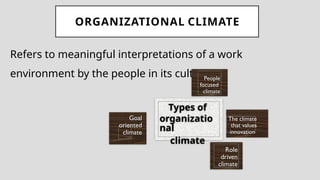
ORGANIZATIONAL CLIMATE
Refers to meaningful interpretations of a work
environment by the people in its culture.
Types of
organizatio
nal
climate
People
focused
climate
The climate
that values
innovation
Goal
oriented
climate
Role
driven
climate
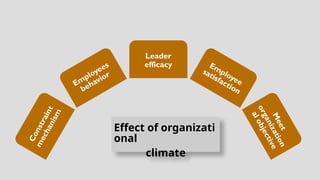
C
o
n
s
t
r
a
i
n
t
m
e
c
h
a
n
i
s
m
Employees
behavior
Leader
efficacy Employee
satisfaction
M
e
e
t
o
r
g
a
n
i
z
a
t
i
o
n
a
l
o
b
j
e
c
t
i
v
e
Effect of organizati
onal
climate
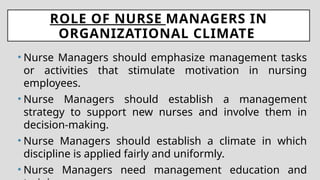
ROLE OF NURSE MANAGERS IN
ORGANIZATIONAL CLIMATE
• Nurse Managers should emphasize management tasks
or activities that stimulate motivation in nursing
employees.
• Nurse Managers should establish a management
strategy to support new nurses and involve them in
decision-making.
• Nurse Managers should establish a climate in which
discipline is applied fairly and uniformly.
• Nurse Managers need management education and
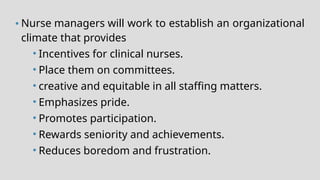
• Nurse managers will work to establish an organizational
climate that provides
• Incentives for clinical nurses.
• Place them on committees.
• creative and equitable in all staffing matters.
• Emphasizes pride.
• Promotes participation.
• Rewards seniority and achievements.
• Reduces boredom and frustration.
REFERENCES

ORGANIZING IN NURSING MANAGEMENT. POWERPOINT

  • 1.
  • 2.
    ORGANIZING is theprocess of establishing formal authority Involves setting up the organizational structure through identification of groupings, roles and relationships a.Determines staff needed through developing and maintaining staffing patterns and distributes them in the various areas as needed b.Develops job descriptions by defining the qualifications and functions of personnel
  • 3.
    • Organizing isone way which nursing management coordinates the various activities of a department or a unit so that the staff can get its work done in an orderly fashion • Organizing means having qualified people and the right materials, information and equipment needed to deal with contingencies
  • 4.
    DEFINITION Organizing is theprocess of arranging and allocating work, authority, and resources among an organization’s members so that they can achieve organizational goal. - Stoner, Freeman and Gilbert PROCESS OF ORGANIZIN G Division of Work Grouping of Work Delegation of Authority Coordination of Work
  • 5.
    PRINCIPLES OF ORGANIZATION: Communication: effective and open communication in all forms; thread that binds the organization together and Directions of communication are  Downward Upward  Lateral/Horizontal  Grapevine  Unity of Command  Span of Control  Delegation of authority  Similar Assignments (Specialization)  Unity of Purpose  Efficiency  Coordination  Responsibility  Scalar Chain  Continuity Communication Unity of Command Span of Control Delegation of authority Similar Assignments Unity of Purpose
  • 6.
    ORGANIZING AS APROCESS- ASSIGNMENT, DELEGATION AND COORDINATION Recognizin g the Work Work Grouping Create a Hierarchy Delegatio n of Authority Coordinatio n
  • 7.
    HOSPITALS • As perWHO, “Hospitals are reservoirs of critical resources and knowledge. They can be classified according to the interventions they provide, the roles they play in the health system and the health and educational services they offer to the communities in and around them.” • Regional hospital • Intermediate / district hospital • Rural hospital WHO CLASSIFICATION
  • 8.
    CLASSIFICATION OF HOSPITAL Based on the Objective s Teaching- cum- Research Hospitals: General Hospitals Specialised Hospitals: Isolation Hospitals Basedon Ownershi p/Control Basis: Public Hospitals: Voluntary Hospitals Private Nursing Homes Corporate Hospitals Based on Size (Bed Strength) Teaching Hospitals District Hospitals Taluk Hospitals Primary Health Centres Based on Manageme nt Union Governmen t/Governme nt of India: State Governmen ts: Local Bodies: Autonomou s Bodies: Based on the Level of Care Primary Hospitals: Secondary Hospitals District Health System: County Health System Tertiary Hospitals Based on Cost Elite Hospitals: Budget Hospitals:
  • 9.
    SERVICES RENDERED IN THEHOSPITAL E s s e n t i a l s e r v i c e s Supportive service Utility services Administrative services Biomedical service Educative function
  • 11.
    ORGANIZATIONAL DEVELOPMENT Organizational development is along- term, systematic, and continuous activity that aims to increase performance, solve challenges, and increase organizational effectiveness OBJECTIVES Ongoing achievement Better communication Employee growth Enhancement of products and services Higher profit
  • 12.
    Determine where work is tobe done Seeking the problem Making a plan of action Generating inspiration and a plan Implementing Evaluating initial result Changing course or in the future Process of organizational development
  • 13.
  • 14.
    CHALLENGES TO ORGANISATIONAL CHANGEAND DEVELOPMENT Fear of unknown Conflicting goals Exhaustion Lack of leadership Lack of understanding of planned changes Having trouble altering the mission or values
  • 15.
  • 16.
    ORGANIZATIONAL STRUCTURE • Theorganizational structure refers to the process by which a group is formed its channel of authority, span of control and lines of communication. • It is the formal structure, the official arrangement of positions or working relationships that will coordinate efforts of workers of diverse interest and abilities KEY ELEMENTS OF ORGANIZATIONAL STRUCTURE Job design Departmentation Delegation Span of Control Chain of command
  • 17.
    FUNCTIONS OF ORGANIZATIONAL STRUCTURE Establishing an organizational hierarchy Helping management createteams Guiding employees and managers in decision making processes Facilitating professional growth
  • 18.
    TYPES OF ORGANIZATIONALSTRUCTURE Line Organizationa l structure Functional Organizationa l structure Adhoc Organizationa l structure Matrix Organizationa l structure Flat Organizationa l structure
  • 19.
  • 20.
  • 22.
    PATTERNS OF ORGANIZATIONAL STRUCTURE TALLOR CENTRALIZED STRUCTURE FLAT OR DECENTRALIZED STRUCTURES
  • 23.
    TALL OR CENTRALIZEDSTRUCTURE • Large, complex organizations often require a taller hierarchy. • In its simplest form, a tall structure results in one long chain of command similar to the military. • As an organization grows, the number of management levels increases and the structure grows taller. In a tall structure, managers form many ranks and each has a small area of control. • Responsible for only a few subordinates, so there is a narrow span of control Because of the vertical nature of the structure, there are many levels of communication
  • 24.
    TALL OR CENTRALIZEDSTRUCTURE Advantage; • 1. The quality of performance will improve due to close supervision. • 2. Discipline will improve. • 3. Superior - Subordinate relations will improve. • 4. Control and Supervision will become easy and convenient. • 5. The manager gets more time to plan and organise the future activities. • 6. The efforts of subordinates can be easily coordinated. • 7. Tall Organisation encourages development of staff. • 8. There is mutual trust between superior and subordinates Disadvantage • 1. Tall Organisation creates many levels of management. • 2. There are many delays and distortion in communication. • 3. Decisions and actions are delayed. • 4. It is very costly because there are many managers. The managers are paid high salaries. • 5. It is difficult to coordinate the activities of different levels. • 6. There is strict supervision. So the subordinates do not have any freedom. • 7. Tall Organisation is not suitable for routine and standardised jobs.
  • 25.
    FLAT OR DECENTRALIZEDSTRUCTURES 1. Flat structures have fewer management levels, with each level controlling a broad area or group. 2. Flat organizations focus on empowering employees rather than adhering to the chain of command. 3. By encouraging autonomy and self-direction, flat structures attempt to tap into employees’ creative talents and to solve problems by collaboration. 4. Refers to an organizational structure with few or no levels of intervention between management and staff.
  • 26.
    FLAT OR DECENTRALIZEDSTRUCTURES ADVANTAGES 1. Flat Organization is less costly because it has only few managers. 2. It creates fewer levels of management. 3. Quick decisions and actions can be taken because it has only a few levels of management. 4. Fast and clear communication is possible among these few levels of management. 5. Subordinates are free from close and strict supervision and control. 6. It is more suitable for routine and standardized activities. 7. Superiors may not be too dominating because of large numbers of subordinates. 8. The principle of “shared governance” produces maximum potential for professional growth DISADVANTAGES 1. There are chances of loose control because there are many subordinates under one manager. 2. The discipline in the organization may be bad due to loose control. 3. The relations between the superiors and subordinates may be bad. Close and informal relations may not be possible. 4. There may be problems of team work because there are many subordinates under one manager. 5. Flat organization structure may create problems of coordination between various subordinates. 6. Efficient and experienced superiors are required to manage a large number of subordinates. 7. It may not be suitable for complex activities. 8. The quality of performance may be bad
  • 27.
    TYPES OF ORGANIZATION Nature ofAuthority Line Organization- each position has general authority over the lower positions in the hierarchy. (also known as Bureaucratic/Pyramidal) Informal Organization- refers to horizontal relationship rather than vertical.(Flat or horizontal organization) Staff Organization- purely advisory to the line structure with no authority to put recommendations into action. Functional Organization – each unit is responsible for a given part of the organization’s workload. Line Organization/ Bureaucratic/ Pyramidal • Shows that each position has general authority over the lower position of the hierarchy. • ARA and power are concentrated at the top. Flat Organization • refers to an organizational structure with few or no levels of intervention between management and staff. Staff Organization • purely advisory to the line structure with no authority to place recommendations into action. Functional Organization • permits a specialist to aid line position within a limited and clearly defined scope authority.
  • 28.
    ORGANIZATIONAL CHART • Anorganizational chart is a usual way of describing a formal organization using a chart. The chart shows the flow of authority, responsibility, and communication among various departments that are located at different levels of the hierarchy • An organizational chart is a line drawing showing how an organization’s parts are linked.
  • 29.
    USES OF ORGANIZATIONALCHART Supervisory and organizational communication Restructuring Workforce planning Resource allocation Genealogy
  • 30.
    TYPES OF ORGANIZATIONALCHARTS Hierarchical type Flat type Matrix type Circular type
  • 31.
    TYPES OF ORGANIZATIONALCHARTS • 1. Vertical charts • It shows high-level management at the top with formal lines of authority down the hierarchy, are most common. 2. A left-to-right (horizontal) charts: It shows the high-level management at the left with lower positions to the right. Shows relative length of formal lines of authority, helps simplify understanding the lines of authority and responsibility.
  • 32.
    • 3. Circularcharts • It shows the high-level management in the centre with successive positions in circles. It shows the outward flow of formal authority from the high-level management. It reduces status implications.
  • 33.
    FEATURES OF ANORGANIZATIONAL CHART • Diagrammatic representation • Formal organisational structure • Lines of authority and formal relationships • Channel of communication and departmental linkages
  • 34.
    CREATING AN ORGANIZATIONALCHART Define the purpose and scope Gather the information Choose the platformand display strategy for the chart that should be created Make plans for continuous chart updates
  • 35.
    ADVANTAGES OF ANORGANIZATIONAL CHART 1. It provides a quick visual illustration of the organizational structure. 2. It provides help in organizational planning. 3. It shows lines of formal authority, responsibility and accountability. 4. It clarifies who supervises whom and to whom one is responsible. 5. It emphasizes the important aspect of each position. 6. It facilitates management development and training. 7. It is used to evaluate strengths and weakness of the current structure. 8. It describes channels of communication.
  • 36.
    DISADVANTAGES • 1. Chartsbecome outdated quickly. • 2. Does not show informal relationship. • 3. Does not show duties and responsibilities. • 4. Poorly prepared charts might create misleading effects.
  • 37.
  • 38.
    Organizational effectiveness isthe extent of growth and profit by utilizing defined and finite resources without disturbing internal resources Leadership Communi cation Accountab ility Delivery Performance Measurem ent STEPS OF ORGANIZATIONAL EFFECTIVENESS
  • 39.
    EFFECTIVENESS MODELS ORGANIZATIONAL EFFECTIVENESSMEANS… Goal model : accomplishing its goals Internal process model : High-quality internal processes Resource-based model : obtaining resources needed for high performance Strategic constituency model :satisfying strategic constituencies that hold sway over the organization Stakeholder model : satisfying stakeholders of the organization Competing values model :The presence of simultaneous opposites Abundance model: flourishing and virtuousness
  • 40.
  • 41.
    FACTORS AFFECTING ORGANISATIONAL EFFECTIVENESS •Internal, complexity & public opinion • Individual goal, competency, satisfaction & motivation, attitude, perception, commitment and group norms and value. Structural design, output variables, size & organizational climate • formalizations., standards, autonomy, communications, leadership styles, human resource management, rewards and recognitions, promotion policies, effective interactions, managing conflicts and disputes Managerial characteristics Organisational characteristics Environmental characteristics Employee attitude
  • 42.
    HOSPITAL ADMINISTRATION, CONTROL ANDLINE OF AUTHORITY The process of competent men and women assisting in planning and supervising a healthcare facility’s everyday operations is called hospital administration Role of an administrator in Hospital administration • Patient care • Organization • Resource management • Regular responsibility • Community work
  • 43.
    CONTROL AND LINEOF AUTHORITY Every hospital, indeed, nearly every organization, has a chain of command. The chain of command is the line of authority and responsibility along which orders are passed within the nursing department, the hospital and between different units. The primary traits of hospital management structure are • A strict line of authority Ensures effective channel communication regarding their services • An environment of command and control permits the arrangement of certain job divisions and accountability chains
  • 44.
  • 45.
    HOSPITAL STATISTICS • HospitalStatistics is collecting, processing, analyzing, and transmitting the information required to manage the hospital services. • Information obtained from hospital indoor and outdoor facilities regarding the quality of care, utilization of services, quantity of services delivered, workload, performance evaluation, and other hospital-related administrative and logistic affairs is called ‘Hospital Statistics’.
  • 46.
    Uses of Hospital Statistics Measure ofthe health status of the community Measure of healthcare utilization Measure of evaluation of quality of care Guide for planning the future development of the hospital Allocation of resources in different areas Identify deficiencies at various levels; ie. Input, process, and outcome of services Evaluate the effectiveness and efficiency of the administration Re-orientation of health service delivery Efforts for improvement of hospital facilities Comparison of the present and past performance of the hospital Appraisal of work performed by the medical, nursing, and other staff To conduct research
  • 47.
    USES OF HOSPITALSTATISTICS AND UTILIZATION INDICES Inpatient Inpatient census Bed count days Total bed count days Discharges Length of stay Census Daily census Live birth Maternal death Neonatal death Perinatal death Transfer Outpatient
  • 48.
    BED-DAYS OR PATIENT-DAY S •A bed-day is a day during which a person is confined to a bed and in which the patient stays overnight in a hospital. • One full day is counted when admission before mid-day and discharge after mid-day. • Patient-day should not include data for healthy new born infants. • Bed Supply Rate (BSR)(Bed to population ratio) = (No of Beds available ÷ No of population served) x 1000 • WHO Standard: 5 beds/ 1000 population
  • 49.
    BED TURNOVER RATEAVERA GE • Bed Turnover Rate :Average is number of patients cared for a bed during a given period. • BTR= (No of discharges including deaths for a given period of time ÷ Average bed count for that period of time) x 100 • Indicates: • An important measure of hospital utilization indices. • Gives the net effect of changes in Occupancy Rate and Average Length of Stay (ALS) • Example: In 2009, there were 2358 discharges in a particular hospital, and the Number of beds in that hospital was 300. • Hospital Bed turnover rate = 2358/300 = 7.86
  • 50.
    AVERAGE BED OCCUPANCY •Average number of days during which the bed is occupied by a patient in the course of a given period of time. • Average Daily Census (ADC) is an Average number of patients in the hospital at a given time per day. • This is the ratio of the total number of in-patient days (Excluding newborns) to the total number of days in the same period. ADC= Total Patient Days ÷ Number of calendar days in a period. 
  • 51.
    AVERAGE LENGTH OFSTAY (ALOS) • Average Length of stay (ALOS) is a term which is used to calculate a patient's day of admission in the hospital till the day of discharge i.e. the number of days a patient stayed in a hospital for treatment and ALOS is indicator of efficiency. • Average Length Of Stay (In Days) = (Total Inpatient Days Of Care / Total Discharges) • Total Length of stay = 6 + 11 + 5 + 8 = 30 days Average Length of Stay = Total length of stay / Total number of discharges = 30 / 4 = 7.5 days Given, Number of patients
  • 52.
    BED OCCUPANCY RATE(BOR) • BOR is the average occupancy of hospital beds in percentage. It is the ratio between beds used and beds provided. • The beds occupancy rate is calculated based on the midnight bed census at each hospital. • Number of patients' day (service days) in a year = Number of beds x 365 X 100 • [For example, the BOR for Monday is based on the bed census taken at 0000 hrs Tuesday]. • - 80-85% BOR is ideal for good quality of patient care. • - 15-20% beds are vacant for emergency, maternity, isolation, intensive care (Dead
  • 53.
    Example : In themonth of June 4000 inpatient days were served in a hospital with 150 beds . BOR = Total number of inpatient days for a given period x 100 / Available beds x Number of days in the period Given, Total number of inpatient days = 4000. Available beds = 150. June has 30 days. So, number of days in the period = 30 = 4000 x 100 / 150 x 30 = 400000 / 4500 = 88.889 %
  • 54.
    BED TURN OVERINTERVAL (TOI) • Turnover interval (TOI): Average length of time (in days) that elapses between the discharge of one inpatient and the admission of the next inpatient to the same bed. It is the average period in days, that a bed remains empty. • TOI = (Available staffed bed days – Occupied bed days) / Inpatient discharges. Inpatient discharges include deaths, transfers out to other specialties/significant facilities and transfers out to other hospitals. • Interpretation: • Negative TOI indicates scarcity of beds and over-utilization. • Long positive TOI s indicative of under-utilization because of defective admission procedures or poor quality medical care and Short positive TOI is
  • 55.
    GROSS DEATH R ATE •Gross Death Rate: Ratio of total deaths to total discharges including deaths. In general hospital, it should not exceed 3%. • Gross Death Rate= (Total death in a period ÷ Total discharge) x 100 • Formula: r = ( n / t ) * 100 • Where, r = (Hospital) Gross Death rate • n = Number of Deaths of Inpatients in a Period • t = Number of Discharges ( Including Deaths ) in the Same Period NET DEATH RATE • A death rate, also known as the institutional death rate, that does not include deaths, which occur within 48 hours of admission (24 hours of admission in some countries). • Anaesthetic death rate = (No of deaths due to anesthesia ÷ No of patients anesthetized during that period) x 5000 • It should be less than 1 in 5000 • Post Operative death rate = (Deaths within 10 days of surgery ÷ Total operations during that period) x 100 • Usual value is 1-2% (Depending on the nature of the surgery)
  • 56.
    AUTOPSY RAT E • Patientswho are dead on arrival (DOA) at the hospital and fetal deaths are excluded from both the numerator and the denominator. • Autopsy Rate = (Number of pathological autopsies performed ÷ Number of deaths during that period) x 100 • Autopsy Rate of more than 15-20% indicates enquiry type of medical staff, progressive in outlook. • Caesarean Section Rate = (Total CS performed ÷ Total live-births during that period) x 100 • - Normal value is 3-4%.
  • 57.
    AVERAGE DAILY INPATIENTCENSUS • Is the average number of inpatients present for each day for a given period. • Average daily inpatient census =Total number of inpatients in June/ total number of days in June AVERAGE DAILY DISCHARGE CENSUS • Is the average number of discharges present each day for a given period. • Average daily discharge census=Total number of discharge in June/ total number of days in June
  • 58.
  • 59.
    • "The processof delivering care to the client by combining various aspects of nursing service which will fit to various patient care settings to produce a common outcome of delivering quality care and meeting the needs of clients." • “A written delegation of duties to care for a group of patients by trained personnel assigned to the unit based on their knowledge, skills, job description, and patients nursing needs.”
  • 60.
    PURPOSE OF NURSINGCARE DELIVERY SYSTEM To delegate the work to the nursing personnel employed in the unit based on the administrative policies, lines of authority and job description. Provide safe, competent, quality care that meets client needs and maximizes client outcomes across the continuum of care To gain the cooperation of the nursing personnel by knowing and accepting the acceptance of the work to be done. Facilitate accountability because of the defined responsibility of patient care. Provides for the teaching of staff nurses and nursing students. Fairness distribution of staff responsibilities or activities Define the responsibility of each staff member. Prevents overlapping of nursing functions. Increase the sk ills of nursing personnel.
  • 61.
    CRITERIA OF SELECTINGTHE APPROPRIATE METHOD OF NURSING CARE DELIVERY SYSTEM 1- The skills and expertise of the staff 2- The availability of registered professional nurses 3- The economic resources of the organization 4- The acuity of the patient 5- The complexity of the task to be completed
  • 62.
    METHODS OF NURSINGCARE DELIVERY SYSTEM 1. Case method 2. Functional method 3. Team method 4. Modular method 5. Primary nursing (A)Traditio nal methods 1. Case management 2. Practice Partnership 3. Differentiated practice 4. Patient centered care B) Advanced methods
  • 63.
    CASE METHOD (TOTALPATIENT CARE) OR (PRIVATE METHOD)
  • 64.
    2. FUNCTIONAL METHOD(TASK ORIENTED): • Emerged during 1950s, due to shortage of nurses. • This method focuses on getting the greatest amount of tasks in the least time. • In this method, the nursing care is divided into tasks and each staff member is assigning to perform one or two tasks for all patients in the unit according to the DIVISION OF TASK Head nurse: Responsible for the direction and supervision of the staff, make rounds with physician, gives reports to the next shift of nurses who would care for the patient. Registered professional nurses: Responsible for administering medication to all unit patients, another for changing dressings and administering ordered treatments (such as postural drainage or warm compresses) for all patient Technical nurses:: Responsible for taking vital signs and recording intake and output for all patients in the unit, while another might be giving baths to all bedridden patients. Nurse aides: Responsible for making beds for all ambulatory patients and assisting mobility- impaired patients to move in bed or walk in the hall. Unit clerk: Responsible for answering telephone, delivering messages, recording admissions and discharges, etc.
  • 65.
    Advantages: • Less equipmentand supplies are needed. • Each nurse becomes highly skillful, she develops speed and efficiency in doing her assigned task. • She become more independent and needs less supervision. • Inexpensive method, e.g., nurses are from different categories • Care is provided economically and efficiently • Tasks are completed quickly & Useful in emergencies Disadvantages: • Fragmentation and depersonalization of patient care. • No one nurse knows or evaluates patient care. • It is difficult to define responsibility for errors in patient care. • Some aspects of patient care are omitted, e.g., teaching. • Poor nurse / patient communication and Monotony in doping the one task. • Nurse become less skillful in other tasks, their abilities are not fully utilized. • Patient may be confused with many care providers • Neglecting the humanity of the patient and the individual needs of the patient will be lost in an effort to get the work done.
  • 66.
    3-TEAM METHOD (DEMOCRATICTEAM LEADER) • The concept of team nursing was introduced in the early 1950s. • It is a method of nursing an assignment that binds professional, technical, and nurse aides into small teams. • This method allows for efficient utilization of technical and/or nurse’s aides through the direct supervision, guidance, and teaching of professional nurses. • The most commonly used model and is still in use today. The goal of the Team method is for a team to work democratically. • The Team Leader must be both a skilled clinician and an effective group leader Team conferences occur in which the expertise of every staff member is used to plan the care
  • 67.
    PROCESS OF IMPLEMENTINGTHE TEAM METHOD: • One registered nurse in the team is appointed by the head nurse to serve as a team leader. • The team members commonly consist of at least one professional nurse, one technical nurse, nursing students, and nursing aides. • All team members may receive reports about their patients’ care needs from the team leader or team member on the previous shift. • Without team planning and communication through team conferences, team nursing may become in reality just a variation of the functional method. Professional nurse to care for the most seriously ill patients, to ensure informed observation and skilled interventions. Technical nurse to bath, feed, and move and change dressings for patients. Aides are assigned to make beds, assist ambulatory patients with bathing and grooming, testing urine and performing simple nursing care procedures. Team leader usually administers medications and monitors parenteral fluid therapy for all patients assigned to the team.
  • 68.
    ADVANTAGES: 1. Availability ofprofessional nurse skills for a large number of patients. 2.Continuous supervision of less trained personnel, thus providing better patient care. 3.Increase in the number and duration of professional nurse-patient interactions. 4. Help in developing leadership skills. 5.Great opportunity for initiative and shared responsibility. 6. Maximal use of individual abilities 7.Reduction of time spent in performing non- nursing activities. 8.Total effort of the group is better than that of each individual member. 9.It promotes nurses sense of belonging. 10.All nurses have contact with the patient; they share in the planning, and provision of his care. DISADVANTAGES: • Most nursing programs do not prepare nurses for leadership roles. • Nurses are more interested in developing clinical patient care skills than leadership abilities. • With staff shortage, it is difficult to properly apply this method. • It needs more time by the team leader to meet and share ideas and coordinates efforts. • Needs more supplies and equipment. • Can lead to blurred lines of responsibility , errors and
  • 69.
    4-MODULAR NURSING ORDISTRICT NURSING: • A modification to team nursing, focusing on the geographic location of patient rooms and assignment of staff members. • This is mini-team (two or three members) approach. • Modular nursing assignment is used when the nursing staff includes technical and nurse aides, as well as professional nurses. • Although two or three persons are assigned to each module, the greatest responsibility for the care of assigned patients falls on the professional nurse. • The professional nurse is also responsible for guiding and
  • 70.
    4-MODULAR NURSING ORDISTRICT NURSING: Advantages: • 1. It decreases the sense of isolation and unrealistic expectations. • 2. It increases continuity and quality of care. • 3. More time may be spent in direct care. • 4. Nurse's morale is improved Disadvantages: • 1. Increased costs to stock each module • 2. Long corridors common in many hospitals are not conducive to modular nursing.
  • 71.
    6-PRIMARY NURSING • Thismethod is the best in an agency with an all- professional nurse staff. It is a comprehensive, continuous, and coordinated nursing process for meeting the total needs of each patient. • A nursing care delivery system in which one nurse is responsible and accountable for the nursing care of specific patients for the duration of their stay • It is also known as relationship-based nursing, developed in the late 1960’s by Marie Manthey, uses some of the concepts of total patient care, and brings the RN back to
  • 72.
    • The Primarynurse is responsible for 24- hour-a-day total patient care from admission through discharge. • When the primary nurse is not on duty, associated nurse, who follow the care plan established by the primary nurse, provide care. • The primary nurse, preferably baccalaureate prepared, with autonomy, responsibility, and accountable for meeting outcome criteria, and communicating with the patient, the physician, the associated nurses, and other team members. • Also it is designed for hospitals; it is used in home health nursing, hospice nursing, and other health care
  • 73.
    ADVANTAGES : • It decreasethe number of people in the chain of commands • Reduce the number of error and cost per patient per day. • Mobile use auxiliary workers. • Increase satisfaction of nurse and patient, • A patient is secured. • Nurses identify the patient outcome as a result of their work. • Patient has fewer complications and a shorter hospitalization (decreased length of hospital stay). • Facilitate accountability as the primary nurse is the one accountable for nursing care activities. • Decrease in the number of unlicensed personnel. DISADVANTAGE S: • Primary nursing confines a nurse's talent to a limited number of patients & Time consuming. • It success depends on the quality of nursing staff and administrative support. • It requires excellent communication between the primary nurse and associate nurses. • RN may not have the experience or educational background to provide the total patient care. • The agency needs to educate staff for an adequate transmission from the previous role to the primary role, so it is costly for the agency. • It requires enough professional nurses to provide primary nurse care. • The RN may not accept the 24hour responsibility for patient care. • In times of nursing shortage, the primary nursing may not be the strategy for choice
  • 74.
    B) ADVANCED METHODS:1- PRACTICE PARTNERSHIP (CO-PRIMARY NURSING): • The partnership model, sometimes referred to as co-primary nursing, is a modification of primary nursing and was designed to make more efficient use of the RN. • A nursing care delivery system in which senior and junior staff members share patient care responsibilities. • Is a more recent concept also introduced by Marie Manthey (1989). • It can be applied to Primary Nursing and used in team nursing, modular nursing, and total patient care. • It offered an efficient way of using the skills of a mix of professional and nonprofessional staff with different levels of expertise. • In the partnership model the RN is partnered with an LPN (licensed practical nurses), or UAP (unlicensed assistive personnel), and the pair work together consistently to care for an assigned group of patients.
  • 75.
    Advantages: • 1.More continuityof care and accountability for patient care than team and modular nursing. • 2.Less expensive for the organization and more satisfying professionally for the partners than total patient care and primary care. • 3.The RN can encourage the training and growth of his or her partner. Disadvantages: • 1- The potential for the junior member of the team to assume more responsibility than appropriate. • 2-The RN may have difficulty delegating to the partner. • 3-Consistent partnerships are difficult to maintain based on varied staff scheduled.
  • 76.
    2- CASE MANAGEMENT •As a dynamic and systematic collaborative approach to providing and coordinating health care service to a defined population. • Case management is a process of monitoring an individual patient’s health care by the case manager, to maximize positive outcomes and contain costs. • A model of identifying, coordinating, and monitoring the implementation of services needed to achieve desired patient care outcomes within a specified period of time. • It is a strategy to coordinate care, maintain quality, and
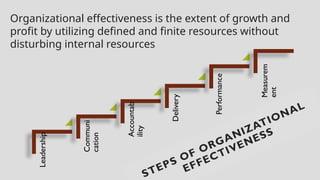
  • 77.
    THE CASE MANAGER(CASE COORDINATOR): • The case manager is a professional nurse with advanced level of nursing practice and advanced managerial and communication skills. • The (ANA) recommended a baccalaureate in nursing with 3 years of clinical experience as the minimum preparation for a nurse case manager. • In an acute care setting the case manager has a case load of 10 to 15 patients and follows patient’s progress through the system from admission to discharge. • Case manager has responsibility and authority for planning, implementing, coordinating and evaluating care for the patient throughout the period of illness, regardless of the patient’s movement among various units and services (such as emergency room, surgical unit, recovery unit, etc.). • The case manager ensures that plans are made in advance for the next needed step. • Through this, the manager assists with decision-making and helps to ensure that the patient receives care that will achieve the most positive outcomes in the most efficient
  • 78.
    ADVANTAGE S: 1.Enhancing nurse’s professionaldevelopment and job satisfaction 2. Increase collaboration between different health professionals. 3. Reduce patient complication. 4. Improve quality of care. 5. Facilitating the continuity of patient care. 6. Facilitate discharge of the patient within an appropriate length of stay. 7. Reduce cost.
  • 79.
    CRITICAL PATHWAY: • Alsocalled critical paths, practice protocols, clinical practice guideline, patient care protocols or care maps, a predetermined written plan of care for a particular health problem. • Tools or guidelines that direct care by identifying expected outcomes that are developed by the collaborative practice team. • Successful case management relies on critical pathways to guide care. • Critical pathway include: specific medical diagnosis, the expected length of stay, patient identification data, appropriate time frames (in days, hours, minutes, or visits) for interventions, and patient outcomes. • A recent evolution of critical paths is the incorporation of actual and potential nursing diagnosis with specific time frames into the critical pathway. • A copy of this form is given to the patient and the family, and the nurse
  • 80.
    3-PATIENT -CENTERED CARE •A nursing care delivery system that is unit-based and consists of patient care coordinators, patient care associates, unit support assistants, administrative support personnel, and a nurse manager. • It is developed in the late 1980s; it may be used in outpatient and homecare settings, patient with chronic conditions are appropriate candidates for patient-centered care approaches. • The role of the nurse is broadened to coordinate a team of multifunctional unit-based caregivers. • All patient care services are unit-based, including admission and discharge, diagnostic and treatment services, and nutrition services and medical records. • The focus of Patient -centered care is decentralization, the promotion of efficiency and quality, and cost control. • The number of care givers is reduced, but their responsibilities are increased.
  • 81.
    Advantages: 1. Patient comesinto contact with fewer workers. 2. Workers are unit based and spend more time in direct-care activities. 3. RN is accountable for a wide range of serv 4. Increase the quality of care and increase patient satisfaction. 5. Cost-effectiveices and functions at a higher level to ensure more consistent patient care. Disadvantages: 1. Major change in organizational structure is required. 2. Major change is required also in the roles of the nurse manager and the team members. 3. Departments other than nursing must be willing to accept nursing leadership.
  • 82.
    4- DIFFERENTIATED PRACTI CE •A nursing care delivery system that maximizes nursing resources by focusing on the structure of nursing roles according to education, experience, and competency. • It has been used in a variety of inpatient, acute care settings as well as in home care and clinics. • It is designed to identify distinct levels of nursing practice based on defined abilities that are incorporated into job descriptions. • The aim is to match patient needs with nursing competencies to facilitate the effective and efficient use of nursing resources. • Nurses prepared at associate/ diploma, baccalaureate, masters, and doctorate level are integrated. • Each defined role is different and complementary. Nurses choose the role 
  • 83.
    4- DIFFERENTIATED PRACTI CE Advantages: •1- Improve patient care, and contribute to patient safety. • 2- Allow for the most effective and efficient use of scarce resources. • 3- Increase satisfaction for nurses. • 4- Provide opportunity to compensate nurses fairly based on their expertise, contributions, and productivity
  • 84.
  • 85.
    ORGANIZATIONAL CLIMATE Refers tomeaningful interpretations of a work environment by the people in its culture. Types of organizatio nal climate People focused climate The climate that values innovation Goal oriented climate Role driven climate
  • 86.
  • 87.
    ROLE OF NURSEMANAGERS IN ORGANIZATIONAL CLIMATE • Nurse Managers should emphasize management tasks or activities that stimulate motivation in nursing employees. • Nurse Managers should establish a management strategy to support new nurses and involve them in decision-making. • Nurse Managers should establish a climate in which discipline is applied fairly and uniformly. • Nurse Managers need management education and
  • 88.
    • Nurse managerswill work to establish an organizational climate that provides • Incentives for clinical nurses. • Place them on committees. • creative and equitable in all staffing matters. • Emphasizes pride. • Promotes participation. • Rewards seniority and achievements. • Reduces boredom and frustration.
  • 89.