





SCHIZOPHRENIA AND OTHER
PSYCHOTIC DISORDERS
B.KAVITHA M.SC(N)
ASSOCIATE PROFESSOR
ASWINI COLLEGE OF NURSING
THRISSUR
INTRODUCTION
The schizophrenic disorders are
characterized in general by fundamental and
characteristic distortions of thinking and
perception, and affects that are inappropriate
or blunted. Clear consciousness and
intellectual capacity are usually maintained
although certain cognitive deficits may evolve
in the course of time.
Schizophrenia occurs with regular
frequency nearly everywhere in the world in 1
% of population and begins mainly in young
age (mostly around 16 to 25 years).
DEFINITION
Schizophrenia is a psychotic
condition characterized by a
disturbance in thinking, emotions,
volition and faculties in the presence
of clear consciousness, which usually
leads to social withdrawal
HISTORY
Emil Kraepelin:
He called schizophrenia as
“Dementia Praecox” as it
deteriorate the personality.
Eugen Bleuler:
He renamed Kraepelin’s dementia
praecox as schizophrenia (1911); he
recognized the cognitive
impairment in this illness, which he
named as a “splitting of mind”.
Bleuler’s 4 As
Four fundamental symptoms:
•Affective blunting
•Disturbance of association (fragmented
thinking)
•Autism
•Ambivalence (fragmented emotional response)
These groups of symptoms, are called four A’ s
and Bleuler thought, that they are primary for this
diagnosis.
The other known symptoms,
hallucinations, delusions, which are
appearing in schizophrenia very often
also, he used to call as a “secondary
symptoms”, because they could be
seen in any other psychotic disease,
which are caused by quite different
factors — from intoxication to
infection or other disease entities.
Kurt Schneider:
He emphasized the role of
psychotic symptoms, as
hallucinations, delusions and
gave them the privilege of „the
first rank symptoms” even in the
concept of the diagnosis of
schizophrenia.
EPIDEOMIOLOGY
• Common and prevalent in all cultures
• About 15% of new patients are
schizophrenic patients in admissions
• Total 50% of mentally ill patients are
diagnosed are schizophrenic patients
• Equal in both men and female & more
common in lower economic group
• Peak age of onset is 15 – 25 years for men
and 25 to 35 years for women
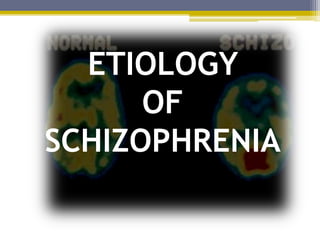
ETIOLOGY
OF
SCHIZOPHRENIA
ETIOLOGY OF SCHIZOPHRENIA
• The etiology and pathogenesis of
schizophrenia is not known
• It is accepted, that schizophrenia is “the
group of schizophrenias” which origin is
multifactorial:
▫ Internal Factors – Genetic, Inborn,
Biochemical
▫ External Factors – Trauma, Infection Of
CNS, Stress
Biological theories
Include
Biochemical,
Neurostructural,
Genetic,
Perinatal risk factors
other theories
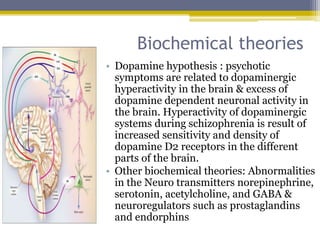
Biochemical theories
• Dopamine hypothesis : psychotic
symptoms are related to dopaminergic
hyperactivity in the brain & excess of
dopamine dependent neuronal activity in
the brain. Hyperactivity of dopaminergic
systems during schizophrenia is result of
increased sensitivity and density of
dopamine D2 receptors in the different
parts of the brain.
• Other biochemical theories: Abnormalities
in the Neuro transmitters norepinephrine,
serotonin, acetylcholine, and GABA &
neuroregulators such as prostaglandins
and endorphins
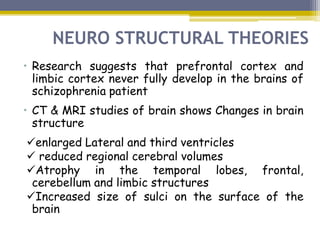
NEURO STRUCTURAL THEORIES
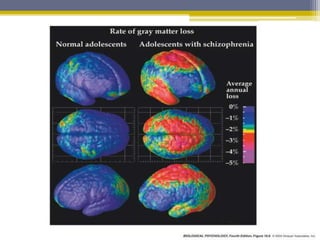
• Research suggests that prefrontal cortex and
limbic cortex never fully develop in the brains of
schizophrenia patient
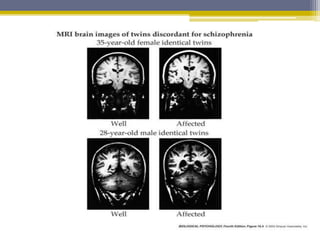
• CT & MRI studies of brain shows Changes in brain
structure
enlarged Lateral and third ventricles
 reduced regional cerebral volumes
Atrophy in the temporal lobes, frontal,
cerebellum and limbic structures
Increased size of sulci on the surface of the
brain
ETIOLOGY OF SCHIZOPHRENIA -
NEURODEVELOPMENT MODEL
• Neurodevelopment model supposes in schizophrenia the
presence of “silent lesion” in the brain, mostly in the parts,
important for the development of integration (frontal,
parietal and temporal), which is caused by different factors
(genetic, inborn, infection, trauma...) during very early
development of the brain in prenatal or early postnatal
period of life.
• It does not interfere too much with the basic brain
functioning in early years, but expresses itself in the time,
when the subject is stressed by demands of growing needs
for integration, during formative years in adolescence and
young adulthood.
GENETICS OF SCHIZOPHRENIA
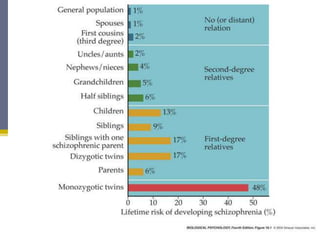
• Many psychiatric disorders are multi factorial
(caused by the interaction of external and genetic
factors) and from the genetic point of view very
often polygenically determined.
• More among the consanguineous marriage
• Relative risk for schizophrenia is around:
 15% for one parent affected
 35% for both parents affected
 10% for brother or sister affected
 12.8% for children
11.05
‫ד‬
"
‫ברוך‬ ‫יהודה‬ ‫ר‬
‫הנפש‬ ‫לבריאות‬ ‫המרכז‬ ‫מנהל‬
‫ע‬
"
‫י‬ ‫ש‬
.
‫אברבנאל‬
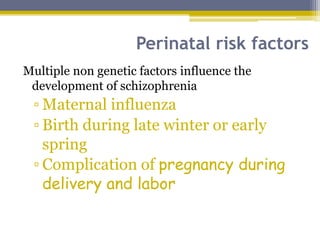
Perinatal risk factors
Multiple non genetic factors influence the
development of schizophrenia
▫ Maternal influenza
▫ Birth during late winter or early
spring
▫ Complication of pregnancy during
delivery and labor
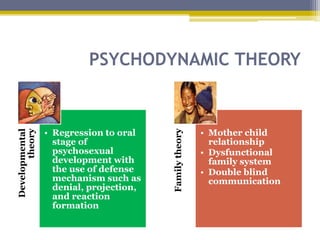
PSYCHODYNAMIC THEORY
Developmental
theory
• Regression to oral
stage of
psychosexual
development with
the use of defense
mechanism such as
denial, projection,
and reaction
formation
Family
theory
• Mother child
relationship
• Dysfunctional
family system
• Double blind
communication
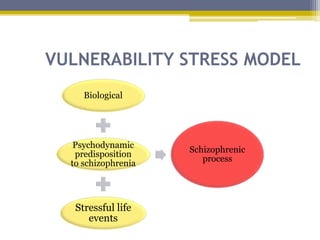
VULNERABILITY STRESS MODEL
Biological
Psychodynamic
predisposition
to schizophrenia
Stressful life
events
Schizophrenic
process
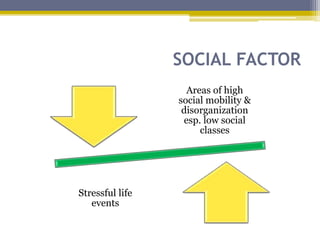
SOCIAL FACTOR
Areas of high
social mobility &
disorganization
esp. low social
classes
Stressful life
events
CLINICAL
FEATURES
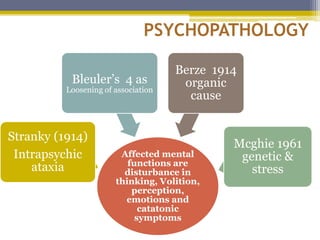
PSYCHOPATHOLOGY
Affected mental
functions are
disturbance in
thinking, Volition,
perception,
emotions and
catatonic
symptoms
Stranky (1914)
Intrapsychic
ataxia
Bleuler’s 4 as
Loosening of association
Berze 1914
organic
cause
Mcghie 1961
genetic &
stress
PSYCHO
PATHOLOGY
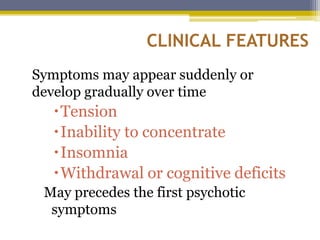
CLINICAL FEATURES
Symptoms may appear suddenly or
develop gradually over time
Tension
Inability to concentrate
Insomnia
Withdrawal or cognitive deficits
May precedes the first psychotic
symptoms
Bleuler’s 4 As
Four fundamental symptoms:
•Affective disturbance: inability to show appropriate
response
•Associative looseness (fragmented thinking) :
Inability to think logically
•Autistic thinking: unable to relate to others
•Ambivalence (fragmented emotional
response):contradictory or opposing emotions,
attitudes, ideas or desires for same persons, things
or situations simultaneously opposite feelings
These groups of symptoms, are called four A’ s and
Bleuler thought, that they are primary for this
diagnosis.
Kurt Schneider:
He emphasized the role of psychotic symptoms, as
hallucinations, delusions and gave them the
privilege of “the first rank symptoms” even in the
concept of the diagnosis of schizophrenia.
•Thought echo
•Hallucinatory voices – form of statement & reply
& running commentary
•Thought withdrawal
•Thought insertion
•Thought broadcasting
•Delusional perception
•Somatic passivity
•Made volition or acts
•Made impulses
•Made feelings
• The negative symptoms are represented by
cognitive disorders, having its origin
probably in the disorders of associations
of thoughts, combined with emotional
blunting and small or missing production
of hallucinations and delusions
• The positive symptom are characterized by
the presence of hallucinations and
delusions the division is not quite strict
and lesser or greater mixture of symptoms
from these two groups are possible
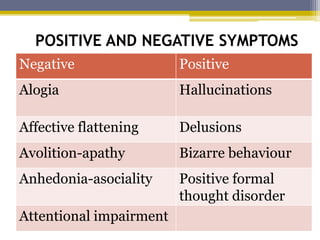
POSITIVE AND NEGATIVE SYMPTOMS
Negative Positive
Alogia Hallucinations
Affective flattening Delusions
Avolition-apathy Bizarre behaviour
Anhedonia-asociality Positive formal
thought disorder
Attentional impairment
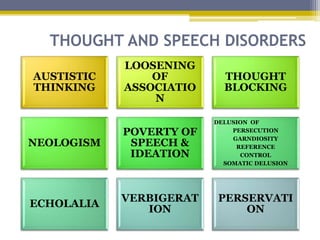
THOUGHT AND SPEECH DISORDERS
AUSTISTIC
THINKING
LOOSENING
OF
ASSOCIATIO
N
THOUGHT
BLOCKING
NEOLOGISM
POVERTY OF
SPEECH &
IDEATION
DELUSION OF
PERSECUTION
GARNDIOSITY
REFERENCE
CONTROL
SOMATIC DELUSION
ECHOLALIA
VERBIGERAT
ION
PERSERVATI
ON
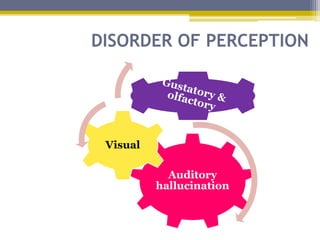
DISORDER OF PERCEPTION
Auditory
hallucination
Visual
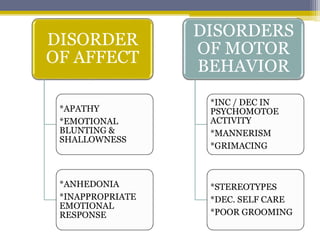
DISORDER
OF AFFECT
*APATHY
*EMOTIONAL
BLUNTING &
SHALLOWNESS
*ANHEDONIA
*INAPPROPRIATE
EMOTIONAL
RESPONSE
DISORDERS
OF MOTOR
BEHAVIOR
*INC / DEC IN
PSYCHOMOTOE
ACTIVITY
*MANNERISM
*GRIMACING
*STEREOTYPES
*DEC. SELF CARE
*POOR GROOMING
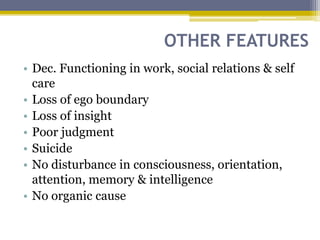
OTHER FEATURES
• Dec. Functioning in work, social relations & self
care
• Loss of ego boundary
• Loss of insight
• Poor judgment
• Suicide
• No disturbance in consciousness, orientation,
attention, memory & intelligence
• No organic cause
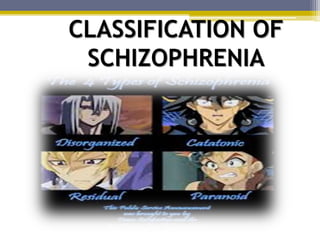
CLASSIFICATION OF
SCHIZOPHRENIA
F20-F29 SCHIZOPHRENIA, SCHIZOTYPAL
AND DELUSIONAL DISORDERS
• F20 Schizophrenia
▫ F20.0 Paranoid schizophrenia
▫ F20.1 Hebephrenic schizophrenia
▫ F20.2 Catatonic schizophrenia
▫ F20.3 Undifferentiated schizophrenia
▫ F20.4 Post-schizophrenic depression
▫ F20.5 Residual schizophrenia
▫ F20.6 Simple schizophrenia
▫ F20.8 Other schizophrenia
▫ F20.9 Schizophrenia, unspecified
• F21 Schizotypal disorder
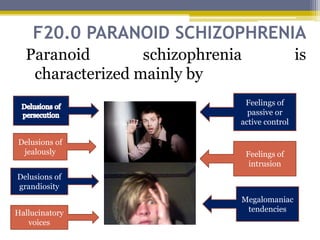
F20.0 PARANOID SCHIZOPHRENIA
Paranoid schizophrenia is
characterized mainly by
Delusions of
jealously
Delusions of
grandiosity
Hallucinatory
voices
Feelings of
intrusion
Feelings of
passive or
active control
Megalomaniac
tendencies
PARANOID SCHIZOPHRENIA
• The delusions are not usually systemized
too much, without tight logical
connections and are often combined with
hallucinations of different senses, mostly
with hearing voices.
• Disturbances of affect, volition and
speech, and catatonic symptoms, are
either absent or relatively inconspicuous
F20.1 HEBEPHRENIC SCHIZOPHRENIA
• Hebephrenic schizophrenia is characterized by
disorganized thinking with blunted and
inappropriate emotions. It begins mostly in
adolescent age ,the behavior is often bizarre. There
could appear mannerisms, grimacing, inappropriate
laugh and joking, pseudo philosophical brooding
and sudden impulsive reactions without external
stimulation. There is a tendency to social isolation.
• Usually the prognosis is poor because of the rapid
development of "negative" symptoms, particularly
flattening of affect and loss of volition. Hebephrenic
should normally be diagnosed only in adolescents or
young adults.
• Denoted also as disorganized schizophrenia
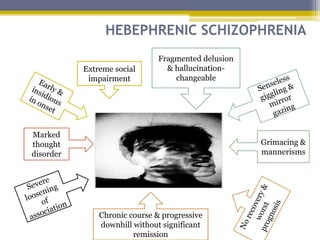
HEBEPHRENIC SCHIZOPHRENIA
Marked
thought
disorder
Extreme social
impairment
Fragmented delusion
& hallucination-
changeable
Grimacing &
mannerisms
Chronic course & progressive
downhill without significant
remission
11.05
‫ד‬
"
‫ברוך‬ ‫יהודה‬ ‫ר‬
‫ע‬ ‫הנפש‬ ‫לבריאות‬ ‫המרכז‬ ‫מנהל‬
"
‫ש‬
‫י‬
.
‫אברבנאל‬
F20.2 CATATONIC SCHIZOPHRENIA
Catatonic schizophrenia is
characterized mainly by disturbance
of motoric activity, which might be
Strongly increased i.e. catatonic
excitement or
Decreased i.e. catatonic stupor, and
Catatonia alternating between
excitement and stupor.
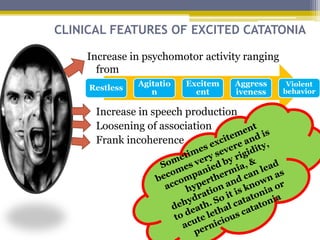
CLINICAL FEATURES OF EXCITED CATATONIA
Increase in psychomotor activity ranging
from
Increase in speech production
Loosening of association
Frank incoherence
Restless
Agitatio
n
Excitem
ent
Aggress
iveness
Violent
behavior
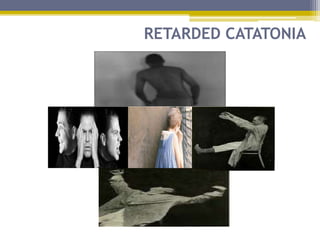
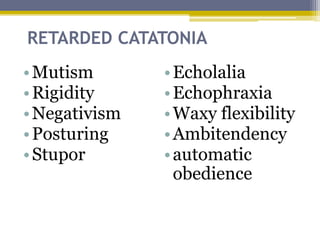
RETARDED CATATONIA
RETARDED CATATONIA
•Mutism
•Rigidity
•Negativism
•Posturing
•Stupor
•Echolalia
•Echophraxia
•Waxy flexibility
•Ambitendency
•automatic
obedience
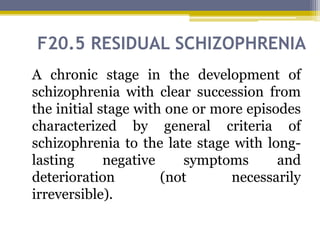
F20.5 RESIDUAL SCHIZOPHRENIA
A chronic stage in the development of
schizophrenia with clear succession from
the initial stage with one or more episodes
characterized by general criteria of
schizophrenia to the late stage with long-
lasting negative symptoms and
deterioration (not necessarily
irreversible).
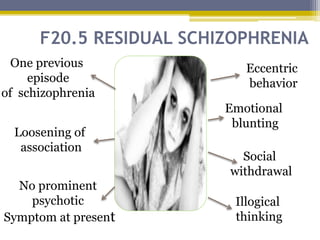
F20.5 RESIDUAL SCHIZOPHRENIA
Emotional
blunting
Eccentric
behavior
Illogical
thinking
Social
withdrawal
Loosening of
association
One previous
episode
of schizophrenia
No prominent
psychotic
Symptom at present
F20.3 UNDIFFERENTIATED
SCHIZOPHRENIA
• Psychotic conditions meeting the general
diagnostic criteria for schizophrenia but not
conforming to any of the subtypes in F20.0-
F20.2, or exhibiting the features of more than
one of them without a clear predominance of a
particular set of diagnostic characteristics.
• This subgroup represents also the former
diagnosis of atypical schizophrenia.
F20.6 SIMPLE SCHIZOPHRENIA
• Simple schizophrenia is characterized by
early and slowly developing initial stage
with growing social isolation, withdrawal,
small activity, passivity, avolition and
dependence on the others.
• The patients are indifferent, without any
initiative and volition. There is not
expressed the presence of hallucinations
and delusions.
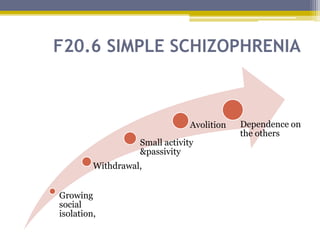
F20.6 SIMPLE SCHIZOPHRENIA
Growing
social
isolation,
Withdrawal,
Small activity
&passivity
Avolition Dependence on
the others
F20.6 SIMPLE SCHIZOPHRENIA
• Early & insidious onset
• Progressive course
• Presence of characteristic negative symptoms
• Vague hypochondrial features
• Wandering tendency
• Self absorbed idleness
• Aimless activity
• Poor prognosis
• No previous episode with all typical psychotic
symptoms ( differ from residual schizophrenia)
F20.4 POST SCHIZOPHRENIC
DEPRESSION
• A depressive episode, which may be
prolonged, develop in the presence of
residual or active features of
schizophrenia, either “positive” or
“negative”, must still be present but they
no longer dominate the clinical picture.
• These depressive states are associated
with an increased risk of suicide.
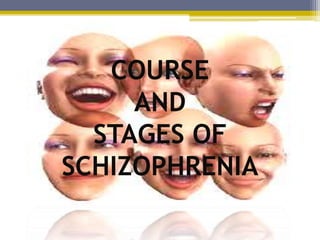
COURSE
AND
STAGES OF
SCHIZOPHRENIA
COURSE OF ILLNESS
• Course of schizophrenia:
▫ continuous without temporary improvement
▫ episodic with progressive or stable deficit
▫ episodic with complete or incomplete remission
▫ Classic course is one of exacerabations &
remissions
▫ Schizophrenia is most crippling & devastating of
all psychiatric illness
▫ 50% of patient have poor prognosis with repeated
admission
▫ Where as only 29% have good prognosis after first
hospitalization
TYPICAL STAGES OF SCHIZOPHRENIA:
PRODROMAL PHASE
• In medical terms, a prodrome refers to the early
symptoms and signs of an illness that come before
the characteristic symptoms of an illness emerges.
• social isolation, avoiding family and friends, and
deteriorating school or work performance is
common, and help from family members is critical
in identifying the initial phase of schizophrenia.
• Many behaviors exhibited in the prodrome are
considered to be normal and not necessarily
indicative of first-stage schizophrenia.
• Signs of the promodal phase are not specific
to schizophrenia and can often be mistaken as the
development of another mental illness.
• This phase is impossible to identify until an
individual reaches the acute phase.
TYPICAL STAGES OF SCHIZOPHRENIA:
ACUTE STAGE
• It is the point of full development of the disease.
• In this phase, the person experiences significant positive, negative,
and cognitive symptoms. The person might appear to be psychotic,
extremely disorganized and exhibit confused thought. Others might
experience hallucinations and delusions, and behavior might be
extreme enough to warrant a stay in a mental health facility to
stabilize the disease.
• Most patients require antipsychotic medication to alleviate the
symptoms during the acute phase of schizophrenia. Without
medication, the acute stage can last weeks, months or even
indefinitely.
• Rarely does the active phase resolve itself without treatment. The
acute phase differs from person to person. Some may enter into the
acute phase only once, while others find themselves there repeatedly
during the course of their lifetime.
• Positive symptoms are common in this stage.
TYPICAL STAGES OF SCHIZOPHRENIA:
The Residual Stage
The residual stage is the final stage of
schizophrenia and shares similar characteristics
with the promodal stage. The individual won’t
appear to be psychotic but residual negative
and cognitive symptoms may exist. This phase
occurs when an individual with schizophrenia
has stabilized and is on a consistent treatment
plan for schizophrenia. Hallucinations and
delusions disappear in this stage, although the
person might continue to think and behave
strangely.
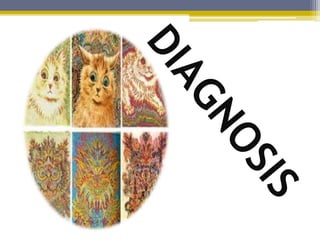
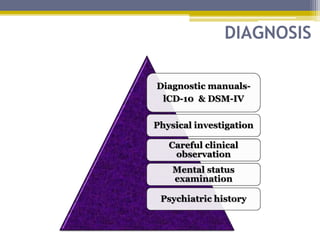
DIAGNOSIS
Diagnostic manuals-
lCD-10 & DSM-IV
Physical investigation
Careful clinical
observation
Mental status
examination
Psychiatric history
CLINICAL PICTURE
• Diagnostic manuals:
▫ lCD-10 (“International Classification of
Disease” WHO)
▫ DSM-IV („Diagnostic and Statistical Manual“,
APA)
• Clinical picture of schizophrenia is according to
lCD-10, defined from the point of view of the
presence and expression of primary and/or
secondary symptoms (at present covered by the
terms negative and positive symptoms):
• The negative symptoms are represented by
cognitive disorders, having its origin
probably in the disorders of associations
of thoughts, combined with emotional
blunting and small or missing production
of hallucinations and delusions
• The positive symptom are characterized by
the presence of hallucinations and
delusions the division is not quite strict
and lesser or greater mixture of symptoms
from these two groups are possible
THE CRITERIA OF DIAGNOSIS
For the diagnosis of schizophrenia is necessary
• presence of one very clear symptom - from point a)
to d)
• or the presence of the symptoms from at least two
groups - from point e) to h) for one month or more:
 the hearing of own thoughts, the feelings of thought
withdrawal, thought insertion, or thought broadcasting
 the delusions of control, outside manipulation and
influence, or the feelings of passivity, which are
connected with the movements of the body or
extremities, specific thoughts, acting or feelings,
delusional perception
• hallucinated voices, which are commenting
permanently the behavior of the patient or they
talk about him between themselves, or the other
types of hallucinatory voices, coming from
different parts of body
• permanent delusions of different kind, which are
inappropriate and unacceptable in given culture
THE CRITERIA OF DIAGNOSIS
• The lasting hallucination of every form
• Blocks or intrusion of thoughts into the flow of
thinking and resulting incoherence and
irrelevance of speech, or neologisms
• Catatonic behavior
• “The negative symptoms”, for instance the
expressed apathy, poor speech, blunting and
inappropriateness of emotional reactions
• Expressed and conspicuous qualitative changes in
patient’s behavior, the loss of interests, hobbies,
aimlessness, inactivity, the loss of relations to
others and social withdrawal
DIAGNOSIS
• Diagnosis of acute schizophorm disorder (F23.2)
– if the conditions for diagnosis of
schizophrenia are fulfilled, but lasting less than
one month
• Diagnosis of schizoaffective disorder (F25)
- if the schizophrenic and affective
symptoms are developing together at the same
time
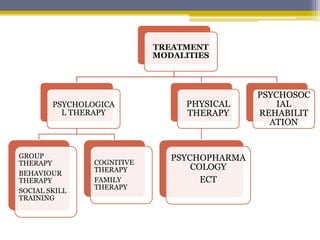
TREATMENT
MODALITIES
PSYCHOLOGICA
L THERAPY
GROUP
THERAPY
BEHAVIOUR
THERAPY
SOCIAL SKILL
TRAINING
COGNITIVE
THERAPY
FAMILY
THERAPY
PHYSICAL
THERAPY
PSYCHOPHARMA
COLOGY
ECT
PSYCHOSOC
IAL
REHABILIT
ATION
PSYCHOPHARMACOLOGY
• The acute psychotic schizophrenic patients
will respond usually to antipsychotic
medication.
• According to current consensus we use in the
first line therapy the newer atypical
antipsychotics are preferred than with
conventional antipsychotics
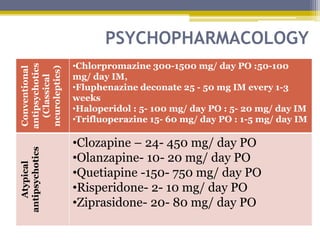
PSYCHOPHARMACOLOGY
Conventional
antipsychotics
(Classical
neuroleptics)
•Chlorpromazine 300-1500 mg/ day PO :50-100
mg/ day IM,
•Fluphenazine deconate 25 - 50 mg IM every 1-3
weeks
•Haloperidol : 5- 100 mg/ day PO : 5- 20 mg/ day IM
•Trifluoperazine 15- 60 mg/ day PO : 1-5 mg/ day IM
Atypical
antipsychotics
•Clozapine – 24- 450 mg/ day PO
•Olanzapine- 10- 20 mg/ day PO
•Quetiapine -150- 750 mg/ day PO
•Risperidone- 2- 10 mg/ day PO
•Ziprasidone- 20- 80 mg/ day PO
WHY ATYPICAL IS BETTER THAN
CONVENTIONAL ANTIPSYCHOTICS
• Because of their partial efficacy and by
appearance of extra pyramidal side-effects
• Atypical antipsychotic control wider range
of signs and symptoms than conventional
agents do and cause few or no adverse
motor affects
PRECAUTION OF TAKING CLOZAPINE
• Clozapine may cause agranulocytosis ( a
potentially fatal blood disorder marked by a low
WBC and pronounced neutrophil depletion
• Patient receiving Clozapine requires routine
blood monitoring to detect the disorder because
it is reversible if caught early
• Other drugs used in the treatment of
schizophrenia are antidepressants, mood
stabilizers & benzodiazepine etc.
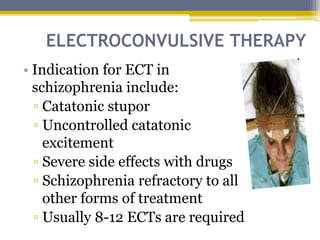
ELECTROCONVULSIVE THERAPY
• Indication for ECT in
schizophrenia include:
▫ Catatonic stupor
▫ Uncontrolled catatonic
excitement
▫ Severe side effects with drugs
▫ Schizophrenia refractory to all
other forms of treatment
▫ Usually 8-12 ECTs are required
PSYCHOLOGICAL THERAPIES
• Group therapy:
▫ The social interaction
▫ Sense of cohesiveness
▫ Identification
▫ Reality testing achieved within the
group setting
PSYCHOLOGICAL THERAPIES
• Behavior therapy: is useful in
▫ Reducing the frequency of bizarre,
disturbing and deviant behavior
▫ And increasing appropriate behaviors
PSYCHOLOGICAL THERAPIES
• Social skills training:
addresses behaviors such as Poor eye
contact, odd facial expressions and
lack of spontaneity in social situations
through the use of videotapes, role
playing and home work assignment
PSYCHOLOGICAL THERAPIES
Cognitive therapy:
used to improve cognitive
distortions like Reducing
distractibility and Correcting
judgment.
PSYCHOLOGICAL THERAPIES
• Family therapy:
involves Family education because relapse rate
is found high in families with high expressed
emotions in which family members make critical
comments, express hostility & show emotional
over involvement, so they are taught to decrease
their expectation & family tensions
PSYCHOSOCIAL REHABILITAION
This includes activity therapy
•To develop the work habit
•Training in a new vocation
•Or retraining in a previous skill
•Vocational guidance
•Independent job placement
NURSING
MANAGEMENT
NURSING MANAGEMENT
• Nursing assessment
▫ History collection
 Patient
 Family members
 Significant others
 Previous records
• Mental status examination
• Physical examination
• Laboratory investigations
• Observe behavioral pattern, posturing,
psychomotor disturbance, appearance
& hygiene
• Identify the type of disturbance the
patient is experiencing
• Note the effect & emotional tone of the
patient and whether they are
appropriate in relation to the thought
or present situation.
• Assess for theme and content of delusional
thinking. If the delusional is persecution
oriented, assess the nature of the threat and risk
for violence.
• Assess speech patterns associated with the
delusions.
• Assess for ability to perform self care activity, i.e
sleep pattern and interaction with other
patients.
• Determine any suicidal intent or recent attempts
that may have been made
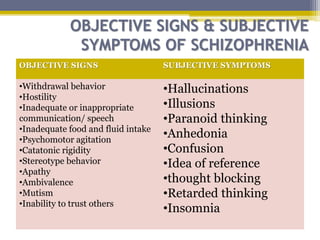
OBJECTIVE SIGNS & SUBJECTIVE
SYMPTOMS OF SCHIZOPHRENIA
OBJECTIVE SIGNS SUBJECTIVE SYMPTOMS
•Withdrawal behavior
•Hostility
•Inadequate or inappropriate
communication/ speech
•Inadequate food and fluid intake
•Psychomotor agitation
•Catatonic rigidity
•Stereotype behavior
•Apathy
•Ambivalence
•Mutism
•Inability to trust others
•Hallucinations
•Illusions
•Paranoid thinking
•Anhedonia
•Confusion
•Idea of reference
•thought blocking
•Retarded thinking
•Insomnia
NURSING DIAGNOSIS 1
OBJECTIVES:
Disturbed thought process related inability to
trust, panic anxiety, possible hereditary or
biochemical factors evidenced by delusional
thinking, extreme suspiciousness of others.
• the patient will
▫ Eliminate pattern of delusional thinking
▫ Demonstrate trust in others
▫ Demonstrate decreased anxiety level
▫ Demonstrate improved reality orientation
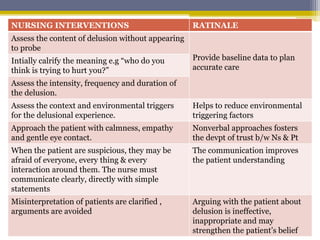
NURSING INTERVENTIONS RATINALE
Assess the content of delusion without appearing
to probe
Provide baseline data to plan
accurate care
Intially calrify the meaning e.g “who do you
think is trying to hurt you?”
Assess the intensity, frequency and duration of
the delusion.
Assess the context and environmental triggers
for the delusional experience.
Helps to reduce environmental
triggering factors
Approach the patient with calmness, empathy
and gentle eye contact.
Nonverbal approaches fosters
the devpt of trust b/w Ns & Pt
When the patient are suspicious, they may be
afraid of everyone, every thing & every
interaction around them. The nurse must
communicate clearly, directly with simple
statements
The communication improves
the patient understanding
Misinterpretation of patients are clarified ,
arguments are avoided
Arguing with the patient about
delusion is ineffective,
inappropriate and may
strengthen the patient’s belief
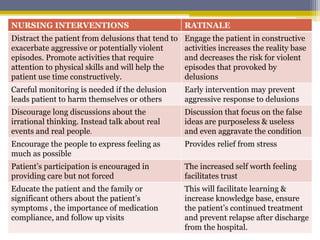
NURSING INTERVENTIONS RATINALE
Distract the patient from delusions that tend to
exacerbate aggressive or potentially violent
episodes. Promote activities that require
attention to physical skills and will help the
patient use time constructively.
Engage the patient in constructive
activities increases the reality base
and decreases the risk for violent
episodes that provoked by
delusions
Careful monitoring is needed if the delusion
leads patient to harm themselves or others
Early intervention may prevent
aggressive response to delusions
Discourage long discussions about the
irrational thinking. Instead talk about real
events and real people.
Discussion that focus on the false
ideas are purposeless & useless
and even aggravate the condition
Encourage the people to express feeling as
much as possible
Provides relief from stress
Patient’s participation is encouraged in
providing care but not forced
The increased self worth feeling
facilitates trust
Educate the patient and the family or
significant others about the patient’s
symptoms , the importance of medication
compliance, and follow up visits
This will facilitate learning &
increase knowledge base, ensure
the patient’s continued treatment
and prevent relapse after discharge
from the hospital.
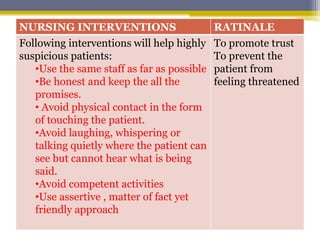
NURSING INTERVENTIONS RATINALE
Following interventions will help highly
suspicious patients:
•Use the same staff as far as possible
•Be honest and keep the all the
promises.
• Avoid physical contact in the form
of touching the patient.
•Avoid laughing, whispering or
talking quietly where the patient can
see but cannot hear what is being
said.
•Avoid competent activities
•Use assertive , matter of fact yet
friendly approach
To promote trust
To prevent the
patient from
feeling threatened
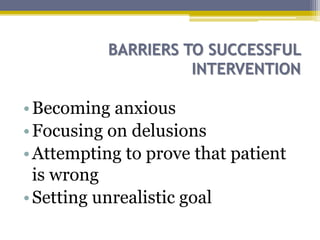
BARRIERS TO SUCCESSFUL
INTERVENTION
•Becoming anxious
•Focusing on delusions
•Attempting to prove that patient
is wrong
•Setting unrealistic goal
NURSING DIAGNOSIS II
OBJECTIVES:
Ineffective health maintenance related to
inability to trust, extreme suspiciousness
evidenced by inadequate food and fluid intake,
difficulty in falling asleep & poor diet intake
• the patient will
▫ Maintain adequate nutrition, hydration and
elimination
▫ Maintain adequate sleep and rest
▫ Take medication as administered
NURSING INTERVENTIONS RATINALE
Assess for malnutrition and
dehydration.
If the patient delusion are related to
food they may refuse to eat because
the patient believes that the food is
poisoned
Monitor food and fluid intake Patient’s physiological problems are
the first priority. The patient may be
unaware of or ignore his or needs
for food and fluids
Creative approaches may need to be
taken with the patients who is not
eating such as allowing to take
packed foods, fruits and eggs etc.
To ensure that the self care needs are
met
Suspicious patient’s sleep may be
disturbed by nightmares or severe
anxiety so that he cannot fall asleep:
provide less stimulating
environment
Patient may feel more comfortable
in less stimulating environment
Administer sedatives if needed To facilitate normal sleep
NURSING INTERVENTIONS RATINALE
Prevent day time snap by involving in
physical exercise or day treatment
program
To facilitate normal sleep pattern
If the patient is suspicious to take
medications, allows the patient to open
the sealed medication packed.
The patient has the opportunity
to see the medications sealed in
package, which may decrease
suspicious
If toileting needs are not being met,
establish a structured schedule for the
patient
A structured schedule may help
the patient to establish a pattern
so that he can develop a habit of
toileting independently
Monitor the patients elimination
patterns. If constipation occurs use
medication to establish regularity
Constipation frequently occurs
with he use of major tranquilizer,
decreased food and fluid intake
and decrease activity level
NURSING DIAGNOSIS III
OBJECTIVES:
Self care deficit related to withdrawal, regression,
panic anxiety, cognitive impairment, inability to trust
evidenced by difficulty in carrying out tasks
associated with hygiene, dressing, grooming, eating,
sleeping and toileting
• the patient will
▫ Demonstrate increased interest in self care.
▫ Complete daily activities with minimum
assistance
▫ Demonstrate adequate personal hygiene skill
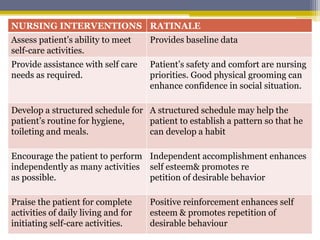
NURSING INTERVENTIONS RATINALE
Assess patient’s ability to meet
self-care activities.
Provides baseline data
Provide assistance with self care
needs as required.
Patient’s safety and comfort are nursing
priorities. Good physical grooming can
enhance confidence in social situation.
Develop a structured schedule for
patient’s routine for hygiene,
toileting and meals.
A structured schedule may help the
patient to establish a pattern so that he
can develop a habit
Encourage the patient to perform
independently as many activities
as possible.
Independent accomplishment enhances
self esteem& promotes re
petition of desirable behavior
Praise the patient for complete
activities of daily living and for
initiating self-care activities.
Positive reinforcement enhances self
esteem & promotes repetition of
desirable behaviour
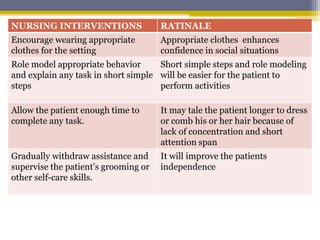
NURSING INTERVENTIONS RATINALE
Encourage wearing appropriate
clothes for the setting
Appropriate clothes enhances
confidence in social situations
Role model appropriate behavior
and explain any task in short simple
steps
Short simple steps and role modeling
will be easier for the patient to
perform activities
Allow the patient enough time to
complete any task.
It may tale the patient longer to dress
or comb his or her hair because of
lack of concentration and short
attention span
Gradually withdraw assistance and
supervise the patient’s grooming or
other self-care skills.
It will improve the patients
independence
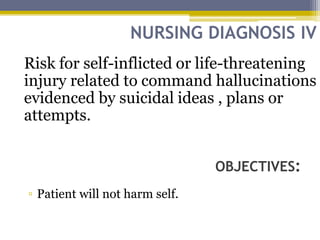
NURSING DIAGNOSIS IV
OBJECTIVES:
Risk for self-inflicted or life-threatening
injury related to command hallucinations
evidenced by suicidal ideas , plans or
attempts.
▫ Patient will not harm self.
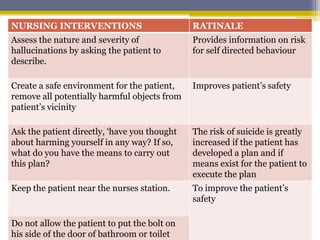
NURSING INTERVENTIONS RATINALE
Assess the nature and severity of
hallucinations by asking the patient to
describe.
Provides information on risk
for self directed behaviour
Create a safe environment for the patient,
remove all potentially harmful objects from
patient’s vicinity
Improves patient’s safety
Ask the patient directly, ‘have you thought
about harming yourself in any way? If so,
what do you have the means to carry out
this plan?
The risk of suicide is greatly
increased if the patient has
developed a plan and if
means exist for the patient to
execute the plan
Keep the patient near the nurses station. To improve the patient’s
safety
Do not allow the patient to put the bolt on
his side of the door of bathroom or toilet
NURSING DIAGNOSIS V
OBJECTIVES:
Disturbed sensory-perception (auditory/visual)
related to panic anxiety, possible hereditary or
biochemical factors evidenced by inappropriate
responses, disordered thought sequencing , poor
concentration, disorientation, withdrawn behavior
▫ The Patient will
 Demonstrated decreased hallucinations
 Interacts with others
 Verbalize plans to deal with hallucinations, if they recur
NURSING INTERVENTIONS
• Nurse should show acceptance and use
active listening skills.
• Assess for type of hallucinations and
characteristics of hallucinations.
• Ask what voices are saying and whose
voice it is.
• Avoid further discussion of hallucination
to prevent reinforcing inappropriate
behavior.
Conti…
• Observe the patient for hallucinating
behavior like talking to self, laughing to
self, stopping in mid-sentence.
• Determine precipitating factors that may
exacerbate the patient’s hallucinatory
experience.
• Interrupt hallucination by calling patient
by name or move the patient to another
area.
Conti…
• Help the patient to understand the connection between
anxiety and hallucination.
• Help patient learn that he can dismiss hallucinations by
humming or whistling or saying “go away” or “be quiet”
Provide a busy schedule of activity to prevent being all
alone.
• Provide conversation or a concrete activity of interest to
the patient.
• Show acceptance of the patient’s behavior and of the
patient as a person.
• Educate the patient and family/significant others about
the patient’s symptoms, the importance of medication
compliance.
OTHER NURSING DIAGNOSIS ARE
• Potential for violence, self directed or at others ,
related to command hallucinations evidenced by
physical violence, destruction of objects in the
environment or self destructive behavior
• Social isolation related to inability to trust,
panic, anxiety , delusional thinking, evidenced
by withdrawal sad, dull effect, preoccupied with
own thoughts , expression of feeling of rejection
of aloneness imposed by others
OTHER NURSING DIAGNOSIS ARE
• Impaired verbal communication related to
panic anxiety, unrealistic thinking
evidenced by loosening of association,
echolalia
• Ineffective family coping related to highly
ambivalent family relationships evidenced
by neglectful care of the patient
EVALUATION
A few questions that may facilitate the
process of evaluation can be:
• Has the patient established trust with at
least one staff member?
• Is delusional thinking still prevalent?
• Are hallucinations still evident?
• Is the patient able to interact with others
appropriately?
OTHER PSYCHOTIC DISORDER
The term psychosis is defined as gross
impairment in reality thinking, marked
disturbance in personality with
impaired social and occupational
functioning and presence of
characteristic symptoms like delusions
and hallucinations
F20-F29 SCHIZOPHRENIA,
SCHIZOTYPAL AND DELUSIONAL
DISORDERS
F22 Persistent delusional disorders
F23 Acute and transient psychotic disorders
F24 Induced delusional disorder
F25 Schizoaffective disorders
F28 Other nonorganic psychotic disorders
F29 Unspecified nonorganic psychosis
F22 PERSISTENT DELUSIONAL
DISORDERS
• Includes a variety of disorders in which
long-standing delusions constitute the
only, or the most conspicuous, clinical
characteristic and which cannot be
classified as organic, schizophrenic or
affective.
• Their origin is probably heterogeneous,
but it seems, that there is some relation to
schizophrenia.
F23 ACUTE AND TRANSIENT
PSYCHOTIC DISORDERS
• The criteria should be the following features:
acute beginning (to two weeks) presence of
typical symptoms (quickly changing
“polymorphic symptoms”) presence of typical
schizophrenic symptoms.
• Complete recovery usually occurs within a few
months, often within a few weeks or even days.
• The disorder may or may not be associated with
acute stress, defined as usually stressful events
preceding the onset by one to two weeks.
F24 INDUCED DELUSIONAL DISORDER
• A delusional disorder shared by two or more
people with close emotional links. Only one of the
people suffers from a genuine psychotic disorder;
the delusions are induced in the other(s) and
usually disappear when the people are separated.
• The psychotic disorder of the dominant member
of this dyad is mainly, but not necessarily, of
schizophrenic type. The original delusions of
dominant member and his partner are usually
chronic, either persecutory or megalomaniac.
F25 SCHIZOAFFECTIVE DISORDERS
• Episodic disorders in which both affective and
schizophrenic symptoms are prominent (during the
same episode of the illness or at least during few
days) but which do not justify a diagnosis of either
schizophrenia or depressive or manic episodes.
• Patients suffering from periodic schizoaffective
disorders, especially with manic symptoms, have
usually good prognosis with full remissions without
any remaining defects.
• They are divided in different subgroups:
 F25.0 Schizoaffective disorder, manic type
 F25.1 Schizoaffective disorder, depressive type
 F25.2 Schizoaffective disorder, mixed type
 F25.8 Other schizoaffective disorders
 F25.9 Schizoaffective disorder, unspecified
CAPGRAS SYNDROME (THE DELUSION
OF DOUBLES)
THAT other person in the environment is not
their real selves but is their own doubles. It is
one of the delusional misidentification
syndromes
TREATMENT:
▫ Antipsychotics
▫ Mood stabilizers
▫ Antidepressant
▫ ECT
▫ Supportive psychotherapy
GERIATRIC CONSIDERATION
• Schizophrenia declines with age
• In old age, schizophrenia is more prevalent in
women than in men & is characterized by
paranoid delusion
• Patient may responds to supportive
psychotherapy and low doses of atypical
antipsychotic drugs.
• Psychotic symptoms that appear in late life are
usually associated with depression or dementia ,
not schizophrenia
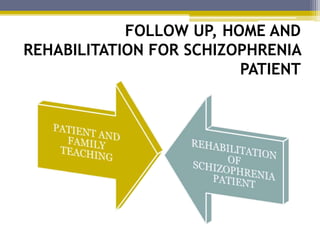
FOLLOW UP, HOME AND
REHABILITATION FOR SCHIZOPHRENIA
PATIENT
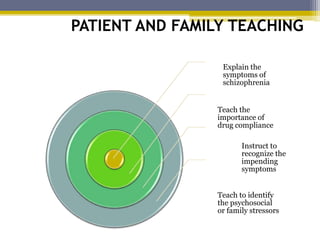
PATIENT AND FAMILY TEACHING
Explain the
symptoms of
schizophrenia
Teach the
importance of
drug compliance
Instruct to
recognize the
impending
symptoms
Teach to identify
the psychosocial
or family stressors
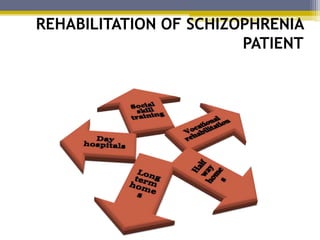
REHABILITATION OF SCHIZOPHRENIA
PATIENT
THE END

schizophrenia.pptx

  • 1.
    SCHIZOPHRENIA AND OTHER PSYCHOTICDISORDERS B.KAVITHA M.SC(N) ASSOCIATE PROFESSOR ASWINI COLLEGE OF NURSING THRISSUR
  • 2.
    INTRODUCTION The schizophrenic disordersare characterized in general by fundamental and characteristic distortions of thinking and perception, and affects that are inappropriate or blunted. Clear consciousness and intellectual capacity are usually maintained although certain cognitive deficits may evolve in the course of time. Schizophrenia occurs with regular frequency nearly everywhere in the world in 1 % of population and begins mainly in young age (mostly around 16 to 25 years).
  • 3.
    DEFINITION Schizophrenia is apsychotic condition characterized by a disturbance in thinking, emotions, volition and faculties in the presence of clear consciousness, which usually leads to social withdrawal
  • 4.
    HISTORY Emil Kraepelin: He calledschizophrenia as “Dementia Praecox” as it deteriorate the personality. Eugen Bleuler: He renamed Kraepelin’s dementia praecox as schizophrenia (1911); he recognized the cognitive impairment in this illness, which he named as a “splitting of mind”.
  • 5.
    Bleuler’s 4 As Fourfundamental symptoms: •Affective blunting •Disturbance of association (fragmented thinking) •Autism •Ambivalence (fragmented emotional response) These groups of symptoms, are called four A’ s and Bleuler thought, that they are primary for this diagnosis.
  • 6.
    The other knownsymptoms, hallucinations, delusions, which are appearing in schizophrenia very often also, he used to call as a “secondary symptoms”, because they could be seen in any other psychotic disease, which are caused by quite different factors — from intoxication to infection or other disease entities.
  • 7.
    Kurt Schneider: He emphasizedthe role of psychotic symptoms, as hallucinations, delusions and gave them the privilege of „the first rank symptoms” even in the concept of the diagnosis of schizophrenia.
  • 8.
    EPIDEOMIOLOGY • Common andprevalent in all cultures • About 15% of new patients are schizophrenic patients in admissions • Total 50% of mentally ill patients are diagnosed are schizophrenic patients • Equal in both men and female & more common in lower economic group • Peak age of onset is 15 – 25 years for men and 25 to 35 years for women
  • 9.
  • 10.
    ETIOLOGY OF SCHIZOPHRENIA •The etiology and pathogenesis of schizophrenia is not known • It is accepted, that schizophrenia is “the group of schizophrenias” which origin is multifactorial: ▫ Internal Factors – Genetic, Inborn, Biochemical ▫ External Factors – Trauma, Infection Of CNS, Stress
  • 11.
  • 12.
    Biochemical theories • Dopaminehypothesis : psychotic symptoms are related to dopaminergic hyperactivity in the brain & excess of dopamine dependent neuronal activity in the brain. Hyperactivity of dopaminergic systems during schizophrenia is result of increased sensitivity and density of dopamine D2 receptors in the different parts of the brain. • Other biochemical theories: Abnormalities in the Neuro transmitters norepinephrine, serotonin, acetylcholine, and GABA & neuroregulators such as prostaglandins and endorphins
  • 13.
    NEURO STRUCTURAL THEORIES •Research suggests that prefrontal cortex and limbic cortex never fully develop in the brains of schizophrenia patient • CT & MRI studies of brain shows Changes in brain structure enlarged Lateral and third ventricles  reduced regional cerebral volumes Atrophy in the temporal lobes, frontal, cerebellum and limbic structures Increased size of sulci on the surface of the brain
  • 16.
    ETIOLOGY OF SCHIZOPHRENIA- NEURODEVELOPMENT MODEL • Neurodevelopment model supposes in schizophrenia the presence of “silent lesion” in the brain, mostly in the parts, important for the development of integration (frontal, parietal and temporal), which is caused by different factors (genetic, inborn, infection, trauma...) during very early development of the brain in prenatal or early postnatal period of life. • It does not interfere too much with the basic brain functioning in early years, but expresses itself in the time, when the subject is stressed by demands of growing needs for integration, during formative years in adolescence and young adulthood.
  • 17.
    GENETICS OF SCHIZOPHRENIA •Many psychiatric disorders are multi factorial (caused by the interaction of external and genetic factors) and from the genetic point of view very often polygenically determined. • More among the consanguineous marriage • Relative risk for schizophrenia is around:  15% for one parent affected  35% for both parents affected  10% for brother or sister affected  12.8% for children
  • 18.
    11.05 ‫ד‬ " ‫ברוך‬ ‫יהודה‬ ‫ר‬ ‫הנפש‬‫לבריאות‬ ‫המרכז‬ ‫מנהל‬ ‫ע‬ " ‫י‬ ‫ש‬ . ‫אברבנאל‬
  • 19.
    Perinatal risk factors Multiplenon genetic factors influence the development of schizophrenia ▫ Maternal influenza ▫ Birth during late winter or early spring ▫ Complication of pregnancy during delivery and labor
  • 20.
    PSYCHODYNAMIC THEORY Developmental theory • Regressionto oral stage of psychosexual development with the use of defense mechanism such as denial, projection, and reaction formation Family theory • Mother child relationship • Dysfunctional family system • Double blind communication
  • 21.
    VULNERABILITY STRESS MODEL Biological Psychodynamic predisposition toschizophrenia Stressful life events Schizophrenic process
  • 22.
    SOCIAL FACTOR Areas ofhigh social mobility & disorganization esp. low social classes Stressful life events
  • 23.
  • 24.
    PSYCHOPATHOLOGY Affected mental functions are disturbancein thinking, Volition, perception, emotions and catatonic symptoms Stranky (1914) Intrapsychic ataxia Bleuler’s 4 as Loosening of association Berze 1914 organic cause Mcghie 1961 genetic & stress
  • 25.
  • 26.
    CLINICAL FEATURES Symptoms mayappear suddenly or develop gradually over time Tension Inability to concentrate Insomnia Withdrawal or cognitive deficits May precedes the first psychotic symptoms
  • 27.
    Bleuler’s 4 As Fourfundamental symptoms: •Affective disturbance: inability to show appropriate response •Associative looseness (fragmented thinking) : Inability to think logically •Autistic thinking: unable to relate to others •Ambivalence (fragmented emotional response):contradictory or opposing emotions, attitudes, ideas or desires for same persons, things or situations simultaneously opposite feelings These groups of symptoms, are called four A’ s and Bleuler thought, that they are primary for this diagnosis.
  • 28.
    Kurt Schneider: He emphasizedthe role of psychotic symptoms, as hallucinations, delusions and gave them the privilege of “the first rank symptoms” even in the concept of the diagnosis of schizophrenia. •Thought echo •Hallucinatory voices – form of statement & reply & running commentary •Thought withdrawal •Thought insertion •Thought broadcasting •Delusional perception •Somatic passivity •Made volition or acts •Made impulses •Made feelings
  • 29.
    • The negativesymptoms are represented by cognitive disorders, having its origin probably in the disorders of associations of thoughts, combined with emotional blunting and small or missing production of hallucinations and delusions • The positive symptom are characterized by the presence of hallucinations and delusions the division is not quite strict and lesser or greater mixture of symptoms from these two groups are possible
  • 30.
    POSITIVE AND NEGATIVESYMPTOMS Negative Positive Alogia Hallucinations Affective flattening Delusions Avolition-apathy Bizarre behaviour Anhedonia-asociality Positive formal thought disorder Attentional impairment
  • 31.
    THOUGHT AND SPEECHDISORDERS AUSTISTIC THINKING LOOSENING OF ASSOCIATIO N THOUGHT BLOCKING NEOLOGISM POVERTY OF SPEECH & IDEATION DELUSION OF PERSECUTION GARNDIOSITY REFERENCE CONTROL SOMATIC DELUSION ECHOLALIA VERBIGERAT ION PERSERVATI ON
  • 32.
  • 33.
    DISORDER OF AFFECT *APATHY *EMOTIONAL BLUNTING & SHALLOWNESS *ANHEDONIA *INAPPROPRIATE EMOTIONAL RESPONSE DISORDERS OFMOTOR BEHAVIOR *INC / DEC IN PSYCHOMOTOE ACTIVITY *MANNERISM *GRIMACING *STEREOTYPES *DEC. SELF CARE *POOR GROOMING
  • 34.
    OTHER FEATURES • Dec.Functioning in work, social relations & self care • Loss of ego boundary • Loss of insight • Poor judgment • Suicide • No disturbance in consciousness, orientation, attention, memory & intelligence • No organic cause
  • 35.
  • 36.
    F20-F29 SCHIZOPHRENIA, SCHIZOTYPAL ANDDELUSIONAL DISORDERS • F20 Schizophrenia ▫ F20.0 Paranoid schizophrenia ▫ F20.1 Hebephrenic schizophrenia ▫ F20.2 Catatonic schizophrenia ▫ F20.3 Undifferentiated schizophrenia ▫ F20.4 Post-schizophrenic depression ▫ F20.5 Residual schizophrenia ▫ F20.6 Simple schizophrenia ▫ F20.8 Other schizophrenia ▫ F20.9 Schizophrenia, unspecified • F21 Schizotypal disorder
  • 38.
    F20.0 PARANOID SCHIZOPHRENIA Paranoidschizophrenia is characterized mainly by Delusions of jealously Delusions of grandiosity Hallucinatory voices Feelings of intrusion Feelings of passive or active control Megalomaniac tendencies
  • 39.
    PARANOID SCHIZOPHRENIA • Thedelusions are not usually systemized too much, without tight logical connections and are often combined with hallucinations of different senses, mostly with hearing voices. • Disturbances of affect, volition and speech, and catatonic symptoms, are either absent or relatively inconspicuous
  • 40.
    F20.1 HEBEPHRENIC SCHIZOPHRENIA •Hebephrenic schizophrenia is characterized by disorganized thinking with blunted and inappropriate emotions. It begins mostly in adolescent age ,the behavior is often bizarre. There could appear mannerisms, grimacing, inappropriate laugh and joking, pseudo philosophical brooding and sudden impulsive reactions without external stimulation. There is a tendency to social isolation. • Usually the prognosis is poor because of the rapid development of "negative" symptoms, particularly flattening of affect and loss of volition. Hebephrenic should normally be diagnosed only in adolescents or young adults. • Denoted also as disorganized schizophrenia
  • 41.
    HEBEPHRENIC SCHIZOPHRENIA Marked thought disorder Extreme social impairment Fragmenteddelusion & hallucination- changeable Grimacing & mannerisms Chronic course & progressive downhill without significant remission
  • 42.
    11.05 ‫ד‬ " ‫ברוך‬ ‫יהודה‬ ‫ר‬ ‫ע‬‫הנפש‬ ‫לבריאות‬ ‫המרכז‬ ‫מנהל‬ " ‫ש‬ ‫י‬ . ‫אברבנאל‬
  • 43.
    F20.2 CATATONIC SCHIZOPHRENIA Catatonicschizophrenia is characterized mainly by disturbance of motoric activity, which might be Strongly increased i.e. catatonic excitement or Decreased i.e. catatonic stupor, and Catatonia alternating between excitement and stupor.
  • 44.
    CLINICAL FEATURES OFEXCITED CATATONIA Increase in psychomotor activity ranging from Increase in speech production Loosening of association Frank incoherence Restless Agitatio n Excitem ent Aggress iveness Violent behavior
  • 45.
  • 46.
  • 47.
    F20.5 RESIDUAL SCHIZOPHRENIA Achronic stage in the development of schizophrenia with clear succession from the initial stage with one or more episodes characterized by general criteria of schizophrenia to the late stage with long- lasting negative symptoms and deterioration (not necessarily irreversible).
  • 48.
    F20.5 RESIDUAL SCHIZOPHRENIA Emotional blunting Eccentric behavior Illogical thinking Social withdrawal Looseningof association One previous episode of schizophrenia No prominent psychotic Symptom at present
  • 49.
    F20.3 UNDIFFERENTIATED SCHIZOPHRENIA • Psychoticconditions meeting the general diagnostic criteria for schizophrenia but not conforming to any of the subtypes in F20.0- F20.2, or exhibiting the features of more than one of them without a clear predominance of a particular set of diagnostic characteristics. • This subgroup represents also the former diagnosis of atypical schizophrenia.
  • 50.
    F20.6 SIMPLE SCHIZOPHRENIA •Simple schizophrenia is characterized by early and slowly developing initial stage with growing social isolation, withdrawal, small activity, passivity, avolition and dependence on the others. • The patients are indifferent, without any initiative and volition. There is not expressed the presence of hallucinations and delusions.
  • 51.
    F20.6 SIMPLE SCHIZOPHRENIA Growing social isolation, Withdrawal, Smallactivity &passivity Avolition Dependence on the others
  • 52.
    F20.6 SIMPLE SCHIZOPHRENIA •Early & insidious onset • Progressive course • Presence of characteristic negative symptoms • Vague hypochondrial features • Wandering tendency • Self absorbed idleness • Aimless activity • Poor prognosis • No previous episode with all typical psychotic symptoms ( differ from residual schizophrenia)
  • 53.
    F20.4 POST SCHIZOPHRENIC DEPRESSION •A depressive episode, which may be prolonged, develop in the presence of residual or active features of schizophrenia, either “positive” or “negative”, must still be present but they no longer dominate the clinical picture. • These depressive states are associated with an increased risk of suicide.
  • 54.
  • 55.
    COURSE OF ILLNESS •Course of schizophrenia: ▫ continuous without temporary improvement ▫ episodic with progressive or stable deficit ▫ episodic with complete or incomplete remission ▫ Classic course is one of exacerabations & remissions ▫ Schizophrenia is most crippling & devastating of all psychiatric illness ▫ 50% of patient have poor prognosis with repeated admission ▫ Where as only 29% have good prognosis after first hospitalization
  • 56.
    TYPICAL STAGES OFSCHIZOPHRENIA: PRODROMAL PHASE • In medical terms, a prodrome refers to the early symptoms and signs of an illness that come before the characteristic symptoms of an illness emerges. • social isolation, avoiding family and friends, and deteriorating school or work performance is common, and help from family members is critical in identifying the initial phase of schizophrenia. • Many behaviors exhibited in the prodrome are considered to be normal and not necessarily indicative of first-stage schizophrenia. • Signs of the promodal phase are not specific to schizophrenia and can often be mistaken as the development of another mental illness. • This phase is impossible to identify until an individual reaches the acute phase.
  • 57.
    TYPICAL STAGES OFSCHIZOPHRENIA: ACUTE STAGE • It is the point of full development of the disease. • In this phase, the person experiences significant positive, negative, and cognitive symptoms. The person might appear to be psychotic, extremely disorganized and exhibit confused thought. Others might experience hallucinations and delusions, and behavior might be extreme enough to warrant a stay in a mental health facility to stabilize the disease. • Most patients require antipsychotic medication to alleviate the symptoms during the acute phase of schizophrenia. Without medication, the acute stage can last weeks, months or even indefinitely. • Rarely does the active phase resolve itself without treatment. The acute phase differs from person to person. Some may enter into the acute phase only once, while others find themselves there repeatedly during the course of their lifetime. • Positive symptoms are common in this stage.
  • 58.
    TYPICAL STAGES OFSCHIZOPHRENIA: The Residual Stage The residual stage is the final stage of schizophrenia and shares similar characteristics with the promodal stage. The individual won’t appear to be psychotic but residual negative and cognitive symptoms may exist. This phase occurs when an individual with schizophrenia has stabilized and is on a consistent treatment plan for schizophrenia. Hallucinations and delusions disappear in this stage, although the person might continue to think and behave strangely.
  • 60.
    DIAGNOSIS Diagnostic manuals- lCD-10 &DSM-IV Physical investigation Careful clinical observation Mental status examination Psychiatric history
  • 61.
    CLINICAL PICTURE • Diagnosticmanuals: ▫ lCD-10 (“International Classification of Disease” WHO) ▫ DSM-IV („Diagnostic and Statistical Manual“, APA) • Clinical picture of schizophrenia is according to lCD-10, defined from the point of view of the presence and expression of primary and/or secondary symptoms (at present covered by the terms negative and positive symptoms):
  • 62.
    • The negativesymptoms are represented by cognitive disorders, having its origin probably in the disorders of associations of thoughts, combined with emotional blunting and small or missing production of hallucinations and delusions • The positive symptom are characterized by the presence of hallucinations and delusions the division is not quite strict and lesser or greater mixture of symptoms from these two groups are possible
  • 63.
    THE CRITERIA OFDIAGNOSIS For the diagnosis of schizophrenia is necessary • presence of one very clear symptom - from point a) to d) • or the presence of the symptoms from at least two groups - from point e) to h) for one month or more:  the hearing of own thoughts, the feelings of thought withdrawal, thought insertion, or thought broadcasting  the delusions of control, outside manipulation and influence, or the feelings of passivity, which are connected with the movements of the body or extremities, specific thoughts, acting or feelings, delusional perception
  • 64.
    • hallucinated voices,which are commenting permanently the behavior of the patient or they talk about him between themselves, or the other types of hallucinatory voices, coming from different parts of body • permanent delusions of different kind, which are inappropriate and unacceptable in given culture
  • 65.
    THE CRITERIA OFDIAGNOSIS • The lasting hallucination of every form • Blocks or intrusion of thoughts into the flow of thinking and resulting incoherence and irrelevance of speech, or neologisms • Catatonic behavior • “The negative symptoms”, for instance the expressed apathy, poor speech, blunting and inappropriateness of emotional reactions • Expressed and conspicuous qualitative changes in patient’s behavior, the loss of interests, hobbies, aimlessness, inactivity, the loss of relations to others and social withdrawal
  • 66.
    DIAGNOSIS • Diagnosis ofacute schizophorm disorder (F23.2) – if the conditions for diagnosis of schizophrenia are fulfilled, but lasting less than one month • Diagnosis of schizoaffective disorder (F25) - if the schizophrenic and affective symptoms are developing together at the same time
  • 68.
  • 69.
    PSYCHOPHARMACOLOGY • The acutepsychotic schizophrenic patients will respond usually to antipsychotic medication. • According to current consensus we use in the first line therapy the newer atypical antipsychotics are preferred than with conventional antipsychotics
  • 70.
    PSYCHOPHARMACOLOGY Conventional antipsychotics (Classical neuroleptics) •Chlorpromazine 300-1500 mg/day PO :50-100 mg/ day IM, •Fluphenazine deconate 25 - 50 mg IM every 1-3 weeks •Haloperidol : 5- 100 mg/ day PO : 5- 20 mg/ day IM •Trifluoperazine 15- 60 mg/ day PO : 1-5 mg/ day IM Atypical antipsychotics •Clozapine – 24- 450 mg/ day PO •Olanzapine- 10- 20 mg/ day PO •Quetiapine -150- 750 mg/ day PO •Risperidone- 2- 10 mg/ day PO •Ziprasidone- 20- 80 mg/ day PO
  • 71.
    WHY ATYPICAL ISBETTER THAN CONVENTIONAL ANTIPSYCHOTICS • Because of their partial efficacy and by appearance of extra pyramidal side-effects • Atypical antipsychotic control wider range of signs and symptoms than conventional agents do and cause few or no adverse motor affects
  • 72.
    PRECAUTION OF TAKINGCLOZAPINE • Clozapine may cause agranulocytosis ( a potentially fatal blood disorder marked by a low WBC and pronounced neutrophil depletion • Patient receiving Clozapine requires routine blood monitoring to detect the disorder because it is reversible if caught early • Other drugs used in the treatment of schizophrenia are antidepressants, mood stabilizers & benzodiazepine etc.
  • 73.
    ELECTROCONVULSIVE THERAPY • Indicationfor ECT in schizophrenia include: ▫ Catatonic stupor ▫ Uncontrolled catatonic excitement ▫ Severe side effects with drugs ▫ Schizophrenia refractory to all other forms of treatment ▫ Usually 8-12 ECTs are required
  • 74.
    PSYCHOLOGICAL THERAPIES • Grouptherapy: ▫ The social interaction ▫ Sense of cohesiveness ▫ Identification ▫ Reality testing achieved within the group setting
  • 75.
    PSYCHOLOGICAL THERAPIES • Behaviortherapy: is useful in ▫ Reducing the frequency of bizarre, disturbing and deviant behavior ▫ And increasing appropriate behaviors
  • 76.
    PSYCHOLOGICAL THERAPIES • Socialskills training: addresses behaviors such as Poor eye contact, odd facial expressions and lack of spontaneity in social situations through the use of videotapes, role playing and home work assignment
  • 77.
    PSYCHOLOGICAL THERAPIES Cognitive therapy: usedto improve cognitive distortions like Reducing distractibility and Correcting judgment.
  • 78.
    PSYCHOLOGICAL THERAPIES • Familytherapy: involves Family education because relapse rate is found high in families with high expressed emotions in which family members make critical comments, express hostility & show emotional over involvement, so they are taught to decrease their expectation & family tensions
  • 79.
    PSYCHOSOCIAL REHABILITAION This includesactivity therapy •To develop the work habit •Training in a new vocation •Or retraining in a previous skill •Vocational guidance •Independent job placement
  • 80.
  • 81.
    NURSING MANAGEMENT • Nursingassessment ▫ History collection  Patient  Family members  Significant others  Previous records • Mental status examination • Physical examination • Laboratory investigations
  • 82.
    • Observe behavioralpattern, posturing, psychomotor disturbance, appearance & hygiene • Identify the type of disturbance the patient is experiencing • Note the effect & emotional tone of the patient and whether they are appropriate in relation to the thought or present situation.
  • 83.
    • Assess fortheme and content of delusional thinking. If the delusional is persecution oriented, assess the nature of the threat and risk for violence. • Assess speech patterns associated with the delusions. • Assess for ability to perform self care activity, i.e sleep pattern and interaction with other patients. • Determine any suicidal intent or recent attempts that may have been made
  • 84.
    OBJECTIVE SIGNS &SUBJECTIVE SYMPTOMS OF SCHIZOPHRENIA OBJECTIVE SIGNS SUBJECTIVE SYMPTOMS •Withdrawal behavior •Hostility •Inadequate or inappropriate communication/ speech •Inadequate food and fluid intake •Psychomotor agitation •Catatonic rigidity •Stereotype behavior •Apathy •Ambivalence •Mutism •Inability to trust others •Hallucinations •Illusions •Paranoid thinking •Anhedonia •Confusion •Idea of reference •thought blocking •Retarded thinking •Insomnia
  • 85.
    NURSING DIAGNOSIS 1 OBJECTIVES: Disturbedthought process related inability to trust, panic anxiety, possible hereditary or biochemical factors evidenced by delusional thinking, extreme suspiciousness of others. • the patient will ▫ Eliminate pattern of delusional thinking ▫ Demonstrate trust in others ▫ Demonstrate decreased anxiety level ▫ Demonstrate improved reality orientation
  • 86.
    NURSING INTERVENTIONS RATINALE Assessthe content of delusion without appearing to probe Provide baseline data to plan accurate care Intially calrify the meaning e.g “who do you think is trying to hurt you?” Assess the intensity, frequency and duration of the delusion. Assess the context and environmental triggers for the delusional experience. Helps to reduce environmental triggering factors Approach the patient with calmness, empathy and gentle eye contact. Nonverbal approaches fosters the devpt of trust b/w Ns & Pt When the patient are suspicious, they may be afraid of everyone, every thing & every interaction around them. The nurse must communicate clearly, directly with simple statements The communication improves the patient understanding Misinterpretation of patients are clarified , arguments are avoided Arguing with the patient about delusion is ineffective, inappropriate and may strengthen the patient’s belief
  • 87.
    NURSING INTERVENTIONS RATINALE Distractthe patient from delusions that tend to exacerbate aggressive or potentially violent episodes. Promote activities that require attention to physical skills and will help the patient use time constructively. Engage the patient in constructive activities increases the reality base and decreases the risk for violent episodes that provoked by delusions Careful monitoring is needed if the delusion leads patient to harm themselves or others Early intervention may prevent aggressive response to delusions Discourage long discussions about the irrational thinking. Instead talk about real events and real people. Discussion that focus on the false ideas are purposeless & useless and even aggravate the condition Encourage the people to express feeling as much as possible Provides relief from stress Patient’s participation is encouraged in providing care but not forced The increased self worth feeling facilitates trust Educate the patient and the family or significant others about the patient’s symptoms , the importance of medication compliance, and follow up visits This will facilitate learning & increase knowledge base, ensure the patient’s continued treatment and prevent relapse after discharge from the hospital.
  • 88.
    NURSING INTERVENTIONS RATINALE Followinginterventions will help highly suspicious patients: •Use the same staff as far as possible •Be honest and keep the all the promises. • Avoid physical contact in the form of touching the patient. •Avoid laughing, whispering or talking quietly where the patient can see but cannot hear what is being said. •Avoid competent activities •Use assertive , matter of fact yet friendly approach To promote trust To prevent the patient from feeling threatened
  • 89.
    BARRIERS TO SUCCESSFUL INTERVENTION •Becominganxious •Focusing on delusions •Attempting to prove that patient is wrong •Setting unrealistic goal
  • 90.
    NURSING DIAGNOSIS II OBJECTIVES: Ineffectivehealth maintenance related to inability to trust, extreme suspiciousness evidenced by inadequate food and fluid intake, difficulty in falling asleep & poor diet intake • the patient will ▫ Maintain adequate nutrition, hydration and elimination ▫ Maintain adequate sleep and rest ▫ Take medication as administered
  • 91.
    NURSING INTERVENTIONS RATINALE Assessfor malnutrition and dehydration. If the patient delusion are related to food they may refuse to eat because the patient believes that the food is poisoned Monitor food and fluid intake Patient’s physiological problems are the first priority. The patient may be unaware of or ignore his or needs for food and fluids Creative approaches may need to be taken with the patients who is not eating such as allowing to take packed foods, fruits and eggs etc. To ensure that the self care needs are met Suspicious patient’s sleep may be disturbed by nightmares or severe anxiety so that he cannot fall asleep: provide less stimulating environment Patient may feel more comfortable in less stimulating environment Administer sedatives if needed To facilitate normal sleep
  • 92.
    NURSING INTERVENTIONS RATINALE Preventday time snap by involving in physical exercise or day treatment program To facilitate normal sleep pattern If the patient is suspicious to take medications, allows the patient to open the sealed medication packed. The patient has the opportunity to see the medications sealed in package, which may decrease suspicious If toileting needs are not being met, establish a structured schedule for the patient A structured schedule may help the patient to establish a pattern so that he can develop a habit of toileting independently Monitor the patients elimination patterns. If constipation occurs use medication to establish regularity Constipation frequently occurs with he use of major tranquilizer, decreased food and fluid intake and decrease activity level
  • 93.
    NURSING DIAGNOSIS III OBJECTIVES: Selfcare deficit related to withdrawal, regression, panic anxiety, cognitive impairment, inability to trust evidenced by difficulty in carrying out tasks associated with hygiene, dressing, grooming, eating, sleeping and toileting • the patient will ▫ Demonstrate increased interest in self care. ▫ Complete daily activities with minimum assistance ▫ Demonstrate adequate personal hygiene skill
  • 94.
    NURSING INTERVENTIONS RATINALE Assesspatient’s ability to meet self-care activities. Provides baseline data Provide assistance with self care needs as required. Patient’s safety and comfort are nursing priorities. Good physical grooming can enhance confidence in social situation. Develop a structured schedule for patient’s routine for hygiene, toileting and meals. A structured schedule may help the patient to establish a pattern so that he can develop a habit Encourage the patient to perform independently as many activities as possible. Independent accomplishment enhances self esteem& promotes re petition of desirable behavior Praise the patient for complete activities of daily living and for initiating self-care activities. Positive reinforcement enhances self esteem & promotes repetition of desirable behaviour
  • 95.
    NURSING INTERVENTIONS RATINALE Encouragewearing appropriate clothes for the setting Appropriate clothes enhances confidence in social situations Role model appropriate behavior and explain any task in short simple steps Short simple steps and role modeling will be easier for the patient to perform activities Allow the patient enough time to complete any task. It may tale the patient longer to dress or comb his or her hair because of lack of concentration and short attention span Gradually withdraw assistance and supervise the patient’s grooming or other self-care skills. It will improve the patients independence
  • 96.
    NURSING DIAGNOSIS IV OBJECTIVES: Riskfor self-inflicted or life-threatening injury related to command hallucinations evidenced by suicidal ideas , plans or attempts. ▫ Patient will not harm self.
  • 97.
    NURSING INTERVENTIONS RATINALE Assessthe nature and severity of hallucinations by asking the patient to describe. Provides information on risk for self directed behaviour Create a safe environment for the patient, remove all potentially harmful objects from patient’s vicinity Improves patient’s safety Ask the patient directly, ‘have you thought about harming yourself in any way? If so, what do you have the means to carry out this plan? The risk of suicide is greatly increased if the patient has developed a plan and if means exist for the patient to execute the plan Keep the patient near the nurses station. To improve the patient’s safety Do not allow the patient to put the bolt on his side of the door of bathroom or toilet
  • 98.
    NURSING DIAGNOSIS V OBJECTIVES: Disturbedsensory-perception (auditory/visual) related to panic anxiety, possible hereditary or biochemical factors evidenced by inappropriate responses, disordered thought sequencing , poor concentration, disorientation, withdrawn behavior ▫ The Patient will  Demonstrated decreased hallucinations  Interacts with others  Verbalize plans to deal with hallucinations, if they recur
  • 99.
    NURSING INTERVENTIONS • Nurseshould show acceptance and use active listening skills. • Assess for type of hallucinations and characteristics of hallucinations. • Ask what voices are saying and whose voice it is. • Avoid further discussion of hallucination to prevent reinforcing inappropriate behavior.
  • 100.
    Conti… • Observe thepatient for hallucinating behavior like talking to self, laughing to self, stopping in mid-sentence. • Determine precipitating factors that may exacerbate the patient’s hallucinatory experience. • Interrupt hallucination by calling patient by name or move the patient to another area.
  • 101.
    Conti… • Help thepatient to understand the connection between anxiety and hallucination. • Help patient learn that he can dismiss hallucinations by humming or whistling or saying “go away” or “be quiet” Provide a busy schedule of activity to prevent being all alone. • Provide conversation or a concrete activity of interest to the patient. • Show acceptance of the patient’s behavior and of the patient as a person. • Educate the patient and family/significant others about the patient’s symptoms, the importance of medication compliance.
  • 102.
    OTHER NURSING DIAGNOSISARE • Potential for violence, self directed or at others , related to command hallucinations evidenced by physical violence, destruction of objects in the environment or self destructive behavior • Social isolation related to inability to trust, panic, anxiety , delusional thinking, evidenced by withdrawal sad, dull effect, preoccupied with own thoughts , expression of feeling of rejection of aloneness imposed by others
  • 103.
    OTHER NURSING DIAGNOSISARE • Impaired verbal communication related to panic anxiety, unrealistic thinking evidenced by loosening of association, echolalia • Ineffective family coping related to highly ambivalent family relationships evidenced by neglectful care of the patient
  • 104.
    EVALUATION A few questionsthat may facilitate the process of evaluation can be: • Has the patient established trust with at least one staff member? • Is delusional thinking still prevalent? • Are hallucinations still evident? • Is the patient able to interact with others appropriately?
  • 105.
    OTHER PSYCHOTIC DISORDER Theterm psychosis is defined as gross impairment in reality thinking, marked disturbance in personality with impaired social and occupational functioning and presence of characteristic symptoms like delusions and hallucinations
  • 106.
    F20-F29 SCHIZOPHRENIA, SCHIZOTYPAL ANDDELUSIONAL DISORDERS F22 Persistent delusional disorders F23 Acute and transient psychotic disorders F24 Induced delusional disorder F25 Schizoaffective disorders F28 Other nonorganic psychotic disorders F29 Unspecified nonorganic psychosis
  • 107.
    F22 PERSISTENT DELUSIONAL DISORDERS •Includes a variety of disorders in which long-standing delusions constitute the only, or the most conspicuous, clinical characteristic and which cannot be classified as organic, schizophrenic or affective. • Their origin is probably heterogeneous, but it seems, that there is some relation to schizophrenia.
  • 108.
    F23 ACUTE ANDTRANSIENT PSYCHOTIC DISORDERS • The criteria should be the following features: acute beginning (to two weeks) presence of typical symptoms (quickly changing “polymorphic symptoms”) presence of typical schizophrenic symptoms. • Complete recovery usually occurs within a few months, often within a few weeks or even days. • The disorder may or may not be associated with acute stress, defined as usually stressful events preceding the onset by one to two weeks.
  • 109.
    F24 INDUCED DELUSIONALDISORDER • A delusional disorder shared by two or more people with close emotional links. Only one of the people suffers from a genuine psychotic disorder; the delusions are induced in the other(s) and usually disappear when the people are separated. • The psychotic disorder of the dominant member of this dyad is mainly, but not necessarily, of schizophrenic type. The original delusions of dominant member and his partner are usually chronic, either persecutory or megalomaniac.
  • 110.
    F25 SCHIZOAFFECTIVE DISORDERS •Episodic disorders in which both affective and schizophrenic symptoms are prominent (during the same episode of the illness or at least during few days) but which do not justify a diagnosis of either schizophrenia or depressive or manic episodes. • Patients suffering from periodic schizoaffective disorders, especially with manic symptoms, have usually good prognosis with full remissions without any remaining defects. • They are divided in different subgroups:  F25.0 Schizoaffective disorder, manic type  F25.1 Schizoaffective disorder, depressive type  F25.2 Schizoaffective disorder, mixed type  F25.8 Other schizoaffective disorders  F25.9 Schizoaffective disorder, unspecified
  • 111.
    CAPGRAS SYNDROME (THEDELUSION OF DOUBLES) THAT other person in the environment is not their real selves but is their own doubles. It is one of the delusional misidentification syndromes TREATMENT: ▫ Antipsychotics ▫ Mood stabilizers ▫ Antidepressant ▫ ECT ▫ Supportive psychotherapy
  • 112.
    GERIATRIC CONSIDERATION • Schizophreniadeclines with age • In old age, schizophrenia is more prevalent in women than in men & is characterized by paranoid delusion • Patient may responds to supportive psychotherapy and low doses of atypical antipsychotic drugs. • Psychotic symptoms that appear in late life are usually associated with depression or dementia , not schizophrenia
  • 113.
    FOLLOW UP, HOMEAND REHABILITATION FOR SCHIZOPHRENIA PATIENT
  • 114.
    PATIENT AND FAMILYTEACHING Explain the symptoms of schizophrenia Teach the importance of drug compliance Instruct to recognize the impending symptoms Teach to identify the psychosocial or family stressors
  • 115.
  • 116.