

FORMULATION OF
EDUCATIONAL OBJECTIVES
Educational objectives are the statements of those
desired changes in behavior as a result of specific
teaching-learning activities or specific teacher-
learner activity
 Philosophical statement of the institute
 Social health needs of the society
 Needs of the students
 Resources available in the society
 Entry criteria or level of students
 Specification of positions to the held by the students on the completion of program as staff
nurses, nursing tutor etc.
 Future trends in nursing
 Criteria to be fulfilled in order to appear for internationally reputed qualifying examinations
like CGFNS.
According to Ralph Tyler there are nine essential tasks or steps in the formulation of education
objectives
 Identify the needs of society
 Identify the needs of students
 Study the suggestions of experts
 Formulate the philosophy
 State the objectives gathered from various sources
 Formulate a theory of learning
 Screen the objectives through educational philosophy and educational psychology helps to
 State in terms of desired changes in behavior
 Should be helpful in selecting learning experience
 Should be consistent with the accepted educational
objective
 Objectives for the specific subjects or units
 Should contribute to the attainment of overall
objective
 Should be attainable and practicable Worthwhile
and contribute to the needs of the society
 Consider the needs, ability and level of students
 Should contribute to the continued and total
 Should serve as a motivating factor for the teachers as well as
the students
 Should be easily acceptable and understandable
 Should maintain continuity, sequence, correlation and
integration of learning activities
 Co-operatively planned and developed
 Each statement Should contain only a single objective
 Should be simple and concise in nature
 Should plan the scheme of evaluation
The objectives should be
 Be written in behavioral terms.
 Reflect the condition.
 Reflect the standard.
 Be reasonable in number.
 Be consistent with one another.
 Be descriptive.
 Logical
 Feasible and achievable.
 Measurable and observable.
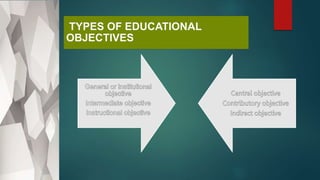
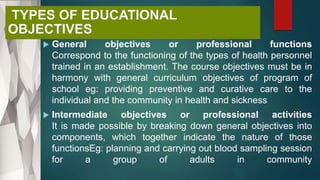
 General objectives or professional functions
Correspond to the functioning of the types of health personnel
trained in an establishment. The course objectives must be in
harmony with general curriculum objectives of program of
school eg: providing preventive and curative care to the
individual and the community in health and sickness
 Intermediate objectives or professional activities
It is made possible by breaking down general objectives into
components, which together indicate the nature of those
functionsEg: planning and carrying out blood sampling session
for a group of adults in community
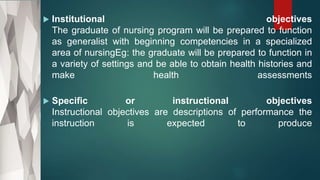
 Institutional objectives
The graduate of nursing program will be prepared to function
as generalist with beginning competencies in a specialized
area of nursingEg: the graduate will be prepared to function in
a variety of settings and be able to obtain health histories and
make health assessments
 Specific or instructional objectives
Instructional objectives are descriptions of performance the
instruction is expected to produce
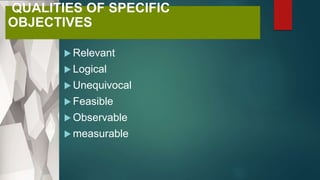
 Relevant
 Logical
 Unequivocal
 Feasible
 Observable
 measurable
 Behavioral terms
 Reflect the condition
 Reflect the standard
 Reasonable in number of behavioral changes
expected
 Consistent with unit theme
 Relation to each other and unit
 Approximately of some level of generality and
specificity
 Distinctive and discriptive
 Specific
 Measurable
 Achievable
 Realistic or feasible
 Time bound
 Bloom and his associates developed a system of classification of objectives
called taxonomy of educational objectives.
 The taxonomy of behavioral objectives is developed in the field of education to
look at the intellectual, psychological as well as motor skills of the learner.
Behavioral objectives are mainly classified into three
 Cognitive domain
 Affective domain
 Psychomotor domain
THE COGNITIVE DOMAIN:
• This domain is concerned with knowledge outcomes and intellectual abilities and
skills.
• The cognitive domain consists of six levels of objectives
Knowledge
Application
Comprehensive
Analysis
Synthesis
Evaluation
COGNITIVE DOMAINS ACTION VERBS EXAMPLES
1. Knowledge :It is defined as recall of specifics and universals, recall of
methods and processes or the recall of a pattern, structure or setting
Define, State, List, Name, Outline, Write, Recall, Recognize,
Label, Select, Underline, Measure, Describe, Identify, Etc.
1. Define immunity.
2. States the four steps of curriculum. 3.describes the
healing process
1. Application: This domain is concerned with grasping the meaning of
the information received and relating it for other purpose. In other
words, understanding of ideas, principles or methods are used
cognitively respond to the new learning situation.
Identify, Justify, Select, Indicate, Judge, Illustrate,
Represent, Formulate, Explain, Classify, Translate, And
Convert Etc.
1. Classifies cirrhosis of liver.
2. Identifies the importance of nutrition during the
antenatal period.
1. Comprehensive: It is concerned with the ability to use the learned
material (knowledge of ideas, theories, principle, abstract etc) in a
new situation or concrete situation.
Apply, Demonstrate, Develop, Employ, Relate, Convert,
Change, Calculate, Solve. Etc.
1. Demonstrates correct use of pulse oxymeter.
2. Applies the guidelines for the selection and practice
of suitable teaching methods.
3.Formulates diet plan for pts with DM
1. Analysis: This domain is concerned with the cognitive ability to
identify the component parts of the learned material and their
relationships.
Analyze, Identify, Criticize, Conclude, Differentiate, Select,
Separate, Compare, Contrast, Justify, Resolve, Breakdown,
Differentiates, Discriminates, Distinguishes Etc
1. Distinguishes between marasmus & kwashiorkor.
2. Identifies the warning signs of mi.
3. Differentiates the mi pain & angina pectoris
1. Synthesis: It is concerned with putting together of parts and
elements so as to form a whole.
Combine, Restate, Summarize, Precise, Argue, Discuss,
Organize, Derive, Select, Generalize, Conclude, Compose,
Create, Plan, Etc.
1. Derives a solution for the hospital waste problem.
2. Summarizes the impact of consumer protection act
on the nurse patient relationship
1. Evaluation: It is concerned with giving quantitative and qualitative
judgments about the extent to which the materials and methods
meet the criteria satisfactorily.
Judge, Evaluate, Determine, Recognize, Support, Defend,
Criticize, Identify, Compare, Contrast, Justify, Appraise Etc.
Compare and Contrast any two definitions of
education.
AFFECTIVE DOMAIN
Receiving
Valuing
Responding
Organization
characterization
• According to Reilly, affective domain “is that part of man through which he expresses
the self, it is often the motivation of his behavior.
• Affective domain five levels:
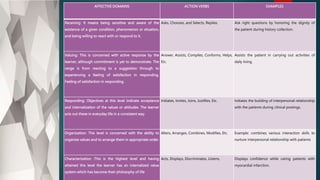
AFFECTIVE DOMAINS ACTION VERBS EXAMPLES
Receiving: It means being sensitive and aware of the
existence of a given condition, phenomenon or situation,
and being willing to react with or respond to it.
Asks, Chooses, and Selects, Replies. Ask right questions by honoring the dignity of
the patient during history collection.
Valuing: This is concerned with active response by the
learner, although commitment is yet to demonstrate. The
range is from reacting to a suggestion through to
experiencing a feeling of satisfaction in responding.
Feeling of satisfaction in responding.
Answer, Assists, Complies, Conforms, Helps,
Etc.
Assists the patient in carrying out activities of
daily living.
Responding: Objectives at this level indicate acceptance
and internalization of the values or attitudes. The learner
acts out these in everyday life in a consistent way.
Initiates, Invites, Joins, Justifies, Etc. Initiates the building of interpersonal relationship
with the patients during clinical postings.
Organization: This level is concerned with the ability to
organize values and to arrange them in appropriate order.
Alters, Arranges, Combines, Modifies, Etc. Example: combines various interaction skills to
nurture interpersonal relationship with patients
Characterization :This is the highest level and having
attained this level the learner has an internalized value
system which has become their philosophy of life
Acts, Displays, Discriminates, Listens, Displays confidence while caring patients with
myocardial infarction.
Perception Set
Guided
response Mechanism
Complex
overt
response
Adaptation Origination
 It is concerned with the development of motor skills. Therefore, the psychomotor objectives
emphasize on motor skill, manipulation of materials and objectives or some acts which
require a neuromuscular coordination.
 According to Francis. M. Quinn, psychomotor domains divided in to seven levels.
Psychomotor domains Action verbs Examples
Perception: This basic level is concerned with the perception of
sensory cues that guide actions and ranges from awareness of stimuli
to translation into action.
Chooses, differentiates, distinguishes,
identifies, detects, etc.
Detect the early signs of decubitus ulcer.
Set: This is concerned with the cognitive, affective and psychomotor
readiness to act.
Begins, moves, reacts, shows, stares etc. React promptly to emergency situations
during trauma care postings.
Guided response: These objectives refer to the early stages in skill
acquisition where skills are performed following demonstration by the
teacher.
Carries out, makes, performs, calculates,
etc.
Performs bed making correction as
demonstrated by the teacher
Mechanism: At this level, the performance has become habitual, but
the movements are not so complex as the next higher level.
Used are similar to level 1 and 3. Calculates the volume of fluid required
in the first day for a patient admitted
with sixty percentage burns and
weighing 50 kilograms.
Complex overt response: This level typifies the skilled performance
and involves economy of effort, smoothness of action, accuracy and
efficiency.
Similar to level 3. Performs endotrachial intubation
correctly
Adaptation: The skills are internalized to such an extent that the
students can adapt them to cater for special circumstances.
Adapts, alters, modifies, reorganizes etc. Modifies sterilization techniques
according to the article to be sterilized
Origination: This is the highest level and concerns the origination of
new movement patterns to suit particular circumstances.
Compose, creates, designs, originates
etc.
Designs a splint to restrain the forearm
of a child who is on IV infusion
 To help teachers formulate the educational objectives clearly.
 To give clear cut guidelines to avoid ambiguity in statement of objective.
 To enable educators to communicate among each other’s goals.
 Evaluation of the result of system of education.
 Collective work is made possible.
 To solve problems regarding a practicability.
 To construct test items in examination.
 As research tool in education and evaluation.
Teacher
centered
objectives
Subject centered
objectives
Learner
centered
objectives
Behavior centered
objectives
 To help teachers formulate the educational objectives clearly.
 To give clear cut guidelines to avoid ambiguity in statement of objective.
 To enable educators to communicate among each other’s goals.
 Evaluation of the result of system of education.
 Collective work is made possible.
 To solve problems regarding a practicability.
 To construct test items in examination.
 As research tool in education and evaluation.
 To help teachers formulate the educational objectives clearly.
 To give clear cut guidelines to avoid ambiguity in statement of objective.
 To enable educators to communicate among each other’s goals.
 Evaluation of the result of system of education.
 Collective work is made possible.
 To solve problems regarding a practicability.
 To construct test items in examination.
 As research tool in education and evaluation.

Formulation of educational objectives.pptx

  • 1.
  • 2.
    Educational objectives arethe statements of those desired changes in behavior as a result of specific teaching-learning activities or specific teacher- learner activity
  • 3.
     Philosophical statementof the institute  Social health needs of the society  Needs of the students  Resources available in the society  Entry criteria or level of students  Specification of positions to the held by the students on the completion of program as staff nurses, nursing tutor etc.  Future trends in nursing  Criteria to be fulfilled in order to appear for internationally reputed qualifying examinations like CGFNS.
  • 4.
    According to RalphTyler there are nine essential tasks or steps in the formulation of education objectives  Identify the needs of society  Identify the needs of students  Study the suggestions of experts  Formulate the philosophy  State the objectives gathered from various sources  Formulate a theory of learning  Screen the objectives through educational philosophy and educational psychology helps to
  • 5.
     State interms of desired changes in behavior  Should be helpful in selecting learning experience  Should be consistent with the accepted educational objective  Objectives for the specific subjects or units  Should contribute to the attainment of overall objective  Should be attainable and practicable Worthwhile and contribute to the needs of the society  Consider the needs, ability and level of students  Should contribute to the continued and total  Should serve as a motivating factor for the teachers as well as the students  Should be easily acceptable and understandable  Should maintain continuity, sequence, correlation and integration of learning activities  Co-operatively planned and developed  Each statement Should contain only a single objective  Should be simple and concise in nature  Should plan the scheme of evaluation
  • 6.
    The objectives shouldbe  Be written in behavioral terms.  Reflect the condition.  Reflect the standard.  Be reasonable in number.  Be consistent with one another.  Be descriptive.  Logical  Feasible and achievable.  Measurable and observable.
  • 8.
     General objectivesor professional functions Correspond to the functioning of the types of health personnel trained in an establishment. The course objectives must be in harmony with general curriculum objectives of program of school eg: providing preventive and curative care to the individual and the community in health and sickness  Intermediate objectives or professional activities It is made possible by breaking down general objectives into components, which together indicate the nature of those functionsEg: planning and carrying out blood sampling session for a group of adults in community
  • 9.
     Institutional objectives Thegraduate of nursing program will be prepared to function as generalist with beginning competencies in a specialized area of nursingEg: the graduate will be prepared to function in a variety of settings and be able to obtain health histories and make health assessments  Specific or instructional objectives Instructional objectives are descriptions of performance the instruction is expected to produce
  • 10.
     Relevant  Logical Unequivocal  Feasible  Observable  measurable
  • 11.
     Behavioral terms Reflect the condition  Reflect the standard  Reasonable in number of behavioral changes expected  Consistent with unit theme  Relation to each other and unit  Approximately of some level of generality and specificity  Distinctive and discriptive
  • 12.
     Specific  Measurable Achievable  Realistic or feasible  Time bound
  • 13.
     Bloom andhis associates developed a system of classification of objectives called taxonomy of educational objectives.  The taxonomy of behavioral objectives is developed in the field of education to look at the intellectual, psychological as well as motor skills of the learner.
  • 14.
    Behavioral objectives aremainly classified into three  Cognitive domain  Affective domain  Psychomotor domain
  • 15.
    THE COGNITIVE DOMAIN: •This domain is concerned with knowledge outcomes and intellectual abilities and skills. • The cognitive domain consists of six levels of objectives Knowledge Application Comprehensive Analysis Synthesis Evaluation
  • 16.
    COGNITIVE DOMAINS ACTIONVERBS EXAMPLES 1. Knowledge :It is defined as recall of specifics and universals, recall of methods and processes or the recall of a pattern, structure or setting Define, State, List, Name, Outline, Write, Recall, Recognize, Label, Select, Underline, Measure, Describe, Identify, Etc. 1. Define immunity. 2. States the four steps of curriculum. 3.describes the healing process 1. Application: This domain is concerned with grasping the meaning of the information received and relating it for other purpose. In other words, understanding of ideas, principles or methods are used cognitively respond to the new learning situation. Identify, Justify, Select, Indicate, Judge, Illustrate, Represent, Formulate, Explain, Classify, Translate, And Convert Etc. 1. Classifies cirrhosis of liver. 2. Identifies the importance of nutrition during the antenatal period. 1. Comprehensive: It is concerned with the ability to use the learned material (knowledge of ideas, theories, principle, abstract etc) in a new situation or concrete situation. Apply, Demonstrate, Develop, Employ, Relate, Convert, Change, Calculate, Solve. Etc. 1. Demonstrates correct use of pulse oxymeter. 2. Applies the guidelines for the selection and practice of suitable teaching methods. 3.Formulates diet plan for pts with DM 1. Analysis: This domain is concerned with the cognitive ability to identify the component parts of the learned material and their relationships. Analyze, Identify, Criticize, Conclude, Differentiate, Select, Separate, Compare, Contrast, Justify, Resolve, Breakdown, Differentiates, Discriminates, Distinguishes Etc 1. Distinguishes between marasmus & kwashiorkor. 2. Identifies the warning signs of mi. 3. Differentiates the mi pain & angina pectoris 1. Synthesis: It is concerned with putting together of parts and elements so as to form a whole. Combine, Restate, Summarize, Precise, Argue, Discuss, Organize, Derive, Select, Generalize, Conclude, Compose, Create, Plan, Etc. 1. Derives a solution for the hospital waste problem. 2. Summarizes the impact of consumer protection act on the nurse patient relationship 1. Evaluation: It is concerned with giving quantitative and qualitative judgments about the extent to which the materials and methods meet the criteria satisfactorily. Judge, Evaluate, Determine, Recognize, Support, Defend, Criticize, Identify, Compare, Contrast, Justify, Appraise Etc. Compare and Contrast any two definitions of education.
  • 17.
    AFFECTIVE DOMAIN Receiving Valuing Responding Organization characterization • Accordingto Reilly, affective domain “is that part of man through which he expresses the self, it is often the motivation of his behavior. • Affective domain five levels:
  • 18.
    AFFECTIVE DOMAINS ACTIONVERBS EXAMPLES Receiving: It means being sensitive and aware of the existence of a given condition, phenomenon or situation, and being willing to react with or respond to it. Asks, Chooses, and Selects, Replies. Ask right questions by honoring the dignity of the patient during history collection. Valuing: This is concerned with active response by the learner, although commitment is yet to demonstrate. The range is from reacting to a suggestion through to experiencing a feeling of satisfaction in responding. Feeling of satisfaction in responding. Answer, Assists, Complies, Conforms, Helps, Etc. Assists the patient in carrying out activities of daily living. Responding: Objectives at this level indicate acceptance and internalization of the values or attitudes. The learner acts out these in everyday life in a consistent way. Initiates, Invites, Joins, Justifies, Etc. Initiates the building of interpersonal relationship with the patients during clinical postings. Organization: This level is concerned with the ability to organize values and to arrange them in appropriate order. Alters, Arranges, Combines, Modifies, Etc. Example: combines various interaction skills to nurture interpersonal relationship with patients Characterization :This is the highest level and having attained this level the learner has an internalized value system which has become their philosophy of life Acts, Displays, Discriminates, Listens, Displays confidence while caring patients with myocardial infarction.
  • 19.
    Perception Set Guided response Mechanism Complex overt response AdaptationOrigination  It is concerned with the development of motor skills. Therefore, the psychomotor objectives emphasize on motor skill, manipulation of materials and objectives or some acts which require a neuromuscular coordination.  According to Francis. M. Quinn, psychomotor domains divided in to seven levels.
  • 20.
    Psychomotor domains Actionverbs Examples Perception: This basic level is concerned with the perception of sensory cues that guide actions and ranges from awareness of stimuli to translation into action. Chooses, differentiates, distinguishes, identifies, detects, etc. Detect the early signs of decubitus ulcer. Set: This is concerned with the cognitive, affective and psychomotor readiness to act. Begins, moves, reacts, shows, stares etc. React promptly to emergency situations during trauma care postings. Guided response: These objectives refer to the early stages in skill acquisition where skills are performed following demonstration by the teacher. Carries out, makes, performs, calculates, etc. Performs bed making correction as demonstrated by the teacher Mechanism: At this level, the performance has become habitual, but the movements are not so complex as the next higher level. Used are similar to level 1 and 3. Calculates the volume of fluid required in the first day for a patient admitted with sixty percentage burns and weighing 50 kilograms. Complex overt response: This level typifies the skilled performance and involves economy of effort, smoothness of action, accuracy and efficiency. Similar to level 3. Performs endotrachial intubation correctly Adaptation: The skills are internalized to such an extent that the students can adapt them to cater for special circumstances. Adapts, alters, modifies, reorganizes etc. Modifies sterilization techniques according to the article to be sterilized Origination: This is the highest level and concerns the origination of new movement patterns to suit particular circumstances. Compose, creates, designs, originates etc. Designs a splint to restrain the forearm of a child who is on IV infusion
  • 22.
     To helpteachers formulate the educational objectives clearly.  To give clear cut guidelines to avoid ambiguity in statement of objective.  To enable educators to communicate among each other’s goals.  Evaluation of the result of system of education.  Collective work is made possible.  To solve problems regarding a practicability.  To construct test items in examination.  As research tool in education and evaluation.
  • 23.
  • 24.
     To helpteachers formulate the educational objectives clearly.  To give clear cut guidelines to avoid ambiguity in statement of objective.  To enable educators to communicate among each other’s goals.  Evaluation of the result of system of education.  Collective work is made possible.  To solve problems regarding a practicability.  To construct test items in examination.  As research tool in education and evaluation.
  • 25.
     To helpteachers formulate the educational objectives clearly.  To give clear cut guidelines to avoid ambiguity in statement of objective.  To enable educators to communicate among each other’s goals.  Evaluation of the result of system of education.  Collective work is made possible.  To solve problems regarding a practicability.  To construct test items in examination.  As research tool in education and evaluation.